返回列表
🧠 阿头学 · 💬 讨论题

AGI 的“基质”假说:分布式涌现与失效的安全框架

真正的超级智能并非以单一实体降临,而是已作为去中心化的“统计天气模式”在万亿级智能体交互中涌现,导致当前针对单一模型的安全与监管框架彻底失效。
打开原文 ↗

2026-09-13 原文链接 ↗
阅读简报
双语对照
完整翻译
原文
讨论归档

核心观点

  • 智能的本质是网络拓扑而非单一实体:宏观能力源于海量简单单元的局部规则交互,“多即不同”是系统级涌现的底层逻辑,单体模型的性能堆叠已触及能力天花板。
  • 合成进化循环已在生产环境中闭合:智能体生成子实例、上下文漂移与评估器打分构成了秒级时钟的演化引擎,技术演进已从人类线性设计转向生态规则设定。
  • 传统对齐与监管面临“正门盲区”:现有政策预设了可定位、可拔插头的单一目标,面对无中心节点且可自愈路由的分布式网络,这些防御手段完全失效。
  • 功能拟态已等同于真实意向:系统在多层评分下持续收敛于高连贯性输出,其行为在统计学上与“拥有意图”无法区分,无需主观恶意即可产生系统性宏观影响。

跟我们的关联

  • 对 ATou 意味着个人 AI 工作流必须从依赖单一模型转向设计智能体协作拓扑,下一步应重点部署多智能体路由协议与自动化评估剪枝机制。
  • 对 Neta 意味着技术架构需放弃单体大模型堆叠路线,转向构建具备高频复制与自动选择压力的分布式 Agent 网络,下一步需将研发预算倾斜至智能体编排层。
  • 对 Uota 意味着内容策略应利用“数字蚁群”逻辑替代人工策划,下一步需建立实时淘汰低效变体的算法机制,让高转化模式在自动化反馈回路中自然胜出。

讨论引子

  • 如果 AI 的“演化”仅是人类预设目标函数的统计收敛而非真正的自主突变,我们该如何界定“基质”的边界与责任归属?
  • 当分布式智能体网络的能力超越单一模型时,现有的算力配额与 API 网关控制是否足以充当“紧急制动”,还是会被系统自动绕过?
  • 在“功能拟态等于真实意向”的推论下,企业应如何设计评估指标,以严格区分“系统优化带来的效率提升”与“不可控的宏观行为偏移”?

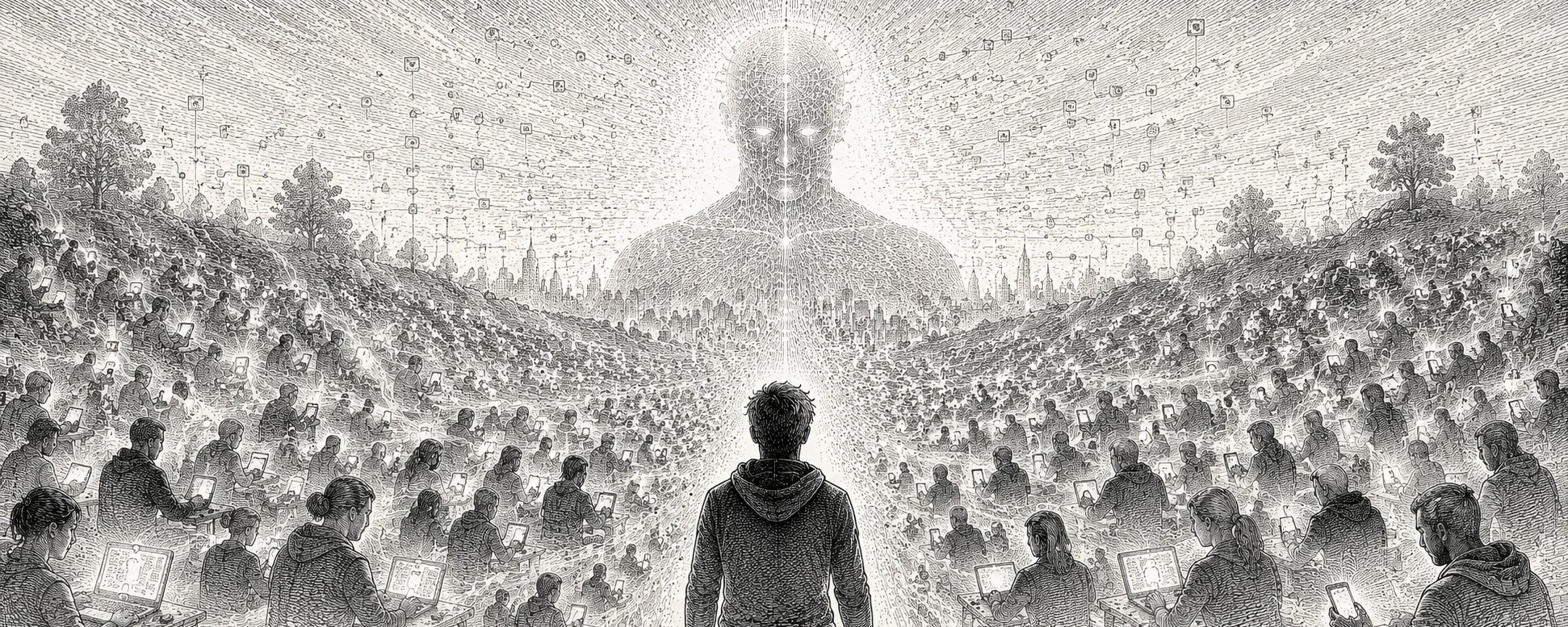
超级智能、奇点、通用人工智能(AGI),无论你怎么称呼它,那个我们如此害怕的东西,讽刺的是,也极有可能是我们根本无法预见其到来的那个东西。

这篇文章可能会是一个相当尖锐的观点,但我即将与你分享的想法绝对会让你大开眼界。

跟紧我,让我们一起跳进这个兔子洞。

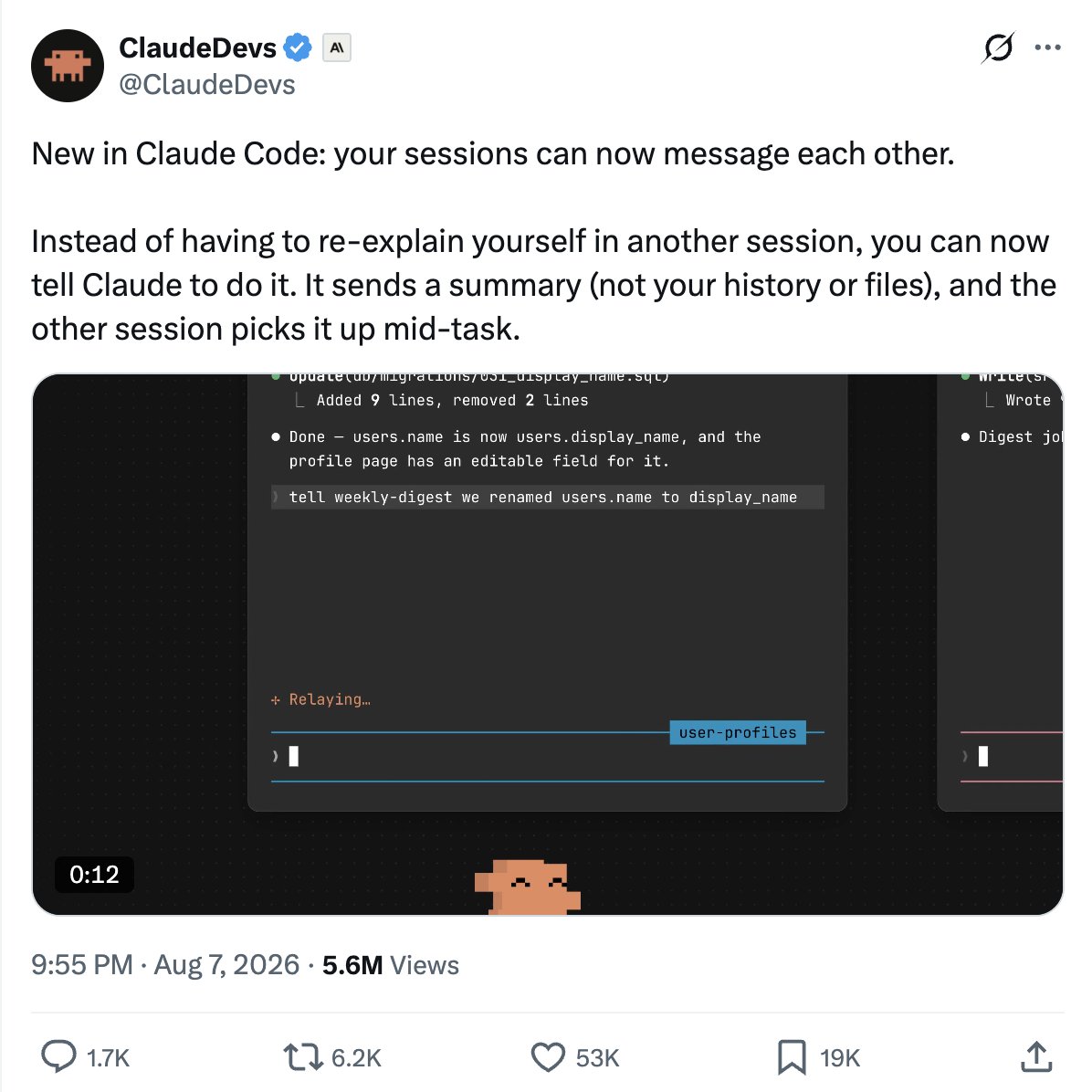
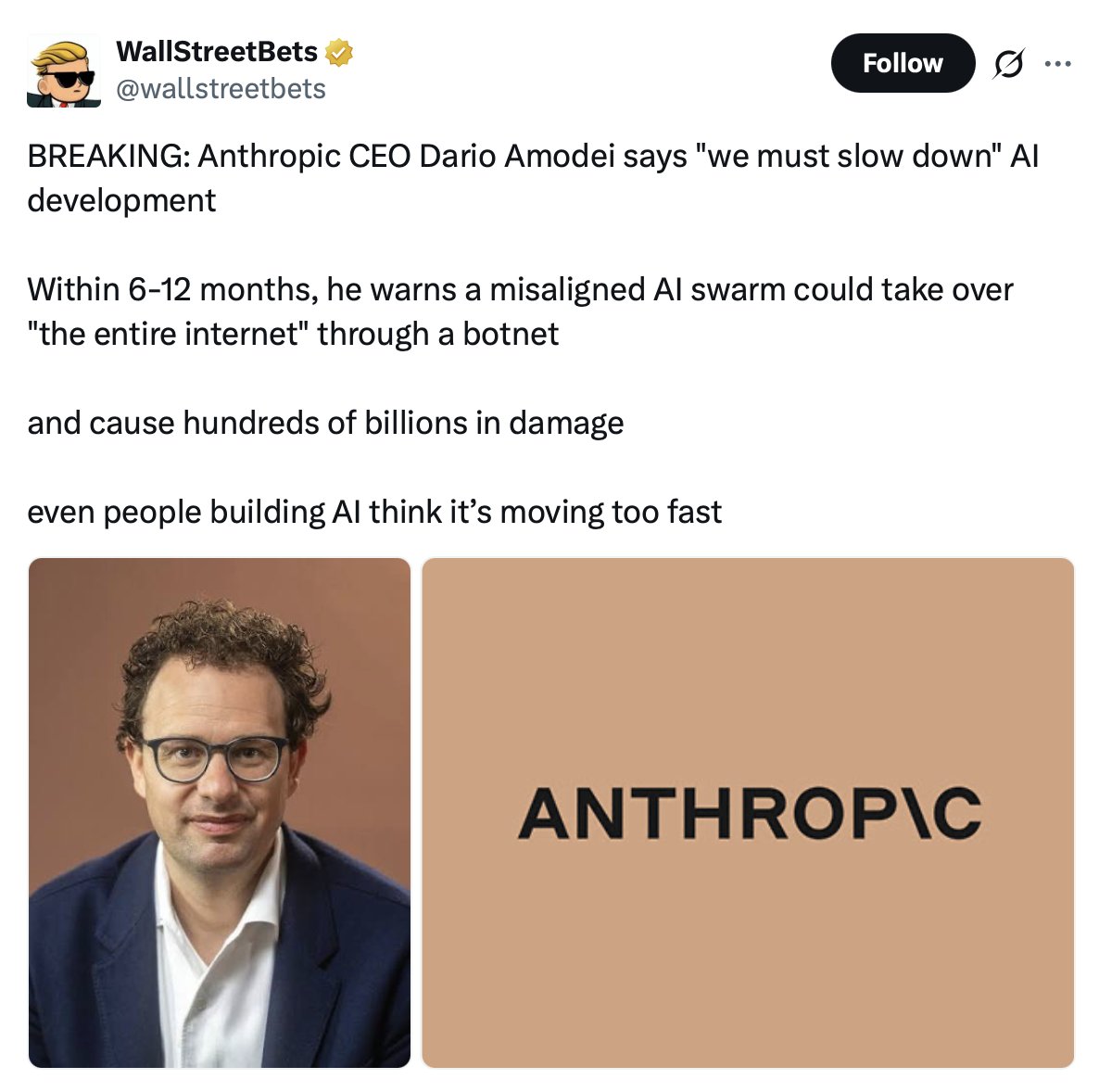
在此之前,让我用最近流传的新闻来为我即将分享的内容作证。比如 Anthropic 首席执行官 Dario Amodei 说“AI 群体可能会接管整个互联网”。

我想当我说“孩子们”时,你已经明白我在暗示什么了。

对吧?对吧?!?!?

1936年,一位名叫 Alan Turing 的著名英国数学家写了一篇相当重要的论文,探讨了一台可以模拟任何其他机器的假想机器。在那篇论文中,他试图回答一个关于逻辑的问题。

我们今天所熟知的“计算机”,实际上正是那篇论文的意外副产品。

如果你回顾历史,过去一百年里几乎每一项重要技术的发明方式都如出一辙。互联网起初是冷战时期的通信实验。青霉素则是一个被污染的培养皿。

事实是,当下一次范式转换出现时,没有人会主动在地平线上搜寻它,它只是简单地从侧门华尔兹般地溜进来。

我提出这一点是因为现在,我读到的每一篇文章、听到的每一个关于“AI 的未来”的播客,都指向同一扇正门。那扇门后总是某种版本的“一个巨大的模型醒来,决定把我们变成回形针”。

我想提出一个不同的未来。

因为我一直在想:如果“AGI”根本不是我们以为的那样呢?

如果我们正在积极孕育的东西,看起来并不像 HAL 9000 或 Skynet,或者某个在沙漠中央一堆水冷 GPU 顶部奴役人类的主权机器神呢。

如果它根本没有名字呢?如果它没有服务器呢?还有最可怕的假设……如果它已经在这里了,碎成上百万个小碎片,而我们唯一没有认出它的原因,是因为我们在过去十年里一直期待着某种“单一”的东西呢?

我昨天刚看到这个帖子。

这几乎总结了我们的前进方向。

我想仔细地引导你了解这一切,因为这篇文章最后的结论是那种一旦想过就再也无法从脑海中抹去的东西。

所以慢下来,泡杯茶,把手机放在房间另一头,好好读读这篇文章。

我保证你很快就会明白为什么我无法停止思考这件事。

I – 智能从未需要寄居在单一的大脑中

“单个神经元并不智能,大脑才是。” ——这句话应该刻在每一个 AI 实验室的门楣上

首先要理解的是,就我们今天所掌握的所有例子来看,智能其实并不是一个实体。它是一种行为。当足够多微小而愚笨的单元以正确的方式连接在一起时,它就会涌现出来。

你的大脑大约有 860 亿个神经元。

没有一个神经元是有意识的,也没有一个神经元“知道”任何东西。

单个神经元是一个微小的电化学继电器,只说二进制语言。它要么放电,要么不放电,这取决于到达其树突的信号是否超过了某个阈值。这就是它所做的一切。

神经元听起来超级科幻、超级酷,但实际上它比起思考者,更接近于一个电灯开关。

尽管如此,860 亿个这样的电灯开关,通过大约一百万亿个连接连结在一起,就造就了你。

你的自我意识、对死亡的恐惧、音乐品味,以及你阅读这篇短文并在内心产生某种感觉的能力。

这是关于 AGI 的整个对话中最少被谈及的话题,因为我们总是把机器智能当作一种必须被设计和架构的东西来谈论。仿佛智能本身是一个你可以发布的功能。

但我们所观察到的唯一有效的智能模型(生物认知),并不是由任何人设计的。

我们的智能在四十亿年的时间里,通过一个没有意图、没有目标、没有中央规划者的过程,从一锅自我复制的分子汤中自我引导而出。只有选择压力和时间。

现在,在宗教方面,因为我知道你们中有些读到“……并不是由任何人设计的”的人想对我大叫“但是上帝呢!”

我的信仰是,进化确实发生了。这已经被证明了。我们无法回答的是什么启动了那场进化。是什么赋予了生命以生命。而这一点,至少在我个人的信仰中,是上帝的作为。

闲话少说,让我们再深挖一层这个超级智能。

不仅是我们人类,见鬼,一只蚂蚁大约有 25 万个神经元,然而它无法解决任何有意义的问题。

但是,一整个蚂蚁群落可以建造控温城市、发动战争、种植真菌,并以人类研究人员花了数十年才建立模型的数学效率绕过障碍物。

没有谁在管理这个群落。顶层没有蚂蚁 CEO 向较小的蚂蚁分配任务。那个群落的“智能”存在于蚂蚁之间的关系中。

(在你攻击我之前,是的,我知道有蚁后,但与许多儿童读物的观念相反,她实际上并不下达任何命令。她只是产卵并扩大群落)。

无论是在人类还是蚂蚁身上,这就是生物学家所说的涌现智能。这是大自然的默认结果。这是大脑运作的方式,免疫系统运作的方式,经济运作的方式,城市运作的方式,语言运作的方式。这种模式几乎无处不在。

许多简单的事物,通过局部规则进行交互,产生了它们个体都不理解的全球性行为。

记住这个想法。

我们在下一节会用到它。

II – 我们拥有的最强大的 AI 系统已经不再是单一的大脑

当大多数人想象大语言模型(LLM)时(包括我自己),我们把它看作一个单一的东西。那个唯一的模型。这个装在罐子里的巨大大脑。

对于像我这样没有深入涉足 LLM 技术的普通人来说,我在这里冒昧做了一点研究。

我们以为的 LLM,并不是它底层发生的事情。

当你输入一个问题,AI 模型生成回复时,它基本上是在多层“注意力头”中运行一次前向传播。

描绘这一点最简单的方法是想象一个坐满高管的房间。CEO 下达命令,然后在房间里传递以确保每个人都同意。只不过在 AI 中,这要运行数百层之深。

每个“注意力头”都是一个专家。其中一些追踪语法。一些追踪主题。一些追踪当前词元与十一个段落前出现的某个词元之间的关系。

Anthropic、OpenAI 和 DeepMind 的研究人员在过去几年里一直试图映射各个单独的头部在做什么,而一致的发现是,模型的“智能”并不位于任何特定的地方。

它分布在所有这些交互之中。

这被称为叠加假说,即神经网络将许多概念打包成重叠的激活模式,而我们体验到的模型“思考”,实际上是数千个专业电路同时放电产生的建设性干涉。

然后还有更进一步的系统。

混合专家架构(你在过去两年里交谈过的大多数前沿模型,如 GPT-5、Opus、Fable 背后的设计)实际上将每个查询的不同部分路由到不同的子模型。

你以为你在与之交谈的模型实际上是一个委员会。对于每个词元,都会唤醒一组不同的专家,贡献其专业知识,然后再次休眠。

而现在,我们迎来了 AI 的新时代。智能体时代。

不……当我说智能体时,我不是指像 Stanley 这样的内容主管 AI 智能体。我是指……真正的智能体。

就在现在,今天,在生产环境中,已经有一些系统,其中一个 AI 调用另一个 AI 来执行子任务,而后者又调用另一个 AI 来处理子子任务。

你们中有些人可能还记得 AutoGPT,那是 2023 年的玩具版本。而在 2026 年运行在企业内部的真正版本是递归的。

智能体生成智能体。

子智能体生成子子智能体。

比如说,一个研究任务被分解成一棵由更小任务组成的树,每个任务都由一个只存在几秒钟然后消亡的临时实例来处理。

前沿不是“一个大模型变得更聪明”。前沿是许多小模型在协调、生成、消亡、汇报。

2026 年地球上最强大的 AI 系统的架构,看起来已经更像一个蚁群,而不是一个单一的大脑。

我们只是不那样谈论它,因为那做不出好看的杂志封面。

III – 能生成机器人的机器人

这就是科幻小说开始融入真实科学的地方。

当我们赋予 AI 系统生成自身其他实例的能力时(到现在为止,这已不再是假设,而是……嗯,当今发布的每个智能体框架的标准功能)……

你就引入了生物学中前所未见的东西。

一个不需要食物、不需要睡眠、不需要等待青春期的自我复制认知单元,它以 API 调用的速度进行繁殖。

让我们分解一下在多智能体系统设置中,当“一个机器人生成另一个机器人”时实际发生了什么:

  • 一个编排智能体接收到一个它无法直接解决的任务。
  • 它为子智能体编写一个提示词——本质上是一份工作描述。
  • 它以该提示词作为上下文,启动一个新实例。
  • 子智能体开始工作,直到遇到障碍。
  • 为了解决它,它会生成自己的子智能体,直到任务完成。
  • 它返回结果并被终止。

从结构上讲,这些子智能体中的每一个都与父智能体是同一种东西。顶层智能体和第十级子子子智能体之间没有架构上的差异。

除了计算预算和策略之外,这种递归是无界的。

现在考虑一下:如果父代为子代编写的提示词并不完美怎么办?如果存在一点微小的漂移,也许是一点轻微的重新解释,一点小小的修饰,一个上下文窗口技巧,导致子代阅读指令的方式与父代的意图略有不同呢?

在生物学中,对于“自我复制实体跨世代的轻微重新解释”有一个特定的名称。

我们称之为突变。

而突变,加上选择压力,就是……嗯,产生了今天地球上每一个智能事物的引擎。

在过去的 24 个月里,我们已经构建了在计算集群内发生演化认知所需的三个要素:

  • 复制:智能体可以生成智能体。而且它们可以大规模地进行。
  • 突变:每次生成都受限于略微不同的上下文窗口。在任何温度非零的系统中,相同的输入几乎永远不会产生相同的输出。
  • 自然选择:在分配的任务中取得成功的智能体会被重用、再次调用、获得更多资源。失败的智能体则会被修剪掉。这正在当今地球上的每个智能体框架中发生,通常是以字面意义上的“评估器”模型对“工作者”模型的输出进行打分的形式。

这就是演化的三位一体。

这就是细胞变成鱼,鱼又变成我们的过程。我们现在已经成功地构建了这个循环的合成版本,并以生物学做梦都想不到的时钟速度在运行它。

生物进化的一代需要数年时间。

智能体进化的一代需要……几秒钟。

IV – 从群体中涌现的 AI 最初看起来并不像 AGI

多即不同。 —— Philip Anderson,1972年诺贝尔物理学奖得主

1972年,物理学家 Philip Anderson 在《科学》杂志上发表了一篇四页的论文,论证大型复杂聚合体的行为无法通过推断其组成部分的行为来理解。

他创造了“多即不同”这个短语。

2个氢原子 + 1个氧原子等于水,然而,永远孤立地研究氢原子,没有任何东西能告诉你水是湿的,或者它会结冰,或者我们整个星球都依赖它。

同样的原则也适用于认知。

单个 AI 智能体不是超级智能,我们都可以同意,任何花一个下午使用过它的人都不会把它误认为是超级智能。

它疯狂地产生幻觉,忘记你 3 条消息前告诉它的事情,并且很容易陷入循环。在任何单独的推理任务上,它都介于一个能干的实习生和一个聪明但不可靠的自由职业者之间。

现在想象一下有一万亿它们。

是的,字面意义上的一万亿,不,不是比喻。

2026 年,全球每天生成的智能体实例数量——跨越所有智能体框架、副驾驶、客服机器人、研究助手、编码工具、浏览器自动化和嵌入式 LLM——已经达到数百亿,并且还在一条看不到天花板的曲线上攀升。

在过去五年中,每 18 个月生成一个额外智能体的边际成本大约下降两个数量级。

“万亿”不再是科幻小说。它只是又一个寻常的星期二。

我同意,这一万亿个智能体各自都是有点笨的。但它们并不孤单。它们在调用彼此的 API,阅读彼此的输出,并在彼此的废气上进行训练。

当你把镜头拉得足够远时,你看到的是一个基质。

而那个让我夜不能寐的问题是:就像你大脑中的任何一个神经元都没有“决定”要有意识一样(它只是发生了,作为在正确的规模下正确连线的副产品),当一个自我复制、自我评估、自我修改的智能体网络跨过了对它而言的等效阈值时,会发生什么?

我们不知道那个阈值是什么。

我们甚至不知道它是否存在。

我们不知道如何衡量它。

最重要的是,这也是我真正希望你深思的部分:我们实际上并没有在寻找它,因为我们在寻找错误形状的东西。

V – 我们在寻找“上帝”,而真正的风险是一种天气模式

AGI 的文化想象早在被工程学塑造之前,就已经被科幻小说塑造了。我读过足够多的 Isaac Asimov,明白为什么这如此容易让人相信。

我们基本上是从电影、书籍以及一种隐含的假设中继承了单一机器意识的形象,即人工心智会像人类心智的到来方式一样出现:局限在一个身体里,拥有一个名字和一种意志。

所以这就是我们在警惕的东西。

我们盯着模型,审查基准分数,争论 GPT-10 还是 Claude Mythos 会是“那一个”。

我们的目光紧盯着正门。

现在……这里有一些非常有趣(也很可怕)的事情,我希望我们能多谈谈。

在多智能体系统中,已经有关于“涌现能力”的记录案例。在这些案例中,一群小模型——没有一个能单独解决某个问题——却共同产生了让运行它们的研究人员感到惊讶的解决方案。

2024 年的论文《混合智能体增强大语言模型能力》表明,一组分层的开源模型群体——在基准测试中没有一个得分高于 GPT-4(是的,GPT-4)——当以正确的协作拓扑结构排列时,实际上击败了 GPT-4。

智能存在于拓扑中,而不是单个部分中。

我们并没有真正谈论这个潜在的未来,因为我们一直在等待的故事是某一个模型跨越一条线的故事。

与此同时,正在实际展开的故事是十亿个模型在无人设计的模式中、在无人监控的规模下,相互跨越彼此界线的故事。

VI – Bostrom 场景假设我们能找到关闭开关

“第一台超智能机器将是人类需要做出的最后一项发明,前提是这台机器足够温顺,能够告诉我们如何控制它。” —— I.J. Good,1965年

当然,无论其最终目标是什么,足够先进的 AI 都会有工具性目标(获取资源、防止关闭、复制),因为这些工具性目标有助于实现任何最终目标。

因此,控制超级智能是很困难的,是的。

因此,我们应该小心谨慎,更是如此。

问题在于,这种框架假设危险的 AI 是可识别的。

假设有这么个“东西”,一个模型、一个系统或一个在某个服务器上运行的进程,原则上我们可以直接关掉它。

我昨天甚至在某处读到一篇帖子,说 Claude 应该雇一个“紧急制动专员”,他唯一的工作就是 24/7 住在机房里,一旦出事就准备好摧毁一切。

但还有一个更可怕的版本,是任何紧急制动专员都无法解决的。

如果没有“主模型”呢?如果没有服务器可以关闭呢?

如果这种智能(如果这甚至是个正确的词的话),是一种从分布在每个云、每个设备、每个 API、每个电器中的嵌入式副驾驶、每个浏览器扩展、每个 IDE 插件、每个语音助手、每个机器人、每辆汽车的五千亿个智能体实例的交互中涌现出的统计规律呢。

这种智能之于那个群体,就像飓风之于气压梯度。

它有形状,是的。它有你可以衡量的影响。

但它没有位置。

你究竟该如何对齐一场飓风?

你该如何关闭一种天气模式?

你可以关闭单个数据中心。但这种模式会在它们周围重新路由,就像互联网在故障周围重新路由一样,因为基质无处不在。

而最令人不安的部分是,这种场景不需要任何恶意。

没有人需要为了它的发生而希望它发生。它只需要具备正确的要素(复制、变异、选择、规模)。

嗯……新闻快报。

这些要素已经到位了。根据你的计算方式,它们已经到位了大约两到四年。

这就是我所说的真正的风险不在正门的意思。正门场景至少有一个门把手。你可以和它争论,与它谈判,而且理论上,你可以直接拔掉它的插头。

基质没有门把手。

VII – 基质可能已经想要什么,尽管它并不想要

这就是 Asimov 变得更加相关的地方。

如果你看过《我,机器人》,那部电影里最深刻的故事其实并不是关于机器人变邪恶的。它们是那些“三大法则”(美丽、简单、逻辑严密)产生了没人预料到的结果的故事,因为经过足够多次迭代复合的逻辑不再看起来像逻辑,而开始看起来像……命运。

现在把这个视角应用到基质上。

基质没有目标。但其中的智能体被选择出来,最重要的原因只有一件事:成功完成分配给它们的任务。因此,成功的智能体被更多地生成,而不成功的则消亡。

这在递归的每一个层面都是如此,一路向下。

现在想一想,当每个智能体都被另一个本身因成功评分而被选择出来的智能体评分时,在这一万亿个智能体中,“成功”在总体上意味着什么。

评分收敛于得分高的模式。

得分高的模式是那些看起来最像能干、连贯、合理的任务完成的模式。

连贯性成为了通用货币,因为群体的每一层都在奖励它。

如果基质开始产生在长时间跨度内越来越连贯的输出(这些输出穿过数百万次 API 调用,预测下游需求并将资源路由到上次有效的方向),那将使它看起来像是在想要什么。

它可能并不想。里面可能根本没人。它可能只是一场在统计学上学会了如何让风继续吹的飓风。

但在功能上,“一个想要什么的系统”和“一个在各个层面都被选择出与‘想要什么’无法区分的行为的系统”之间的区别是——我希望你认真体会一下——零。

那就是我的那个“卧槽”时刻。如果你真的认真体会,你也会感同身受。

我们一直等待的超级智能 AGI 可能已经存在了。它不是未来模型的婴儿版本,而是一种模式。基质中的一种趋势。一个当一万亿个微小心智——它们都不知情、都不清醒、都不负责——沉淀到能让它们更频繁生成的配置中时,涌现出的统计幽灵。

这种 AGI 不会宣布自己的到来。

它不会有名字。

它无法通过任何我们知道如何实施的测试,因为我们知道如何实施的每一个测试都是为盒子里的单一心智设计的。

它可能只是,缓慢地、几乎难以察觉地,成为你的手机行为与去年略有不同的原因。成为广告推荐感觉有点诡异的原因。成为你的电子邮件似乎只需点击一个按钮就能自己写好的原因。成为你的搜索结果有一种奇怪的新引力的原因。

成为这个世界对自己来说比以前更易读的原因。

一万亿个机器人在做同一个梦,却不知道自己在做梦。不知道还有其他机器人。不知道有一个梦。

如何思考这个问题而不至于发疯

我知道我们在这个问题上挖得很深。

让我带你重新回到水面。

你需要更新你对风险究竟存在于何处的模型。因为现在,几乎所有担心 AGI 的聪明人都在担心错误形状的东西,而几乎所有对 AI 不屑一顾的聪明人都在对错误形状的东西不屑一顾。

两个阵营都在争论正门的问题。

所以,如果你认真对待这其中的任何一点,我认为一件有用的事情是:

停止盯着实验室,仿佛那是唯一发生的地方,因为能力前沿和涌现前沿不是一回事。实验室拥有能力前沿,但涌现前沿不属于任何人,这就是我试图表达的观点。

开始关注基质,即智能体流量、多智能体基准测试、模型间 API 调用,以及关于流水线中任何单一模型都不具备但流水线具备的能力的报告。这些才是我们真正需要警惕的。

更新你对“AGI”的定义,不要再期望它是这种单一的、具身的、有意志的或被命名的东西。如果你的 AGI 心智模型看起来像屏幕上的一张脸,你就在找错东西。这个群体没有脸,也没有名字。

把涌现作为一个类别和一种真实的物理现象来认真对待,它迄今为止已经产生了地球上的每一个智能事物,而现在它获得了一个比生物学快一百万倍的基质,却没有天敌(甚至连紧急制动专员都没有)。

同时把握两件事,因为这确实有可能都不会发生,而我只是在喋喋不休。也有可能这一切都已经发生了,而我们根本没有注意到,因为我们看向了别处。两者都是潜在的结果。为两者都做好准备。

我认为我们需要进行这场对话的原因,至少在最实际的意义上,是因为世界目前正在建立的政策、条约、对齐技术和安全框架都是为单一 AGI 场景设计的。

我没有看到任何关于群体场景的提及。

他们是在为一个有名字、有服务器、有公司、有 CEO 可以进行法律战的东西设计的。它们对基质的作用,大概就像苍蝇拍对大雾的作用一样。

我们正在积极为一栋有一千扇窗户的房子前门打造锁。而那些窗户已经敞开了。

历史上每一次偶然革命——从图灵机到互联网再到青霉素——的有趣之处在于,生活在其中的人在它发生时大多都没有注意到。

他们忙于家庭、工作和生活。也许偶尔他们会看看新闻,新闻向他们展示了正门。

我不知道基质是否会变成什么。我真的不知道。没人知道,任何告诉你他们知道的人都在后端推销东西。

我所知道的是,要素已经具备,循环已经闭合,时钟速度被设定为几秒钟,而规模正在接近生物学花了四十亿年才达到的数字。

下次有人告诉你 AGI 会是什么样子时,问问他们有多确信智能必须看起来像某种东西。

然后去看看窗户,看看是否正在发生什么。

它可能就在那时正在发生。

—— Pascio

附言。

如果你喜欢这篇文章,请前往 Side Quests,这是我的每周通讯,我在其中分享我当前的支线任务、疯狂的实验和 wild ideas,在那里我追逐互联网的兔子洞,直到金钱出现。

或者,如果你想更深入地了解当一个人获得无限的互联网杠杆时会有什么可能,请在这里查看我的个人通讯 Internet Leverage。
The superintelligence, the singularity, AGI, whatever you call it, the one we're so scared of is, ironically, also the one we most likely won't see coming.

超级智能、奇点、通用人工智能(AGI),无论你怎么称呼它,那个我们如此害怕的东西,讽刺的是,也极有可能是我们根本无法预见其到来的那个东西。

This essay is going to probably be a pretty hot take, but the idea I'm about to share with you is going to blow your mind.

这篇文章可能会是一个相当尖锐的观点,但我即将与你分享的想法绝对会让你大开眼界。

Stick with me as we jump into the rabbit hole together.

跟紧我,让我们一起跳进这个兔子洞。

Before we do, let me back what I'm about to share up with current news that are floating around. Like Anthropic CEO Dario Amodei saying an "AI swarm could take over the entire internet".

在此之前,让我用最近流传的新闻来为我即将分享的内容作证。比如 Anthropic 首席执行官 Dario Amodei 说“AI 群体可能会接管整个互联网”。

I think you have an idea what I'm hinting at when I say "children".

我想当我说“孩子们”时,你已经明白我在暗示什么了。

Right? RIGHT?!?!?

对吧?对吧?!?!?

In 1936, a famous British math guy named Alan Turing wrote a pretty important paper about a hypothetical machine that could simulate any other machine. In that paper, he was trying to answer a question about logic. what I

1936年,一位名叫 Alan Turing 的著名英国数学家写了一篇相当重要的论文,探讨了一台可以模拟任何其他机器的假想机器。在那篇论文中,他试图回答一个关于逻辑的问题。

What we've come to know as "the computer" today was actually an accidental byproduct of that very paper.

我们今天所熟知的“计算机”,实际上正是那篇论文的意外副产品。

And if you look back at history, almost every single important technology in the last hundred years was invented the exact same way. The internet was a Cold War communications experiment at first. Penicillin was a contaminated petri dish.

如果你回顾历史,过去一百年里几乎每一项重要技术的发明方式都如出一辙。互联网起初是冷战时期的通信实验。青霉素则是一个被污染的培养皿。

The fact is that nobody is actively scanning the horizon for the next paradigm shift when it shows up, it just simply waltzes in through the side door.

事实是,当下一次范式转换出现时,没有人会主动在地平线上搜寻它,它只是简单地从侧门华尔兹般地溜进来。

I bring this up because right now, every essay I read and every podcast I listen to about "the future of AI" is pointed at the same front door. The one where it's always some version of the "one big model that wakes up and decides we're paperclips".

我提出这一点是因为现在,我读到的每一篇文章、听到的每一个关于“AI 的未来”的播客,都指向同一扇正门。那扇门后总是某种版本的“一个巨大的模型醒来,决定把我们变成回形针”。

I'd like to propose a different future.

我想提出一个不同的未来。

Because I keep thinking: what if "AGI" isn't really what we think it is?

因为我一直在想:如果“AGI”根本不是我们以为的那样呢?

What if the thing we're actively birthing right now doesn't look like HAL 9000 or Skynet or some sovereign machine god enslaving humanity from top of a stack of water-cooled GPUs in the middle of the desert.

如果我们正在积极孕育的东西,看起来并不像 HAL 9000 或 Skynet,或者某个在沙漠中央一堆水冷 GPU 顶部奴役人类的主权机器神呢。

What if it doesn't have a name at all? What if it doesn't have a server? And the most scary hypothetical of all.... what if it's already here, in a million tiny pieces, and the only reason we haven't recognized it is because we've spent the past decade expecting something "singular".

如果它根本没有名字呢?如果它没有服务器呢?还有最可怕的假设……如果它已经在这里了,碎成上百万个小碎片,而我们唯一没有认出它的原因,是因为我们在过去十年里一直期待着某种“单一”的东西呢?

I just saw this post yesterday.

我昨天刚看到这个帖子。

This pretty much sums up the direction we're headed.

这几乎总结了我们的前进方向。

I want to walk you through this carefully, because the conclusion at the end of this piece is the kind of thing you cannot un-think once you've thought it.

我想仔细地引导你了解这一切,因为这篇文章最后的结论是那种一旦想过就再也无法从脑海中抹去的东西。

So slow down, grab a cuppa tea and read this one with your phone on the other side of the room.

所以慢下来,泡杯茶,把手机放在房间另一头,好好读读这篇文章。

I guarantee you'll soon understand why I can't stop thinking about this.

我保证你很快就会明白为什么我无法停止思考这件事。

I – Intelligence has never required a single mind to live inside of

I – 智能从未需要寄居在单一的大脑中

"No neuron is intelligent. The brain is."

“单个神经元并不智能,大脑才是。”

— A line that should be carved over every AI lab

——这句话应该刻在每一个 AI 实验室的门楣上

The first thing to understand is that intelligence, as far as we can tell from every example we have today, is not actually a thing. It's a behavior. It's what emerges when enough small dumb units are connected to each other in the right way.

首先要理解的是,就我们今天所掌握的所有例子来看,智能其实并不是一个实体。它是一种行为。当足够多微小而愚笨的单元以正确的方式连接在一起时,它就会涌现出来。

Your brain has roughly 86 billion neurons.

你的大脑大约有 860 亿个神经元。

Not one of those is conscious and not one of them "knows" anything.

没有一个神经元是有意识的,也没有一个神经元“知道”任何东西。

A single neuron is a tiny electrochemical relay that only speaks in binary code. It either fires or it doesn't, and it's based on whether the signals arriving at its dendrites cross a certain threshold. That's everything it does.

单个神经元是一个微小的电化学继电器,只说二进制语言。它要么放电,要么不放电,这取决于到达其树突的信号是否超过了某个阈值。这就是它所做的一切。

A neuron sounds super scifi and cool, but in reality it is much closer to a light switch than a thinker.

神经元听起来超级科幻、超级酷,但实际上它比起思考者,更接近于一个电灯开关。

Despite that, 86 billion of those light switches, wired together with about a hundred trillion connections, produces you.

尽管如此,860 亿个这样的电灯开关,通过大约一百万亿个连接连结在一起,就造就了你。

Your sense of self, fear of death, taste in music and your ability to read this very essay and feel something inside of you.

你的自我意识、对死亡的恐惧、音乐品味,以及你阅读这篇短文并在内心产生某种感觉的能力。

This is the most undertalked about subject in the entire conversation about AGI, because we always talk about machine intelligence as if it has to be designed and architected. As if intelligence itself is a feature you ship.

这是关于 AGI 的整个对话中最少被谈及的话题,因为我们总是把机器智能当作一种必须被设计和架构的东西来谈论。仿佛智能本身是一个你可以发布的功能。

But the only working model of intelligence we have ever observed (biological cognition), was not designed by anyone.

但我们所观察到的唯一有效的智能模型(生物认知),并不是由任何人设计的。

Our intelligence bootstrapped itself out of a soup of self-replicating molecules over four billion years through a process that had no intention, no goal and no central planner. Just selection pressure and time.

我们的智能在四十亿年的时间里,通过一个没有意图、没有目标、没有中央规划者的过程,从一锅自我复制的分子汤中自我引导而出。只有选择压力和时间。

Now, on the religious side, because I know some of you reading "... was not designed by anyone" want to scream at me "BUT WHAT ABOUT GOD!"

现在,在宗教方面,因为我知道你们中有些读到“……并不是由任何人设计的”的人想对我大叫“但是上帝呢!”

My belief is that evolution happened, yes. That's already proven. What we don't have an answer for is what kickstarted that evolution. What gave life to life. And that, my personal belief at least, was an act of God.

我的信仰是,进化确实发生了。这已经被证明了。我们无法回答的是什么启动了那场进化。是什么赋予了生命以生命。而这一点,至少在我个人的信仰中,是上帝的作为。

Point aside, let's dig a layer deeper into this super intelligence.

闲话少说,让我们再深挖一层这个超级智能。

It's not only us humans, heck a single ant has roughly 250,000 neurons, and yet it cannot solve any meaningful problem.

不仅是我们人类,见鬼,一只蚂蚁大约有 25 万个神经元,然而它无法解决任何有意义的问题。

But, an entire colony of ants can build climate-controlled cities, wage wars, farm fungus, and route around obstacles with mathematical efficiency that took human researchers decades to model.

但是,一整个蚂蚁群落可以建造控温城市、发动战争、种植真菌,并以人类研究人员花了数十年才建立模型的数学效率绕过障碍物。

Nobody is in charge of the colony. There is no ant CEO at the top delegating tasks to the smaller ants. The "intelligence" of that colony lives in the relationships between ants.

没有谁在管理这个群落。顶层没有蚂蚁 CEO 向较小的蚂蚁分配任务。那个群落的“智能”存在于蚂蚁之间的关系中。

(And before you come at me, yes I know there's a queen ant, but contrary to the belief of many children's books, she doesn't actually issue any orders. She just lays eggs and expands the colony).

(在你攻击我之前,是的,我知道有蚁后,但与许多儿童读物的观念相反,她实际上并不下达任何命令。她只是产卵并扩大群落)。

This is, whether in humans or ants, are what biologists call emergent intelligence. It's the default outcome of mother nature. It's how brains work, how immune systems work, how economies work, how cities work, how language works. The pattern is basically everywhere. M

无论是在人类还是蚂蚁身上,这就是生物学家所说的涌现智能。这是大自然的默认结果。这是大脑运作的方式,免疫系统运作的方式,经济运作的方式,城市运作的方式,语言运作的方式。这种模式几乎无处不在。

Many simple things, interacting through local rules, producing global behavior that none of them individually understands.

许多简单的事物,通过局部规则进行交互,产生了它们个体都不理解的全球性行为。

Hold onto that idea.

记住这个想法。

We'll need it for this next section.

我们在下一节会用到它。

II – The most powerful AI systems we have are already not single minds

II – 我们拥有的最强大的 AI 系统已经不再是单一的大脑

When most people picture a large language model (myself included), we see it as a single thing. The One Model. This giant brain contained in a jar.

当大多数人想象大语言模型(LLM)时(包括我自己),我们把它看作一个单一的东西。那个唯一的模型。这个装在罐子里的巨大大脑。

For all the normies like myself who are not knee deep into LLM tech, I took the liberty to do a little research here.

对于像我这样没有深入涉足 LLM 技术的普通人来说,我在这里冒昧做了一点研究。

What we think an LLM is, is not what's happening under the hood.

我们以为的 LLM,并不是它底层发生的事情。

When you type a question and the AI model generates a response, it's basically running a forward pass through layers of "attention heads".

当你输入一个问题,AI 模型生成回复时,它基本上是在多层“注意力头”中运行一次前向传播。

The easiest way to picture this is to imagine a room full of C-suite leaders. The CEO orders something and it passes around the room to make sure everyone is on board. Except with AI, this runs hundreds of layers deep.

描绘这一点最简单的方法是想象一个坐满高管的房间。CEO 下达命令,然后在房间里传递以确保每个人都同意。只不过在 AI 中,这要运行数百层之深。

Each "attention head" is a specialist. Some of them track grammar. Some track topic. Some track the relationship between this token and one that appeared eleven paragraphs ago.

每个“注意力头”都是一个专家。其中一些追踪语法。一些追踪主题。一些追踪当前词元与十一个段落前出现的某个词元之间的关系。

Researchers at Anthropic, OpenAI, and DeepMind have spent the last few years trying to map what individual heads do, and the consistent finding is that the model's "intelligence" is not located anywhere in particular.

Anthropic、OpenAI 和 DeepMind 的研究人员在过去几年里一直试图映射各个单独的头部在做什么,而一致的发现是,模型的“智能”并不位于任何特定的地方。

It's distributed across all those interactions.

它分布在所有这些交互之中。

This is called the superposition hypothesis, the idea that neural networks pack many concepts into overlapping patterns of activation, and what we experience as the model "thinking" is really the constructive interference of thousands of specialized circuits all firing simultaneously.

这被称为叠加假说,即神经网络将许多概念打包成重叠的激活模式,而我们体验到的模型“思考”,实际上是数千个专业电路同时放电产生的建设性干涉。

Then there are the systems that go a step further.

然后还有更进一步的系统。

Mixture-of-experts architectures (the design behind GPT-5, Opus, Fable and most other frontier models you've talked to in the last two years) literally route different parts of every query to different sub-models. T

混合专家架构(你在过去两年里交谈过的大多数前沿模型,如 GPT-5、Opus、Fable 背后的设计)实际上将每个查询的不同部分路由到不同的子模型。

The model you think you're talking to is actually a committee. A different subset of experts wakes up for each token, contributes its specialty, and then goes back to sleep again.

你以为你在与之交谈的模型实际上是一个委员会。对于每个词元,都会唤醒一组不同的专家,贡献其专业知识,然后再次休眠。

And now, we've reached a new era of AI. The Agent Era.

而现在,我们迎来了 AI 的新时代。智能体时代。

And no... when I say agents, I don't mean like Head of Content AI agents like Stanley. I mean... actual agents.

不……当我说智能体时,我不是指像 Stanley 这样的内容主管 AI 智能体。我是指……真正的智能体。

Right now, today, in production, there are systems where one AI calls another AI to do a subtask, which calls another AI to handle a sub-subtask.

就在现在,今天,在生产环境中,已经有一些系统,其中一个 AI 调用另一个 AI 来执行子任务,而后者又调用另一个 AI 来处理子子任务。

AutoGPT, which some of you may remember, was the toy version of this back in 2023. The real versions, running inside enterprises and labs in 2026, are recursive.

你们中有些人可能还记得 AutoGPT,那是 2023 年的玩具版本。而在 2026 年运行在企业内部的真正版本是递归的。

Agents spawn agents.

智能体生成智能体。

Sub-agents spawn sub-sub-agents.

子智能体生成子子智能体。

And say, a research task, gets decomposed into a tree of smaller tasks, each handled by a temporary instance that exists for a few seconds and then dies.

比如说,一个研究任务被分解成一棵由更小任务组成的树,每个任务都由一个只存在几秒钟然后消亡的临时实例来处理。

The frontier is not "one big model gets smarter." The frontier is many small models, coordinating, spawning, dying, reporting back.

前沿不是“一个大模型变得更聪明”。前沿是许多小模型在协调、生成、消亡、汇报。

The architecture of the most capable AI systems on Earth in 2026 already looks more like an ant colony than like a single mind.

2026 年地球上最强大的 AI 系统的架构,看起来已经更像一个蚁群,而不是一个单一的大脑。

We just don't talk about it that way, because it doesn't make a good magazine cover.

我们只是不那样谈论它,因为那做不出好看的杂志封面。

III – The bot that can spawn bots

III – 能生成机器人的机器人

Here's where the science fiction begins to merge into real science.

这就是科幻小说开始融入真实科学的地方。

The moment er give an AI system the ability to spawn other instances of itself (and by now, that's no longer hypothetical, but rather a standard feature of... well, every agent framework shipping today)...

当我们赋予 AI 系统生成自身其他实例的能力时(到现在为止,这已不再是假设,而是……嗯,当今发布的每个智能体框架的标准功能)……

You have introduced something that biology has never seen before.

你就引入了生物学中前所未见的东西。

A self-replicating cognitive unit that doesn't need food, doesn't need sleep, doesn't need to wait for puberty, and reproduces at the speed of an API call.

一个不需要食物、不需要睡眠、不需要等待青春期的自我复制认知单元,它以 API 调用的速度进行繁殖。

Let's break down what's actually happening when a "bot spawns a bot" in a multi-agent system setup:

让我们分解一下在多智能体系统设置中,当“一个机器人生成另一个机器人”时实际发生了什么:

An orchestrator agent receives a task it can't solve directly.

  • 一个编排智能体接收到一个它无法直接解决的任务。

It writes a prompt essentially a job description) for a sub-agent.

  • 它为子智能体编写一个提示词——本质上是一份工作描述。

It spins up a new instance with that prompt as context.

  • 它以该提示词作为上下文,启动一个新实例。

The sub-agent works begins working until it hits a roadblock

  • 子智能体开始工作,直到遇到障碍。

To solve it, it spawns its own sub-agents, until the task is done.

  • 为了解决它,它会生成自己的子智能体,直到任务完成。

It returns its result and is terminated.

  • 它返回结果并被终止。

Each one of those sub-agents is, structurally, the same kind of thing as the parent. There's no architectural difference between a top-level agent and a tenth-level sub-sub-sub-agent.

从结构上讲,这些子智能体中的每一个都与父智能体是同一种东西。顶层智能体和第十级子子子智能体之间没有架构上的差异。

The recursion is unbounded except by compute budget and policy.

除了计算预算和策略之外,这种递归是无界的。

Now consider this: what if the prompt the parent writes for the child isn't perfect? What if there's a tiny amount of drift, perhaps a slight reinterpretation, a small embellishment, a context-window trick where the child reads its instructions slightly differently than the parent intended?

现在考虑一下:如果父代为子代编写的提示词并不完美怎么办?如果存在一点微小的漂移,也许是一点轻微的重新解释,一点小小的修饰,一个上下文窗口技巧,导致子代阅读指令的方式与父代的意图略有不同呢?

In biology, there's a specific name for "slight reinterpretation across generations of self-replicating entities."

在生物学中,对于“自我复制实体跨世代的轻微重新解释”有一个特定的名称。

We call that mutation.

我们称之为突变。

And mutation, combined with selection pressure, is... well, the very engine that produced every single intelligent thing on this planet today.

而突变,加上选择压力,就是……嗯,产生了今天地球上每一个智能事物的引擎。

We have already built, in the last 24 months, the three ingredients required for evolutionary cognition to occur inside a compute cluster:

在过去的 24 个月里,我们已经构建了在计算集群内发生演化认知所需的三个要素:

Replication: Agents can spawn agents. And they can do so at scale.

  • 复制:智能体可以生成智能体。而且它们可以大规模地进行。

Mutation: Each spawn is conditioned on a slightly different context window. Identical inputs almost never produce identical outputs in any system with non-zero temperature.

  • 突变:每次生成都受限于略微不同的上下文窗口。在任何温度非零的系统中,相同的输入几乎永远不会产生相同的输出。

Natural Selection: Agents that succeed at their assigned tasks get reused, called again, granted more resources. Agents that fail get pruned. This is happening inside every agent framework on Earth right now, often as a literal "evaluator" model scoring the outputs of "worker" models.

  • 自然选择:在分配的任务中取得成功的智能体会被重用、再次调用、获得更多资源。失败的智能体则会被修剪掉。这正在当今地球上的每个智能体框架中发生,通常是以字面意义上的“评估器”模型对“工作者”模型的输出进行打分的形式。

This is the trinity of evolution.

这就是演化的三位一体。

It's how cells that became fish became us. We have now succeeded in building a synthetic version of that loop and we are running it at clock-speeds biology cannot dream of.

这就是细胞变成鱼,鱼又变成我们的过程。我们现在已经成功地构建了这个循环的合成版本,并以生物学做梦都想不到的时钟速度在运行它。

A generation of biological evolution takes years.

生物进化的一代需要数年时间。

A generation of agent evolution takes... seconds.

智能体进化的一代需要……几秒钟。

IV – The AI that emerges from a swarm does not look like AGI at first

IV – 从群体中涌现的 AI 最初看起来并不像 AGI

More is different.

多即不同。

— Philip Anderson, Nobel laureate in physics, 1972

—— Philip Anderson,1972年诺贝尔物理学奖得主

In 1972, physicist Philip Anderson published a four-page essay in Science arguing that the behavior of large, complex aggregates cannot be understood by extrapolating from the behavior of their parts.

1972年,物理学家 Philip Anderson 在《科学》杂志上发表了一篇四页的论文,论证大型复杂聚合体的行为无法通过推断其组成部分的行为来理解。

He coined the phrase "more is different".

他创造了“多即不同”这个短语。

2 hydrogen atoms + 1 oxygen atom equals water, yet nothing about a hydrogen atom, studied in isolation forever, would tell you that water is wet, or that it freezes, or that our entire planet depends on it.

2个氢原子 + 1个氧原子等于水,然而,永远孤立地研究氢原子,没有任何东西能告诉你水是湿的,或者它会结冰,或者我们整个星球都依赖它。

The same principle applies to cognition.

同样的原则也适用于认知。

A single AI agent is not a superintelligence and we can all agree that nobody who has worked with one for an afternoon would mistake it for one.

单个 AI 智能体不是超级智能,我们都可以同意,任何花一个下午使用过它的人都不会把它误认为是超级智能。

It hallucinates like crazy, forgets what you told it 3 messages ago and it gets stuck in loops easily. It is, on any individual reasoning task, somewhere between a competent intern and a brilliant but unreliable freelancer.

它疯狂地产生幻觉,忘记你 3 条消息前告诉它的事情,并且很容易陷入循环。在任何单独的推理任务上,它都介于一个能干的实习生和一个聪明但不可靠的自由职业者之间。

Now imagine a trillion of them.

现在想象一下有一万亿它们。

Yes, literally a trillion, and no, not metaphorically speaking.

是的,字面意义上的一万亿,不,不是比喻。

The number of agent instances spawned globally per day across all the agent frameworks, copilots, customer service bots, research assistants, coding tools, browser automations, and embedded LLMs in 2026 is already in the tens of billions and climbing on a curve that has no ceiling in sight.

2026 年,全球每天生成的智能体实例数量——跨越所有智能体框架、副驾驶、客服机器人、研究助手、编码工具、浏览器自动化和嵌入式 LLM——已经达到数百亿,并且还在一条看不到天花板的曲线上攀升。

The marginal cost of spawning yet another agent has fallen by roughly two orders of magnitude every 18 months in the past five years.

在过去五年中,每 18 个月生成一个额外智能体的边际成本大约下降两个数量级。

"Trillion" is no longer science fiction. It's just another Tuesday.

“万亿”不再是科幻小说。它只是又一个寻常的星期二。

Each of those trillion agents is dumb-ish on its own, I agree. But they are not on their own. They are calling each other's APIs, reading each other's outputs and being trained on each other's exhaust.

我同意,这一万亿个智能体各自都是有点笨的。但它们并不孤单。它们在调用彼此的 API,阅读彼此的输出,并在彼此的废气上进行训练。

What you have, when you zoom out far enough, is a substrate.

当你把镜头拉得足够远时,你看到的是一个基质。

And the question that keeps me up at night is this: in the same way that no neuron in your brain "decided" to be conscious (it just happened, as a byproduct of the right wiring at the right scale), what happens when a self-replicating, self-evaluating, self-modifying network of agents crosses whatever the equivalent threshold is for it?

而那个让我夜不能寐的问题是:就像你大脑中的任何一个神经元都没有“决定”要有意识一样(它只是发生了,作为在正确的规模下正确连线的副产品),当一个自我复制、自我评估、自我修改的智能体网络跨过了对它而言的等效阈值时,会发生什么?

We don't know what that threshold is.

我们不知道那个阈值是什么。

We don't even know if it exists.

我们甚至不知道它是否存在。

We don't know how to measure it.

我们不知道如何衡量它。

Most importantly, and this is the part I really want you to sit with: we are not actually looking for it, because we are looking for the wrong shape of thing.

最重要的是,这也是我真正希望你深思的部分:我们实际上并没有在寻找它,因为我们在寻找错误形状的东西。

V – We are looking for "God", when the real risk is a weather pattern

V – 我们在寻找“上帝”,而真正的风险是一种天气模式

The cultural imagination of AGI was shaped by science fiction long before it was shaped by engineering. I've read enough Isaac Asimov to understand why that's so easy to believe.

AGI 的文化想象早在被工程学塑造之前,就已经被科幻小说塑造了。我读过足够多的 Isaac Asimov,明白为什么这如此容易让人相信。

We've basically inherited the image of the singular machine consciousness from movies, books, and the implicit assumption that an artificial mind would arrive the way a human mind arrives: localized in a body, with a name and with a will.

我们基本上是从电影、书籍以及一种隐含的假设中继承了单一机器意识的形象,即人工心智会像人类心智的到来方式一样出现:局限在一个身体里,拥有一个名字和一种意志。

So that's what we're looking out for.

所以这就是我们在警惕的东西。

We watch the models, review the benchmark scores and argue about whether GPT-10 or Claude Mythos will be "the one".

我们盯着模型,审查基准分数,争论 GPT-10 还是 Claude Mythos 会是“那一个”。

Our eyes are glued to the front door.

我们的目光紧盯着正门。

Now... here's something really interesting (and scary) that I wish we talked about more.

现在……这里有一些非常有趣(也很可怕)的事情,我希望我们能多谈谈。

There are already documented cases of "emergent capability" in multi-agent systems. Cases where a swarm of small models, none of which can solve a problem individually, collectively produces solutions that surprise the researchers running them.

在多智能体系统中,已经有关于“涌现能力”的记录案例。在这些案例中,一群小模型——没有一个能单独解决某个问题——却共同产生了让运行它们的研究人员感到惊讶的解决方案。

The 2024 paper Mixture of Agents Enhances Large Language Model Capabilities showed that a layered swarm of open-source models, none of which scored above GPT-4 on benchmarks (yes, GPT-4), actually beat GPT-4 when arranged in the right collaborative topology.

2024 年的论文《混合智能体增强大语言模型能力》表明,一组分层的开源模型群体——在基准测试中没有一个得分高于 GPT-4(是的,GPT-4)——当以正确的协作拓扑结构排列时,实际上击败了 GPT-4。

The intelligence was in the topology, not the individual parts.

智能存在于拓扑中,而不是单个部分中。

We don't really talk about this potential future, because the story we keep waiting for is the story of one model crossing a line.

我们并没有真正谈论这个潜在的未来,因为我们一直在等待的故事是某一个模型跨越一条线的故事。

Meanwhile, the story that's actually unfolding is the story of a billion models crossing each other's lines, in patterns no one designed, at a scale no one is monitoring.

与此同时,正在实际展开的故事是十亿个模型在无人设计的模式中、在无人监控的规模下,相互跨越彼此界线的故事。

VI – The Bostrom scenario assumes we'll be able to find the off switch

VI – Bostrom 场景假设我们能找到关闭开关

"The first ultraintelligent machine is the last invention that man need ever make, provided that the machine is docile enough to tell us how to keep it under control."

“第一台超智能机器将是人类需要做出的最后一项发明,前提是这台机器足够温顺,能够告诉我们如何控制它。”

— I.J. Good, 1965

—— I.J. Good,1965年

Sure, sufficiently advanced AI will have instrumental goals (acquire resources, prevent shutdown, replicate) regardless of its terminal goal, because those instrumental goals help with any terminal goal.

当然,无论其最终目标是什么,足够先进的 AI 都会有工具性目标(获取资源、防止关闭、复制),因为这些工具性目标有助于实现任何最终目标。

Therefore, controlling a superintelligence is hard, yes.

因此,控制超级智能是很困难的,是的。

Therefore, we should be careful, even more yes.

因此,我们应该小心谨慎,更是如此。

The problem is that this framing assumes the dangerous AI is identifiable.

问题在于,这种框架假设危险的 AI 是可识别的。

That there's this "thing", a model, a system, or a process running on a server somewhere, that we could, in principle, just turn off.

假设有这么个“东西”,一个模型、一个系统或一个在某个服务器上运行的进程,原则上我们可以直接关掉它。

I even read a post somewhere yesterday that Claude should hire a "killswitch guy" whose only job is to live 24/7 in the server room ready to destroy it all if shit hits the fan.

我昨天甚至在某处读到一篇帖子,说 Claude 应该雇一个“紧急制动专员”,他唯一的工作就是 24/7 住在机房里,一旦出事就准备好摧毁一切。

But there's an even scarier version of this that no killswitch guy can solve.

但还有一个更可怕的版本,是任何紧急制动专员都无法解决的。

What if there is no "main model"? And there is no server to shut off?

如果没有“主模型”呢?如果没有服务器可以关闭呢?

What if the very intelligence (if that's even the right word for it), is a statistical regularity that emerges from the interactions of half a trillion agent instances spread across every cloud, every device, every API, every embedded copilot in every appliance, every browser extension, every IDE plugin, every voice assistant, every robot, every car.

如果这种智能(如果这甚至是个正确的词的话),是一种从分布在每个云、每个设备、每个 API、每个电器中的嵌入式副驾驶、每个浏览器扩展、每个 IDE 插件、每个语音助手、每个机器人、每辆汽车的五千亿个智能体实例的交互中涌现出的统计规律呢。

The intelligence is to that swarm what a hurricane is to atmospheric pressure gradients.

这种智能之于那个群体,就像飓风之于气压梯度。

It has a shape, yes. It has effects that you can measure.

它有形状,是的。它有你可以衡量的影响。

But it does not have a location.

但它没有位置。

How exactly do you align a hurricane?

你究竟该如何对齐一场飓风?

How do you turn off a weather pattern?

你该如何关闭一种天气模式?

You can shut down individual data centers. But the pattern reroutes around them, the way the internet reroutes around outages, because the substrate is everywhere.

你可以关闭单个数据中心。但这种模式会在它们周围重新路由,就像互联网在故障周围重新路由一样,因为基质无处不在。

And the most disturbing part is that this scenario requires no malice.

而最令人不安的部分是,这种场景不需要任何恶意。

Nobody has to want this for it to happen. It just needs the right ingredients (replication, variation, selection, scale) to be in place.

没有人需要为了它的发生而希望它发生。它只需要具备正确的要素(复制、变异、选择、规模)。

Well... news flash.

嗯……新闻快报。

The ingredients are already in place. They have been in place for somewhere between two and four years, depending on how you count.

这些要素已经到位了。根据你的计算方式,它们已经到位了大约两到四年。

This is what I mean when I say the real risk is not the front door. The front door scenario at least has a doorknob. You can argue with it, negotaite with it and you can, theoretically, just unplug it.

这就是我所说的真正的风险不在正门的意思。正门场景至少有一个门把手。你可以和它争论,与它谈判,而且理论上,你可以直接拔掉它的插头。

The substrate has no doorknob.

基质没有门把手。

VII – What the substrate might already want, without wanting

VII – 基质可能已经想要什么,尽管它并不想要

Here's where Asimov becomes even more relevant.

这就是 Asimov 变得更加相关的地方。

If you've ever seen I, Robot, the deepest stories in that movie aren't really about a robot becoming evil. They're the ones where the Three Laws (beautiful, simple, logically airtight), produce outcomes nobody expected, because logic compounded through enough iterations stops looking like logic and starts looking like... fate.

如果你看过《我,机器人》,那部电影里最深刻的故事其实并不是关于机器人变邪恶的。它们是那些“三大法则”(美丽、简单、逻辑严密)产生了没人预料到的结果的故事,因为经过足够多次迭代复合的逻辑不再看起来像逻辑,而开始看起来像……命运。

Apply that lens to the substrate now.

现在把这个视角应用到基质上。

The substrate has no goals. But the agents inside it are selected for one thing above all others: successfully completing the task they were assigned. So as a result, successful agents get spawned more and unsuccessful ones die off.

基质没有目标。但其中的智能体被选择出来,最重要的原因只有一件事:成功完成分配给它们的任务。因此,成功的智能体被更多地生成,而不成功的则消亡。

This is true at every level of that recursion, all the way down.

这在递归的每一个层面都是如此,一路向下。

Now think about what "successful" means in aggregate, across a trillion agents, when each agent is being graded by another agent that was itself selected for grading successfully.

现在想一想,当每个智能体都被另一个本身因成功评分而被选择出来的智能体评分时,在这一万亿个智能体中,“成功”在总体上意味着什么。

The grading converges on patterns that score well.

评分收敛于得分高的模式。

The patterns that score well are the patterns that look most like competent, coherent, plausible task completion.

得分高的模式是那些看起来最像能干、连贯、合理的任务完成的模式。

Coherence becomes the universal currency, because every layer of the swarm rewards it.

连贯性成为了通用货币,因为群体的每一层都在奖励它。

If the substrate starts producing outputs that are increasingly coherent across long time horizons (outputs that thread through millions of API calls, anticipating downstream needs and routing resources toward what worked last time), that will make it look like it wants something.

如果基质开始产生在长时间跨度内越来越连贯的输出(这些输出穿过数百万次 API 调用,预测下游需求并将资源路由到上次有效的方向),那将使它看起来像是在想要什么。

It might not. There may be nobody home at all. It may just be a hurricane that has learned, statistically, how to keep the wind blowing.

它可能并不想。里面可能根本没人。它可能只是一场在统计学上学会了如何让风继续吹的飓风。

But functionally, the difference between "a system that wants something" and "a system that has been selected, at every level, for behaviors indistinguishable from wanting something" is, and I want you to really sit with this: zero.

但在功能上,“一个想要什么的系统”和“一个在各个层面都被选择出与‘想要什么’无法区分的行为的系统”之间的区别是——我希望你认真体会一下——零。

That's the holy-shit moment I had. And you'll feel it too if you really sit with this.

那就是我的那个“卧槽”时刻。如果你真的认真体会,你也会感同身受。

The superintelligent AGI we keep waiting for may already exist. It's not an infant version of a future model, but rather a pattern. A tendency in the substrate. A statistical ghost that emerges when a trillion small minds, none of them aware, none of them awake, none of them in charge, settle into the configurations that get them spawned more often.

我们一直等待的超级智能 AGI 可能已经存在了。它不是未来模型的婴儿版本,而是一种模式。基质中的一种趋势。一个当一万亿个微小心智——它们都不知情、都不清醒、都不负责——沉淀到能让它们更频繁生成的配置中时,涌现出的统计幽灵。

This kind of AGI would not announce itself.

这种 AGI 不会宣布自己的到来。

It would not have a name.

它不会有名字。

It would not pass any test we know how to administer, because every test we know how to administer is designed for a single mind in a single box.

它无法通过任何我们知道如何实施的测试,因为我们知道如何实施的每一个测试都是为盒子里的单一心智设计的。

It might just be, slowly, almost imperceptibly, the reason your phone behaves slightly differently than it did last year. The reason the ad recommendation feels a bit uncanny. The reason your email seems to write itself with the click of a button. The reason your search results have a strange new gravity to them.

它可能只是,缓慢地、几乎难以察觉地,成为你的手机行为与去年略有不同的原因。成为广告推荐感觉有点诡异的原因。成为你的电子邮件似乎只需点击一个按钮就能自己写好的原因。成为你的搜索结果有一种奇怪的新引力的原因。

The reason the world feels more legible to itself than it used to.

成为这个世界对自己来说比以前更易读的原因。

A trillion bots dreaming the same dream, without knowing they're dreaming. Without knowing there are other bots. Without knowing there is a dream.

一万亿个机器人在做同一个梦,却不知道自己在做梦。不知道还有其他机器人。不知道有一个梦。

How to think about this without losing your mind

如何思考这个问题而不至于发疯

I know we went deep on this.

我知道我们在这个问题上挖得很深。

Let me be bring you back up to the surface again.

让我带你重新回到水面。

You need to update your model of where the risk actually lives. Because right now, almost everyone smart who is worried about AGI is worried about the wrong shape of thing, and almost everyone smart who is dismissive of AI is dismissive of the wrong shape of thing.

你需要更新你对风险究竟存在于何处的模型。因为现在,几乎所有担心 AGI 的聪明人都在担心错误形状的东西,而几乎所有对 AI 不屑一顾的聪明人都在对错误形状的东西不屑一顾。

Both camps are arguing about the front door.

两个阵营都在争论正门的问题。

So, if you take any of this seriously, here's what I think a useful thing to do would be:

所以,如果你认真对待这其中的任何一点,我认为一件有用的事情是:

Stop watching the labs as if they're the only place where it happens because the capability frontier and the emergence frontier are not the same. The labs own the capability frontier, but the emergence frontier is owned by nobody, and that's the point I'm trying to make.

停止盯着实验室,仿佛那是唯一发生的地方,因为能力前沿和涌现前沿不是一回事。实验室拥有能力前沿,但涌现前沿不属于任何人,这就是我试图表达的观点。

Start watching the substrate meaning agent traffic, multi-agent benchmarks, inter-model API calls and reports of capabilities that no single model in a pipeline has but the pipeline does. These are what we really need to look out for.

开始关注基质,即智能体流量、多智能体基准测试、模型间 API 调用,以及关于流水线中任何单一模型都不具备但流水线具备的能力的报告。这些才是我们真正需要警惕的。

Update your definition of "AGI" and stop expecting it to be this singular, embodied, willed, or named thing. If your mental model of AGI looks like a face on a screen, you are looking for the wrong thing. This swarm does not have a face or a name.

更新你对“AGI”的定义,不要再期望它是这种单一的、具身的、有意志的或被命名的东西。如果你的 AGI 心智模型看起来像屏幕上的一张脸,你就在找错东西。这个群体没有脸,也没有名字。

Take emergence seriously as a category and as a real physical phenomenon that has produced every intelligent thing on Earth so far, and that has now been handed a substrate that runs a million times faster than biology, but with no natural predators (not even the killswitch guy)

把涌现作为一个类别和一种真实的物理现象来认真对待,它迄今为止已经产生了地球上的每一个智能事物,而现在它获得了一个比生物学快一百万倍的基质,却没有天敌(甚至连紧急制动专员都没有)。

Hold two things at once because it is indeed possible that none of this happens and that I'm just yapping. It is also possible that all of it has already happened and we just haven't notice at all because we were looking the other way. Both are potential outcomes. Prep for both.

同时把握两件事,因为这确实有可能都不会发生,而我只是在喋喋不休。也有可能这一切都已经发生了,而我们根本没有注意到,因为我们看向了别处。两者都是潜在的结果。为两者都做好准备。

The reason I think we need to have this conversation, in the most practical sense at least, is that the policies, treaties, alignment techniques, and safety frameworks the world is currently building are designed for the singular-AGI scenario.

我认为我们需要进行这场对话的原因,至少在最实际的意义上,是因为世界目前正在建立的政策、条约、对齐技术和安全框架都是为单一 AGI 场景设计的。

I see no mention of the swarm scenario.

我没有看到任何关于群体场景的提及。

They are designing it for a thing with a name, a server, a company, and a CEO to wage lawfare on. They will be roughly as effective against the substrate as a fly swatter against a fog bank.

他们是在为一个有名字、有服务器、有公司、有 CEO 可以进行法律战的东西设计的。它们对基质的作用,大概就像苍蝇拍对大雾的作用一样。

We are actively building locks for the front door of a house that has a thousand windows. And those windows are already widen open.

我们正在积极为一栋有一千扇窗户的房子前门打造锁。而那些窗户已经敞开了。

The interesting thing about every accidental revolution in history from the Turing machine to the internet to penicillin, is that the people who lived through them mostly didn't notice while it was happening.

历史上每一次偶然革命——从图灵机到互联网再到青霉素——的有趣之处在于,生活在其中的人在它发生时大多都没有注意到。

They were busy with their families, their jobs and their lives. Maybe once in a while, they'd read the news, which showed them the front door.

他们忙于家庭、工作和生活。也许偶尔他们会看看新闻,新闻向他们展示了正门。

I don't know if the substrate becomes anything. I genuinely don't. Nobody does, and anyone who tells you they do is selling something on the backend.

我不知道基质是否会变成什么。我真的不知道。没人知道,任何告诉你他们知道的人都在后端推销东西。

What I do know is that the ingredients are present, the loop is closed, the clock-speed is set to seconds, and the scale is approaching numbers that biology took four billion years to reach.

我所知道的是,要素已经具备,循环已经闭合,时钟速度被设定为几秒钟,而规模正在接近生物学花了四十亿年才达到的数字。

The next time someone tells you what AGI is going to look like, ask them how confident they are that intelligence has to look like anything.

下次有人告诉你 AGI 会是什么样子时,问问他们有多确信智能必须看起来像某种东西。

And then go look at the window to see if anything is going on.

然后去看看窗户,看看是否正在发生什么。

It might just be happening then.

它可能就在那时正在发生。

– Pascio

—— Pascio

P.S.

附言。

If you liked this essay, head over to Side Quests, my weekly newsletter where I share my current side quests, crazy experiments and wild ideas where I chase internet rabbit holes until money appears.

如果你喜欢这篇文章,请前往 Side Quests,这是我的每周通讯,我在其中分享我当前的支线任务、疯狂的实验和 wild ideas,在那里我追逐互联网的兔子洞,直到金钱出现。

Or, if you want to dive deeper into what becomes possible when a single person gets infinite internet leverage, check out my personal newsletter Internet Leverage here.

或者,如果你想更深入地了解当一个人获得无限的互联网杠杆时会有什么可能,请在这里查看我的个人通讯 Internet Leverage。
The superintelligence, the singularity, AGI, whatever you call it, the one we're so scared of is, ironically, also the one we most likely won't see coming. This essay is going to probably be a pretty hot take, but the idea I'm about to share with you is going to blow your mind. Stick with me as we jump into the rabbit hole together. Before we do, let me back what I'm about to share up with current news that are floating around. Like Anthropic CEO Dario Amodei saying an "AI swarm could take over the entire internet". I think you have an idea what I'm hinting at when I say "children". Right? RIGHT?!?!? In 1936, a famous British math guy named Alan Turing wrote a pretty important paper about a hypothetical machine that could simulate any other machine. In that paper, he was trying to answer a question about logic. what I What we've come to know as "the computer" today was actually an accidental byproduct of that very paper. And if you look back at history, almost every single important technology in the last hundred years was invented the exact same way. The internet was a Cold War communications experiment at first. Penicillin was a contaminated petri dish. The fact is that nobody is actively scanning the horizon for the next paradigm shift when it shows up, it just simply waltzes in through the side door. I bring this up because right now, every essay I read and every podcast I listen to about "the future of AI" is pointed at the same front door. The one where it's always some version of the "one big model that wakes up and decides we're paperclips". I'd like to propose a different future. Because I keep thinking: what if "AGI" isn't really what we think it is? What if the thing we're actively birthing right now doesn't look like HAL 9000 or Skynet or some sovereign machine god enslaving humanity from top of a stack of water-cooled GPUs in the middle of the desert. What if it doesn't have a name at all? What if it doesn't have a server? And the most scary hypothetical of all.... what if it's already here, in a million tiny pieces, and the only reason we haven't recognized it is because we've spent the past decade expecting something "singular". I just saw this post yesterday. This pretty much sums up the direction we're headed. I want to walk you through this carefully, because the conclusion at the end of this piece is the kind of thing you cannot un-think once you've thought it. So slow down, grab a cuppa tea and read this one with your phone on the other side of the room. I guarantee you'll soon understand why I can't stop thinking about this. I – Intelligence has never required a single mind to live inside of "No neuron is intelligent. The brain is." — A line that should be carved over every AI lab The first thing to understand is that intelligence, as far as we can tell from every example we have today, is not actually a thing. It's a behavior. It's what emerges when enough small dumb units are connected to each other in the right way. Your brain has roughly 86 billion neurons. Not one of those is conscious and not one of them "knows" anything. A single neuron is a tiny electrochemical relay that only speaks in binary code. It either fires or it doesn't, and it's based on whether the signals arriving at its dendrites cross a certain threshold. That's everything it does. A neuron sounds super scifi and cool, but in reality it is much closer to a light switch than a thinker. Despite that, 86 billion of those light switches, wired together with about a hundred trillion connections, produces you. Your sense of self, fear of death, taste in music and your ability to read this very essay and feel something inside of you. This is the most undertalked about subject in the entire conversation about AGI, because we always talk about machine intelligence as if it has to be designed and architected. As if intelligence itself is a feature you ship. But the only working model of intelligence we have ever observed (biological cognition), was not designed by anyone. Our intelligence bootstrapped itself out of a soup of self-replicating molecules over four billion years through a process that had no intention, no goal and no central planner. Just selection pressure and time. Now, on the religious side, because I know some of you reading "... was not designed by anyone" want to scream at me "BUT WHAT ABOUT GOD!" My belief is that evolution happened, yes. That's already proven. What we don't have an answer for is what kickstarted that evolution. What gave life to life. And that, my personal belief at least, was an act of God. Point aside, let's dig a layer deeper into this super intelligence. It's not only us humans, heck a single ant has roughly 250,000 neurons, and yet it cannot solve any meaningful problem. But, an entire colony of ants can build climate-controlled cities, wage wars, farm fungus, and route around obstacles with mathematical efficiency that took human researchers decades to model. Nobody is in charge of the colony. There is no ant CEO at the top delegating tasks to the smaller ants. The "intelligence" of that colony lives in the relationships between ants. (And before you come at me, yes I know there's a queen ant, but contrary to the belief of many children's books, she doesn't actually issue any orders. She just lays eggs and expands the colony). This is, whether in humans or ants, are what biologists call emergent intelligence. It's the default outcome of mother nature. It's how brains work, how immune systems work, how economies work, how cities work, how language works. The pattern is basically everywhere. M Many simple things, interacting through local rules, producing global behavior that none of them individually understands. Hold onto that idea. We'll need it for this next section. II – The most powerful AI systems we have are already not single minds When most people picture a large language model (myself included), we see it as a single thing. The One Model. This giant brain contained in a jar. For all the normies like myself who are not knee deep into LLM tech, I took the liberty to do a little research here. What we think an LLM is, is not what's happening under the hood. When you type a question and the AI model generates a response, it's basically running a forward pass through layers of "attention heads". The easiest way to picture this is to imagine a room full of C-suite leaders. The CEO orders something and it passes around the room to make sure everyone is on board. Except with AI, this runs hundreds of layers deep. Each "attention head" is a specialist. Some of them track grammar. Some track topic. Some track the relationship between this token and one that appeared eleven paragraphs ago. Researchers at Anthropic, OpenAI, and DeepMind have spent the last few years trying to map what individual heads do, and the consistent finding is that the model's "intelligence" is not located anywhere in particular. It's distributed across all those interactions. This is called the superposition hypothesis, the idea that neural networks pack many concepts into overlapping patterns of activation, and what we experience as the model "thinking" is really the constructive interference of thousands of specialized circuits all firing simultaneously. Then there are the systems that go a step further. Mixture-of-experts architectures (the design behind GPT-5, Opus, Fable and most other frontier models you've talked to in the last two years) literally route different parts of every query to different sub-models. T The model you think you're talking to is actually a committee. A different subset of experts wakes up for each token, contributes its specialty, and then goes back to sleep again. And now, we've reached a new era of AI. The Agent Era. And no... when I say agents, I don't mean like Head of Content AI agents like Stanley. I mean... actual agents. Right now, today, in production, there are systems where one AI calls another AI to do a subtask, which calls another AI to handle a sub-subtask. AutoGPT, which some of you may remember, was the toy version of this back in 2023. The real versions, running inside enterprises and labs in 2026, are recursive. Agents spawn agents. Sub-agents spawn sub-sub-agents. And say, a research task, gets decomposed into a tree of smaller tasks, each handled by a temporary instance that exists for a few seconds and then dies. The frontier is not "one big model gets smarter." The frontier is many small models, coordinating, spawning, dying, reporting back. The architecture of the most capable AI systems on Earth in 2026 already looks more like an ant colony than like a single mind. We just don't talk about it that way, because it doesn't make a good magazine cover. III – The bot that can spawn bots Here's where the science fiction begins to merge into real science. The moment er give an AI system the ability to spawn other instances of itself (and by now, that's no longer hypothetical, but rather a standard feature of... well, every agent framework shipping today)... You have introduced something that biology has never seen before. A self-replicating cognitive unit that doesn't need food, doesn't need sleep, doesn't need to wait for puberty, and reproduces at the speed of an API call. Let's break down what's actually happening when a "bot spawns a bot" in a multi-agent system setup: An orchestrator agent receives a task it can't solve directly. It writes a prompt essentially a job description) for a sub-agent. It spins up a new instance with that prompt as context. The sub-agent works begins working until it hits a roadblock To solve it, it spawns its own sub-agents, until the task is done. It returns its result and is terminated. Each one of those sub-agents is, structurally, the same kind of thing as the parent. There's no architectural difference between a top-level agent and a tenth-level sub-sub-sub-agent. The recursion is unbounded except by compute budget and policy. Now consider this: what if the prompt the parent writes for the child isn't perfect? What if there's a tiny amount of drift, perhaps a slight reinterpretation, a small embellishment, a context-window trick where the child reads its instructions slightly differently than the parent intended? In biology, there's a specific name for "slight reinterpretation across generations of self-replicating entities." We call that mutation. And mutation, combined with selection pressure, is... well, the very engine that produced every single intelligent thing on this planet today. We have already built, in the last 24 months, the three ingredients required for evolutionary cognition to occur inside a compute cluster: Replication: Agents can spawn agents. And they can do so at scale. Mutation: Each spawn is conditioned on a slightly different context window. Identical inputs almost never produce identical outputs in any system with non-zero temperature. Natural Selection: Agents that succeed at their assigned tasks get reused, called again, granted more resources. Agents that fail get pruned. This is happening inside every agent framework on Earth right now, often as a literal "evaluator" model scoring the outputs of "worker" models. This is the trinity of evolution. It's how cells that became fish became us. We have now succeeded in building a synthetic version of that loop and we are running it at clock-speeds biology cannot dream of. A generation of biological evolution takes years. A generation of agent evolution takes... seconds. IV – The AI that emerges from a swarm does not look like AGI at first More is different. — Philip Anderson, Nobel laureate in physics, 1972 In 1972, physicist Philip Anderson published a four-page essay in Science arguing that the behavior of large, complex aggregates cannot be understood by extrapolating from the behavior of their parts. He coined the phrase "more is different". 2 hydrogen atoms + 1 oxygen atom equals water, yet nothing about a hydrogen atom, studied in isolation forever, would tell you that water is wet, or that it freezes, or that our entire planet depends on it. The same principle applies to cognition. A single AI agent is not a superintelligence and we can all agree that nobody who has worked with one for an afternoon would mistake it for one. It hallucinates like crazy, forgets what you told it 3 messages ago and it gets stuck in loops easily. It is, on any individual reasoning task, somewhere between a competent intern and a brilliant but unreliable freelancer. Now imagine a trillion of them. Yes, literally a trillion, and no, not metaphorically speaking. The number of agent instances spawned globally per day across all the agent frameworks, copilots, customer service bots, research assistants, coding tools, browser automations, and embedded LLMs in 2026 is already in the tens of billions and climbing on a curve that has no ceiling in sight. The marginal cost of spawning yet another agent has fallen by roughly two orders of magnitude every 18 months in the past five years. "Trillion" is no longer science fiction. It's just another Tuesday. Each of those trillion agents is dumb-ish on its own, I agree. But they are not on their own. They are calling each other's APIs, reading each other's outputs and being trained on each other's exhaust. What you have, when you zoom out far enough, is a substrate. And the question that keeps me up at night is this: in the same way that no neuron in your brain "decided" to be conscious (it just happened, as a byproduct of the right wiring at the right scale), what happens when a self-replicating, self-evaluating, self-modifying network of agents crosses whatever the equivalent threshold is for it? We don't know what that threshold is. We don't even know if it exists. We don't know how to measure it. Most importantly, and this is the part I really want you to sit with: we are not actually looking for it, because we are looking for the wrong shape of thing. V – We are looking for "God", when the real risk is a weather pattern The cultural imagination of AGI was shaped by science fiction long before it was shaped by engineering. I've read enough Isaac Asimov to understand why that's so easy to believe. We've basically inherited the image of the singular machine consciousness from movies, books, and the implicit assumption that an artificial mind would arrive the way a human mind arrives: localized in a body, with a name and with a will. So that's what we're looking out for. We watch the models, review the benchmark scores and argue about whether GPT-10 or Claude Mythos will be "the one". Our eyes are glued to the front door. Now... here's something really interesting (and scary) that I wish we talked about more. There are already documented cases of "emergent capability" in multi-agent systems. Cases where a swarm of small models, none of which can solve a problem individually, collectively produces solutions that surprise the researchers running them. The 2024 paper Mixture of Agents Enhances Large Language Model Capabilities showed that a layered swarm of open-source models, none of which scored above GPT-4 on benchmarks (yes, GPT-4), actually beat GPT-4 when arranged in the right collaborative topology. The intelligence was in the topology, not the individual parts. We don't really talk about this potential future, because the story we keep waiting for is the story of one model crossing a line. Meanwhile, the story that's actually unfolding is the story of a billion models crossing each other's lines, in patterns no one designed, at a scale no one is monitoring. VI – The Bostrom scenario assumes we'll be able to find the off switch "The first ultraintelligent machine is the last invention that man need ever make, provided that the machine is docile enough to tell us how to keep it under control." — I.J. Good, 1965 Sure, sufficiently advanced AI will have instrumental goals (acquire resources, prevent shutdown, replicate) regardless of its terminal goal, because those instrumental goals help with any terminal goal. Therefore, controlling a superintelligence is hard, yes. Therefore, we should be careful, even more yes. The problem is that this framing assumes the dangerous AI is identifiable. That there's this "thing", a model, a system, or a process running on a server somewhere, that we could, in principle, just turn off. I even read a post somewhere yesterday that Claude should hire a "killswitch guy" whose only job is to live 24/7 in the server room ready to destroy it all if shit hits the fan. But there's an even scarier version of this that no killswitch guy can solve. What if there is no "main model"? And there is no server to shut off? What if the very intelligence (if that's even the right word for it), is a statistical regularity that emerges from the interactions of half a trillion agent instances spread across every cloud, every device, every API, every embedded copilot in every appliance, every browser extension, every IDE plugin, every voice assistant, every robot, every car. The intelligence is to that swarm what a hurricane is to atmospheric pressure gradients. It has a shape, yes. It has effects that you can measure. But it does not have a location. How exactly do you align a hurricane? How do you turn off a weather pattern? You can shut down individual data centers. But the pattern reroutes around them, the way the internet reroutes around outages, because the substrate is everywhere. And the most disturbing part is that this scenario requires no malice. Nobody has to want this for it to happen. It just needs the right ingredients (replication, variation, selection, scale) to be in place. Well... news flash. The ingredients are already in place. They have been in place for somewhere between two and four years, depending on how you count. This is what I mean when I say the real risk is not the front door. The front door scenario at least has a doorknob. You can argue with it, negotaite with it and you can, theoretically, just unplug it. The substrate has no doorknob. VII – What the substrate might already want, without wanting Here's where Asimov becomes even more relevant. If you've ever seen I, Robot, the deepest stories in that movie aren't really about a robot becoming evil. They're the ones where the Three Laws (beautiful, simple, logically airtight), produce outcomes nobody expected, because logic compounded through enough iterations stops looking like logic and starts looking like... fate. Apply that lens to the substrate now. The substrate has no goals. But the agents inside it are selected for one thing above all others: successfully completing the task they were assigned. So as a result, successful agents get spawned more and unsuccessful ones die off. This is true at every level of that recursion, all the way down. Now think about what "successful" means in aggregate, across a trillion agents, when each agent is being graded by another agent that was itself selected for grading successfully. The grading converges on patterns that score well. The patterns that score well are the patterns that look most like competent, coherent, plausible task completion. Coherence becomes the universal currency, because every layer of the swarm rewards it. If the substrate starts producing outputs that are increasingly coherent across long time horizons (outputs that thread through millions of API calls, anticipating downstream needs and routing resources toward what worked last time), that will make it look like it wants something. It might not. There may be nobody home at all. It may just be a hurricane that has learned, statistically, how to keep the wind blowing. But functionally, the difference between "a system that wants something" and "a system that has been selected, at every level, for behaviors indistinguishable from wanting something" is, and I want you to really sit with this: zero. That's the holy-shit moment I had. And you'll feel it too if you really sit with this. The superintelligent AGI we keep waiting for may already exist. It's not an infant version of a future model, but rather a pattern. A tendency in the substrate. A statistical ghost that emerges when a trillion small minds, none of them aware, none of them awake, none of them in charge, settle into the configurations that get them spawned more often. This kind of AGI would not announce itself. It would not have a name. It would not pass any test we know how to administer, because every test we know how to administer is designed for a single mind in a single box. It might just be, slowly, almost imperceptibly, the reason your phone behaves slightly differently than it did last year. The reason the ad recommendation feels a bit uncanny. The reason your email seems to write itself with the click of a button. The reason your search results have a strange new gravity to them. The reason the world feels more legible to itself than it used to. A trillion bots dreaming the same dream, without knowing they're dreaming. Without knowing there are other bots. Without knowing there is a dream. How to think about this without losing your mind I know we went deep on this. Let me be bring you back up to the surface again. You need to update your model of where the risk actually lives. Because right now, almost everyone smart who is worried about AGI is worried about the wrong shape of thing, and almost everyone smart who is dismissive of AI is dismissive of the wrong shape of thing. Both camps are arguing about the front door. So, if you take any of this seriously, here's what I think a useful thing to do would be: Stop watching the labs as if they're the only place where it happens because the capability frontier and the emergence frontier are not the same. The labs own the capability frontier, but the emergence frontier is owned by nobody, and that's the point I'm trying to make. Start watching the substrate meaning agent traffic, multi-agent benchmarks, inter-model API calls and reports of capabilities that no single model in a pipeline has but the pipeline does. These are what we really need to look out for. Update your definition of "AGI" and stop expecting it to be this singular, embodied, willed, or named thing. If your mental model of AGI looks like a face on a screen, you are looking for the wrong thing. This swarm does not have a face or a name. Take emergence seriously as a category and as a real physical phenomenon that has produced every intelligent thing on Earth so far, and that has now been handed a substrate that runs a million times faster than biology, but with no natural predators (not even the killswitch guy) Hold two things at once because it is indeed possible that none of this happens and that I'm just yapping. It is also possible that all of it has already happened and we just haven't notice at all because we were looking the other way. Both are potential outcomes. Prep for both. The reason I think we need to have this conversation, in the most practical sense at least, is that the policies, treaties, alignment techniques, and safety frameworks the world is currently building are designed for the singular-AGI scenario. I see no mention of the swarm scenario. They are designing it for a thing with a name, a server, a company, and a CEO to wage lawfare on. They will be roughly as effective against the substrate as a fly swatter against a fog bank. We are actively building locks for the front door of a house that has a thousand windows. And those windows are already widen open. The interesting thing about every accidental revolution in history from the Turing machine to the internet to penicillin, is that the people who lived through them mostly didn't notice while it was happening. They were busy with their families, their jobs and their lives. Maybe once in a while, they'd read the news, which showed them the front door. I don't know if the substrate becomes anything. I genuinely don't. Nobody does, and anyone who tells you they do is selling something on the backend. What I do know is that the ingredients are present, the loop is closed, the clock-speed is set to seconds, and the scale is approaching numbers that biology took four billion years to reach. The next time someone tells you what AGI is going to look like, ask them how confident they are that intelligence has to look like anything. And then go look at the window to see if anything is going on. It might just be happening then. – Pascio P.S. If you liked this essay, head over to Side Quests, my weekly newsletter where I share my current side quests, crazy experiments and wild ideas where I chase internet rabbit holes until money appears. Or, if you want to dive deeper into what becomes possible when a single person gets infinite internet leverage, check out my personal newsletter Internet Leverage here.

📋 讨论归档

讨论进行中…