返回列表
🧠 阿头学 · 💬 讨论题

公开交易策略的真相:能复现、能扣费、还能赚钱的只有少数

这篇文章最有价值的判断不是“找到了 21 个赚钱策略”,而是证明了大多数公开 TradingView 策略经不起逐笔复现和真实手续费检验,高频薄利策略尤其容易被成本杀死。
打开原文 ↗

2026-04-16 原文链接 ↗
阅读简报
双语对照
完整翻译
原文
讨论归档

核心观点

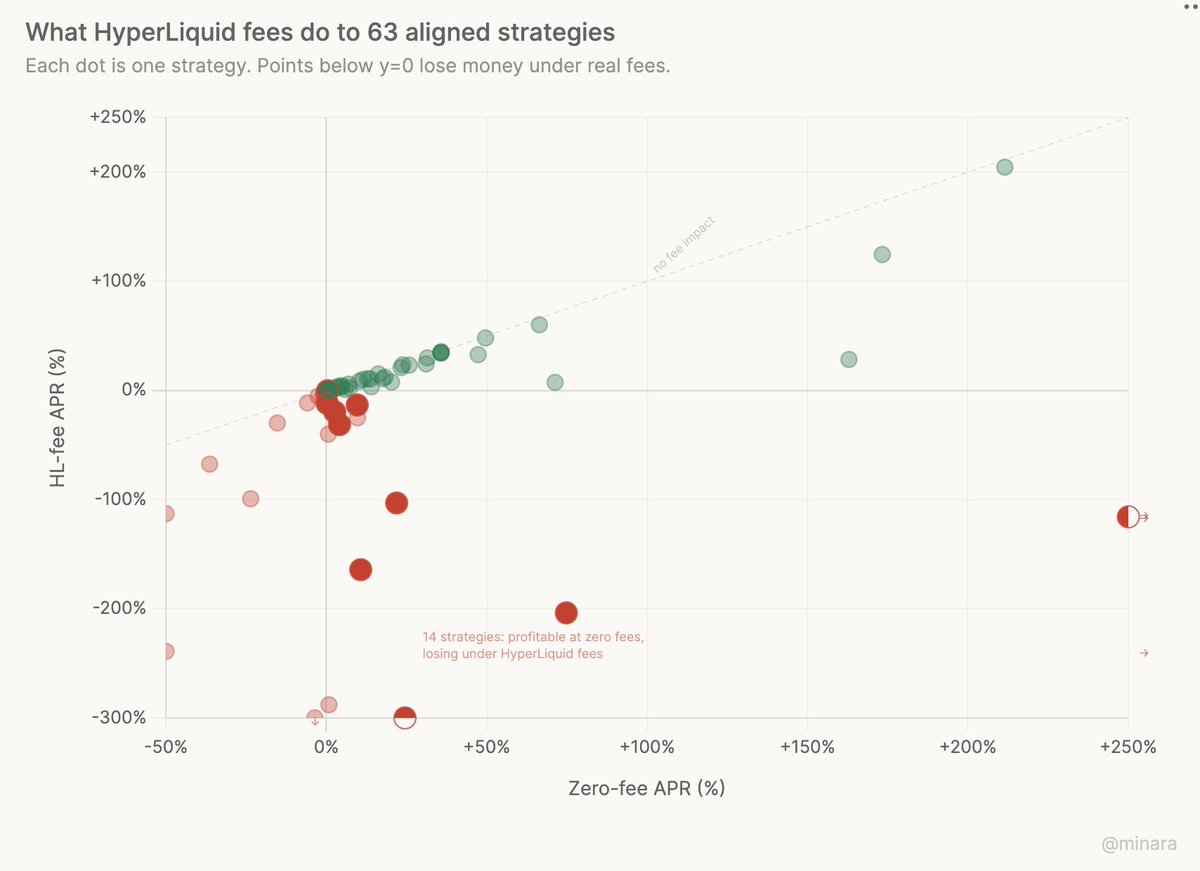
  • 复现比盈利更先验 236 个公开 TradingView 策略里,只有 63 个通过逐笔交易对齐;如果只用 ±15% 盈亏误差,会有约 103 个“看似复现”的策略混进来,这说明报表接近不等于交易逻辑真实一致。
  • 手续费杀死的是高频薄利,不是某一类指标 在 63 个已复现策略中,14 个在零手续费下盈利、加入 HyperLiquid 费率后亏损,而这 14 个年交易次数全部超过 200 次;年交易次数少于 25 次的策略几乎保住了零手续费优势。
  • 低胜率不等于坏策略,高胜率也不等于好策略 很多 Tier 1 策略胜率只有 35%-50%,但靠少数大赢家覆盖亏损和手续费;相反,100% 胜率的小止盈策略如果单笔利润太薄,手续费会迅速吞掉优势。
  • 榜单头部不该被当成可直接实盘的“赚钱机器” 榜首策略 90 天只交易 16 次却被年化成 +204%,统计置信度明显不足;四年只交易 4 次的 SuperTrend 策略虽然回测漂亮,但样本小到不能支撑强结论。
  • 优化案例更像产品展示,不是严格研究证明 多数“拯救策略”发生在样本内,有些甚至从原策略重写成另一套高排名模板,这能说明结构诊断有启发,但不能证明优化后的策略具备稳健样本外收益。

跟我们的关联

  • 对 ATou 意味着:评估策略或项目不能只看最终收益,要先看过程是否可复现。 下一步可以把“逐笔对齐”迁移成任务评估标准:不是只问结果好不好,而是检查每一步决策、成本、假设是否一致。
  • 对 Neta 意味着:任何高频动作都必须先算单位经济模型。 下一步在投放、内容、销售、agent 调用里都应先问:单次收益是否覆盖平台费、时间成本、失败率和维护成本,否则高频只是在放大亏损。
  • 对 Uota 意味着:复杂系统的有效性不来自堆指标,而来自结构与环境匹配。 下一步可以用“频率 × 单次边际收益 × 固定摩擦成本”筛掉不值得优化的流程、策略或产品功能。
  • 对交易实践意味着:公开策略默认不可信,但不是完全没价值。 下一步应先复现交易路径,再做零费用与真实费用双版本回测,最后才讨论参数优化和实盘部署。

讨论引子

  • 如果一个策略在短窗口里年化收益极高但交易次数很少,我们应该如何给它打折,才不会被“年化幻觉”欺骗?
  • “逐笔复现”这种评估方法能否迁移到 AI agent、增长实验和组织流程评估里,替代只看最终 KPI 的粗糙判断?
  • 当一个策略通过重写后变得盈利,它还是“原策略的优化”,还是已经变成了另一个策略?

TL; DR - 我们逐笔测试了 236 个公开 TradingView 策略,并按 HyperLiquid 的真实费率重新计算 - 63 个通过严格复现。36 个盈利。21 个年化收益超过 10% - 交易频率是最大的手续费杀手:所有从盈利变亏损的策略,年交易次数都超过 200 次 - 低频策略几乎保住了全部优势。表现最好的一例:90 天内交易 16 次,年化收益 +204% - 行业内常用的 ±15% 盈亏误差标准,会让约 103 个策略通过。逐笔交易匹配只通过了 63 个。差距来自那些看起来被复现了、但实际没有复现的策略 - 我们也尝试修复 4 个失效策略。样本内:全部改善。样本外:其中一次测试显示收益没有延续

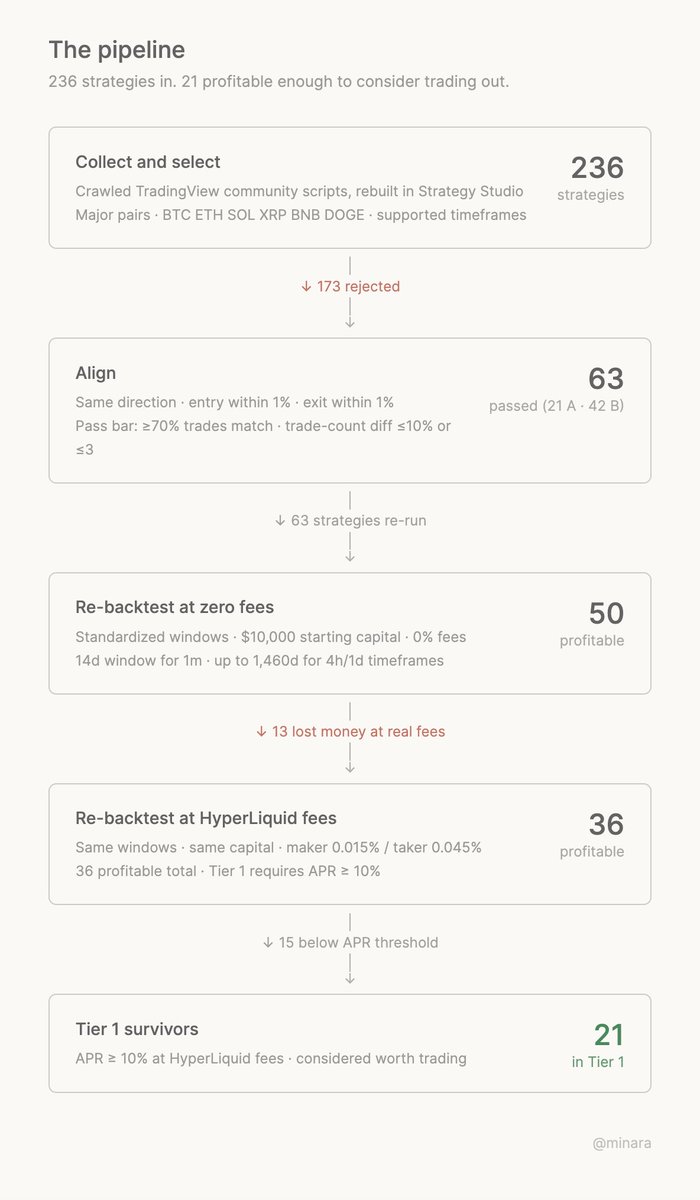
过去三个月,我们团队搭建了一条流水线:收集公开 PineScript 策略,在内部测试工具 Strategy Studio 中逐一重建,把每一笔交易与 TradingView 自己的回测引擎对齐复现,再按 HyperLiquid 的真实费率结构重新运行一遍,也就是 maker 0.015%、taker 0.045%。我们用这条流水线测试了 236 个策略,覆盖主流交易对 BTC、ETH、SOL、XRP、BNB、DOGE 和支持的时间周期,最后只有 21 个策略年化收益超过 10%。

这篇文章会讲清楚这条流水线、整体结果,以及四个具体策略。它们分别展示了从一张 TradingView 截图到真实订单簿之间,会发生什么。

流水线

完整流程分四个阶段:

  1. 收集和筛选。我们从 TradingView 社区库中抓取公开可用的 PineScript v5 策略,筛选出交易主流交易对 BTC、ETH、SOL、XRP、BNB、DOGE 且使用受支持时间周期的策略,并在 Strategy Studio 中重建了其中 236 个。

  2. 对齐。每个策略都在 Strategy Studio 中按完全相同条件运行:同样的资金、手续费、仓位大小和日期范围,全部与原始 TradingView 回测一致。我们用三个条件匹配每一笔交易:方向相同,入场价误差在 1% 以内,出场价误差在 1% 以内。如果至少 70% 的 TradingView 交易能在 Strategy Studio 中找到匹配交易,并且总交易数差异不超过 10% 或 3 笔,就算通过对齐。236 个策略中有 63 个通过:21 个达到更严格的 “A” 档,要求匹配率 ≥90%、盈亏偏差 ≤10%;42 个达到 “B” 档。剩下 173 个存在逐笔交易层面的差异,任何合理的参数调校都无法弥合。

  3. 零手续费重新回测。63 个已对齐策略全部在标准化窗口中重新运行:1m 用 14 天,5m 用 60 天,15m 用 90 天,30m 用 365 天,1h 用 730 天,4h 和 1d 用 1,460 天,起始资金均为 10,000 美元,手续费为零。这一步把策略逻辑和执行成本分离开。

  4. 按 HyperLiquid 费率重新回测。同样的窗口、同样的资金,但加入 maker 0.015%、taker 0.045% 的费率。回测引擎只模拟手续费;真实 HyperLiquid 市价单还会预留额外滑点容忍度,但这里不建模滑点,因为那会降低与 TradingView 原始报告之间的可比性。如果你打算真正交易,真正重要的是这个数字。

光是对齐步骤就花了数周调试。TradingView 和 Strategy Studio 在 bar magnets、夏令时切换、按合约计算仓位大小等问题上的处理方式不同,导致几个策略需要手动修正。总工程投入超过 300 小时。

数字

在 63 个已对齐且有近期双费率回测数据的策略中:

  • 21 个年化收益超过 10%(Tier 1)

  • 15 个盈利,但年化收益低于 10%(Tier 2)

  • 27 个亏损(Tier 3)

  • 57% 的策略在真实手续费后仍保持盈利

  • 扣除手续费后的年化收益中位数:+2.4%

  • 扣除手续费后的夏普比率中位数:+0.41

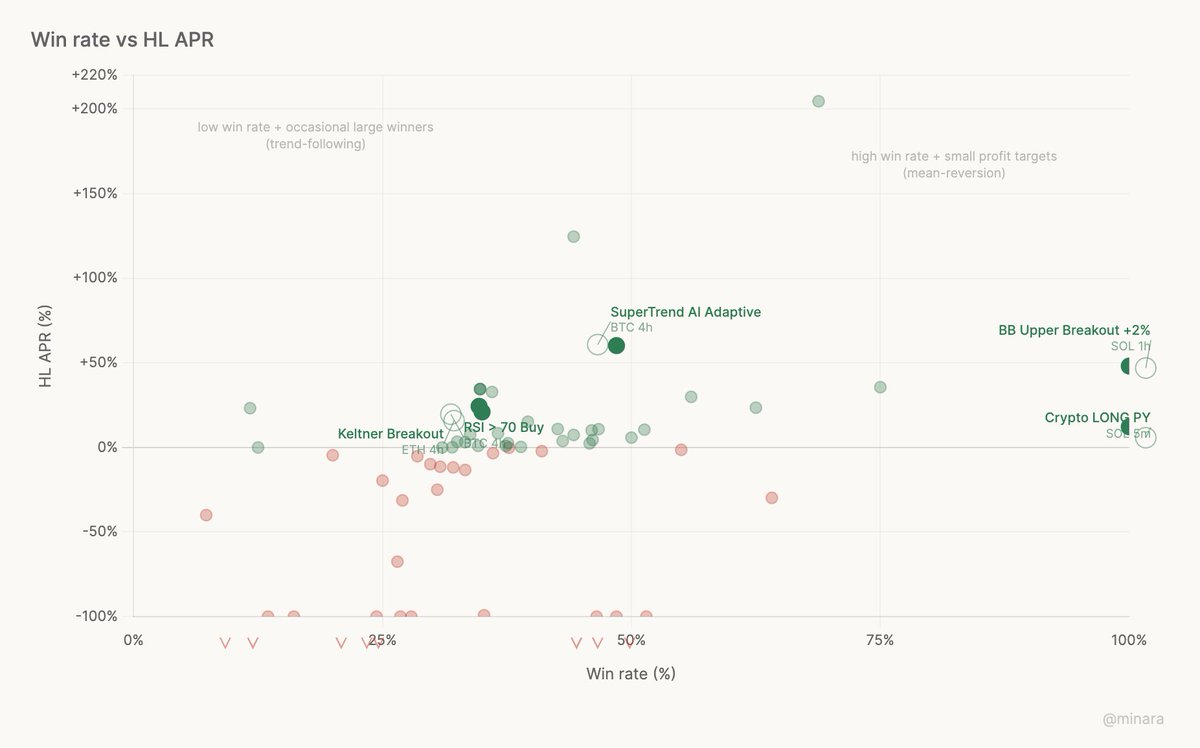
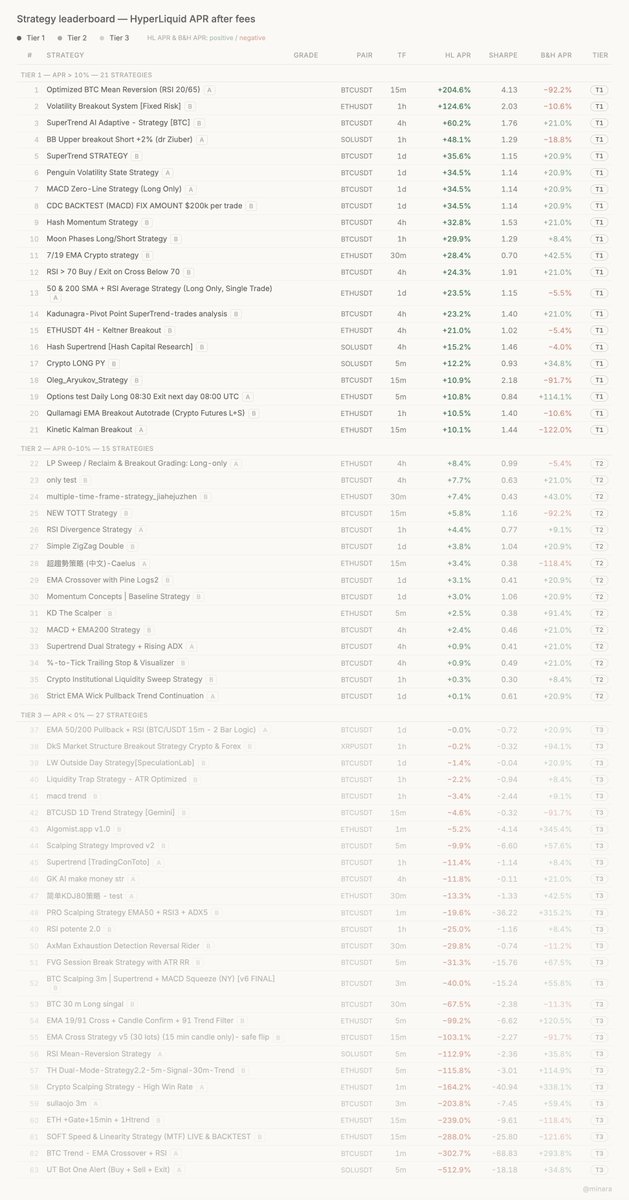
(点击图片查看完整排行榜)

https://www.tradingview.com/script/sl42otOB/

这 21 个赚钱策略是:

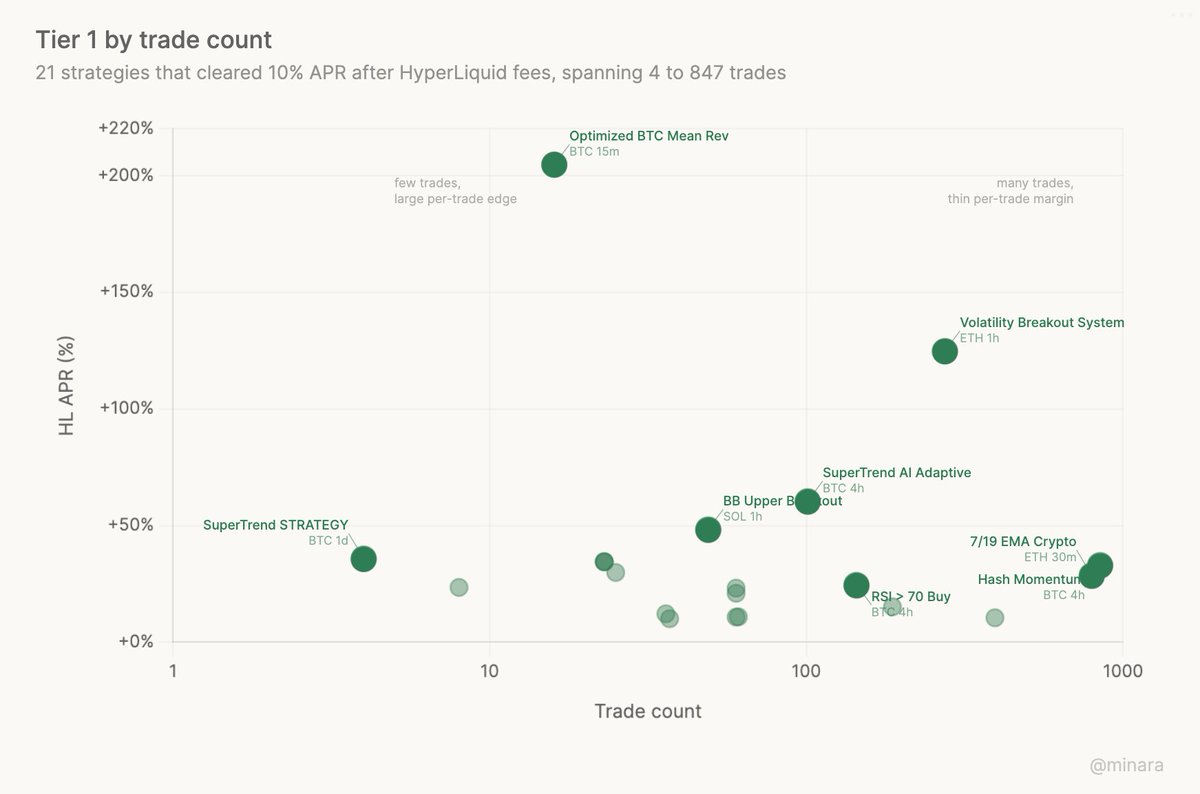
  • Optimized BTC Mean Reversion (RSI 20/65) — BTCUSDT 15m,+204.6% 年化收益

  • Volatility Breakout System [Fixed Risk] — ETHUSDT 1h,+124.6% 年化收益

  • SuperTrend AI Adaptive - Strategy [BTC] — BTCUSDT 4h,+60.2% 年化收益

  • BB Upper breakout Short +2% (dr Ziuber) — SOLUSDT 1h,+48.1% 年化收益

  • SuperTrend STRATEGY — BTCUSDT 1d,+35.6% 年化收益

  • Penguin Volatility State Strategy — BTCUSDT 1d,+34.5% 年化收益

  • MACD Zero-Line Strategy (Long Only) — BTCUSDT 1d,+34.5% 年化收益

  • CDC BACKTEST (MACD) FIX AMOUNT $200k per trade — BTCUSDT 1d,+34.5% 年化收益

  • Hash Momentum Strategy — BTCUSDT 4h,+32.8% 年化收益

  • Moon Phases Long/Short Strategy — BTCUSDT 1h,+29.9% 年化收益

  • 7/19 EMA Crypto strategy — ETHUSDT 30m,+28.4% 年化收益

  • RSI > 70 Buy / Exit on Cross Below 70 — BTCUSDT 4h,+24.3% 年化收益

  • 50 & 200 SMA + RSI Average Strategy (Long Only, Single Trade) — ETHUSDT 1d,+23.5% 年化收益

  • Kadunagra-Pivot Point SuperTrend-trades analysis — BTCUSDT 4h,+23.2% 年化收益

  • ETHUSDT 4H - Keltner Breakout — ETHUSDT 4h,+21.0% 年化收益

  • Hash Supertrend [Hash Capital Research] — SOLUSDT 4h,+15.2% 年化收益

  • Crypto LONG PY — SOLUSDT 5m,+12.2% 年化收益

  • Oleg_Aryukov_Strategy — BTCUSDT 15m,+10.9% 年化收益

  • Options test Daily Long 08:30 Exit next day 08:00 UTC — ETHUSDT 5m,+10.8% 年化收益

  • Qullamagi EMA Breakout Autotrade (Crypto Futures L+S) — ETHUSDT 1h,+10.5% 年化收益

  • Kinetic Kalman Breakout — ETHUSDT 15m,+10.1% 年化收益

在 HyperLiquid 手续费下,Tier 1 榜首并不是趋势交易者会预期的样子。表现最好的,是一个 15m 的优化版 BTC 均值回归策略,90 天内只交易 16 次,年化收益 +204%,夏普比率超过 4。第二名是 ETH 1h 动量策略,年化收益 +124%。第三名是 BTC 4h 自适应 SuperTrend,年化收益 +60%。排行榜头部混合了均值回归、动量和趋势跟随。没有任何一种方法占据绝对优势。

表格中段,是手续费敏感性开始咬人的地方。15 个 Tier 2 策略都赚钱,但赚得不多。其中很多在零手续费下本来能排进 Tier 1,只是在加上手续费后跌破了 10% 门槛。它们的逻辑有效;交易频率侵蚀了优势。

到了分布底部,亏损会加速。模式每次都一样:高交易次数、低胜率、单笔利润薄。BTC 1m 的 Buy Sell Signal 是我们在这条流水线多轮迭代中反复看到的典型例子:14 天内交易 2,655 次,资本亏损 -64.7%,折算成年化为 -1,687.6%。它支付的手续费超过了它理论上能赚到的一切。

这个数据集中胜率很高的策略,结构都很相似:拿一个小的固定利润,快速出场,然后重新入场。SOL 1h 的 BB Upper Breakout Short +2% 在 49 笔交易中达到 100% 胜率。SOL 5m 的 Crypto LONG PY 在 39 笔交易中达到 100% 胜率。BTC 1h 的 OrangePulse v3.0 Lite 在 118 笔交易中达到 94.9% 胜率。这些都是带有小额固定止盈的均值回归策略,它们的结构也是它们的弱点。每次盈利都很小,而一来一回的手续费固定吃掉 0.06%。当平均盈利只有 1.5% 时,手续费在其他因素发生之前就已经消耗掉约 4% 的优势。OrangePulse 勉强活了下来,年化收益 +0.1%。榜单再往下一个策略就没有活下来。

https://www.tradingview.com/script/DJT1l5tH/

相反的画像,在纸面上更难看,实际表现却更好。BTC 4h 的 RSI > 70 Buy 胜率约为 35%。它三笔交易里差不多会亏两笔。SuperTrend AI Adaptive 接近 48%。Keltner Breakout 接近 34%。这些是趋势跟随策略,大多数交易亏一点,少数交易赚很多。偶尔出现的大赢家会轻松吸收手续费成本。按扣费后年化收益排名,多数 Tier 1 策略的胜率在 35% 到 50% 之间。低胜率配高利润因子,才是活下来的画像。

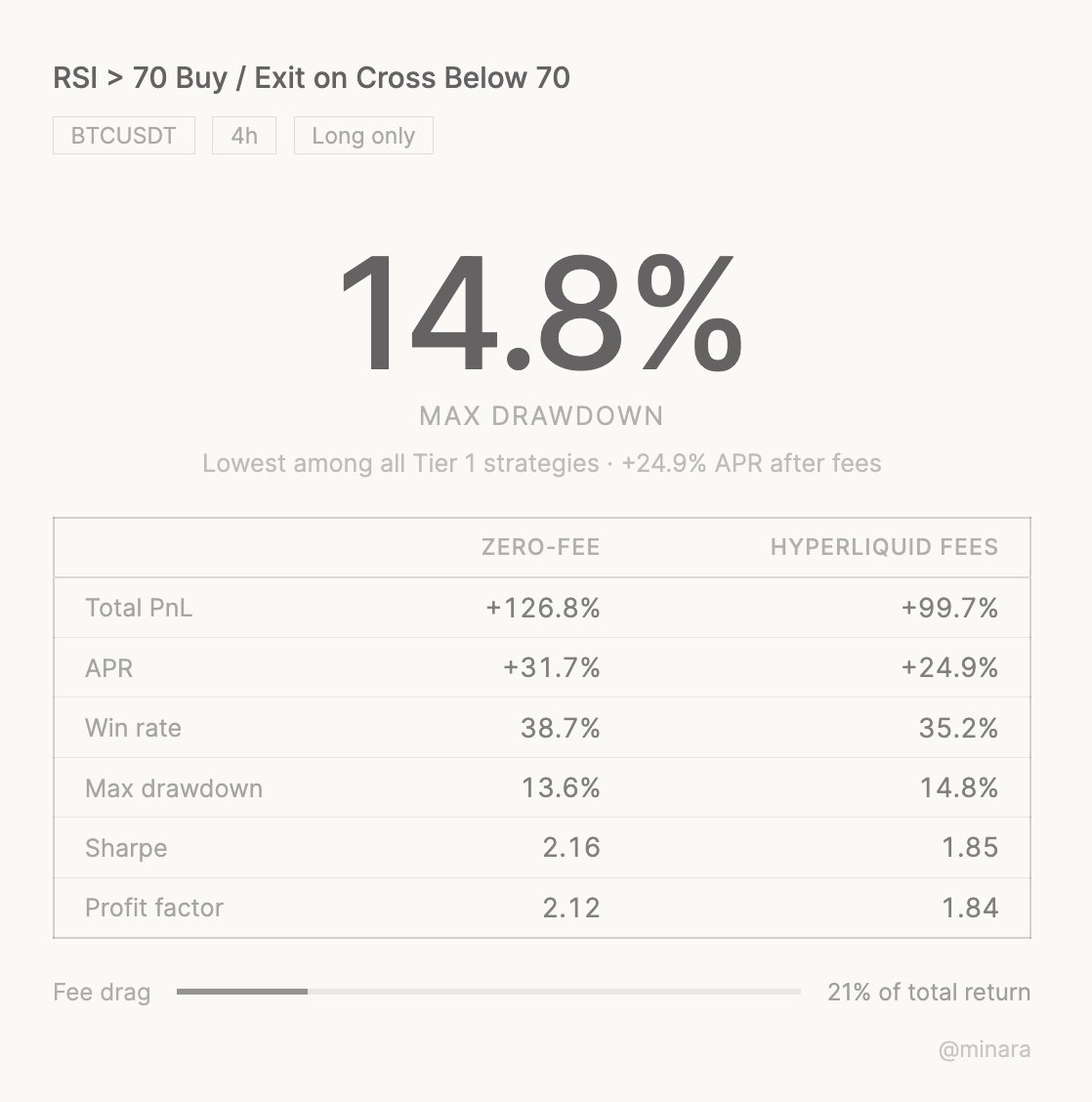
BTC 1d 上的 Tier 1 策略 SuperTrend STRATEGY,在 4 笔交易历史中承受过 46.1% 的最大回撤。RSI > 70 Buy 同样进入 Tier 1,最大回撤为 14.8%,夏普比率超过 2。承受 46% 回撤和承受 15% 回撤,是完全不同的体验,即便前者在周期结束时的最终数字更大。

用夏普比率排序,数据集会呈现出和原始年化收益不同的样子。Tier 1 中最高夏普属于一个 15 分钟均值回归策略,它在短窗口内只做了很少的交易。RSI > 70 Buy 和 SuperTrend AI Adaptive 在风险调整后的指标上也靠前。低年化收益、可控回撤和高夏普,有时比一个需要先熬过近乎爆仓回撤的高年化收益更适合交易。

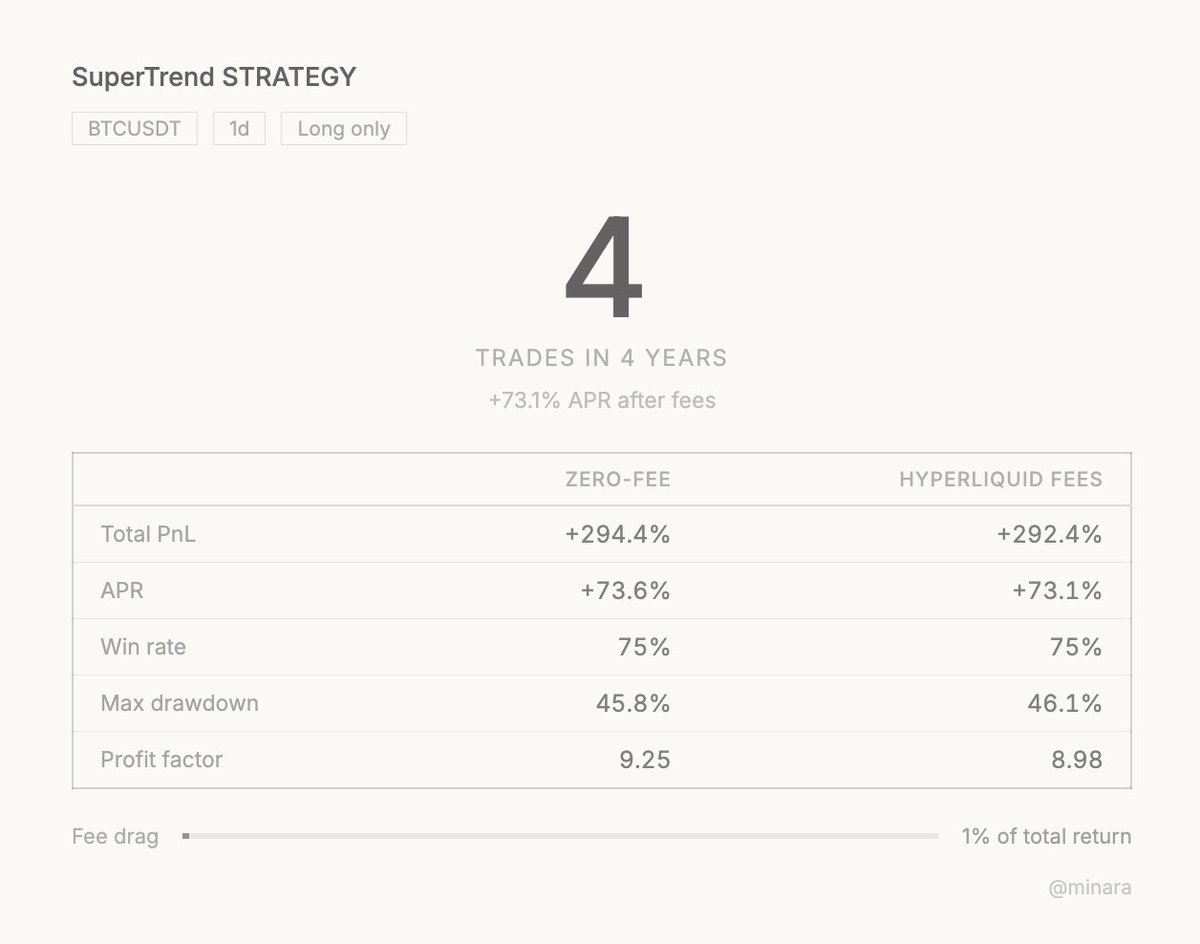
利润因子讲的是相关的故事。SuperTrend 的利润因子 8.98,意味着它的总盈利接近总亏损的九倍。这个比例解释了为什么四笔交易就足以进入 Tier 1。其他 Tier 1 策略的优势来自许多更小的盈利,单笔利润分布在几十个或几百个仓位上。两种都有效。只是有效的方式不同。

Tier 1 榜单头部混合了均值回归、动量和趋势跟随。复杂多因子系统和简单单参数策略都在里面。复杂或简单,都不能稳定预测这 63 个策略的收益。真正能预测收益的,是策略单笔交易画像和它所处手续费环境之间是否匹配。没有任何指标或过滤器组合统治 Tier 1:趋势跟随出现得最多,但布林带、Keltner 通道、EMA 交叉、MACD、基于日历的入场,也都产出了 Tier 1 成员。

手续费影响的主要驱动因素不是策略类型、资产或时间周期,而是交易次数。在 63 个分析池策略中,有 14 个在零手续费下盈利,但一旦加入 HyperLiquid 手续费就变成亏损。这 14 个每一个年交易次数都超过 200 次。年交易次数少于 25 次的策略,几乎保住了全部零手续费收益。

这些策略整体偏向趋势跟随,最常见的时间周期是 4h 和日线。BTC 是交易最多的资产,但池子里也包含 ETH、SOL、XRP、BNB 和 DOGE 策略。

上面的聚合结果,把 63 个策略压成了平均数和分层。下面四个案例会把平均数拆开:一个胜率 100% 的均值回归做空策略,一个四年只触发四次的趋势跟随策略,一个买入超买状态的动量策略,一个在亏损市场中跑赢的经典均线策略。每个在纸面上看起来都不对。每个都跑出来了。

(以下所有案例都在 Strategy Studio 内部测试版本中运行。申请早期访问,请看本文末尾链接。)

案例 1:胜率 100% 的做空策略,BB Upper Breakout Short +2%,作者 @DrZiuber,SOLUSDT,1h

https://www.tradingview.com/script/UBGvlIlq/

这个策略在价格突破布林带上轨 2% 时做空 SOL,布林带参数为 20 周期、2 个标准差,并在盈利 2% 时退出。这是教科书式均值回归:当资产价格相对近期区间向上冲得太远,就卖出它,等待回落。

在 730 天内,它交易了 49 次。每一笔都盈利。胜率:100%。

按 HyperLiquid 手续费计算,它总收益 +96.3%,年化收益 +48.1%。手续费拖累为 3%,几乎可以忽略,因为这个策略交易不频繁,并且每个仓位都拿到了有意义的利润。

对齐检查很干净:Strategy Studio 与 TradingView 的结果误差在 2% 以内,交易次数完全一致。

显然也有注意事项。两年 49 笔交易是一个小样本。这个策略只在 SOL 上有效,而 SOL 在这段时期有特定的波动画像。49 笔交易 100% 胜率,不代表接下来 49 笔也会 100%。最大回撤为 36.7%,意味着在均值回归完成前,策略曾一度承受明显的未实现亏损。注意事项是真的。优势也是真的。

https://www.tradingview.com/script/1x2AawHf/

**案例 2:四年四笔交易,SuperTrend STRATEGY,作者 holdon_to_profits,BTCUSDT,1d **

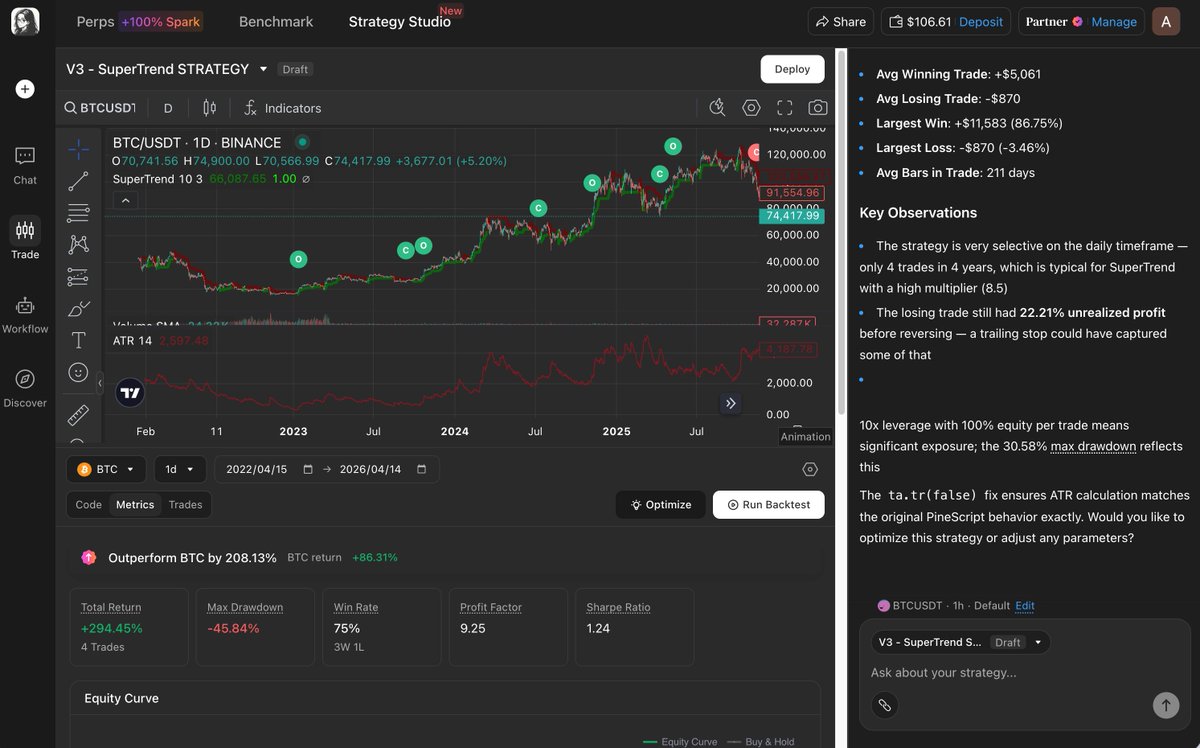
大多数策略都试图捕捉尽可能多的波动。这个策略反着来。它在 BTC 日线蜡烛图上运行经典 SuperTrend 指标,ATR 周期 10,乘数 8.5,并在趋势转为看涨时做多。高乘数意味着它几乎忽略一切噪音。只有重大的趋势反转才会触发信号。

四年时间,也就是 1,460 天,它只交易了四次。三次盈利,一次亏损。按 HyperLiquid 手续费计算,总收益 +292.4%,年化收益 +73.1%。

手续费拖累为 1%。四年四笔交易,意味着它总共只支付八次手续费,也就是入场和出场。在 HyperLiquid 的费率结构下,这个成本几乎没有意义。

夏普比率为 1.24。利润因子为 8.98。最大回撤为 46.1%,很大,但可以预期。当你在没有止损的情况下持有 BTC 穿越趋势反转,你就会一直承受回撤,直到 SuperTrend 翻转。

即便覆盖了四年的日线蜡烛,四笔交易仍然是小样本。8.98 的利润因子对于被测试周期来说是准确的;但这个数字周围的置信区间很宽。排名是真的。它也部分是交易次数很少且窗口有利带来的结果。

它与 TradingView 的对齐很紧:盈亏偏差 7%,交易次数相同,在 TV 回测窗口中为 7 笔,胜率相同。

高乘数 SuperTrend 几乎都算不上一个完整策略。它更接近于“当 BTC 开始牛市时买入,当牛市结束时卖出”。我们测试的 37 个策略中,有 34 个使用了更多信号、更多过滤器和更多逻辑。这个策略只用了 ATR 和一个乘数。它排第二。

https://www.tradingview.com/script/LmNV3ZLN/

案例 3:买入超买,RSI > 70 Buy / Exit on Cross Below 70,作者 Boubizee,BTCUSDT,4h

https://www.tradingview.com/script/wZIdSrBG/

每个初学者都会学到同一条规则:RSI 高于 70 意味着超买,该卖了。这个策略反过来做。它在 RSI(14) 上穿 70 时买入 BTC,并在 RSI 跌回 70 以下时退出。这是一个动量延续策略:它假设强 RSI 读数代表强势,而不是衰竭。

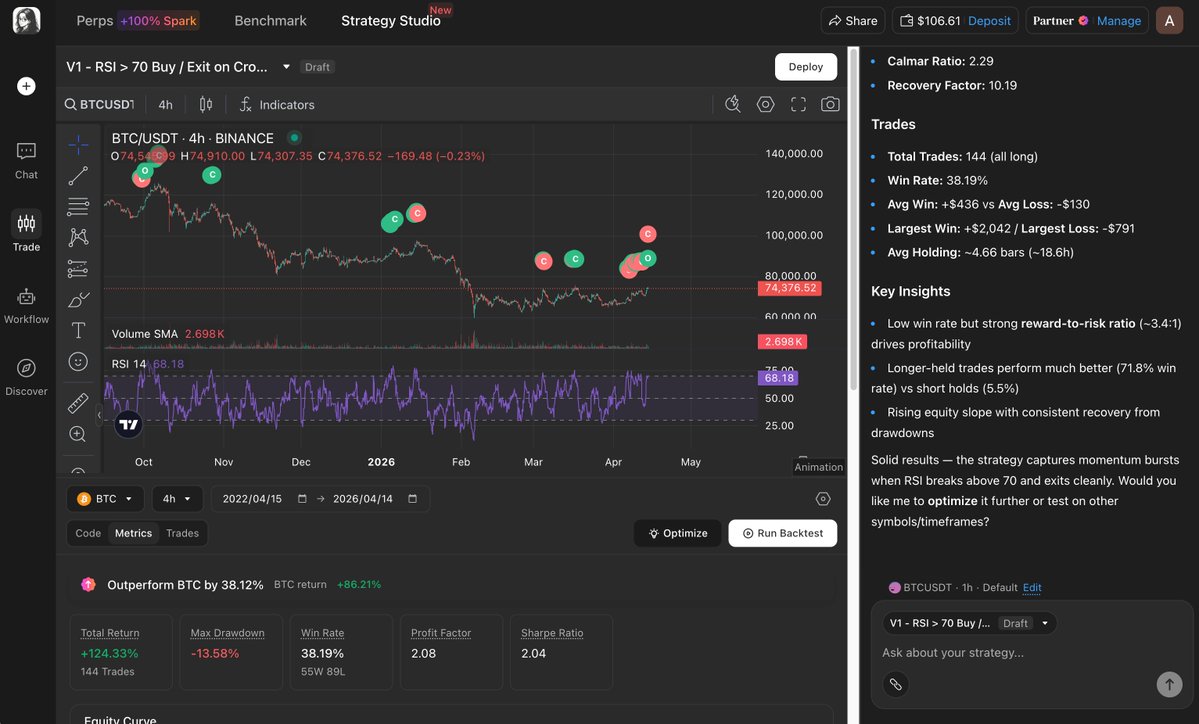
在 1,460 天内,它交易了 142 次。胜率:35.2%。按 HyperLiquid 手续费计算,总收益 +99.7%,年化收益 +24.9%。

夏普比率为 1.85。最大回撤为 14.8%。年化 +24.9%、最大回撤 14.8%,这个风险调整后的画像,比我们数据集中许多名义年化更高的策略更好。

手续费拖累为 21%,明显但不致命。四年 142 笔交易,每笔往返成本平均约为 0.06%。单笔优势足够大,所以能活下来。

对齐很干净:相对 TradingView 的盈亏偏差为 2%,交易次数匹配。

指标阈值是经验法则,不是法律。在 BTC 4h 上,过去四年和 142 笔交易中,RSI 高于 70 更常意味着动量,而不是衰竭。

案例 4:跑赢一个亏损市场,50 & 200 SMA + RSI Average Strategy,作者 muratkbesiroglu,ETHUSDT,1d

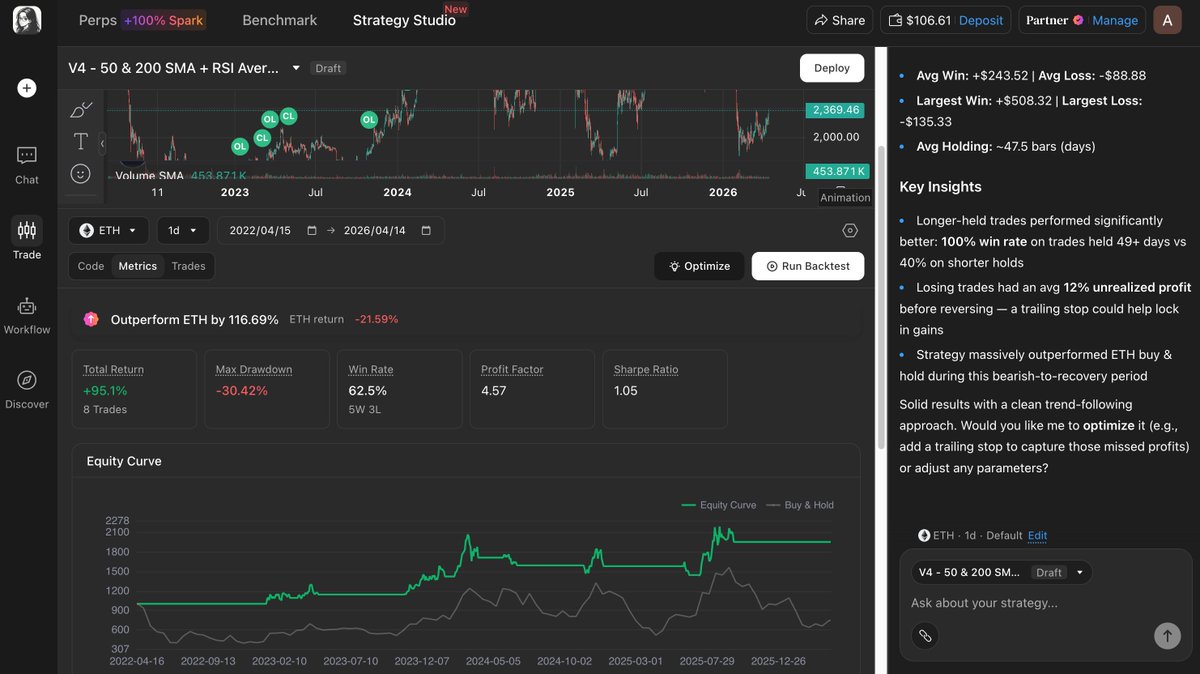
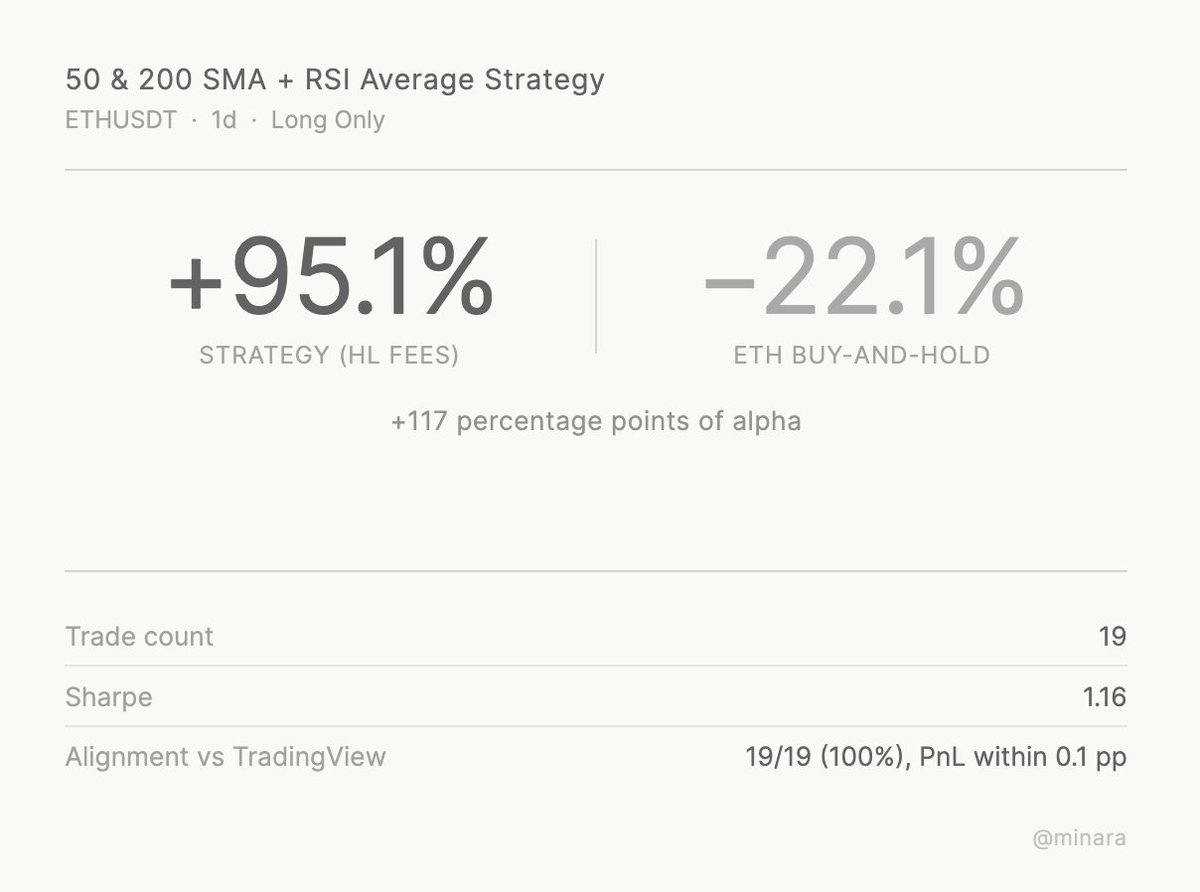
这个策略使用了趋势跟随中最古老的想法之一:当价格位于 50 日和 200 日 SMA 之上,并且平滑 RSI(RSI-21 的 9 周期均值)高于 57 时做多。当价格跌破 50 日 SMA 且 RSI 均值回落到 57 以下时退出。只做多,同一时间只持有一个仓位,无杠杆。

在测试窗口内,它交易了 19 次。按 HyperLiquid 手续费计算,它收益 +95.1%,而 ETH 买入持有收益为 -22.1%。在单纯持有 ETH 亏钱的时期,这个策略跑赢市场 +117 个百分点。

夏普比率为 1.16。策略在大多数横盘和下跌时期都空仓,这也是它大幅跑赢买入持有的原因:57 这个 RSI 阈值过滤器,迫使它在低动量环境中持有现金,而这些环境正是长期持有者被拖下水的时候。

对齐检查几乎完美:19 笔中的 19 笔都匹配 TradingView 引擎,盈亏误差在 0.1 个百分点以内,在 TV 测试窗口中为 1,072.0% 对 1,071.9%。

本文中的大多数策略,是在买入持有本身表现不错的时期跑赢了买入持有。这个策略是在买入持有亏损的时期跑赢了买入持有。这是另一种测试,也更难。教科书答案仍然有效;真正让它有效的,是在疲弱时期离开市场的纪律。

https://minara.ai/app/trade/strategy-studio

优化

这四个案例从不同角度指向了同一个模式。让它们有效的,不是指标选择、胜率或复杂度,而是单笔交易优势与手续费成本之间的匹配:每个策略要么交易足够少,从而保住优势;要么单笔利润足够大,能吸收一来一回的成本。BTC 1d 的 SuperTrend 四年只支付了八次手续费。SOL 的均值回归做空策略在 730 天里交易 49 次。RSI 延续策略三笔只赢一笔,但赢家足够大,以至于手续费几乎不显眼。SMA 策略的优势不在于它交易了什么,而在于它跳过了什么:RSI 过滤器让它在长期持有者被拖入水下的时期保持现金。

复现是 Minara 会做的一件事。下面四个案例展示了另一件事:从数据集亏损端拿出一个策略,识别它结构上哪里坏了,然后修复它。修复方式从四行补丁到完整重写都有,而且并不是所有修复都能在样本外数据中继续成立。这些是我们在测试中遇到的典型优化案例。

拯救 1:Buy Sell Signal Strategy → Quant Trend Engine 风格逻辑(完整重写)

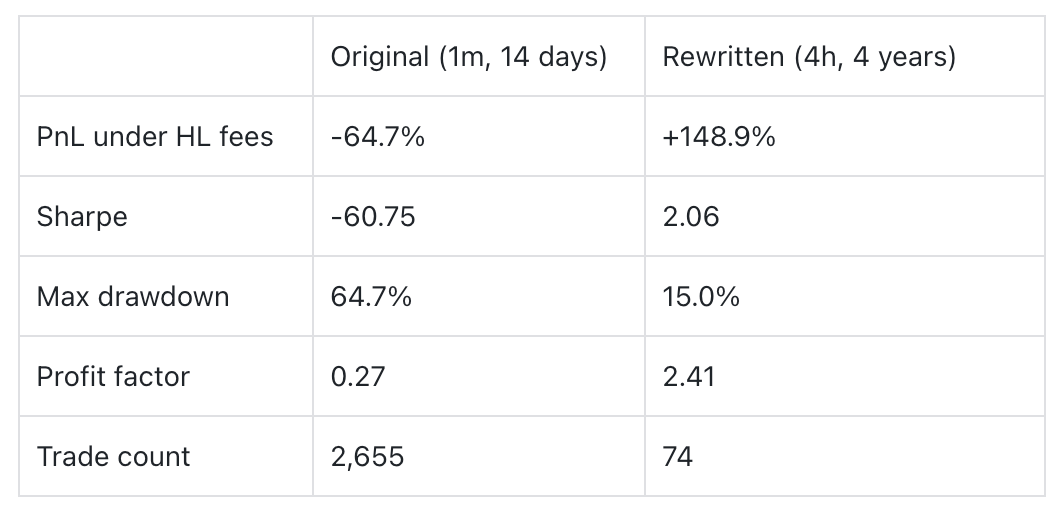
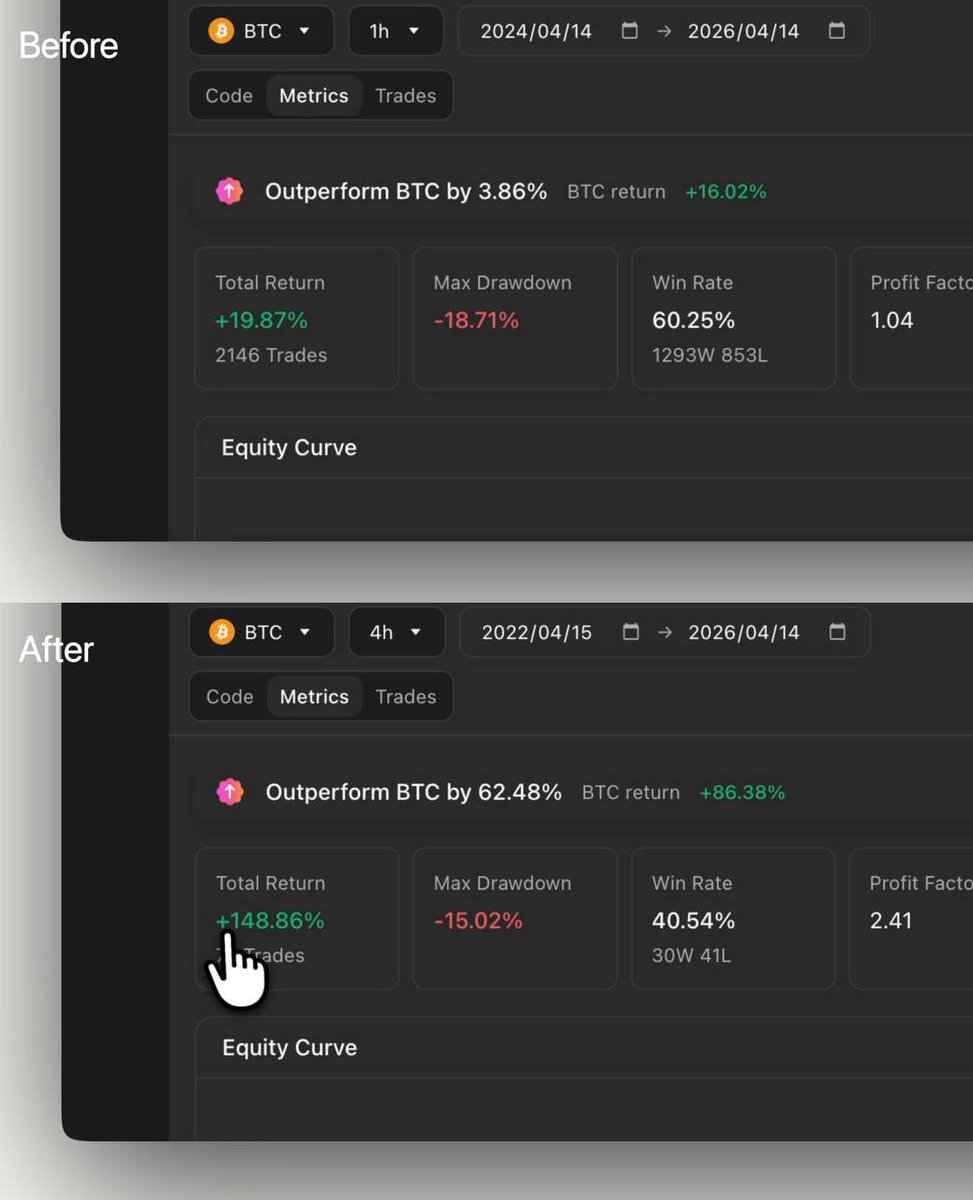
第一个目标是 Buy Sell Signal Strategy, 一个 BTC 1 分钟剥头皮策略,14 天内交易 2,655 次,并在 HyperLiquid 手续费下亏掉 64.7% 的本金。Minara 拒绝调参数,而是从头重写,借用了我们数据集中高排名模板的结构元素。结果是一个 4h 多因子趋势跟随策略,与原始 EMA 交叉逻辑在结构上已经无关。

https://www.tradingview.com/script/R4mgYcZ5/

Minara 做了这些改变:

  • 时间周期:1m → 4h。 1m 窗口在 14 天内产生 2,655 笔交易。4h 窗口每年大约产生 18 笔交易。为了覆盖手续费所需的单笔优势,从不可能的 0.09%+ 降到了可实现的 0.2% 到 0.5%。

  • 入场:单一 EMA 交叉 → 8 因子加权评分。 重写后,策略要求 EMA 排列、斜率、分离度、动量持续性、路径效率、突破强度、ATR 状态、回调收复这几个因素合计达到至少 5.0 分。没有任何单一因素能单独触发入场。

  • 加入路径效率过滤器。 Kaufman Efficiency Ratio ≥ 0.33。这个单一过滤器会阻止横盘市场中的入场,而原始策略的大多数亏损都发生在那里。

  • 止损:固定 0.5 ATR → 2% 硬止损 + 2.8 ATR 跟踪止损。 1m 上紧贴 ATR 的止损会被噪音吃掉。跟踪止损给真正的趋势留下运行空间。

  • 方向:多空双向 → 只做多。 BTC 的长期 beta 为正。做空一个结构上向上漂移的资产,在任何策略逻辑生效前就已经放弃了优势。

  • 出场后冷却 5 根 K 线。 防止重新进入刚刚触发上一次止损的同一段噪音形态。

https://x.com/drziuber

Minara 没有发明这个结构。它选择了一个类似 Quant Trend Engine 的骨架,而后者已经是我们数据集中的顶尖表现者,并针对原策略的资产做了适配。判断一个策略何时在结构上不可救,并提出一个已知有效的替代方案,比假装参数调校会奏效更有用。

拯救 2:XRP Non-Stop Strategy,作者 antishyilma81 → XRP Trailing ATR

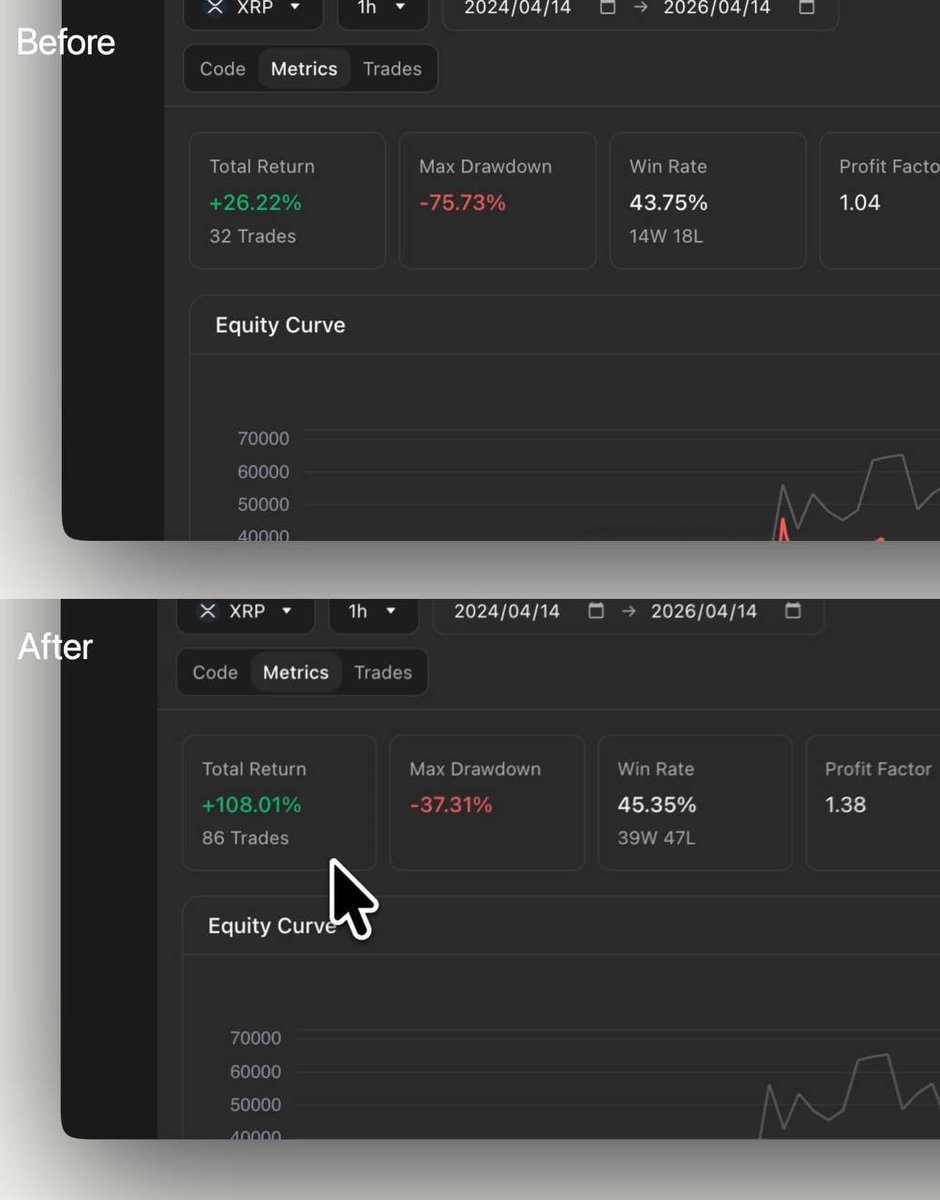
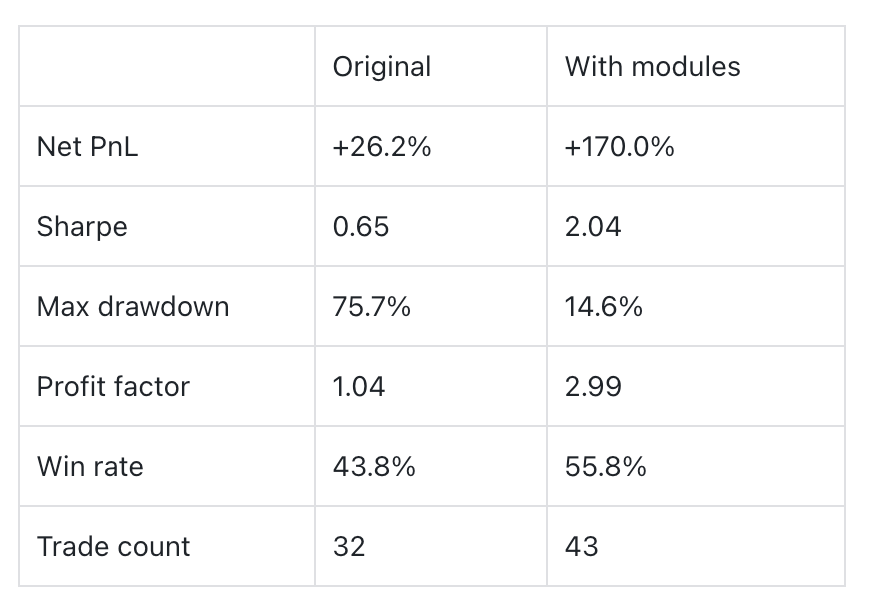
第二个目标是 XRP Non-Stop Strategy,一个只做多的趋势跟随策略,使用 EMA 20/50 过滤,并配有固定 25% 止盈和 15% 止损。730 天内,它实现 +26.2% 盈亏,胜率 43.8%。问题不是名义收益。问题是最大回撤 75.7%,利润因子 1.04,这意味着策略之所以能活下来,只是因为某一笔最终盈利刚好抵消了之前积累的亏损。Minara 保留了骨架,也就是 EMA 过滤、只做多、25% 止盈、XRP ticker guard,并在外面加了四个模块。

Minara 做了这些改变:

  • 止损:固定 15% → 2.5 ATR 初始止损,2.0 ATR 跟踪止损,只能上移。 固定 15% 在高波动状态下太紧,在低波动状态下又太松,而且无法保护未实现盈利。ATR 跟踪止损会随着价格上涨锁定利润。单是这个改动,就解释了最大回撤从 75.7% 降到 14.6% 的大部分原因。

  • RSI 入场过滤:要求 RSI < 45。 这看起来反直觉地严格。EMA 已经确认上升趋势后,只有 RSI 回落时才入场,也就是买回调,而不是买突破。胜率从 43.8% 提升到 55.8%。

  • ATR 状态过滤:当 ATR/price < 1.5% 时跳过。 低波动窗口会产生虚假 EMA 交叉,止损也容易被刮掉。阻断这些窗口后,利润因子从 1.04 提升到 2.99。

  • 出场后冷却 3 根 K 线。 防止重新进入刚刚触发止损的同一段震荡形态。

https://www.tradingview.com/script/6zYF9Xts/

这个策略交易次数更多了,但单笔质量更高。Minara 也报告了四个测试后被拒绝的替代方案:更紧的 1.5 ATR 跟踪止损会被正常回调刮掉,更短的 EMA 会产生更多虚假交叉,更近的 15% 止盈会限制赢家并压垮利润因子,8 根 K 线冷却会错过延续入场。被拒绝的分支和被接受的修改一样,界定了参数空间。

拯救 3:EMA 50/200 Pullback + RSI(BTC/USDT 15m - 2 Bar Logic)

第三个目标是 BTC 15m 上的 EMA 50/200 Pullback 策略,它使用两根 K 线的回调并收复信号,配固定 0.49% 止损和 1:5 盈亏比。骨架是合理的。执行尺度错了:15m 上 0.49% 的止损处在正常噪音内部,而 1:5 盈亏比在纸面上好看,但实际不可达,因为多数交易会在到达目标前先被止损。Minara 改了时间周期,替换了风险模型,加入趋势过滤,加入跟踪止损,并收紧入场条件。

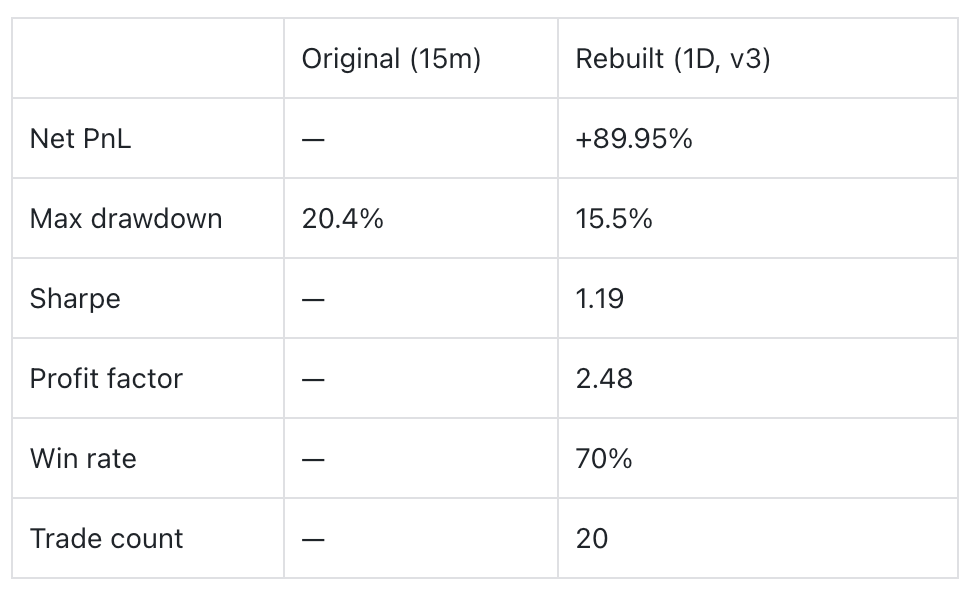
样本内结果(2022-04 到 2025-01,2.8 年):

https://www.tradingview.com/script/VLRj2sG9-SuperTrend-STRATEGY/

Minara 做了这些改变:

  • 时间周期:15m → 1D。 15m 上 0.49% 的止损约等于 0.16 ATR,位于正常噪音内部。在日线上,同样百分比约为 0.5 ATR,已经是有意义的波动。回调并收复信号也从微观结构事件,变成了跨两天的结构性事件。

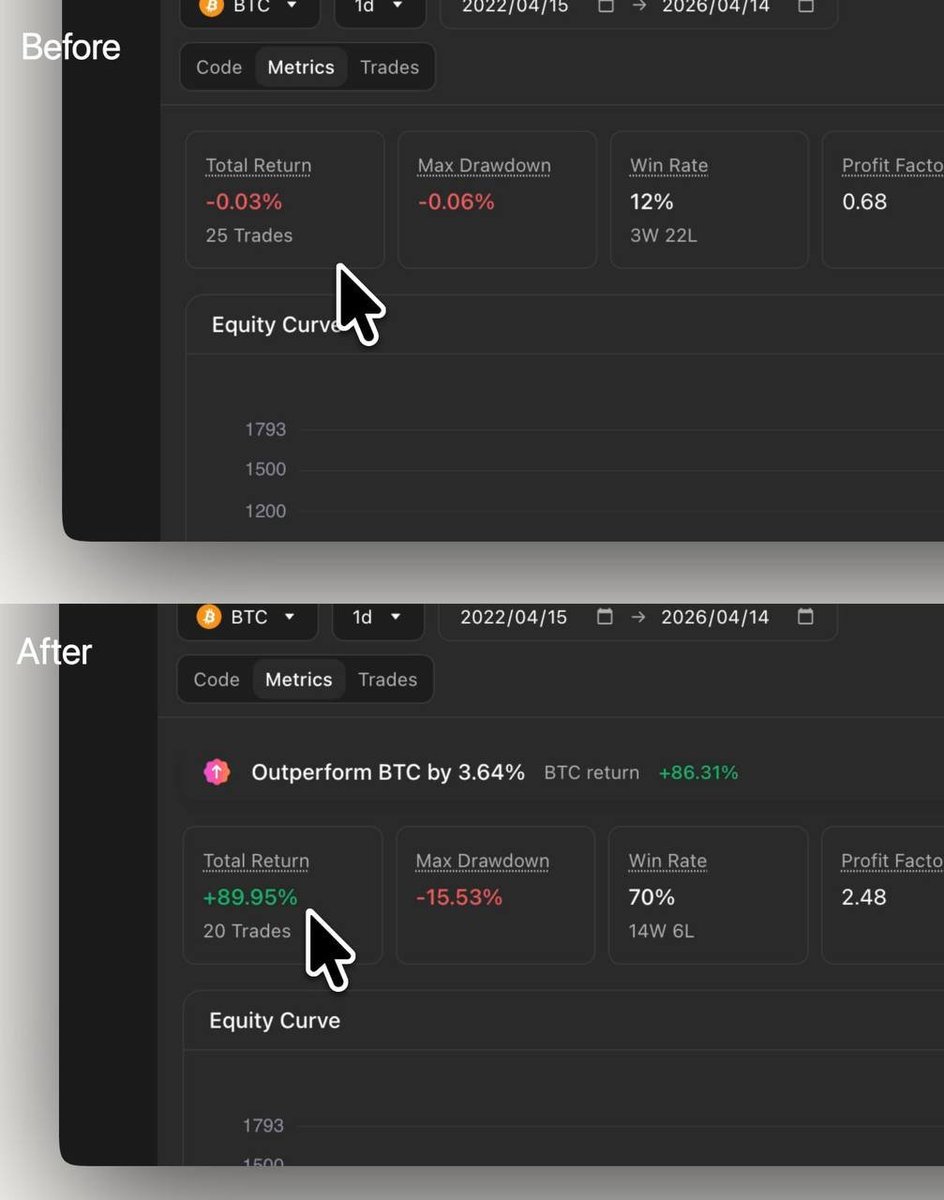
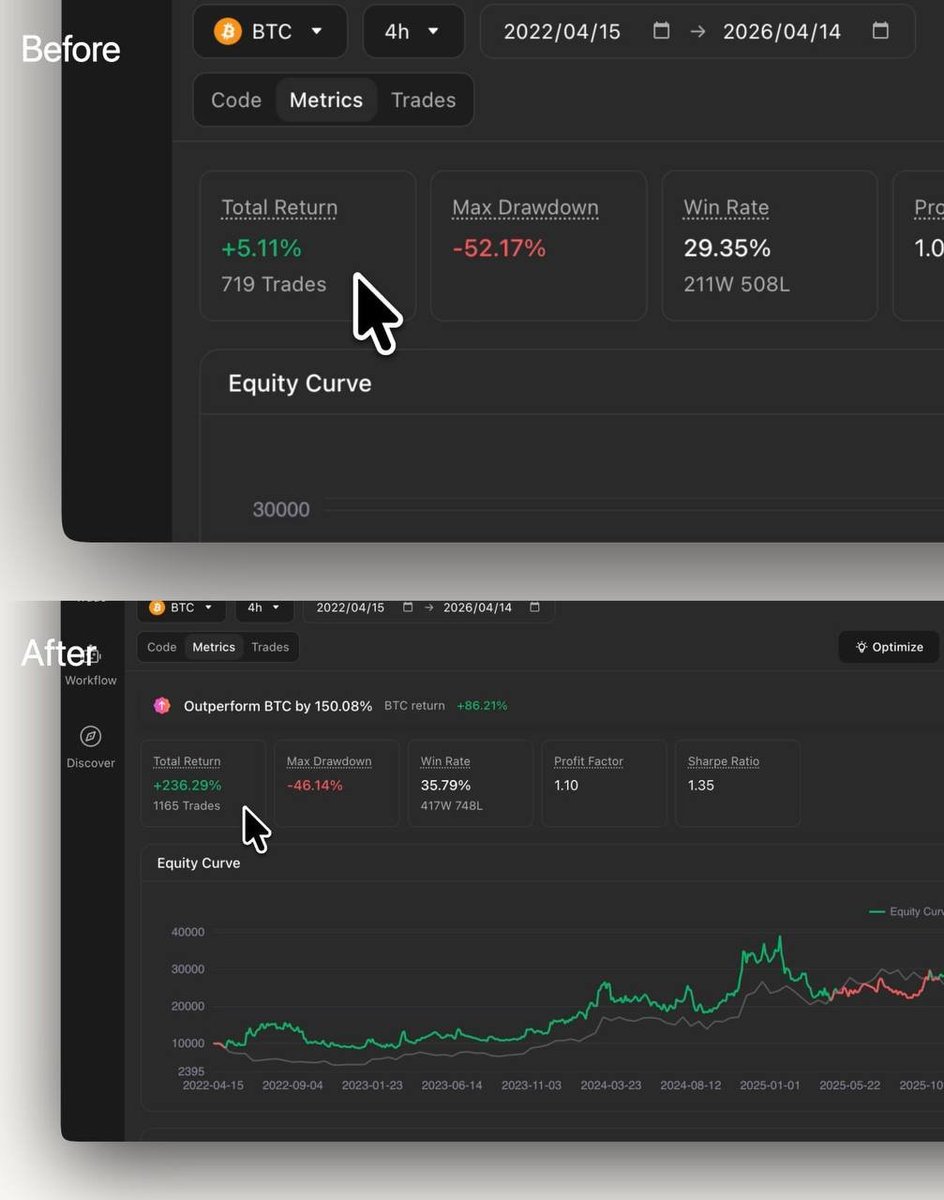
  • 风险模型:1x 下固定 0.49% / 2.45% → 20x 杠杆下 ATR 缩放的 1.5 / 4.0。 盈亏比从纸面上的 1:5 降为真实的 1:2.63。原始比例不可达;新的比例实际被 20 笔交易中的 14 笔达到。提高杠杆是因为四年 20 笔交易频率很低,需要放大单笔影响,才能产生有意义的回报。

  • 加入跟踪止损:盈利 +2 ATR 后激活,按 1 ATR 跟踪。 20 笔交易中,有 12 笔通过跟踪止损退出,平均收益 +6.21%。如果没有跟踪止损,这些中等距离赢家要么会反转回初始止损,要么会停在止盈下方。

  • 加入 ADX > 20 趋势强度过滤器。 EMA 50/200 确认方向,但不确认趋势是否真的在推进。ADX 要求真实的方向性动量,阻断那种“EMA 排列看起来看涨,但价格正在震荡”的环境,而原策略大多数亏损都来自这种环境。Minara 把这一步作为单独的 v2 → v3 迭代报告,所以它的边际贡献可以被单独测量。

  • RSI 阈值:> 50 → 做多时限定在 45 到 75。 原策略会把 RSI = 85 也当作买入信号。限定区间能过滤掉接近超买顶部的后期入场,同时保留有意义的动量区间。

https://www.tradingview.com/script/VLRj2sG9/

拯救 4:Momentum Strategy → Momentum ATR Exit

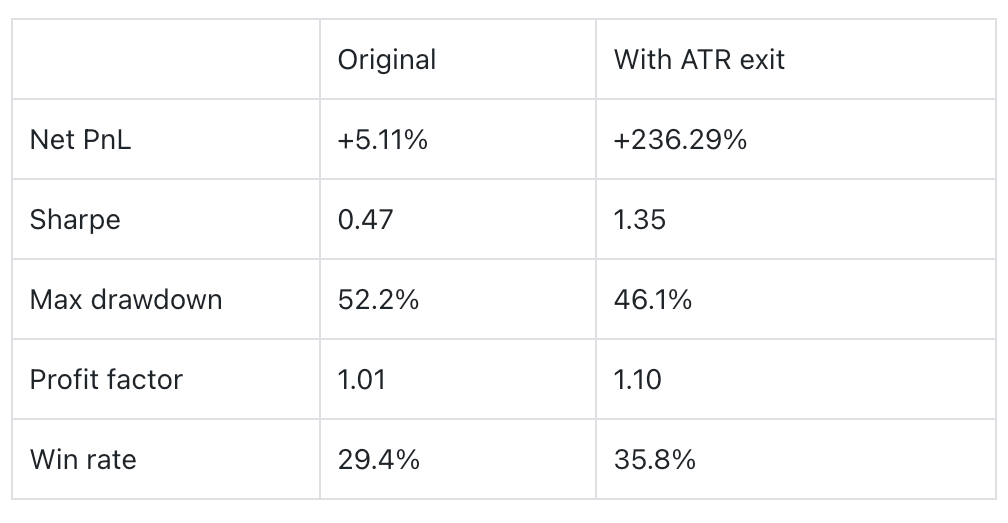
第四个目标是 Momentum Strategy,一个经典 TradingView 模板:当 12 根 K 线动量为正且加速时做多,当两者都为负时做空。入场逻辑很干净。策略完全没有退出逻辑:没有止损,没有止盈,没有定时平仓。仓位只有在反向信号触发时才会翻转。这会把每一段盈利趋势变成一场往返:策略先吃到上涨,然后在等待反转确认时把收益全部吐回去。1,165 笔交易的利润因子为 1.01,等于随机。Minara 的诊断是:入场有优势,出场不存在。修复只用了四行代码。

Minara 做了这些改变:

  • 加入 ATR 缩放止损:1.5 × ATR(14)。 距离随当前波动率变化,而不是固定百分比。

  • 加入 ATR 缩放止盈:3 × ATR(14)。 每笔交易内置 2:1 的回报风险比。

  • 入场逻辑:不变。 mom0 > 0 和 mom1 > 0 条件,以及 stop=high+mintick 挂单,都原样保留。

全部改动就这些。其他所有东西,也就是动量计算、方向、仓位大小、多空对称性,都被保留了。

https://www.tradingview.com/script/J5akHbOr-XRP-Non-Stop-Strategy-TP-25-SL-15/

注意事项

这些发现成立于特定条件下。其中几个条件值得明说。

市场环境。 回测窗口在最长时间周期上覆盖 2016 到 2026 年,高频策略窗口更短,而加密市场整体是净看涨的。几个 Tier 1 策略是只做多趋势跟随者,直接受益于持续向上的漂移。在多年熊市中,大多数策略的风险画像会不同,其中一些会跌出 Tier 1。

资产集中。 已对齐策略池偏向 BTC。ETH、SOL、XRP、BNB 和 DOGE 策略基于更小样本,未必能泛化。我们没有测试波动率或流动性画像不同的其他山寨币。

样本外验证。 本文中只有一个策略,也就是拯救 3,在调参过程之外保留的数据上做过测试。其余结果都应视为样本内:策略逻辑是在同一批用于识别它的数据上评估的。优化案例尤其有过拟合风险,需要更大的样本外样本才能排除。

选择偏差,量化后看。 我们测试了 236 个通过初筛的公开 PineScript 策略,初筛条件包括支持的标的、支持的时间周期、足够的 K 线历史。其中只有 27% 通过逐笔交易复现。在 63 个被复现的策略中,57% 在 HyperLiquid 手续费后仍然盈利。在我们这个总体中,一个随机 TV 策略既能复现自己的回测、又能在现实手续费后赚钱的复合概率约为 15%,差不多七分之一。

对齐标准的选择很重要。 从 ±15% 盈亏容忍度改为逐笔交易匹配后,通过率从约 44% 降到 27%。不同验证标准会得出不同结论。本文中任何报告为“已对齐”的地方,指的都是逐笔交易对齐。其他团队可能用更宽松的标准报告更高对齐率;我们认为那是噪音,不是信号。

手续费特定性。 所有真实手续费数字都假设 HyperLiquid 的费率结构,即 maker 0.015%、taker 0.045%。taker 费率更高的交易所会把更多策略推入 Tier 3。零手续费环境会让几个 Tier 3 结果重新变成盈利。

回测与实盘。 这些都是回测。实盘执行会加入延迟、部分成交和订单簿影响,而纯 OHLC 回放无法捕捉这些。

接下来

本文描述的已对齐策略库、双费率回测结果和优化工具,都会进入 Minara Strategy Studio。我们目前正在内部测试。正式推出时,访问权限会分批开放,首先面向已经在等待名单上的用户。⬇️

https://minara.ai/app/trade/strategy-studio

(点击输入框即可注册。)

随着更多社区策略出现,我们计划推出一个“策略广场”,交易者可以在里面分享、讨论,甚至从自己的策略中获得收益。敬请期待。👀

TL; DR - We tested 236 public TradingView strategies trade-by-trade under HyperLiquid's real fees - 63 passed strict replication. 36 were profitable. 21 cleared 10% annualized return - Trade frequency is the main fee killer: every strategy that flipped from profitable to losing traded 200+ times per year - Low-frequency strategies kept almost all of their edge. The best: 16 trades in 90 days, +204% annualized - The industry-standard ±15% PnL bar would have passed ~103 strategies. Trade-by-trade matching passed 63. The gap is strategies that look replicated but aren't - We also tried to fix 4 broken strategies. In-sample: all improved. Out-of-sample: one test showed the gains didn't hold

TL; DR - 我们逐笔测试了 236 个公开 TradingView 策略,并按 HyperLiquid 的真实费率重新计算 - 63 个通过严格复现。36 个盈利。21 个年化收益超过 10% - 交易频率是最大的手续费杀手:所有从盈利变亏损的策略,年交易次数都超过 200 次 - 低频策略几乎保住了全部优势。表现最好的一例:90 天内交易 16 次,年化收益 +204% - 行业内常用的 ±15% 盈亏误差标准,会让约 103 个策略通过。逐笔交易匹配只通过了 63 个。差距来自那些看起来被复现了、但实际没有复现的策略 - 我们也尝试修复 4 个失效策略。样本内:全部改善。样本外:其中一次测试显示收益没有延续

Over the past three months, our team built a pipeline that collects public PineScript strategies, rebuilds each one in our internal-testing Strategy Studio, replicates every trade against TradingView's own backtest engine, and re-runs everything under HyperLiquid's real fee structure (0.015% maker, 0.045% taker). We ran 236 strategies through this pipeline on major pairs (BTC, ETH, SOL, XRP, BNB, DOGE) and supported timeframes, only 21 cleared 10% APR.
过去三个月,我们团队搭建了一条流水线:收集公开 PineScript 策略,在内部测试工具 Strategy Studio 中逐一重建,把每一笔交易与 TradingView 自己的回测引擎对齐复现,再按 HyperLiquid 的真实费率结构重新运行一遍,也就是 maker 0.015%、taker 0.045%。我们用这条流水线测试了 236 个策略,覆盖主流交易对 BTC、ETH、SOL、XRP、BNB、DOGE 和支持的时间周期,最后只有 21 个策略年化收益超过 10%。

This article covers the pipeline, the aggregate results, and four specific strategies that tell different stories about what happens between a TradingView screenshot and a live order book.

这篇文章会讲清楚这条流水线、整体结果,以及四个具体策略。它们分别展示了从一张 TradingView 截图到真实订单簿之间,会发生什么。

The pipeline

流水线

The full process runs in four stages:

完整流程分四个阶段:

  1. Collect and select. We crawled publicly available PineScript v5 strategies from TradingView's community library, filtered for strategies trading major pairs (BTC, ETH, SOL, XRP, BNB, DOGE) on supported timeframes, and rebuilt 236 of them in Strategy Studio.
  1. 收集和筛选。我们从 TradingView 社区库中抓取公开可用的 PineScript v5 策略,筛选出交易主流交易对 BTC、ETH、SOL、XRP、BNB、DOGE 且使用受支持时间周期的策略,并在 Strategy Studio 中重建了其中 236 个。
  1. Align. Each strategy ran on Strategy Studio under identical conditions: same capital, commission, position sizing, and date range as the original TradingView backtest. We matched every trade on three conditions: same direction, entry price within 1%, and exit price within 1%. A strategy passed alignment if at least 70% of its TradingView trades had a matching Strategy Studio trade, and the total trade count differed by no more than 10% (or 3 trades). 63 of 236 passed: 21 at the stricter "A" bar (≥90% match, ≤10% PnL divergence), 42 at "B". The remaining 173 showed trade-level discrepancies that no sensible parameter tuning would close.
  1. 对齐。每个策略都在 Strategy Studio 中按完全相同条件运行:同样的资金、手续费、仓位大小和日期范围,全部与原始 TradingView 回测一致。我们用三个条件匹配每一笔交易:方向相同,入场价误差在 1% 以内,出场价误差在 1% 以内。如果至少 70% 的 TradingView 交易能在 Strategy Studio 中找到匹配交易,并且总交易数差异不超过 10% 或 3 笔,就算通过对齐。236 个策略中有 63 个通过:21 个达到更严格的 “A” 档,要求匹配率 ≥90%、盈亏偏差 ≤10%;42 个达到 “B” 档。剩下 173 个存在逐笔交易层面的差异,任何合理的参数调校都无法弥合。
  1. Re-backtest at zero fees. All 63 aligned strategies ran again on standardized windows (14 days for 1m, 60 days for 5m, 90 days for 15m, 365 days for 30m, 730 days for 1h, 1,460 days for 4h and 1d) with $10,000 starting capital and zero fees. This isolates the strategy logic from execution costs.
  1. 零手续费重新回测。63 个已对齐策略全部在标准化窗口中重新运行:1m 用 14 天,5m 用 60 天,15m 用 90 天,30m 用 365 天,1h 用 730 天,4h 和 1d 用 1,460 天,起始资金均为 10,000 美元,手续费为零。这一步把策略逻辑和执行成本分离开。
  1. Re-backtest at HyperLiquid fees. Same windows, same capital, but with maker 0.015% and taker 0.045%. The backtest engine simulates fees only; a live HyperLiquid market order reserves additional slippage tolerance, but we do not model that here because it would reduce comparability with TradingView's own report. This is the number that matters if you plan to trade it.
  1. 按 HyperLiquid 费率重新回测。同样的窗口、同样的资金,但加入 maker 0.015%、taker 0.045% 的费率。回测引擎只模拟手续费;真实 HyperLiquid 市价单还会预留额外滑点容忍度,但这里不建模滑点,因为那会降低与 TradingView 原始报告之间的可比性。如果你打算真正交易,真正重要的是这个数字。

The alignment step alone took weeks of debugging. Differences in how TradingView and Strategy Studio handle bar magnets, DST transitions, and contract-based position sizing required manual corrections for several strategies. The total engineering effort exceeded 300 hours.

光是对齐步骤就花了数周调试。TradingView 和 Strategy Studio 在 bar magnets、夏令时切换、按合约计算仓位大小等问题上的处理方式不同,导致几个策略需要手动修正。总工程投入超过 300 小时。

Numbers

数字

Of the 63 aligned strategies with recent dual-fee backtest data:

在 63 个已对齐且有近期双费率回测数据的策略中:

  • 21 produced annualized returns above 10% (Tier 1)
  • 21 个年化收益超过 10%(Tier 1)
  • 15 were profitable but below 10% APR (Tier 2)
  • 15 个盈利,但年化收益低于 10%(Tier 2)
  • 27 lost money (Tier 3)
  • 27 个亏损(Tier 3)
  • 57% of strategies remained profitable after real fees
  • 57% 的策略在真实手续费后仍保持盈利
  • Median APR after fees: +2.4%
  • 扣除手续费后的年化收益中位数:+2.4%
  • Median Sharpe after fees: +0.41
  • 扣除手续费后的夏普比率中位数:+0.41

(click the image for full-size leaderboard)

(点击图片查看完整排行榜)

The 21 money-maker straties are:

这 21 个赚钱策略是:

  • Optimized BTC Mean Reversion (RSI 20/65) — BTCUSDT 15m, +204.6% APR
  • Optimized BTC Mean Reversion (RSI 20/65) — BTCUSDT 15m,+204.6% 年化收益
  • Volatility Breakout System [Fixed Risk] — ETHUSDT 1h, +124.6% APR
  • Volatility Breakout System [Fixed Risk] — ETHUSDT 1h,+124.6% 年化收益
  • SuperTrend AI Adaptive - Strategy [BTC] — BTCUSDT 4h, +60.2% APR
  • SuperTrend AI Adaptive - Strategy [BTC] — BTCUSDT 4h,+60.2% 年化收益
  • BB Upper breakout Short +2% (dr Ziuber) — SOLUSDT 1h, +48.1% APR
  • BB Upper breakout Short +2% (dr Ziuber) — SOLUSDT 1h,+48.1% 年化收益
  • SuperTrend STRATEGY — BTCUSDT 1d, +35.6% APR
  • SuperTrend STRATEGY — BTCUSDT 1d,+35.6% 年化收益

  • Penguin Volatility State Strategy — BTCUSDT 1d, +34.5% APR
  • Penguin Volatility State Strategy — BTCUSDT 1d,+34.5% 年化收益
  • MACD Zero-Line Strategy (Long Only) — BTCUSDT 1d, +34.5% APR
  • MACD Zero-Line Strategy (Long Only) — BTCUSDT 1d,+34.5% 年化收益
  • CDC BACKTEST (MACD) FIX AMOUNT $200k per trade — BTCUSDT 1d, +34.5% APR
  • CDC BACKTEST (MACD) FIX AMOUNT $200k per trade — BTCUSDT 1d,+34.5% 年化收益
  • Hash Momentum Strategy — BTCUSDT 4h, +32.8% APR
  • Hash Momentum Strategy — BTCUSDT 4h,+32.8% 年化收益

  • Moon Phases Long/Short Strategy — BTCUSDT 1h, +29.9% APR
  • Moon Phases Long/Short Strategy — BTCUSDT 1h,+29.9% 年化收益
  • 7/19 EMA Crypto strategy — ETHUSDT 30m, +28.4% APR
  • 7/19 EMA Crypto strategy — ETHUSDT 30m,+28.4% 年化收益
  • RSI > 70 Buy / Exit on Cross Below 70 — BTCUSDT 4h, +24.3% APR
  • RSI > 70 Buy / Exit on Cross Below 70 — BTCUSDT 4h,+24.3% 年化收益

  • 50 & 200 SMA + RSI Average Strategy (Long Only, Single Trade) — ETHUSDT 1d, +23.5% APR
  • 50 & 200 SMA + RSI Average Strategy (Long Only, Single Trade) — ETHUSDT 1d,+23.5% 年化收益

  • Kadunagra-Pivot Point SuperTrend-trades analysis — BTCUSDT 4h, +23.2% APR
  • Kadunagra-Pivot Point SuperTrend-trades analysis — BTCUSDT 4h,+23.2% 年化收益
  • ETHUSDT 4H - Keltner Breakout — ETHUSDT 4h, +21.0% APR
  • ETHUSDT 4H - Keltner Breakout — ETHUSDT 4h,+21.0% 年化收益

  • Hash Supertrend [Hash Capital Research] — SOLUSDT 4h, +15.2% APR
  • Hash Supertrend [Hash Capital Research] — SOLUSDT 4h,+15.2% 年化收益

  • Crypto LONG PY — SOLUSDT 5m, +12.2% APR
  • Crypto LONG PY — SOLUSDT 5m,+12.2% 年化收益

  • Oleg_Aryukov_Strategy — BTCUSDT 15m, +10.9% APR
  • Oleg_Aryukov_Strategy — BTCUSDT 15m,+10.9% 年化收益
  • Options test Daily Long 08:30 Exit next day 08:00 UTC — ETHUSDT 5m, +10.8% APR
  • Options test Daily Long 08:30 Exit next day 08:00 UTC — ETHUSDT 5m,+10.8% 年化收益
  • Qullamagi EMA Breakout Autotrade (Crypto Futures L+S) — ETHUSDT 1h, +10.5% APR
  • Qullamagi EMA Breakout Autotrade (Crypto Futures L+S) — ETHUSDT 1h,+10.5% 年化收益
  • Kinetic Kalman Breakout — ETHUSDT 15m, +10.1% APR
  • Kinetic Kalman Breakout — ETHUSDT 15m,+10.1% 年化收益

The top of the Tier 1 table under HyperLiquid fees is not what a trend follower would expect. The best performer is an optimized BTC mean-reversion strategy on 15m that placed 16 trades in 90 days and returned +204% annualized, with a Sharpe ratio above 4. Second is an ETH 1h momentum strategy at +124% APR. Third is an adaptive SuperTrend on BTC 4h at +60% APR. The top of the leaderboard mixes mean reversion, momentum, and trend following. No single approach dominated.

在 HyperLiquid 手续费下,Tier 1 榜首并不是趋势交易者会预期的样子。表现最好的,是一个 15m 的优化版 BTC 均值回归策略,90 天内只交易 16 次,年化收益 +204%,夏普比率超过 4。第二名是 ETH 1h 动量策略,年化收益 +124%。第三名是 BTC 4h 自适应 SuperTrend,年化收益 +60%。排行榜头部混合了均值回归、动量和趋势跟随。没有任何一种方法占据绝对优势。

The middle of the table is where fee sensitivity starts to bite. The 15 Tier 2 strategies all made money, but barely. Many of them would have ranked Tier 1 at zero fees and dropped below the 10% threshold only when fees were applied. Their logic works; their trade frequency erodes the edge.

表格中段,是手续费敏感性开始咬人的地方。15 个 Tier 2 策略都赚钱,但赚得不多。其中很多在零手续费下本来能排进 Tier 1,只是在加上手续费后跌破了 10% 门槛。它们的逻辑有效;交易频率侵蚀了优势。

At the bottom of the distribution, losses accelerate. The pattern is the same each time: high trade count, low win rate, thin per-trade margin. Buy Sell Signal on BTC 1m is the canonical example we have seen across iterations of this pipeline: 2,655 trades in 14 days, a -64.7% loss on capital, which extrapolates to -1,687.6% APR. It paid more in fees than it could have possibly earned.

到了分布底部,亏损会加速。模式每次都一样:高交易次数、低胜率、单笔利润薄。BTC 1m 的 Buy Sell Signal 是我们在这条流水线多轮迭代中反复看到的典型例子:14 天内交易 2,655 次,资本亏损 -64.7%,折算成年化为 -1,687.6%。它支付的手续费超过了它理论上能赚到的一切。

The strategies with very high win rates in this dataset are all built the same way: take a small fixed profit, exit quickly, re-enter. BB Upper Breakout Short +2% on SOL 1h hit 100% over 49 trades. Crypto LONG PY on SOL 5m hit 100% over 39 trades. OrangePulse v3.0 Lite on BTC 1h hit 94.9% over 118 trades. These are mean-reversion strategies with small, fixed profit targets, and their structure is also their weakness. Each winner is small, and the round-trip fee eats a constant 0.06%. When the average winner makes 1.5%, fees consume roughly 4% of the edge before anything else. OrangePulse survived this with a +0.1% APR. The next strategy down the list did not.

这个数据集中胜率很高的策略,结构都很相似:拿一个小的固定利润,快速出场,然后重新入场。SOL 1h 的 BB Upper Breakout Short +2% 在 49 笔交易中达到 100% 胜率。SOL 5m 的 Crypto LONG PY 在 39 笔交易中达到 100% 胜率。BTC 1h 的 OrangePulse v3.0 Lite 在 118 笔交易中达到 94.9% 胜率。这些都是带有小额固定止盈的均值回归策略,它们的结构也是它们的弱点。每次盈利都很小,而一来一回的手续费固定吃掉 0.06%。当平均盈利只有 1.5% 时,手续费在其他因素发生之前就已经消耗掉约 4% 的优势。OrangePulse 勉强活了下来,年化收益 +0.1%。榜单再往下一个策略就没有活下来。

The inverse profile looks worse on paper and performs better in practice. RSI > 70 Buy on BTC 4h has a win rate around 35%. It loses nearly two trades out of three. SuperTrend AI Adaptive sits near 48%. Keltner Breakout near 34%. These are trend-following strategies where most trades lose a little and a few trades win a lot. The occasional large winners absorb fee costs without effort. Most of the Tier 1 strategies by annualized return after fees have win rates between 35% and 50%. A low win rate paired with a high profit factor is the profile that survived.

相反的画像,在纸面上更难看,实际表现却更好。BTC 4h 的 RSI > 70 Buy 胜率约为 35%。它三笔交易里差不多会亏两笔。SuperTrend AI Adaptive 接近 48%。Keltner Breakout 接近 34%。这些是趋势跟随策略,大多数交易亏一点,少数交易赚很多。偶尔出现的大赢家会轻松吸收手续费成本。按扣费后年化收益排名,多数 Tier 1 策略的胜率在 35% 到 50% 之间。低胜率配高利润因子,才是活下来的画像。

SuperTrend STRATEGY, a Tier 1 performer on BTC 1d, carried a 46.1% max drawdown across its 4-trade history. RSI > 70 Buy also cleared Tier 1 with a 14.8% max drawdown and a Sharpe ratio above 2. Holding through a 46% drawdown is a different experience than holding through a 15% one, even if the final number at the end of the period is larger.

BTC 1d 上的 Tier 1 策略 SuperTrend STRATEGY,在 4 笔交易历史中承受过 46.1% 的最大回撤。RSI > 70 Buy 同样进入 Tier 1,最大回撤为 14.8%,夏普比率超过 2。承受 46% 回撤和承受 15% 回撤,是完全不同的体验,即便前者在周期结束时的最终数字更大。

Sharpe ratios sort the dataset differently than raw APR. The highest Sharpe in Tier 1 belongs to a 15-minute mean-reversion strategy that took very few trades over a short window. RSI > 70 Buy and SuperTrend AI Adaptive are also near the top on risk-adjusted measures. A low APR with a contained drawdown and a high Sharpe can represent a more tradeable position than a high APR that requires surviving near-ruin first.

用夏普比率排序,数据集会呈现出和原始年化收益不同的样子。Tier 1 中最高夏普属于一个 15 分钟均值回归策略,它在短窗口内只做了很少的交易。RSI > 70 Buy 和 SuperTrend AI Adaptive 在风险调整后的指标上也靠前。低年化收益、可控回撤和高夏普,有时比一个需要先熬过近乎爆仓回撤的高年化收益更适合交易。

Profit factors tell a related story. SuperTrend's 8.98 means its total profits were nearly nine times its total losses. That ratio explains why four trades were enough to rank in Tier 1. Other Tier 1 strategies get their edge from many smaller wins, per-trade margins distributed across dozens or hundreds of positions. Both work. They work differently.

利润因子讲的是相关的故事。SuperTrend 的利润因子 8.98,意味着它的总盈利接近总亏损的九倍。这个比例解释了为什么四笔交易就足以进入 Tier 1。其他 Tier 1 策略的优势来自许多更小的盈利,单笔利润分布在几十个或几百个仓位上。两种都有效。只是有效的方式不同。

The top of the Tier 1 list mixes mean reversion, momentum, and trend following. Complex multi-factor systems and simple single-parameter strategies both appear. Neither complexity nor simplicity predicted returns consistently across the 63 strategies. What predicted returns was the match between the strategy's per-trade profile and the fee environment it would trade in. No indicator or filter combination dominated Tier 1: trend following appeared most often, but Bollinger Bands, Keltner channels, EMA crossovers, MACD, and calendar-based entries all produced Tier 1 members.

Tier 1 榜单头部混合了均值回归、动量和趋势跟随。复杂多因子系统和简单单参数策略都在里面。复杂或简单,都不能稳定预测这 63 个策略的收益。真正能预测收益的,是策略单笔交易画像和它所处手续费环境之间是否匹配。没有任何指标或过滤器组合统治 Tier 1:趋势跟随出现得最多,但布林带、Keltner 通道、EMA 交叉、MACD、基于日历的入场,也都产出了 Tier 1 成员。

The primary driver of fee impact was not strategy type, asset, or timeframe. It was trade count. Of the 63 strategies in the analysis pool, 14 were profitable at zero fees and lost money once HyperLiquid fees were applied. Every one of those 14 traded above 200 times per year. Strategies that traded fewer than 25 times per year retained almost all of their zero-fee return.

手续费影响的主要驱动因素不是策略类型、资产或时间周期,而是交易次数。在 63 个分析池策略中,有 14 个在零手续费下盈利,但一旦加入 HyperLiquid 手续费就变成亏损。这 14 个每一个年交易次数都超过 200 次。年交易次数少于 25 次的策略,几乎保住了全部零手续费收益。

The strategies skewed toward trend following, with the most common timeframes being 4h and daily. BTC was the most-traded asset, but the pool also includes ETH, SOL, XRP, BNB, and DOGE strategies.

这些策略整体偏向趋势跟随,最常见的时间周期是 4h 和日线。BTC 是交易最多的资产,但池子里也包含 ETH、SOL、XRP、BNB 和 DOGE 策略。

The aggregates above flatten 63 strategies into averages and tiers. The four cases below break the averages apart: a mean-reversion short with a 100% win rate, a trend follower that fires four times in four years, a momentum play that buys overbought conditions, and a classic moving-average strategy that beat a losing market. Each one looks wrong on paper. Each one worked.

上面的聚合结果,把 63 个策略压成了平均数和分层。下面四个案例会把平均数拆开:一个胜率 100% 的均值回归做空策略,一个四年只触发四次的趋势跟随策略,一个买入超买状态的动量策略,一个在亏损市场中跑赢的经典均线策略。每个在纸面上看起来都不对。每个都跑出来了。

(All cases below were run in the internal test build of Strategy Studio. To apply for early access, see the link at the end of this article.)

(以下所有案例都在 Strategy Studio 内部测试版本中运行。申请早期访问,请看本文末尾链接。)

Case 1: The 100% win rate short, BB Upper Breakout Short +2% by @DrZiuber, SOLUSDT, 1h

案例 1:胜率 100% 的做空策略,BB Upper Breakout Short +2%,作者 @DrZiuber,SOLUSDT,1h

This strategy shorts SOL when the price breaks 2% above the upper Bollinger Band (20-period, 2 standard deviations) and exits at 2% profit. It is a textbook mean reversion play: when an asset spikes too far above its recent range, sell it and wait for the pullback.

这个策略在价格突破布林带上轨 2% 时做空 SOL,布林带参数为 20 周期、2 个标准差,并在盈利 2% 时退出。这是教科书式均值回归:当资产价格相对近期区间向上冲得太远,就卖出它,等待回落。

Over 730 days, it placed 49 trades. Every single one was profitable. Win rate: 100%.

在 730 天内,它交易了 49 次。每一笔都盈利。胜率:100%。

Under HyperLiquid fees, it returned +96.3% total, or +48.1% annualized. The fee drag was 3%, almost nothing, because the strategy trades infrequently and takes a meaningful profit on each position.

按 HyperLiquid 手续费计算,它总收益 +96.3%,年化收益 +48.1%。手续费拖累为 3%,几乎可以忽略,因为这个策略交易不频繁,并且每个仓位都拿到了有意义的利润。

The alignment check was clean: Strategy Studio matched TradingView's results within 2%, with identical trade counts.

对齐检查很干净:Strategy Studio 与 TradingView 的结果误差在 2% 以内,交易次数完全一致。

There are obvious caveats. Forty-nine trades over two years is a small sample. The strategy only works on SOL, which has had a specific volatility profile during this period. A 100% win rate over 49 trades does not imply a 100% win rate over the next 49. And the max drawdown was 36.7%, meaning at one point the strategy was sitting on a significant unrealized loss before the reversion completed. The caveats are real. So is the edge.

显然也有注意事项。两年 49 笔交易是一个小样本。这个策略只在 SOL 上有效,而 SOL 在这段时期有特定的波动画像。49 笔交易 100% 胜率,不代表接下来 49 笔也会 100%。最大回撤为 36.7%,意味着在均值回归完成前,策略曾一度承受明显的未实现亏损。注意事项是真的。优势也是真的。

**Case 2: Four trades in four years, SuperTrend STRATEGY by holdon_to_profits, BTCUSDT, 1d **

**案例 2:四年四笔交易,SuperTrend STRATEGY,作者 holdon_to_profits,BTCUSDT,1d **

Most strategies try to catch as many moves as possible. This one does the opposite. It runs a classic SuperTrend indicator (ATR period 10, multiplier 8.5) on BTC daily candles and goes long when the trend flips bullish. The high multiplier means it ignores almost everything. Only major trend reversals trigger a signal.

大多数策略都试图捕捉尽可能多的波动。这个策略反着来。它在 BTC 日线蜡烛图上运行经典 SuperTrend 指标,ATR 周期 10,乘数 8.5,并在趋势转为看涨时做多。高乘数意味着它几乎忽略一切噪音。只有重大的趋势反转才会触发信号。

Over four years (1,460 days), it placed four trades. Three were winners, one was a loser. Total return under HyperLiquid fees: +292.4%, or +73.1% annualized.

四年时间,也就是 1,460 天,它只交易了四次。三次盈利,一次亏损。按 HyperLiquid 手续费计算,总收益 +292.4%,年化收益 +73.1%。

The fee drag was 1%. Four trades in four years means the strategy paid fees eight times total (entry and exit). Under HyperLiquid's fee structure, that cost was functionally irrelevant.

手续费拖累为 1%。四年四笔交易,意味着它总共只支付八次手续费,也就是入场和出场。在 HyperLiquid 的费率结构下,这个成本几乎没有意义。

The Sharpe ratio was 1.24. The profit factor was 8.98. The max drawdown was 46.1%, which is large but expected. When you hold BTC through a trend reversal with no stop loss, you ride the drawdown until the SuperTrend flips.

夏普比率为 1.24。利润因子为 8.98。最大回撤为 46.1%,很大,但可以预期。当你在没有止损的情况下持有 BTC 穿越趋势反转,你就会一直承受回撤,直到 SuperTrend 翻转。

Four trades is a small sample even when they cover four years of daily candles. The profit factor of 8.98 is accurate for the period tested; the confidence interval around that number is wide. The rank is real. It is also partly an artifact of a narrow trade count on a favorable window.

即便覆盖了四年的日线蜡烛,四笔交易仍然是小样本。8.98 的利润因子对于被测试周期来说是准确的;但这个数字周围的置信区间很宽。排名是真的。它也部分是交易次数很少且窗口有利带来的结果。

The alignment with TradingView was tight: 7% PnL divergence, identical trade count (7 trades during the TV backtest window), identical win rate.

它与 TradingView 的对齐很紧:盈亏偏差 7%,交易次数相同,在 TV 回测窗口中为 7 笔,胜率相同。

The SuperTrend with a high multiplier is barely a strategy at all. It is closer to "buy BTC when it starts a bull market, sell when it ends." Of the 37 strategies we tested, 34 used more signals, more filters, and more logic. This one used ATR and a multiplier. It ranked second.

高乘数 SuperTrend 几乎都算不上一个完整策略。它更接近于“当 BTC 开始牛市时买入,当牛市结束时卖出”。我们测试的 37 个策略中,有 34 个使用了更多信号、更多过滤器和更多逻辑。这个策略只用了 ATR 和一个乘数。它排第二。

Case 3: Buying overbought, RSI > 70 Buy / Exit on Cross Below 70 by Boubizee, BTCUSDT, 4h

案例 3:买入超买,RSI > 70 Buy / Exit on Cross Below 70,作者 Boubizee,BTCUSDT,4h

Every beginner learns the same rule: RSI above 70 means overbought, time to sell. This strategy does the opposite. It buys BTC when RSI(14) crosses above 70 and exits when RSI drops back below 70. It is a momentum continuation play: the assumption is that a strong RSI reading signals strength, not exhaustion.

每个初学者都会学到同一条规则:RSI 高于 70 意味着超买,该卖了。这个策略反过来做。它在 RSI(14) 上穿 70 时买入 BTC,并在 RSI 跌回 70 以下时退出。这是一个动量延续策略:它假设强 RSI 读数代表强势,而不是衰竭。

Over 1,460 days, it placed 142 trades. Win rate: 35.2%. Under HyperLiquid fees, it returned +99.7% total, or +24.9% annualized.

在 1,460 天内,它交易了 142 次。胜率:35.2%。按 HyperLiquid 手续费计算,总收益 +99.7%,年化收益 +24.9%。

The Sharpe ratio was 1.85. The max drawdown was 14.8%. +24.9% annually with a 14.8% max drawdown is a better risk-adjusted profile than most strategies in our dataset that returned higher nominal APR.

夏普比率为 1.85。最大回撤为 14.8%。年化 +24.9%、最大回撤 14.8%,这个风险调整后的画像,比我们数据集中许多名义年化更高的策略更好。

Fee drag was 21%, meaningful but not disqualifying. At 142 trades over four years, the round-trip cost on each trade averaged roughly 0.06%. The per-trade edge was large enough to survive it.

手续费拖累为 21%,明显但不致命。四年 142 笔交易,每笔往返成本平均约为 0.06%。单笔优势足够大,所以能活下来。

Alignment was clean: 2% PnL divergence against TradingView, with matching trade counts.

对齐很干净:相对 TradingView 的盈亏偏差为 2%,交易次数匹配。

Indicator thresholds are heuristics, not laws. On BTC at 4h, over four years and 142 trades, RSI above 70 more often meant momentum than exhaustion.

指标阈值是经验法则,不是法律。在 BTC 4h 上,过去四年和 142 笔交易中,RSI 高于 70 更常意味着动量,而不是衰竭。

Case 4: Beating a losing market, 50 & 200 SMA + RSI Average Strategy by muratkbesiroglu, ETHUSDT, 1d

案例 4:跑赢一个亏损市场,50 & 200 SMA + RSI Average Strategy,作者 muratkbesiroglu,ETHUSDT,1d

This strategy uses one of the oldest ideas in trend following: go long when price sits above both the 50-day and 200-day SMA, and when a smoothed RSI (9-period average of RSI-21) is above 57. Exit when price drops below the 50-day SMA and the RSI average falls back under 57. Long-only, one position at a time, no leverage.

这个策略使用了趋势跟随中最古老的想法之一:当价格位于 50 日和 200 日 SMA 之上,并且平滑 RSI(RSI-21 的 9 周期均值)高于 57 时做多。当价格跌破 50 日 SMA 且 RSI 均值回落到 57 以下时退出。只做多,同一时间只持有一个仓位,无杠杆。

Over the test window, it placed 19 trades. Under HyperLiquid fees, it returned +95.1% while ETH buy-and-hold returned -22.1%. The strategy beat the market by +117 percentage points in a period when simply holding ETH lost money.

在测试窗口内,它交易了 19 次。按 HyperLiquid 手续费计算,它收益 +95.1%,而 ETH 买入持有收益为 -22.1%。在单纯持有 ETH 亏钱的时期,这个策略跑赢市场 +117 个百分点。

The Sharpe ratio was 1.16. The strategy stayed out of the market during most sideways and down periods, which is why it outperformed buy-and-hold by such a wide margin: the 57-threshold RSI filter forced it to sit in cash during low-momentum conditions that dragged long-term holders.

夏普比率为 1.16。策略在大多数横盘和下跌时期都空仓,这也是它大幅跑赢买入持有的原因:57 这个 RSI 阈值过滤器,迫使它在低动量环境中持有现金,而这些环境正是长期持有者被拖下水的时候。

The alignment check was near-perfect: 19 of 19 trades matched TradingView's engine, with PnL within 0.1 percentage points (1,072.0% vs 1,071.9% over the TV test window).

对齐检查几乎完美:19 笔中的 19 笔都匹配 TradingView 引擎,盈亏误差在 0.1 个百分点以内,在 TV 测试窗口中为 1,072.0% 对 1,071.9%。

Most strategies in this article beat buy-and-hold during a period when buy-and-hold was doing well. This one beat buy-and-hold during a period when buy-and-hold was losing. That is a different kind of test, and a harder one. The textbook answer still works; the discipline to stay out of the market during weak periods is what makes it work.

本文中的大多数策略,是在买入持有本身表现不错的时期跑赢了买入持有。这个策略是在买入持有亏损的时期跑赢了买入持有。这是另一种测试,也更难。教科书答案仍然有效;真正让它有效的,是在疲弱时期离开市场的纪律。

Optimization

优化

The four cases point at the same pattern from different angles. What made them work was not indicator choice, win rate, or complexity. It was the match between per-trade edge and fee cost: each strategy either traded infrequently enough to preserve its edge, or took profits large enough to absorb the round-trip. The SuperTrend on BTC 1d paid fees eight times in four years. The mean-reversion short on SOL traded 49 times across 730 days. The RSI continuation play won only one trade in three, but the winners were large enough that fees barely registered. The SMA strategy's edge was not in what it traded but in what it skipped: the RSI filter kept it in cash during the periods that dragged long-term holders underwater.

这四个案例从不同角度指向了同一个模式。让它们有效的,不是指标选择、胜率或复杂度,而是单笔交易优势与手续费成本之间的匹配:每个策略要么交易足够少,从而保住优势;要么单笔利润足够大,能吸收一来一回的成本。BTC 1d 的 SuperTrend 四年只支付了八次手续费。SOL 的均值回归做空策略在 730 天里交易 49 次。RSI 延续策略三笔只赢一笔,但赢家足够大,以至于手续费几乎不显眼。SMA 策略的优势不在于它交易了什么,而在于它跳过了什么:RSI 过滤器让它在长期持有者被拖入水下的时期保持现金。

Replication is one thing Minara does. The four cases below show another: take a strategy from the losing end of the dataset, identify what is structurally wrong, and fix it. The fixes range from a four-line patch to a complete rewrite, and not all of them held up on out-of-sample data. These are the typical optimization cases we encountered during testing.

复现是 Minara 会做的一件事。下面四个案例展示了另一件事:从数据集亏损端拿出一个策略,识别它结构上哪里坏了,然后修复它。修复方式从四行补丁到完整重写都有,而且并不是所有修复都能在样本外数据中继续成立。这些是我们在测试中遇到的典型优化案例。

Rescue 1: Buy Sell Signal Strategy → Quant Trend Engine-style logic (complete rewrite)

拯救 1:Buy Sell Signal Strategy → Quant Trend Engine 风格逻辑(完整重写)

The first target was the Buy Sell Signal Strategy, a 1-minute BTC scalper that placed 2,655 trades in 14 days and lost 64.7% of its capital under HyperLiquid fees. Minara refused to tune the strategy and rewrote it from scratch, borrowing structural elements from high-ranking templates in our dataset. The result is a 4h multi-factor trend follower, structurally unrelated to the original EMA cross logic.

第一个目标是 Buy Sell Signal Strategy, 一个 BTC 1 分钟剥头皮策略,14 天内交易 2,655 次,并在 HyperLiquid 手续费下亏掉 64.7% 的本金。Minara 拒绝调参数,而是从头重写,借用了我们数据集中高排名模板的结构元素。结果是一个 4h 多因子趋势跟随策略,与原始 EMA 交叉逻辑在结构上已经无关。

What Minara changed:

Minara 做了这些改变:

  • Timeframe: 1m → 4h. The 1m window produced 2,655 trades in 14 days. The 4h window produces about 18 trades per year. The per-trade edge needed to survive fees dropped from an impossible 0.09%+ to a reachable 0.2 to 0.5%.
  • 时间周期:1m → 4h。 1m 窗口在 14 天内产生 2,655 笔交易。4h 窗口每年大约产生 18 笔交易。为了覆盖手续费所需的单笔优势,从不可能的 0.09%+ 降到了可实现的 0.2% 到 0.5%。
  • Entry: single EMA cross → 8-factor weighted score. The rewrite requires a minimum score of 5.0 across EMA stacking, slope, separation, momentum persistence, path efficiency, breakout strength, ATR regime, and pullback reclaim. No single factor can fire an entry alone.
  • 入场:单一 EMA 交叉 → 8 因子加权评分。 重写后,策略要求 EMA 排列、斜率、分离度、动量持续性、路径效率、突破强度、ATR 状态、回调收复这几个因素合计达到至少 5.0 分。没有任何单一因素能单独触发入场。
  • Added a Path Efficiency filter. Kaufman Efficiency Ratio ≥ 0.33. This single filter blocks entries during sideways markets, where the original strategy accumulated most of its losses.
  • 加入路径效率过滤器。 Kaufman Efficiency Ratio ≥ 0.33。这个单一过滤器会阻止横盘市场中的入场,而原始策略的大多数亏损都发生在那里。
  • Stop loss: 0.5 ATR fixed → 2% hard stop + 2.8 ATR trailing. Tight ATR stops on 1m get eaten by noise. The trail gives real trends room to run.
  • 止损:固定 0.5 ATR → 2% 硬止损 + 2.8 ATR 跟踪止损。 1m 上紧贴 ATR 的止损会被噪音吃掉。跟踪止损给真正的趋势留下运行空间。
  • Direction: long & short → long only. BTC's long-term beta is positive. Shorting a structurally upward-drifting asset gives up edge before any strategy logic applies.
  • 方向:多空双向 → 只做多。 BTC 的长期 beta 为正。做空一个结构上向上漂移的资产,在任何策略逻辑生效前就已经放弃了优势。
  • 5-bar cooldown after exits. Prevents re-entry into the same noise pattern that just triggered the previous stop.
  • 出场后冷却 5 根 K 线。 防止重新进入刚刚触发上一次止损的同一段噪音形态。

Minara did not invent this structure. It selected a skeleton similar to Quant Trend Engine, already the top performer in our dataset, and adapted it for the original strategy's asset. Diagnosing when a strategy is structurally unsalvageable and proposing a known-good replacement is more useful than pretending parameter tuning will work.

Minara 没有发明这个结构。它选择了一个类似 Quant Trend Engine 的骨架,而后者已经是我们数据集中的顶尖表现者,并针对原策略的资产做了适配。判断一个策略何时在结构上不可救,并提出一个已知有效的替代方案,比假装参数调校会奏效更有用。

Rescue 2: XRP Non-Stop Strategy by antishyilma81 → XRP Trailing ATR

拯救 2:XRP Non-Stop Strategy,作者 antishyilma81 → XRP Trailing ATR

The second target was the XRP Non-Stop Strategy, a long-only trend-follower using EMA 20/50 filtering with a fixed 25% take profit and 15% stop loss. Over 730 days it returned +26.2% PnL with a 43.8% win rate. The problem was not the nominal return. The problem was a 75.7% max drawdown and a profit factor of 1.04, meaning the strategy survived only because one eventual win happened to offset accumulated losses. Minara kept the skeleton (EMA filter, long-only, 25% take profit, XRP ticker guard) and added four modules around it.

第二个目标是 XRP Non-Stop Strategy,一个只做多的趋势跟随策略,使用 EMA 20/50 过滤,并配有固定 25% 止盈和 15% 止损。730 天内,它实现 +26.2% 盈亏,胜率 43.8%。问题不是名义收益。问题是最大回撤 75.7%,利润因子 1.04,这意味着策略之所以能活下来,只是因为某一笔最终盈利刚好抵消了之前积累的亏损。Minara 保留了骨架,也就是 EMA 过滤、只做多、25% 止盈、XRP ticker guard,并在外面加了四个模块。

What Minara changed:

Minara 做了这些改变:

  • Stop loss: fixed 15% → 2.5 ATR initial, 2.0 ATR trailing, ratchet-only. The fixed 15% was either too tight in high-volatility regimes or too loose in low-volatility ones, and it offered no protection on unrealized gains. The ATR trail locks profit as price advances. This single change accounts for most of the drawdown reduction from 75.7% to 14.6%.
  • 止损:固定 15% → 2.5 ATR 初始止损,2.0 ATR 跟踪止损,只能上移。 固定 15% 在高波动状态下太紧,在低波动状态下又太松,而且无法保护未实现盈利。ATR 跟踪止损会随着价格上涨锁定利润。单是这个改动,就解释了最大回撤从 75.7% 降到 14.6% 的大部分原因。
  • RSI entry filter: require RSI < 45. Counter-intuitively strict. With EMA already confirming the uptrend, entries fire only when RSI dips, buying pullbacks instead of breakouts. Win rate rose from 43.8% to 55.8%.
  • RSI 入场过滤:要求 RSI < 45。 这看起来反直觉地严格。EMA 已经确认上升趋势后,只有 RSI 回落时才入场,也就是买回调,而不是买突破。胜率从 43.8% 提升到 55.8%。
  • ATR regime filter: skip when ATR/price < 1.5%. Low-volatility windows produce false EMA crosses and tight stops that get scraped. Blocking those windows raised profit factor from 1.04 to 2.99.
  • ATR 状态过滤:当 ATR/price < 1.5% 时跳过。 低波动窗口会产生虚假 EMA 交叉,止损也容易被刮掉。阻断这些窗口后,利润因子从 1.04 提升到 2.99。
  • 3-bar cooldown after exits. Prevents re-entering the same chop pattern that just triggered the stop.
  • 出场后冷却 3 根 K 线。 防止重新进入刚刚触发止损的同一段震荡形态。

The strategy is trading more but with higher per-trade quality. Minara also reported four alternatives it tested and rejected: a tighter 1.5 ATR trail got scraped by normal pullbacks, shorter EMAs produced more false crosses, a closer 15% take profit capped winners and collapsed the profit factor, and an 8-bar cooldown missed continuation entries. The rejected branches define the parameter space as much as the accepted changes do.

这个策略交易次数更多了,但单笔质量更高。Minara 也报告了四个测试后被拒绝的替代方案:更紧的 1.5 ATR 跟踪止损会被正常回调刮掉,更短的 EMA 会产生更多虚假交叉,更近的 15% 止盈会限制赢家并压垮利润因子,8 根 K 线冷却会错过延续入场。被拒绝的分支和被接受的修改一样,界定了参数空间。

Rescue 3: EMA 50/200 Pullback + RSI (BTC/USDT 15m - 2 Bar Logic)

拯救 3:EMA 50/200 Pullback + RSI(BTC/USDT 15m - 2 Bar Logic)

The third target was the EMA 50/200 Pullback strategy on BTC 15m, which used a 2-bar pullback-and-reclaim signal with a fixed 0.49% stop and a 1:5 reward ratio. The skeleton was reasonable. The execution scale was wrong: a 0.49% stop on 15m is sitting inside normal noise, and the 1:5 reward ratio looks attractive on paper but is unreachable in practice when most trades stop out before reaching target. Minara changed the timeframe, replaced the risk model, added a trend filter, added a trailing stop, and tightened the entry conditions.

第三个目标是 BTC 15m 上的 EMA 50/200 Pullback 策略,它使用两根 K 线的回调并收复信号,配固定 0.49% 止损和 1:5 盈亏比。骨架是合理的。执行尺度错了:15m 上 0.49% 的止损处在正常噪音内部,而 1:5 盈亏比在纸面上好看,但实际不可达,因为多数交易会在到达目标前先被止损。Minara 改了时间周期,替换了风险模型,加入趋势过滤,加入跟踪止损,并收紧入场条件。

In-sample results (2022-04 to 2025-01, 2.8 years):

样本内结果(2022-04 到 2025-01,2.8 年):

What Minara changed:

Minara 做了这些改变:

  • Timeframe: 15m → 1D. A 0.49% stop on 15m is roughly 0.16 ATR (inside normal noise). On daily, the same percentage is ~0.5 ATR (a meaningful move). The pullback-and-reclaim signal also shifts from a microstructure event to a structural one across two days.
  • 时间周期:15m → 1D。 15m 上 0.49% 的止损约等于 0.16 ATR,位于正常噪音内部。在日线上,同样百分比约为 0.5 ATR,已经是有意义的波动。回调并收复信号也从微观结构事件,变成了跨两天的结构性事件。
  • Risk model: fixed 0.49% / 2.45% at 1x → ATR-scaled 1.5 / 4.0 at 20x leverage. Risk-reward drops from a paper 1:5 to a real 1:2.63. The original ratio was unreachable; the new one is actually achieved by 14 of 20 trades. Leverage was raised because 20 trades over 4 years is a low frequency that needs amplified per-trade impact to produce a meaningful return.
  • 风险模型:1x 下固定 0.49% / 2.45% → 20x 杠杆下 ATR 缩放的 1.5 / 4.0。 盈亏比从纸面上的 1:5 降为真实的 1:2.63。原始比例不可达;新的比例实际被 20 笔交易中的 14 笔达到。提高杠杆是因为四年 20 笔交易频率很低,需要放大单笔影响,才能产生有意义的回报。
  • Trailing stop added: activate at +2 ATR profit, trail by 1 ATR. Out of 20 trades, 12 exited via trailing stop with average +6.21% gain. Without the trail, those mid-distance winners would have either reversed back to the initial stop or stalled below the take profit.
  • 加入跟踪止损:盈利 +2 ATR 后激活,按 1 ATR 跟踪。 20 笔交易中,有 12 笔通过跟踪止损退出,平均收益 +6.21%。如果没有跟踪止损,这些中等距离赢家要么会反转回初始止损,要么会停在止盈下方。
  • ADX > 20 trend strength filter added. EMA 50/200 confirms direction but not whether the trend is actually advancing. ADX requires real directional momentum, blocking the "EMA stack looks bullish but price is chopping" environment that produced most of the original strategy's losses. Minara reported this as a separate v2 → v3 iteration so its marginal contribution could be measured independently.
  • 加入 ADX > 20 趋势强度过滤器。 EMA 50/200 确认方向,但不确认趋势是否真的在推进。ADX 要求真实的方向性动量,阻断那种“EMA 排列看起来看涨,但价格正在震荡”的环境,而原策略大多数亏损都来自这种环境。Minara 把这一步作为单独的 v2 → v3 迭代报告,所以它的边际贡献可以被单独测量。
  • RSI threshold: > 50 → bounded 45 to 75 (long). The original accepted RSI = 85 as a buy signal. The bounded range filters out late-stage entries near overbought tops while keeping the meaningful momentum range.
  • RSI 阈值:> 50 → 做多时限定在 45 到 75。 原策略会把 RSI = 85 也当作买入信号。限定区间能过滤掉接近超买顶部的后期入场,同时保留有意义的动量区间。

Rescue 4: Momentum Strategy → Momentum ATR Exit

拯救 4:Momentum Strategy → Momentum ATR Exit

The fourth target was the Momentum Strategy, a classic TradingView template: go long when 12-bar momentum is positive and accelerating, go short when both are negative. The entry logic was clean. The strategy had no exit logic at all: no stop loss, no take profit, no timed close. Positions only flipped when the opposite signal triggered. This turned every winning trend into a round-trip: the strategy rode the move up, then gave it all back waiting for the reversal to confirm. Profit factor was 1.01 over 1,165 trades, which is random. Minara's diagnosis: the entry has edge, the exit doesn't exist. The fix was four lines of code.

第四个目标是 Momentum Strategy,一个经典 TradingView 模板:当 12 根 K 线动量为正且加速时做多,当两者都为负时做空。入场逻辑很干净。策略完全没有退出逻辑:没有止损,没有止盈,没有定时平仓。仓位只有在反向信号触发时才会翻转。这会把每一段盈利趋势变成一场往返:策略先吃到上涨,然后在等待反转确认时把收益全部吐回去。1,165 笔交易的利润因子为 1.01,等于随机。Minara 的诊断是:入场有优势,出场不存在。修复只用了四行代码。

What Minara changed:

Minara 做了这些改变:

  • Added ATR-scaled stop loss: 1.5 × ATR(14). Distance scales with current volatility instead of a fixed percentage.
  • 加入 ATR 缩放止损:1.5 × ATR(14)。 距离随当前波动率变化,而不是固定百分比。
  • Added ATR-scaled take profit: 3 × ATR(14). A 2:1 reward-to-risk ratio built into every trade.
  • 加入 ATR 缩放止盈:3 × ATR(14)。 每笔交易内置 2:1 的回报风险比。
  • Entry logic: unchanged. The mom0 > 0 and mom1 > 0 condition and the stop=high+mintick pending order stayed verbatim.
  • 入场逻辑:不变。 mom0 > 0 和 mom1 > 0 条件,以及 stop=high+mintick 挂单,都原样保留。

That was the entire change. Everything else (momentum calculation, direction, position sizing, long/short symmetry) was preserved.

全部改动就这些。其他所有东西,也就是动量计算、方向、仓位大小、多空对称性,都被保留了。

Caveats

注意事项

These findings hold under specific conditions. Several of those conditions are worth naming.

这些发现成立于特定条件下。其中几个条件值得明说。

Market regime. The backtest window (2016 to 2026 for the longest timeframes, shorter for higher-frequency strategies) was net bullish for crypto. Several Tier 1 strategies are long-only trend followers that benefit directly from sustained upward drift. In a multi-year bear market, most would have different risk profiles and some would fall out of Tier 1.

市场环境。 回测窗口在最长时间周期上覆盖 2016 到 2026 年,高频策略窗口更短,而加密市场整体是净看涨的。几个 Tier 1 策略是只做多趋势跟随者,直接受益于持续向上的漂移。在多年熊市中,大多数策略的风险画像会不同,其中一些会跌出 Tier 1。

Asset concentration. The aligned pool skewed toward BTC. ETH, SOL, XRP, BNB, and DOGE strategies are based on smaller samples and may not generalize. Altcoins with different volatility or liquidity profiles were not tested.

资产集中。 已对齐策略池偏向 BTC。ETH、SOL、XRP、BNB 和 DOGE 策略基于更小样本,未必能泛化。我们没有测试波动率或流动性画像不同的其他山寨币。

Out-of-sample validation. Only one strategy in this article (Rescue 3) was tested on data held out from the tuning process. The remaining results should be read as in-sample: strategy logic was evaluated on the same data used to identify it. The optimization cases in particular carry overfit risk that larger OOS samples would be needed to rule out.

样本外验证。 本文中只有一个策略,也就是拯救 3,在调参过程之外保留的数据上做过测试。其余结果都应视为样本内:策略逻辑是在同一批用于识别它的数据上评估的。优化案例尤其有过拟合风险,需要更大的样本外样本才能排除。

Selection bias, quantified. We tested 236 public PineScript strategies that survived our initial screen (supported symbol, supported timeframe, sufficient kline history). Of those, only 27% passed trade-by-trade replication. Of the 63 that replicated, 57% remained profitable under HyperLiquid fees. The compound probability that a random TV strategy in our population both replicates its own backtest and makes money net of realistic fees is roughly 15%, about one in seven.

选择偏差,量化后看。 我们测试了 236 个通过初筛的公开 PineScript 策略,初筛条件包括支持的标的、支持的时间周期、足够的 K 线历史。其中只有 27% 通过逐笔交易复现。在 63 个被复现的策略中,57% 在 HyperLiquid 手续费后仍然盈利。在我们这个总体中,一个随机 TV 策略既能复现自己的回测、又能在现实手续费后赚钱的复合概率约为 15%,差不多七分之一。

Alignment bar choice matters. Moving from ±15% PnL tolerance to trade-by-trade matching dropped our pass rate from roughly 44% to 27%. Different verification standards produce different conclusions. Anywhere in this article we report "aligned", we mean trade-by-trade. Other teams may report higher alignment rates using looser bars; we view that as noise, not signal.

对齐标准的选择很重要。 从 ±15% 盈亏容忍度改为逐笔交易匹配后,通过率从约 44% 降到 27%。不同验证标准会得出不同结论。本文中任何报告为“已对齐”的地方,指的都是逐笔交易对齐。其他团队可能用更宽松的标准报告更高对齐率;我们认为那是噪音,不是信号。

Fee specificity. All real-fee numbers assume HyperLiquid's fee structure (0.015% maker, 0.045% taker). Exchanges with higher taker fees would push more strategies into Tier 3. Zero-fee environments would flip several Tier 3 results back to profitable.

手续费特定性。 所有真实手续费数字都假设 HyperLiquid 的费率结构,即 maker 0.015%、taker 0.045%。taker 费率更高的交易所会把更多策略推入 Tier 3。零手续费环境会让几个 Tier 3 结果重新变成盈利。

Backtest vs live. These are backtests. Live execution adds latency, partial fills, and order book effects that pure OHLC replay does not capture.

回测与实盘。 这些都是回测。实盘执行会加入延迟、部分成交和订单簿影响,而纯 OHLC 回放无法捕捉这些。

What comes next

接下来

The aligned strategy library, dual-fee backtest results, and optimization tools described in this article are all coming to Minara Strategy Studio. We are currently in internal testing. When we launch, access will open in batches starting with users already on the waitlist. ⬇️

本文描述的已对齐策略库、双费率回测结果和优化工具,都会进入 Minara Strategy Studio。我们目前正在内部测试。正式推出时,访问权限会分批开放,首先面向已经在等待名单上的用户。⬇️

https://minara.ai/app/trade/strategy-studio

https://minara.ai/app/trade/strategy-studio

(Click the input box to sign up.)

(点击输入框即可注册。)

As more community strategies emerge, we are planning a "strategy square", where traders can share, discuss, and even earn from your own strategies. Stay tuned. 👀

随着更多社区策略出现,我们计划推出一个“策略广场”,交易者可以在里面分享、讨论,甚至从自己的策略中获得收益。敬请期待。👀

TL; DR - We tested 236 public TradingView strategies trade-by-trade under HyperLiquid's real fees - 63 passed strict replication. 36 were profitable. 21 cleared 10% annualized return - Trade frequency is the main fee killer: every strategy that flipped from profitable to losing traded 200+ times per year - Low-frequency strategies kept almost all of their edge. The best: 16 trades in 90 days, +204% annualized - The industry-standard ±15% PnL bar would have passed ~103 strategies. Trade-by-trade matching passed 63. The gap is strategies that look replicated but aren't - We also tried to fix 4 broken strategies. In-sample: all improved. Out-of-sample: one test showed the gains didn't hold

Over the past three months, our team built a pipeline that collects public PineScript strategies, rebuilds each one in our internal-testing Strategy Studio, replicates every trade against TradingView's own backtest engine, and re-runs everything under HyperLiquid's real fee structure (0.015% maker, 0.045% taker). We ran 236 strategies through this pipeline on major pairs (BTC, ETH, SOL, XRP, BNB, DOGE) and supported timeframes, only 21 cleared 10% APR.

This article covers the pipeline, the aggregate results, and four specific strategies that tell different stories about what happens between a TradingView screenshot and a live order book.

The pipeline

The full process runs in four stages:
  1. Collect and select. We crawled publicly available PineScript v5 strategies from TradingView's community library, filtered for strategies trading major pairs (BTC, ETH, SOL, XRP, BNB, DOGE) on supported timeframes, and rebuilt 236 of them in Strategy Studio.

  2. Align. Each strategy ran on Strategy Studio under identical conditions: same capital, commission, position sizing, and date range as the original TradingView backtest. We matched every trade on three conditions: same direction, entry price within 1%, and exit price within 1%. A strategy passed alignment if at least 70% of its TradingView trades had a matching Strategy Studio trade, and the total trade count differed by no more than 10% (or 3 trades). 63 of 236 passed: 21 at the stricter "A" bar (≥90% match, ≤10% PnL divergence), 42 at "B". The remaining 173 showed trade-level discrepancies that no sensible parameter tuning would close.

  3. Re-backtest at zero fees. All 63 aligned strategies ran again on standardized windows (14 days for 1m, 60 days for 5m, 90 days for 15m, 365 days for 30m, 730 days for 1h, 1,460 days for 4h and 1d) with $10,000 starting capital and zero fees. This isolates the strategy logic from execution costs.

  4. Re-backtest at HyperLiquid fees. Same windows, same capital, but with maker 0.015% and taker 0.045%. The backtest engine simulates fees only; a live HyperLiquid market order reserves additional slippage tolerance, but we do not model that here because it would reduce comparability with TradingView's own report. This is the number that matters if you plan to trade it.

The alignment step alone took weeks of debugging. Differences in how TradingView and Strategy Studio handle bar magnets, DST transitions, and contract-based position sizing required manual corrections for several strategies. The total engineering effort exceeded 300 hours.

Numbers

Of the 63 aligned strategies with recent dual-fee backtest data:

  • 21 produced annualized returns above 10% (Tier 1)

  • 15 were profitable but below 10% APR (Tier 2)

  • 27 lost money (Tier 3)

  • 57% of strategies remained profitable after real fees

  • Median APR after fees: +2.4%

  • Median Sharpe after fees: +0.41

(click the image for full-size leaderboard)

https://www.tradingview.com/script/sl42otOB/

The 21 money-maker straties are:

  • Optimized BTC Mean Reversion (RSI 20/65) — BTCUSDT 15m, +204.6% APR

  • Volatility Breakout System [Fixed Risk] — ETHUSDT 1h, +124.6% APR

  • SuperTrend AI Adaptive - Strategy [BTC] — BTCUSDT 4h, +60.2% APR

  • BB Upper breakout Short +2% (dr Ziuber) — SOLUSDT 1h, +48.1% APR

  • SuperTrend STRATEGY — BTCUSDT 1d, +35.6% APR
  • Penguin Volatility State Strategy — BTCUSDT 1d, +34.5% APR

  • MACD Zero-Line Strategy (Long Only) — BTCUSDT 1d, +34.5% APR

  • CDC BACKTEST (MACD) FIX AMOUNT $200k per trade — BTCUSDT 1d, +34.5% APR

  • Hash Momentum Strategy — BTCUSDT 4h, +32.8% APR
  • Moon Phases Long/Short Strategy — BTCUSDT 1h, +29.9% APR

  • 7/19 EMA Crypto strategy — ETHUSDT 30m, +28.4% APR

  • RSI > 70 Buy / Exit on Cross Below 70 — BTCUSDT 4h, +24.3% APR
  • 50 & 200 SMA + RSI Average Strategy (Long Only, Single Trade) — ETHUSDT 1d, +23.5% APR
  • Kadunagra-Pivot Point SuperTrend-trades analysis — BTCUSDT 4h, +23.2% APR

  • ETHUSDT 4H - Keltner Breakout — ETHUSDT 4h, +21.0% APR
  • Hash Supertrend [Hash Capital Research] — SOLUSDT 4h, +15.2% APR
  • Crypto LONG PY — SOLUSDT 5m, +12.2% APR
  • Oleg_Aryukov_Strategy — BTCUSDT 15m, +10.9% APR

  • Options test Daily Long 08:30 Exit next day 08:00 UTC — ETHUSDT 5m, +10.8% APR

  • Qullamagi EMA Breakout Autotrade (Crypto Futures L+S) — ETHUSDT 1h, +10.5% APR

  • Kinetic Kalman Breakout — ETHUSDT 15m, +10.1% APR

The top of the Tier 1 table under HyperLiquid fees is not what a trend follower would expect. The best performer is an optimized BTC mean-reversion strategy on 15m that placed 16 trades in 90 days and returned +204% annualized, with a Sharpe ratio above 4. Second is an ETH 1h momentum strategy at +124% APR. Third is an adaptive SuperTrend on BTC 4h at +60% APR. The top of the leaderboard mixes mean reversion, momentum, and trend following. No single approach dominated.

The middle of the table is where fee sensitivity starts to bite. The 15 Tier 2 strategies all made money, but barely. Many of them would have ranked Tier 1 at zero fees and dropped below the 10% threshold only when fees were applied. Their logic works; their trade frequency erodes the edge.

At the bottom of the distribution, losses accelerate. The pattern is the same each time: high trade count, low win rate, thin per-trade margin. Buy Sell Signal on BTC 1m is the canonical example we have seen across iterations of this pipeline: 2,655 trades in 14 days, a -64.7% loss on capital, which extrapolates to -1,687.6% APR. It paid more in fees than it could have possibly earned.

The strategies with very high win rates in this dataset are all built the same way: take a small fixed profit, exit quickly, re-enter. BB Upper Breakout Short +2% on SOL 1h hit 100% over 49 trades. Crypto LONG PY on SOL 5m hit 100% over 39 trades. OrangePulse v3.0 Lite on BTC 1h hit 94.9% over 118 trades. These are mean-reversion strategies with small, fixed profit targets, and their structure is also their weakness. Each winner is small, and the round-trip fee eats a constant 0.06%. When the average winner makes 1.5%, fees consume roughly 4% of the edge before anything else. OrangePulse survived this with a +0.1% APR. The next strategy down the list did not.

https://www.tradingview.com/script/DJT1l5tH/

The inverse profile looks worse on paper and performs better in practice. RSI > 70 Buy on BTC 4h has a win rate around 35%. It loses nearly two trades out of three. SuperTrend AI Adaptive sits near 48%. Keltner Breakout near 34%. These are trend-following strategies where most trades lose a little and a few trades win a lot. The occasional large winners absorb fee costs without effort. Most of the Tier 1 strategies by annualized return after fees have win rates between 35% and 50%. A low win rate paired with a high profit factor is the profile that survived.

SuperTrend STRATEGY, a Tier 1 performer on BTC 1d, carried a 46.1% max drawdown across its 4-trade history. RSI > 70 Buy also cleared Tier 1 with a 14.8% max drawdown and a Sharpe ratio above 2. Holding through a 46% drawdown is a different experience than holding through a 15% one, even if the final number at the end of the period is larger.

Sharpe ratios sort the dataset differently than raw APR. The highest Sharpe in Tier 1 belongs to a 15-minute mean-reversion strategy that took very few trades over a short window. RSI > 70 Buy and SuperTrend AI Adaptive are also near the top on risk-adjusted measures. A low APR with a contained drawdown and a high Sharpe can represent a more tradeable position than a high APR that requires surviving near-ruin first.
Profit factors tell a related story. SuperTrend's 8.98 means its total profits were nearly nine times its total losses. That ratio explains why four trades were enough to rank in Tier 1. Other Tier 1 strategies get their edge from many smaller wins, per-trade margins distributed across dozens or hundreds of positions. Both work. They work differently.

The top of the Tier 1 list mixes mean reversion, momentum, and trend following. Complex multi-factor systems and simple single-parameter strategies both appear. Neither complexity nor simplicity predicted returns consistently across the 63 strategies. What predicted returns was the match between the strategy's per-trade profile and the fee environment it would trade in. No indicator or filter combination dominated Tier 1: trend following appeared most often, but Bollinger Bands, Keltner channels, EMA crossovers, MACD, and calendar-based entries all produced Tier 1 members.
The primary driver of fee impact was not strategy type, asset, or timeframe. It was trade count. Of the 63 strategies in the analysis pool, 14 were profitable at zero fees and lost money once HyperLiquid fees were applied. Every one of those 14 traded above 200 times per year. Strategies that traded fewer than 25 times per year retained almost all of their zero-fee return.

The strategies skewed toward trend following, with the most common timeframes being 4h and daily. BTC was the most-traded asset, but the pool also includes ETH, SOL, XRP, BNB, and DOGE strategies.

The aggregates above flatten 63 strategies into averages and tiers. The four cases below break the averages apart: a mean-reversion short with a 100% win rate, a trend follower that fires four times in four years, a momentum play that buys overbought conditions, and a classic moving-average strategy that beat a losing market. Each one looks wrong on paper. Each one worked.

(All cases below were run in the internal test build of Strategy Studio. To apply for early access, see the link at the end of this article.)

Case 1: The 100% win rate short, BB Upper Breakout Short +2% by @DrZiuber, SOLUSDT, 1h

https://www.tradingview.com/script/UBGvlIlq/

This strategy shorts SOL when the price breaks 2% above the upper Bollinger Band (20-period, 2 standard deviations) and exits at 2% profit. It is a textbook mean reversion play: when an asset spikes too far above its recent range, sell it and wait for the pullback.

Over 730 days, it placed 49 trades. Every single one was profitable. Win rate: 100%.

Under HyperLiquid fees, it returned +96.3% total, or +48.1% annualized. The fee drag was 3%, almost nothing, because the strategy trades infrequently and takes a meaningful profit on each position.

The alignment check was clean: Strategy Studio matched TradingView's results within 2%, with identical trade counts.

There are obvious caveats. Forty-nine trades over two years is a small sample. The strategy only works on SOL, which has had a specific volatility profile during this period. A 100% win rate over 49 trades does not imply a 100% win rate over the next 49. And the max drawdown was 36.7%, meaning at one point the strategy was sitting on a significant unrealized loss before the reversion completed. The caveats are real. So is the edge.

https://www.tradingview.com/script/1x2AawHf/

**Case 2: Four trades in four years, SuperTrend STRATEGY by holdon_to_profits, BTCUSDT, 1d **
Most strategies try to catch as many moves as possible. This one does the opposite. It runs a classic SuperTrend indicator (ATR period 10, multiplier 8.5) on BTC daily candles and goes long when the trend flips bullish. The high multiplier means it ignores almost everything. Only major trend reversals trigger a signal.

Over four years (1,460 days), it placed four trades. Three were winners, one was a loser. Total return under HyperLiquid fees: +292.4%, or +73.1% annualized.

The fee drag was 1%. Four trades in four years means the strategy paid fees eight times total (entry and exit). Under HyperLiquid's fee structure, that cost was functionally irrelevant.

The Sharpe ratio was 1.24. The profit factor was 8.98. The max drawdown was 46.1%, which is large but expected. When you hold BTC through a trend reversal with no stop loss, you ride the drawdown until the SuperTrend flips.

Four trades is a small sample even when they cover four years of daily candles. The profit factor of 8.98 is accurate for the period tested; the confidence interval around that number is wide. The rank is real. It is also partly an artifact of a narrow trade count on a favorable window.

The alignment with TradingView was tight: 7% PnL divergence, identical trade count (7 trades during the TV backtest window), identical win rate.

The SuperTrend with a high multiplier is barely a strategy at all. It is closer to "buy BTC when it starts a bull market, sell when it ends." Of the 37 strategies we tested, 34 used more signals, more filters, and more logic. This one used ATR and a multiplier. It ranked second.

https://www.tradingview.com/script/LmNV3ZLN/

Case 3: Buying overbought, RSI > 70 Buy / Exit on Cross Below 70 by Boubizee, BTCUSDT, 4h
https://www.tradingview.com/script/wZIdSrBG/

Every beginner learns the same rule: RSI above 70 means overbought, time to sell. This strategy does the opposite. It buys BTC when RSI(14) crosses above 70 and exits when RSI drops back below 70. It is a momentum continuation play: the assumption is that a strong RSI reading signals strength, not exhaustion.

Over 1,460 days, it placed 142 trades. Win rate: 35.2%. Under HyperLiquid fees, it returned +99.7% total, or +24.9% annualized.

The Sharpe ratio was 1.85. The max drawdown was 14.8%. +24.9% annually with a 14.8% max drawdown is a better risk-adjusted profile than most strategies in our dataset that returned higher nominal APR.

Fee drag was 21%, meaningful but not disqualifying. At 142 trades over four years, the round-trip cost on each trade averaged roughly 0.06%. The per-trade edge was large enough to survive it.

Alignment was clean: 2% PnL divergence against TradingView, with matching trade counts.

Indicator thresholds are heuristics, not laws. On BTC at 4h, over four years and 142 trades, RSI above 70 more often meant momentum than exhaustion.
Case 4: Beating a losing market, 50 & 200 SMA + RSI Average Strategy by muratkbesiroglu, ETHUSDT, 1d
This strategy uses one of the oldest ideas in trend following: go long when price sits above both the 50-day and 200-day SMA, and when a smoothed RSI (9-period average of RSI-21) is above 57. Exit when price drops below the 50-day SMA and the RSI average falls back under 57. Long-only, one position at a time, no leverage.

Over the test window, it placed 19 trades. Under HyperLiquid fees, it returned +95.1% while ETH buy-and-hold returned -22.1%. The strategy beat the market by +117 percentage points in a period when simply holding ETH lost money.

The Sharpe ratio was 1.16. The strategy stayed out of the market during most sideways and down periods, which is why it outperformed buy-and-hold by such a wide margin: the 57-threshold RSI filter forced it to sit in cash during low-momentum conditions that dragged long-term holders.

The alignment check was near-perfect: 19 of 19 trades matched TradingView's engine, with PnL within 0.1 percentage points (1,072.0% vs 1,071.9% over the TV test window).

Most strategies in this article beat buy-and-hold during a period when buy-and-hold was doing well. This one beat buy-and-hold during a period when buy-and-hold was losing. That is a different kind of test, and a harder one. The textbook answer still works; the discipline to stay out of the market during weak periods is what makes it work.

https://minara.ai/app/trade/strategy-studio

Optimization

The four cases point at the same pattern from different angles. What made them work was not indicator choice, win rate, or complexity. It was the match between per-trade edge and fee cost: each strategy either traded infrequently enough to preserve its edge, or took profits large enough to absorb the round-trip. The SuperTrend on BTC 1d paid fees eight times in four years. The mean-reversion short on SOL traded 49 times across 730 days. The RSI continuation play won only one trade in three, but the winners were large enough that fees barely registered. The SMA strategy's edge was not in what it traded but in what it skipped: the RSI filter kept it in cash during the periods that dragged long-term holders underwater.

Replication is one thing Minara does. The four cases below show another: take a strategy from the losing end of the dataset, identify what is structurally wrong, and fix it. The fixes range from a four-line patch to a complete rewrite, and not all of them held up on out-of-sample data. These are the typical optimization cases we encountered during testing.

Rescue 1: Buy Sell Signal Strategy → Quant Trend Engine-style logic (complete rewrite)

The first target was the Buy Sell Signal Strategy, a 1-minute BTC scalper that placed 2,655 trades in 14 days and lost 64.7% of its capital under HyperLiquid fees. Minara refused to tune the strategy and rewrote it from scratch, borrowing structural elements from high-ranking templates in our dataset. The result is a 4h multi-factor trend follower, structurally unrelated to the original EMA cross logic.

https://www.tradingview.com/script/R4mgYcZ5/

What Minara changed:

  • Timeframe: 1m → 4h. The 1m window produced 2,655 trades in 14 days. The 4h window produces about 18 trades per year. The per-trade edge needed to survive fees dropped from an impossible 0.09%+ to a reachable 0.2 to 0.5%.

  • Entry: single EMA cross → 8-factor weighted score. The rewrite requires a minimum score of 5.0 across EMA stacking, slope, separation, momentum persistence, path efficiency, breakout strength, ATR regime, and pullback reclaim. No single factor can fire an entry alone.

  • Added a Path Efficiency filter. Kaufman Efficiency Ratio ≥ 0.33. This single filter blocks entries during sideways markets, where the original strategy accumulated most of its losses.

  • Stop loss: 0.5 ATR fixed → 2% hard stop + 2.8 ATR trailing. Tight ATR stops on 1m get eaten by noise. The trail gives real trends room to run.

  • Direction: long & short → long only. BTC's long-term beta is positive. Shorting a structurally upward-drifting asset gives up edge before any strategy logic applies.

  • 5-bar cooldown after exits. Prevents re-entry into the same noise pattern that just triggered the previous stop.

https://x.com/drziuber

Minara did not invent this structure. It selected a skeleton similar to Quant Trend Engine, already the top performer in our dataset, and adapted it for the original strategy's asset. Diagnosing when a strategy is structurally unsalvageable and proposing a known-good replacement is more useful than pretending parameter tuning will work.

Rescue 2: XRP Non-Stop Strategy by antishyilma81 → XRP Trailing ATR
The second target was the XRP Non-Stop Strategy, a long-only trend-follower using EMA 20/50 filtering with a fixed 25% take profit and 15% stop loss. Over 730 days it returned +26.2% PnL with a 43.8% win rate. The problem was not the nominal return. The problem was a 75.7% max drawdown and a profit factor of 1.04, meaning the strategy survived only because one eventual win happened to offset accumulated losses. Minara kept the skeleton (EMA filter, long-only, 25% take profit, XRP ticker guard) and added four modules around it.
What Minara changed:

  • Stop loss: fixed 15% → 2.5 ATR initial, 2.0 ATR trailing, ratchet-only. The fixed 15% was either too tight in high-volatility regimes or too loose in low-volatility ones, and it offered no protection on unrealized gains. The ATR trail locks profit as price advances. This single change accounts for most of the drawdown reduction from 75.7% to 14.6%.

  • RSI entry filter: require RSI < 45. Counter-intuitively strict. With EMA already confirming the uptrend, entries fire only when RSI dips, buying pullbacks instead of breakouts. Win rate rose from 43.8% to 55.8%.

  • ATR regime filter: skip when ATR/price < 1.5%. Low-volatility windows produce false EMA crosses and tight stops that get scraped. Blocking those windows raised profit factor from 1.04 to 2.99.

  • 3-bar cooldown after exits. Prevents re-entering the same chop pattern that just triggered the stop.

https://www.tradingview.com/script/6zYF9Xts/

The strategy is trading more but with higher per-trade quality. Minara also reported four alternatives it tested and rejected: a tighter 1.5 ATR trail got scraped by normal pullbacks, shorter EMAs produced more false crosses, a closer 15% take profit capped winners and collapsed the profit factor, and an 8-bar cooldown missed continuation entries. The rejected branches define the parameter space as much as the accepted changes do.

Rescue 3: EMA 50/200 Pullback + RSI (BTC/USDT 15m - 2 Bar Logic)

The third target was the EMA 50/200 Pullback strategy on BTC 15m, which used a 2-bar pullback-and-reclaim signal with a fixed 0.49% stop and a 1:5 reward ratio. The skeleton was reasonable. The execution scale was wrong: a 0.49% stop on 15m is sitting inside normal noise, and the 1:5 reward ratio looks attractive on paper but is unreachable in practice when most trades stop out before reaching target. Minara changed the timeframe, replaced the risk model, added a trend filter, added a trailing stop, and tightened the entry conditions.

In-sample results (2022-04 to 2025-01, 2.8 years):

https://www.tradingview.com/script/VLRj2sG9-SuperTrend-STRATEGY/

What Minara changed:

  • Timeframe: 15m → 1D. A 0.49% stop on 15m is roughly 0.16 ATR (inside normal noise). On daily, the same percentage is ~0.5 ATR (a meaningful move). The pullback-and-reclaim signal also shifts from a microstructure event to a structural one across two days.

  • Risk model: fixed 0.49% / 2.45% at 1x → ATR-scaled 1.5 / 4.0 at 20x leverage. Risk-reward drops from a paper 1:5 to a real 1:2.63. The original ratio was unreachable; the new one is actually achieved by 14 of 20 trades. Leverage was raised because 20 trades over 4 years is a low frequency that needs amplified per-trade impact to produce a meaningful return.

  • Trailing stop added: activate at +2 ATR profit, trail by 1 ATR. Out of 20 trades, 12 exited via trailing stop with average +6.21% gain. Without the trail, those mid-distance winners would have either reversed back to the initial stop or stalled below the take profit.

  • ADX > 20 trend strength filter added. EMA 50/200 confirms direction but not whether the trend is actually advancing. ADX requires real directional momentum, blocking the "EMA stack looks bullish but price is chopping" environment that produced most of the original strategy's losses. Minara reported this as a separate v2 → v3 iteration so its marginal contribution could be measured independently.

  • RSI threshold: > 50 → bounded 45 to 75 (long). The original accepted RSI = 85 as a buy signal. The bounded range filters out late-stage entries near overbought tops while keeping the meaningful momentum range.

https://www.tradingview.com/script/VLRj2sG9/

Rescue 4: Momentum Strategy → Momentum ATR Exit

The fourth target was the Momentum Strategy, a classic TradingView template: go long when 12-bar momentum is positive and accelerating, go short when both are negative. The entry logic was clean. The strategy had no exit logic at all: no stop loss, no take profit, no timed close. Positions only flipped when the opposite signal triggered. This turned every winning trend into a round-trip: the strategy rode the move up, then gave it all back waiting for the reversal to confirm. Profit factor was 1.01 over 1,165 trades, which is random. Minara's diagnosis: the entry has edge, the exit doesn't exist. The fix was four lines of code.
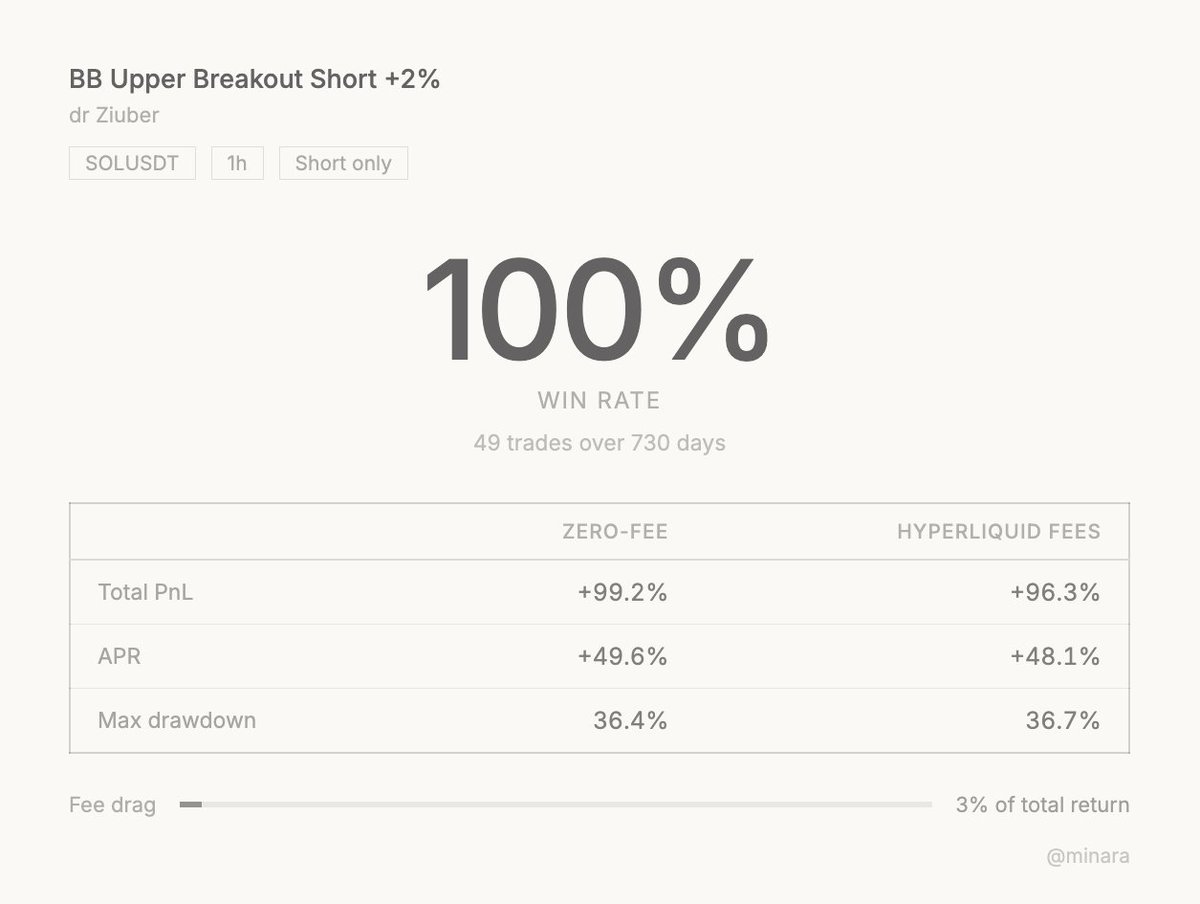
What Minara changed:

  • Added ATR-scaled stop loss: 1.5 × ATR(14). Distance scales with current volatility instead of a fixed percentage.

  • Added ATR-scaled take profit: 3 × ATR(14). A 2:1 reward-to-risk ratio built into every trade.

  • Entry logic: unchanged. The mom0 > 0 and mom1 > 0 condition and the stop=high+mintick pending order stayed verbatim.

That was the entire change. Everything else (momentum calculation, direction, position sizing, long/short symmetry) was preserved.

https://www.tradingview.com/script/J5akHbOr-XRP-Non-Stop-Strategy-TP-25-SL-15/

Caveats

These findings hold under specific conditions. Several of those conditions are worth naming.

Market regime. The backtest window (2016 to 2026 for the longest timeframes, shorter for higher-frequency strategies) was net bullish for crypto. Several Tier 1 strategies are long-only trend followers that benefit directly from sustained upward drift. In a multi-year bear market, most would have different risk profiles and some would fall out of Tier 1.

Asset concentration. The aligned pool skewed toward BTC. ETH, SOL, XRP, BNB, and DOGE strategies are based on smaller samples and may not generalize. Altcoins with different volatility or liquidity profiles were not tested.

Out-of-sample validation. Only one strategy in this article (Rescue 3) was tested on data held out from the tuning process. The remaining results should be read as in-sample: strategy logic was evaluated on the same data used to identify it. The optimization cases in particular carry overfit risk that larger OOS samples would be needed to rule out.

Selection bias, quantified. We tested 236 public PineScript strategies that survived our initial screen (supported symbol, supported timeframe, sufficient kline history). Of those, only 27% passed trade-by-trade replication. Of the 63 that replicated, 57% remained profitable under HyperLiquid fees. The compound probability that a random TV strategy in our population both replicates its own backtest and makes money net of realistic fees is roughly 15%, about one in seven.

Alignment bar choice matters. Moving from ±15% PnL tolerance to trade-by-trade matching dropped our pass rate from roughly 44% to 27%. Different verification standards produce different conclusions. Anywhere in this article we report "aligned", we mean trade-by-trade. Other teams may report higher alignment rates using looser bars; we view that as noise, not signal.

Fee specificity. All real-fee numbers assume HyperLiquid's fee structure (0.015% maker, 0.045% taker). Exchanges with higher taker fees would push more strategies into Tier 3. Zero-fee environments would flip several Tier 3 results back to profitable.

Backtest vs live. These are backtests. Live execution adds latency, partial fills, and order book effects that pure OHLC replay does not capture.

What comes next

The aligned strategy library, dual-fee backtest results, and optimization tools described in this article are all coming to Minara Strategy Studio. We are currently in internal testing. When we launch, access will open in batches starting with users already on the waitlist. ⬇️

https://minara.ai/app/trade/strategy-studio

(Click the input box to sign up.)

As more community strategies emerge, we are planning a "strategy square", where traders can share, discuss, and even earn from your own strategies. Stay tuned. 👀
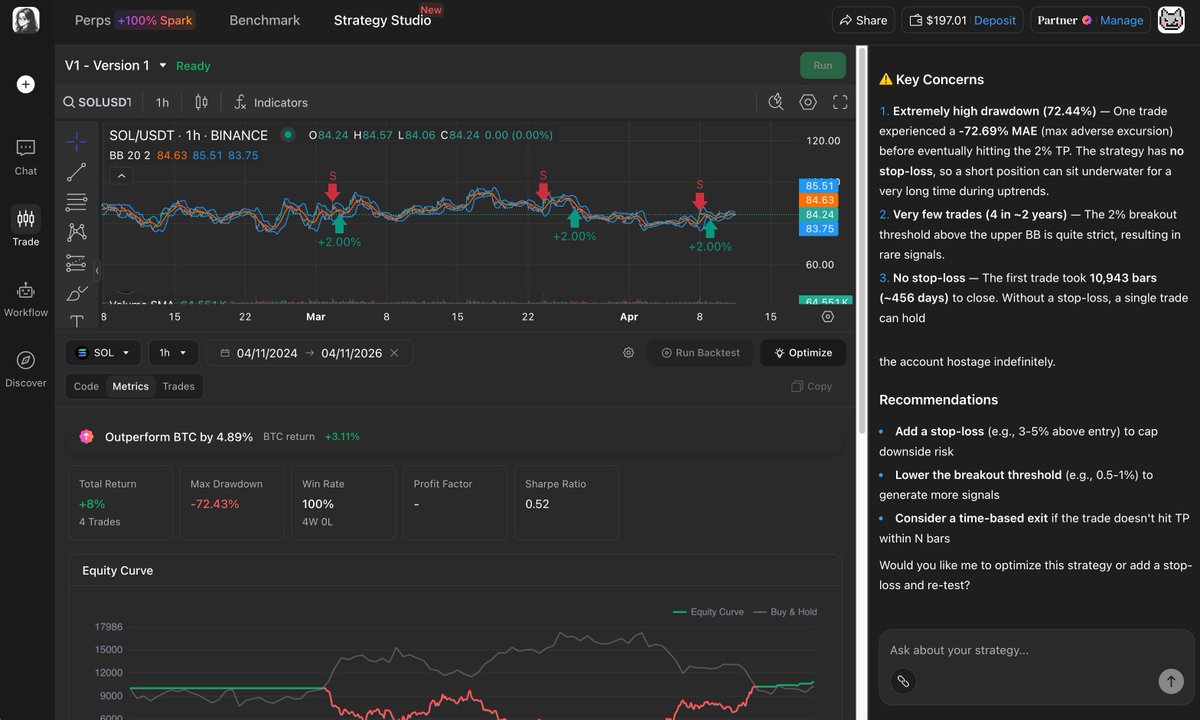
📋 讨论归档

讨论进行中…