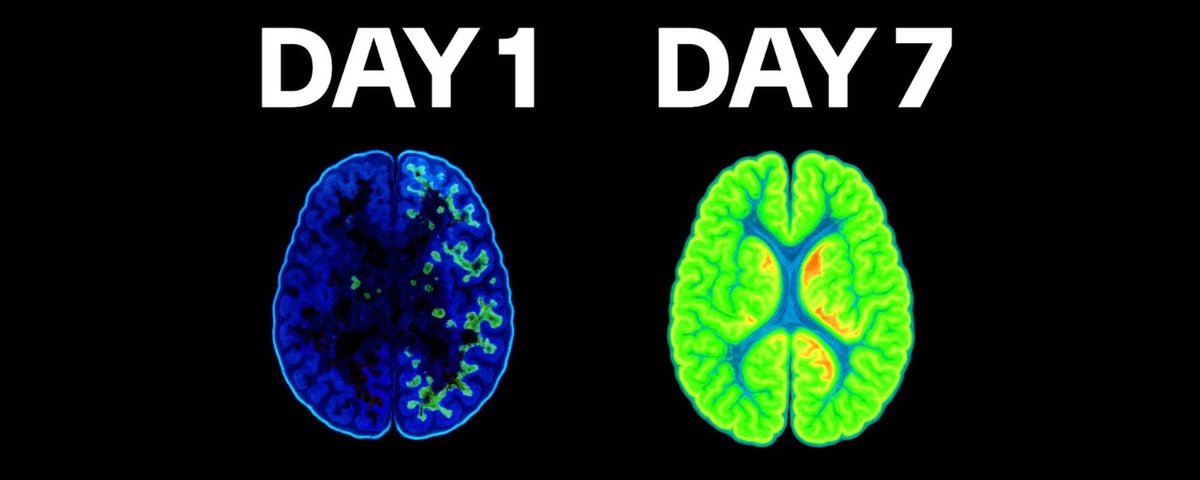
Once a week, for exactly ninety minutes, I sit with a blank sheet of paper and run a simple process. That single ritual does more for my results than the other 40 hours of work that week combined.
In the next few minutes, I'll walk you through the neuroscience behind it and hand you the three-step protocol so precisely you can run it yourself this Sunday.
I. MARCUS' FIVE-YEAR STANDSTILL
When I moved to the States, one of the first friends I made was Marcus. He was 38, a teaching assistant at UCLA, halfway through his PhD.
Every time we grabbed dinner or went for a walk around campus, the PhD came up.
He'd lay the whole thing out - finish the doctorate, get a faculty position, run his own research lab. He had the steps mapped. The timeline was reasonable. He just had to keep going.
Four years later, we were driving up the 405 to a conference. It was early, the freeway was still quiet, and somewhere around Culver City, I asked how the PhD was going.
He leaned back in his seat.
Couple credits this semester. He'd had to take last semester off, you know, life stuff, but he was back on it.
Next year, he was really going to lock in.
I kept my eyes on the road.
I'd heard this before. Not a similar answer. This answer. The same words, in almost the same tone of voice, two years earlier.
Same credits. Same semester off. Same "next year."
I remember thinking: this is the third time he's told me the plan is on track.
And nothing about his situation has changed since the first time.
The problem is - Marcus wasn't lazy. He wasn't coasting.
He could walk you through every step of the plan, and it sounded good every single time he said it.
But the PhD still hadn't moved.
Five years of effort, and he was still standing in exactly the same spot.
II. GOAL DISPLACEMENT: THE SILENT SABOTEUR
What Marcus had run into has a name in the research. Sociologist Robert Michels called it goal displacement - when the process designed to achieve a goal quietly becomes the goal itself.
The means replace the end.
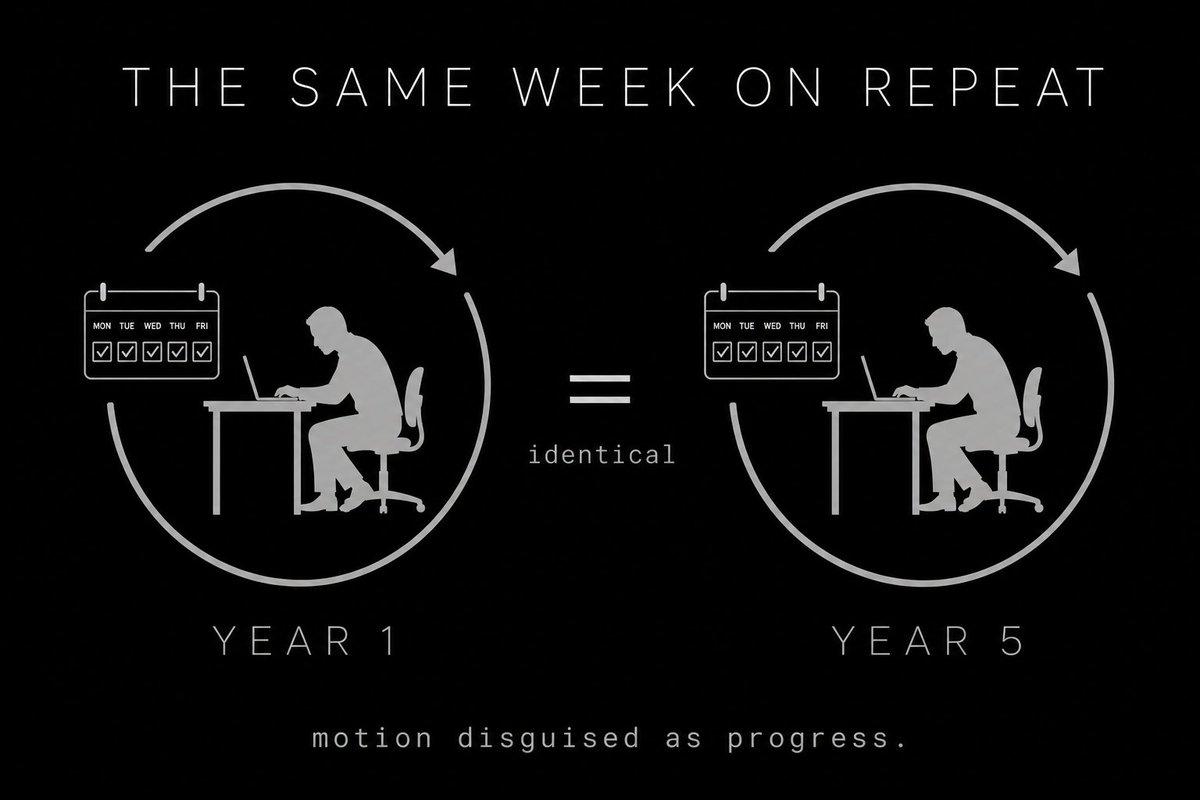
Marcus wasn't pursuing a PhD anymore. He was being a PhD student.
Those are very different things.
You've felt this without naming it. You work hard every day, but at the end of each week, month, or year, you're not as close to your goals as the effort suggests you should be.
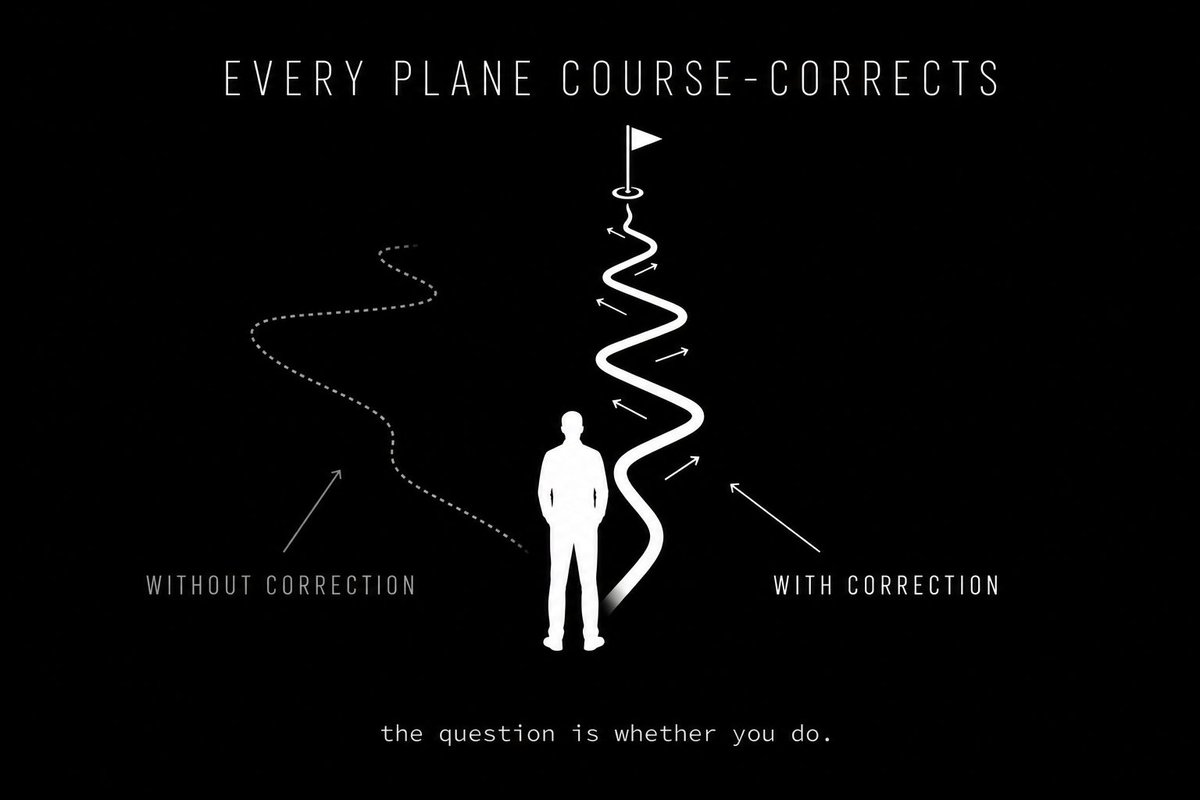
A plane never flies a straight line to its destination. Every second of every flight, wind and turbulence are nudging it off course. The reason it lands where it's supposed to is that the navigation system is course-correcting thousands of times between departure and arrival.
Your goals work the same way. The drift inside your days and weeks is constant and invisible.
The question isn't whether you'll get pulled off course. You will.
The question is whether you have a navigation system that keeps pulling you back, so you land where you intend across years and decades.
Most don't.
And without one, the gap between long-term goals and daily actions quietly widens - until one day you look back and realize you were always moving, but never toward where you actually wanted to go.
What follows is that navigation system - the process that takes your long-term goals and translates them into weekly and daily course-corrections, so that the days you live become a servant to where you want to be a decade ahead.
III. THE FLOW FLYWHEEL
It's called the Flow Flywheel.
The Flow Flywheel is a 90-minute weekly ritual that eliminates goal displacement by ensuring everything you do moves you directly toward your goals.
A flywheel is a mechanical device that stores rotational energy. Once it starts spinning, it builds momentum that makes it easier to keep going.
Your Flow Flywheel works the same way. Each time you spin it, you strengthen the connection between your daily work and your long-term goals.
The Flow Flywheel works by systematically activating one of flow state's most powerful neurological triggers: clear goals.
When your brain has a clearly defined target, the dorsolateral prefrontal cortex, your executive command center, downregulates.
It stops scanning, questioning, and second-guessing, and hands control to the faster, more intuitive networks that drive flow.
When your goals are vague, competing, or disconnected from what you're actually doing today, the prefrontal cortex stays hyperactive. It keeps interrupting with "should I be doing this right now?" and "is this really the best use of my time?"
That internal noise blocks flow state across the week.
The Flow Flywheel eliminates the noise. Your brain stops arbitrating between priorities and starts executing against them.
But there's a second reason this matters more than people realize.
Flow is indiscriminate.
Flow doesn't care what you're flowing toward. You can lock into a state of deep, effortless focus building the business that changes your life - or reorganizing your Google Drive for the third time this month.
Flow feels like progress regardless of whether it is progress. That's what makes it so seductive and so dangerous without direction.
Marcus probably experienced flow while working day to day. But he'd never locked his flow states onto a specific target, week after week, year after year.
The Flow Flywheel prevents this. It doesn't just get you into flow more often. It ensures your flow states are allocated toward the actions that actually move your life forward.
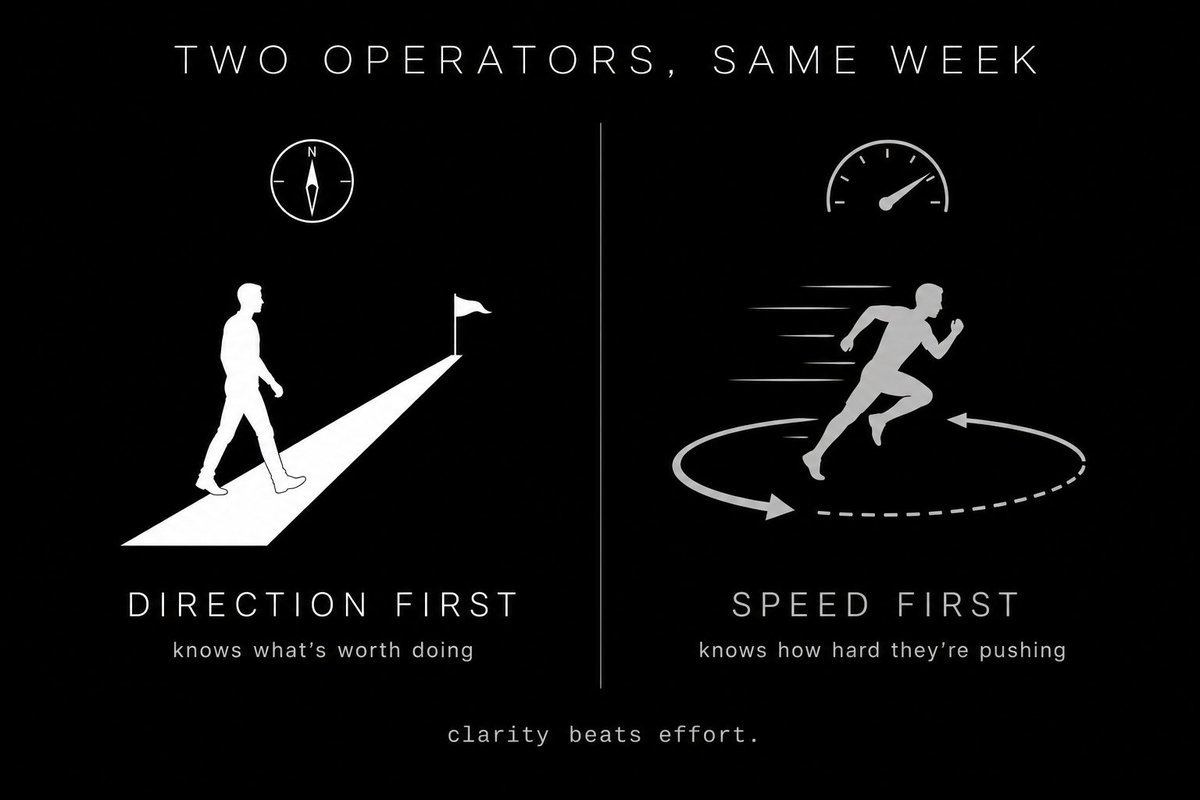
Because when it comes to peak performance, most operators make a fundamental error: they prioritize speed over direction.
They judge their productivity by effort-based metrics - hours worked, tasks completed, mental exhaustion at day's end.
That's a speedometer. It tells you how hard you're pushing. It says nothing about whether you're headed in the right direction.
What you need first is a GPS - a clearly defined destination and a signal showing how far you've moved toward it.
Once your destination is locked in, then speed matters.
Top performers aren't busier. They're clearer. They know exactly what's worth doing - and everything that isn't.
The Flow Flywheel is the GPS that gives you that clarity.
Follow @RianSweetDoris for more content like this.
IV. THE THREE STEPS
The Flow Flywheel has three core steps. Think of them like an airplane's pre-flight sequence:
First, check your destination (review goals). Then plot your flight path (identify dominoes). Then schedule takeoff during ideal weather conditions (allocate flow states to those dominoes).
I'll walk you through each step now.
STEP 1 — REVIEW YOUR GOALS
The first step is to review your goals across every timeframe - yearly, quarterly, monthly, and weekly.
Most operators have big goals floating in their minds without clear connections to their daily action steps. The plan is vague. The week pretends it's executing on it.
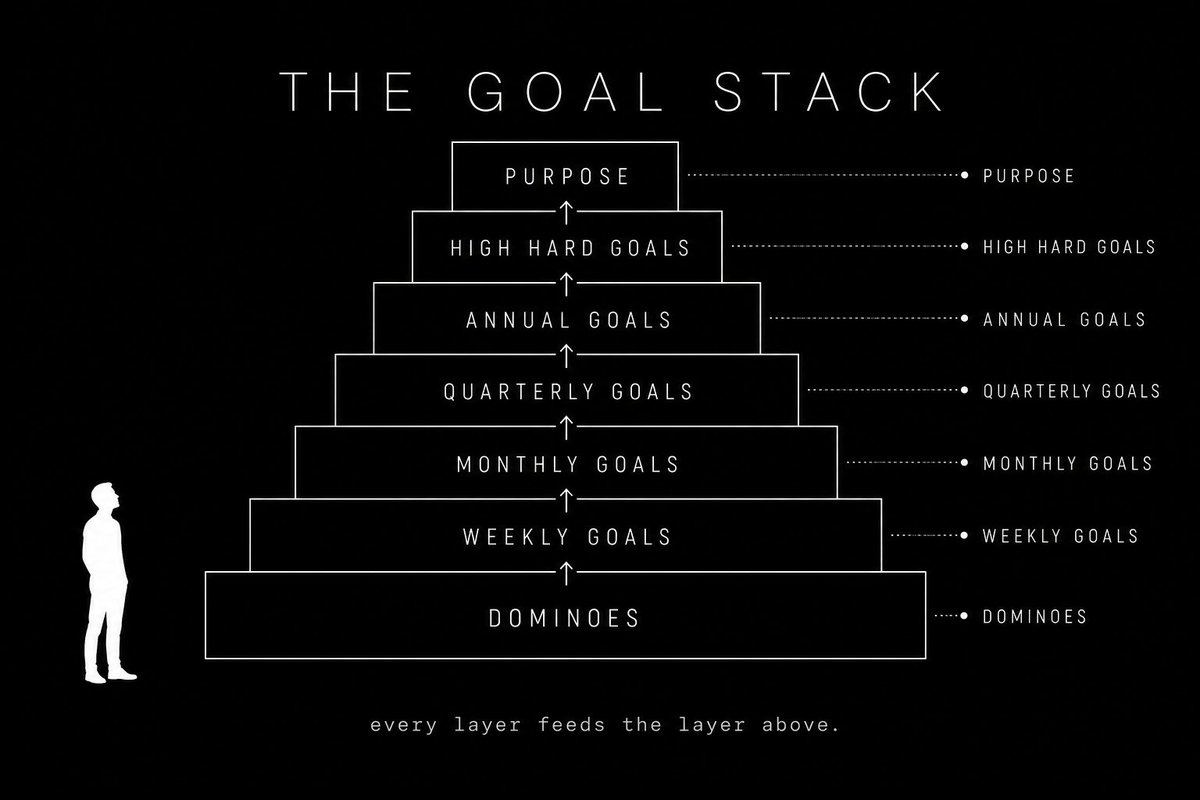
What you want instead is a Goal Stack.
Your Goal Stack is a staircase connecting daily actions directly to your long-term goals. Seven layers, each derived from the layer beneath it:
-
Purpose — the problem you've chosen to solve. The foundation that gives direction to everything above it.
-
High Hard Goals — your ambitious 1-5 year objectives.
-
Annual Goals — high hard goals broken down into one year.
-
Quarterly Goals — annual goals segmented into 90-day milestones.
-
Monthly Goals — the specific outcomes that hit your quarterly targets.
-
Weekly Goals — the actions needed each week to hit the monthly target.
-
Dominoes — the specific tasks that move you toward your goals each day, more than anything else you could do.
EXAMPLE — BUILDING A BUSINESS
If your high hard goal is building a $10M company in three years, this year's goal might be $1M in revenue, this quarter's goal might be launching a new product line, and this month's goal might be completing the prototype.
EXAMPLE — ELON MUSK AND MARS
Musk's stated high hard goal is settling Mars. To get there, fully reusable rockets that slash space travel costs.
Annually, SpaceX advances Starship and Raptor engine production.
Quarterly milestones involve major tests like suborbital flights.
Monthly objectives include assembling Starship prototypes or building multiple Raptor engines.
Weekly actions might be static fire tests or welding components.
Daily tasks are granular - reentry simulations, software tweaks, inspecting parts.
Every layer feeds the layer beneath it. Every action serves the destination.
The power of the Goal Stack is alignment.
When your daily actions directly feed your weekly goals, which feed your monthly goals, which feed your quarterly goals, all the way up, you eliminate goal displacement structurally. There's no room for "motion that isn't progress" because every action is tied to the goal above it.
But the stack only works if you review it every week. Otherwise it ossifies into a document you wrote once and forgot.
THE WEEKLY REVIEW
During your weekly Flow Flywheel session, spend 15 minutes reviewing the entire stack. Three questions:
-
How were my actions from the past week driving me toward my goals
-
What is the gap between what I did and what the goals require?
-
What specific actions this week close that gap?
This reconnection keeps your goals front of mind and prevents the slow drift that becomes goal displacement.
STEP 2 — IDENTIFY YOUR WEEKLY DOMINOES
The second step is identifying your dominoes for the coming week.
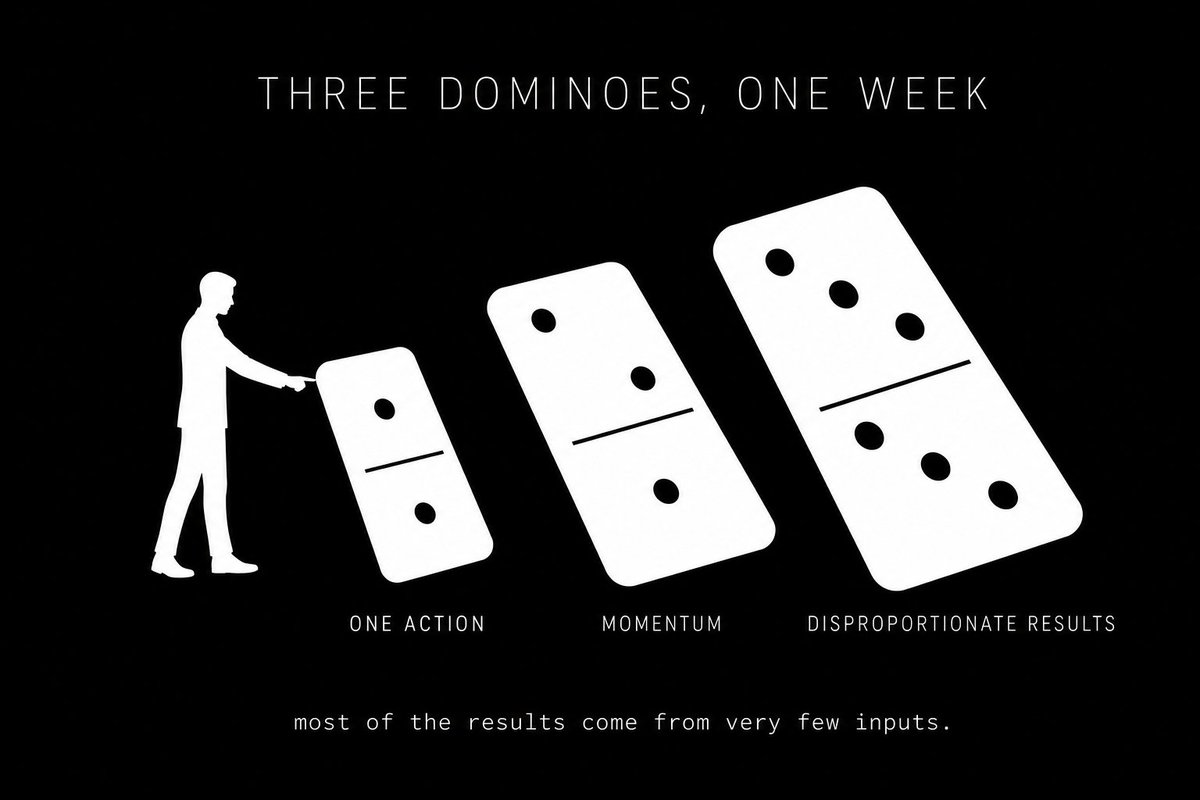
Dominoes are the actions that, if done, move you toward your goals more than anything else conceivable.
A physical domino can knock over another one 1.5 times its size.
The right action this week creates momentum disproportionate to the effort it takes. Only if it's the right action, placed in the right sequence.
Your dominoes aren't everything you could do. They're the few things that make everything else easier, closer, or unnecessary.
Ask: "Which three dominoes, done this week, yank my target closest?"
POWER LAWS, NOT BELL CURVES
Amateurs fail here because they can't identify their dominoes. Their days fill with tasks that feel productive but don't move them toward their long-term goals.
Progress follows power laws, not bell curves. A power law means most of the results come from very few inputs. More extreme than the 80/20 rule. Closer to 5% of your effort creating 95% of your progress.
You spend hours on email, meetings, and busywork. A small handful of activities - closing one important deal, writing one great email, making one critical decision — drives almost all your actual progress.
Those are your dominoes.
HOW TO IDENTIFY THEM
- For each of your goals, ask: "What single action would move this forward most dramatically?"
- Be ruthless about causality - which action will most directly cause the outcome you want?
- Limit yourself to no more than three dominoes per week. Break each domino into three specific tasks per day.
This constraint forces focus. When you can only choose three things, you naturally gravitate toward the highest-impact activities.
EXAMPLE — A PRODUCT LAUNCH
If your goal is to launch a new product, your dominoes for the week might be:
-
Finalize the prototype design
-
Complete the pricing strategy
-
Schedule meetings with key manufacturing partners
That's it. Specific. Causal. Each one directly advances the goal.
THINKING IN CAUSAL CHAINS
One way to train yourself to spot dominoes is to stop thinking in isolated tasks and start thinking in causal chains.
There's a scene in The Avengers where Doctor Strange peers into 14 million possible futures.
When asked how many lead to victory, he replies: "One."
Goal-directedness is spotting the exact actions that lead to your goal among the millions you could take instead.
Every goal is an effect waiting for its causes. When you're highly goal-directed, your brain stops seeing a pile of disconnected tasks and starts seeing a line of dominoes.
You don't just ask, "What's next?" You ask, "What domino knocks down all the rest?"
STEP 3 — THE DAILY FLOW FLYWHEEL
The third step is a daily version of the same ritual. A 15-minute practice at the end of every workday that bridges your weekly planning into daily execution.
I call it the Daily Flow Flywheel.
WHY DAILY MATTERS
Your weekly Flow Flywheel realigns your actions with your goals every seven days. The Daily Flow Flywheel tightens that connection every 24 hours.
Without it, even the best weekly planning loses effectiveness as the days progress.
By Monday evening, your morning clarity has begun to fade. By Wednesday, external demands have started to override your priorities. By Friday, you're back to reacting rather than directing.
The Daily Flow Flywheel interrupts this entropy and keeps your goal connection razor-sharp.
THE FIVE STEPS
First, review your Goal Stack. Pull up your goals document and check today's actions against your long-term objectives. Ask: "Did today's work move me closer to my goals?" This daily compass check prevents the subtle drift that becomes displacement.
Second, identify tomorrow's most critical dominoes. The two or three tasks that most dramatically move your weekly targets forward. By deciding the day before, you eliminate decision fatigue when you sit down to work. You're allocating your flow states in advance.
Third, allocate those dominoes onto your calendar with an estimate of how long each will take. Specific times. Specific durations. Treat them like meetings you can't reschedule.
Fourth, break each action into wildly specific micro-goals. Instead of "work on presentation," write: "open slide deck, add client data to slide 3, create bar chart comparing Q1-Q2 results." These are your clear goals - the quintessential flow trigger.
Fifth, take the first step of the first step. Open the document. Create the folder. Write the first sentence. This removes the psychological barrier to starting tomorrow. When you sit down to work, you'll be continuing rather than beginning - a critical distinction for your brain.
By designing your days this way, you create the conditions for flow to emerge naturally and consistently. The Flow Flywheel stops being a weekly planning session and becomes a continuous system for sustained progress.
V. THE COMPOUNDING EFFECT
The difference between a typical Monday and a Monday after your Flow Flywheel is the difference between driving through a big city with no GPS versus driving with Google Maps running. Radically less time, effort, and headache to reach your destination.
The math makes the ritual a non-negotiable.
Ninety minutes is 3.8% of a 40-hour work week.
When you run the Flow Flywheel properly, those 90 minutes generate the clarity that makes the remaining 96.2% actually count.
Without it, you might work all 40 hours and still make zero meaningful progress on the work that determines whether you hit your goals.
The single highest priority in any week is always running the Flow Flywheel. It's a categorically distinct task - because it governs every other task you do.
VI. YOUR MOVE
I've been spinning my Flow Flywheel for over eleven years. I've reviewed my long-term goals week after week, and I've had to rewrite them multiple times - because each version has come true and the next version had to be bigger.
This week, run the Flow Flywheel for yourself.
Set aside 90 minutes on Sunday or Friday - the two best days I've found to execute this. Review your goals. Identify your dominoes. Schedule them into your week. Then run the 15-minute Daily Flow Flywheel at the end of every workday after that.
The protocol only works if you build the Goal Stack first - every layer feeding the layer beneath it, daily actions tied to the decade ahead.
The years don't have to zip by with your goals unrealized. You don't have to mistake motion for progress.
Your days can finally serve your decades.
Build the bridge between the life you envision and the week you live, so the life you envision becomes the life you live.
If this article resonated, subscribe to my free 30-day email sequence at the link in my bio. And follow @RianSweetDoris on X for more like this.