返回列表
🧠 阿头学

SpaceX 期权上市的“波动率崩塌”陷阱与套利逻辑

本文披着硬核期权分析的外衣贩卖交易课程,其核心假设“内部人利用锁仓漏洞卖出看涨期权”存在致命法律硬伤,但其揭示的“情绪溢价终将向结构性现实回归”这一套利模型依然极具跨界指导价值。
打开原文 ↗

2026-07-08 原文链接 ↗
阅读简报
双语对照
完整翻译
原文
讨论归档

核心观点

  • 锁仓造就衍生品泄洪口: 物理或规则上的禁售(如IPO锁仓)无法消灭资本变现的欲望,只会迫使抛压以“卖出备兑看涨期权”的形式向衍生品市场转移。
  • 散户买梦想,机构卖铲子: 面对自带极强头条效应的巨兽级标的,散户的非理性做多推高了隐含波动率(IV),而机构通过机械性卖出期权精准收割了这部分荒谬的情绪溢价。
  • 波动率崩塌是物理规律: 无论是否存在内部人抛压,极度狂热的超级IPO在度过最初的价格发现期后,其被高估的隐含波动率必然向历史实现波动率发生均值回归。
  • 代理锚定是定价唯一解: 在缺乏历史数据的新兴市场中,寻找最接近的代理标的(如用特斯拉锚定SpaceX)并衡量其偏离倍数,是捕捉均值回归套利空间的唯一量化手段。

跟我们的关联

  • 对 ATou 意味着什么、下一步怎么用:商业模式设计中必须警惕“主通道堵塞-侧通道溢出”效应。下一步在规划产品限制(如防导出、防白嫖)时,必须提前官方布局“期权市场”(如高级API或付费授权),主动承接并收割溢出的需求,而不是把利润让给第三方黑产。
  • 对 Neta 意味着什么、下一步怎么用:市场对新概念(如AI Agent)的Hype周期就是一条高耸的IV曲线。下一步在做海外增长或营销时,绝对不要去赌叙事的最终胜率,而是作为“卖水人”提供确定性工具或服务,直接套利早期的“情绪溢价”。
  • 对 Uota 意味着什么、下一步怎么用:任何狂热事件的定价都存在“叙事波动率”与“实现波动率”的巨大错配。下一步在评估新项目或新资产时,必须强制寻找一个成熟的“代理锚定物”,一旦发现情绪定价偏离基准超过两倍,立刻启动逆向做空机制。

讨论引子

  • 当散户的“Gamma逼空”力量足以打爆做市商时,传统的“波动率均值回归”模型是否已经永久失效?
  • 在AI Agent的商业化落地中,哪些场景属于被高估的“看涨期权”,哪些场景才是真正能产生现金流的“备兑卖出”?

Space Exploration Technologies Corp($SPCX)周五不仅打破了 IPO 纪录簿上的各项纪录,还彻底改写了市场处理超大市值上市公司的规则。

这场历史性 IPO 以固定且不可议价的每股 135 美元定价,惊人地募资了 750 亿美元。周五二级市场交易开启后,股价一开盘就强势上冲,以 150 美元开出,并一路猛涨,首个交易日收于约 160.95 美元。这意味着相较发行价迅速上涨了 20%,从而将其公开市场估值牢牢推至约 1.77 万亿美元这一令人瞠目的水平。

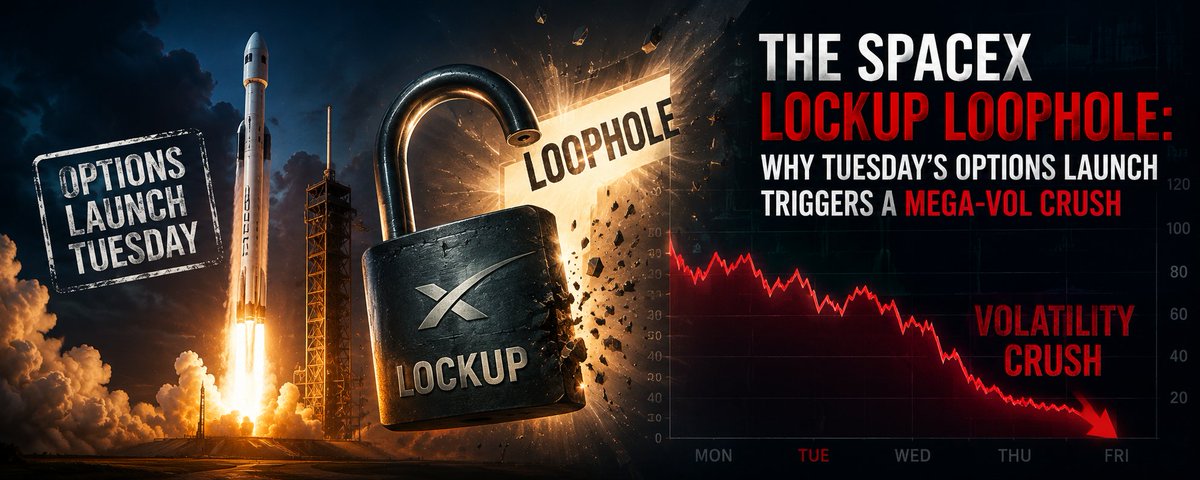
尽管一项刚刚大幅修改并快速推进的指数纳入规则,将迫使被动型 ETF 在本月晚些时候大举买入该股,以将其纳入 Nasdaq-100,但还有一个更具爆发力的微观结构性动力,将在本周二正式启动,那就是:期权链上市。

漏洞所在:把备兑看涨期权变成武器

当一只高 beta 股票以 135 美元定价,却瞬间冲上 160 美元以上时,海量账面财富就会被法律高墙困在里面。机构配置者、早期风投支持者,以及趁机参与 IPO 前投资的买家,手里握有大量股份,但由于严格的 90 天到 180 天锁仓协议,他们在法律上无法把这些股票直接抛向公开市场。他们坐拥巨额财富,却完全暴露在高波动资产的情绪摆布之下,而且他们极度渴望将其变现或加以保护。

这时,锁仓漏洞就出现了。他们不能卖出现货股票,但其中一些人完全可以针对这些持股卖出看涨期权

由于这是一只由散户主导、受头条驱动的巨兽,期权做市商在首日期权链定价时一定会采取防御姿态。为了保护自己,避免遭遇典型散户那种买彩票式的看涨买入冲击,隐含波动率(IV)开盘时轻松就会高于 100%。这意味着期权权利金会贵得离谱。

对内部持有人来说,卖出虚值的上行看涨期权,可以让他们在被锁定的持股上收割年化两位数甚至三位数的收益率。等到周二早晨期权终端一亮起绿色信号,价值数十亿美元的机构备兑覆盖卖出墙,就会猛砸进买价盘,从而立刻对权利金形成结构性的供给冲击。

历史先例:波动率如何被屠杀

这种戏码在过去几次具有时代意义的市场新贵登场时已经上演过。当结构性的备兑卖出供给撞上散户狂热时,隐含波动率会被彻底掏空。

  1. Facebook(FB)—— 2012 年 5 月

当 FB 在 IPO 六天后推出期权时,各大交易台为了防范散户科技狂热,给期权链开出了明显虚高的 IV。近月平值(ATM)隐含波动率开盘时高得惊人,达到 80% 到 85%。在最初 72 小时内,被锁仓持有人发起的机构备兑看涨卖出潮,以极快速度涌入市场,使近月隐含波动率从 85% 压缩到 60% 多的中段。即便标的现货依然成交火热,这也是一次干净利落的 20 个点波动率崩塌。

  1. Coinbase(COIN)—— 2021 年 4 月

Coinbase 在加密狂热高涨之际通过直接上市进入公开市场。其期权上市时,平值 IV 已远远超过 90% 到 95%。由于直接上市没有锁仓,内部人直接把现货股权砸向现货市场,但期权上市同样出现了大规模即时机构备兑卖出,同时散户对看涨期权的需求也迅速降温。最终形成的这场波动率崩塌,在完整的首个期权交易周内就把期权权利金整整砍掉一半,IV 被拖低到 60% 出头,而股价则在横盘偏弱中震荡。

由于 SpaceX 采用的是传统 IPO 结构,内部持有人锁仓在手,账面浮盈巨大,因此卖出备兑的机械性压力会完美复制 Facebook 的模式:现货市场的退出之门被堵死,资金流只能被迫涌向卖出看涨期权。

交易设计:逆着狂热下手

有几种参与方式。

  1. 看涨信用价差:在限定风险下同时做空波动率和现货

面对一只高 IV 股票,第一反应可能是卖出看涨信用价差,比如卖出一张 30 Delta 的看涨期权,再买入一张 15 Delta 的看涨期权作为保护。

由于散户非常渴望用固定权利金来博取上行收益,期权链远端虚值区域会出现严重的上行偏斜。你卖出的看涨期权价格会很贵,但你买入用于保护的那张期权,其 IV 同样也被严重抬高。因此,这类交易的风险回报比未必好看,最好也许是先等股价动能耗尽后再进场。

  1. 直接做空波动率并做 Delta 对冲:隐含波动率与实现波动率之间的套利

拥有结构性资产负债表优势的专业玩家,会通过做裸 Straddle 或直接做空 Strangle 来参与,并把判断锚定在 SpaceX 最接近的代理标的上,也就是 Tesla($TSLA)。Tesla 在高热度环境下的自然实现波动率通常稳定在 50% 到 65% 之间。如果 SpaceX 上市时 IV 达到 110%,那市场定价出来的日波动方差,几乎是 Tesla 自然状态的两倍。把这种原始波动率溢价,直接卖给正在涌入的机构备兑卖出流,就能抓住一个巨大的供需错配。

  1. 看跌蝶式价差:现货下跌,波动率下跌

对于那些想在未来 30 天里,用更省资本的方式表达观点、同时又不承担裸露风险的交易者来说,适合的玩法是虚值看跌蝶式价差

按现货收在约 160.95 美元来算,一个合理的结构也许是使用30 美元宽翼来做空下行波动率:

  • 买入 1 张 150 美元 Put(约 35 Delta)

  • 卖出 2 张 120 美元 Puts(约 15 Delta,也就是这只蝶式的目标腹部)

  • 买入 1 张 90 美元 Put(深度虚值保护)

这笔交易的到期日选择非常关键,因为你需要给市场足够时间,让狂热退潮,也让 ETF 和 NDX 的被动买盘完成兑现。

Space Exploration Technologies Corp ($SPCX) didn't just break the IPO record books on Friday; it completely rewrote the rules for how the market processes mega-cap listings.

Priced at a fixed, non-negotiable $135 per share, the historic IPO raised a staggering $75 billion. When secondary trading kicked off on Friday, the stock exploded right out of the gate, opening at $150 and rallying hard to close its first session around $160.95. That represents a prompt 20% pop from the offering price, cementing a jaw-dropping public market valuation of approximately $1.77 Trillion.

While a newly overhauled, fast-tracked index rule will force passive ETFs to buy massive blocks of the stock to slide it into the Nasdaq-100 later this month, a far more explosive microstructural dynamic goes live this coming Tuesday: The Options Chain Launch.

Space Exploration Technologies Corp($SPCX)周五不仅打破了 IPO 纪录簿上的各项纪录,还彻底改写了市场处理超大市值上市公司的规则。

这场历史性 IPO 以固定且不可议价的每股 135 美元定价,惊人地募资了 750 亿美元。周五二级市场交易开启后,股价一开盘就强势上冲,以 150 美元开出,并一路猛涨,首个交易日收于约 160.95 美元。这意味着相较发行价迅速上涨了 20%,从而将其公开市场估值牢牢推至约 1.77 万亿美元这一令人瞠目的水平。

尽管一项刚刚大幅修改并快速推进的指数纳入规则,将迫使被动型 ETF 在本月晚些时候大举买入该股,以将其纳入 Nasdaq-100,但还有一个更具爆发力的微观结构性动力,将在本周二正式启动,那就是:期权链上市。

The Loophole: Weaponizing Covered Calls

When a high-beta stock prices at $135 and instantly runs past $160, it traps an ocean of paper wealth behind legal walls. Institutional allocators, early venture capital backers, and opportunistic pre-IPO buyers hold a massive supply of shares that they legally cannot dump onto the open market due to strict 90- to 180-day lockup agreements. They are sitting on massive fortunes, completely exposed to the whims of a hyper-volatile asset, and they are gagging to monetize or protect it.

Enter the lockup loophole. They cannot sell the physical stock, but some of them can absolutely sell Call options against it.

Because this is a retail-dominated, headline-driven monster, option market makers are going to price the opening chains defensively. To insulate themselves from standard retail "lottery-ticket" upside call buying, implied volatility (IV) will easily open north of 100%. This means option premiums are going to be obscenely expensive.

For an insider, selling an out-of-the-money upside call allows them to harvest double- or triple-digit annualized yields on their locked-up shares. The moment those option terminals blink green on Tuesday morning, a multi-billion-dollar wall of institutional overwrite selling is going to slam the bid sheets, creating an immediate, structural supply shock to premium.

漏洞所在:把备兑看涨期权变成武器

当一只高 beta 股票以 135 美元定价,却瞬间冲上 160 美元以上时,海量账面财富就会被法律高墙困在里面。机构配置者、早期风投支持者,以及趁机参与 IPO 前投资的买家,手里握有大量股份,但由于严格的 90 天到 180 天锁仓协议,他们在法律上无法把这些股票直接抛向公开市场。他们坐拥巨额财富,却完全暴露在高波动资产的情绪摆布之下,而且他们极度渴望将其变现或加以保护。

这时,锁仓漏洞就出现了。他们不能卖出现货股票,但其中一些人完全可以针对这些持股卖出看涨期权

由于这是一只由散户主导、受头条驱动的巨兽,期权做市商在首日期权链定价时一定会采取防御姿态。为了保护自己,避免遭遇典型散户那种买彩票式的看涨买入冲击,隐含波动率(IV)开盘时轻松就会高于 100%。这意味着期权权利金会贵得离谱。

对内部持有人来说,卖出虚值的上行看涨期权,可以让他们在被锁定的持股上收割年化两位数甚至三位数的收益率。等到周二早晨期权终端一亮起绿色信号,价值数十亿美元的机构备兑覆盖卖出墙,就会猛砸进买价盘,从而立刻对权利金形成结构性的供给冲击。

Historical Precedents: When Vol Gets Slaughtered

We have seen this movie play out during previous generational market arrivals. When structural overwrite supply clashes with retail hype, implied volatility gets completely hollowed out.

  1. Facebook (FB) — May 2012

When FB options launched six days post-IPO, the desks opened the chains with heavily inflated IVs to protect against retail tech-mania. The front-month at-the-money (ATM) implied volatility opened exceptionally high at 80-85%. Within the first 72 hours, the wave of institutional covered-call writing from locked-up holders hit the tape with such velocity that front-month implied volatility compressed from 85% into the mid-60s—a clean 20-point crush even as the underlying spot remained heavily traded.

  1. Coinbase (COIN) — April 2021

Coinbase went public via a direct listing amidst roaring crypto euphoria. Options opened with an ATM IV well past 90-95%. Because a direct listing has no lockups, insiders dumped raw equity straight into the spot market, but the options launch also saw a massive wave of immediate institutional overwriting alongside a fast cooling of retail call demand. The resulting "Vol Crush" cut options premiums clean in half within its first full week of options trading, dragging IV down into the low 60s while the stock chopped sideways-to-down.

Since SpaceX is a traditional IPO structure with locked-up insiders sitting on a massive paper pop, the mechanical pressure to overwrite will mimic the Facebook model perfectly: the spot market exit door is blocked, forcing flow into call selling.

历史先例:波动率如何被屠杀

这种戏码在过去几次具有时代意义的市场新贵登场时已经上演过。当结构性的备兑卖出供给撞上散户狂热时,隐含波动率会被彻底掏空。

  1. Facebook(FB)—— 2012 年 5 月

当 FB 在 IPO 六天后推出期权时,各大交易台为了防范散户科技狂热,给期权链开出了明显虚高的 IV。近月平值(ATM)隐含波动率开盘时高得惊人,达到 80% 到 85%。在最初 72 小时内,被锁仓持有人发起的机构备兑看涨卖出潮,以极快速度涌入市场,使近月隐含波动率从 85% 压缩到 60% 多的中段。即便标的现货依然成交火热,这也是一次干净利落的 20 个点波动率崩塌。

  1. Coinbase(COIN)—— 2021 年 4 月

Coinbase 在加密狂热高涨之际通过直接上市进入公开市场。其期权上市时,平值 IV 已远远超过 90% 到 95%。由于直接上市没有锁仓,内部人直接把现货股权砸向现货市场,但期权上市同样出现了大规模即时机构备兑卖出,同时散户对看涨期权的需求也迅速降温。最终形成的这场波动率崩塌,在完整的首个期权交易周内就把期权权利金整整砍掉一半,IV 被拖低到 60% 出头,而股价则在横盘偏弱中震荡。

由于 SpaceX 采用的是传统 IPO 结构,内部持有人锁仓在手,账面浮盈巨大,因此卖出备兑的机械性压力会完美复制 Facebook 的模式:现货市场的退出之门被堵死,资金流只能被迫涌向卖出看涨期权。

Designing the Trade: Fading the Hype

A few ways to play it.

  1. Call Credit Spreads: Fade Vol and Spot with Defined Risk

Your initial instinct on a high-IV name might be to sell a Call Credit Spread (e.g., selling a 30-delta call and buying a 15-delta call for protection).

Because retail investors are desperate for fixed-premium upside expressions, the outer wings of the options chain will suffer from severe upside skew. You will be selling an expensive call, but also buying an option with an equally over-inflated IV. Therefore, the risk vs reward may not look amazing on these and you may be better off waiting to see the stock run out of momentum before entering.

  1. Short Vol (Delta hedged): The Implied vs. Realized Vol Arbitrage

Professionals with structural balance sheets will attack this by running naked Straddles or Outright Short Strangles, anchoring their view to SpaceX's closest proxy, Tesla ($TSLA). Tesla’s natural high-hype realized volatility typically anchors between 50% and 65%. If SpaceX opens at an IV of 110%, the market is pricing in a daily variance that is nearly double Tesla's natural reality. Selling that raw volatility premium straight into the institutional overwrite flow captures a massive supply-and-demand mismatch.

  1. The Put Butterfly: "Spot Down / Vol Down"

For traders looking for a capital-efficient expression over the next 30 days without naked risk, the play is an Out-of-the-Money Put Butterfly.

With spot closing around $160.95, a sensible structure may be one that utilizes $30 wide wings to get short downside volatility:

  • Buy 1x $150 Put (approx. 35 Delta)

  • Sell 2x $120 Puts (approx. 15 Delta — the target "belly" of the fly)

  • Buy 1x $90 Put (deep OTM protection)

Picking the expiry on this one is key as you need enough time for the hype to fade and the passive buying from ETFs and NDX to play out.

For deeper insights into options positioning and volatility mechanics, watch our FREE masterclass(linked in Bio)

交易设计:逆着狂热下手

有几种参与方式。

  1. 看涨信用价差:在限定风险下同时做空波动率和现货

面对一只高 IV 股票,第一反应可能是卖出看涨信用价差,比如卖出一张 30 Delta 的看涨期权,再买入一张 15 Delta 的看涨期权作为保护。

由于散户非常渴望用固定权利金来博取上行收益,期权链远端虚值区域会出现严重的上行偏斜。你卖出的看涨期权价格会很贵,但你买入用于保护的那张期权,其 IV 同样也被严重抬高。因此,这类交易的风险回报比未必好看,最好也许是先等股价动能耗尽后再进场。

  1. 直接做空波动率并做 Delta 对冲:隐含波动率与实现波动率之间的套利

拥有结构性资产负债表优势的专业玩家,会通过做裸 Straddle 或直接做空 Strangle 来参与,并把判断锚定在 SpaceX 最接近的代理标的上,也就是 Tesla($TSLA)。Tesla 在高热度环境下的自然实现波动率通常稳定在 50% 到 65% 之间。如果 SpaceX 上市时 IV 达到 110%,那市场定价出来的日波动方差,几乎是 Tesla 自然状态的两倍。把这种原始波动率溢价,直接卖给正在涌入的机构备兑卖出流,就能抓住一个巨大的供需错配。

  1. 看跌蝶式价差:现货下跌,波动率下跌

对于那些想在未来 30 天里,用更省资本的方式表达观点、同时又不承担裸露风险的交易者来说,适合的玩法是虚值看跌蝶式价差

按现货收在约 160.95 美元来算,一个合理的结构也许是使用30 美元宽翼来做空下行波动率:

  • 买入 1 张 150 美元 Put(约 35 Delta)

  • 卖出 2 张 120 美元 Puts(约 15 Delta,也就是这只蝶式的目标腹部)

  • 买入 1 张 90 美元 Put(深度虚值保护)

这笔交易的到期日选择非常关键,因为你需要给市场足够时间,让狂热退潮,也让 ETF 和 NDX 的被动买盘完成兑现。

Space Exploration Technologies Corp ($SPCX) didn't just break the IPO record books on Friday; it completely rewrote the rules for how the market processes mega-cap listings.

Priced at a fixed, non-negotiable $135 per share, the historic IPO raised a staggering $75 billion. When secondary trading kicked off on Friday, the stock exploded right out of the gate, opening at $150 and rallying hard to close its first session around $160.95. That represents a prompt 20% pop from the offering price, cementing a jaw-dropping public market valuation of approximately $1.77 Trillion.

While a newly overhauled, fast-tracked index rule will force passive ETFs to buy massive blocks of the stock to slide it into the Nasdaq-100 later this month, a far more explosive microstructural dynamic goes live this coming Tuesday: The Options Chain Launch.

The Loophole: Weaponizing Covered Calls

When a high-beta stock prices at $135 and instantly runs past $160, it traps an ocean of paper wealth behind legal walls. Institutional allocators, early venture capital backers, and opportunistic pre-IPO buyers hold a massive supply of shares that they legally cannot dump onto the open market due to strict 90- to 180-day lockup agreements. They are sitting on massive fortunes, completely exposed to the whims of a hyper-volatile asset, and they are gagging to monetize or protect it.

Enter the lockup loophole. They cannot sell the physical stock, but some of them can absolutely sell Call options against it.

Because this is a retail-dominated, headline-driven monster, option market makers are going to price the opening chains defensively. To insulate themselves from standard retail "lottery-ticket" upside call buying, implied volatility (IV) will easily open north of 100%. This means option premiums are going to be obscenely expensive.

For an insider, selling an out-of-the-money upside call allows them to harvest double- or triple-digit annualized yields on their locked-up shares. The moment those option terminals blink green on Tuesday morning, a multi-billion-dollar wall of institutional overwrite selling is going to slam the bid sheets, creating an immediate, structural supply shock to premium.

Historical Precedents: When Vol Gets Slaughtered

We have seen this movie play out during previous generational market arrivals. When structural overwrite supply clashes with retail hype, implied volatility gets completely hollowed out.

  1. Facebook (FB) — May 2012

When FB options launched six days post-IPO, the desks opened the chains with heavily inflated IVs to protect against retail tech-mania. The front-month at-the-money (ATM) implied volatility opened exceptionally high at 80-85%. Within the first 72 hours, the wave of institutional covered-call writing from locked-up holders hit the tape with such velocity that front-month implied volatility compressed from 85% into the mid-60s—a clean 20-point crush even as the underlying spot remained heavily traded.

  1. Coinbase (COIN) — April 2021

Coinbase went public via a direct listing amidst roaring crypto euphoria. Options opened with an ATM IV well past 90-95%. Because a direct listing has no lockups, insiders dumped raw equity straight into the spot market, but the options launch also saw a massive wave of immediate institutional overwriting alongside a fast cooling of retail call demand. The resulting "Vol Crush" cut options premiums clean in half within its first full week of options trading, dragging IV down into the low 60s while the stock chopped sideways-to-down.

Since SpaceX is a traditional IPO structure with locked-up insiders sitting on a massive paper pop, the mechanical pressure to overwrite will mimic the Facebook model perfectly: the spot market exit door is blocked, forcing flow into call selling.

Designing the Trade: Fading the Hype

A few ways to play it.

  1. Call Credit Spreads: Fade Vol and Spot with Defined Risk

Your initial instinct on a high-IV name might be to sell a Call Credit Spread (e.g., selling a 30-delta call and buying a 15-delta call for protection).

Because retail investors are desperate for fixed-premium upside expressions, the outer wings of the options chain will suffer from severe upside skew. You will be selling an expensive call, but also buying an option with an equally over-inflated IV. Therefore, the risk vs reward may not look amazing on these and you may be better off waiting to see the stock run out of momentum before entering.

  1. Short Vol (Delta hedged): The Implied vs. Realized Vol Arbitrage

Professionals with structural balance sheets will attack this by running naked Straddles or Outright Short Strangles, anchoring their view to SpaceX's closest proxy, Tesla ($TSLA). Tesla’s natural high-hype realized volatility typically anchors between 50% and 65%. If SpaceX opens at an IV of 110%, the market is pricing in a daily variance that is nearly double Tesla's natural reality. Selling that raw volatility premium straight into the institutional overwrite flow captures a massive supply-and-demand mismatch.

  1. The Put Butterfly: "Spot Down / Vol Down"

For traders looking for a capital-efficient expression over the next 30 days without naked risk, the play is an Out-of-the-Money Put Butterfly.

With spot closing around $160.95, a sensible structure may be one that utilizes $30 wide wings to get short downside volatility:

  • Buy 1x $150 Put (approx. 35 Delta)

  • Sell 2x $120 Puts (approx. 15 Delta — the target "belly" of the fly)

  • Buy 1x $90 Put (deep OTM protection)

Picking the expiry on this one is key as you need enough time for the hype to fade and the passive buying from ETFs and NDX to play out.

For deeper insights into options positioning and volatility mechanics, watch our FREE masterclass(linked in Bio)

📋 讨论归档

讨论进行中…