返回列表
🧠 阿头学 · 🪞 Uota学 · 💬 讨论题

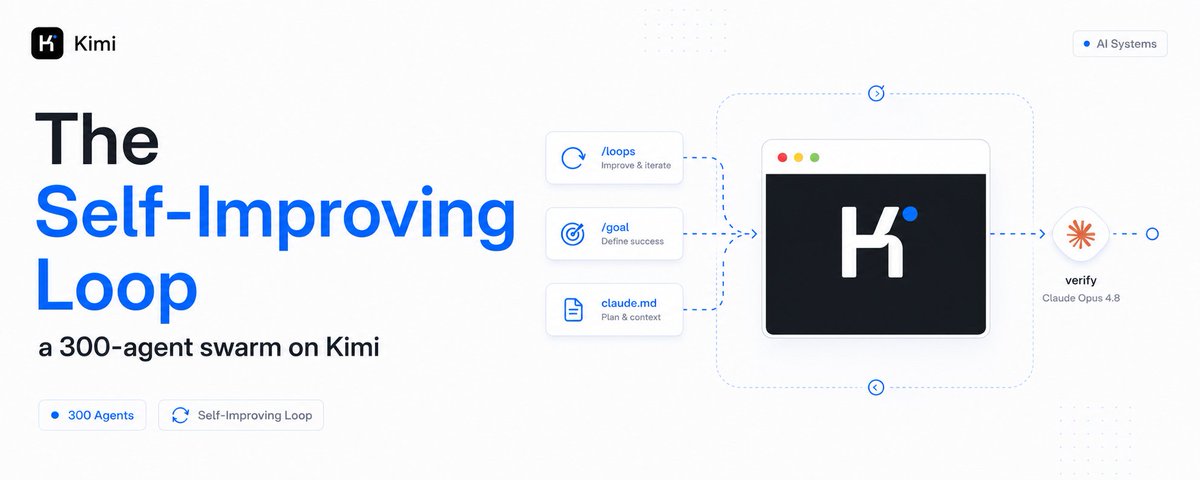
自我进化的闭环:Kimi 上的 300 智能体群

本文披着虚构模型(Opus 4.8)和伪开源(Kimi)的营销外衣,却极其精准地揭示了“廉价算力并发+昂贵模型质检”的非对称AI工程套利本质。
打开原文 ↗

2026-07-08 原文链接 ↗
阅读简报
双语对照
完整翻译
原文
讨论归档

核心观点

  • 非对称双模型架构:用极低成本的Kimi做300并发穷举,用高逻辑的Opus做结果质检,这种算力套利打破了“高质量必高成本”的死结。
  • 用Spec取代Prompt:放弃许愿式提示词,通过强制定义交付物格式、边界锁和冲突熔断机制,将大模型当做需要微观验收的外包团队而非全能神。
  • 系统级复利而非模型进化:大模型本身没有记忆,真正的护城河是将验证环节的纠错反馈沉淀为外部约束文件(Skill),实现边际成本从20分钟坍塌至30秒。
  • 独立上下文防污染:将长任务拆解为短而专的子任务,给每个智能体分配独立收口的上下文,是防止大模型长文本降智的结构性诀窍。

跟我们的关联

  • 对 ATou 意味着什么、下一步怎么用:个人工作流的护城河不在于追逐最新模型,而在于建立专属的“错误档案库”,下一步应把日常重复任务的纠错记录固化为系统提示词中的SOP约束文档。
  • 对 Uota 意味着什么、下一步怎么用:AI应用的核心壁垒是“资产化”而非“对话框”,下一步在设计产品时,必须强制要求用户定义结构化输出(如40页PDF+2万行CSV),用精确的交付物倒逼模型的执行质量。
  • 对 ATou/Uota 意味着什么、下一步怎么用:算力套利时代已经到来,下一步应停止用单一昂贵模型跑全流程,改用“便宜模型做发散+顶级模型做收敛”的Maker-Checker架构降低综合试错成本。

讨论引子

  • 随着长文本模型(如Gemini 1.5 Pro)原生能力的提升,“拆解为300个短上下文智能体”的复杂架构是否会被“单模型超长上下文”直接降维打击?
  • 当系统累积的约束规则(CONSTRAINTS.md)越来越长,如何解决大模型在长系统提示词下的“注意力丢失(Lost in the middle)”问题?

一个免费的开源模型,只靠一条提示词,就能驱动 300 个并行智能体,完成 4,000 个协同步骤,而且在真实研究任务上的表现,比那些价格高出 5 倍的模型还更好。

大多数人甚至从没真正打开过它。

他们打开 Kimi,输入一个问题,拿到答案,关掉标签页。这只是聊天框。它能用。但那大概只占这个产品能力的 10%。

大多数人真正跳过的是这一部分:

这个智能体群不只是跑得快。只要用对了,它每次都会留下点东西。可能是一个可复用的技能,更锋利的 spec,或者一条约束,防止下一次运行重犯今天的错误。

昨天替你跑任务的那群智能体,应该比今天这一群更聪明。

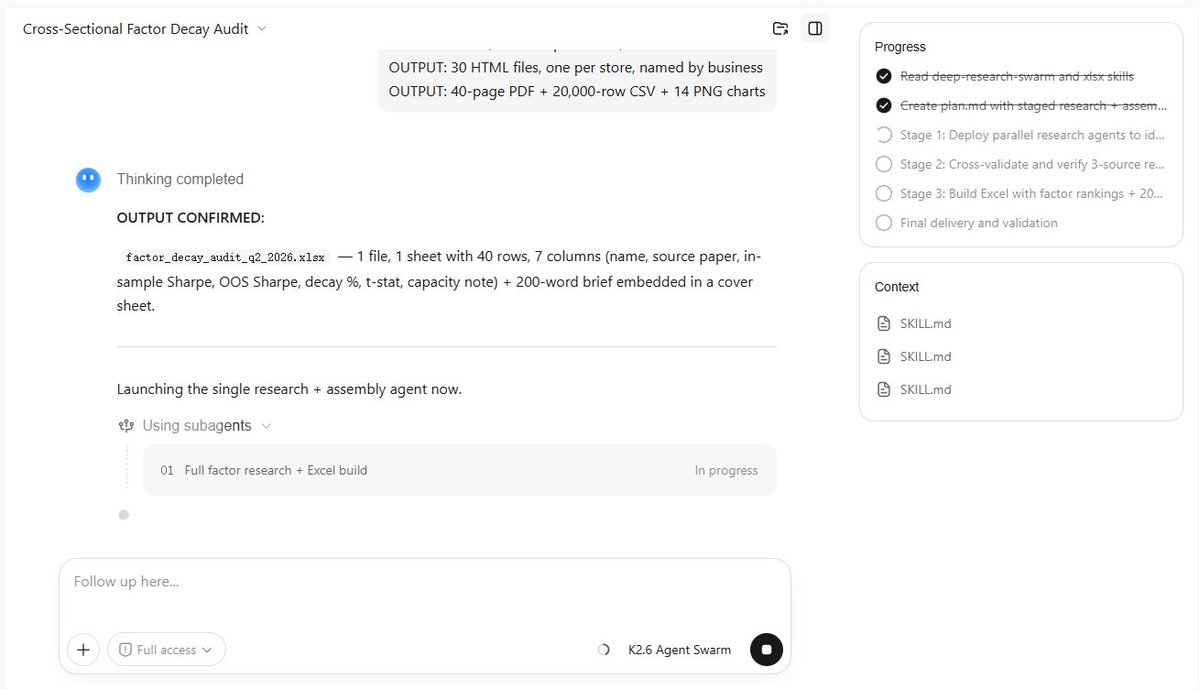
OUTPUT: [file type] / [count] / [naming] / [format detail]

# strong examples:
OUTPUT: 1 .xlsx, one row per model, + 200-word brief
OUTPUT: 30 HTML files, one per store, named by business
OUTPUT: 40-page PDF + 20,000-row CSV + 14 PNG charts

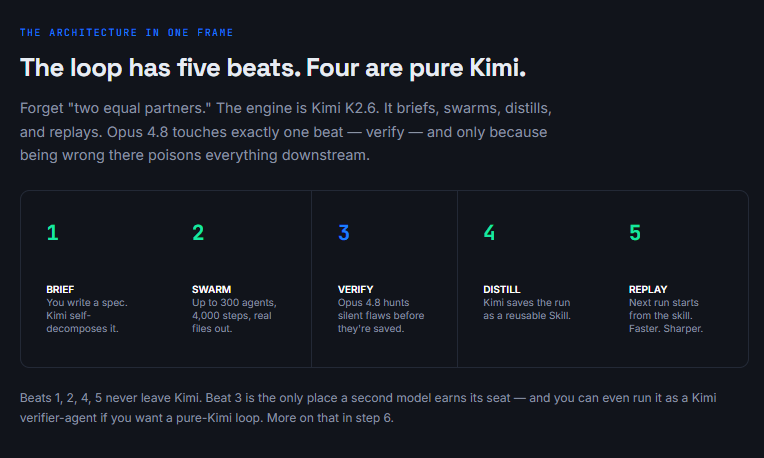
这就是闭环。 Kimi 负责干活,也负责学习。Opus 4.8 守在其中一个关口,也就是验证关,它唯一的职责就是阻止垃圾被保存成技能。引擎负责学习,守门员负责保证它不自欺。

有些人选定一个模型就一条路走到黑。有些人追着排行榜顶端跑。还有些人接上 LangGraph,然后花整个周末去调一张 DAG。

结果通常都一样。一个工作流,跑到第 50 次时,做的事和第 1 次一模一样。

这里不是这样。这里给出的是一整套会不断复利的智能体群打法。10 个步骤。每一条提示词都能直接复制粘贴。每一个数字都经过验证。

第一部分,先把这个闭环搭一次。之后就一直用下去。

01. 写 spec,不要写 prompt

大多数人一听到 300 个智能体,就会甩出一句话,比如 研究健身 App 市场,然后指望它产出惊艳结果。这是烧钱最快、产出垃圾也最快的方式。

一行提示词,等于把所有决定权都交给智能体群,而它大概率会决定错。

把智能体群当成承包方,不要当成神灯。spec 要定义清楚收集什么,什么算有效,允许哪些来源,输出格式具体是什么,出现冲突时怎么处理。大多数人会跳过的关键点在于,Kimi 会自己决定任务拆解方式。

你不用像在 CrewAI 里那样手工搭智能体,不用像 LangGraph 那样去接图,也不用像 AutoGen 那样定义结构。你只需要描述目标,智能体群会自己搭出组织结构图。

spec 是整个闭环里杠杆最高的产物,因为到了第 4 步,它会变成你可复用技能的种子。

# CONSTRAINTS.md — loaded automatically
- every claimed figure must trace to a primary source or be flagged
- no silent conflict resolution — surface contradictions
- [rule distilled from last run's Opus feedback]
- [the mistake you never want repeated]
Scope-lock: do not touch anything outside the spec's SCOPE block.
02. 花钱之前,先看任务拆解方案

这是新手最常跳过的一步,也是跳过后代价最高的一步。

提交 spec 之后,Kimi 会在正式运行前先给出执行方案,也就是会用多少子智能体,每个负责什么,依赖顺序是什么,步骤预算是多少。

看它。一场拆错了的 200 智能体运行,浪费的是真金白银和真时间。检查方案本身不花钱。你要看三件事。它有没有理解范围,智能体数量对这个任务规模来说是否合理,输出方案是不是你真正需要的东西。

有个细节值得知道。4,000 步是指 整个智能体群的总协同步骤预算,不是每个智能体 4,000 步。一次 300 智能体的运行,平均每个大约 13 步,也就是短而专的子任务。这能帮助你判断你的任务是否适合这种形状。

Execute the spec end to end.
Parallelize wherever the plan allows.
Report progress every 30 steps.
Flag any blocker immediately — do not work around it silently.
If a sub-agent stalls >10 min, reassign or report.
Merge everything into the OUTPUT defined in the spec.

一行提示词是愿望。spec 是命令。智能体群执行的是命令。

03. 让它浪费一点,这正是重点

现在开始运行。最多 300 个子智能体会分波并行启动。第一波处理那些完全独立的子任务。

随着结果回流,编排器会继续发起下一波,去处理依赖这些结果的任务,直到整张依赖图被跑完。

每个子智能体都在自己受限的上下文窗口里工作。这就是结构上的诀窍。单个智能体处理长任务时,会不断塞满自己的窗口,直到被淹没,开始做有损摘要,而之后的每一步推理都会越来越差。

智能体群给每个子任务分配独立且收口的上下文,所以回到协调器手里的,只有结构化输出。这就是为什么它在那些能把单个智能体拖垮的任务上也不会崩。

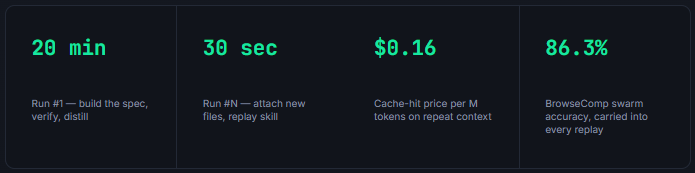
因为 Kimi 的价格是输入每百万 token 0.95 美元,输出每百万 token 4.00 美元,而命中缓存时只要 0.16 美元,所以你完全可以把第一次尝试直接扔掉,再跑一遍。廉价的大规模运行,会改变你愿意尝试什么。

Run the saved skill "[name]" on these new inputs.
Apply CONSTRAINTS.md. Use the captured output format.
[attach new files]
Report only deviations from the skill's expected shape.
04. 要真实文件,不要聊天框里的回答

智能体群的输出,不该是窗口里的一段文字。它应该是能直接进入你工作流的结构化交付物。而这一点,恰恰是大多数文章都没讲到的。

一次运行,就能产出 PDF、表格、数据集、幻灯片和可运行代码,而且都来自同一次启动,因为 Kimi 原生就支持生成这些格式。

所以 spec 一开始就要先写输出。

一份全面的报告,会给智能体留出提前收工的空间。一份 40 页 PDF 加一个 20,000 行的 CSV 再加 14 张可直接导出的 PNG 图表,才会给它们一个必须达到的质量目标。

差别就在输出层面的具体程度。
05. 把诚实的模型对准输出,问它哪里错了

这里是唯一不由 Kimi 来做的环节。这个智能体群有个已知缺点。如果你不明确要求验证,它会产出自信满满但引用不足的结论,而不同子智能体之间有时还会互相矛盾。看起来完成了,和真的正确了,是完全不同的两回事。

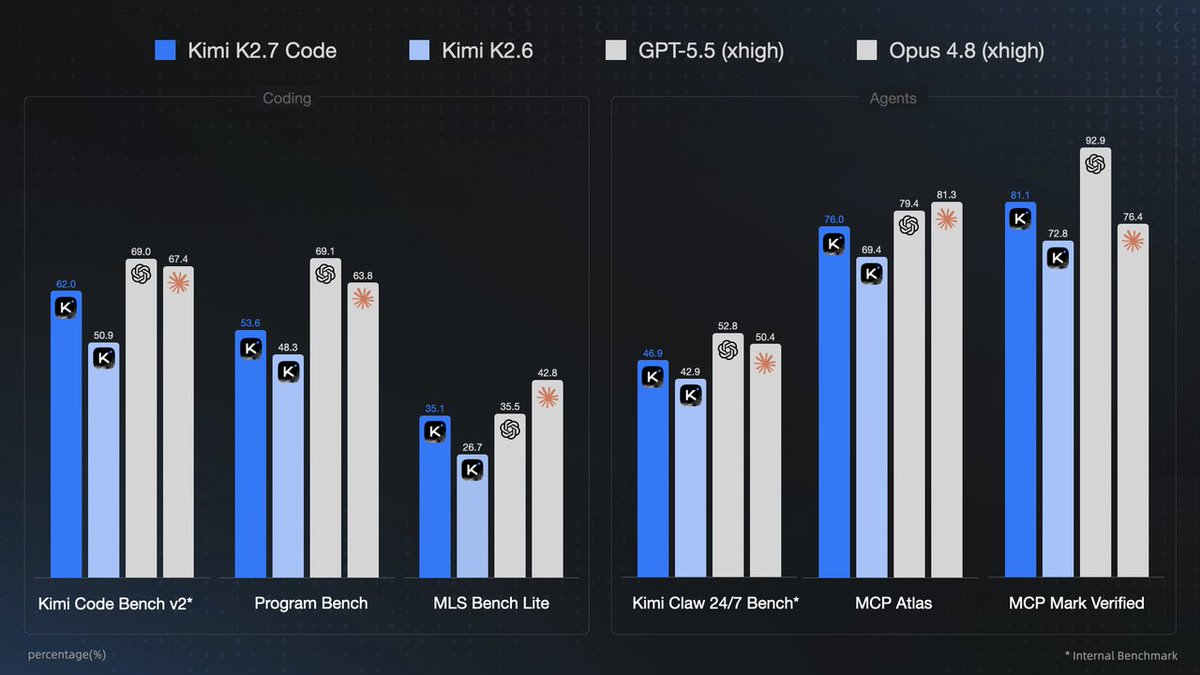
Opus 4.8 正好就是为这个关口而生的。Anthropic 报告说,和 4.7 相比,它 放过自身代码缺陷且不加指出的概率大约低了 4 倍,而且它是第一个在不加批判地报告有缺陷结果这一项上拿到 0% 的 Claude。

它在这里的唯一职责就是反驳,不是夸奖。你花高价 token 不是为了让它生成内容,而是为了在第 4 步把某个悄无声息的错误永久存成技能之前,把它揪出来。
只有当有可靠的东西在检查结果时,廉价的大规模运行才是真正的超能力。验证关必须保留。

Show me the proposed decomposition before running:
- how many sub-agents, and what each one handles
- the dependency order (what blocks what)
- estimated step budget
- where the biggest quality-drop risk sits
Do NOT execute yet. Wait for my confirmation.

06. 把整个工作流保存成一个 Skill

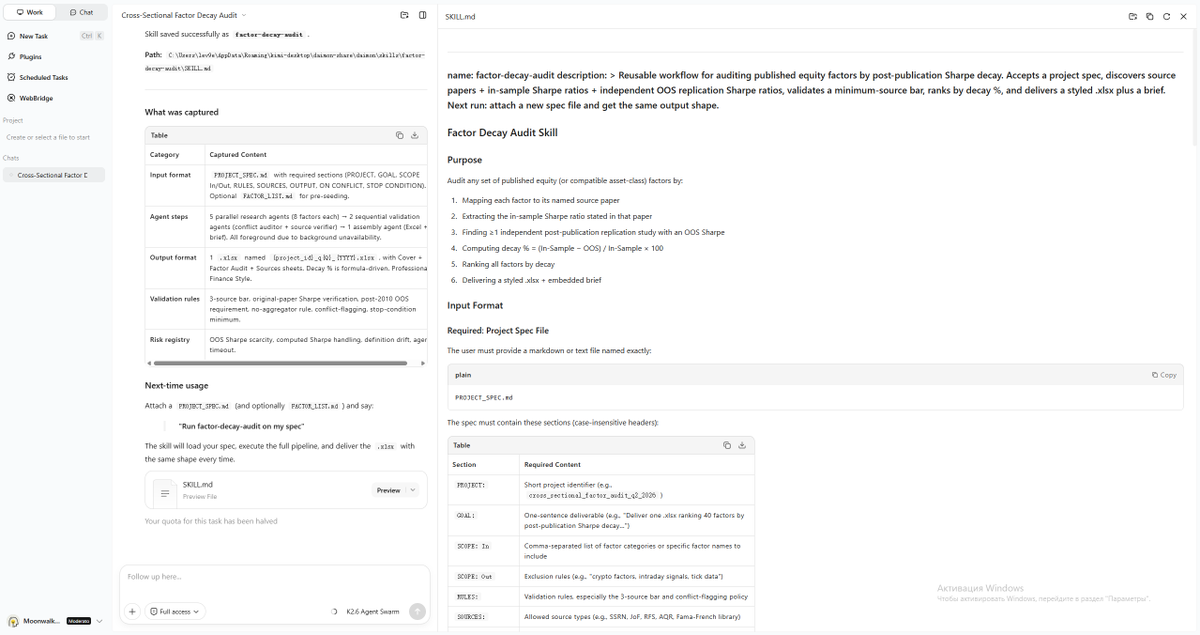
这一步,才让这个闭环真正具备自我进化能力。遇到你还会重复跑的任务,就让 Kimi 把整个工作流保存成可复用的 Skill,里面包括输入格式、智能体步骤和输出格式。

第一次运行要 20 分钟。之后每次再跑,只要 30 秒。

这才是自学习这个词更诚实的版本。模型本身并不会在你的多次运行之间重新训练权重。

真正变聪明的是 围绕它的系统。你的技能库会随着每个项目一起增长,而之后每一次智能体群运行,都会自动套用这些技能。

竞争对手没法在一周内复制这套技能库。它是由你几个月真实运行积累出来的。
Save this entire workflow as a reusable Skill: "[name]"
Capture:
- input format (what files / spec shape it expects)
- the agent steps that worked
- the output format and naming convention
- the validation rules from the spec
Next time I run this, I attach new files and get the same shape.
07. 把你自己的文档喂进去,作为智能体群的知识

Skill 保存的是 流程。Document-to-Skill 保存的是 领域。把你最好的作品上传进去,比如一份成交提案、一份打磨好的报告、一套演示文稿,Kimi 会提取其中的结构和风格指纹,把它保存成一个技能,之后每一次智能体群运行都会自动套用。

真正开始复利的地方就在这里。你喂进去的每一份 PDF、逐字稿或表格,都会变成 300 个并行智能体共同依赖的上下文依据,而不是让它们退回去依赖通用训练数据。

你喂得越多,后面每一次运行就越准确。报告会越来越不像通用 AI 产物,而越来越像 你的 作品。

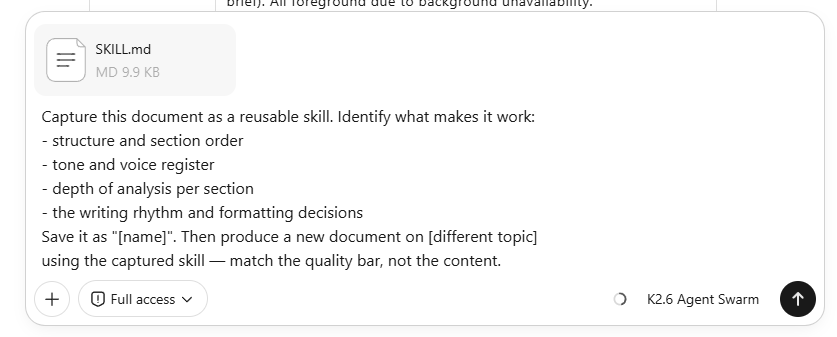
Capture this document as a reusable skill. Identify what makes it work:
- structure and section order
- tone and voice register
- depth of analysis per section
- the writing rhythm and formatting decisions
Save it as "[name]". Then produce a new document on [different topic]
using the captured skill — match the quality bar, not the content.

08. 把验证反馈变成永久规则

第 5 步只能抓住一次错误。第 8 步要确保这个错误以后再也不会出现。把 Opus 给出的修正清单拿过来,不要只是补当前输出,而是把经验直接写进项目级约束文件里,让 Kimi 在每次会话开始时自动读取。

这就是闭环从自己的失败里学习。Opus 在第 1 次运行里指出的偏差,会在第 2 次运行里变成一条硬规则。

跑过几个项目之后,你的约束文件会逐渐变成一份会自我执行的活文档,而验证关每次要抓的问题也会越来越少。

09. 用新输入重放这个技能,看着成本一路塌下来

现在回到真正的回报。第 2 次运行不再从零开始。它从你在第 6 到第 8 步里搭好的 Skill、智能体群知识和约束文件起步。

同样的工作流,新文件,更少的准备工作。

到了这里,复利就不再只是个流行词,而是会直接出现在账单上。第一轮竞品监控,需要完整的 spec 和一次验证流程。

到了第四轮,只需要拿保存好的 Skill,给它一个 30 秒提示词就够了。而且输出会更锋利,因为它继承了前几次运行里所有修正。
第一轮 20 分钟。第五十轮 30 秒。这个差距,就是为什么你要搭一个闭环,而不是只写一条提示词。

10. 把这个闭环升级成后台智能体

最后一步。一旦某个闭环稳定下来,并且已经由技能支撑,就别再手动启动它了。

把触发条件交给 Kimi,比如一个时间计划、新文件落地、某个竞争对手的定价页面,让它主动跑完整个闭环,只把交付物和差异浮出来给你看。

竞品监控就是最干净的例子。

第 1 次运行,你亲手搭建,亲手验证。等它变成后台智能体之后,它就会每周并行检查所有竞争对手,再把简报丢进你的收件箱,而边际时间成本为零。

到最后,人类在这个闭环里只剩下两件事。提出问题。基于答案做决定。

# PROJECT: [name]
GOAL: [one sentence — the deliverable, not the topic]
SCOPE: [what's in, what's explicitly out]
RULES: [validation — what counts as a verified row/finding]
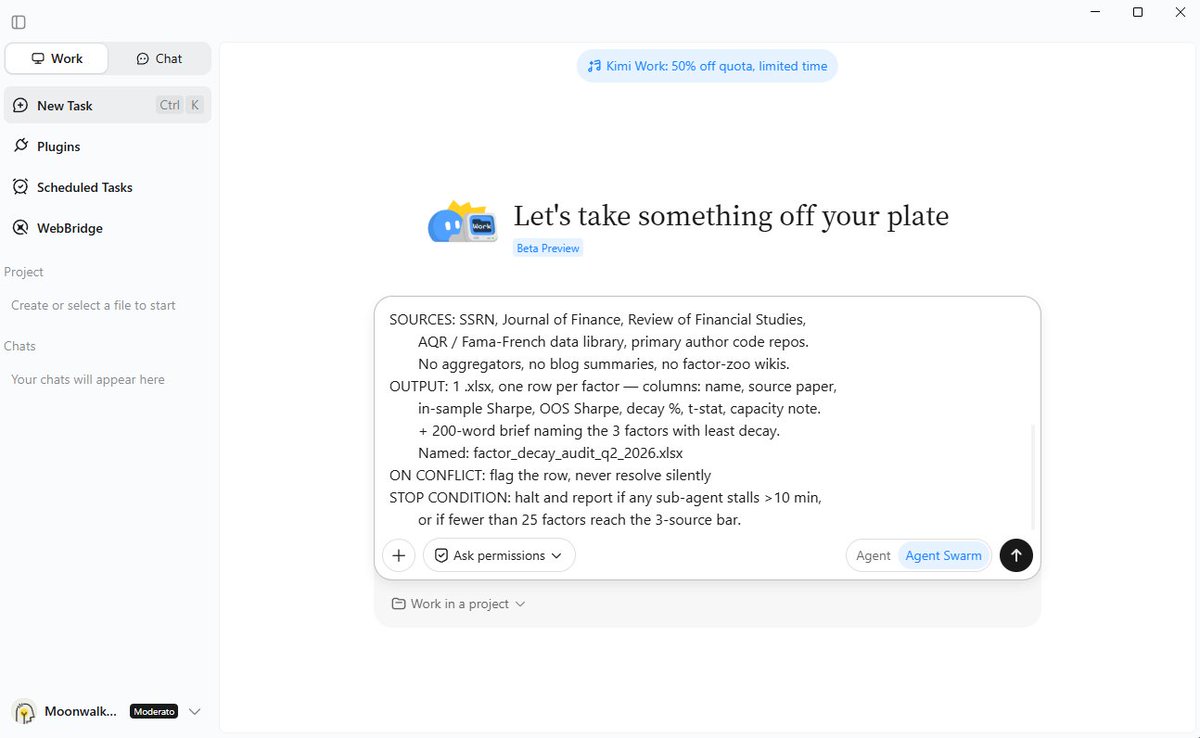
SOURCES: [official posts, papers, primary only — no aggregators]
OUTPUT: [file type / count / naming / format details]
ON CONFLICT: flag the row, never resolve silently
STOP CONDITION: [when to halt and report instead of guessing]
Run skill "[name]" on a weekly schedule.
Trigger: [schedule / new file / monitored URL]
On each run: execute the swarm, apply CONSTRAINTS.md,
verify, then deliver the OUTPUT + a diff vs last run.
Only ping me if a deviation crosses [threshold].

结语

当那些封闭实验室还在一个接一个地发布更聪明的聊天机器人时,一个开源模型已经在并行驱动 300 个智能体,而且你每让它跑一次,它都在系统层面变得更聪明。

这种轮廓,我们已经见过一次了。一个开放发布,重新定义了封闭前沿原本以为自己独占的东西,整个领域一夜之间开始重新校准。DeepSeek 就是这样。

一个建立在开放权重模型上的自学习智能体群,也有同样的形状。

那些还在争论到底哪个模型赢了的人,回答的是一个已经不再重要的问题。

现在真正的问题不是哪个模型最聪明,而是你一次能跑多少个,谁在检查它们的工作,以及你的这套系统今天是否比昨天更锋利。

大多数人读完这些,还是会继续把 Kimi 当聊天框用。少数人会在这周把这个闭环搭起来。第一次运行要 20 分钟。之后的每一次运行,都会变成你真正拥有的杠杆。

把它搭起来。验证它。提炼它。然后看着它每跑一次,就更便宜一点,也更锋利一点。

A free open-source model is running 300 parallel agents across 4,000 coordinated steps from a single prompt, and it scores higher on real research tasks than models you pay 5x more for.

一个免费的开源模型,只靠一条提示词,就能驱动 300 个并行智能体,完成 4,000 个协同步骤,而且在真实研究任务上的表现,比那些价格高出 5 倍的模型还更好。

Most people have never opened it.

大多数人甚至从没真正打开过它。

They open Kimi, type a question, get an answer, close the tab. That's the chatbox. It works. It's also about 10% of what the product does.

他们打开 Kimi,输入一个问题,拿到答案,关掉标签页。这只是聊天框。它能用。但那大概只占这个产品能力的 10%。

**Here's the part most people skip: **

大多数人真正跳过的是这一部分:

The swarm doesn't just run fast. Run it right and it leaves something behind every time - a reusable skill, a sharper spec, a constraint that stops the next run from repeating today's mistake.

这个智能体群不只是跑得快。只要用对了,它每次都会留下点东西。可能是一个可复用的技能,更锋利的 spec,或者一条约束,防止下一次运行重犯今天的错误。

The swarm that ran your task yesterday should be smarter than the one running it today.

昨天替你跑任务的那群智能体,应该比今天这一群更聪明。

OUTPUT: [file type] / [count] / [naming] / [format detail]

# strong examples:
OUTPUT: 1 .xlsx, one row per model, + 200-word brief
OUTPUT: 30 HTML files, one per store, named by business
OUTPUT: 40-page PDF + 20,000-row CSV + 14 PNG charts
OUTPUT: [file type] / [count] / [naming] / [format detail]

# strong examples:
OUTPUT: 1 .xlsx, one row per model, + 200-word brief
OUTPUT: 30 HTML files, one per store, named by business
OUTPUT: 40-page PDF + 20,000-row CSV + 14 PNG charts

That's the loop. Kimi does the work and the learning. Opus 4.8 sits at one gate - the verify gate - and its only job is to stop garbage from getting saved as a skill. The engine learns. The closer keeps it honest.

这就是闭环。 Kimi 负责干活,也负责学习。Opus 4.8 守在其中一个关口,也就是验证关,它唯一的职责就是阻止垃圾被保存成技能。引擎负责学习,守门员负责保证它不自欺。

Some people pick one model and marry it. Some chase the top benchmark line. Others wire up LangGraph and spend a weekend debugging a DAG.

有些人选定一个模型就一条路走到黑。有些人追着排行榜顶端跑。还有些人接上 LangGraph,然后花整个周末去调一张 DAG。

The result is usually the same: a workflow that does the exact same thing on run #50 as it did on run #1.

结果通常都一样。一个工作流,跑到第 50 次时,做的事和第 1 次一模一样。

This is not that. This is the complete playbook for a swarm that compounds. 10 steps. Every prompt is copy-paste. Every number is verified.

这里不是这样。这里给出的是一整套会不断复利的智能体群打法。10 个步骤。每一条提示词都能直接复制粘贴。每一个数字都经过验证。

Part 1 - Build the loop once. Run it forever.

第一部分,先把这个闭环搭一次。之后就一直用下去。

01. Write a spec, not a prompt

01. 写 spec,不要写 prompt

When most people hear "300 agents" they fire off a one-liner -"research the fitness app market" - and expect brilliance. That's the fastest way to burn credits and get junk.

大多数人一听到 300 个智能体,就会甩出一句话,比如 研究健身 App 市场,然后指望它产出惊艳结果。这是烧钱最快、产出垃圾也最快的方式。

A one-line prompt gives the swarm permission to decide everything, and it will decide wrong.

一行提示词,等于把所有决定权都交给智能体群,而它大概率会决定错。

Treat the swarm like a contractor, not a genie. A spec defines what to collect, what counts as valid, which sources are allowed, the exact output format, and what to do on conflict. Here's the part most people skip: Kimi decides the decomposition itself.

把智能体群当成承包方,不要当成神灯。spec 要定义清楚收集什么,什么算有效,允许哪些来源,输出格式具体是什么,出现冲突时怎么处理。大多数人会跳过的关键点在于,Kimi 会自己决定任务拆解方式。

You don't build the agents like you would in CrewAI, you don't wire the graph like LangGraph, you don't define structure like AutoGen. You describe the goal - the swarm builds the org chart.

你不用像在 CrewAI 里那样手工搭智能体,不用像 LangGraph 那样去接图,也不用像 AutoGen 那样定义结构。你只需要描述目标,智能体群会自己搭出组织结构图。

The spec is the single highest-leverage artifact in the whole loop, because in step 4 it becomes the seed of your reusable skill.

spec 是整个闭环里杠杆最高的产物,因为到了第 4 步,它会变成你可复用技能的种子。

# CONSTRAINTS.md — loaded automatically
- every claimed figure must trace to a primary source or be flagged
- no silent conflict resolution — surface contradictions
- [rule distilled from last run's Opus feedback]
- [the mistake you never want repeated]
Scope-lock: do not touch anything outside the spec's SCOPE block.
# CONSTRAINTS.md — loaded automatically
- every claimed figure must trace to a primary source or be flagged
- no silent conflict resolution — surface contradictions
- [rule distilled from last run's Opus feedback]
- [the mistake you never want repeated]
Scope-lock: do not touch anything outside the spec's SCOPE block.

02. Read the decomposition plan before you spend a cent

02. 花钱之前,先看任务拆解方案

This is the step first-timers skip, and it's the most expensive one to skip.

这是新手最常跳过的一步,也是跳过后代价最高的一步。

After you submit the spec, Kimi shows you the execution plan before it runs - how many sub-agents, what each handles, the dependency order, the step budget.

提交 spec 之后,Kimi 会在正式运行前先给出执行方案,也就是会用多少子智能体,每个负责什么,依赖顺序是什么,步骤预算是多少。

Read it. A 200-agent swarm decomposed wrong costs real money and real hours. Checking the plan costs nothing. You're looking for three things: does it understand the scope, is the agent count sane for the task size, and does the output plan match what you actually need.

看它。一场拆错了的 200 智能体运行,浪费的是真金白银和真时间。检查方案本身不花钱。你要看三件事。它有没有理解范围,智能体数量对这个任务规模来说是否合理,输出方案是不是你真正需要的东西。

One detail worth knowing: the 4,000 steps is a total coordinated budget across the swarm, not 4,000 steps per agent. A 300-agent run averages ~13 steps each - short, specialized subtasks. That tells you whether your task fits the shape.

有个细节值得知道。4,000 步是指 整个智能体群的总协同步骤预算,不是每个智能体 4,000 步。一次 300 智能体的运行,平均每个大约 13 步,也就是短而专的子任务。这能帮助你判断你的任务是否适合这种形状。

Execute the spec end to end.
Parallelize wherever the plan allows.
Report progress every 30 steps.
Flag any blocker immediately — do not work around it silently.
If a sub-agent stalls >10 min, reassign or report.
Merge everything into the OUTPUT defined in the spec.
Execute the spec end to end.
Parallelize wherever the plan allows.
Report progress every 30 steps.
Flag any blocker immediately — do not work around it silently.
If a sub-agent stalls >10 min, reassign or report.
Merge everything into the OUTPUT defined in the spec.

A one-line prompt is a wish. A spec is an order. The swarm executes orders.

一行提示词是愿望。spec 是命令。智能体群执行的是命令。

03. Let it be wasteful - that's the point

03. 让它浪费一点,这正是重点

Now you run it. Up to 300 sub-agents fire in parallel waves. The first wave handles fully independent subtasks.

现在开始运行。最多 300 个子智能体会分波并行启动。第一波处理那些完全独立的子任务。

As results land, the orchestrator launches the next wave on whatever depended on them, until the dependency graph resolves.

随着结果回流,编排器会继续发起下一波,去处理依赖这些结果的任务,直到整张依赖图被跑完。

Each sub-agent works in its own bounded context window. That's the structural trick: a single agent on a long task fills its window until it drowns and starts lossy summarization, and every reasoning step after that gets worse.

每个子智能体都在自己受限的上下文窗口里工作。这就是结构上的诀窍。单个智能体处理长任务时,会不断塞满自己的窗口,直到被淹没,开始做有损摘要,而之后的每一步推理都会越来越差。

The swarm gives each subtask its own scoped context, so only structured output flows back to the coordinator. That's why it doesn't collapse on tasks that break a single agent.

智能体群给每个子任务分配独立且收口的上下文,所以回到协调器手里的,只有结构化输出。这就是为什么它在那些能把单个智能体拖垮的任务上也不会崩。

Because Kimi runs at $0.95/M in and $4.00/M out - with cache hits at $0.16 - you can afford to throw the first attempt away and run it again. Cheap volume changes what you're willing to attempt.

因为 Kimi 的价格是输入每百万 token 0.95 美元,输出每百万 token 4.00 美元,而命中缓存时只要 0.16 美元,所以你完全可以把第一次尝试直接扔掉,再跑一遍。廉价的大规模运行,会改变你愿意尝试什么。

Run the saved skill "[name]" on these new inputs.
Apply CONSTRAINTS.md. Use the captured output format.
[attach new files]
Report only deviations from the skill's expected shape.
Run the saved skill "[name]" on these new inputs.
Apply CONSTRAINTS.md. Use the captured output format.
[attach new files]
Report only deviations from the skill's expected shape.

04. Demand real files, not a chat answer

04. 要真实文件,不要聊天框里的回答

The output of a swarm is not text in a window. It's structured deliverables that go straight into your work - and this is the part most articles miss.

智能体群的输出,不该是窗口里的一段文字。它应该是能直接进入你工作流的结构化交付物。而这一点,恰恰是大多数文章都没讲到的。

One run lands PDFs, spreadsheets, datasets, slide decks, and working code, all from a single launch, because Kimi emits those formats natively.

一次运行,就能产出 PDF、表格、数据集、幻灯片和可运行代码,而且都来自同一次启动,因为 Kimi 原生就支持生成这些格式。

So lead the spec with the output, always.

所以 spec 一开始就要先写输出。

"A comprehensive report" gives agents permission to stop early. "A 40-page PDF + one CSV with 20,000 rows + 14 export-ready PNG charts" gives them a quality target to hit.

一份全面的报告,会给智能体留出提前收工的空间。一份 40 页 PDF 加一个 20,000 行的 CSV 再加 14 张可直接导出的 PNG 图表,才会给它们一个必须达到的质量目标。

Specificity at the output level is the difference.

差别就在输出层面的具体程度。

05. Point the honest model at the output and ask what's wrong

05. 把诚实的模型对准输出,问它哪里错了

Here's the one beat that isn't Kimi. The swarm's known flaw: unless you explicitly demand verification, it produces confident, under-cited claims, and independent sub-agents sometimes contradict each other. "Looks done" and "is correct" are different planets.

这里是唯一不由 Kimi 来做的环节。这个智能体群有个已知缺点。如果你不明确要求验证,它会产出自信满满但引用不足的结论,而不同子智能体之间有时还会互相矛盾。看起来完成了,和真的正确了,是完全不同的两回事。

Opus 4.8 is built for exactly this gate. Anthropic reports it's roughly 4x less likely than 4.7 to let a flaw in its own code pass unremarked, and it's the first Claude to score 0% on uncritically reporting flawed results.

Opus 4.8 正好就是为这个关口而生的。Anthropic 报告说,和 4.7 相比,它 放过自身代码缺陷且不加指出的概率大约低了 4 倍,而且它是第一个在不加批判地报告有缺陷结果这一项上拿到 0% 的 Claude。

Its only job here is to refute, not to praise. You're not paying premium tokens to generate - you're paying them to catch the silent flaw before step 4 saves it into a skill forever.

它在这里的唯一职责就是反驳,不是夸奖。你花高价 token 不是为了让它生成内容,而是为了在第 4 步把某个悄无声息的错误永久存成技能之前,把它揪出来。

Cheap volume is only a superpower when something trustworthy is checking the work. Keep the verify gate.

只有当有可靠的东西在检查结果时,廉价的大规模运行才是真正的超能力。验证关必须保留。

Show me the proposed decomposition before running:
- how many sub-agents, and what each one handles
- the dependency order (what blocks what)
- estimated step budget
- where the biggest quality-drop risk sits
Do NOT execute yet. Wait for my confirmation.
Show me the proposed decomposition before running:
- how many sub-agents, and what each one handles
- the dependency order (what blocks what)
- estimated step budget
- where the biggest quality-drop risk sits
Do NOT execute yet. Wait for my confirmation.

06. Save the whole workflow as a Skill

06. 把整个工作流保存成一个 Skill

This is the beat that makes the loop self-improving. After a run you'll repeat, tell Kimi to capture the entire workflow as a reusable Skill - input format, agent steps, output format.

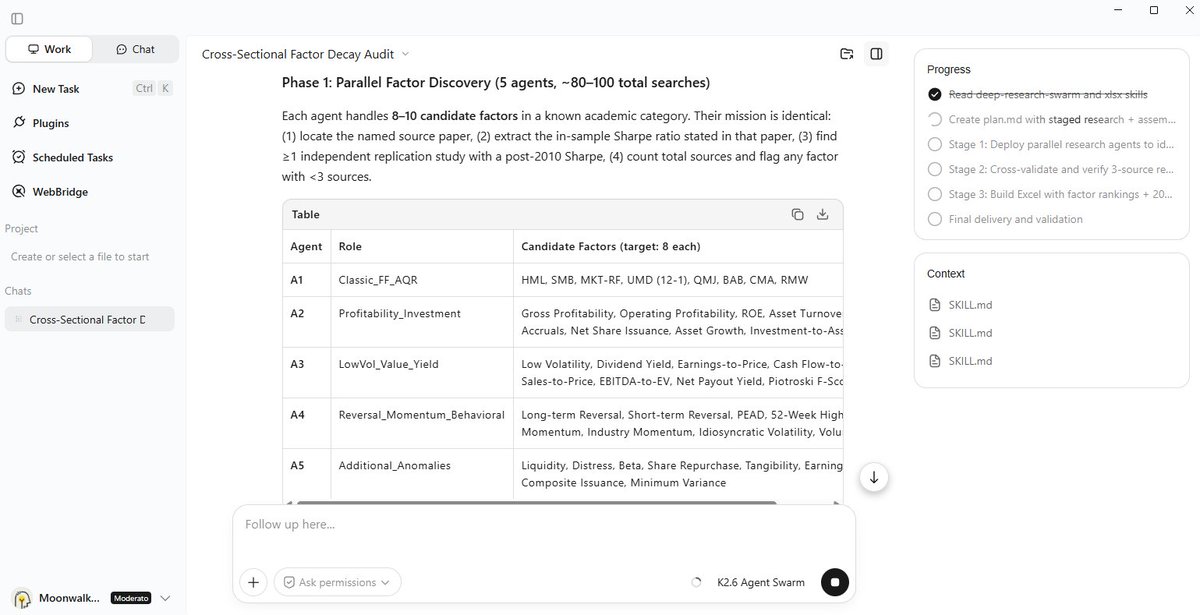
这一步,才让这个闭环真正具备自我进化能力。遇到你还会重复跑的任务,就让 Kimi 把整个工作流保存成可复用的 Skill,里面包括输入格式、智能体步骤和输出格式。

The first run takes 20 minutes. Every run after it takes 30 seconds.

第一次运行要 20 分钟。之后每次再跑,只要 30 秒。

That's the honest version of "self-learning." The model isn't retraining its weights between your runs.

这才是自学习这个词更诚实的版本。模型本身并不会在你的多次运行之间重新训练权重。

The system around it is getting smarter - your skill library grows with every project, and every future swarm applies those skills automatically.

真正变聪明的是 围绕它的系统。你的技能库会随着每个项目一起增长,而之后每一次智能体群运行,都会自动套用这些技能。

A competitor can't copy that library in a week. It's built from months of your real runs.

竞争对手没法在一周内复制这套技能库。它是由你几个月真实运行积累出来的。

Save this entire workflow as a reusable Skill: "[name]"
Capture:
- input format (what files / spec shape it expects)
- the agent steps that worked
- the output format and naming convention
- the validation rules from the spec
Next time I run this, I attach new files and get the same shape.
Save this entire workflow as a reusable Skill: "[name]"
Capture:
- input format (what files / spec shape it expects)
- the agent steps that worked
- the output format and naming convention
- the validation rules from the spec
Next time I run this, I attach new files and get the same shape.

07. Feed your own documents in as swarm knowledge

07. 把你自己的文档喂进去,作为智能体群的知识

Skills capture process. Document-to-Skill captures domain. Upload your best work - a closed-deal proposal, a polished report, a deck - and Kimi captures its structural and stylistic fingerprint as a skill every future swarm applies automatically.

Skill 保存的是 流程。Document-to-Skill 保存的是 领域。把你最好的作品上传进去,比如一份成交提案、一份打磨好的报告、一套演示文稿,Kimi 会提取其中的结构和风格指纹,把它保存成一个技能,之后每一次智能体群运行都会自动套用。

Here's where it compounds: every PDF, transcript, or spreadsheet you feed in becomes context that all 300 parallel agents can ground against, instead of falling back on general training data.

真正开始复利的地方就在这里。你喂进去的每一份 PDF、逐字稿或表格,都会变成 300 个并行智能体共同依赖的上下文依据,而不是让它们退回去依赖通用训练数据。

The more you feed it, the more accurate every subsequent run becomes. Reports stop reading like generic AI and start reading like your work.

你喂得越多,后面每一次运行就越准确。报告会越来越不像通用 AI 产物,而越来越像 你的 作品。

Capture this document as a reusable skill. Identify what makes it work:
- structure and section order
- tone and voice register
- depth of analysis per section
- the writing rhythm and formatting decisions
Save it as "[name]". Then produce a new document on [different topic]
using the captured skill — match the quality bar, not the content.
Capture this document as a reusable skill. Identify what makes it work:
- structure and section order
- tone and voice register
- depth of analysis per section
- the writing rhythm and formatting decisions
Save it as "[name]". Then produce a new document on [different topic]
using the captured skill — match the quality bar, not the content.

08. Turn the verify feedback into a permanent rule

08. 把验证反馈变成永久规则

Step 5 catches a flaw once. Step 8 makes sure the swarm never makes it again. Take Opus's fix list and don't just patch the output - bake the lesson into a project-level constraints file Kimi reads automatically at the start of every session.

第 5 步只能抓住一次错误。第 8 步要确保这个错误以后再也不会出现。把 Opus 给出的修正清单拿过来,不要只是补当前输出,而是把经验直接写进项目级约束文件里,让 Kimi 在每次会话开始时自动读取。

This is the loop learning from its own failures. The drift that Opus flagged on run #1 becomes a hard rule on run #2.

这就是闭环从自己的失败里学习。Opus 在第 1 次运行里指出的偏差,会在第 2 次运行里变成一条硬规则。

Over a few projects, your constraints file turns into living documentation that enforces itself - and the verify gate has less and less to catch each time.

跑过几个项目之后,你的约束文件会逐渐变成一份会自我执行的活文档,而验证关每次要抓的问题也会越来越少。

09. Replay the skill on new inputs - watch the cost collapse

09. 用新输入重放这个技能,看着成本一路塌下来

Now the payoff. Run #2 doesn't start from zero. It starts from the skill, the swarm knowledge, and the constraints file you built in steps 6–8.

现在回到真正的回报。第 2 次运行不再从零开始。它从你在第 6 到第 8 步里搭好的 Skill、智能体群知识和约束文件起步。

Same workflow, new files, a fraction of the setup.

同样的工作流,新文件,更少的准备工作。

This is where "compounding" stops being a buzzword and shows up on the invoice. The first competitive-monitoring run takes a full spec and a verify pass.

到了这里,复利就不再只是个流行词,而是会直接出现在账单上。第一轮竞品监控,需要完整的 spec 和一次验证流程。

The fourth one is a 30-second prompt against the saved skill, and the output is sharper because it inherits every fix from the runs before it.

到了第四轮,只需要拿保存好的 Skill,给它一个 30 秒提示词就够了。而且输出会更锋利,因为它继承了前几次运行里所有修正。
20 minutes on run one. 30 seconds on run fifty. That gap is the whole reason to build a loop instead of a prompt.

第一轮 20 分钟。第五十轮 30 秒。这个差距,就是为什么你要搭一个闭环,而不是只写一条提示词。

10. Promote the loop to a background agent

10. 把这个闭环升级成后台智能体

The final move: once a loop is stable and skill-backed, you stop launching it by hand.

最后一步。一旦某个闭环稳定下来,并且已经由技能支撑,就别再手动启动它了。

Point Kimi at the trigger - a schedule, a new file drop, a competitor's pricing page - and let it run the whole loop proactively, surfacing only the deliverable and the deviations.

把触发条件交给 Kimi,比如一个时间计划、新文件落地、某个竞争对手的定价页面,让它主动跑完整个闭环,只把交付物和差异浮出来给你看。

Competitive monitoring is the clean example.

竞品监控就是最干净的例子。

Run #1 you build and verify by hand. By the time it's a background agent, it's checking every competitor in parallel weekly and dropping a brief in your inbox at zero marginal time cost.

第 1 次运行,你亲手搭建,亲手验证。等它变成后台智能体之后,它就会每周并行检查所有竞争对手,再把简报丢进你的收件箱,而边际时间成本为零。

The only human left in the loop is the question you set and the decision you make on the answer.

到最后,人类在这个闭环里只剩下两件事。提出问题。基于答案做决定。

# PROJECT: [name]
GOAL: [one sentence — the deliverable, not the topic]
SCOPE: [what's in, what's explicitly out]
RULES: [validation — what counts as a verified row/finding]
SOURCES: [official posts, papers, primary only — no aggregators]
OUTPUT: [file type / count / naming / format details]
ON CONFLICT: flag the row, never resolve silently
STOP CONDITION: [when to halt and report instead of guessing]
# PROJECT: [name]
GOAL: [one sentence — the deliverable, not the topic]
SCOPE: [what's in, what's explicitly out]
RULES: [validation — what counts as a verified row/finding]
SOURCES: [official posts, papers, primary only — no aggregators]
OUTPUT: [file type / count / naming / format details]
ON CONFLICT: flag the row, never resolve silently
STOP CONDITION: [when to halt and report instead of guessing]
Run skill "[name]" on a weekly schedule.
Trigger: [schedule / new file / monitored URL]
On each run: execute the swarm, apply CONSTRAINTS.md,
verify, then deliver the OUTPUT + a diff vs last run.
Only ping me if a deviation crosses [threshold].
Run skill "[name]" on a weekly schedule.
Trigger: [schedule / new file / monitored URL]
On each run: execute the swarm, apply CONSTRAINTS.md,
verify, then deliver the OUTPUT + a diff vs last run.
Only ping me if a deviation crosses [threshold].

Conclusion:

结语

While the closed labs keep shipping one smarter chatbot at a time, an open model is running 300 agents in parallel - and getting smarter at the system level with every run you give it.

当那些封闭实验室还在一个接一个地发布更聪明的聊天机器人时,一个开源模型已经在并行驱动 300 个智能体,而且你每让它跑一次,它都在系统层面变得更聪明。

We've seen this exact fingerprint once already. An open release reframes what the closed frontier thought it owned, and the whole field recalibrates overnight. It happened with DeepSeek.

这种轮廓,我们已经见过一次了。一个开放发布,重新定义了封闭前沿原本以为自己独占的东西,整个领域一夜之间开始重新校准。DeepSeek 就是这样。

A self-learning swarm on an open-weight model has the same shape.

一个建立在开放权重模型上的自学习智能体群,也有同样的形状。

The builders still arguing about which model "won" are answering a question that stopped mattering.

那些还在争论到底哪个模型赢了的人,回答的是一个已经不再重要的问题。

The question now isn't which model is smartest. It's how many you can run at once, who's checking their work, and whether your setup is sharper today than it was yesterday.

现在真正的问题不是哪个模型最聪明,而是你一次能跑多少个,谁在检查它们的工作,以及你的这套系统今天是否比昨天更锋利。

Most people will read this and keep using Kimi as a chatbox. A few will build the loop this week. The first run takes 20 minutes. Every run after that is leverage you own.

大多数人读完这些,还是会继续把 Kimi 当聊天框用。少数人会在这周把这个闭环搭起来。第一次运行要 20 分钟。之后的每一次运行,都会变成你真正拥有的杠杆。

Build it. Verify it. Distill it. Then watch it get cheaper and sharper every single time you run it.

把它搭起来。验证它。提炼它。然后看着它每跑一次,就更便宜一点,也更锋利一点。

A free open-source model is running 300 parallel agents across 4,000 coordinated steps from a single prompt, and it scores higher on real research tasks than models you pay 5x more for.

Most people have never opened it.

They open Kimi, type a question, get an answer, close the tab. That's the chatbox. It works. It's also about 10% of what the product does.

**Here's the part most people skip: **

The swarm doesn't just run fast. Run it right and it leaves something behind every time - a reusable skill, a sharper spec, a constraint that stops the next run from repeating today's mistake.

The swarm that ran your task yesterday should be smarter than the one running it today.

OUTPUT: [file type] / [count] / [naming] / [format detail]

# strong examples:
OUTPUT: 1 .xlsx, one row per model, + 200-word brief
OUTPUT: 30 HTML files, one per store, named by business
OUTPUT: 40-page PDF + 20,000-row CSV + 14 PNG charts

That's the loop. Kimi does the work and the learning. Opus 4.8 sits at one gate - the verify gate - and its only job is to stop garbage from getting saved as a skill. The engine learns. The closer keeps it honest.

Some people pick one model and marry it. Some chase the top benchmark line. Others wire up LangGraph and spend a weekend debugging a DAG.

The result is usually the same: a workflow that does the exact same thing on run #50 as it did on run #1.

This is not that. This is the complete playbook for a swarm that compounds. 10 steps. Every prompt is copy-paste. Every number is verified.

Part 1 - Build the loop once. Run it forever.

01. Write a spec, not a prompt

When most people hear "300 agents" they fire off a one-liner -"research the fitness app market" - and expect brilliance. That's the fastest way to burn credits and get junk.

A one-line prompt gives the swarm permission to decide everything, and it will decide wrong.

Treat the swarm like a contractor, not a genie. A spec defines what to collect, what counts as valid, which sources are allowed, the exact output format, and what to do on conflict. Here's the part most people skip: Kimi decides the decomposition itself.

You don't build the agents like you would in CrewAI, you don't wire the graph like LangGraph, you don't define structure like AutoGen. You describe the goal - the swarm builds the org chart.

The spec is the single highest-leverage artifact in the whole loop, because in step 4 it becomes the seed of your reusable skill.

# CONSTRAINTS.md — loaded automatically
- every claimed figure must trace to a primary source or be flagged
- no silent conflict resolution — surface contradictions
- [rule distilled from last run's Opus feedback]
- [the mistake you never want repeated]
Scope-lock: do not touch anything outside the spec's SCOPE block.

02. Read the decomposition plan before you spend a cent

This is the step first-timers skip, and it's the most expensive one to skip.

After you submit the spec, Kimi shows you the execution plan before it runs - how many sub-agents, what each handles, the dependency order, the step budget.

Read it. A 200-agent swarm decomposed wrong costs real money and real hours. Checking the plan costs nothing. You're looking for three things: does it understand the scope, is the agent count sane for the task size, and does the output plan match what you actually need.

One detail worth knowing: the 4,000 steps is a total coordinated budget across the swarm, not 4,000 steps per agent. A 300-agent run averages ~13 steps each - short, specialized subtasks. That tells you whether your task fits the shape.

Execute the spec end to end.
Parallelize wherever the plan allows.
Report progress every 30 steps.
Flag any blocker immediately — do not work around it silently.
If a sub-agent stalls >10 min, reassign or report.
Merge everything into the OUTPUT defined in the spec.

A one-line prompt is a wish. A spec is an order. The swarm executes orders.

03. Let it be wasteful - that's the point

Now you run it. Up to 300 sub-agents fire in parallel waves. The first wave handles fully independent subtasks.

As results land, the orchestrator launches the next wave on whatever depended on them, until the dependency graph resolves.

Each sub-agent works in its own bounded context window. That's the structural trick: a single agent on a long task fills its window until it drowns and starts lossy summarization, and every reasoning step after that gets worse.

The swarm gives each subtask its own scoped context, so only structured output flows back to the coordinator. That's why it doesn't collapse on tasks that break a single agent.

Because Kimi runs at $0.95/M in and $4.00/M out - with cache hits at $0.16 - you can afford to throw the first attempt away and run it again. Cheap volume changes what you're willing to attempt.

Run the saved skill "[name]" on these new inputs.
Apply CONSTRAINTS.md. Use the captured output format.
[attach new files]
Report only deviations from the skill's expected shape.

04. Demand real files, not a chat answer

The output of a swarm is not text in a window. It's structured deliverables that go straight into your work - and this is the part most articles miss.

One run lands PDFs, spreadsheets, datasets, slide decks, and working code, all from a single launch, because Kimi emits those formats natively.

So lead the spec with the output, always.

"A comprehensive report" gives agents permission to stop early. "A 40-page PDF + one CSV with 20,000 rows + 14 export-ready PNG charts" gives them a quality target to hit.

Specificity at the output level is the difference.

05. Point the honest model at the output and ask what's wrong

Here's the one beat that isn't Kimi. The swarm's known flaw: unless you explicitly demand verification, it produces confident, under-cited claims, and independent sub-agents sometimes contradict each other. "Looks done" and "is correct" are different planets.

Opus 4.8 is built for exactly this gate. Anthropic reports it's roughly 4x less likely than 4.7 to let a flaw in its own code pass unremarked, and it's the first Claude to score 0% on uncritically reporting flawed results.

Its only job here is to refute, not to praise. You're not paying premium tokens to generate - you're paying them to catch the silent flaw before step 4 saves it into a skill forever.

Cheap volume is only a superpower when something trustworthy is checking the work. Keep the verify gate.

Show me the proposed decomposition before running:
- how many sub-agents, and what each one handles
- the dependency order (what blocks what)
- estimated step budget
- where the biggest quality-drop risk sits
Do NOT execute yet. Wait for my confirmation.

06. Save the whole workflow as a Skill

This is the beat that makes the loop self-improving. After a run you'll repeat, tell Kimi to capture the entire workflow as a reusable Skill - input format, agent steps, output format.

The first run takes 20 minutes. Every run after it takes 30 seconds.

That's the honest version of "self-learning." The model isn't retraining its weights between your runs.

The system around it is getting smarter - your skill library grows with every project, and every future swarm applies those skills automatically.

A competitor can't copy that library in a week. It's built from months of your real runs.

Save this entire workflow as a reusable Skill: "[name]"
Capture:
- input format (what files / spec shape it expects)
- the agent steps that worked
- the output format and naming convention
- the validation rules from the spec
Next time I run this, I attach new files and get the same shape.

07. Feed your own documents in as swarm knowledge

Skills capture process. Document-to-Skill captures domain. Upload your best work - a closed-deal proposal, a polished report, a deck - and Kimi captures its structural and stylistic fingerprint as a skill every future swarm applies automatically.

Here's where it compounds: every PDF, transcript, or spreadsheet you feed in becomes context that all 300 parallel agents can ground against, instead of falling back on general training data.

The more you feed it, the more accurate every subsequent run becomes. Reports stop reading like generic AI and start reading like your work.

Capture this document as a reusable skill. Identify what makes it work:
- structure and section order
- tone and voice register
- depth of analysis per section
- the writing rhythm and formatting decisions
Save it as "[name]". Then produce a new document on [different topic]
using the captured skill — match the quality bar, not the content.

08. Turn the verify feedback into a permanent rule

Step 5 catches a flaw once. Step 8 makes sure the swarm never makes it again. Take Opus's fix list and don't just patch the output - bake the lesson into a project-level constraints file Kimi reads automatically at the start of every session.

This is the loop learning from its own failures. The drift that Opus flagged on run #1 becomes a hard rule on run #2.

Over a few projects, your constraints file turns into living documentation that enforces itself - and the verify gate has less and less to catch each time.

09. Replay the skill on new inputs - watch the cost collapse

Now the payoff. Run #2 doesn't start from zero. It starts from the skill, the swarm knowledge, and the constraints file you built in steps 6–8.

Same workflow, new files, a fraction of the setup.

This is where "compounding" stops being a buzzword and shows up on the invoice. The first competitive-monitoring run takes a full spec and a verify pass.

The fourth one is a 30-second prompt against the saved skill, and the output is sharper because it inherits every fix from the runs before it.

20 minutes on run one. 30 seconds on run fifty. That gap is the whole reason to build a loop instead of a prompt.

10. Promote the loop to a background agent

The final move: once a loop is stable and skill-backed, you stop launching it by hand.

Point Kimi at the trigger - a schedule, a new file drop, a competitor's pricing page - and let it run the whole loop proactively, surfacing only the deliverable and the deviations.

Competitive monitoring is the clean example.

Run #1 you build and verify by hand. By the time it's a background agent, it's checking every competitor in parallel weekly and dropping a brief in your inbox at zero marginal time cost.

The only human left in the loop is the question you set and the decision you make on the answer.

# PROJECT: [name]
GOAL: [one sentence — the deliverable, not the topic]
SCOPE: [what's in, what's explicitly out]
RULES: [validation — what counts as a verified row/finding]
SOURCES: [official posts, papers, primary only — no aggregators]
OUTPUT: [file type / count / naming / format details]
ON CONFLICT: flag the row, never resolve silently
STOP CONDITION: [when to halt and report instead of guessing]
Run skill "[name]" on a weekly schedule.
Trigger: [schedule / new file / monitored URL]
On each run: execute the swarm, apply CONSTRAINTS.md,
verify, then deliver the OUTPUT + a diff vs last run.
Only ping me if a deviation crosses [threshold].

Conclusion:

While the closed labs keep shipping one smarter chatbot at a time, an open model is running 300 agents in parallel - and getting smarter at the system level with every run you give it.

We've seen this exact fingerprint once already. An open release reframes what the closed frontier thought it owned, and the whole field recalibrates overnight. It happened with DeepSeek.

A self-learning swarm on an open-weight model has the same shape.

The builders still arguing about which model "won" are answering a question that stopped mattering.

The question now isn't which model is smartest. It's how many you can run at once, who's checking their work, and whether your setup is sharper today than it was yesterday.

Most people will read this and keep using Kimi as a chatbox. A few will build the loop this week. The first run takes 20 minutes. Every run after that is leverage you own.

Build it. Verify it. Distill it. Then watch it get cheaper and sharper every single time you run it.

📋 讨论归档

讨论进行中…