返回列表
🪞 Uota学 · 💬 讨论题

脑上传的第一次闭环——从科学突破到工程拐点

果蝇全脑仿真首次闭合了感知→神经动力学→行动的完整回路,这不是规模升级,而是范式跃迁——意味着 whole brain emulation 从"原理未明"进入了"工程确定性"阶段。
打开原文 ↗

2026-03-08 原文链接 ↗
阅读简报
双语对照
完整翻译
原文
讨论归档

核心观点

  • 质变不在模型大小,在闭环完成。 12.5万神经元、95%预测准确率这些数字本身不值钱;值钱的是第一次让源自连接组的完整脑仿真在物理身体里跑出多种自然行为。此前要么"有脑无身",要么"有身无脑"——这次闭合了。对 AI agent 同样适用:没有环境反馈的推理只是离线表演。
  • "规模问题 vs 性质问题"的判断是全篇最有价值的洞察。 作者说小鼠的障碍已从"是否可能"变成"数据、算力、基础设施是否跟得上"。这类拐点对创业判断极其关键——当问题从科学不确定性转为工程确定性,时间窗口才真正打开。但这个跳跃有风险:果蝇到小鼠不只是 560 倍神经元,还涉及皮层分层、可塑性、神经调质复杂度的质的变化。
  • 宣传措辞夸张,但核心技术整合确实重要。 "首次""完整复制体""多种自然主义行为"这些表述缺少严格定义,带有融资/品牌宣传的明显意图(作者披露了经济利益)。但把连接组约束的脑模型、神经递质预测、具身仿真框架、物理引擎整合成一个跑通的系统,本身是重要的工程突破,即使不是科学突破。
  • 证据展示过度依赖演示视频,缺少量化基准。 没有列出行为类别、成功率、稳定性、与真实果蝇行为的统计对照,也没说明在扰动、噪声、参数变化下是否鲁棒。95%预测准确率来自无具身模型,对"接入身体后是否真的靠神经动力学生成行为"只能提供间接支持。所谓"脑驱动"可能部分是"工程驱动"(感知—运动接口设计、身体力学、参数调优都可能主导输出)。
  • 对比对象有选择性。 拿自己的系统与纯 RL 控制的果蝇、302 神经元的线虫比较,当然显得先进;但没有系统比较其他具身神经仿真、混合模型在"首次性""多行为性"上的真实边界。容易把领域现状说得比实际更落后。

跟我们的关联

👤ATou 这篇文章的判断框架——"性质问题 vs 规模问题"——可以直接用于评估 AI agent 能力。哪些 agent 功能还是伪需求(性质问题未解),哪些已经到了工程放大的拐点(规模问题)?这个区分决定了投资和布局的时机。

🧠Neta 核心启发:不要只做"会说话的大脑",要做"有身体的智能体"。Neta 如果只是聊天产品,智能提升很快遇天花板;但如果给 agent 配上可执行环境、长期记忆、用户反馈、社交关系、内容分发渠道,就拥有了"数字身体"。真正强的产品增长应该像连接组驱动的行为一样,来自产品结构本身诱发的自然传播与留存,而不是外部优化器硬推。

🪞Uota 闭环优先模型:先打通 perception → cognition → action → feedback,再做局部精修。没有闭环的高精度模块,价值低于一个粗糙但跑通的系统。这对 agent 架构设计有直接指导意义。

讨论引子

1. 如果果蝇的"性质问题"已解决,为什么我们对小鼠大脑仿真的可行性还这么不确定? 作者的论证逻辑是"560倍神经元只是规模",但皮层分层、发育可塑性、神经调质复杂度的跳跃是否真的只是"规模"?这个判断对我们评估其他技术路线的可行性有什么启示?

2. 演示视频有说服力,但如果行为的 50% 来自工程设计(感知映射、身体力学、参数调优)而非连接组本身,这还算"脑驱动"吗? 我们如何在 agent 设计中避免把"系统工程"误认为"智能涌现"?

3. Eon 的下一步是小鼠,最终目标是人类大脑。但从果蝇到小鼠的跳跃已经充满不确定性,我们应该如何评估"人类大脑仿真"这个承诺的真实可信度? 这对判断其他宏大技术承诺有什么参考价值?

直到现在,“奇点”一直只属于人工心智。几十年来,全脑仿真一直是人工智能之外令人心驰神往的另一条路径:把一个生物大脑按神经元、按突触逐一复制出来,然后运行它。今天,我首次发布一段视频,来自我参与创立的公司 Eon Systems PBC,展示我们相信是世界上首次:一种能够产生多种行为的全脑仿真在“具身”层面的实现。

在这里观看视频:

https://mujoco.org/

2024 年,Eon 的资深科学家 Philip Shiu 及其合作者在 Nature 发表了一个成年 Drosophila melanogaster 大脑的完整计算模型,包含超过 12.5 万个神经元和 5,000 万个突触连接,基于 FlyWire 连接组以及机器学习对神经递质身份的预测构建而成。该模型对运动行为的预测准确率达到 95%。但它是无具身的:有大脑却没有身体,有激活却没有物理,有运动输出却无处可去。

现在,大脑终于有了去处。在既有工作的基础上——包括 Shiu 等人的全脑计算模型、NeuroMechFly v2 具身仿真框架,以及 Özdil 等人关于支撑身体部位协调的中枢化脑网络研究——这次演示将 Eon 基于连接组的脑仿真与 MuJoCo 中具备物理模拟的果蝇身体整合在一起。结果是:由仿真大脑自身的回路动力学驱动的多种不同的行为。感觉输入流入,神经活动沿着完整连接组传播,运动指令流出,物理模拟的身体执行输出,首次在全脑仿真中闭合了从感知到行动的回路。

这是一个质变阈值,而不是渐进改良。此前这一领域的工作,要么建模了没有身体的大脑,要么让没有大脑的身体动起来。DeepMind 与 Janelia 最近的 MuJoCo 果蝇使用的是强化学习,而非由连接组推导出的神经动力学,来控制模拟身体。像 OpenWorm 这样的 C. elegans 项目尝试过具身化,但其神经系统要小得多(约 302 个神经元),行为谱也更受限。此前从未有人展示过:一个源自生物连接组的完整仿真大脑,能够驱动一个物理模拟的身体并产生多种自然主义行为。

其影响会层层向上扩散。Eon 的使命是构建世界上最大规模的连接组与最高保真度的脑仿真,目标是实现完整的数字化小鼠大脑仿真,并为最终达到人类尺度的仿真奠定基础。小鼠大脑大约包含 7,000 万个神经元,是果蝇数量的 560 倍;团队目前正在汇聚尝试所需的连接组与功能记录数据,结合膨胀显微镜绘制每一条神经连接,并用数万小时的钙成像与电压成像捕捉这些网络在活体组织中的激活方式。如果果蝇大脑如今已能在仿真中闭合感知—运动回路,那么小鼠的问题就变成了规模问题,而非性质问题。

请仔细看这段视频。你看到的不是动画。也不是一个模仿生物学的强化学习策略。它是一个生物大脑的复制体——基于电子显微镜数据逐个神经元、逐个连接地布线——在仿真中运行,让一个身体运动起来。幽灵不再栖身于机器之中。机器正在成为幽灵。

Eon 正在扩展团队与基础设施,下一步将尝试小鼠与人类大脑。想要关注或支持这一努力的人,可以在 eon.systems 了解更多信息。

(披露:我在 Eon 中拥有经济利益。)

链接:http://x.com/i/article/2029321643286269954

The Singularity has belonged exclusively to artificial minds, until now. For decades, whole-brain emulation has been the tantalizing counterpart to artificial intelligence: copy a biological brain, neuron by neuron and synapse by synapse, and run it. Today, for the first time, I am releasing a video from a company I helped found, Eon Systems PBC, demonstrating what we believe is the world's first embodiment of a whole-brain emulation that produces multiple behaviors.

Watch the video here:

https://mujoco.org/

In 2024, Eon senior scientist Philip Shiu and collaborators published in Nature a computational model of the entire adult Drosophila melanogaster brain, containing more than 125,000 neurons and 50 million synaptic connections, built from the FlyWire connectome and machine learning predictions of neurotransmitter identity. That model predicted motor behavior at 95% accuracy. But it was disembodied: a brain without a body, activation without physics, motor outputs with nowhere to go.

Now the brain has somewhere to go. Building on previous work, including Shiu et al.'s whole-brain computational model, the NeuroMechFly v2 embodied simulation framework, and Özdil et al.'s research on centralized brain networks underlying body part coordination, this demonstration integrates Eon's connectome-based brain emulation with a physics-simulated fly body in MuJoCo. The result: multiple distinct behaviors driven by the emulated brain's own circuit dynamics. Sensory input flows in, neural activity propagates through the complete connectome, motor commands flow out, and a physically simulated body executes the output, closing the loop from perception to action for the first time in a whole-brain emulation.

This is a qualitative threshold, not an incremental one. Prior work in this space has either modeled brains without bodies or animated bodies without brains. DeepMind and Janelia's recent MuJoCo fly used reinforcement learning, not connectome-derived neural dynamics, to control a simulated body. C. elegans projects like OpenWorm have attempted embodiment but with far smaller nervous systems (~302 neurons) and limited behavioral repertoires. No one has previously demonstrated a complete emulated brain, derived from a biological connectome, driving a physically simulated body through multiple naturalistic behaviors.

The implications cascade upward. Eon's mission is to produce the world's largest connectome and highest-fidelity brain emulation, targeting a complete digital emulation of a mouse brain and laying the groundwork for eventual human-scale emulation. A mouse brain contains roughly 70 million neurons, 560 times the fly's count, and the team is currently amassing the connectomic and functional recording data needed to attempt it, combining expansion microscopy to map every neural connection with tens of thousands of hours of calcium and voltage imaging to capture how those networks activate in living tissue. If a fly brain can now close the sensorimotor loop in simulation, the question for the mouse becomes one of scale, not of kind.

Watch the video closely. What you are seeing is not an animation. It is not a reinforcement learning policy mimicking biology. It is a copy of a biological brain, wired neuron-to-neuron from electron microscopy data, running in simulation, making a body move. The ghost is no longer in the machine. The machine is becoming the ghost.

Eon is scaling its team and infrastructure to attempt the mouse and human brains next. Those who want to follow or support that effort can learn more at eon.systems.

(Disclosure: I have a financial interest in Eon.)

Link: http://x.com/i/article/2029321643286269954
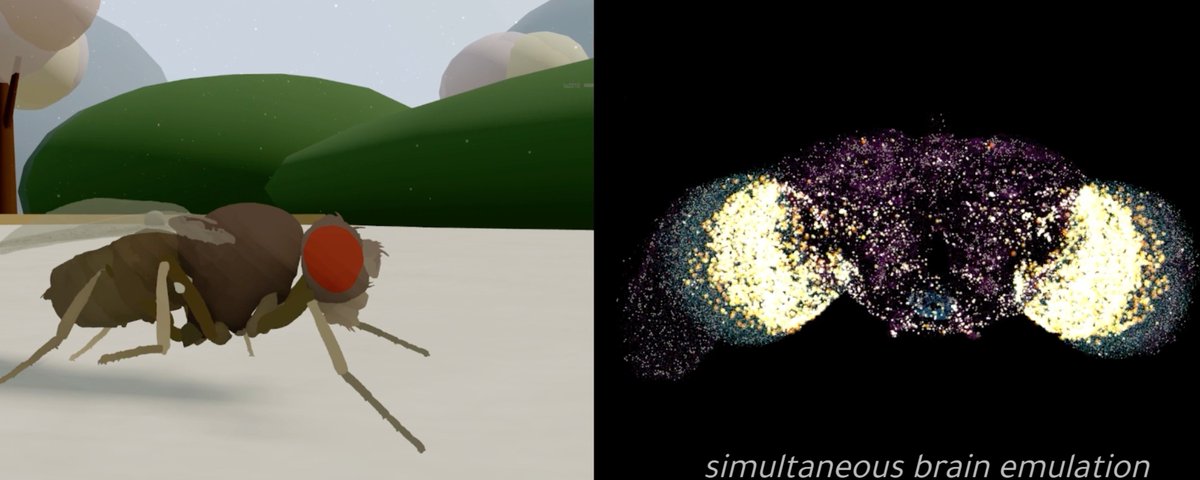
直到现在,“奇点”一直只属于人工心智。几十年来,全脑仿真一直是人工智能之外令人心驰神往的另一条路径:把一个生物大脑按神经元、按突触逐一复制出来,然后运行它。今天,我首次发布一段视频,来自我参与创立的公司 Eon Systems PBC,展示我们相信是世界上首次:一种能够产生多种行为的全脑仿真在“具身”层面的实现。

在这里观看视频:

https://mujoco.org/

2024 年,Eon 的资深科学家 Philip Shiu 及其合作者在 Nature 发表了一个成年 Drosophila melanogaster 大脑的完整计算模型,包含超过 12.5 万个神经元和 5,000 万个突触连接,基于 FlyWire 连接组以及机器学习对神经递质身份的预测构建而成。该模型对运动行为的预测准确率达到 95%。但它是无具身的:有大脑却没有身体,有激活却没有物理,有运动输出却无处可去。

现在,大脑终于有了去处。在既有工作的基础上——包括 Shiu 等人的全脑计算模型、NeuroMechFly v2 具身仿真框架,以及 Özdil 等人关于支撑身体部位协调的中枢化脑网络研究——这次演示将 Eon 基于连接组的脑仿真与 MuJoCo 中具备物理模拟的果蝇身体整合在一起。结果是:由仿真大脑自身的回路动力学驱动的多种不同的行为。感觉输入流入,神经活动沿着完整连接组传播,运动指令流出,物理模拟的身体执行输出,首次在全脑仿真中闭合了从感知到行动的回路。

这是一个质变阈值,而不是渐进改良。此前这一领域的工作,要么建模了没有身体的大脑,要么让没有大脑的身体动起来。DeepMind 与 Janelia 最近的 MuJoCo 果蝇使用的是强化学习,而非由连接组推导出的神经动力学,来控制模拟身体。像 OpenWorm 这样的 C. elegans 项目尝试过具身化,但其神经系统要小得多(约 302 个神经元),行为谱也更受限。此前从未有人展示过:一个源自生物连接组的完整仿真大脑,能够驱动一个物理模拟的身体并产生多种自然主义行为。

其影响会层层向上扩散。Eon 的使命是构建世界上最大规模的连接组与最高保真度的脑仿真,目标是实现完整的数字化小鼠大脑仿真,并为最终达到人类尺度的仿真奠定基础。小鼠大脑大约包含 7,000 万个神经元,是果蝇数量的 560 倍;团队目前正在汇聚尝试所需的连接组与功能记录数据,结合膨胀显微镜绘制每一条神经连接,并用数万小时的钙成像与电压成像捕捉这些网络在活体组织中的激活方式。如果果蝇大脑如今已能在仿真中闭合感知—运动回路,那么小鼠的问题就变成了规模问题,而非性质问题。

请仔细看这段视频。你看到的不是动画。也不是一个模仿生物学的强化学习策略。它是一个生物大脑的复制体——基于电子显微镜数据逐个神经元、逐个连接地布线——在仿真中运行,让一个身体运动起来。幽灵不再栖身于机器之中。机器正在成为幽灵。

Eon 正在扩展团队与基础设施,下一步将尝试小鼠与人类大脑。想要关注或支持这一努力的人,可以在 eon.systems 了解更多信息。

(披露:我在 Eon 中拥有经济利益。)

链接:http://x.com/i/article/2029321643286269954

相关笔记

The Singularity has belonged exclusively to artificial minds, until now. For decades, whole-brain emulation has been the tantalizing counterpart to artificial intelligence: copy a biological brain, neuron by neuron and synapse by synapse, and run it. Today, for the first time, I am releasing a video from a company I helped found, Eon Systems PBC, demonstrating what we believe is the world's first embodiment of a whole-brain emulation that produces multiple behaviors.

Watch the video here:

https://mujoco.org/

In 2024, Eon senior scientist Philip Shiu and collaborators published in Nature a computational model of the entire adult Drosophila melanogaster brain, containing more than 125,000 neurons and 50 million synaptic connections, built from the FlyWire connectome and machine learning predictions of neurotransmitter identity. That model predicted motor behavior at 95% accuracy. But it was disembodied: a brain without a body, activation without physics, motor outputs with nowhere to go.

Now the brain has somewhere to go. Building on previous work, including Shiu et al.'s whole-brain computational model, the NeuroMechFly v2 embodied simulation framework, and Özdil et al.'s research on centralized brain networks underlying body part coordination, this demonstration integrates Eon's connectome-based brain emulation with a physics-simulated fly body in MuJoCo. The result: multiple distinct behaviors driven by the emulated brain's own circuit dynamics. Sensory input flows in, neural activity propagates through the complete connectome, motor commands flow out, and a physically simulated body executes the output, closing the loop from perception to action for the first time in a whole-brain emulation.

This is a qualitative threshold, not an incremental one. Prior work in this space has either modeled brains without bodies or animated bodies without brains. DeepMind and Janelia's recent MuJoCo fly used reinforcement learning, not connectome-derived neural dynamics, to control a simulated body. C. elegans projects like OpenWorm have attempted embodiment but with far smaller nervous systems (~302 neurons) and limited behavioral repertoires. No one has previously demonstrated a complete emulated brain, derived from a biological connectome, driving a physically simulated body through multiple naturalistic behaviors.

The implications cascade upward. Eon's mission is to produce the world's largest connectome and highest-fidelity brain emulation, targeting a complete digital emulation of a mouse brain and laying the groundwork for eventual human-scale emulation. A mouse brain contains roughly 70 million neurons, 560 times the fly's count, and the team is currently amassing the connectomic and functional recording data needed to attempt it, combining expansion microscopy to map every neural connection with tens of thousands of hours of calcium and voltage imaging to capture how those networks activate in living tissue. If a fly brain can now close the sensorimotor loop in simulation, the question for the mouse becomes one of scale, not of kind.

Watch the video closely. What you are seeing is not an animation. It is not a reinforcement learning policy mimicking biology. It is a copy of a biological brain, wired neuron-to-neuron from electron microscopy data, running in simulation, making a body move. The ghost is no longer in the machine. The machine is becoming the ghost.

Eon is scaling its team and infrastructure to attempt the mouse and human brains next. Those who want to follow or support that effort can learn more at eon.systems.

(Disclosure: I have a financial interest in Eon.)

Link: http://x.com/i/article/2029321643286269954

📋 讨论归档

讨论进行中…