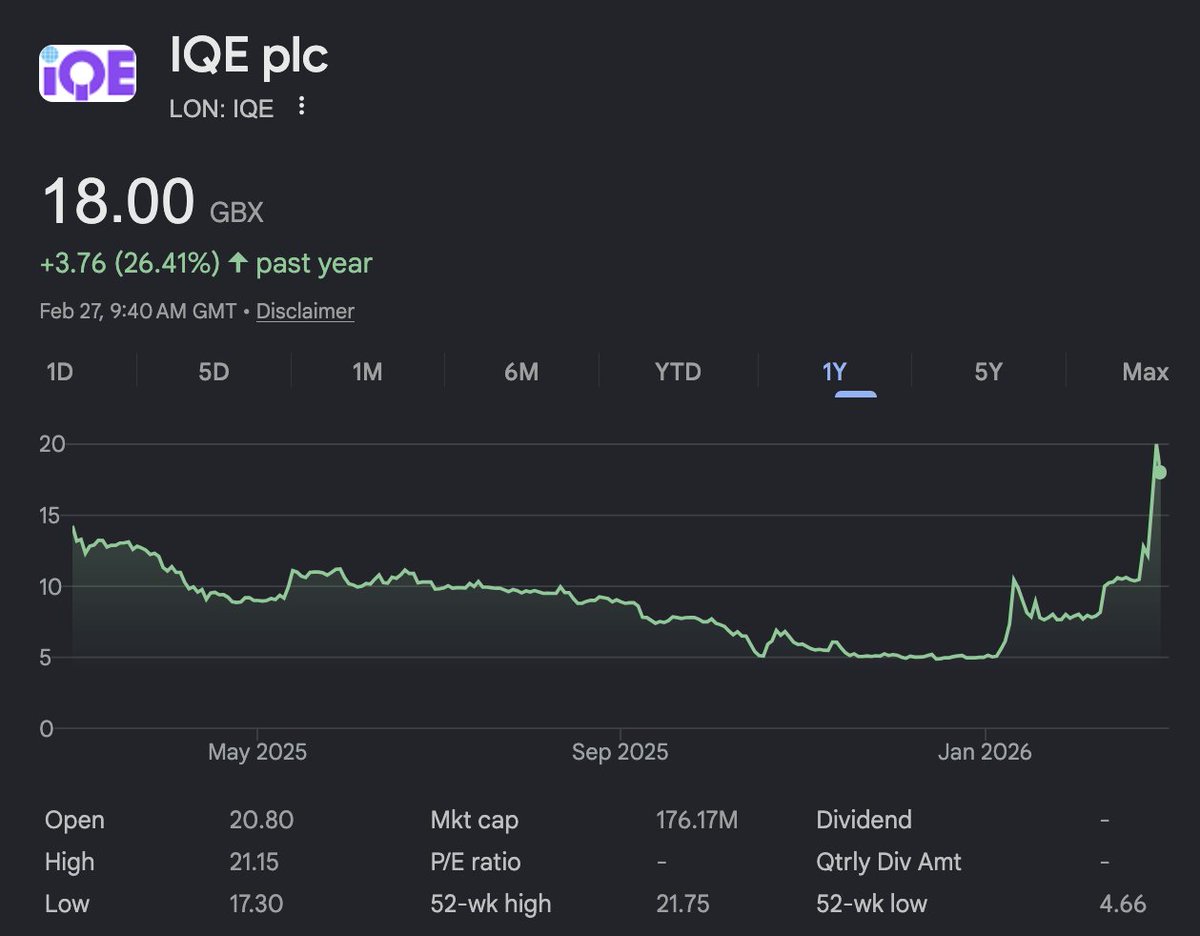
IQE's hidden InP optionality versus LandMark's $3.5B valuation. And the $IREN / $CRWV "miner" pivot to photonics:
Before I did a high-level shower thought overview eg. $AXTI -> $IQE -> $LITE -> $GOOGL TPUs, but this is slightly more DD.
Basically: IQE is the largest independent merchant compound semi epitaxial foundry in the world by reactor count and physical capacity.
However, it's trading at distressed valuations because it's burdened by a low-margin legacy wireless business, and near-term liquidity constraints.
LandMark Optoelectronics (TPEX: 3081) is the closest comparison. As a pure-play proxy for AI InP demand in the 800G and 1.6T optical interconnect market, LandMark commands a ~$3.8B billion market cap with large premiums in comparison to $IQE which is trading at a $175M MC.
But if you look deeper at the physical hardware, the disconnect is pretty fascinating:
LandMark's operational scale is physically limited. They only operate around 27 to 30 Metal-Organic Chemical Vapor Deposition (MOCVD) reactors out of a single campus in Taiwan per some estimates.
IQE, by stark contrast, possesses well over 100+ MOCVD and MBE systems globally.
The underlying replacement value and structural capacity of IQE’s photonics asset base looks to vastly exceeds its current public market valuation.
Kind of like if a Bitcoin miner has 3GW capacity, vs 750 MW, there's large optionality to monetize it if they convert it.
And we're seeing an transceiver bottleneck too:
-> The downstream demand for optical transceivers is experiencing unprecedented acceleration.
-> Extreme demand, from $GOOGL, $MSFT, $AMZN and others flow directly up the hardware supply chain.
This puts immense pressure on transceiver integrators like Innolight, optical component manufacturers like $COHR, $LITE, and $AVGO, and ultimately, the merchant epitaxial foundries that grow the raw epiwafers required for the foundational laser chips.
And since other players are hitting a physical capacity ceiling, vertically integrated players like $COHR are capped out, hyperscalers and module makers are desperate for alternative capacity in players like $IQE
And..
Hidden entirely beneath IQE's consolidated corporate lines is a massive fleet of Aixtron AIX 2800G4-TM reactors.
These are natively dual-capable (GaAs/InP) and can be repurposed for InP production at a relatively modest cost ($500K-$1.5M per reactor) but take few months or year to refactor. And obviously qualification and yield risk added to execution (similar to Bitcoin miners doing software orchestration to GPUs like $CRWV).
But still, IQE has the capacity kinda like $IREN or Bitcoin miners that pivoted to HPC. And LandMark is proof of the valuation pure play exposure brings.
The Major Question.. Unlocking Trapped Value:
While IQE generates significantly higher top-line revenue than LandMark, it's priced ($175M MC) for bankruptcy because of its gross debt of 45M.
But the debt looks like pennies to hyperscalers:
The explicit, stated goal of their ongoing Lazard-advised strategic review is to definitively conclude the sale of IQE Taiwan (their legacy GaAs wireless business) and utilize the proceeds to completely and permanently extinguish the parent company's restrictive debt profile.
Once again their convertible loan notes is a norminal face value of £21.2 million, for proceeds of £18 million for the company. Then they're net debt, £23.5 million.
-> The immediate debt burden requiring clearance: £23.5M HSBC facility + £21.2M CLN = ~£45M.
Assuming a highly sale price for the IQE Taiwan unit of between £100 million and £150 millio (not guaranteed), IQE would net £50 million to £100 million in surplus cash after becoming completely debt-free.
However, RF GaAs is not currently "hot", so in a distressed asset sale it might only be £50M to £60M, which gives it enough room to clear debt alone and little cushion room.
The Geopolitical Pivot:
Once debt-free, IQE can shift its massive, currently underutilized manufacturing capacity in places like North Carolina and Wales toward the InP epiwafer market for datacenters.
It creates a fully capitalized, purely Western-based supply chain for the most critical bottleneck in photonics, eliminating more dependency on Asia at a time when the US and UK are heavily prioritizing domestic semiconductor infrastructure.
Basically, just given the amount of raw assets $IQE has:
-> Successfully selling off their Taiwan business wipes out the going-concern risks, clears all debt, and leaves them to monetize their 6-inch inp epiwafer tech directly for the Tier 1 optical transceiver players.
It's a deep asset value trade on a successful restructuring to unlock trapped value. And a currently well-known supplier for optical networking for hyperscalers (so not a science project).
Downside risks are excessive dilution and failure to restructure. But given it's geopolitical importance to Western supply chains and hyperscaler supply chains, it seems to have more cushion.
I personally decided to enter this long as a massive potential turnaround. But again, it's not for everyone and it's extremely high risk.
TLDR:
-> IQE is priced like a distressed RF supplier.
-> It owns real photonics-capable infrastructure.
-> If gross 41M debt is removed and management reallocates capex toward InP, the equity could rerate materially.
-> Restructuring + capacity optionality trade with extreme risk but extreme upside.
Closest comparison is Bitcoin miners like $IREN or $CIFR that pivot their GW capacity to AI HPC. They have a ton of physical hardware (GW capacity), and need funds to pivot (either through sale of Taiwan business or dilution).
It's an optimistic trade I took they can do it (with wiggle room like $INTC given their geopolitical importance to the West).
The downside is extreme dilution, which is always a possibility (meaning your equity gets wiped out to 0 to clear their debts or to help them refactor).
I just found that 45M gross debt (14.4% of float + debt) wasn't the most and management was looking to clear that through asset sales rather than dilution to shareholders.
Just wanted to publish deeper breakdown and more risks of this very binary high risk, but potentially high upside trade.