返回列表
💬 讨论题 · 🧠 阿头学

AI基建正在继承电动车供应链

这篇文章的判断是成立一半、夸大一半:AI 数据中心确实在把需求外溢到功率半导体和被动器件,但“继承 EV 供应链”不自动等于相关公司都会系统性吃到利润。
打开原文 ↗

2026-05-12 原文链接 ↗
阅读简报
双语对照
完整翻译
原文
讨论归档

核心观点

  • 主线从算力转向电力 作者的核心判断是对的:GPU、光模块、HBM 之后,AI 基建的下一层瓶颈正在转向供电、稳压、滤波、保护等电力电子环节,这不是概念炒作,而是高功率密度机架的物理结果。
  • “供应链继承”是有洞察的 文章最有价值的地方在于提出:AI 并不总是创造全新供应链,而是在复用电动车和太阳能扩产时期形成的器件、工艺和产能基础,这个视角比单纯追“AI 纯概念股”更有二阶思维。
  • 供给纪律可能比需求更关键 作者强调 TXN、NXPI 等公司经历过过剩和价格战后不愿激进扩产、反而更愿意提价,这个判断如果持续成立,利润弹性会先于出货量兑现,因此投资逻辑不只是“需求增长”,更是“受伤后的供给克制”。
  • 证据链明显不够硬 文章最大问题是把“技术路径相似”快速推成“投资受益链条成立”,却没有给出足够的量化数据,比如 AI 数据中心需求占相关公司收入的比例、MLCC 真实缺口、ASP 变化幅度和订单持续性,因此结论有前瞻性,但论证有跳跃。
  • 这不是普涨故事而是分化故事 功率器件、MLCC、电感、UPS、连接器、机架外配电不是同一逻辑、也不是同一斜率,文章有意把它们打包成一个主题以增强叙事,但真正能兑现的公司大概率只是一部分,而不是整个板块一起飞。

跟我们的关联

1. 对 ATou 意味着什么:不要再只把 AI 基建理解成“买 GPU 和内存”的线性故事,下一步要把研究框架扩到电力链条,尤其关注“旧周期受伤、但新需求接手”的公司和环节。 2. 对 Neta 意味着什么:这是一个可复用的分析模板,重点不是追最热叙事,而是找“市场还按旧逆风定价、但底层需求已经变了”的位置;下一步可以把这个框架迁移到云、SaaS、工业软件等别的行业。 3. 对 Uota 意味着什么:做产品或内容判断时,真正的瓶颈常出现在主叙事之外,AI agent 增长不只会推高 token 和 GPU,也会推高背后的供电与基础设施成本;下一步可以把“隐性瓶颈”作为持续追踪主题。 4. 对三者共同意味着什么:这篇文章最值得吸收的不是具体股票名单,而是“供应链继承”模型;下一步应该验证哪些旧产业能力会被 AI 接盘,哪些只是叙事上看起来相似、商业上却接不住。

讨论引子

1. “技术来自 EV/光伏”到底能在多大程度上转化为“供应商受益来自 AI”,中间最关键的验证指标是什么? 2. 如果 AI capex 在未来 12-24 个月放缓,功率半导体和 MLCC 的逻辑是被推迟,还是会直接证伪? 3. 真正值得下注的是整个模拟/功率板块,还是少数具备供给纪律、产品匹配度和客户认证优势的公司?

在 AI 基础设施交易的第一阶段,只要知道几个基本点,事情就已经足够简单了。大型语言模型运行在 GPU 上,买英伟达。AI 算力会让光模块摆脱电信行业的冷宫,并带动互连需求显著增长,买光互连相关标的。到了代理式时代,每一丝 AI 算力需求最终都必然要流经内存 OEM,买美光和 SK 海力士。

当时看起来远比这复杂得多,但归根结底,基本就是这么简单。原因有两个。第一,并不是所有人都相信,AI 的普及和落地会需要数据中心出现如此巨大的增长。第二,在疫情后供应链过剩,以及其他诸多压制半导体及其相邻板块的逆风之下,除了最显而易见的一阶受益者之外,其他公司的估值都还相当宽松。

这种情况已经开始变化。随着变化展开,想在 AI 基础设施板块中继续跑赢,仅仅识别当前瓶颈已经不够了,还需要更深入的理解。要看懂未来的路线图,就得具备更多技术判断,这也是为什么我们在 2026 年 1 月启动了 Semis Memo 系列,由我们的半导体分析师 Zephyr 和 Jukan 共同主导。

虽然格局已经演变,但我们的框架没有变。先从宏观出发。找出那些预测中仍然反映着非 AI 逆风遗留压力的领域,再判断 AI 需求是否能强到足以压过去,从而让当前预期显得过低。

这一期,我们将讨论以下几个符合我们标准的方向:

模拟与功率半导体:供应链的继承

代理式时代的 CPU

Neocloud:推理短缺

AI 材料瓶颈

韩国解锁

更新此前的 Semis Memo 观点

最后,我们会谈谈我们将走向何方的一些想法……

我们最早在 2025 年 25 笔交易 中指出,AI 需求大概率会压倒当时模拟与功率半导体板块正在承受的逆风,尤其是在即将到来的多层陶瓷电容器(MLCC)短缺这一点上。

电能质量管理系统中的关键元件,用于解决电压跌落、谐波和瞬态等常见问题,从而确保电气和电子设备稳定可靠地运行。其中包括电容、电感、二极管、电源 IC、浪涌保护器、滤波器、变压器、不间断电源(UPS)。

分立功率半导体(如 MOSFET 和二极管)也将受益,因为它们是构建高效、稳定电源轨的核心组成部分。滤波器、铁氧体磁珠和连接器也可能迎来增长,但最明确、最具长期趋势性的提升,很可能出现在电容和电感上,因为在 AI 驱动的高性能计算环境中,它们是电源转换的核心。

这些标的已经开始跑赢,我们认为这与我们为 2026 年提出的另一个框架直接相关,也就是 创伤后供应失调。功率半导体公司这些年遭遇了一连串逆风,疫情期间的供应过剩、中国模拟芯片厂商的竞争、疲弱的电动车和汽车周期,清单还可以继续列下去。不过,它们现在开始看到数据中心收入攀升。而经历过太多次教训之后,它们并没有急着扩产。

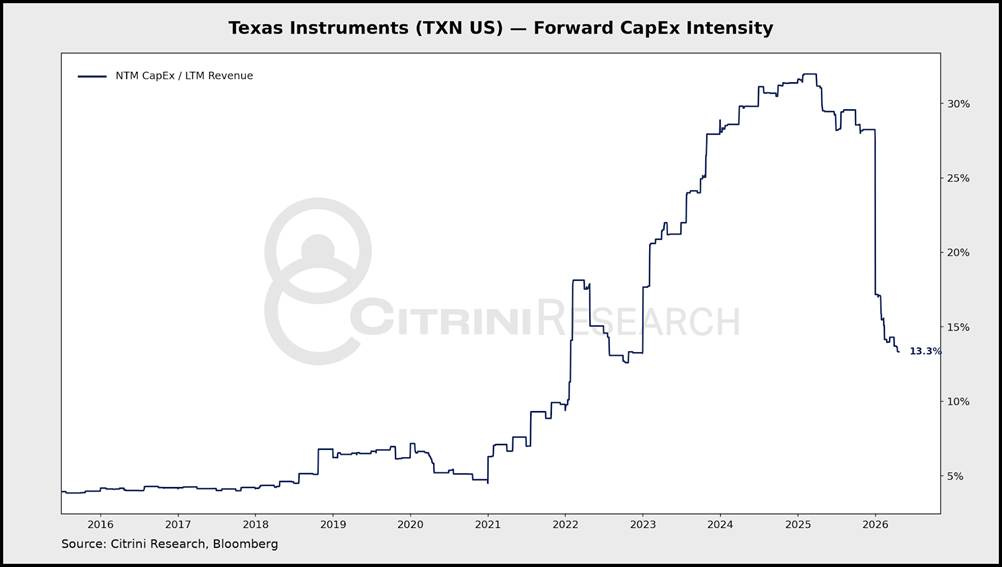
看看 Texas Instruments (TXN US) 的资本开支强度(capex / revenue):

Image 1

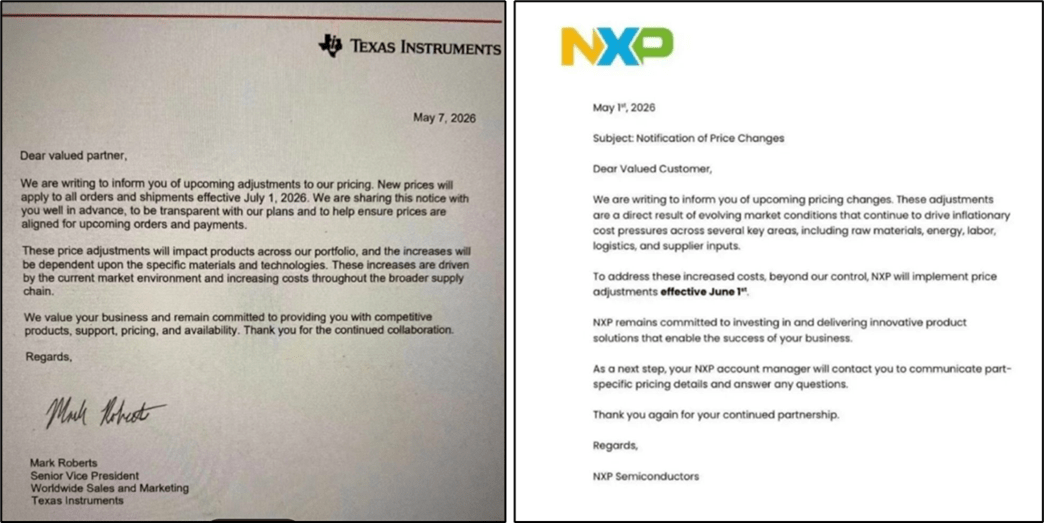
通常到了周期的这个阶段,供给就会开始爬升,但 TXN 和像 NXP Semiconductors (NXPI US) 这样的同行却更愿意提价。

Image 2

现在,我们正处在一个拐点上,这些公司选择让 ASP 上升,而不是向市场大量灌货。不过到目前为止,我们关注的大多还是机架内部的故事。像 Murata Manufacturing (6981 JP)Vishay Intertechnology (VSH US)Samsung Electro-Mechanics (009150 KS) 这样的公司已经开始起飞,因为市场开始真正意识到,MLCC 现在到底有多短缺。

在我们第一个、也是最有把握的部分里,可以高兴地说,你并不需要是半导体专家,也能看懂机架外部功率半导体这个故事。这是一个非常直接的布局。曾经烧伤它们的那轮资本开支,恰好就是这一轮周期所需要的基础设施。

过去很长时间里,我们一直在等汽车行业的压力消退,好让模拟与功率半导体板块的雾气散开。现在我们意识到,事情更大。其实未必需要等到那一步。更准确地说,AI 资本开支建设,正在直接继承电动车扩产时形成的那条供应链。

在英伟达 2025 年 5 月关于 800V DC 机架架构的技术博客中,他们明确将底层技术归功于“电动车和太阳能行业”。这笔交易的核心,就在这里……

For the first innings of the AI Infrastructure trade, it was simple enough just to know the basics. Large Language Models run on GPUs, buy Nvidia. AI compute will lift optics out of the telecom doghouse and cause significant growth for interconnects, buy the optical interconnect names. Every iota of AI compute demand in the agentic era must inevitably flow through the memory OEMs, buy Micron and SK Hynix.

在 AI 基础设施交易的第一阶段,只要知道几个基本点,事情就已经足够简单了。大型语言模型运行在 GPU 上,买英伟达。AI 算力会让光模块摆脱电信行业的冷宫,并带动互连需求显著增长,买光互连相关标的。到了代理式时代,每一丝 AI 算力需求最终都必然要流经内存 OEM,买美光和 SK 海力士。

It seemed a lot more difficult than that at the time, but it was pretty much that simple. The reasons for that were twofold. First, not everyone bought into the massive growth in data centers that would be required for AI to proliferate and actualize. Second, between the post-COVID supply chain glut and numerous other headwinds to semiconductor and adjacent names, valuations remained quite forgiving in all but the most obvious first-order beneficiaries.

当时看起来远比这复杂得多,但归根结底,基本就是这么简单。原因有两个。第一,并不是所有人都相信,AI 的普及和落地会需要数据中心出现如此巨大的增长。第二,在疫情后供应链过剩,以及其他诸多压制半导体及其相邻板块的逆风之下,除了最显而易见的一阶受益者之外,其他公司的估值都还相当宽松。

That’s begun to change, and with it, outperforming in the AI infrastructure complex requires in-depth understanding beyond just identifying current bottlenecks. Understanding the roadmap for the future requires a bit more technical competence, which is why in January 2026 we began our Semis Memo series – guided by our semis analysts Zephyr and Jukan.

这种情况已经开始变化。随着变化展开,想在 AI 基础设施板块中继续跑赢,仅仅识别当前瓶颈已经不够了,还需要更深入的理解。要看懂未来的路线图,就得具备更多技术判断,这也是为什么我们在 2026 年 1 月启动了 Semis Memo 系列,由我们的半导体分析师 Zephyr 和 Jukan 共同主导。

While the landscape has evolved, our framework stays the same. Begin with the macro. Find areas where forecasts are still reflecting overhangs from non-AI related headwinds and determine whether AI demand can overcome them in a way that makes estimates too low.

虽然格局已经演变,但我们的框架没有变。先从宏观出发。找出那些预测中仍然反映着非 AI 逆风遗留压力的领域,再判断 AI 需求是否能强到足以压过去,从而让当前预期显得过低。

In this issue, we’re covering the following places that meet our criteria:

这一期,我们将讨论以下几个符合我们标准的方向:

Analog and Power Semis: Supply Chain Inheritance

模拟与功率半导体:供应链的继承

CPUs in the Agentic Era

代理式时代的 CPU

Neoclouds: The Inference Shortage

Neocloud:推理短缺

AI Materials Bottlenecks

AI 材料瓶颈

Korea Unlocked

韩国解锁

Updating Previous Semis Memo Ideas

更新此前的 Semis Memo 观点

We end with Some Thoughts on Where We’re Going…

最后,我们会谈谈我们将走向何方的一些想法……

We first flagged the likelihood that AI demand would overwhelm the headwinds currently being experienced by the analog and power semi sector in our 25 Trades for 2025, specifically as it related to the upcoming Multilayer Ceramic Capacitors (MLCC) shortage.

我们最早在 2025 年 25 笔交易 中指出,AI 需求大概率会压倒当时模拟与功率半导体板块正在承受的逆风,尤其是在即将到来的多层陶瓷电容器(MLCC)短缺这一点上。

Components integral to power quality management systems address common issues such as voltage sags, harmonics, and transients, thereby ensuring the reliable operation of electrical and electronic equipment. This includes capacitors, inductors, diodes, power ICs, surge protectors, filters, transformers, uninterruptible power supplies (UPS).

Discrete power semiconductors (like MOSFETs and diodes) will also benefit as they are integral to creating efficient, stable power rails. Filters, ferrite beads, and connectors may see growth, but the clearest secular uplift is likely in capacitors and inductors given their centrality to power conversion in AI-driven, high performance computing environments.

电能质量管理系统中的关键元件,用于解决电压跌落、谐波和瞬态等常见问题,从而确保电气和电子设备稳定可靠地运行。其中包括电容、电感、二极管、电源 IC、浪涌保护器、滤波器、变压器、不间断电源(UPS)。

分立功率半导体(如 MOSFET 和二极管)也将受益,因为它们是构建高效、稳定电源轨的核心组成部分。滤波器、铁氧体磁珠和连接器也可能迎来增长,但最明确、最具长期趋势性的提升,很可能出现在电容和电感上,因为在 AI 驱动的高性能计算环境中,它们是电源转换的核心。

These names have begun to outperform, and we feel it’s directly related to another framework we’ve posed for 2026 – “Post-Traumatic Supply Disorder”. The companies dealing with power semis have had to contend with a barrage of headwinds – the COVID supply glut, competition from Chinese analog semis, the anemic EV and automotive cycle…the list goes on. However, they’re beginning to see data center revenues climb. And they’re not rushing to add capacity, having been burnt one too many times.

这些标的已经开始跑赢,我们认为这与我们为 2026 年提出的另一个框架直接相关,也就是 创伤后供应失调。功率半导体公司这些年遭遇了一连串逆风,疫情期间的供应过剩、中国模拟芯片厂商的竞争、疲弱的电动车和汽车周期,清单还可以继续列下去。不过,它们现在开始看到数据中心收入攀升。而经历过太多次教训之后,它们并没有急着扩产。

Take a look at the capex intensity (capex / revenue) for Texas Instruments (TXN US):

看看 Texas Instruments (TXN US) 的资本开支强度(capex / revenue):

Image 1

It’s typically this part of the cycle that results in supply ramping, but instead, TXN and peers like NXP Semiconductors (NXPI US)are content to raise prices.

通常到了周期的这个阶段,供给就会开始爬升,但 TXN 和像 NXP Semiconductors (NXPI US) 这样的同行却更愿意提价。

Image 2

Now, we’re at an inflection point, and these companies are letting ASPs go up rather than flood the market. Up until now, however, we’ve been mostly focused on the rack-internal story. Companies like Murata Manufacturing (6981 JP), Vishay Intertechnology (VSH US)and Samsung Electro-Mechanics (009150 KS)have taken off as the crowd recognizes exactly how short on MLCCs we are.

现在,我们正处在一个拐点上,这些公司选择让 ASP 上升,而不是向市场大量灌货。不过到目前为止,我们关注的大多还是机架内部的故事。像 Murata Manufacturing (6981 JP)Vishay Intertechnology (VSH US)Samsung Electro-Mechanics (009150 KS) 这样的公司已经开始起飞,因为市场开始真正意识到,MLCC 现在到底有多短缺。

For our first and highest-conviction section, we’re glad to say that you don’t have to be a semiconductor expert to understand the rack-external power semis story. It’s a pretty cut and dry setup. The capex that burned them once was actually the exact infrastructure necessary for this part of the cycle.

在我们第一个、也是最有把握的部分里,可以高兴地说,你并不需要是半导体专家,也能看懂机架外部功率半导体这个故事。这是一个非常直接的布局。曾经烧伤它们的那轮资本开支,恰好就是这一轮周期所需要的基础设施。

While we’ve long been waiting for the automotive overhang to lift the fog off of the names in the analog and power semis space, we’re now realizing something more significant. It doesn’t really need to – rather, the AI capex buildout is simply inheriting the EV buildout supply chain.

过去很长时间里,我们一直在等汽车行业的压力消退,好让模拟与功率半导体板块的雾气散开。现在我们意识到,事情更大。其实未必需要等到那一步。更准确地说,AI 资本开支建设,正在直接继承电动车扩产时形成的那条供应链。

In Nvidia’s May 2025 technical blog on 800V DC rack architecture, they credit the underlying technology to “the electric vehicle and solar industries.”That’s the trade…

在英伟达 2025 年 5 月关于 800V DC 机架架构的技术博客中,他们明确将底层技术归功于“电动车和太阳能行业”。这笔交易的核心,就在这里……

For the first innings of the AI Infrastructure trade, it was simple enough just to know the basics. Large Language Models run on GPUs, buy Nvidia. AI compute will lift optics out of the telecom doghouse and cause significant growth for interconnects, buy the optical interconnect names. Every iota of AI compute demand in the agentic era must inevitably flow through the memory OEMs, buy Micron and SK Hynix.

It seemed a lot more difficult than that at the time, but it was pretty much that simple. The reasons for that were twofold. First, not everyone bought into the massive growth in data centers that would be required for AI to proliferate and actualize. Second, between the post-COVID supply chain glut and numerous other headwinds to semiconductor and adjacent names, valuations remained quite forgiving in all but the most obvious first-order beneficiaries.

That’s begun to change, and with it, outperforming in the AI infrastructure complex requires in-depth understanding beyond just identifying current bottlenecks. Understanding the roadmap for the future requires a bit more technical competence, which is why in January 2026 we began our Semis Memo series – guided by our semis analysts Zephyr and Jukan.

While the landscape has evolved, our framework stays the same. Begin with the macro. Find areas where forecasts are still reflecting overhangs from non-AI related headwinds and determine whether AI demand can overcome them in a way that makes estimates too low.

In this issue, we’re covering the following places that meet our criteria:

Analog and Power Semis: Supply Chain Inheritance

CPUs in the Agentic Era

Neoclouds: The Inference Shortage

AI Materials Bottlenecks

Korea Unlocked

Updating Previous Semis Memo Ideas

We end with Some Thoughts on Where We’re Going…

We first flagged the likelihood that AI demand would overwhelm the headwinds currently being experienced by the analog and power semi sector in our 25 Trades for 2025, specifically as it related to the upcoming Multilayer Ceramic Capacitors (MLCC) shortage.

Components integral to power quality management systems address common issues such as voltage sags, harmonics, and transients, thereby ensuring the reliable operation of electrical and electronic equipment. This includes capacitors, inductors, diodes, power ICs, surge protectors, filters, transformers, uninterruptible power supplies (UPS).

Discrete power semiconductors (like MOSFETs and diodes) will also benefit as they are integral to creating efficient, stable power rails. Filters, ferrite beads, and connectors may see growth, but the clearest secular uplift is likely in capacitors and inductors given their centrality to power conversion in AI-driven, high performance computing environments.

These names have begun to outperform, and we feel it’s directly related to another framework we’ve posed for 2026 – “Post-Traumatic Supply Disorder”. The companies dealing with power semis have had to contend with a barrage of headwinds – the COVID supply glut, competition from Chinese analog semis, the anemic EV and automotive cycle…the list goes on. However, they’re beginning to see data center revenues climb. And they’re not rushing to add capacity, having been burnt one too many times.

Take a look at the capex intensity (capex / revenue) for Texas Instruments (TXN US):
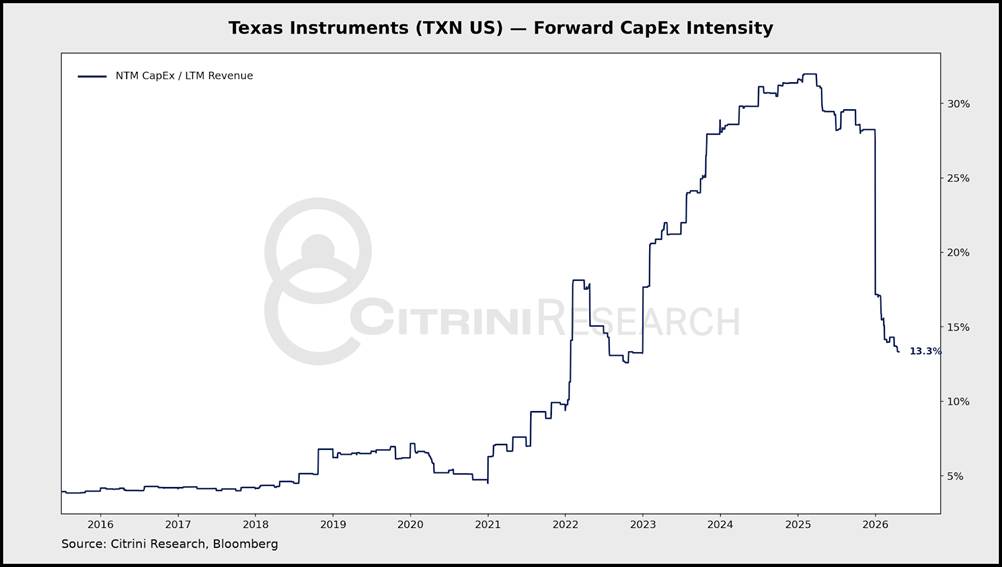
Image 1

It’s typically this part of the cycle that results in supply ramping, but instead, TXN and peers like NXP Semiconductors (NXPI US)are content to raise prices.
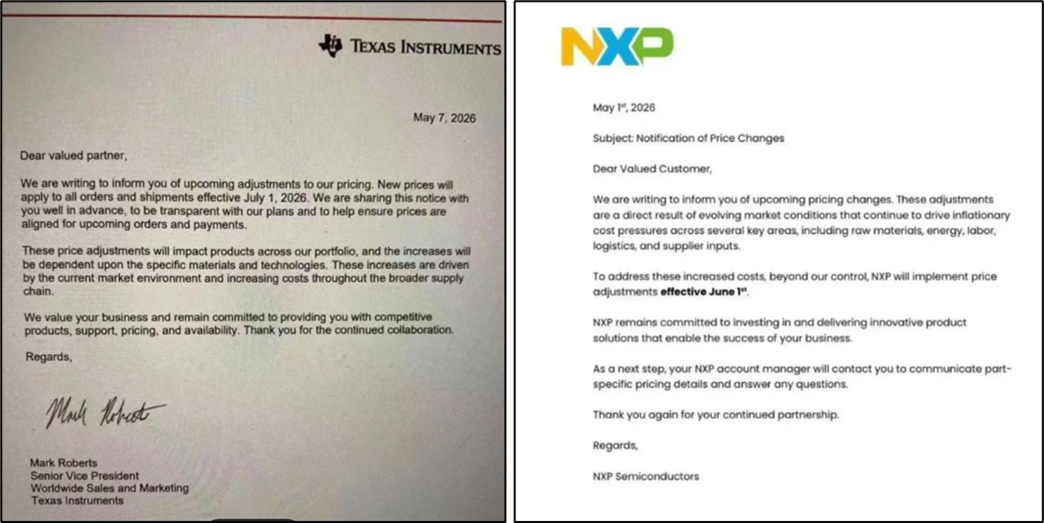
Image 2

Now, we’re at an inflection point, and these companies are letting ASPs go up rather than flood the market. Up until now, however, we’ve been mostly focused on the rack-internal story. Companies like Murata Manufacturing (6981 JP), Vishay Intertechnology (VSH US)and Samsung Electro-Mechanics (009150 KS)have taken off as the crowd recognizes exactly how short on MLCCs we are.

For our first and highest-conviction section, we’re glad to say that you don’t have to be a semiconductor expert to understand the rack-external power semis story. It’s a pretty cut and dry setup. The capex that burned them once was actually the exact infrastructure necessary for this part of the cycle.

While we’ve long been waiting for the automotive overhang to lift the fog off of the names in the analog and power semis space, we’re now realizing something more significant. It doesn’t really need to – rather, the AI capex buildout is simply inheriting the EV buildout supply chain.

In Nvidia’s May 2025 technical blog on 800V DC rack architecture, they credit the underlying technology to “the electric vehicle and solar industries.”That’s the trade…
📋 讨论归档

讨论进行中…