返回列表
🧠 阿头学 · 💰投资

用路由+压缩+缓存把 Claude 账单砍 74%,但别被数据骗了

开发者普遍为"日常任务"付了"前沿模型"的价格,通过智能路由和上下文压缩可以大幅降本,但文章的成本数据来自未来时间点,可信度存疑。
打开原文 ↗

2026-03-08 原文链接 ↗
阅读简报
双语对照
完整翻译
原文
讨论归档

核心观点

  • "大材小用"是真实的成本黑洞 70% 的生产请求(JSON 抽取、翻译、简单总结)根本不需要 Claude,却被默认路由给它。这不是模型选择问题,而是架构问题——大多数团队没有"请求分层"的意识。对 Neta 这样的社交产品,后台流水(安全分类、记忆整理、标签生成)完全可以降级到 $0.10/M token 的廉价模型。
  • 成本优化的真正杠杆在中间件,不在模型本身 路由、压缩、缓存三层叠加才是 74% 节省的来源,单点优化都不够。特别是对 agent 工作流,工具输出冗余和上下文膨胀才是成本放大器——压缩 97% 的日志输出比换模型更直接。这意味着未来 AI 产品竞争力不是"接入最强模型",而是"有没有一个前置控制面"。
  • 数据造假摧毁了全文可信度 免责声明写着"时间为 2026 年 3 月"来背书"真实生产环境数据",这直接把 74% 节省率的真实性打成问号。20,000+ 请求的样本量对代表性也很弱,且完全没披露失败重试率、缓存命中率、路由误判成本。
  • "完全安全的压缩"是违背技术常识的绝对化断言 任何有损压缩(尤其是 10KB→300 字符)都必然伴随信息丢失。在格式严苛或复杂推理的任务中,这会导致幻觉或输出崩溃。文章回避了路由错误和压缩失败的重试成本。
  • Web3 支付接入被包装成"开源工具" 标题强调"开源""GitHub 5k Star"营造免费假象,但快速开始要求在 Base/Solana 充值 USDC。这本质是为 BlockRun(AI 算力分销平台)拉新的商业漏斗,中间商抽成和 Gas 费完全没披露。

跟我们的关联

  • Neta 的成本治理清单 意味着:不要急着换模型,先问三件事:(1) 这次调用必须用最强模型吗?(2) 这段上下文必须原样发过去吗?(3) 这条请求以前是否已经算过?立即组织团队对现有 API 链路做"三层漏斗"改造——拦截/缓存→分流/路由→压缩/精炼。
  • Agent 系统的上下文预算管理 意味着:Agent 的成本黑洞不是推理本身,而是工具日志膨胀和循环调用重复。要成为"能指挥 AI 的 top 0.0001%",关键能力是设计 agent 的上下文预算、调用去重机制、工具输出摘要层,而不只是会写 prompt。
  • 海外增长的实验权解锁 意味着:当推理成本下降后,可以解锁原本不敢做的功能——广告文案变体、多语言落地页、客服自动化、UGC 审核。品牌团队能把 LLM 从"谨慎使用的贵资源"变成"可大规模试错的基础设施"。

讨论引子

  • 你的产品里,真正需要前沿推理的请求占比是多少?如果不是 100%,那被错误分配给昂贵模型的成本每月有多少?
  • 路由器在 <1ms 内从 14 个维度打分,但如果误判一次(把复杂任务丢给廉价模型),重试和用户流失的成本怎么算?你敢信任这个黑盒吗?
  • 缓存命中率在实际业务中通常极低(请求常带时间戳、用户 ID、动态变量),那 ClawRouter 声称的"省 100%"在你的场景里能达到多少?

你爱 Claude,你的钱包却不爱。下面教你如何用更低成本,继续拿到前沿级质量的答案。

问题:Claude 很强,但很贵

如果你在用 Anthropic API 做产品,你肯定已经知道:Claude 是目前最强的推理模型之一。

  • Opus 4.6:每百万 token $5/$25。

  • Sonnet:每百万 token $3/$15。

  • 就连 Haiku 也要:每百万 token $1/$5。

但有件事,大多数开发者不太愿意承认:你绝大多数的 API 调用其实并不需要 Claude。

想想你日常的工作负载。你在做一个 SaaS 应用。有些请求确实需要 Claude 的推理能力——调试复杂代码、分析长文档、编排多步骤的智能体工作流。但更多请求其实很“日常”:从文本里抽取 JSON、回答简单用户问题、翻译一段字符串、总结一段话。

你在为每百万 token $3–$25 的价位买单,而这些活儿用一个 $0.10 的模型做出来几乎一模一样。

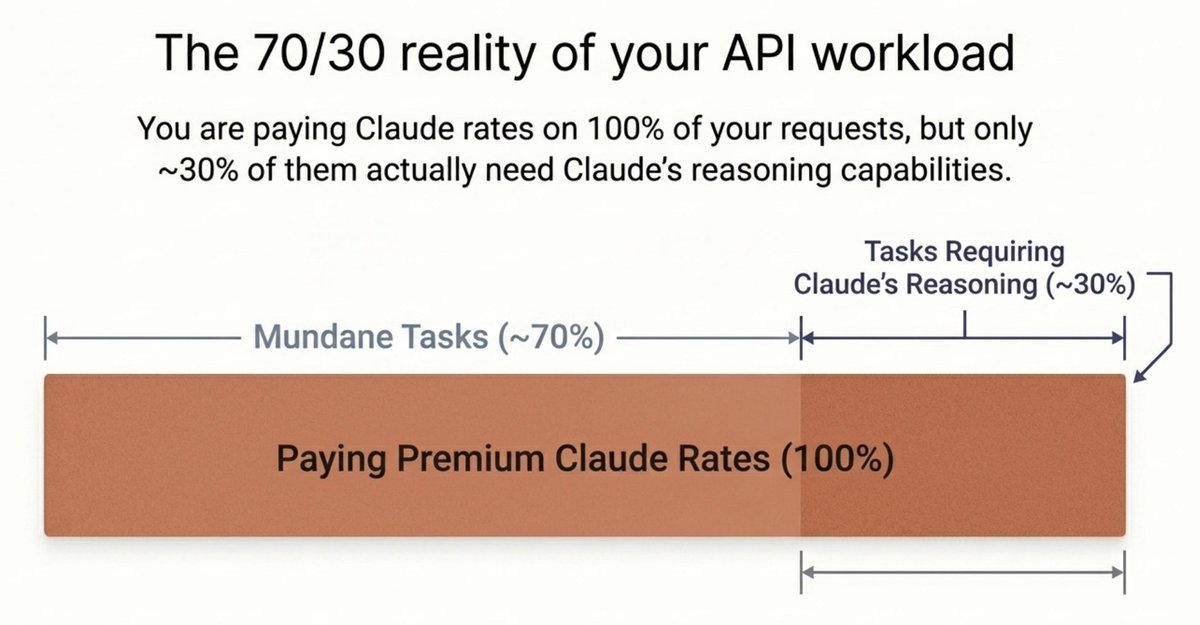
问题很简单:你把 Claude 的价格用在了 100% 的请求上,但真正需要 Claude 的可能只有大约 30%。

典型开发者的工作负载是什么样的?

https://github.com/blockrunai/ClawRouter

日常任务(约 70% 的请求)

这些请求你会不停地发,甚至都不怎么需要动脑:

  • “从这段文字里抽取姓名和邮箱并返回 JSON” —— 任何模型都能做。你却在为结构化抽取付 Claude 的 $15/M 输出 token,而一个 $0.40 的模型也能做得完全没问题。

  • “把这条客服工单用两句话总结” —— 总结早就是成熟题了,这里不需要前沿级推理。

  • “把这条报错信息翻译成西班牙语” —— 翻译是典型的商品化任务。用 Claude 的价格做翻译,就像开着兰博基尼去买菜。

  • “useEffect 和 useLayoutEffect 有什么区别?” —— 事实性问答。基本所有模型都能答对。

  • “把这份 CSV 数据转换成 markdown 表格” —— 纯格式转换。免费模型也能做到一模一样。

真正需要 Claude 的任务(约 30% 的请求)

这里你付的钱才是在买真正的价值:

  • 复杂代码生成 —— “把这个认证模块重构为支持 OAuth2 + PKCE,处理 token refresh,并加上限流。”这是多文件、多约束的推理工作,Claude 在这里确实值回票价。

  • 长文档分析 —— “读完这份 50 页的合同,找出所有可能让我们承担超过 $1M 责任的条款。”上下文窗口与推理质量在这里至关重要。

  • 多步骤智能体编排 —— “扫描这 5 个 API,交叉核对数据,并生成带建议的报告。”这类智能体工作流要求模型在许多步骤中持续维护计划。

  • 高级推理 —— “调试我们分布式系统里的竞态条件”或“证明这个算法是 O(n log n)。”便宜模型在这种任务里很容易跟丢线索。

解决方案:ClawRouter

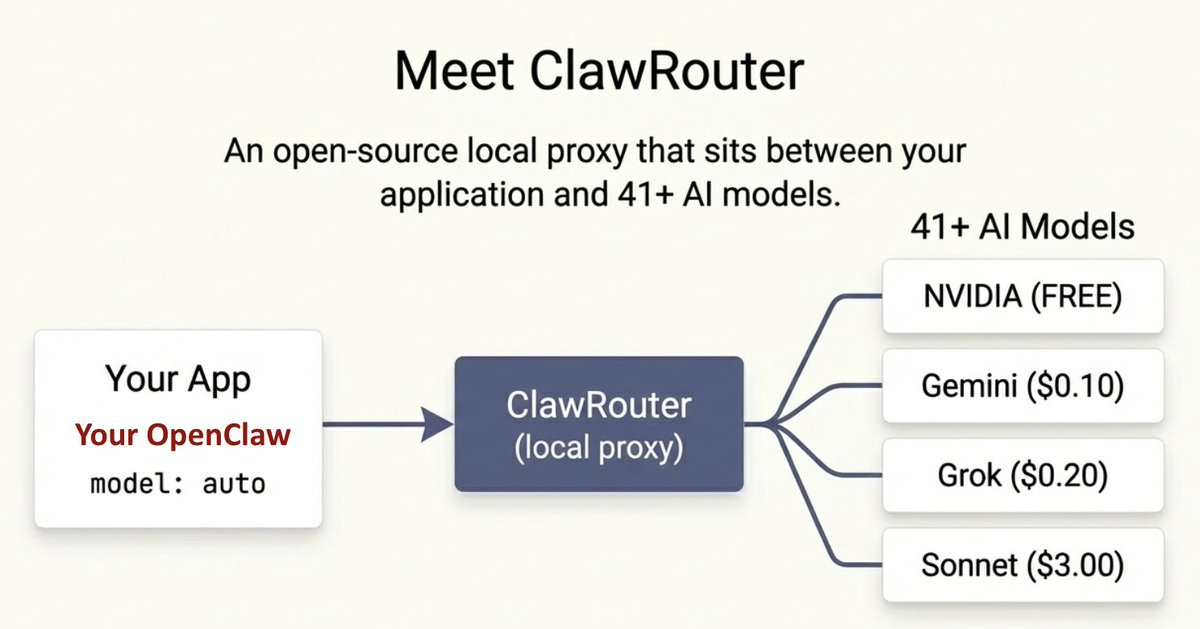
ClawRouter 是一个开源的本地代理,位于你的应用与 41+ 个 AI 模型之间。它通过三种方式帮你省钱:智能路由token 优化、以及响应缓存。上线 1 个月在 Github 拿到 5K stars。https://github.com/BlockRunAI/clawrouter

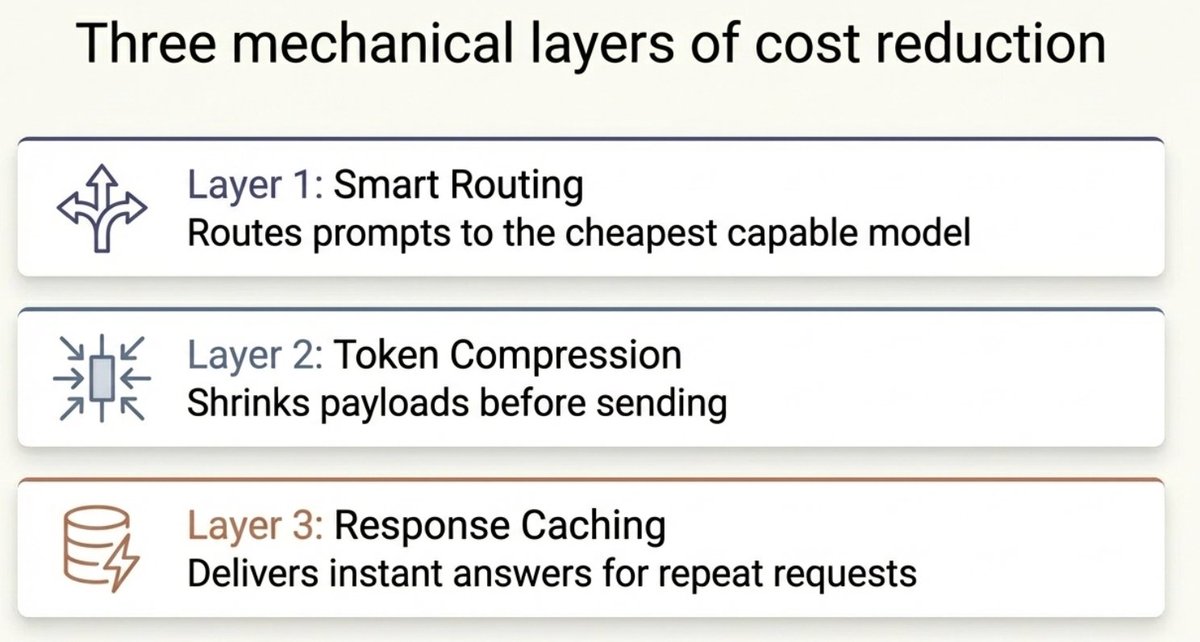
你如何省钱:三层机制

第一层:智能路由(收益最大)

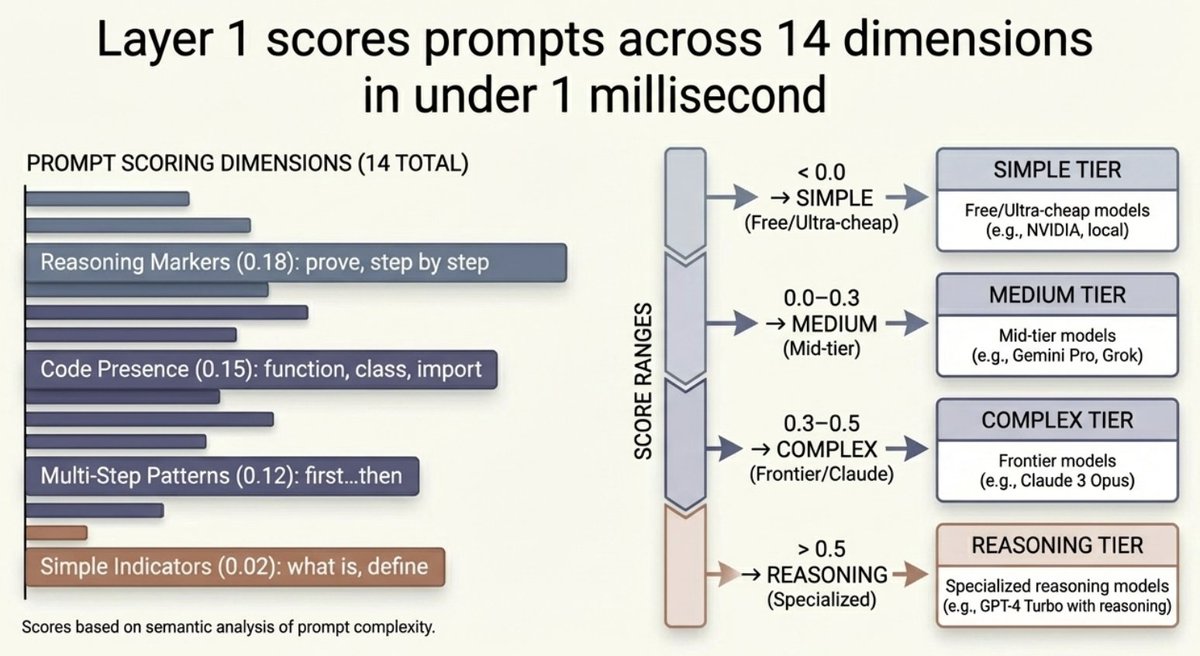
ClawRouter 会在 <1ms 内从 14 个维度为每条提示词打分,并把它路由到能胜任任务的最便宜模型。

结果:77% 的请求会被分配到比 Sonnet 便宜 5–150 倍的模型上。只有真正需要 Claude 的那约 23% 才仍然交给 Claude。

第二层:Token 压缩(每次请求都省)

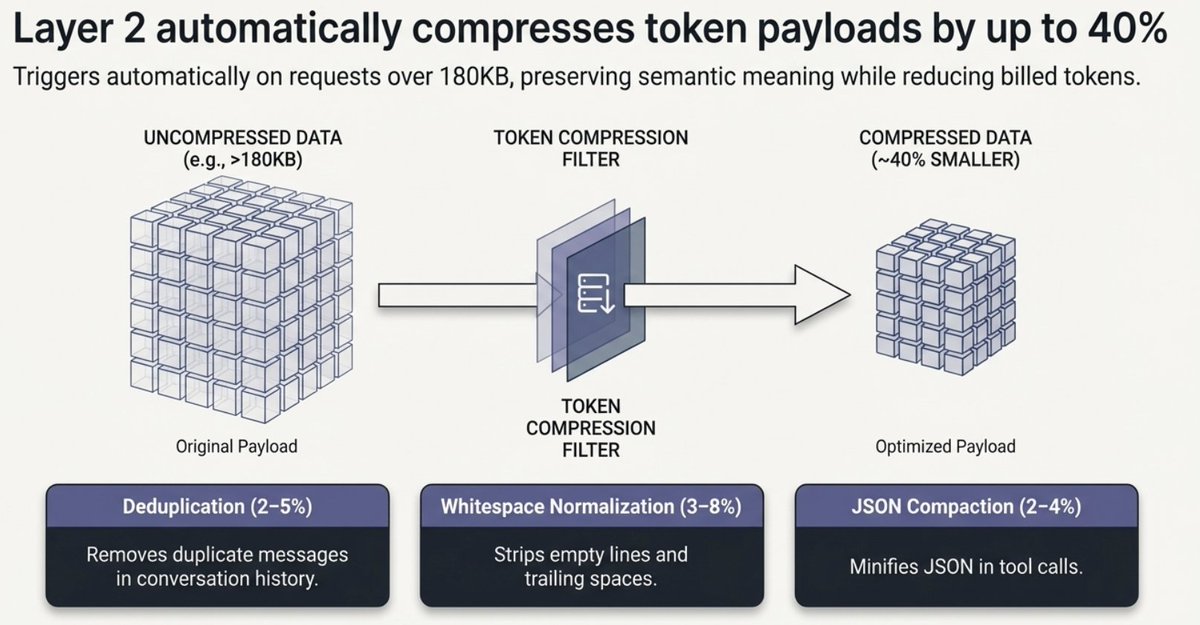
即便请求确实需要发给 Claude,ClawRouter 也会减少你需要付费的 token 数。代理会在把请求发给提供方之前,对你的请求运行多层压缩流水线——而你的计费以压缩后的 token 数为准,而不是原始 token 数。

这三层机制都默认开启,并且完全安全——不会改变语义含义。压缩会在请求大于 180KB 时自动触发(在智能体工作流和长对话里非常常见)。

对于智能体占比高的负载(长工具输出、多轮对话),节省会更大。一个可选的观测压缩层最多可以把巨大的工具输出压缩 97%——把 10KB 的冗长日志输出变成 300 个字符的关键信息。

典型叠加节省:每次请求少 7–15% 的 token。在长上下文的智能体负载中:20–40%。

这在昂贵模型上最关键。如果你把一段 50K token 的智能体对话发给 Claude Sonnet,15% 的压缩每次请求能省大约 ~$0.03——规模化之后就是实打实的钱。

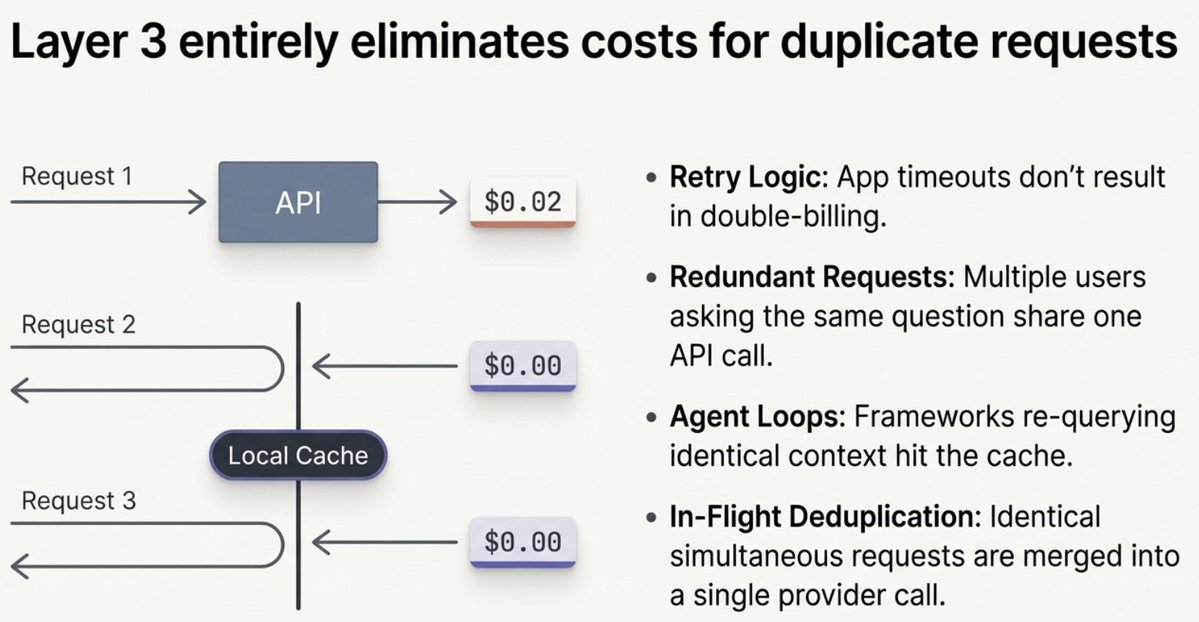
第三层:响应缓存 + 请求去重(省 100%)

ClawRouter 会在本地缓存响应。如果你的应用在 10 分钟内发送了同样的请求,你会立即拿到响应,并且零成本——不发 API 调用,也不会计费 token。

这种情况比你想象得更常见:

  • 重试逻辑 —— 应用超时会重试。没有去重就会付两次钱;有了 ClawRouter,重试会直接从缓存命中并立刻返回。

  • 冗余请求 —— 多个用户或进程问同一个问题?一次 API 调用,多次复用响应。

  • 智能体循环 —— 智能体框架经常带着相同上下文重复查询。缓存可以抓住这些。

Request 1: "Summarize this document" → API call → $0.02 → cached
Request 2: "Summarize this document" → cache hit → $0.00 → instant
Request 3: "Summarize this document" → cache hit → $0.00 → instant

去重器还会捕捉“飞行中”的重复请求:如果两条完全相同的请求同时到达,只有一条会发给提供方。两位调用方都会拿到同一份响应。

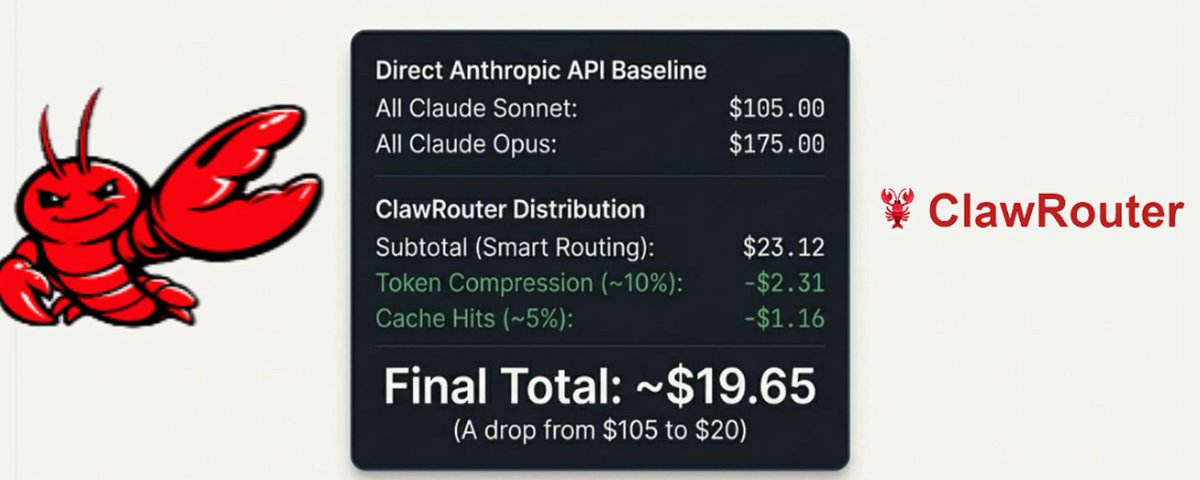
成本测算(诚实数字)

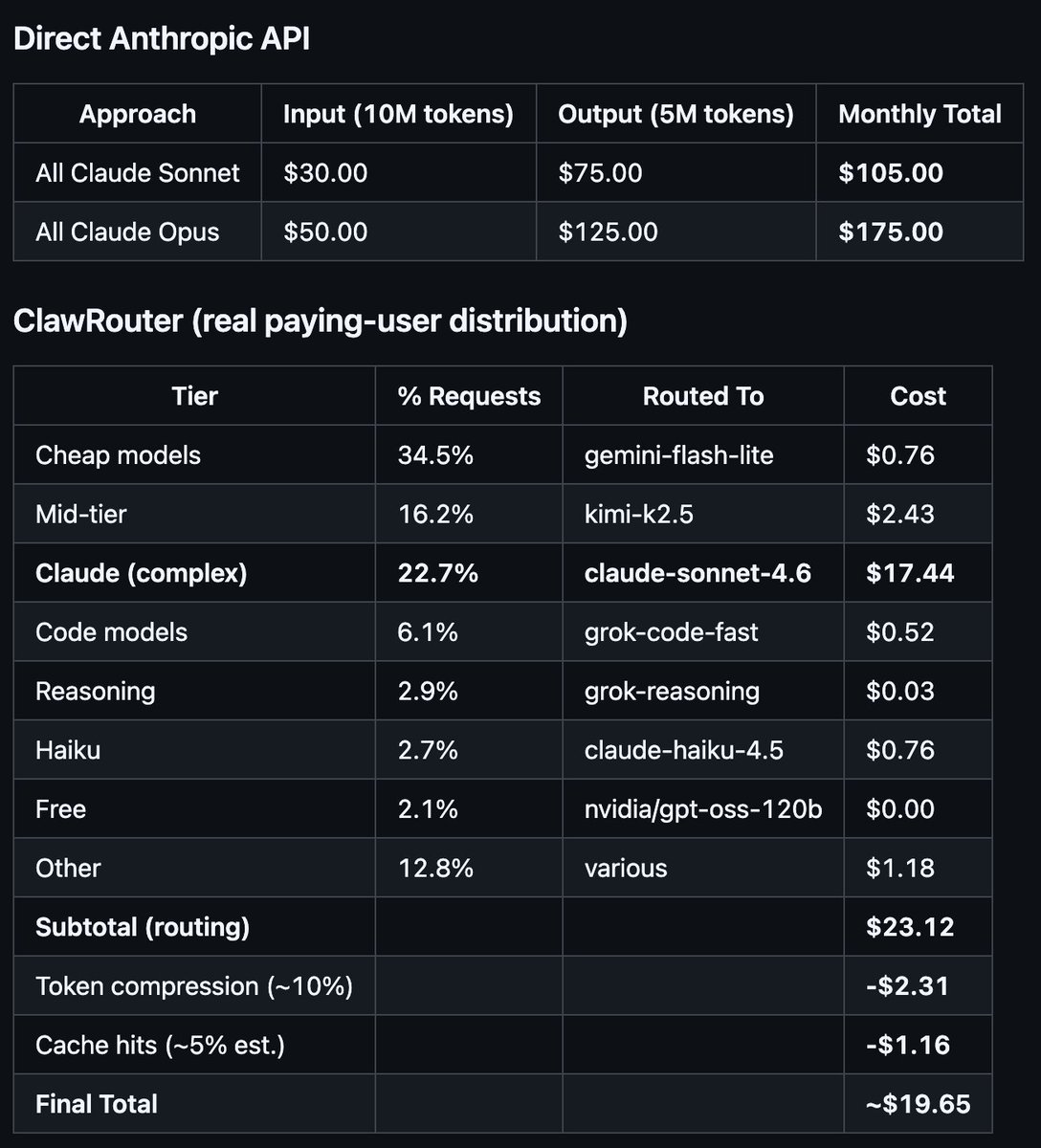
每月 10,000 个混合请求,平均每个请求 1,000 input tokens 和 500 output tokens。

https://github.com/blockrunai/ClawRouter

快速开始:3 分钟

1. 安装并启用智能路由

curl -fsSL https://blockrun.ai/ClawRouter-update | bash

openclaw gateway restart

2. 在 Base 或 Solana 上用 USDC 给你的钱包充值(安装时会打印地址)

$5 足够支撑成千上万次请求

链接:

  • GitHub 上的 ClawRouter — MIT 许可证

  • BlockRun — AI 模型市场

成本数据来自真实生产环境中付费用户的流量,覆盖 20,000+ 次请求,时间为 2026 年 3 月。节省幅度因负载而异——智能体更重、上下文更长的负载会获得更大的压缩收益。ClawRouter 是开源项目,也是 BlockRun 生态的一部分。

Link: http://x.com/i/article/2030130545158402048

You love Claude. Your wallet doesn't. Here's how to keep frontier-quality answers — at a fraction of the cost.

你爱 Claude,你的钱包却不爱。下面教你如何用更低成本,继续拿到前沿级质量的答案。

The Problem: Claude Is Brilliant, But Expensive

If you're building with the Anthropic API, you already know Claude is the best reasoning model available.

  • Opus 4.6 runs $5/$25 per million tokens.

  • Sonnet at $3/$15.

  • Even Haiku costs $1/$5.

But here's what most developers won't admit: the majority of your API calls don't need Claude.

Think about your typical workload. You're building a SaaS app. Some requests need Claude's reasoning — debugging complex code, analyzing long documents, orchestrating multi-step agent workflows. But most requests are mundane: extracting JSON from text, answering simple user questions, translating a string, summarizing a paragraph.

You're paying $3-25 per million tokens for work that a $0.10 model handles identically.

The problem is simple: you're paying Claude rates on 100% of your requests, but only ~30% of them need Claude.

问题:Claude 很强,但很贵

如果你在用 Anthropic API 做产品,你肯定已经知道:Claude 是目前最强的推理模型之一。

  • Opus 4.6:每百万 token $5/$25。

  • Sonnet:每百万 token $3/$15。

  • 就连 Haiku 也要:每百万 token $1/$5。

但有件事,大多数开发者不太愿意承认:你绝大多数的 API 调用其实并不需要 Claude。

想想你日常的工作负载。你在做一个 SaaS 应用。有些请求确实需要 Claude 的推理能力——调试复杂代码、分析长文档、编排多步骤的智能体工作流。但更多请求其实很“日常”:从文本里抽取 JSON、回答简单用户问题、翻译一段字符串、总结一段话。

你在为每百万 token $3–$25 的价位买单,而这些活儿用一个 $0.10 的模型做出来几乎一模一样。

问题很简单:你把 Claude 的价格用在了 100% 的请求上,但真正需要 Claude 的可能只有大约 30%。

What Does a Typical Developer Workload Look Like?

https://github.com/blockrunai/ClawRouter

The Everyday Tasks (~70% of requests)

These are the requests you fire off constantly and barely think about:

  • "Extract the name and email from this text and return JSON" — Any model can do this. You're paying Claude $15/M output tokens for structured extraction that a $0.40 model handles perfectly.

  • "Summarize this customer support ticket in 2 sentences" — Summarization is a solved problem. You don't need frontier reasoning here.

  • "Translate this error message to Spanish" — Translation is a commodity task. Paying Claude rates for it is like taking a Lamborghini to the grocery store.

  • "What's the difference between useEffect and useLayoutEffect?" — Factual Q&A. Every model gets this right.

  • "Convert this CSV data to a markdown table" — Pure formatting. A free model does this identically.

The Tasks That Actually Need Claude (~30% of requests)

This is where you're paying for real value:

  • Complex code generation — "Refactor this authentication module to support OAuth2 + PKCE, handle token refresh, and add rate limiting." Multi-file, multi-constraint reasoning. Claude earns its price here.

  • Long-document analysis — "Read this 50-page contract and identify all clauses that could expose us to liability over $1M." Context window + reasoning quality matter.

  • Multi-step agent orchestration — "Scan these 5 APIs, cross-reference the data, and generate a report with recommendations." Agentic workflows where the model needs to maintain a plan across many steps.

  • Advanced reasoning — "Debug this race condition in our distributed system" or "Prove this algorithm is O(n log n)." Tasks where cheaper models lose the thread.

典型开发者的工作负载是什么样的?

https://github.com/blockrunai/ClawRouter

日常任务(约 70% 的请求)

这些请求你会不停地发,甚至都不怎么需要动脑:

  • “从这段文字里抽取姓名和邮箱并返回 JSON” —— 任何模型都能做。你却在为结构化抽取付 Claude 的 $15/M 输出 token,而一个 $0.40 的模型也能做得完全没问题。

  • “把这条客服工单用两句话总结” —— 总结早就是成熟题了,这里不需要前沿级推理。

  • “把这条报错信息翻译成西班牙语” —— 翻译是典型的商品化任务。用 Claude 的价格做翻译,就像开着兰博基尼去买菜。

  • “useEffect 和 useLayoutEffect 有什么区别?” —— 事实性问答。基本所有模型都能答对。

  • “把这份 CSV 数据转换成 markdown 表格” —— 纯格式转换。免费模型也能做到一模一样。

真正需要 Claude 的任务(约 30% 的请求)

这里你付的钱才是在买真正的价值:

  • 复杂代码生成 —— “把这个认证模块重构为支持 OAuth2 + PKCE,处理 token refresh,并加上限流。”这是多文件、多约束的推理工作,Claude 在这里确实值回票价。

  • 长文档分析 —— “读完这份 50 页的合同,找出所有可能让我们承担超过 $1M 责任的条款。”上下文窗口与推理质量在这里至关重要。

  • 多步骤智能体编排 —— “扫描这 5 个 API,交叉核对数据,并生成带建议的报告。”这类智能体工作流要求模型在许多步骤中持续维护计划。

  • 高级推理 —— “调试我们分布式系统里的竞态条件”或“证明这个算法是 O(n log n)。”便宜模型在这种任务里很容易跟丢线索。

The Solution: ClawRouter

ClawRouter is an open-source local proxy that sits between your app and 41+ AI models. It saves you money in three ways: smart routing, token optimization, and response caching. 5K stars on Github within 1 month. https://github.com/BlockRunAI/clawrouter

解决方案:ClawRouter

ClawRouter 是一个开源的本地代理,位于你的应用与 41+ 个 AI 模型之间。它通过三种方式帮你省钱:智能路由token 优化、以及响应缓存。上线 1 个月在 Github 拿到 5K stars。https://github.com/BlockRunAI/clawrouter

How You Save: Three Layers

Layer 1: Smart Routing (the biggest win)

ClawRouter scores every prompt against 14 dimensions in <1ms and routes it to the cheapest model that can handle the task.

Result: 77% of requests go to models that cost 5-150x less than Sonnet. Only the ~23% that genuinely need Claude still go to Claude.

Layer 2: Token Compression (saves on every request)

Even when a request does go to Claude, ClawRouter reduces the tokens you pay for. The proxy runs a multi-layer compression pipeline on your request before sending it to the provider — and you pay based on the compressed token count, not the original.

These three layers are enabled by default and are completely safe — they don't change semantic meaning. The compression triggers automatically on requests larger than 180KB (common in agent workflows and long conversations).

For agent-heavy workloads (long tool outputs, multi-turn conversations), the savings are even larger. An optional observation compression layer can reduce massive tool outputs by up to 97% — turning 10KB of verbose log output into 300 characters of essential information.

Typical combined savings: 7-15% fewer tokens per request. On long-context agent workloads: 20-40%.

This matters most on expensive models. If you're sending a 50K-token agent conversation to Claude Sonnet, 15% compression saves ~$0.03 per request — that adds up to real money at scale.

Layer 3: Response Cache + Request Deduplication (saves 100%)

ClawRouter caches responses locally. If your app sends the same request within 10 minutes, you get an instant response at zero cost — no API call, no tokens billed.

This is more common than you'd think:

  • Retry logic — Your app retries on timeout. Without dedup, you pay twice. With ClawRouter, the retry resolves from cache instantly.

  • Redundant requests — Multiple users or processes asking the same thing? One API call, multiple responses.

  • Agent loops — Agentic frameworks often re-query with identical context. Cache catches these.

Request 1: "Summarize this document" → API call → $0.02 → cached Request 2: "Summarize this document" → cache hit → $0.00 → instant Request 3: "Summarize this document" → cache hit → $0.00 → instant

The deduplicator also catches in-flight duplicates: if two identical requests arrive simultaneously, only one goes to the provider. Both callers get the same response.

你如何省钱:三层机制

第一层:智能路由(收益最大)

ClawRouter 会在 <1ms 内从 14 个维度为每条提示词打分,并把它路由到能胜任任务的最便宜模型。

结果:77% 的请求会被分配到比 Sonnet 便宜 5–150 倍的模型上。只有真正需要 Claude 的那约 23% 才仍然交给 Claude。

第二层:Token 压缩(每次请求都省)

即便请求确实需要发给 Claude,ClawRouter 也会减少你需要付费的 token 数。代理会在把请求发给提供方之前,对你的请求运行多层压缩流水线——而你的计费以压缩后的 token 数为准,而不是原始 token 数。

这三层机制都默认开启,并且完全安全——不会改变语义含义。压缩会在请求大于 180KB 时自动触发(在智能体工作流和长对话里非常常见)。

对于智能体占比高的负载(长工具输出、多轮对话),节省会更大。一个可选的观测压缩层最多可以把巨大的工具输出压缩 97%——把 10KB 的冗长日志输出变成 300 个字符的关键信息。

典型叠加节省:每次请求少 7–15% 的 token。在长上下文的智能体负载中:20–40%。

这在昂贵模型上最关键。如果你把一段 50K token 的智能体对话发给 Claude Sonnet,15% 的压缩每次请求能省大约 ~$0.03——规模化之后就是实打实的钱。

第三层:响应缓存 + 请求去重(省 100%)

ClawRouter 会在本地缓存响应。如果你的应用在 10 分钟内发送了同样的请求,你会立即拿到响应,并且零成本——不发 API 调用,也不会计费 token。

这种情况比你想象得更常见:

  • 重试逻辑 —— 应用超时会重试。没有去重就会付两次钱;有了 ClawRouter,重试会直接从缓存命中并立刻返回。

  • 冗余请求 —— 多个用户或进程问同一个问题?一次 API 调用,多次复用响应。

  • 智能体循环 —— 智能体框架经常带着相同上下文重复查询。缓存可以抓住这些。

Request 1: "Summarize this document" → API call → $0.02 → cached
Request 2: "Summarize this document" → cache hit → $0.00 → instant
Request 3: "Summarize this document" → cache hit → $0.00 → instant

去重器还会捕捉“飞行中”的重复请求:如果两条完全相同的请求同时到达,只有一条会发给提供方。两位调用方都会拿到同一份响应。

The Cost Math (Honest Numbers)

10,000 mixed requests per month, averaging 1,000 input tokens and 500 output tokens each.

https://github.com/blockrunai/ClawRouter

成本测算(诚实数字)

每月 10,000 个混合请求,平均每个请求 1,000 input tokens 和 500 output tokens。

https://github.com/blockrunai/ClawRouter

Getting Started: 3 Minutes

1. Install with smart routing enabled

curl -fsSL https://blockrun.ai/ClawRouter-update | bash

openclaw gateway restart

2. Fund your wallet with USDC on Base or Solana (address printed on install)

$5 is enough for thousands of requests

Links:

  • ClawRouter on GitHub — MIT License

  • BlockRun — AI model marketplace

Cost data based on real production traffic from paying users across 20,000+ requests, March 2026. Savings vary by workload — agent-heavy and long-context workloads see larger compression benefits. ClawRouter is open-source and part of the BlockRun ecosystem.

Link: http://x.com/i/article/2030130545158402048

快速开始:3 分钟

1. 安装并启用智能路由

curl -fsSL https://blockrun.ai/ClawRouter-update | bash

openclaw gateway restart

2. 在 Base 或 Solana 上用 USDC 给你的钱包充值(安装时会打印地址)

$5 足够支撑成千上万次请求

链接:

  • GitHub 上的 ClawRouter — MIT 许可证

  • BlockRun — AI 模型市场

成本数据来自真实生产环境中付费用户的流量,覆盖 20,000+ 次请求,时间为 2026 年 3 月。节省幅度因负载而异——智能体更重、上下文更长的负载会获得更大的压缩收益。ClawRouter 是开源项目,也是 BlockRun 生态的一部分。

Link: http://x.com/i/article/2030130545158402048
相关笔记

You love Claude. Your wallet doesn't. Here's how to keep frontier-quality answers — at a fraction of the cost.

The Problem: Claude Is Brilliant, But Expensive

If you're building with the Anthropic API, you already know Claude is the best reasoning model available.

  • Opus 4.6 runs $5/$25 per million tokens.

  • Sonnet at $3/$15.

  • Even Haiku costs $1/$5.

But here's what most developers won't admit: the majority of your API calls don't need Claude.

Think about your typical workload. You're building a SaaS app. Some requests need Claude's reasoning — debugging complex code, analyzing long documents, orchestrating multi-step agent workflows. But most requests are mundane: extracting JSON from text, answering simple user questions, translating a string, summarizing a paragraph.

You're paying $3-25 per million tokens for work that a $0.10 model handles identically.

The problem is simple: you're paying Claude rates on 100% of your requests, but only ~30% of them need Claude.

What Does a Typical Developer Workload Look Like?

https://github.com/blockrunai/ClawRouter

The Everyday Tasks (~70% of requests)

These are the requests you fire off constantly and barely think about:

  • "Extract the name and email from this text and return JSON" — Any model can do this. You're paying Claude $15/M output tokens for structured extraction that a $0.40 model handles perfectly.

  • "Summarize this customer support ticket in 2 sentences" — Summarization is a solved problem. You don't need frontier reasoning here.

  • "Translate this error message to Spanish" — Translation is a commodity task. Paying Claude rates for it is like taking a Lamborghini to the grocery store.

  • "What's the difference between useEffect and useLayoutEffect?" — Factual Q&A. Every model gets this right.

  • "Convert this CSV data to a markdown table" — Pure formatting. A free model does this identically.

The Tasks That Actually Need Claude (~30% of requests)

This is where you're paying for real value:

  • Complex code generation — "Refactor this authentication module to support OAuth2 + PKCE, handle token refresh, and add rate limiting." Multi-file, multi-constraint reasoning. Claude earns its price here.

  • Long-document analysis — "Read this 50-page contract and identify all clauses that could expose us to liability over $1M." Context window + reasoning quality matter.

  • Multi-step agent orchestration — "Scan these 5 APIs, cross-reference the data, and generate a report with recommendations." Agentic workflows where the model needs to maintain a plan across many steps.

  • Advanced reasoning — "Debug this race condition in our distributed system" or "Prove this algorithm is O(n log n)." Tasks where cheaper models lose the thread.

The Solution: ClawRouter

ClawRouter is an open-source local proxy that sits between your app and 41+ AI models. It saves you money in three ways: smart routing, token optimization, and response caching. 5K stars on Github within 1 month. https://github.com/BlockRunAI/clawrouter

How You Save: Three Layers

Layer 1: Smart Routing (the biggest win)

ClawRouter scores every prompt against 14 dimensions in <1ms and routes it to the cheapest model that can handle the task.

Result: 77% of requests go to models that cost 5-150x less than Sonnet. Only the ~23% that genuinely need Claude still go to Claude.

Layer 2: Token Compression (saves on every request)

Even when a request does go to Claude, ClawRouter reduces the tokens you pay for. The proxy runs a multi-layer compression pipeline on your request before sending it to the provider — and you pay based on the compressed token count, not the original.

These three layers are enabled by default and are completely safe — they don't change semantic meaning. The compression triggers automatically on requests larger than 180KB (common in agent workflows and long conversations).

For agent-heavy workloads (long tool outputs, multi-turn conversations), the savings are even larger. An optional observation compression layer can reduce massive tool outputs by up to 97% — turning 10KB of verbose log output into 300 characters of essential information.

Typical combined savings: 7-15% fewer tokens per request. On long-context agent workloads: 20-40%.

This matters most on expensive models. If you're sending a 50K-token agent conversation to Claude Sonnet, 15% compression saves ~$0.03 per request — that adds up to real money at scale.

Layer 3: Response Cache + Request Deduplication (saves 100%)

ClawRouter caches responses locally. If your app sends the same request within 10 minutes, you get an instant response at zero cost — no API call, no tokens billed.

This is more common than you'd think:

  • Retry logic — Your app retries on timeout. Without dedup, you pay twice. With ClawRouter, the retry resolves from cache instantly.

  • Redundant requests — Multiple users or processes asking the same thing? One API call, multiple responses.

  • Agent loops — Agentic frameworks often re-query with identical context. Cache catches these.

Request 1: "Summarize this document" → API call → $0.02 → cached Request 2: "Summarize this document" → cache hit → $0.00 → instant Request 3: "Summarize this document" → cache hit → $0.00 → instant

The deduplicator also catches in-flight duplicates: if two identical requests arrive simultaneously, only one goes to the provider. Both callers get the same response.

The Cost Math (Honest Numbers)

10,000 mixed requests per month, averaging 1,000 input tokens and 500 output tokens each.

https://github.com/blockrunai/ClawRouter

Getting Started: 3 Minutes

1. Install with smart routing enabled

curl -fsSL https://blockrun.ai/ClawRouter-update | bash

openclaw gateway restart

2. Fund your wallet with USDC on Base or Solana (address printed on install)

$5 is enough for thousands of requests

Links:

  • ClawRouter on GitHub — MIT License

  • BlockRun — AI model marketplace

Cost data based on real production traffic from paying users across 20,000+ requests, March 2026. Savings vary by workload — agent-heavy and long-context workloads see larger compression benefits. ClawRouter is open-source and part of the BlockRun ecosystem.

Link: http://x.com/i/article/2030130545158402048
📋 讨论归档

讨论进行中…