返回列表
🧠 阿头学

AI算力繁荣的反身性本质与顺周期脆弱性

前沿AI算力的爆发并非源于广泛的产业渗透,而是由AI研发、软件工程与量化交易构成的金融反身性闭环驱动,该模式在上升期制造指数级增长,但在宏观逆风下必然引发需求螺旋式崩塌。
打开原文 ↗

2026-09-02 原文链接 ↗
阅读简报
双语对照
完整翻译
原文
讨论归档

核心观点

  • 需求本质是金融反身性:前沿Token约50%的推理收入集中于AI研发、软件工程与量化交易,三者均遵循“算力投入→收入/融资提升→追加算力”的自强化循环,彻底颠覆了传统SaaS线性客户增长的底层逻辑。
  • 任务属性决定模型定价权:有界任务以降本为核心,终将被开源与廉价模型彻底商品化;无界任务以创造增量Alpha为核心,前沿模型凭借技术代差即可垄断高溢价市场,性能差距直接转化为定价壁垒。
  • 繁荣高度顺周期且极度脆弱:当前AI资本开支与VC流动性及美股情绪深度绑定,三大核心需求相互传染,任何宏观冲击或监管收紧都将直接触发15%至50%的需求断崖式收缩。
  • 估值逻辑将发生根本性迁移:资本市场将抛弃对有界任务稳定现金流的溢价,转而重奖能将巨额算力精准配置于长视野无界任务的团队,跨周期资本配置能力将取代短期交付效率成为新估值锚点。

跟我们的关联

  • 对ATou意味着算力采购决策必须与宏观流动性周期强绑定,而非单纯追逐技术指标;下一步需建立反身性压力测试模型,在利率上行或融资放缓前强制将算力栈切换至成本节约型开源模型以锁定现金流安全垫。
  • 对Neta意味着产品定位必须彻底放弃有界短视野红海,全面转向无界长视野任务以获取生存溢价;下一步需重构产品Roadmap,将研发资源强制倾斜至能扩展用户任务时间边界的Agent功能,并建立“Token消耗-用户收入”的即时转化监控体系。
  • 对Uota意味着团队估值与考核逻辑必须从交付确定性转向长视野资本配置能力;下一步需废除短期功能交付率指标,将算力预算投向无界任务的ROI转化率确立为北极星指标,并提前计提去杠杆缓冲以应对顺周期断裂。

讨论引子

1. 量化交易的零和博弈本质无法支撑“支出越多利润越高”的无限循环,当前AI算力繁荣的真实需求底座究竟会在哪个宏观节点破裂? 2. 当开源生态通过蒸馏与微调在半年内抹平技术代差时,前沿实验室宣称的“无界任务垄断权”是否会被彻底证伪,企业应如何制定模型降级预案? 3. 市场若全面转向重奖长视野资本配置而折现稳定现金流,传统SaaS的估值体系将如何重构,哪些依赖有界任务自动化的AI公司会最先遭遇戴维斯双杀?

预计2028年的AI资本支出(AI capex)将超过法国的国家预算。前沿AI实验室(Frontier AI labs)的收入增长曲线几乎可以为任何数字提供合理性支撑。AI需求中的反身性(Reflexivity)是一把双刃剑,现在是时候开始认真探讨这个话题了。

在最新的播客中,@dwarkesh_sp 提出了一个疑问:考虑到前沿智能(frontier intelligence)每吉瓦(GW)算力预期能带来1000亿美元的收入,为什么前沿实验室不在算力上投入更多?按照这个速度,如果 Anthropic 将其所有预期产能都实现货币化,到2026年底其年度经常性收入(ARR)可能达到5000亿美元——这足以使其按营收计算成为全球第三大公司。

目前还没有人在认真讨论AI需求。如今,分析师们为任何供应水平都建模出无限的AI需求,却并未真正拆解这些需求究竟从何而来。但需求极其重要,它决定了前沿实验室能投入多少资本、将使用哪些模型,以及价值最终将流向何处。

以下是我用于思考AI需求、前沿Token(frontier tokens)价值主张以及若干相关议题的分析框架。

我对AI的未来需求极度乐观。但我的框架表明,对前沿Token的需求可能部分具有反身性(reflexive),其本身正由AI繁荣所推动。这固然很好且能加速增长,但也可能向相反方向螺旋式发展。

所有数字均为估算值。

Token作为时间单位

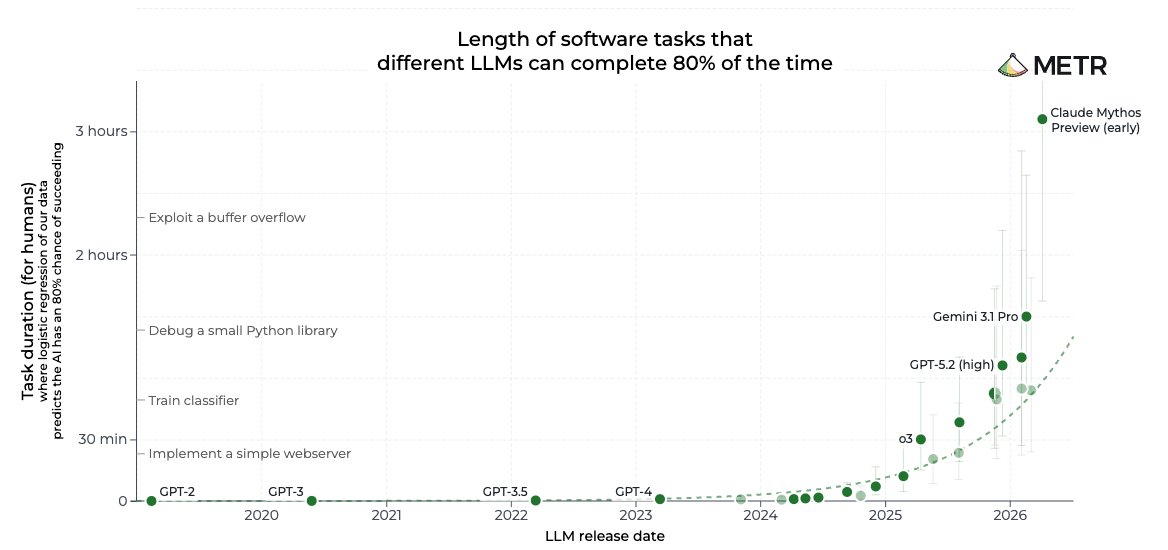
METR 的长视野(long-horizon)图表可能是当今世界上最重要的图表。

“不同大语言模型(LLMs)能在80%的时间内完成的软件任务时长”(METR)。

基于该图表,我常说我们可以将Token视为时间单位。每个模型的Token代表一定的任务视野(task-horizon),而前沿模型拥有最长的持续时间。在图表上,o3 约为30分钟,而 Mythos 约为3小时。使用 o3 的软件工程师可以委派长达30分钟的任务,而使用 Mythos 的工程师则能显著提速——可委派长达3小时的任务。

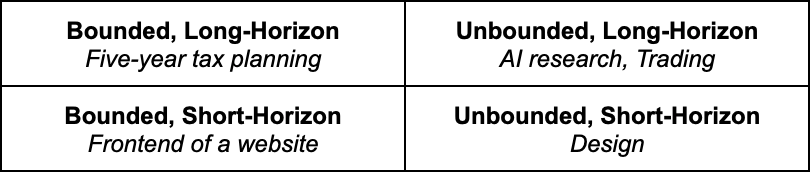
该图表还为构建人类活动提供了一个框架。我们定义如下: - 长视野任务(Long-horizon tasks)与短视野任务(Short-horizon tasks)。“长视野”任务是指目前尚无模型能成功完成的任务——即位于从 GPT-2 到 Mythos 的曲线之上的部分。曲线之下的所有其他任务均为“短视野”任务——实际上,它们已经被AI解决。 - 有界任务(Bounded tasks)与无界任务(Unbounded tasks)。“有界”任务是指曲线在某个点停止扩展的任务:报税是一项有界任务,其复杂度存在上限。“无界”任务是指你总能做得更多的任务:AI研究、太空探索、长寿科学。

劳动力分类法

对AI的需求归根结底是对劳动力的需求。要思考AI需求侧的动态,我们需要一种新的劳动力分类法。想象一个2x2矩阵,将有界/无界类别与长视野/短视野类别结合起来:

有界任务

对于这类任务,AI很快将饱和所有基准测试:你只需相信 METR 的趋势线即可。如今,你可以用任何AI模型轻松一次性(one-shot)完成简单的前端开发(有界、短视野),而税务规划(有界、长视野)可能还需要一两年时间,但我们终将实现。

有界任务也是人们通常希望花费最少时间完成的任务(上行空间有限,主要只是为了不出错)。在此类任务中,对AI的需求将极高,但最终会收敛于最便宜的选项:有界任务的投资回报率(ROI)主要取决于成本节约,而非额外收入(会计需求毕竟有限)。

因此,非前沿模型将占据主导地位:无需为实验室的利润率买单,市场上已有优秀的推理服务提供商,且较小模型的后期训练(post-training)非常有效。开源模型将继续追赶前沿模型——其滞后性对这些任务大多无关紧要,因为你只需将它们自动化一次即可。

无界任务

无界任务则截然不同:顾名思义,你总能做得更多。探索太空,你总能探索得更远。缩小芯片上的节点,你总能缩得更小。改进AI,你总能让它变得更好。你总能构建更多软件,也总需要更新交易策略。

换句话说,无界任务是你希望投入尽可能多时间的任务——这正是前沿Token大多不可妥协的原因。这类任务往往穷尽一生也无法完成。由于这些任务具有极强的凸性(convex)和幂律(power-law)特征,其ROI公式主要聚焦于额外收入而非成本节约。速度越快绝对越好,而竞争动态意味着“抢占先机”是唯一最重要的事。你需要最好的AI模型、该类别中最好的软件、以及Alpha收益(alpha)最高的交易策略。

前沿模型将在此占据主导。就像在F1赛车中一样,赛车只能跑9个月并不重要——你始终需要驾驶性能最好的那一辆。

反身性需求

上述框架如今正在实时上演。

我的观点是,前沿模型前所未有的收入增长是由一小部分无界、长视野任务驱动的。我最好的猜测是:(1)AI研发,(2)软件工程,以及(3)交易。

按此顺序:

AI研发:有传言称,如今的实验室将60%的算力预算用于训练,仅40%用于推理,且可以合理假设全球50%的AI算力容量用于训练。这已足以使AI研发成为明确的第一大用例。但我预计推理预算中也有相当一部分用于某种形式的AI研发。例如,排名靠后的AI实验室使用前沿模型进行研究和合成数据生成,或应用型AI公司进行后期训练。假设前沿AI实验室约20%的推理收入来自AI研发。

软件工程:软件工程显然是AI需求的任务类别,但细微之处在于,此处对前沿Token的大量需求来自初创公司和AI公司,而非传统的财富500强(F500)企业。初创公司不受企业官僚体制的束缚,可以更快、更多地交付代码。交付越多,从客户和投资者那里获得的资金就越多。此外,初创公司之间为争夺市场份额、人才和风险投资(VC)资金而激烈竞争——这种竞争迫使它们使用前沿Token。成熟的AI公司(如 NVIDIA、Amazon 等)也是如此。假设这又占前沿AI实验室推理收入的约15%。

交易:如果量化交易公司是前沿AI Token最大支出者之一的传言属实,且客户在前沿AI Token上的支出呈幂律分布的传言也属实,那么交易占前沿Token收入达到两位数百分比并不会让我感到惊讶。其他投资公司也是如此。假设这也占前沿AI实验室推理收入的15%。

如果这种归因大致正确,那么我们可以说,仅这三类任务就占据了前沿AI实验室推理收入的约50%。

尤其有趣的是,这三类任务在Token支出与收入之间共享一个紧密的反馈循环,使得收入增长具有反身性: - AI研发:AI实验室持续将AI研发支出转化为更强的模型能力,这几乎能即时提升收入与融资能力,进而使实验室能在研发上投入更多,如此循环; - 软件工程:使用AI的初创公司可以快速构建大量软件,借此扩大收入并募集股权资金,随后迅速将这些资源投入更多Token,如此循环; - 交易:交易公司可以即时测试Token支出对市场的影响,利润越高,就能将更多资金再投资于AI驱动的策略,如此循环。

我将这些任务的需求描述为反身性,是因为它们都遵循相同的模式:增加Token支出会带来更多收入和更强的融资能力,这反过来又为它们提供了更多资源来投资Token,如此往复——似乎没有上限。

对于这些任务,唯一的限制是你能向问题分配多少Token。最优秀的公司是那些能够筹集足够资本并将其配置到正确赌注上的公司——正如 Anthropic 率先将重心聚焦于编程所做的那样。这里最妙的一点是,总可寻址市场(TAM)大致是无限的——Token支出拓展了我们可以完成的任务边界,而ROI由更高的收入驱动。

对于这些任务,只有前沿模型才重要。这正是前沿模型如今成为一门极佳生意的原因。反身性需求仅针对前沿模型,即使仅比开源模型领先六个月,也足以抢占整个市场。

相比之下,有界任务正由数十家初创公司解决。这很好且不可避免。然而,此类收入不存在反身性。你或许可以削减成本,但降低成本与增加收入之间没有即时的反馈循环。而且,节省的成本中必须有一部分与RLaaS提供商分享,且成本削减存在上限。

关于开源与闭源之争,或消费者市场与企业市场之争,我将把其中的启示留给读者自行思考。

反身性是一把双刃剑

对前沿Token的反身性需求是一把双刃剑。反身性在上升期表现极佳,在下跌期则极为糟糕。

涉及的数字如此庞大,以至于我们必须考虑前沿Token需求至少暂时收缩的情景。在这种情况下,问题在于关键需求驱动因素是相互关联且高度顺周期(super procyclical)的。

关联性

三大关键任务中任何一项的需求收缩,都可能直接冲击前沿Token收入的15%至20%,并且由于关联性,冲击幅度可能高达50%。

目前的情况是:(i)前沿AI更高的收入推高了实验室的股权价值,这(ii)鼓励了更多风险投资(VC)的投入,其中大部分用于购买Token,这(iii)提升了实验室和初创公司的价值,进而(iv)推动公开市场上行,量化公司从中获利并(v)增加对前沿Token的支出。这只是一个例子,但传染效应可能从该循环中的任何一步开始。

高度顺周期性

这些任务具有高度顺周期性,因为随着周期上行,其需求会加速增长;而当周期下行时,其需求也可能向相反方向加速萎缩。

市场状况直接影响这三大关键驱动因素的需求。市场上行允许量化交易公司在Token上投入更多,同时也为AI实验室和初创公司提供了更多可投资资本。

在此框架下,可能只需要一个简单的触发因素,就会引发向下的反身性修正。例如,我脑海中立刻浮现的有: - 监管放缓AI能力的进展; - 更高的利率减缓基础设施建设(buildout); - 任何外部冲击。

AI需求模型

显然,我们需要一个前沿Token需求模型。

高度顺周期且强关联的需求是脆弱的。尽管一路走来有些波折,但 ChatGPT 的首次发布几乎与纳斯达克最近的相对底部重合,此后私募和公开市场均一路向右上方攀升。我们甚至尚未探讨AI实验室收入潜在放缓将如何影响市场。这种情况短期内不太可能发生(下一代模型可能成为加速的催化剂),但正因如此,现在正是思考该话题的绝佳时机。

鉴于当前年度AI资本支出和收入的水平,一个AI需求模型将与我们现有的供应模型形成互补,并为关键投资决策(从融资到投资)提供依据,尤其是对于那些暴露于基础设施建设中的公司而言。上述框架或许可以作为一个起点。

延伸价值

需求模型还应为基础设施建设之外的资本配置提供指导。价值将持续累积于实体AI供应链。但尽管较少被讨论,价值也将累积于那些致力于无界、长视野任务的团队。

在大约十年内,当今由有界任务产生的大部分价值将从人类劳动力转移至数据中心。从财务角度看,可以将这些任务的劳动力GDP(labor GDP)按一定比例削减,并将其转移至AI供应链。非前沿模型将主导业务量,人们可能仍能赚钱(从事销售、设计和部分长视野规划),但极少有价值会累积到公司层面。

我预计大部分价值将累积于无界任务。特别是那些能够向世界证明其有能力配置资本支出(即Token)以追求这些长视野、无界任务的团队。这是超越模型能力的领域:你始终可以以更长的视野进行思考,我们将看到创始人去追求那些在今天需要耗费几代人才能构建的公司。其中一部分可能是AI实验室本身,另一部分将是新公司。

如今,市场奖励经常性、可预测的现金流——并厌恶那些短期内看不到有形结果的研发和资本支出。未来,我们可能会看到相反的情况:市场将大幅折现来自有界任务的可重复现金流,同时重新定价那些能够明智地进行长期资本配置的团队。

Elon Musk 并非异常现象——他是这一趋势的首个例证。Tesla 和 SpaceX 的交易估值是传统金融分析师按其现金流定价的10倍。但市场一贯地为 Elon 将研发支出配置于任何理性人认为不可能之事的能力进行定价。随着超级智能(superintelligence)的到来,将会出现更多个 Elon。

此处还有更多可探讨的内容——但这留待日后另文详述。

AI capex for 2028 is forecast to be larger than the budget of France. Frontier AI labs’ revenue ramp justifies almost any number. Reflexivity in AI demand is a double-edged sword, and it's now a good time to start talking about it.

预计2028年的AI资本支出(AI capex)将超过法国的国家预算。前沿AI实验室(Frontier AI labs)的收入增长曲线几乎可以为任何数字提供合理性支撑。AI需求中的反身性(Reflexivity)是一把双刃剑,现在是时候开始认真探讨这个话题了。

On his latest podcast, @dwarkesh_sp wonders why the frontier labs are not spending even more on compute, given expectations of $100B/GW in revenue for frontier intelligence. At these rates, if Anthropic were to monetize all of its expected capacity, it could be at $500B ARR by the end of 2026 - enough to be the third-largest company in the world by revenue.

在最新的播客中,@dwarkesh_sp 提出了一个疑问:考虑到前沿智能(frontier intelligence)每吉瓦(GW)算力预期能带来1000亿美元的收入,为什么前沿实验室不在算力上投入更多?按照这个速度,如果 Anthropic 将其所有预期产能都实现货币化,到2026年底其年度经常性收入(ARR)可能达到5000亿美元——这足以使其按营收计算成为全球第三大公司。

Nobody is talking seriously about AI demand. Today, analysts model infinite demand for AI for any level of supply, without really breaking down where that demand is coming from. But demand is extremely important, it dictates how much capital frontier labs can invest, which models will be used, and where the value will accrue.

目前还没有人在认真讨论AI需求。如今,分析师们为任何供应水平都建模出无限的AI需求,却并未真正拆解这些需求究竟从何而来。但需求极其重要,它决定了前沿实验室能投入多少资本、将使用哪些模型,以及价值最终将流向何处。

Below is my framework for thinking about AI demand, the case for frontier tokens, and a few adjacent topics.

以下是我用于思考AI需求、前沿Token(frontier tokens)价值主张以及若干相关议题的分析框架。

I am extremely optimistic about future demand for AI. But my framework suggests that demand for frontier tokens may be partly reflexive, fueled by the AI boom itself. This is great and accelerates growth, but it may also spiral in the opposite direction.

我对AI的未来需求极度乐观。但我的框架表明,对前沿Token的需求可能部分具有反身性(reflexive),其本身正由AI繁荣所推动。这固然很好且能加速增长,但也可能向相反方向螺旋式发展。

All numbers are estimates.

所有数字均为估算值。

Tokens as units of time

Token作为时间单位

METR’s long-horizon chart is possibly the most important chart in the world today.

METR 的长视野(long-horizon)图表可能是当今世界上最重要的图表。

"Length of software tasks that different LLMs can complete 80% of the time" (METR).

“不同大语言模型(LLMs)能在80%的时间内完成的软件任务时长”(METR)。

Based on the chart, I often say we can think about tokens as units of time. Tokens from each model represent a certain task-horizon, and frontier models have the longest duration. On the chart, o3 is ~ 30 min, while Mythos is ~ 3h. A software engineer using o3 can delegate tasks of up to 30 min, while one using Mythos is significantly sped up - delegating up to 3h.

基于该图表,我常说我们可以将Token视为时间单位。每个模型的Token代表一定的任务视野(task-horizon),而前沿模型拥有最长的持续时间。在图表上,o3 约为30分钟,而 Mythos 约为3小时。使用 o3 的软件工程师可以委派长达30分钟的任务,而使用 Mythos 的工程师则能显著提速——可委派长达3小时的任务。

The chart also provides a framework for structuring human activities. Let’s define:

该图表还为构建人类活动提供了一个框架。我们定义如下:

Long-horizon vs. short-horizon tasks. “Long-horizon” tasks are the ones that no model succeeds at yet - i.e., above the curve which runs from GPT-2 to Mythos. Everything else, below the curve, is “short-horizon” - effectively, it’s already been solved by AI.

  • 长视野任务(Long-horizon tasks)与短视野任务(Short-horizon tasks)。“长视野”任务是指目前尚无模型能成功完成的任务——即位于从 GPT-2 到 Mythos 的曲线之上的部分。曲线之下的所有其他任务均为“短视野”任务——实际上,它们已经被AI解决。

Bounded vs. unbounded tasks. “Bounded” tasks are those for which, at some point, the curve stops scaling: doing taxes is a bounded task, there’s a limit to its complexity. “Unbounded” tasks are those for which you can always do more: AI research, exploring space, longevity.

  • 有界任务(Bounded tasks)与无界任务(Unbounded tasks)。“有界”任务是指曲线在某个点停止扩展的任务:报税是一项有界任务,其复杂度存在上限。“无界”任务是指你总能做得更多的任务:AI研究、太空探索、长寿科学。

Labor taxonomy

劳动力分类法

Demand for AI is ultimately demand for labor. And to think about AI demand-side dynamics, we need a new labor taxonomy. Imagine a 2-by-2 matrix, combining the bounded-unbounded categories with long-horizon and short-horizon ones:

对AI的需求归根结底是对劳动力的需求。要思考AI需求侧的动态,我们需要一种新的劳动力分类法。想象一个2x2矩阵,将有界/无界类别与长视野/短视野类别结合起来:

Bounded Tasks

有界任务

For these tasks, AI will soon saturate all benchmarks: one can just trust METR’s trendline. You can easily one-shot a simple frontend (bounded, short-horizon) with any AI model today, while tax planning (bounded, long-horizon) may take another year or two, but we’ll get there.

对于这类任务,AI很快将饱和所有基准测试:你只需相信 METR 的趋势线即可。如今,你可以用任何AI模型轻松一次性(one-shot)完成简单的前端开发(有界、短视野),而税务规划(有界、长视野)可能还需要一两年时间,但我们终将实现。

Bounded tasks are also those for which one would generally like to spend the least amount of time possible (little upside, mostly just a matter of not making mistakes). Here, demand for AI will be extremely high, but converge on the cheapest possible option: the ROI for bounded tasks is mostly a function of cost savings rather than additional revenue (there’s only so much demand for accounting).

有界任务也是人们通常希望花费最少时间完成的任务(上行空间有限,主要只是为了不出错)。在此类任务中,对AI的需求将极高,但最终会收敛于最便宜的选项:有界任务的投资回报率(ROI)主要取决于成本节约,而非额外收入(会计需求毕竟有限)。

Therefore, non-frontier models will dominate: no need to pay for the labs’ margins, great inference providers are available, and post-training of smaller models is effective. And open source models will continue to catch up with the frontier - with a lag that is mostly irrelevant for these tasks, since you just have to automate them once.

因此,非前沿模型将占据主导地位:无需为实验室的利润率买单,市场上已有优秀的推理服务提供商,且较小模型的后期训练(post-training)非常有效。开源模型将继续追赶前沿模型——其滞后性对这些任务大多无关紧要,因为你只需将它们自动化一次即可。

Unbounded Tasks

无界任务

Unbounded tasks are very different: by definition, you can always do more. Exploring space, you can always explore further. Shrinking the node on a chip, you can always shrink it more. Improving AI, you will always be able to make it better. And you can always build more software, and you always need to update trading strategies.

无界任务则截然不同:顾名思义,你总能做得更多。探索太空,你总能探索得更远。缩小芯片上的节点,你总能缩得更小。改进AI,你总能让它变得更好。你总能构建更多软件,也总需要更新交易策略。

In other words, unbounded tasks are those for which you’d want to spend as much time as possible - that’s why frontier tokens are mostly non-negotiable. These are the kinds of tasks for which one life is often not enough. Due to the very convex, power-law nature of these tasks, the ROI equation is mostly focused on additional revenue rather than cost savings. Going faster is strictly better, and competitive dynamics mean that being first is the single most important thing. You want the best AI model, the best software in the category, the trading strategy with the most alpha.

换句话说,无界任务是你希望投入尽可能多时间的任务——这正是前沿Token大多不可妥协的原因。这类任务往往穷尽一生也无法完成。由于这些任务具有极强的凸性(convex)和幂律(power-law)特征,其ROI公式主要聚焦于额外收入而非成本节约。速度越快绝对越好,而竞争动态意味着“抢占先机”是唯一最重要的事。你需要最好的AI模型、该类别中最好的软件、以及Alpha收益(alpha)最高的交易策略。

Frontier models will dominate here. Just like in F1, it doesn't matter if the car only lasts 9 months - you always need to drive the best possible one.

前沿模型将在此占据主导。就像在F1赛车中一样,赛车只能跑9个月并不重要——你始终需要驾驶性能最好的那一辆。

Reflexive demand

反身性需求

The framework described above is already playing out today, in real time.

上述框架如今正在实时上演。

My view is that the unprecedented revenue ramp for frontier models is driven by a small set of unbounded, long-horizon tasks. My best guess is: (1) AI R&D, (2) software engineering, and (3) trading.

我的观点是,前沿模型前所未有的收入增长是由一小部分无界、长视野任务驱动的。我最好的猜测是:(1)AI研发,(2)软件工程,以及(3)交易。

In that order:

按此顺序:

AI R&D: Rumor has it that labs today spend 60% of their compute budget on training and only 40% on inference, and it’s fair to assume that 50% of the world’s AI compute capacity is used for training. That would already make AI R&D the clear #1 use case. But I’d also expect a significant portion of the inference bucket to be some form of AI R&D. For instance, runner-up AI labs using frontier models for research and synthetic data generation, or the applied AI companies doing post-training. Let’s say ~ 20% of inference revenue for the frontier AI labs is coming from AI R&D.

AI研发:有传言称,如今的实验室将60%的算力预算用于训练,仅40%用于推理,且可以合理假设全球50%的AI算力容量用于训练。这已足以使AI研发成为明确的第一大用例。但我预计推理预算中也有相当一部分用于某种形式的AI研发。例如,排名靠后的AI实验室使用前沿模型进行研究和合成数据生成,或应用型AI公司进行后期训练。假设前沿AI实验室约20%的推理收入来自AI研发。

Software engineering: Software engineering is the obvious task category for AI demand, but the nuance is that a large chunk of the demand for frontier tokens here is coming from startups and AI companies - not traditional F500 companies. Startups are unconstrained by corporate bureaucracy, and can just ship more code, faster. The more they ship, the more money from clients and investors. Additionally, startups compete fiercely with each other for market share, talent, and VC money - and competition forces them to use frontier tokens. The same goes for the mature AI companies (NVIDIA, Amazon, etc.). Let’s say this is another ~ 15% of inference revenue for the frontier AI labs.

软件工程:软件工程显然是AI需求的任务类别,但细微之处在于,此处对前沿Token的大量需求来自初创公司和AI公司,而非传统的财富500强(F500)企业。初创公司不受企业官僚体制的束缚,可以更快、更多地交付代码。交付越多,从客户和投资者那里获得的资金就越多。此外,初创公司之间为争夺市场份额、人才和风险投资(VC)资金而激烈竞争——这种竞争迫使它们使用前沿Token。成熟的AI公司(如 NVIDIA、Amazon 等)也是如此。假设这又占前沿AI实验室推理收入的约15%。

Trading: If rumors that quant trading firms are some of the largest spenders on frontier AI tokens are true, and if rumors that spend on frontier AI tokens by customers is power-law distributed are true, then it wouldn’t surprise me to see trading as a double-digit percentage of frontier token revenue. This holds for other investment firms as well. Let’s say this too is 15% of inference revenue for the frontier AI labs.

交易:如果量化交易公司是前沿AI Token最大支出者之一的传言属实,且客户在前沿AI Token上的支出呈幂律分布的传言也属实,那么交易占前沿Token收入达到两位数百分比并不会让我感到惊讶。其他投资公司也是如此。假设这也占前沿AI实验室推理收入的15%。

If this attribution is roughly right, then we could say that these three categories of tasks alone account for ~ 50% of frontier AI lab inference revenue.

如果这种归因大致正确,那么我们可以说,仅这三类任务就占据了前沿AI实验室推理收入的约50%。

What is especially interesting is that these three sets share a tight feedback loop between token spend and revenue, such that revenue growth is reflexive:

尤其有趣的是,这三类任务在Token支出与收入之间共享一个紧密的反馈循环,使得收入增长具有反身性:

AI R&D: AI labs have consistently translated AI R&D spend into stronger model capabilities, which increase revenue and the ability to raise capital almost instantaneously, and in turn allow the labs to spend more on R&D, and so on;

  • AI研发:AI实验室持续将AI研发支出转化为更强的模型能力,这几乎能即时提升收入与融资能力,进而使实验室能在研发上投入更多,如此循环;

Software engineering: A startup using AI can build a lot of software fast, use that to scale revenue and raise equity, and quickly deploy those resources on even more tokens, and so on;

  • 软件工程:使用AI的初创公司可以快速构建大量软件,借此扩大收入并募集股权资金,随后迅速将这些资源投入更多Token,如此循环;

Trading: A trading firm can test the impact of token spend instantaneously on the market, and the higher the profits, the more it can reinvest in AI-powered strategies, and so on.

  • 交易:交易公司可以即时测试Token支出对市场的影响,利润越高,就能将更多资金再投资于AI驱动的策略,如此循环。

I describe demand for these tasks as reflexive because they all share the same pattern: larger spend on tokens yields more revenue and a stronger ability to raise capital, which in turn gives them more resources to invest in tokens, and so on - seemingly with no upper bound.

我将这些任务的需求描述为反身性,是因为它们都遵循相同的模式:增加Token支出会带来更多收入和更强的融资能力,这反过来又为它们提供了更多资源来投资Token,如此往复——似乎没有上限。

For these tasks, the only constraint is how many tokens you can allocate to the problem. The best companies are the ones that can raise enough capital and allocate it to the right bets - as Anthropic did by being the first to narrow its focus to coding. And the cool thing here is that the total addressable market is roughly infinite - token spend expands the horizon of what we can accomplish, and ROI is driven by higher revenue.

对于这些任务,唯一的限制是你能向问题分配多少Token。最优秀的公司是那些能够筹集足够资本并将其配置到正确赌注上的公司——正如 Anthropic 率先将重心聚焦于编程所做的那样。这里最妙的一点是,总可寻址市场(TAM)大致是无限的——Token支出拓展了我们可以完成的任务边界,而ROI由更高的收入驱动。

And for these tasks, only frontier models matter. This is what makes frontier models such a great business today. Reflexive demand is only for frontier models, even a six-month lead over open source is more than enough to capture the whole market.

对于这些任务,只有前沿模型才重要。这正是前沿模型如今成为一门极佳生意的原因。反身性需求仅针对前沿模型,即使仅比开源模型领先六个月,也足以抢占整个市场。

By contrast, bounded tasks are being addressed by dozens and dozens of startups. This is great and inevitable. However, there is no reflexivity for this kind of revenue. You can perhaps cut costs, but there is no immediate feedback loop between lower costs and increased revenue. And a percentage of the cost savings has to be shared with the RLaaS provider, and there’s a ceiling on cost cuts.

相比之下,有界任务正由数十家初创公司解决。这很好且不可避免。然而,此类收入不存在反身性。你或许可以削减成本,但降低成本与增加收入之间没有即时的反馈循环。而且,节省的成本中必须有一部分与RLaaS提供商分享,且成本削减存在上限。

On the debate between open and closed source, or on consumer versus enterprise, I will leave the implications to the reader.

关于开源与闭源之争,或消费者市场与企业市场之争,我将把其中的启示留给读者自行思考。

Reflexivity is double-edged

反身性是一把双刃剑

Reflexive demand for frontier tokens is a double-edged sword. Reflexivity is great on the way up, awful on the way down.

对前沿Token的反身性需求是一把双刃剑。反身性在上升期表现极佳,在下跌期则极为糟糕。

The numbers at stake are so large that one has to consider the scenario where, at least temporarily, demand for frontier tokens contracts. In such a case, the issue is that the key demand drivers are correlated and super procyclical.

涉及的数字如此庞大,以至于我们必须考虑前沿Token需求至少暂时收缩的情景。在这种情况下,问题在于关键需求驱动因素是相互关联且高度顺周期(super procyclical)的。

Correlation

关联性

Demand contraction for any of the three key tasks could hit up to 15–20% of frontier token revenue directly and, due to correlation, up to 50%.

三大关键任务中任何一项的需求收缩,都可能直接冲击前沿Token收入的15%至20%,并且由于关联性,冲击幅度可能高达50%。

Right now: (i) higher revenue for frontier AI drives the equity value of the labs up, which (ii) encourages more investment in VC, a large share of which is spent on tokens, which (iii) increases the value of both labs and startups, and in turn (iv) makes the public markets go up, with the quant firms profiting from it and (v) increasing their spend on frontier tokens. This is just one example, but contagion could start from any of the steps in this loop.

目前的情况是:(i)前沿AI更高的收入推高了实验室的股权价值,这(ii)鼓励了更多风险投资(VC)的投入,其中大部分用于购买Token,这(iii)提升了实验室和初创公司的价值,进而(iv)推动公开市场上行,量化公司从中获利并(v)增加对前沿Token的支出。这只是一个例子,但传染效应可能从该循环中的任何一步开始。

Super procyclicality

高度顺周期性

These tasks are super procyclical because their demand accelerates as the cycle goes up, and may accelerate in the opposite direction when the cycle goes down.

这些任务具有高度顺周期性,因为随着周期上行,其需求会加速增长;而当周期下行时,其需求也可能向相反方向加速萎缩。

The state of the market directly impacts demand for all three key drivers. Market going up allows quant trading firms to spend more on tokens, but also grants AI labs and startups more capital to invest.

市场状况直接影响这三大关键驱动因素的需求。市场上行允许量化交易公司在Token上投入更多,同时也为AI实验室和初创公司提供了更多可投资资本。

Under this framework, you may only need one simple trigger to start a reflexive correction downwards. As examples, off the top of my head:

在此框架下,可能只需要一个简单的触发因素,就会引发向下的反身性修正。例如,我脑海中立刻浮现的有:

Regulation slowing down progress in AI capabilities;

  • 监管放缓AI能力的进展;

Higher interest rates slowing down the buildout;

  • 更高的利率减缓基础设施建设(buildout);

Any exogenous shock.

  • 任何外部冲击。

A model for AI demand

AI需求模型

Obviously, we need a model for frontier token demand.

显然,我们需要一个前沿Token需求模型。

Super procyclical, heavily correlated demand is fragile. While there have been some bumps along the way, the first ChatGPT release almost coincided with the most recent NASDAQ relative bottom, and both private and public markets have gone up and to the right. We haven’t even explored how a potential slowdown in revenue for the AI labs could impact the markets. It’s unlikely that this will happen anytime soon (next-generation models may be a catalyst for acceleration), but precisely for this reason it is now a great time to think about the topic.

高度顺周期且强关联的需求是脆弱的。尽管一路走来有些波折,但 ChatGPT 的首次发布几乎与纳斯达克最近的相对底部重合,此后私募和公开市场均一路向右上方攀升。我们甚至尚未探讨AI实验室收入潜在放缓将如何影响市场。这种情况短期内不太可能发生(下一代模型可能成为加速的催化剂),但正因如此,现在正是思考该话题的绝佳时机。

Given current levels of annual AI capex and revenue, a model for AI demand would complement the one we currently have for supply, and inform critical investment decisions - from financing to investing - especially for the companies exposed to the buildout. The framework above may be a starting point.

鉴于当前年度AI资本支出和收入的水平,一个AI需求模型将与我们现有的供应模型形成互补,并为关键投资决策(从融资到投资)提供依据,尤其是对于那些暴露于基础设施建设中的公司而言。上述框架或许可以作为一个起点。

Value beyond

延伸价值

A model for demand should also inform capital allocation beyond the buildout. Value will keep accruing to the physical AI supply chain. But while less discussed, value will also accrue to teams going after unbounded, long-horizon tasks.

需求模型还应为基础设施建设之外的资本配置提供指导。价值将持续累积于实体AI供应链。但尽管较少被讨论,价值也将累积于那些致力于无界、长视野任务的团队。

Within a decade or so, a large chunk of the value generated by bounded tasks today will be taken from human labor and moved to data centers. Financially, one could take labor GDP for those tasks, apply a percentage cut, and move it to the AI supply chain. Non-frontier models will dominate volumes, people may still make money (doing sales, design, and some long-horizon planning), but little value will accrue to the company.

在大约十年内,当今由有界任务产生的大部分价值将从人类劳动力转移至数据中心。从财务角度看,可以将这些任务的劳动力GDP(labor GDP)按一定比例削减,并将其转移至AI供应链。非前沿模型将主导业务量,人们可能仍能赚钱(从事销售、设计和部分长视野规划),但极少有价值会累积到公司层面。

I expect most of the value to accrue to unbounded tasks. And in particular, to teams that can convince the world of their ability to allocate capex (i.e., tokens) to go after these long-horizon, unbounded tasks. This is the domain outside of model capabilities: you can always think with a longer horizon, and we will see founders going after companies that would take several lifetimes to build today. Some of it may be the AI labs themselves, some of it will be new companies.

我预计大部分价值将累积于无界任务。特别是那些能够向世界证明其有能力配置资本支出(即Token)以追求这些长视野、无界任务的团队。这是超越模型能力的领域:你始终可以以更长的视野进行思考,我们将看到创始人去追求那些在今天需要耗费几代人才能构建的公司。其中一部分可能是AI实验室本身,另一部分将是新公司。

Today, the market rewards recurring, predictable cash flows - and hates R&D and capex spent with no short-term tangible results in sight. In the future, we may see the inverse: the market will heavily discount repeatable cash flow from bounded tasks, while repricing teams that can wisely allocate capex for the long term.

如今,市场奖励经常性、可预测的现金流——并厌恶那些短期内看不到有形结果的研发和资本支出。未来,我们可能会看到相反的情况:市场将大幅折现来自有界任务的可重复现金流,同时重新定价那些能够明智地进行长期资本配置的团队。

Elon Musk is not an anomaly - he’s the first example of this. Tesla and SpaceX trade at 10X what an old-fashioned financial analyst would price their cash flows at. But the market routinely prices Elon’s ability to allocate R&D spend to what any reasonable person would consider impossible. With superintelligence, there will be several more Elons.

Elon Musk 并非异常现象——他是这一趋势的首个例证。Tesla 和 SpaceX 的交易估值是传统金融分析师按其现金流定价的10倍。但市场一贯地为 Elon 将研发支出配置于任何理性人认为不可能之事的能力进行定价。随着超级智能(superintelligence)的到来,将会出现更多个 Elon。

More to say here - but this is a story for another day.

此处还有更多可探讨的内容——但这留待日后另文详述。

AI capex for 2028 is forecast to be larger than the budget of France. Frontier AI labs’ revenue ramp justifies almost any number. Reflexivity in AI demand is a double-edged sword, and it's now a good time to start talking about it. On his latest podcast, @dwarkesh_sp wonders why the frontier labs are not spending even more on compute, given expectations of $100B/GW in revenue for frontier intelligence. At these rates, if Anthropic were to monetize all of its expected capacity, it could be at $500B ARR by the end of 2026 - enough to be the third-largest company in the world by revenue. Nobody is talking seriously about AI demand. Today, analysts model infinite demand for AI for any level of supply, without really breaking down where that demand is coming from. But demand is extremely important, it dictates how much capital frontier labs can invest, which models will be used, and where the value will accrue. Below is my framework for thinking about AI demand, the case for frontier tokens, and a few adjacent topics. I am extremely optimistic about future demand for AI. But my framework suggests that demand for frontier tokens may be partly reflexive, fueled by the AI boom itself. This is great and accelerates growth, but it may also spiral in the opposite direction. All numbers are estimates. Tokens as units of time METR’s long-horizon chart is possibly the most important chart in the world today. "Length of software tasks that different LLMs can complete 80% of the time" (METR). Based on the chart, I often say we can think about tokens as units of time. Tokens from each model represent a certain task-horizon, and frontier models have the longest duration. On the chart, o3 is ~ 30 min, while Mythos is ~ 3h. A software engineer using o3 can delegate tasks of up to 30 min, while one using Mythos is significantly sped up - delegating up to 3h. The chart also provides a framework for structuring human activities. Let’s define: Long-horizon vs. short-horizon tasks. “Long-horizon” tasks are the ones that no model succeeds at yet - i.e., above the curve which runs from GPT-2 to Mythos. Everything else, below the curve, is “short-horizon” - effectively, it’s already been solved by AI. Bounded vs. unbounded tasks. “Bounded” tasks are those for which, at some point, the curve stops scaling: doing taxes is a bounded task, there’s a limit to its complexity. “Unbounded” tasks are those for which you can always do more: AI research, exploring space, longevity. Labor taxonomy Demand for AI is ultimately demand for labor. And to think about AI demand-side dynamics, we need a new labor taxonomy. Imagine a 2-by-2 matrix, combining the bounded-unbounded categories with long-horizon and short-horizon ones: Bounded Tasks For these tasks, AI will soon saturate all benchmarks: one can just trust METR’s trendline. You can easily one-shot a simple frontend (bounded, short-horizon) with any AI model today, while tax planning (bounded, long-horizon) may take another year or two, but we’ll get there. Bounded tasks are also those for which one would generally like to spend the least amount of time possible (little upside, mostly just a matter of not making mistakes). Here, demand for AI will be extremely high, but converge on the cheapest possible option: the ROI for bounded tasks is mostly a function of cost savings rather than additional revenue (there’s only so much demand for accounting). Therefore, non-frontier models will dominate: no need to pay for the labs’ margins, great inference providers are available, and post-training of smaller models is effective. And open source models will continue to catch up with the frontier - with a lag that is mostly irrelevant for these tasks, since you just have to automate them once. Unbounded Tasks Unbounded tasks are very different: by definition, you can always do more. Exploring space, you can always explore further. Shrinking the node on a chip, you can always shrink it more. Improving AI, you will always be able to make it better. And you can always build more software, and you always need to update trading strategies. In other words, unbounded tasks are those for which you’d want to spend as much time as possible - that’s why frontier tokens are mostly non-negotiable. These are the kinds of tasks for which one life is often not enough. Due to the very convex, power-law nature of these tasks, the ROI equation is mostly focused on additional revenue rather than cost savings. Going faster is strictly better, and competitive dynamics mean that being first is the single most important thing. You want the best AI model, the best software in the category, the trading strategy with the most alpha. Frontier models will dominate here. Just like in F1, it doesn't matter if the car only lasts 9 months - you always need to drive the best possible one. Reflexive demand The framework described above is already playing out today, in real time. My view is that the unprecedented revenue ramp for frontier models is driven by a small set of unbounded, long-horizon tasks. My best guess is: (1) AI R&D, (2) software engineering, and (3) trading. In that order: AI R&D: Rumor has it that labs today spend 60% of their compute budget on training and only 40% on inference, and it’s fair to assume that 50% of the world’s AI compute capacity is used for training. That would already make AI R&D the clear #1 use case. But I’d also expect a significant portion of the inference bucket to be some form of AI R&D. For instance, runner-up AI labs using frontier models for research and synthetic data generation, or the applied AI companies doing post-training. Let’s say ~ 20% of inference revenue for the frontier AI labs is coming from AI R&D. Software engineering: Software engineering is the obvious task category for AI demand, but the nuance is that a large chunk of the demand for frontier tokens here is coming from startups and AI companies - not traditional F500 companies. Startups are unconstrained by corporate bureaucracy, and can just ship more code, faster. The more they ship, the more money from clients and investors. Additionally, startups compete fiercely with each other for market share, talent, and VC money - and competition forces them to use frontier tokens. The same goes for the mature AI companies (NVIDIA, Amazon, etc.). Let’s say this is another ~ 15% of inference revenue for the frontier AI labs. Trading: If rumors that quant trading firms are some of the largest spenders on frontier AI tokens are true, and if rumors that spend on frontier AI tokens by customers is power-law distributed are true, then it wouldn’t surprise me to see trading as a double-digit percentage of frontier token revenue. This holds for other investment firms as well. Let’s say this too is 15% of inference revenue for the frontier AI labs. If this attribution is roughly right, then we could say that these three categories of tasks alone account for ~ 50% of frontier AI lab inference revenue. What is especially interesting is that these three sets share a tight feedback loop between token spend and revenue, such that revenue growth is reflexive: AI R&D: AI labs have consistently translated AI R&D spend into stronger model capabilities, which increase revenue and the ability to raise capital almost instantaneously, and in turn allow the labs to spend more on R&D, and so on; Software engineering: A startup using AI can build a lot of software fast, use that to scale revenue and raise equity, and quickly deploy those resources on even more tokens, and so on; Trading: A trading firm can test the impact of token spend instantaneously on the market, and the higher the profits, the more it can reinvest in AI-powered strategies, and so on. I describe demand for these tasks as reflexive because they all share the same pattern: larger spend on tokens yields more revenue and a stronger ability to raise capital, which in turn gives them more resources to invest in tokens, and so on - seemingly with no upper bound. For these tasks, the only constraint is how many tokens you can allocate to the problem. The best companies are the ones that can raise enough capital and allocate it to the right bets - as Anthropic did by being the first to narrow its focus to coding. And the cool thing here is that the total addressable market is roughly infinite - token spend expands the horizon of what we can accomplish, and ROI is driven by higher revenue. And for these tasks, only frontier models matter. This is what makes frontier models such a great business today. Reflexive demand is only for frontier models, even a six-month lead over open source is more than enough to capture the whole market. By contrast, bounded tasks are being addressed by dozens and dozens of startups. This is great and inevitable. However, there is no reflexivity for this kind of revenue. You can perhaps cut costs, but there is no immediate feedback loop between lower costs and increased revenue. And a percentage of the cost savings has to be shared with the RLaaS provider, and there’s a ceiling on cost cuts. On the debate between open and closed source, or on consumer versus enterprise, I will leave the implications to the reader. Reflexivity is double-edged Reflexive demand for frontier tokens is a double-edged sword. Reflexivity is great on the way up, awful on the way down. The numbers at stake are so large that one has to consider the scenario where, at least temporarily, demand for frontier tokens contracts. In such a case, the issue is that the key demand drivers are correlated and super procyclical. Correlation Demand contraction for any of the three key tasks could hit up to 15–20% of frontier token revenue directly and, due to correlation, up to 50%. Right now: (i) higher revenue for frontier AI drives the equity value of the labs up, which (ii) encourages more investment in VC, a large share of which is spent on tokens, which (iii) increases the value of both labs and startups, and in turn (iv) makes the public markets go up, with the quant firms profiting from it and (v) increasing their spend on frontier tokens. This is just one example, but contagion could start from any of the steps in this loop. Super procyclicality These tasks are super procyclical because their demand accelerates as the cycle goes up, and may accelerate in the opposite direction when the cycle goes down. The state of the market directly impacts demand for all three key drivers. Market going up allows quant trading firms to spend more on tokens, but also grants AI labs and startups more capital to invest. Under this framework, you may only need one simple trigger to start a reflexive correction downwards. As examples, off the top of my head: Regulation slowing down progress in AI capabilities; Higher interest rates slowing down the buildout; Any exogenous shock. A model for AI demand Obviously, we need a model for frontier token demand. Super procyclical, heavily correlated demand is fragile. While there have been some bumps along the way, the first ChatGPT release almost coincided with the most recent NASDAQ relative bottom, and both private and public markets have gone up and to the right. We haven’t even explored how a potential slowdown in revenue for the AI labs could impact the markets. It’s unlikely that this will happen anytime soon (next-generation models may be a catalyst for acceleration), but precisely for this reason it is now a great time to think about the topic. Given current levels of annual AI capex and revenue, a model for AI demand would complement the one we currently have for supply, and inform critical investment decisions - from financing to investing - especially for the companies exposed to the buildout. The framework above may be a starting point. Value beyond A model for demand should also inform capital allocation beyond the buildout. Value will keep accruing to the physical AI supply chain. But while less discussed, value will also accrue to teams going after unbounded, long-horizon tasks. Within a decade or so, a large chunk of the value generated by bounded tasks today will be taken from human labor and moved to data centers. Financially, one could take labor GDP for those tasks, apply a percentage cut, and move it to the AI supply chain. Non-frontier models will dominate volumes, people may still make money (doing sales, design, and some long-horizon planning), but little value will accrue to the company. I expect most of the value to accrue to unbounded tasks. And in particular, to teams that can convince the world of their ability to allocate capex (i.e., tokens) to go after these long-horizon, unbounded tasks. This is the domain outside of model capabilities: you can always think with a longer horizon, and we will see founders going after companies that would take several lifetimes to build today. Some of it may be the AI labs themselves, some of it will be new companies. Today, the market rewards recurring, predictable cash flows - and hates R&D and capex spent with no short-term tangible results in sight. In the future, we may see the inverse: the market will heavily discount repeatable cash flow from bounded tasks, while repricing teams that can wisely allocate capex for the long term. Elon Musk is not an anomaly - he’s the first example of this. Tesla and SpaceX trade at 10X what an old-fashioned financial analyst would price their cash flows at. But the market routinely prices Elon’s ability to allocate R&D spend to what any reasonable person would consider impossible. With superintelligence, there will be several more Elons. More to say here - but this is a story for another day.

📋 讨论归档

讨论进行中…