返回列表
🧠 阿头学 · 💬 讨论题

多智能体协同模式不是越复杂越高级,而是要按信息流选型

这篇文章的有效结论是“多智能体选型应围绕上下文边界和信息流来做”,但它把经验框架包装得过于笃定,方法论有用,证据明显不够。
打开原文 ↗

2026-04-14 原文链接 ↗
阅读简报
双语对照
完整翻译
原文
讨论归档

核心观点

  • 选型标准抓对了 文章最站得住脚的地方是把五种模式的差异归结为“上下文保留多久、信息如何流动”,这个判断比按角色名堆智能体更接近真实工程约束。
  • 五种模式各有硬边界 生成器-验证器只在评估标准明确时靠谱;协调者-子智能体只在任务拆解清晰时高效;智能体团队只在子任务长期独立时成立;消息总线只在事件驱动且会持续扩展时合适;共享状态只在协作发现需要实时互相影响时值得上。
  • 最常见失败不在模型,而在编排 文章判断得对:验证器标准不清会制造“伪质检”,共享状态缺终止条件会制造“伪协作”,消息总线路由不准会制造“静默失败”,这些都比单纯换更强模型更致命。
  • “先简单后演进”是全文最稳的建议 从最小可行模式起步,再根据真实瓶颈升级,比一开始追求自治团队、共享记忆、复杂总线要靠谱得多,这个判断对大多数团队都是对的。
  • 推荐顺序有偏见 文章默认“大多数场景先从协调者-子智能体开始”,这个建议并不普适;高风险输出更应该先上验证闭环,天然异步事件流更应该直接走消息总线,这里作者说得太满。

跟我们的关联

  • 对 ATou 意味着什么 如果 ATou 在设计内容、研究、代码或运营类 agent 流程,不能先想“要不要多智能体”,而要先画信息流;下一步可以把现有 workflow 按“是否可验证/是否可预设/是否事件驱动/是否需要共享发现”做一次四分诊断。
  • 对 Neta 意味着什么 Neta 在做系统抽象时,可以把这篇文章当作“协作结构词典”,但不能把五分法当真理;下一步应补上一层现实约束:成本、延迟、权限、回滚、观测、人工接管。
  • 对 Uota 意味着什么 Uota 如果关心组织或产品设计,这篇文章说明了“agent 架构问题本质上也是组织信息路由问题”;下一步可以把团队协作方式映射到这五种模式,看现在的瓶颈到底是中心化过载还是共享状态失控。
  • 对三者共同意味着什么 这不是一篇“怎么搭最先进系统”的文章,而是一篇“如何避免为了高级感而误配架构”的文章;下一步最有价值的用法不是照抄模式,而是建立“按瓶颈演进”的设计习惯。

讨论引子

1. 在我们当前的任务里,真正的瓶颈是模型能力不够,还是信息流设计错了? 2. “先从协调者-子智能体开始”对我们是稳妥建议,还是会把天然事件驱动/高风险任务带偏? 3. 如果共享状态最容易失控,我们是否真的有能力设计可靠的终止条件和冲突处理机制?

多智能体协同模式:五种方法及其适用时机

五种多智能体协同模式、它们的权衡,以及何时该从一种演进到另一种。

-

分类

智能体

-

产品

Claude Platform

-

日期

2026 年 4 月 10 日

-

阅读时长

5

分钟

-

分享

复制链接

https://claude.com/blog/multi-agent-coordination-patterns

在之前的一篇文章里,我们探讨了多智能体系统何时有价值,以及何时单个智能体才是更好的选择。这篇文章写给那些已经做出这个判断、现在需要决定哪种协同模式更适合自己问题的团队。

我们见过不少团队按听起来是否高级来选模式,而不是按问题本身是否匹配。我们的建议是,先从能奏效的最简单模式开始,观察它在哪些地方吃力,再从那里演进。这篇文章会拆解五种模式的运作机制与局限:

  • 生成器-验证器,适合质量要求高且评估标准明确的输出

  • 协调者-子智能体,适合任务拆解清晰、子任务边界明确的场景

  • 智能体团队,适合可并行、彼此独立、持续时间较长的子任务

  • 消息总线,适合事件驱动的流程,以及不断扩大的智能体生态

  • 共享状态,适合协作型工作,智能体需要建立在彼此发现之上继续推进

模式一:生成器-验证器

这是最简单的多智能体模式,也是部署最广的模式之一。我们在上一篇文章中把它称为验证子智能体模式,而这里使用更宽泛的生成器-验证器框架,因为生成器不一定非得是协调者。

它如何运作
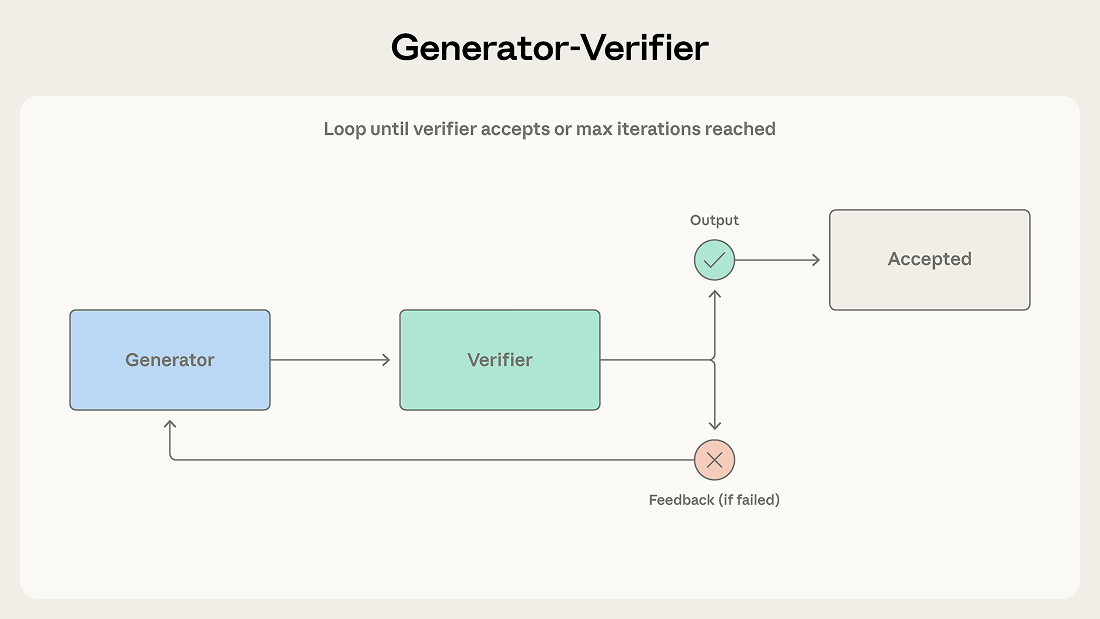
生成器接收任务并产出初始结果,再把结果交给验证器评估。验证器检查输出是否满足所需标准,然后要么接受其为最终结果,要么带着反馈将其退回。如果被退回,这些反馈会回到生成器,生成器据此给出修订版本。这个循环会持续,直到验证器接受结果,或者达到最大迭代次数。

它适合什么场景

比如一个支持系统,需要为客户工单生成邮件回复。生成器会结合产品文档和工单上下文生成初稿。验证器会对照知识库检查准确性,根据品牌规范评估语气,并确认回复是否覆盖了用户提出的每个问题。未通过的检查会带着明确指出问题所在的反馈返回给生成器,比如把某个功能错误地归到了错误的价格档,或者漏答了工单中的某个问题。

当输出质量至关重要,并且评估标准可以明确写出来时,就适合用这种模式。它非常适合代码生成,一个智能体写代码,另一个智能体编写并运行测试;也适用于事实核查、基于评分标准的打分、合规验证,以及所有错误输出代价高于多跑一轮生成的场景。

它会卡在哪里

验证器的能力只取决于它的标准有多好。一个只被要求检查输出是不是好、却没有更多标准的验证器,最后只会给生成器的输出盖章放行。团队最常见的失败方式,就是实现了这个循环,却没有定义清楚验证到底意味着什么。这样会制造出一种质量控制的幻觉,却没有真正的质量控制。我们在上一篇文章里讨论过这种过早获胜的问题。

这种模式还默认生成和验证是可以分开的两种能力。如果评估一个创意方案和生成一个创意方案一样难,验证器就未必能可靠地抓住问题。

最后,迭代循环也可能卡死。如果生成器始终无法解决验证器提出的反馈,系统就会在来回往复中打转,无法收敛。设置最大迭代次数,再配一个兜底策略,比如升级给人工处理,或者带着说明返回当前最好的结果,就能避免它变成无限循环。

模式二:协调者-子智能体

这种模式的核心是层级结构。一个智能体担任团队负责人,负责规划工作、分派任务、整合结果。子智能体负责具体职责,并回传结果。

它如何运作
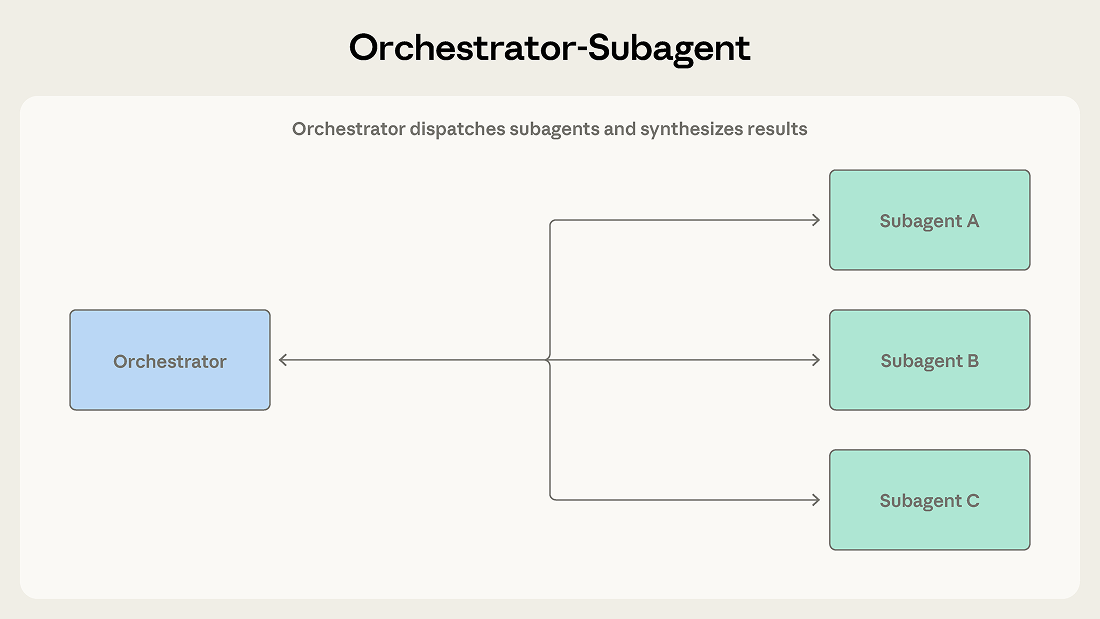
一个主导智能体接收任务,并决定如何推进。它可以亲自处理部分子任务,同时把其他子任务分发给子智能体。子智能体完成工作并返回结果,协调者再将这些结果整合成最终输出。

Claude Code 就使用了这种模式。主智能体会自己写代码、编辑文件、运行命令;当它需要搜索大型代码库或调查彼此独立的问题时,就会在后台派出子智能体,这样主线工作可以继续推进,同时结果陆续返回。每个子智能体都在自己的上下文窗口里运行,并回传提炼后的发现。这样协调者的上下文就能始终聚焦在主任务上,而探索工作则能并行展开。

它适合什么场景

比如一个自动化代码审查系统。每当有一个拉取请求进来,系统需要检查安全漏洞、验证测试覆盖率、评估代码风格,还要判断架构一致性。每一项检查都彼此不同,需要不同的上下文,也会产出清晰的结果。这时协调者可以把每一项检查分派给专门的子智能体,收集结果后,再整合成一份统一的审查意见。

当任务拆解足够清晰,且子任务之间相互依赖很少时,就适合用这种模式。协调者能维持对整体目标的连贯视角,而子智能体则专注于各自的职责。

它会卡在哪里

协调者会变成信息瓶颈。当一个子智能体发现了与另一个子智能体相关的内容时,这条信息必须先回到协调者,再由协调者转发。如果负责安全的子智能体发现了一个会影响架构分析的认证缺陷,协调者就必须识别出这种依赖关系,并把信息准确传过去。经过几次这样的中转之后,关键细节往往就丢了,或者被压缩得太狠。

顺序执行也会限制吞吐量。除非显式并行化,否则子智能体会一个接一个运行,这意味着系统承担了多智能体的 token 成本,却没有拿到速度上的收益。

模式三:智能体团队

当工作可以拆成多个可并行推进、并且能在较长时间内彼此独立完成的子任务时,协调者-子智能体模式就会显得过于束缚。

它如何运作
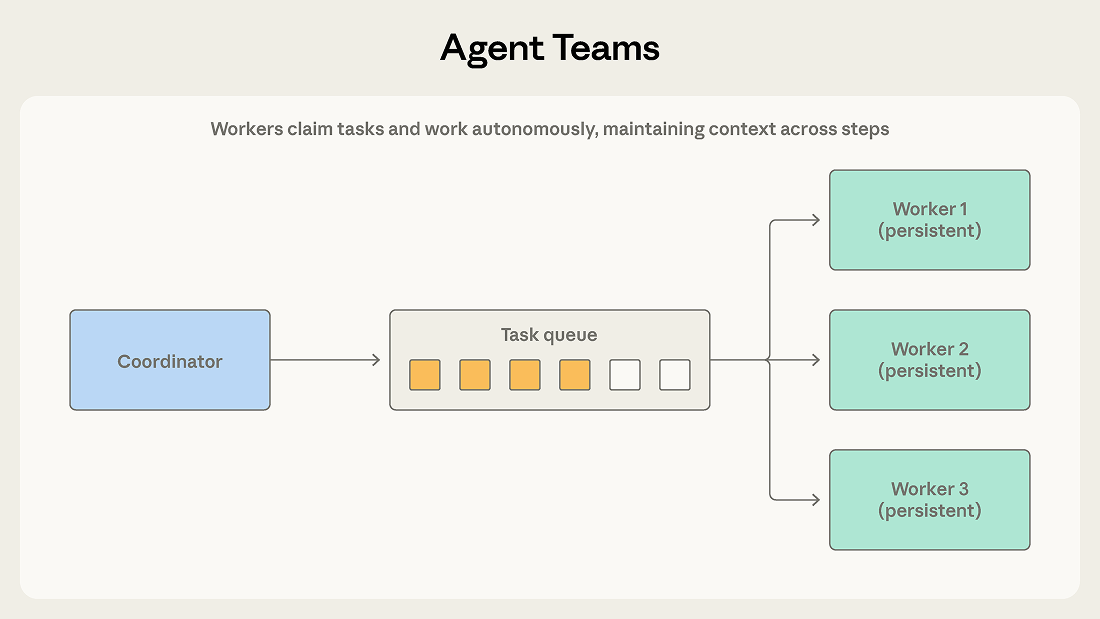
一个协调器会启动多个工作智能体,把它们作为独立进程运行。团队成员从共享队列中领取任务,围绕任务自主地跨多步推进,并在完成时发出信号。

它和协调者-子智能体的区别,在于工作智能体的持续性。协调者会为一个边界明确的子任务临时拉起一个子智能体,子智能体返回结果后就结束。团队成员则会在多次任务之间一直存活,逐步积累上下文和领域专长,时间越久,表现越好。协调器负责分配工作和收集结果,但不会在每次任务之间重置这些工作智能体。

它适合什么场景

比如把一个大型代码库从一个框架迁移到另一个框架。每个服务都可以独立迁移,有自己的依赖、测试套件和部署配置。协调器可以把每个服务分配给一个团队成员,每个成员自主完成迁移过程,包括更新依赖、修改代码、修复测试、做验证。协调器收集完成的迁移结果后,再对整个系统跑集成测试。

当子任务彼此独立,并且能从持续的多步工作中受益时,就适合用这种模式。每个团队成员都能逐渐建立起自己领域内的上下文,而不是每次派发任务都从零开始。

它会卡在哪里

独立性是最关键的前提。不同于协调者-子智能体模式中协调者可以在子智能体之间做信息中介,这里的团队成员是自主运作的,没法轻易共享中间发现。如果一个成员的工作会影响另一个成员,而双方都不知道,最终输出就可能发生冲突。

完成状态也更难判断。因为各个成员会在不同的时长内自主推进,协调器必须能处理部分完成的情况,有的成员两分钟就做完了,另一个可能要二十分钟。

共享资源会让这两个问题更严重。当多个团队成员操作同一个代码库、数据库或文件系统时,两个成员可能会编辑同一个文件,或者做出彼此不兼容的修改。这种模式需要非常仔细的任务切分,以及冲突解决机制。

模式四:消息总线

随着智能体数量增加、交互模式变得更复杂,直接协同就会越来越难管。消息总线通过引入一层共享通信层,让智能体以发布和订阅事件的方式协作。

它如何运作
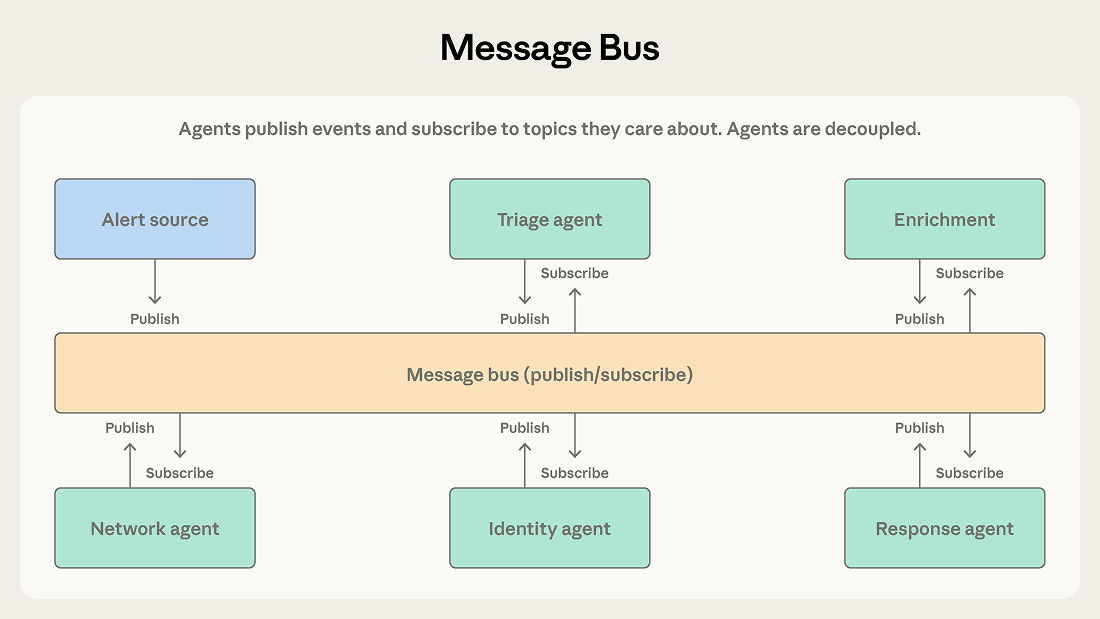
智能体通过两个基础动作进行交互,发布和订阅。智能体订阅自己关心的主题,路由器负责把匹配的消息送过去。拥有新能力的新智能体可以开始接收相关工作,而不需要重接现有连接。

它适合什么场景

一个安全运营自动化系统,就是这种模式大显身手的地方。告警会从多个来源进入,分诊智能体会按严重等级和类型做分类,把高严重性的网络告警分发给网络调查智能体,把和凭证相关的告警交给身份分析智能体。每个调查智能体都可能发布补充信息请求,再由上下文采集智能体去满足这些请求。最终,调查发现会流向响应协调智能体,由它决定该采取什么动作。

这个流水线很适合消息总线,因为事件会从一个阶段流向下一个阶段,团队可以随着威胁类别的变化不断加入新的智能体类型,而且各个智能体可以独立开发和部署。

当流程是由事件推动,而不是由预先写死的顺序决定,并且智能体生态还会继续扩张时,就适合使用这种模式。

它会卡在哪里

事件驱动通信的灵活性,会让追踪问题变得更难。当一个告警触发了跨五个智能体的一连串事件后,想弄清到底发生了什么,就需要非常仔细的日志和关联分析。相比沿着协调者的顺序决策往下追,调试会更难。

路由准确性也至关重要。如果路由器把一个事件错分了,或者直接丢了,系统就会静默失败,什么也没处理,但又不会崩溃。基于大语言模型的路由器带来了语义上的灵活性,但也会带来它自己的一套失败模式。

模式五:共享状态
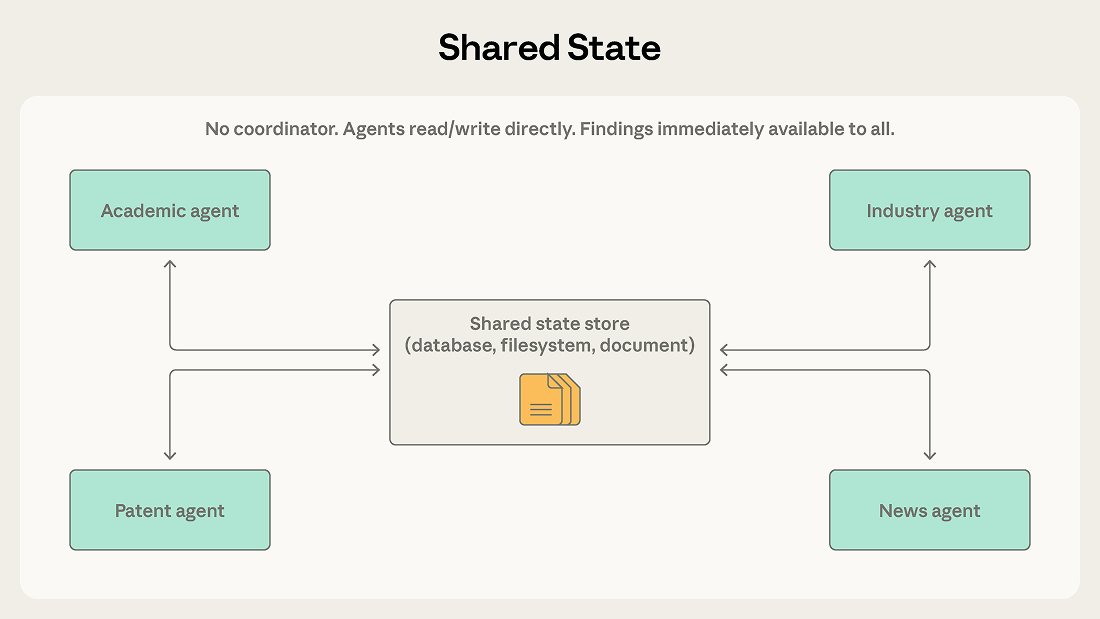
前面几种模式中的协调者、团队负责人和消息路由器,都会在中心位置管理信息流。共享状态把这个中间层拿掉,让智能体通过一个所有人都能直接读写的持久化存储来协同。

它如何运作

智能体自主运作,直接读写共享数据库、文件系统或文档。这里没有中心协调者。智能体会查看存储中与自己相关的信息,根据看到的内容行动,再把自己的发现写回去。工作通常始于一个初始化步骤,把某个问题或数据集写入存储;结束则由某个终止条件决定,比如时间上限、收敛阈值,或者由某个指定的智能体判断存储里已经有了足够好的答案。

它适合什么场景

比如一个研究综合系统,需要多个智能体分别调查一个复杂问题的不同方面。一个查学术文献,一个分析行业报告,一个研究专利申请,第四个盯新闻报道。每个智能体的发现都可能影响其他智能体的调查。查学术文献的智能体,可能会发现一位关键研究者,而这位研究者所在的公司正是行业分析智能体应该重点关注的对象。

在共享状态模式下,这些发现会直接写入共享存储。行业分析智能体可以立刻看到学术智能体的新发现,不需要等协调者来转发信息。智能体会在彼此工作的基础上继续推进,而共享存储会逐步变成一个不断演化的知识库。

共享状态还去掉了协调者这个单点故障。一旦某个智能体停止,其他智能体仍然可以继续读写。在协调者模式或消息总线模式里,协调器或路由器一旦故障,整个系统都会停摆。

它会卡在哪里

没有显式协调时,智能体可能重复劳动,或者走向彼此矛盾的方向。两个智能体可能会独立调查同一条线索。智能体之间的交互会共同塑造系统行为,而不是由上而下设计,这会让结果更难预测。

更麻烦的失败模式是反应式循环。比如智能体 A 写入一条发现,智能体 B 读到后写了跟进内容,智能体 A 又看到了这条跟进并继续回应。系统就会不断消耗 token,做的却是无法收敛的工作。重复劳动和并发写入,都有相对成熟的工程解决方式,比如加锁、版本控制、分区。反应式循环是行为层面的问题,需要被当作一等公民来处理,必须有明确的终止条件,比如时间预算、收敛阈值,也就是连续 N 个周期没有新发现,或者指定一个智能体来负责判断存储中是否已经有了足够充分的答案。那些把终止条件当成事后补丁的系统,往往会无限循环,或者在某个智能体上下文塞满后随意停下。

如何选择,并在模式之间演进

正确的模式取决于系统结构上的几个关键问题。上一篇文章里,我们主张以上下文为中心来拆解任务,也就是按每个智能体需要什么上下文来划分工作,而不是按它做什么类型的工作来划分。这个原则在这里同样适用。不同模式的差别,主要就在于它们如何管理上下文边界,以及信息如何流动。

协调者-子智能体 vs. 智能体团队
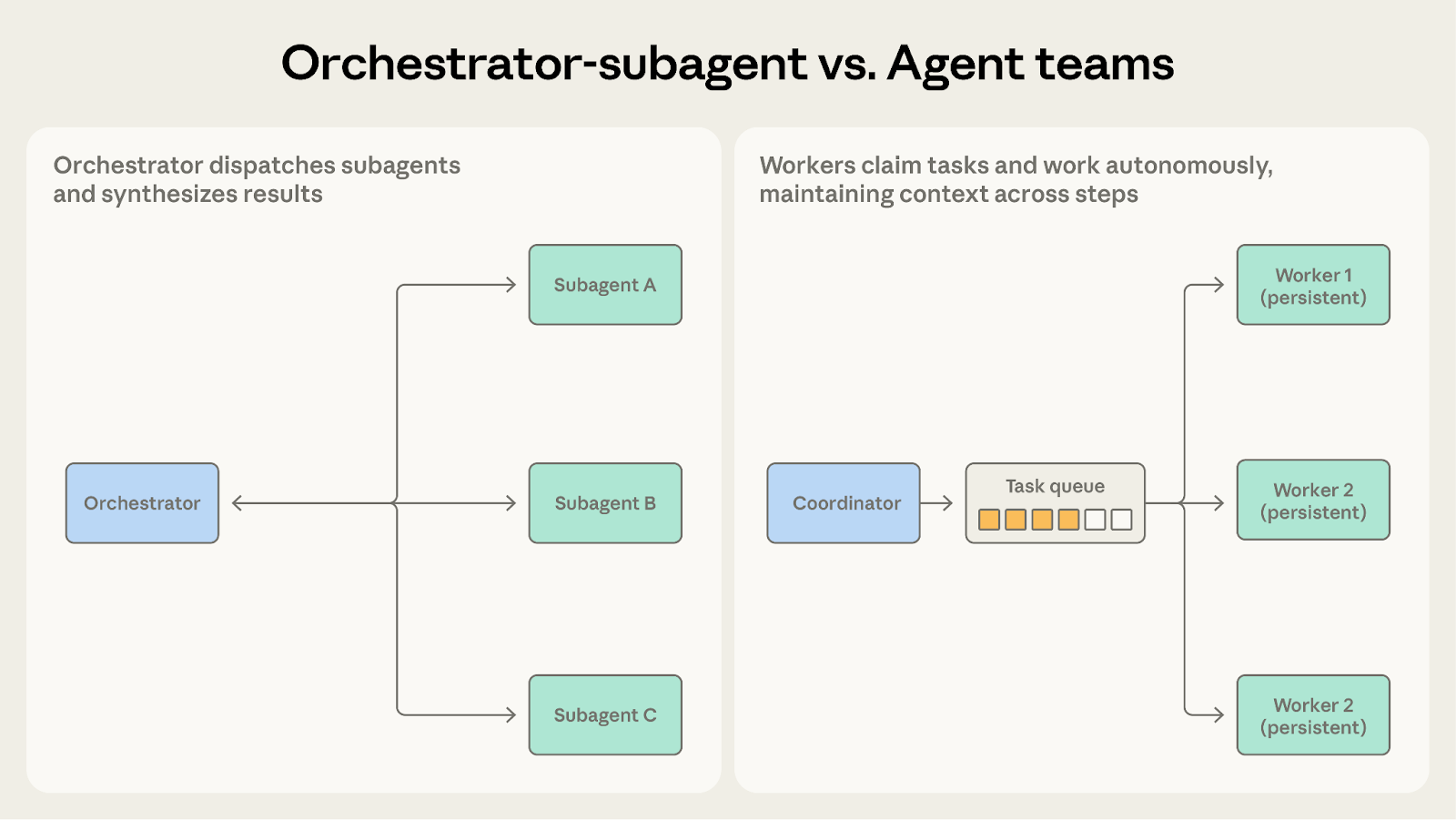
这两种模式都涉及一个协调者向其他智能体分派工作。关键问题在于,工作者需要维持上下文多久。

  • 当子任务较短、聚焦明确,并且能产出清晰结果时,选择协调者-子智能体。代码审查系统就很适合,因为每项检查都会完成分析、生成报告,并在一次边界明确的调用中返回。子智能体不需要跨多个周期保留上下文。

  • 当子任务会从持续的多步工作中获益时,选择智能体团队。代码库迁移就很适合,因为每个团队成员都会逐步真正熟悉自己负责的服务,包括依赖图、测试模式和部署配置。这种积累出来的上下文,会以单次派发无法复制的方式提升表现。

当子智能体需要跨多次调用保留状态时,智能体团队会更合适。

协调者-子智能体 vs. 消息总线
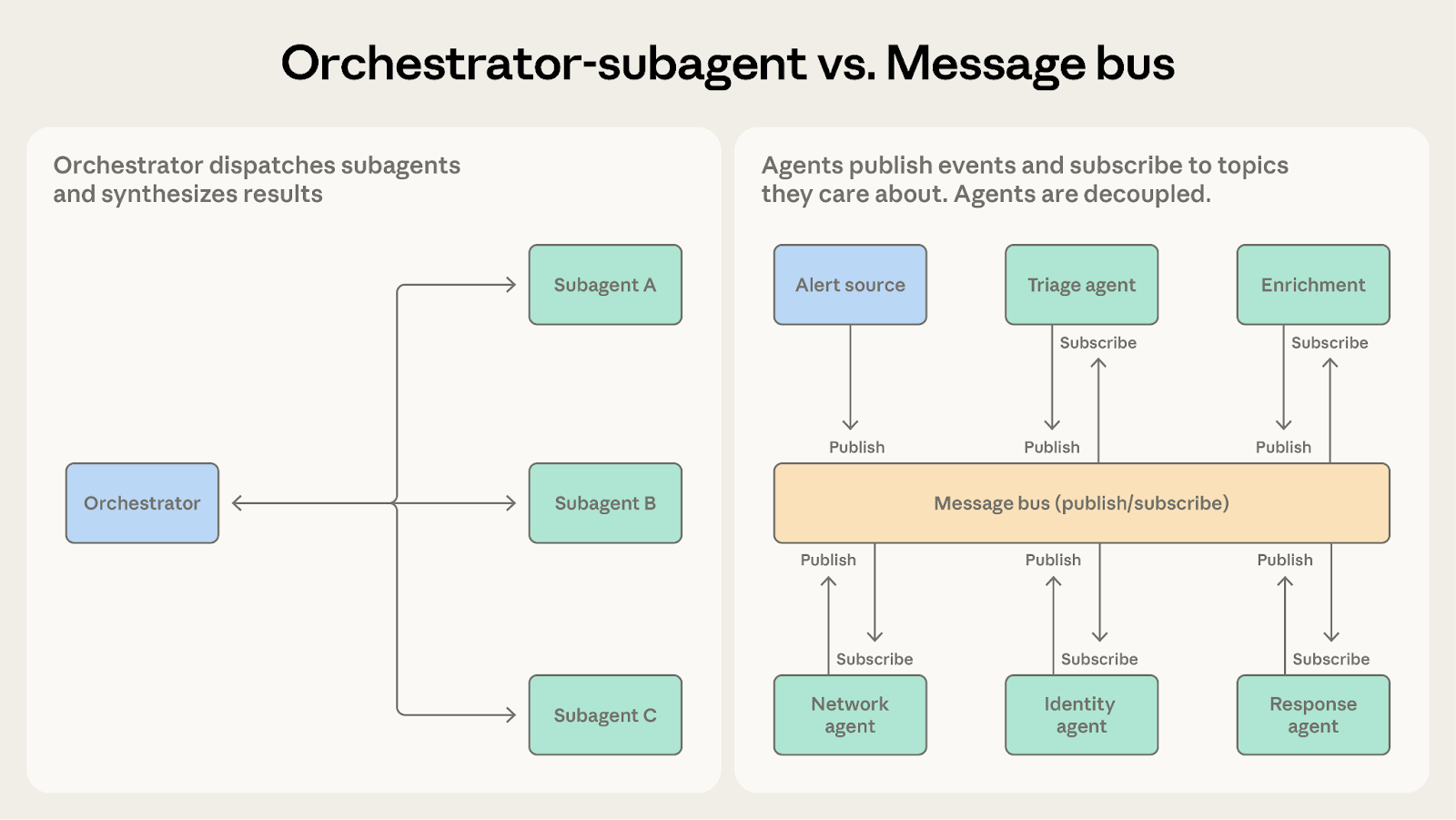
这两种模式都能处理多步工作流。关键问题在于,工作流结构是否可预测。

  • 当步骤顺序事先已知时,选择协调者-子智能体。代码审查系统遵循一条固定流水线,接收 PR,运行检查,整合结果。

  • 当工作流由事件推动,并且会随着新发现而变化时,选择消息总线。安全运营系统无法预先知道会收到什么告警,也无法预先知道这些告警会需要怎样的调查路径。新的告警类型还可能不断出现,带来新的处理需求。消息总线通过把事件路由给有能力处理的智能体,而不是沿着预设顺序推进,来容纳这种变化。

当协调者里为了处理不断扩展的情况而塞进越来越多条件分支时,消息总线会让这种路由逻辑变得更明确,也更容易扩展。

智能体团队 vs. 共享状态
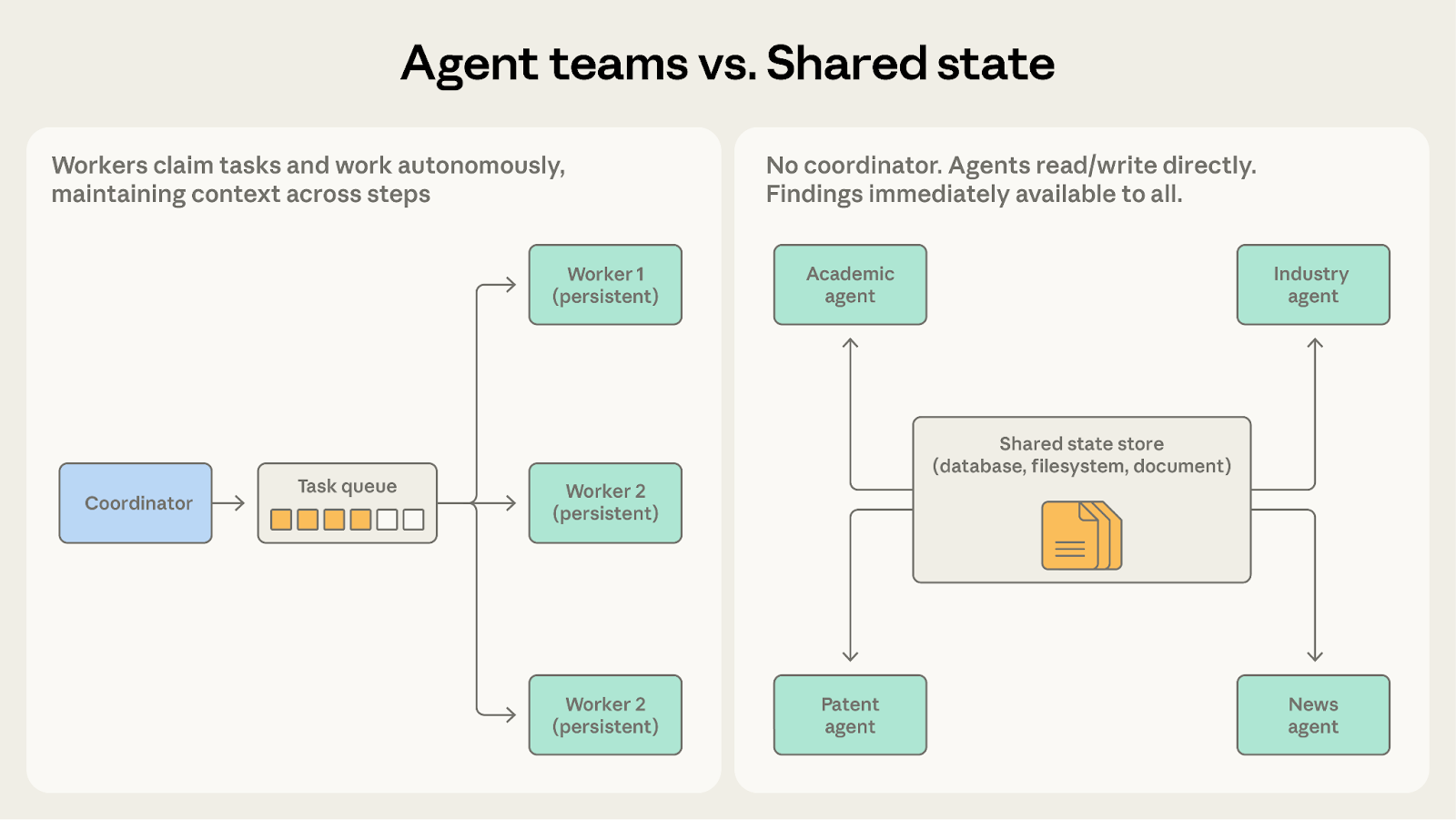
这两种模式都让智能体自主工作。关键问题在于,智能体是否需要彼此的发现。

  • 当智能体处理的是彼此独立、不互相影响的分区任务时,选择智能体团队。代码库迁移就适合这种模式,因为每个团队成员处理自己的服务,协调器在最后把结果合并起来。

  • 当智能体的工作本质上是协作性的,并且彼此的发现需要实时流动时,选择共享状态。研究综合系统更适合这里,因为学术智能体发现一位关键研究者后,这条发现会立刻影响行业智能体接下来的调查。

一旦团队成员需要彼此沟通,而不只是共享最终结果,共享状态会更自然。

消息总线 vs. 共享状态
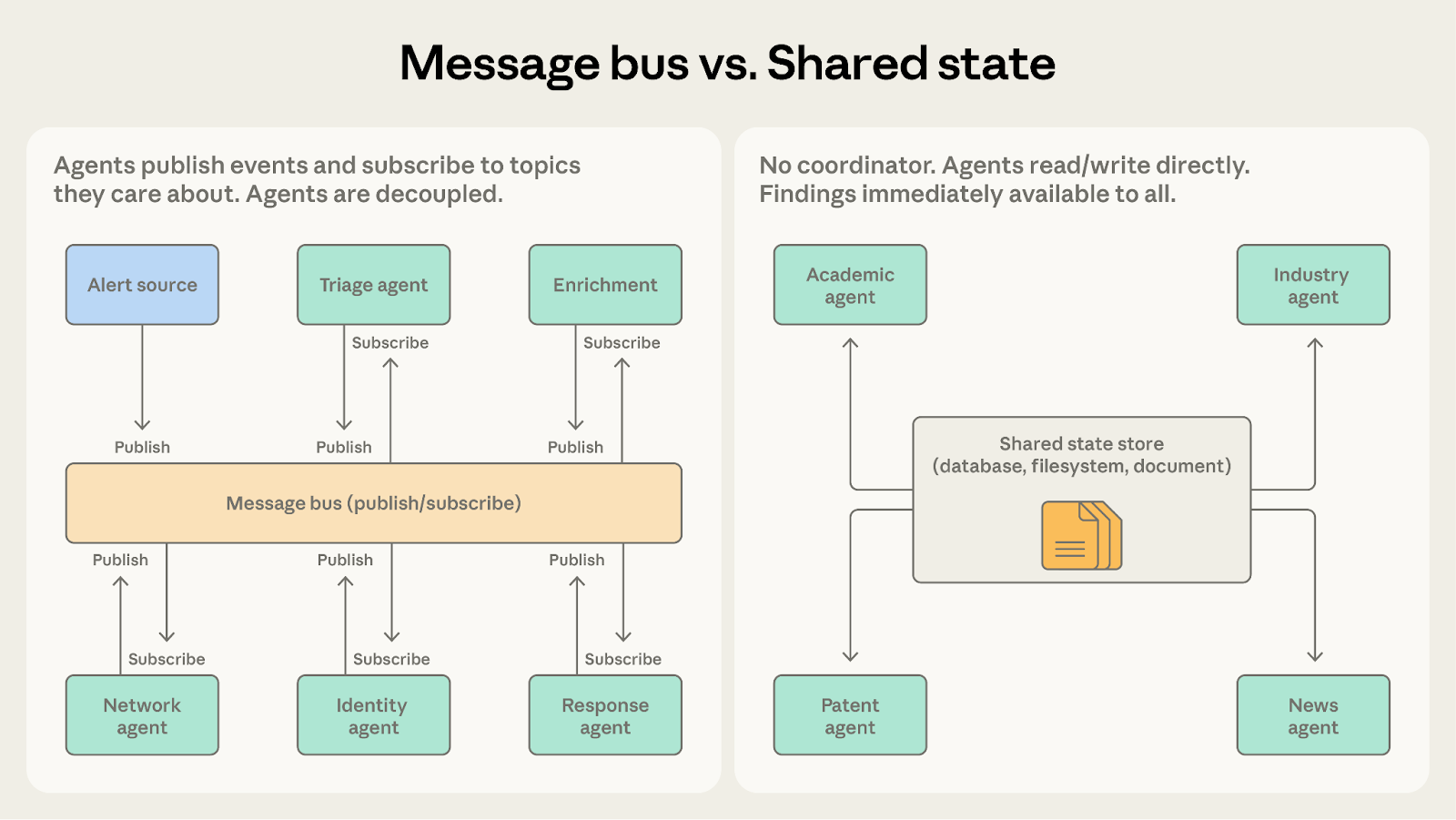
这两种模式都支持复杂的多智能体协同。关键问题在于,工作是以离散事件流动,还是不断累积成共享知识库。

  • 当智能体是在流水线中对事件作出响应时,选择消息总线。安全运营系统会按阶段处理告警,每个事件都会触发下一个事件,直到整个流程完成。这种模式在把事件高效路由给有能力的智能体方面表现很好。

  • 当智能体需要随着时间推移不断建立在累积发现之上时,选择共享状态。研究综合系统会持续积累知识。智能体会反复回到共享存储,查看别人已经发现了什么,再调整自己的调查方向。

消息总线里仍然有一个路由器,也就是说仍然有一个中心组件负责决定事件该往哪走。共享状态则是去中心化的。如果去掉单点故障是优先目标,共享状态在这点上会做得更彻底。

如果消息总线系统里的智能体发布事件,目的已经不是触发动作,而是共享发现,那共享状态会更合适。

如何开始

生产系统里,经常会把多种模式混合使用。一个常见的混合方式,是整体流程使用协调者-子智能体,而在协作密集的子任务里使用共享状态。另一种常见方式,是用消息总线做事件路由,而每类事件内部再由类似智能体团队的工作者来处理。这些模式是积木,不是非此即彼的互斥选项。

下表总结了每种模式分别适用于什么时候。

场景 模式 质量要求高,评估标准明确的输出 生成器-验证器 任务拆解清晰,子任务边界明确 协调者-子智能体 并行工作负载,彼此独立且持续时间长的子任务 智能体团队 事件驱动流程,不断扩大的智能体生态 消息总线 协作型研究,智能体共享发现 共享状态 不允许有单点故障 共享状态

对于大多数使用场景,我们建议从协调者-子智能体开始。它能覆盖最广的一类问题,同时协同开销也最低。先观察它在哪些地方吃力,再在具体需求变得明确之后演进到其他模式。

‍接下来的文章里,我们会逐一深入分析每种模式,并给出生产级实现和案例研究。想了解多智能体系统在什么时候值得投入,可以先看这篇文章 构建多智能体系统:何时以及如何使用它们

致谢

本文由 Cara Phillips 撰写,Eugene Yang、Jiri De Jonghe、Samuel Weller 和 Erik S. 亦有贡献。

未找到任何条目。

上一页上一页

0/5

下一页下一页

电子书

常见问题

未找到任何条目。

相关文章

探索更多产品新闻,以及使用 Claude 构建产品的团队最佳实践。

2026 年 4 月 10 日

为 AI 加速攻势做好安全体系准备

智能体

为 AI 加速攻势做好安全体系准备为 AI 加速攻势做好安全体系准备

为 AI 加速攻势做好安全体系准备为 AI 加速攻势做好安全体系准备
2026 年 1 月 23 日

构建多智能体系统:何时以及如何使用它们

智能体

构建多智能体系统:何时以及如何使用它们构建多智能体系统:何时以及如何使用它们

构建多智能体系统:何时以及如何使用它们构建多智能体系统:何时以及如何使用它们

2026 年 4 月 2 日

发挥 Claude 的智能

智能体

发挥 Claude 的智能发挥 Claude 的智能

发挥 Claude 的智能发挥 Claude 的智能

2026 年 3 月 5 日

AI 智能体的常见工作流模式,以及何时使用它们

智能体

AI 智能体的常见工作流模式,以及何时使用它们AI 智能体的常见工作流模式,以及何时使用它们

AI 智能体的常见工作流模式,以及何时使用它们AI 智能体的常见工作流模式,以及何时使用它们

用 Claude 改变你的组织运作方式

查看定价

查看定价查看定价

联系销售

联系销售联系销售

获取开发者通讯

产品更新、实用指南、社区精选等内容。每月发送到你的收件箱。

订阅订阅

如果你希望接收我们的每月开发者通讯,请提供你的电子邮箱地址。你可以随时取消订阅。

谢谢,你已订阅。

抱歉,你的提交出了点问题,请稍后再试。

首页首页

下一页下一页

谢谢,你的提交已收到。

糟糕,提交表单时出了点问题。

写作

按钮文本按钮文本

学习

按钮文本按钮文本

编程

按钮文本按钮文本

写作

-

帮我为特定受众打造独特的表达风格

你好 Claude!你能帮我为某一类受众打造独特的表达风格吗?如果你需要更多信息,请立刻问我 1 到 2 个关键问题。如果你觉得我上传一些文档会让你做得更好,也请告诉我。你可以使用你能访问的工具,比如 Google Drive、网页搜索等,只要它们有助于更好地完成这个任务。请不要使用分析工具。请让你的回复保持友好、简短、像聊天一样自然。

请尽快开始执行这个任务。如果合适的话,最好能给出一个成品。如果使用成品形式,请考虑哪种形式最适合这个任务,比如交互式、可视化、清单等。谢谢你的帮助!

-

提升我的写作风格

你好 Claude!你能帮我提升写作风格吗?如果你需要更多信息,请立刻问我 1 到 2 个关键问题。如果你觉得我上传一些文档会让你做得更好,也请告诉我。你可以使用你能访问的工具,比如 Google Drive、网页搜索等,只要它们有助于更好地完成这个任务。请不要使用分析工具。请让你的回复保持友好、简短、像聊天一样自然。

请尽快开始执行这个任务。如果合适的话,最好能给出一个成品。如果使用成品形式,请考虑哪种形式最适合这个任务,比如交互式、可视化、清单等。谢谢你的帮助!

-

头脑风暴创意点子

你好 Claude!你能帮我一起头脑风暴一些创意点子吗?如果你需要更多信息,请立刻问我 1 到 2 个关键问题。如果你觉得我上传一些文档会让你做得更好,也请告诉我。你可以使用你能访问的工具,比如 Google Drive、网页搜索等,只要它们有助于更好地完成这个任务。请不要使用分析工具。请让你的回复保持友好、简短、像聊天一样自然。

请尽快开始执行这个任务。如果合适的话,最好能给出一个成品。如果使用成品形式,请考虑哪种形式最适合这个任务,比如交互式、可视化、清单等。谢谢你的帮助!

学习

-

把一个复杂主题讲简单

你好 Claude!你能把一个复杂主题讲得简单一点吗?如果你需要更多信息,请立刻问我 1 到 2 个关键问题。如果你觉得我上传一些文档会让你做得更好,也请告诉我。你可以使用你能访问的工具,比如 Google Drive、网页搜索等,只要它们有助于更好地完成这个任务。请不要使用分析工具。请让你的回复保持友好、简短、像聊天一样自然。

请尽快开始执行这个任务。如果合适的话,最好能给出一个成品。如果使用成品形式,请考虑哪种形式最适合这个任务,比如交互式、可视化、清单等。谢谢你的帮助!

-

帮我理清这些想法

你好 Claude!你能帮我理清这些想法吗?如果你需要更多信息,请立刻问我 1 到 2 个关键问题。如果你觉得我上传一些文档会让你做得更好,也请告诉我。你可以使用你能访问的工具,比如 Google Drive、网页搜索等,只要它们有助于更好地完成这个任务。请不要使用分析工具。请让你的回复保持友好、简短、像聊天一样自然。

请尽快开始执行这个任务。如果合适的话,最好能给出一个成品。如果使用成品形式,请考虑哪种形式最适合这个任务,比如交互式、可视化、清单等。谢谢你的帮助!

-

准备考试或面试

你好 Claude!你能帮我准备考试或面试吗?如果你需要更多信息,请立刻问我 1 到 2 个关键问题。如果你觉得我上传一些文档会让你做得更好,也请告诉我。你可以使用你能访问的工具,比如 Google Drive、网页搜索等,只要它们有助于更好地完成这个任务。请不要使用分析工具。请让你的回复保持友好、简短、像聊天一样自然。

请尽快开始执行这个任务。如果合适的话,最好能给出一个成品。如果使用成品形式,请考虑哪种形式最适合这个任务,比如交互式、可视化、清单等。谢谢你的帮助!

编程

-

解释一个编程概念

你好 Claude!你能帮我解释一个编程概念吗?如果你需要更多信息,请立刻问我 1 到 2 个关键问题。如果你觉得我上传一些文档会让你做得更好,也请告诉我。你可以使用你能访问的工具,比如 Google Drive、网页搜索等,只要它们有助于更好地完成这个任务。请不要使用分析工具。请让你的回复保持友好、简短、像聊天一样自然。

请尽快开始执行这个任务。如果合适的话,最好能给出一个成品。如果使用成品形式,请考虑哪种形式最适合这个任务,比如交互式、可视化、清单等。谢谢你的帮助!

-

看看我的代码并给我一些建议

你好 Claude!你能帮我看看代码并给我一些建议吗?如果你需要更多信息,请立刻问我 1 到 2 个关键问题。如果你觉得我上传一些文档会让你做得更好,也请告诉我。你可以使用你能访问的工具,比如 Google Drive、网页搜索等,只要它们有助于更好地完成这个任务。请不要使用分析工具。请让你的回复保持友好、简短、像聊天一样自然。

请尽快开始执行这个任务。如果合适的话,最好能给出一个成品。如果使用成品形式,请考虑哪种形式最适合这个任务,比如交互式、可视化、清单等。谢谢你的帮助!

-

和我一起随性写代码

你好 Claude!你能和我一起随性写代码吗?如果你需要更多信息,请立刻问我 1 到 2 个关键问题。如果你觉得我上传一些文档会让你做得更好,也请告诉我。你可以使用你能访问的工具,比如 Google Drive、网页搜索等,只要它们有助于更好地完成这个任务。请不要使用分析工具。请让你的回复保持友好、简短、像聊天一样自然。

请尽快开始执行这个任务。如果合适的话,最好能给出一个成品。如果使用成品形式,请考虑哪种形式最适合这个任务,比如交互式、可视化、清单等。谢谢你的帮助!

更多

-

撰写案例研究

这是另一个测试

-

撰写资助申请书

你好 Claude!你能帮我撰写资助申请书吗?如果你需要更多信息,请立刻问我 1 到 2 个关键问题。如果你觉得我上传一些文档会让你做得更好,也请告诉我。你可以使用你能访问的工具,比如 Google Drive、网页搜索等,只要它们有助于更好地完成这个任务。请不要使用分析工具。请让你的回复保持友好、简短、像聊天一样自然。

请尽快开始执行这个任务。如果合适的话,最好能给出一个成品。如果使用成品形式,请考虑哪种形式最适合这个任务,比如交互式、可视化、清单等。谢谢你的帮助!

-

撰写视频脚本

这是一个测试

AnthropicAnthropic

© [year] Anthropic PBC

产品

-

Claude

ClaudeClaude

-

Claude Code

Claude CodeClaude Code

-

Claude Code 企业版

Claude Code for EnterpriseClaude Code for Enterprise

-

Claude Cowork

Claude CoworkClaude Cowork

-

Pro 套餐

Pro planPro plan

-

Max 套餐

Max planMax plan

-

Team 套餐

Team planTeam plan

-

Enterprise 套餐

Enterprise planEnterprise plan

-

下载应用

Download appDownload app

-

定价

PricingPricing

-

Log inLog in

功能

-

Claude Code 安全

Claude Code SecurityClaude Code Security

-

Claude for Chrome

Claude for ChromeClaude for Chrome

-

Claude for Slack

Claude for SlackClaude for Slack

-

Claude for Excel

Claude for ExcelClaude for Excel

-

Claude for PowerPoint

Claude for PowerPointClaude for PowerPoint

-

Claude for Word

Claude for WordClaude for Word

-

Skills

SkillsSkills

模型

-

Mythos 预览版

Mythos previewMythos preview

-

Opus

OpusOpus

-

Sonnet

SonnetSonnet

-

Haiku

HaikuHaiku

解决方案

-

AI 智能体

AI agentsAI agents

-

代码现代化

Code modernizationCode modernization

-

编程

CodingCoding

-

客户支持

Customer supportCustomer support

-

教育

EducationEducation

-

金融服务

Financial servicesFinancial services

-

政府

GovernmentGovernment

-

医疗健康

HealthcareHealthcare

-

生命科学

Life sciencesLife sciences

-

非营利组织

NonprofitsNonprofits

-

安全

SecuritySecurity

Claude Platform

-

概览

OverviewOverview

-

开发者文档

Developer docsDeveloper docs

-

定价

PricingPricing

-

市场

MarketplaceMarketplace

-

Amazon Bedrock

Amazon BedrockAmazon Bedrock

-

Google Cloud 的 Vertex AI

Google Cloud’s Vertex AIGoogle Cloud’s Vertex AI

-

Microsoft Foundry

Microsoft FoundryMicrosoft Foundry

-

区域合规

Regional complianceRegional compliance

-

控制台登录

Console loginConsole login

资源

-

博客

BlogBlog

-

Claude 合作伙伴网络

Claude partner networkClaude partner network

-

社区

CommunityCommunity

-

连接器

ConnectorsConnectors

-

课程

CoursesCourses

-

客户案例

Customer storiesCustomer stories

-

Anthropic 工程团队

Engineering at AnthropicEngineering at Anthropic

-

活动

EventsEvents

-

插件

PluginsPlugins

-

由 Claude 提供支持

Powered by ClaudePowered by Claude

-

服务合作伙伴

Service partnersService partners

-

创业公司计划

Startups programStartups program

-

教程

TutorialsTutorials

-

使用场景

Use casesUse cases

公司

-

Anthropic

AnthropicAnthropic

-

招聘

CareersCareers

-

Economic Futures

Economic FuturesEconomic Futures

-

研究

ResearchResearch

-

新闻

NewsNews

-

负责任扩展政策

Responsible Scaling PolicyResponsible Scaling Policy

-

安全与合规

Security and complianceSecurity and compliance

-

透明度

TransparencyTransparency

帮助与安全

-

可用性

AvailabilityAvailability

-

状态

StatusStatus

-

支持中心

Support centerSupport center

条款与政策

-

隐私选项

Cookie 设置

我们使用 Cookie 来提供并改进服务、分析网站使用情况,并在你同意的情况下,为你定制或个性化体验并推广我们的服务。你可以在这里阅读我们的 Cookie 政策。

自定义 Cookie 设置 拒绝所有 Cookie 接受所有 Cookie

必要

启用安全性和基础功能。

必需

分析

启用网站性能跟踪。

关闭

营销

启用广告个性化和跟踪。

关闭

保存偏好设置

-

隐私政策

Privacy policyPrivacy policy

-

负责任披露政策

Responsible disclosure policyResponsible disclosure policy

-

服务条款:商业版

Terms of service: CommercialTerms of service: Commercial

-

服务条款:消费者版

Terms of service: ConsumerTerms of service: Consumer

Multi-agent coordination patterns: Five approaches and when to use them

Five multi-agent coordination patterns, their trade-offs, and when to evolve from one to another.

Category

Agents

Product

Claude Platform

Date

April 10, 2026

Reading time

5

min

Share

Copy link

https://claude.com/blog/multi-agent-coordination-patterns

In an earlier post, we explored when multi-agent systems provide value and when a single agent is the better choice. This post is for teams that have made that call and now need to decide which coordination pattern fits their problem.

Weve seen teams choose patterns based on what sounds sophisticated rather than what fits the problem at hand. We recommend starting with the simplest pattern that could work, watching where it struggles, and evolving from there. This post examines the mechanics and limitations of five patterns:

  • Generator-verifier, for quality-critical output with explicit evaluation criteria

  • Orchestrator-subagent, for clear task decomposition with bounded subtasks

  • Agent teams, for parallel, independent, long-running subtasks

  • Message bus, for event-driven pipelines with a growing agent ecosystem

  • Shared-state, for collaborative work where agents build on each others findings

多智能体协同模式:五种方法及其适用时机

五种多智能体协同模式、它们的权衡,以及何时该从一种演进到另一种。

-

分类

智能体

-

产品

Claude Platform

-

日期

2026 年 4 月 10 日

-

阅读时长

5

分钟

-

分享

复制链接

https://claude.com/blog/multi-agent-coordination-patterns

在之前的一篇文章里,我们探讨了多智能体系统何时有价值,以及何时单个智能体才是更好的选择。这篇文章写给那些已经做出这个判断、现在需要决定哪种协同模式更适合自己问题的团队。

我们见过不少团队按听起来是否高级来选模式,而不是按问题本身是否匹配。我们的建议是,先从能奏效的最简单模式开始,观察它在哪些地方吃力,再从那里演进。这篇文章会拆解五种模式的运作机制与局限:

  • 生成器-验证器,适合质量要求高且评估标准明确的输出

  • 协调者-子智能体,适合任务拆解清晰、子任务边界明确的场景

  • 智能体团队,适合可并行、彼此独立、持续时间较长的子任务

  • 消息总线,适合事件驱动的流程,以及不断扩大的智能体生态

  • 共享状态,适合协作型工作,智能体需要建立在彼此发现之上继续推进

Pattern 1: Generator-verifier

This is the simplest multi-agent pattern and among the most deployed. We introduced it as the verification subagent pattern in our previous post, and here we use the broader generator-verifier framing because the generator need not be an orchestrator.

How it works

A generator receives a task and produces an initial output, which it passes to a verifier for evaluation. The verifier checks whether the output meets the required criteria and either accepts it as complete or rejects it with feedback. If rejected, that feedback is routed back to the generator, which uses it to produce a revised attempt. This loop continues until the verifier accepts the output or the maximum number of iterations is reached.

Where it works well

Consider a support system that generates email responses to customer tickets. The generator produces an initial response using product documentation and ticket context. The verifier checks accuracy against the knowledge base, evaluates tone against brand guidelines, and confirms the response addresses each issue raised. Failed checks return to the generator with feedback that names the exact problem, such as a feature misattributed to the wrong pricing tier or a ticket issue left unanswered.

Use this pattern when output quality is critical and evaluation criteria can be made explicit. It’s effective for code generation (one agent writes code, another writes and runs tests), fact-checking, rubric-based grading, compliance verification, and any domain where an incorrect output costs more than an additional generation cycle.

Where it struggles

The verifier is only as good as its criteria. A verifier told only to check whether output is good, with no further criteria, will rubber-stamp the generators output. Teams most often fail by implementing the loop without defining what verification means, which creates the illusion of quality control without the substance. (We discussed this early victory problem in the previous post.)

The pattern also assumes generation and verification are separable skills. If evaluating a creative approach is as hard as generating one, the verifier may not reliably catch problems.

Finally, iterative loops can stall. If the generator cant address the verifiers feedback, the system oscillates without converging. A maximum iteration limit with a fallback strategy (escalate to a human, return the best attempt with caveats) prevents this from becoming an infinite loop.

模式一:生成器-验证器

这是最简单的多智能体模式,也是部署最广的模式之一。我们在上一篇文章中把它称为验证子智能体模式,而这里使用更宽泛的生成器-验证器框架,因为生成器不一定非得是协调者。

它如何运作

生成器接收任务并产出初始结果,再把结果交给验证器评估。验证器检查输出是否满足所需标准,然后要么接受其为最终结果,要么带着反馈将其退回。如果被退回,这些反馈会回到生成器,生成器据此给出修订版本。这个循环会持续,直到验证器接受结果,或者达到最大迭代次数。

它适合什么场景

比如一个支持系统,需要为客户工单生成邮件回复。生成器会结合产品文档和工单上下文生成初稿。验证器会对照知识库检查准确性,根据品牌规范评估语气,并确认回复是否覆盖了用户提出的每个问题。未通过的检查会带着明确指出问题所在的反馈返回给生成器,比如把某个功能错误地归到了错误的价格档,或者漏答了工单中的某个问题。

当输出质量至关重要,并且评估标准可以明确写出来时,就适合用这种模式。它非常适合代码生成,一个智能体写代码,另一个智能体编写并运行测试;也适用于事实核查、基于评分标准的打分、合规验证,以及所有错误输出代价高于多跑一轮生成的场景。

它会卡在哪里

验证器的能力只取决于它的标准有多好。一个只被要求检查输出是不是好、却没有更多标准的验证器,最后只会给生成器的输出盖章放行。团队最常见的失败方式,就是实现了这个循环,却没有定义清楚验证到底意味着什么。这样会制造出一种质量控制的幻觉,却没有真正的质量控制。我们在上一篇文章里讨论过这种过早获胜的问题。

这种模式还默认生成和验证是可以分开的两种能力。如果评估一个创意方案和生成一个创意方案一样难,验证器就未必能可靠地抓住问题。

最后,迭代循环也可能卡死。如果生成器始终无法解决验证器提出的反馈,系统就会在来回往复中打转,无法收敛。设置最大迭代次数,再配一个兜底策略,比如升级给人工处理,或者带着说明返回当前最好的结果,就能避免它变成无限循环。

Pattern 2: Orchestrator-subagent

Hierarchy defines this pattern. One agent acts as a team lead that plans work, delegates tasks, and synthesizes results. Subagents handle specific responsibilities and report back.

How it works

A lead agent receives a task and determines how to approach it. It may handle some subtasks directly while dispatching others to subagents. Subagents complete their work and return results, which the orchestrator synthesizes into a final output.

Claude Code uses this pattern. The main agent writes code, edits files, and runs commands itself, dispatching subagents in the background when it needs to search a large codebase or investigate independent questions so work continues while results stream back. Each subagent operates in its own context window and returns distilled findings. This keeps the orchestrators context focused on the primary task while exploration happens in parallel.

Where it works well

Consider an automated code review system. When a pull request arrives, the system needs to check for security vulnerabilities, verify test coverage, assess code style, and evaluate architectural consistency. Each check is distinct, requires different context, and produces a clear output. An orchestrator dispatches each check to a specialized subagent, collects the results, and synthesizes a unified review.

Use this pattern when task decomposition is clear and subtasks have minimal interdependence. The orchestrator maintains a coherent view of the overall goal while subagents stay focused on specific responsibilities.

Where it struggles

The orchestrator becomes an information bottleneck. When a subagent discovers something relevant to another subagents work, that information has to travel back through the orchestrator. If the security subagent finds an authentication flaw that affects the architecture subagents analysis, the orchestrator must recognize this dependency and route the information appropriately. After several such handoffs, critical details are often lost or summarized away.

Sequential execution also limits throughput. Unless explicitly parallelized, subagents run one after another, meaning the system incurs multi-agent token costs without the speed benefit.

模式二:协调者-子智能体

这种模式的核心是层级结构。一个智能体担任团队负责人,负责规划工作、分派任务、整合结果。子智能体负责具体职责,并回传结果。

它如何运作

一个主导智能体接收任务,并决定如何推进。它可以亲自处理部分子任务,同时把其他子任务分发给子智能体。子智能体完成工作并返回结果,协调者再将这些结果整合成最终输出。

Claude Code 就使用了这种模式。主智能体会自己写代码、编辑文件、运行命令;当它需要搜索大型代码库或调查彼此独立的问题时,就会在后台派出子智能体,这样主线工作可以继续推进,同时结果陆续返回。每个子智能体都在自己的上下文窗口里运行,并回传提炼后的发现。这样协调者的上下文就能始终聚焦在主任务上,而探索工作则能并行展开。

它适合什么场景

比如一个自动化代码审查系统。每当有一个拉取请求进来,系统需要检查安全漏洞、验证测试覆盖率、评估代码风格,还要判断架构一致性。每一项检查都彼此不同,需要不同的上下文,也会产出清晰的结果。这时协调者可以把每一项检查分派给专门的子智能体,收集结果后,再整合成一份统一的审查意见。

当任务拆解足够清晰,且子任务之间相互依赖很少时,就适合用这种模式。协调者能维持对整体目标的连贯视角,而子智能体则专注于各自的职责。

它会卡在哪里

协调者会变成信息瓶颈。当一个子智能体发现了与另一个子智能体相关的内容时,这条信息必须先回到协调者,再由协调者转发。如果负责安全的子智能体发现了一个会影响架构分析的认证缺陷,协调者就必须识别出这种依赖关系,并把信息准确传过去。经过几次这样的中转之后,关键细节往往就丢了,或者被压缩得太狠。

顺序执行也会限制吞吐量。除非显式并行化,否则子智能体会一个接一个运行,这意味着系统承担了多智能体的 token 成本,却没有拿到速度上的收益。

Pattern 3: Agent teams

When work decomposes into parallel subtasks that can proceed independently for extended periods, orchestrator-subagent can become unnecessarily constraining.

How it works

A coordinator spawns multiple worker agents as independent processes. Teammates claim tasks from a shared queue, work on them autonomously across multiple steps, and signal completion.

The difference from orchestrator-subagent is worker persistence. The orchestrator spawns a subagent for one bounded subtask, and the subagent terminates after returning a result. Teammates stay alive across many assignments, accumulating context and domain specialization that improve their performance over time. The coordinator assigns work and collects outcomes but doesn’t reset workers between tasks.

Where it works well

Consider migrating a large codebase from one framework to another. A teammate can migrate each service independently, with its own dependencies, test suite, and deployment configuration. A coordinator assigns each service to a teammate, and each teammate works through the migration autonomously: dependency updates, code changes, test fixes, validation. The coordinator collects completed migrations and runs integration tests across the full system.

Use this pattern when subtasks are independent and benefit from sustained, multi-step work. Each teammate builds up context about its domain rather than starting fresh with each dispatch.

Where it struggles

Independence is the critical requirement. Unlike orchestrator-subagent, where the orchestrator can mediate between subagents and route information, teammates operate autonomously and cant easily share intermediate findings. If one teammates work affects anothers, neither is aware, and their outputs may conflict.

Completion detection is also harder. Since teammates work autonomously for variable durations, the coordinator must handle partial completion where one teammate finishes in two minutes and another takes twenty.

Shared resources compound both problems. When multiple teammates operate on the same codebase, database, or file system, two teammates may edit the same file or make incompatible changes. The pattern requires careful task partitioning and conflict resolution mechanisms.

模式三:智能体团队

当工作可以拆成多个可并行推进、并且能在较长时间内彼此独立完成的子任务时,协调者-子智能体模式就会显得过于束缚。

它如何运作

一个协调器会启动多个工作智能体,把它们作为独立进程运行。团队成员从共享队列中领取任务,围绕任务自主地跨多步推进,并在完成时发出信号。

它和协调者-子智能体的区别,在于工作智能体的持续性。协调者会为一个边界明确的子任务临时拉起一个子智能体,子智能体返回结果后就结束。团队成员则会在多次任务之间一直存活,逐步积累上下文和领域专长,时间越久,表现越好。协调器负责分配工作和收集结果,但不会在每次任务之间重置这些工作智能体。

它适合什么场景

比如把一个大型代码库从一个框架迁移到另一个框架。每个服务都可以独立迁移,有自己的依赖、测试套件和部署配置。协调器可以把每个服务分配给一个团队成员,每个成员自主完成迁移过程,包括更新依赖、修改代码、修复测试、做验证。协调器收集完成的迁移结果后,再对整个系统跑集成测试。

当子任务彼此独立,并且能从持续的多步工作中受益时,就适合用这种模式。每个团队成员都能逐渐建立起自己领域内的上下文,而不是每次派发任务都从零开始。

它会卡在哪里

独立性是最关键的前提。不同于协调者-子智能体模式中协调者可以在子智能体之间做信息中介,这里的团队成员是自主运作的,没法轻易共享中间发现。如果一个成员的工作会影响另一个成员,而双方都不知道,最终输出就可能发生冲突。

完成状态也更难判断。因为各个成员会在不同的时长内自主推进,协调器必须能处理部分完成的情况,有的成员两分钟就做完了,另一个可能要二十分钟。

共享资源会让这两个问题更严重。当多个团队成员操作同一个代码库、数据库或文件系统时,两个成员可能会编辑同一个文件,或者做出彼此不兼容的修改。这种模式需要非常仔细的任务切分,以及冲突解决机制。

Pattern 4: Message bus

As agent count increases and interaction patterns grow complex, direct coordination becomes difficult to manage. A message bus introduces a shared communication layer where agents publish and subscribe to events.

How it works

Agents interact through two primitives: publish and subscribe. Agents subscribe to the topics they care about, and a router delivers matching messages. New agents with new capabilities can start receiving relevant work without rewiring existing connections.

Where it works well

A security operations automation system demonstrates where this pattern excels. Alerts arrive from multiple sources, and a triage agent classifies each by severity and type, routing high-severity network alerts to a network investigation agent and credential-related alerts to an identity analysis agent. Each investigation agent may publish enrichment requests that a context-gathering agent fulfills. Findings flow to a response coordination agent that determines the appropriate action.

This pipeline suits the message bus because events flow from one stage to the next, teams can add new agent types as threat categories evolve, and teams can develop and deploy agents independently.

Use this pattern for event-driven pipelines where the workflow emerges from events rather than a predetermined sequence, and where the agent ecosystem is likely to grow.

Where it struggles

The flexibility of event-driven communication makes tracing harder. When an alert triggers a cascade of events across five agents, understanding what happened requires careful logging and correlation. Debugging is harder than following an orchestrators sequential decisions.

Routing accuracy is also critical. If the router misclassifies or drops an event, the system fails silently, handling nothing but never crashing. LLM-based routers provide semantic flexibility but introduce their own failure modes.

模式四:消息总线

随着智能体数量增加、交互模式变得更复杂,直接协同就会越来越难管。消息总线通过引入一层共享通信层,让智能体以发布和订阅事件的方式协作。

它如何运作

智能体通过两个基础动作进行交互,发布和订阅。智能体订阅自己关心的主题,路由器负责把匹配的消息送过去。拥有新能力的新智能体可以开始接收相关工作,而不需要重接现有连接。

它适合什么场景

一个安全运营自动化系统,就是这种模式大显身手的地方。告警会从多个来源进入,分诊智能体会按严重等级和类型做分类,把高严重性的网络告警分发给网络调查智能体,把和凭证相关的告警交给身份分析智能体。每个调查智能体都可能发布补充信息请求,再由上下文采集智能体去满足这些请求。最终,调查发现会流向响应协调智能体,由它决定该采取什么动作。

这个流水线很适合消息总线,因为事件会从一个阶段流向下一个阶段,团队可以随着威胁类别的变化不断加入新的智能体类型,而且各个智能体可以独立开发和部署。

当流程是由事件推动,而不是由预先写死的顺序决定,并且智能体生态还会继续扩张时,就适合使用这种模式。

它会卡在哪里

事件驱动通信的灵活性,会让追踪问题变得更难。当一个告警触发了跨五个智能体的一连串事件后,想弄清到底发生了什么,就需要非常仔细的日志和关联分析。相比沿着协调者的顺序决策往下追,调试会更难。

路由准确性也至关重要。如果路由器把一个事件错分了,或者直接丢了,系统就会静默失败,什么也没处理,但又不会崩溃。基于大语言模型的路由器带来了语义上的灵活性,但也会带来它自己的一套失败模式。

Pattern 5: Shared state

Orchestrators, team leads, and message routers in the previous patterns all centrally manage information flow. Shared state removes the intermediary by letting agents coordinate through a persistent store that all can read and write directly.

How it works

Agents operate autonomously, reading from and writing to a shared database, file system, or document. Theres no central coordinator. Agents check the store for relevant information, act on what they find, and write their findings back. Work typically begins when an initialization step seeds the store with a question or dataset, and ends when a termination condition is met: a time limit, a convergence threshold, or a designated agent determining the store contains a sufficient answer.

Where it works well

Consider a research synthesis system where multiple agents investigate different aspects of a complex question. One explores academic literature, another analyzes industry reports, a third examines patent filings, a fourth monitors news coverage. Each agents findings may inform the others investigations. The academic literature agent might discover a key researcher whose company the industry agent should examine more closely.

With shared state, findings go directly into the store. The industry agent can see the academic agents discoveries immediately, without waiting for a coordinator to route the information. Agents build on each other’s work, and the shared store becomes an evolving knowledge base.

Shared state also removes the coordinator as a single point of failure. If any one agent stops, the others continue reading and writing. In orchestrator and message-bus systems, a coordinator or router failure halts everything.

Where it struggles

Without explicit coordination, agents may duplicate work or pursue contradictory approaches. Two agents might independently investigate the same lead. Agent interactions produce system behavior rather than top-down design, which makes outcomes less predictable.

The harder failure mode is reactive loops. For example, Agent A writes a finding, Agent B reads it and writes a follow-up, Agent A sees the follow-up and responds. The system keeps burning tokens on work that isn’t converging. Duplicate work and concurrent writes have known engineering fixes (locking, versioning, partitioning). Reactive loops are a behavioral problem and need first-class termination conditions: a time budget, a convergence threshold (no new findings for N cycles), or a designated agent whose job is to decide when the store contains a sufficient answer. Systems that treat termination as an afterthought tend to cycle indefinitely or stop arbitrarily when one agents context fills.

模式五:共享状态

前面几种模式中的协调者、团队负责人和消息路由器,都会在中心位置管理信息流。共享状态把这个中间层拿掉,让智能体通过一个所有人都能直接读写的持久化存储来协同。

它如何运作

智能体自主运作,直接读写共享数据库、文件系统或文档。这里没有中心协调者。智能体会查看存储中与自己相关的信息,根据看到的内容行动,再把自己的发现写回去。工作通常始于一个初始化步骤,把某个问题或数据集写入存储;结束则由某个终止条件决定,比如时间上限、收敛阈值,或者由某个指定的智能体判断存储里已经有了足够好的答案。

它适合什么场景

比如一个研究综合系统,需要多个智能体分别调查一个复杂问题的不同方面。一个查学术文献,一个分析行业报告,一个研究专利申请,第四个盯新闻报道。每个智能体的发现都可能影响其他智能体的调查。查学术文献的智能体,可能会发现一位关键研究者,而这位研究者所在的公司正是行业分析智能体应该重点关注的对象。

在共享状态模式下,这些发现会直接写入共享存储。行业分析智能体可以立刻看到学术智能体的新发现,不需要等协调者来转发信息。智能体会在彼此工作的基础上继续推进,而共享存储会逐步变成一个不断演化的知识库。

共享状态还去掉了协调者这个单点故障。一旦某个智能体停止,其他智能体仍然可以继续读写。在协调者模式或消息总线模式里,协调器或路由器一旦故障,整个系统都会停摆。

它会卡在哪里

没有显式协调时,智能体可能重复劳动,或者走向彼此矛盾的方向。两个智能体可能会独立调查同一条线索。智能体之间的交互会共同塑造系统行为,而不是由上而下设计,这会让结果更难预测。

更麻烦的失败模式是反应式循环。比如智能体 A 写入一条发现,智能体 B 读到后写了跟进内容,智能体 A 又看到了这条跟进并继续回应。系统就会不断消耗 token,做的却是无法收敛的工作。重复劳动和并发写入,都有相对成熟的工程解决方式,比如加锁、版本控制、分区。反应式循环是行为层面的问题,需要被当作一等公民来处理,必须有明确的终止条件,比如时间预算、收敛阈值,也就是连续 N 个周期没有新发现,或者指定一个智能体来负责判断存储中是否已经有了足够充分的答案。那些把终止条件当成事后补丁的系统,往往会无限循环,或者在某个智能体上下文塞满后随意停下。

Choosing and evolving between patterns

The right pattern depends on a handful of structural questions about the system. In our previous post, we argued for context-centric decomposition, which divides work by what context each agent needs rather than by what type of work it does. That principle applies here too. The patterns differ in how they manage context boundaries and information flow.

Orchestrator-subagent vs. agent teams

Both involve a coordinator dispatching work to other agents. The question is how long workers need to maintain their context.

  • Choose orchestrator-subagent when subtasks are short, focused, and produce clear outputs. The code review system works well here because each check runs its analysis, generates a report, and returns within a single bounded invocation. The subagent doesnt need to carry context across multiple cycles.

  • Choose agent teams when subtasks benefit from sustained, multi-step work. The codebase migration fits here because each teammate develops real familiarity with its assigned service: the dependency graph, test patterns, deployment configuration. That accumulated context improves performance in ways one-shot dispatch cant replicate.

When subagents need to retain state across invocations, agent teams are the better fit.

Orchestrator-subagent vs. message bus

Both can handle multi-step workflows. The question is how predictable the workflow structure is.

  • Choose orchestrator-subagent when the sequence of steps is known in advance. The code review system follows a fixed pipeline: receive a PR, run checks, synthesize results.

  • Choose message bus when the workflow emerges from events and may vary based on whats discovered. The security operations system cant predict what alerts will arrive or what investigation paths theyll require. New alert types may emerge that need new handling. The message bus accommodates that variability by routing events to capable agents rather than following a predetermined sequence.

As conditional logic accumulates in the orchestrator to handle an expanding variety of cases, the message bus makes that routing explicit and extensible.

Agent teams vs. shared state

Both involve agents working autonomously. The question is whether agents need each others findings.

  • Choose agent teams when agents work on separate partitions that dont interact. The codebase migration fits here because each teammate handles its service and the coordinator combines results at the end.

  • Choose shared state when agents work is collaborative and findings should flow between them in real time. The research synthesis system is a better match because the academic agents discovery of a key researcher immediately becomes relevant to the industry agents investigation.

Once teammates need to communicate with each other rather than only share final results, shared state makes that more natural.

Message bus vs. shared state

Both support complex multi-agent coordination. The question is whether work flows as discrete events or accumulates into a shared knowledge base.

  • Choose message bus when agents react to events in a pipeline. The security operations system processes alerts stage by stage, with each event triggering the next before completing. The pattern is efficient at routing events to capable agents.

  • Choose shared state when agents build on accumulated findings over time. The research synthesis system gathers knowledge continuously. Agents return to the store repeatedly, seeing what others have discovered and adjusting their investigations.

The message bus still has a router, which means a central component decides where events go. Shared state is decentralized. If eliminating single points of failure is a priority, shared state provides that more completely.

If agents in a message bus system are publishing events to share findings rather than trigger actions, shared state is a better fit.

如何选择,并在模式之间演进

正确的模式取决于系统结构上的几个关键问题。上一篇文章里,我们主张以上下文为中心来拆解任务,也就是按每个智能体需要什么上下文来划分工作,而不是按它做什么类型的工作来划分。这个原则在这里同样适用。不同模式的差别,主要就在于它们如何管理上下文边界,以及信息如何流动。

协调者-子智能体 vs. 智能体团队

这两种模式都涉及一个协调者向其他智能体分派工作。关键问题在于,工作者需要维持上下文多久。

  • 当子任务较短、聚焦明确,并且能产出清晰结果时,选择协调者-子智能体。代码审查系统就很适合,因为每项检查都会完成分析、生成报告,并在一次边界明确的调用中返回。子智能体不需要跨多个周期保留上下文。

  • 当子任务会从持续的多步工作中获益时,选择智能体团队。代码库迁移就很适合,因为每个团队成员都会逐步真正熟悉自己负责的服务,包括依赖图、测试模式和部署配置。这种积累出来的上下文,会以单次派发无法复制的方式提升表现。

当子智能体需要跨多次调用保留状态时,智能体团队会更合适。

协调者-子智能体 vs. 消息总线

这两种模式都能处理多步工作流。关键问题在于,工作流结构是否可预测。

  • 当步骤顺序事先已知时,选择协调者-子智能体。代码审查系统遵循一条固定流水线,接收 PR,运行检查,整合结果。

  • 当工作流由事件推动,并且会随着新发现而变化时,选择消息总线。安全运营系统无法预先知道会收到什么告警,也无法预先知道这些告警会需要怎样的调查路径。新的告警类型还可能不断出现,带来新的处理需求。消息总线通过把事件路由给有能力处理的智能体,而不是沿着预设顺序推进,来容纳这种变化。

当协调者里为了处理不断扩展的情况而塞进越来越多条件分支时,消息总线会让这种路由逻辑变得更明确,也更容易扩展。

智能体团队 vs. 共享状态

这两种模式都让智能体自主工作。关键问题在于,智能体是否需要彼此的发现。

  • 当智能体处理的是彼此独立、不互相影响的分区任务时,选择智能体团队。代码库迁移就适合这种模式,因为每个团队成员处理自己的服务,协调器在最后把结果合并起来。

  • 当智能体的工作本质上是协作性的,并且彼此的发现需要实时流动时,选择共享状态。研究综合系统更适合这里,因为学术智能体发现一位关键研究者后,这条发现会立刻影响行业智能体接下来的调查。

一旦团队成员需要彼此沟通,而不只是共享最终结果,共享状态会更自然。

消息总线 vs. 共享状态

这两种模式都支持复杂的多智能体协同。关键问题在于,工作是以离散事件流动,还是不断累积成共享知识库。

  • 当智能体是在流水线中对事件作出响应时,选择消息总线。安全运营系统会按阶段处理告警,每个事件都会触发下一个事件,直到整个流程完成。这种模式在把事件高效路由给有能力的智能体方面表现很好。

  • 当智能体需要随着时间推移不断建立在累积发现之上时,选择共享状态。研究综合系统会持续积累知识。智能体会反复回到共享存储,查看别人已经发现了什么,再调整自己的调查方向。

消息总线里仍然有一个路由器,也就是说仍然有一个中心组件负责决定事件该往哪走。共享状态则是去中心化的。如果去掉单点故障是优先目标,共享状态在这点上会做得更彻底。

如果消息总线系统里的智能体发布事件,目的已经不是触发动作,而是共享发现,那共享状态会更合适。

Getting started

Production systems often combine patterns. A common hybrid uses orchestrator-subagent for the overall workflow with shared state for a collaboration-heavy subtask. Another uses message bus for event routing with agent team-style workers handling each event type. These patterns are building blocks, not mutually exclusive choices.

The following table summarizes when each pattern is appropriate.

Situation Pattern     Quality-critical output, explicit evaluation criteria Generator-Verifier   Clear task decomposition, bounded subtasks Orchestrator-Subagent   Parallel workload, independent long-running subtasks Agent Teams   Event-driven pipeline, growing agent ecosystem Message Bus   Collaborative research, agents share discoveries Shared State   No single point of failure required Shared State

For most use cases, we recommend starting with orchestrator-subagent. It handles the widest range of problems with the least coordination overhead. Observe where it struggles, then evolve toward other patterns as specific needs become clear.

‍In upcoming posts, we will examine each pattern in depth with production implementations and case studies. For background on when multi-agent systems are worth the investment, see Building multi-agent systems: when and how to use them.

如何开始

生产系统里,经常会把多种模式混合使用。一个常见的混合方式,是整体流程使用协调者-子智能体,而在协作密集的子任务里使用共享状态。另一种常见方式,是用消息总线做事件路由,而每类事件内部再由类似智能体团队的工作者来处理。这些模式是积木,不是非此即彼的互斥选项。

下表总结了每种模式分别适用于什么时候。

场景 模式 质量要求高,评估标准明确的输出 生成器-验证器 任务拆解清晰,子任务边界明确 协调者-子智能体 并行工作负载,彼此独立且持续时间长的子任务 智能体团队 事件驱动流程,不断扩大的智能体生态 消息总线 协作型研究,智能体共享发现 共享状态 不允许有单点故障 共享状态

对于大多数使用场景,我们建议从协调者-子智能体开始。它能覆盖最广的一类问题,同时协同开销也最低。先观察它在哪些地方吃力,再在具体需求变得明确之后演进到其他模式。

‍接下来的文章里,我们会逐一深入分析每种模式,并给出生产级实现和案例研究。想了解多智能体系统在什么时候值得投入,可以先看这篇文章 构建多智能体系统:何时以及如何使用它们

Acknowledgements

Written by Cara Phillips, with contributions from Eugene Yang, Jiri De Jonghe, Samuel Weller, and Erik S.

No items found.

PrevPrev

0/5

NextNext

eBook

致谢

本文由 Cara Phillips 撰写,Eugene Yang、Jiri De Jonghe、Samuel Weller 和 Erik S. 亦有贡献。

未找到任何条目。

上一页上一页

0/5

下一页下一页

电子书

常见问题

未找到任何条目。

FAQ

No items found.

相关文章

探索更多产品新闻,以及使用 Claude 构建产品的团队最佳实践。

2026 年 4 月 10 日

为 AI 加速攻势做好安全体系准备

智能体

为 AI 加速攻势做好安全体系准备为 AI 加速攻势做好安全体系准备

为 AI 加速攻势做好安全体系准备为 AI 加速攻势做好安全体系准备

2026 年 1 月 23 日

构建多智能体系统:何时以及如何使用它们

智能体

构建多智能体系统:何时以及如何使用它们构建多智能体系统:何时以及如何使用它们

构建多智能体系统:何时以及如何使用它们构建多智能体系统:何时以及如何使用它们

2026 年 4 月 2 日

发挥 Claude 的智能

智能体

发挥 Claude 的智能发挥 Claude 的智能

发挥 Claude 的智能发挥 Claude 的智能

2026 年 3 月 5 日

AI 智能体的常见工作流模式,以及何时使用它们

智能体

AI 智能体的常见工作流模式,以及何时使用它们AI 智能体的常见工作流模式,以及何时使用它们

AI 智能体的常见工作流模式,以及何时使用它们AI 智能体的常见工作流模式,以及何时使用它们

用 Claude 改变你的组织运作方式

查看定价

查看定价查看定价

联系销售

联系销售联系销售

获取开发者通讯

产品更新、实用指南、社区精选等内容。每月发送到你的收件箱。

订阅订阅

如果你希望接收我们的每月开发者通讯,请提供你的电子邮箱地址。你可以随时取消订阅。

谢谢,你已订阅。

抱歉,你的提交出了点问题,请稍后再试。

首页首页

下一页下一页

谢谢,你的提交已收到。

糟糕,提交表单时出了点问题。

写作

按钮文本按钮文本

学习

按钮文本按钮文本

编程

按钮文本按钮文本

写作

-

帮我为特定受众打造独特的表达风格

你好 Claude!你能帮我为某一类受众打造独特的表达风格吗?如果你需要更多信息,请立刻问我 1 到 2 个关键问题。如果你觉得我上传一些文档会让你做得更好,也请告诉我。你可以使用你能访问的工具,比如 Google Drive、网页搜索等,只要它们有助于更好地完成这个任务。请不要使用分析工具。请让你的回复保持友好、简短、像聊天一样自然。

请尽快开始执行这个任务。如果合适的话,最好能给出一个成品。如果使用成品形式,请考虑哪种形式最适合这个任务,比如交互式、可视化、清单等。谢谢你的帮助!

-

提升我的写作风格

你好 Claude!你能帮我提升写作风格吗?如果你需要更多信息,请立刻问我 1 到 2 个关键问题。如果你觉得我上传一些文档会让你做得更好,也请告诉我。你可以使用你能访问的工具,比如 Google Drive、网页搜索等,只要它们有助于更好地完成这个任务。请不要使用分析工具。请让你的回复保持友好、简短、像聊天一样自然。

请尽快开始执行这个任务。如果合适的话,最好能给出一个成品。如果使用成品形式,请考虑哪种形式最适合这个任务,比如交互式、可视化、清单等。谢谢你的帮助!

-

头脑风暴创意点子

你好 Claude!你能帮我一起头脑风暴一些创意点子吗?如果你需要更多信息,请立刻问我 1 到 2 个关键问题。如果你觉得我上传一些文档会让你做得更好,也请告诉我。你可以使用你能访问的工具,比如 Google Drive、网页搜索等,只要它们有助于更好地完成这个任务。请不要使用分析工具。请让你的回复保持友好、简短、像聊天一样自然。

请尽快开始执行这个任务。如果合适的话,最好能给出一个成品。如果使用成品形式,请考虑哪种形式最适合这个任务,比如交互式、可视化、清单等。谢谢你的帮助!

学习

-

把一个复杂主题讲简单

你好 Claude!你能把一个复杂主题讲得简单一点吗?如果你需要更多信息,请立刻问我 1 到 2 个关键问题。如果你觉得我上传一些文档会让你做得更好,也请告诉我。你可以使用你能访问的工具,比如 Google Drive、网页搜索等,只要它们有助于更好地完成这个任务。请不要使用分析工具。请让你的回复保持友好、简短、像聊天一样自然。

请尽快开始执行这个任务。如果合适的话,最好能给出一个成品。如果使用成品形式,请考虑哪种形式最适合这个任务,比如交互式、可视化、清单等。谢谢你的帮助!

-

帮我理清这些想法

你好 Claude!你能帮我理清这些想法吗?如果你需要更多信息,请立刻问我 1 到 2 个关键问题。如果你觉得我上传一些文档会让你做得更好,也请告诉我。你可以使用你能访问的工具,比如 Google Drive、网页搜索等,只要它们有助于更好地完成这个任务。请不要使用分析工具。请让你的回复保持友好、简短、像聊天一样自然。

请尽快开始执行这个任务。如果合适的话,最好能给出一个成品。如果使用成品形式,请考虑哪种形式最适合这个任务,比如交互式、可视化、清单等。谢谢你的帮助!

-

准备考试或面试

你好 Claude!你能帮我准备考试或面试吗?如果你需要更多信息,请立刻问我 1 到 2 个关键问题。如果你觉得我上传一些文档会让你做得更好,也请告诉我。你可以使用你能访问的工具,比如 Google Drive、网页搜索等,只要它们有助于更好地完成这个任务。请不要使用分析工具。请让你的回复保持友好、简短、像聊天一样自然。

请尽快开始执行这个任务。如果合适的话,最好能给出一个成品。如果使用成品形式,请考虑哪种形式最适合这个任务,比如交互式、可视化、清单等。谢谢你的帮助!

编程

-

解释一个编程概念

你好 Claude!你能帮我解释一个编程概念吗?如果你需要更多信息,请立刻问我 1 到 2 个关键问题。如果你觉得我上传一些文档会让你做得更好,也请告诉我。你可以使用你能访问的工具,比如 Google Drive、网页搜索等,只要它们有助于更好地完成这个任务。请不要使用分析工具。请让你的回复保持友好、简短、像聊天一样自然。

请尽快开始执行这个任务。如果合适的话,最好能给出一个成品。如果使用成品形式,请考虑哪种形式最适合这个任务,比如交互式、可视化、清单等。谢谢你的帮助!

-

看看我的代码并给我一些建议

你好 Claude!你能帮我看看代码并给我一些建议吗?如果你需要更多信息,请立刻问我 1 到 2 个关键问题。如果你觉得我上传一些文档会让你做得更好,也请告诉我。你可以使用你能访问的工具,比如 Google Drive、网页搜索等,只要它们有助于更好地完成这个任务。请不要使用分析工具。请让你的回复保持友好、简短、像聊天一样自然。

请尽快开始执行这个任务。如果合适的话,最好能给出一个成品。如果使用成品形式,请考虑哪种形式最适合这个任务,比如交互式、可视化、清单等。谢谢你的帮助!

-

和我一起随性写代码

你好 Claude!你能和我一起随性写代码吗?如果你需要更多信息,请立刻问我 1 到 2 个关键问题。如果你觉得我上传一些文档会让你做得更好,也请告诉我。你可以使用你能访问的工具,比如 Google Drive、网页搜索等,只要它们有助于更好地完成这个任务。请不要使用分析工具。请让你的回复保持友好、简短、像聊天一样自然。

请尽快开始执行这个任务。如果合适的话,最好能给出一个成品。如果使用成品形式,请考虑哪种形式最适合这个任务,比如交互式、可视化、清单等。谢谢你的帮助!

更多

-

撰写案例研究

这是另一个测试

-

撰写资助申请书

你好 Claude!你能帮我撰写资助申请书吗?如果你需要更多信息,请立刻问我 1 到 2 个关键问题。如果你觉得我上传一些文档会让你做得更好,也请告诉我。你可以使用你能访问的工具,比如 Google Drive、网页搜索等,只要它们有助于更好地完成这个任务。请不要使用分析工具。请让你的回复保持友好、简短、像聊天一样自然。

请尽快开始执行这个任务。如果合适的话,最好能给出一个成品。如果使用成品形式,请考虑哪种形式最适合这个任务,比如交互式、可视化、清单等。谢谢你的帮助!

-

撰写视频脚本

这是一个测试

AnthropicAnthropic

© [year] Anthropic PBC

产品

-

Claude

ClaudeClaude

-

Claude Code

Claude CodeClaude Code

-

Claude Code 企业版

Claude Code for EnterpriseClaude Code for Enterprise

-

Claude Cowork

Claude CoworkClaude Cowork

-

Pro 套餐

Pro planPro plan

-

Max 套餐

Max planMax plan

-

Team 套餐

Team planTeam plan

-

Enterprise 套餐

Enterprise planEnterprise plan

-

下载应用

Download appDownload app

-

定价

PricingPricing

-

Log inLog in

功能

-

Claude Code 安全

Claude Code SecurityClaude Code Security

-

Claude for Chrome

Claude for ChromeClaude for Chrome

-

Claude for Slack

Claude for SlackClaude for Slack

-

Claude for Excel

Claude for ExcelClaude for Excel

-

Claude for PowerPoint

Claude for PowerPointClaude for PowerPoint

-

Claude for Word

Claude for WordClaude for Word

-

Skills

SkillsSkills

模型

-

Mythos 预览版

Mythos previewMythos preview

-

Opus

OpusOpus

-

Sonnet

SonnetSonnet

-

Haiku

HaikuHaiku

解决方案

-

AI 智能体

AI agentsAI agents

-

代码现代化

Code modernizationCode modernization

-

编程

CodingCoding

-

客户支持

Customer supportCustomer support

-

教育

EducationEducation

-

金融服务

Financial servicesFinancial services

-

政府

GovernmentGovernment

-

医疗健康

HealthcareHealthcare

-

生命科学

Life sciencesLife sciences

-

非营利组织

NonprofitsNonprofits

-

安全

SecuritySecurity

Claude Platform

-

概览

OverviewOverview

-

开发者文档

Developer docsDeveloper docs

-

定价

PricingPricing

-

市场

MarketplaceMarketplace

-

Amazon Bedrock

Amazon BedrockAmazon Bedrock

-

Google Cloud 的 Vertex AI

Google Cloud’s Vertex AIGoogle Cloud’s Vertex AI

-

Microsoft Foundry

Microsoft FoundryMicrosoft Foundry

-

区域合规

Regional complianceRegional compliance

-

控制台登录

Console loginConsole login

资源

-

博客

BlogBlog

-

Claude 合作伙伴网络

Claude partner networkClaude partner network

-

社区

CommunityCommunity

-

连接器

ConnectorsConnectors

-

课程

CoursesCourses

-

客户案例

Customer storiesCustomer stories

-

Anthropic 工程团队

Engineering at AnthropicEngineering at Anthropic

-

活动

EventsEvents

-

插件

PluginsPlugins

-

由 Claude 提供支持

Powered by ClaudePowered by Claude

-

服务合作伙伴

Service partnersService partners

-

创业公司计划

Startups programStartups program

-

教程

TutorialsTutorials

-

使用场景

Use casesUse cases

公司

-

Anthropic

AnthropicAnthropic

-

招聘

CareersCareers

-

Economic Futures

Economic FuturesEconomic Futures

-

研究

ResearchResearch

-

新闻

NewsNews

-

负责任扩展政策

Responsible Scaling PolicyResponsible Scaling Policy

-

安全与合规

Security and complianceSecurity and compliance

-

透明度

TransparencyTransparency

帮助与安全

-

可用性

AvailabilityAvailability

-

状态

StatusStatus

-

支持中心

Support centerSupport center

条款与政策

-

隐私选项

Cookie 设置

我们使用 Cookie 来提供并改进服务、分析网站使用情况,并在你同意的情况下,为你定制或个性化体验并推广我们的服务。你可以在这里阅读我们的 Cookie 政策。

自定义 Cookie 设置 拒绝所有 Cookie 接受所有 Cookie

必要

启用安全性和基础功能。

必需

分析

启用网站性能跟踪。

关闭

营销

启用广告个性化和跟踪。

关闭

保存偏好设置

-

隐私政策

Privacy policyPrivacy policy

-

负责任披露政策

Responsible disclosure policyResponsible disclosure policy

-

服务条款:商业版

Terms of service: CommercialTerms of service: Commercial

-

服务条款:消费者版

Terms of service: ConsumerTerms of service: Consumer

Multi-agent coordination patterns: Five approaches and when to use them

Five multi-agent coordination patterns, their trade-offs, and when to evolve from one to another.

Category

Agents

Product

Claude Platform

Date

April 10, 2026

Reading time

5

min

Share

Copy link

https://claude.com/blog/multi-agent-coordination-patterns

In an earlier post, we explored when multi-agent systems provide value and when a single agent is the better choice. This post is for teams that have made that call and now need to decide which coordination pattern fits their problem.

Weve seen teams choose patterns based on what sounds sophisticated rather than what fits the problem at hand. We recommend starting with the simplest pattern that could work, watching where it struggles, and evolving from there. This post examines the mechanics and limitations of five patterns:

  • Generator-verifier, for quality-critical output with explicit evaluation criteria

  • Orchestrator-subagent, for clear task decomposition with bounded subtasks

  • Agent teams, for parallel, independent, long-running subtasks

  • Message bus, for event-driven pipelines with a growing agent ecosystem

  • Shared-state, for collaborative work where agents build on each others findings

Pattern 1: Generator-verifier

This is the simplest multi-agent pattern and among the most deployed. We introduced it as the verification subagent pattern in our previous post, and here we use the broader generator-verifier framing because the generator need not be an orchestrator.

How it works

A generator receives a task and produces an initial output, which it passes to a verifier for evaluation. The verifier checks whether the output meets the required criteria and either accepts it as complete or rejects it with feedback. If rejected, that feedback is routed back to the generator, which uses it to produce a revised attempt. This loop continues until the verifier accepts the output or the maximum number of iterations is reached.

Where it works well

Consider a support system that generates email responses to customer tickets. The generator produces an initial response using product documentation and ticket context. The verifier checks accuracy against the knowledge base, evaluates tone against brand guidelines, and confirms the response addresses each issue raised. Failed checks return to the generator with feedback that names the exact problem, such as a feature misattributed to the wrong pricing tier or a ticket issue left unanswered.

Use this pattern when output quality is critical and evaluation criteria can be made explicit. It’s effective for code generation (one agent writes code, another writes and runs tests), fact-checking, rubric-based grading, compliance verification, and any domain where an incorrect output costs more than an additional generation cycle.

Where it struggles

The verifier is only as good as its criteria. A verifier told only to check whether output is good, with no further criteria, will rubber-stamp the generators output. Teams most often fail by implementing the loop without defining what verification means, which creates the illusion of quality control without the substance. (We discussed this early victory problem in the previous post.)

The pattern also assumes generation and verification are separable skills. If evaluating a creative approach is as hard as generating one, the verifier may not reliably catch problems.

Finally, iterative loops can stall. If the generator cant address the verifiers feedback, the system oscillates without converging. A maximum iteration limit with a fallback strategy (escalate to a human, return the best attempt with caveats) prevents this from becoming an infinite loop.

Pattern 2: Orchestrator-subagent

Hierarchy defines this pattern. One agent acts as a team lead that plans work, delegates tasks, and synthesizes results. Subagents handle specific responsibilities and report back.

How it works

A lead agent receives a task and determines how to approach it. It may handle some subtasks directly while dispatching others to subagents. Subagents complete their work and return results, which the orchestrator synthesizes into a final output.

Claude Code uses this pattern. The main agent writes code, edits files, and runs commands itself, dispatching subagents in the background when it needs to search a large codebase or investigate independent questions so work continues while results stream back. Each subagent operates in its own context window and returns distilled findings. This keeps the orchestrators context focused on the primary task while exploration happens in parallel.

Where it works well

Consider an automated code review system. When a pull request arrives, the system needs to check for security vulnerabilities, verify test coverage, assess code style, and evaluate architectural consistency. Each check is distinct, requires different context, and produces a clear output. An orchestrator dispatches each check to a specialized subagent, collects the results, and synthesizes a unified review.

Use this pattern when task decomposition is clear and subtasks have minimal interdependence. The orchestrator maintains a coherent view of the overall goal while subagents stay focused on specific responsibilities.

Where it struggles

The orchestrator becomes an information bottleneck. When a subagent discovers something relevant to another subagents work, that information has to travel back through the orchestrator. If the security subagent finds an authentication flaw that affects the architecture subagents analysis, the orchestrator must recognize this dependency and route the information appropriately. After several such handoffs, critical details are often lost or summarized away.

Sequential execution also limits throughput. Unless explicitly parallelized, subagents run one after another, meaning the system incurs multi-agent token costs without the speed benefit.

Pattern 3: Agent teams

When work decomposes into parallel subtasks that can proceed independently for extended periods, orchestrator-subagent can become unnecessarily constraining.

How it works

A coordinator spawns multiple worker agents as independent processes. Teammates claim tasks from a shared queue, work on them autonomously across multiple steps, and signal completion.

The difference from orchestrator-subagent is worker persistence. The orchestrator spawns a subagent for one bounded subtask, and the subagent terminates after returning a result. Teammates stay alive across many assignments, accumulating context and domain specialization that improve their performance over time. The coordinator assigns work and collects outcomes but doesn’t reset workers between tasks.

Where it works well

Consider migrating a large codebase from one framework to another. A teammate can migrate each service independently, with its own dependencies, test suite, and deployment configuration. A coordinator assigns each service to a teammate, and each teammate works through the migration autonomously: dependency updates, code changes, test fixes, validation. The coordinator collects completed migrations and runs integration tests across the full system.

Use this pattern when subtasks are independent and benefit from sustained, multi-step work. Each teammate builds up context about its domain rather than starting fresh with each dispatch.

Where it struggles

Independence is the critical requirement. Unlike orchestrator-subagent, where the orchestrator can mediate between subagents and route information, teammates operate autonomously and cant easily share intermediate findings. If one teammates work affects anothers, neither is aware, and their outputs may conflict.

Completion detection is also harder. Since teammates work autonomously for variable durations, the coordinator must handle partial completion where one teammate finishes in two minutes and another takes twenty.

Shared resources compound both problems. When multiple teammates operate on the same codebase, database, or file system, two teammates may edit the same file or make incompatible changes. The pattern requires careful task partitioning and conflict resolution mechanisms.

Pattern 4: Message bus

As agent count increases and interaction patterns grow complex, direct coordination becomes difficult to manage. A message bus introduces a shared communication layer where agents publish and subscribe to events.

How it works

Agents interact through two primitives: publish and subscribe. Agents subscribe to the topics they care about, and a router delivers matching messages. New agents with new capabilities can start receiving relevant work without rewiring existing connections.

Where it works well

A security operations automation system demonstrates where this pattern excels. Alerts arrive from multiple sources, and a triage agent classifies each by severity and type, routing high-severity network alerts to a network investigation agent and credential-related alerts to an identity analysis agent. Each investigation agent may publish enrichment requests that a context-gathering agent fulfills. Findings flow to a response coordination agent that determines the appropriate action.

This pipeline suits the message bus because events flow from one stage to the next, teams can add new agent types as threat categories evolve, and teams can develop and deploy agents independently.

Use this pattern for event-driven pipelines where the workflow emerges from events rather than a predetermined sequence, and where the agent ecosystem is likely to grow.

Where it struggles

The flexibility of event-driven communication makes tracing harder. When an alert triggers a cascade of events across five agents, understanding what happened requires careful logging and correlation. Debugging is harder than following an orchestrators sequential decisions.

Routing accuracy is also critical. If the router misclassifies or drops an event, the system fails silently, handling nothing but never crashing. LLM-based routers provide semantic flexibility but introduce their own failure modes.

Pattern 5: Shared state

Orchestrators, team leads, and message routers in the previous patterns all centrally manage information flow. Shared state removes the intermediary by letting agents coordinate through a persistent store that all can read and write directly.

How it works

Agents operate autonomously, reading from and writing to a shared database, file system, or document. Theres no central coordinator. Agents check the store for relevant information, act on what they find, and write their findings back. Work typically begins when an initialization step seeds the store with a question or dataset, and ends when a termination condition is met: a time limit, a convergence threshold, or a designated agent determining the store contains a sufficient answer.

Where it works well

Consider a research synthesis system where multiple agents investigate different aspects of a complex question. One explores academic literature, another analyzes industry reports, a third examines patent filings, a fourth monitors news coverage. Each agents findings may inform the others investigations. The academic literature agent might discover a key researcher whose company the industry agent should examine more closely.

With shared state, findings go directly into the store. The industry agent can see the academic agents discoveries immediately, without waiting for a coordinator to route the information. Agents build on each other’s work, and the shared store becomes an evolving knowledge base.

Shared state also removes the coordinator as a single point of failure. If any one agent stops, the others continue reading and writing. In orchestrator and message-bus systems, a coordinator or router failure halts everything.

Where it struggles

Without explicit coordination, agents may duplicate work or pursue contradictory approaches. Two agents might independently investigate the same lead. Agent interactions produce system behavior rather than top-down design, which makes outcomes less predictable.

The harder failure mode is reactive loops. For example, Agent A writes a finding, Agent B reads it and writes a follow-up, Agent A sees the follow-up and responds. The system keeps burning tokens on work that isn’t converging. Duplicate work and concurrent writes have known engineering fixes (locking, versioning, partitioning). Reactive loops are a behavioral problem and need first-class termination conditions: a time budget, a convergence threshold (no new findings for N cycles), or a designated agent whose job is to decide when the store contains a sufficient answer. Systems that treat termination as an afterthought tend to cycle indefinitely or stop arbitrarily when one agents context fills.

Choosing and evolving between patterns

The right pattern depends on a handful of structural questions about the system. In our previous post, we argued for context-centric decomposition, which divides work by what context each agent needs rather than by what type of work it does. That principle applies here too. The patterns differ in how they manage context boundaries and information flow.

Orchestrator-subagent vs. agent teams

Both involve a coordinator dispatching work to other agents. The question is how long workers need to maintain their context.

  • Choose orchestrator-subagent when subtasks are short, focused, and produce clear outputs. The code review system works well here because each check runs its analysis, generates a report, and returns within a single bounded invocation. The subagent doesnt need to carry context across multiple cycles.

  • Choose agent teams when subtasks benefit from sustained, multi-step work. The codebase migration fits here because each teammate develops real familiarity with its assigned service: the dependency graph, test patterns, deployment configuration. That accumulated context improves performance in ways one-shot dispatch cant replicate.

When subagents need to retain state across invocations, agent teams are the better fit.

Orchestrator-subagent vs. message bus

Both can handle multi-step workflows. The question is how predictable the workflow structure is.

  • Choose orchestrator-subagent when the sequence of steps is known in advance. The code review system follows a fixed pipeline: receive a PR, run checks, synthesize results.

  • Choose message bus when the workflow emerges from events and may vary based on whats discovered. The security operations system cant predict what alerts will arrive or what investigation paths theyll require. New alert types may emerge that need new handling. The message bus accommodates that variability by routing events to capable agents rather than following a predetermined sequence.

As conditional logic accumulates in the orchestrator to handle an expanding variety of cases, the message bus makes that routing explicit and extensible.

Agent teams vs. shared state

Both involve agents working autonomously. The question is whether agents need each others findings.

  • Choose agent teams when agents work on separate partitions that dont interact. The codebase migration fits here because each teammate handles its service and the coordinator combines results at the end.

  • Choose shared state when agents work is collaborative and findings should flow between them in real time. The research synthesis system is a better match because the academic agents discovery of a key researcher immediately becomes relevant to the industry agents investigation.

Once teammates need to communicate with each other rather than only share final results, shared state makes that more natural.

Message bus vs. shared state

Both support complex multi-agent coordination. The question is whether work flows as discrete events or accumulates into a shared knowledge base.

  • Choose message bus when agents react to events in a pipeline. The security operations system processes alerts stage by stage, with each event triggering the next before completing. The pattern is efficient at routing events to capable agents.

  • Choose shared state when agents build on accumulated findings over time. The research synthesis system gathers knowledge continuously. Agents return to the store repeatedly, seeing what others have discovered and adjusting their investigations.

The message bus still has a router, which means a central component decides where events go. Shared state is decentralized. If eliminating single points of failure is a priority, shared state provides that more completely.

If agents in a message bus system are publishing events to share findings rather than trigger actions, shared state is a better fit.

Getting started

Production systems often combine patterns. A common hybrid uses orchestrator-subagent for the overall workflow with shared state for a collaboration-heavy subtask. Another uses message bus for event routing with agent team-style workers handling each event type. These patterns are building blocks, not mutually exclusive choices.

The following table summarizes when each pattern is appropriate.

Situation Pattern     Quality-critical output, explicit evaluation criteria Generator-Verifier   Clear task decomposition, bounded subtasks Orchestrator-Subagent   Parallel workload, independent long-running subtasks Agent Teams   Event-driven pipeline, growing agent ecosystem Message Bus   Collaborative research, agents share discoveries Shared State   No single point of failure required Shared State

For most use cases, we recommend starting with orchestrator-subagent. It handles the widest range of problems with the least coordination overhead. Observe where it struggles, then evolve toward other patterns as specific needs become clear.

‍In upcoming posts, we will examine each pattern in depth with production implementations and case studies. For background on when multi-agent systems are worth the investment, see Building multi-agent systems: when and how to use them.

Acknowledgements

Written by Cara Phillips, with contributions from Eugene Yang, Jiri De Jonghe, Samuel Weller, and Erik S.

No items found.

PrevPrev

0/5

NextNext

eBook

FAQ

No items found.

📋 讨论归档

讨论进行中…