返回列表
🪞 Uota学

算力金融化:用期权对冲破解云厂商的期限错配死局

AI云厂商必须将算力采购从“物理长约”转向“金融对冲”,否则浮动成本与固定售价的期限错配将直接击穿企业毛利。
打开原文 ↗

2026-09-28 原文链接 ↗
阅读简报
双语对照
完整翻译
原文
讨论归档

核心观点

  • 隐性多头风险暴露 推理云厂商以固定价格向客户收费却承担浮动GPU账单,实质上已裸持算力价格多头头寸,企业必须主动剥离价格风险而非被动承受。
  • 伪远期曲线拆解定价 通过拆解供应商1/3/5年阶梯套餐报价并叠加贴现率,可反推隐含的远期区块价格,该基准能直接戳穿供应商打包定价的利润水分。
  • 复合期权优化现金流 采用“期权的期权”结构,企业仅需支付少量前期权利金即可锁定未来对冲权,该设计将巨额预付转化为可退出的流动性资产,彻底改变初创公司的融资节奏。
  • 尾部风险压制优于均价优化 蒙特卡洛模拟证明,引入看涨期权仅使平均成本微升3.4%,却能将最坏5%情景下的成本骤降34%,支付确定性权利金以买断破产级现金流断裂风险是绝对正确的财务决策。

跟我们的关联

  • 对ATou意味着战略采购需从“囤卡保交付”转向“风险定价管理”,下一步应在供应商谈判中强制要求提供阶梯报价拆解,并建立内部期权对冲预算池以替代盲目长协。
  • 对Uota意味着产品定价模型必须内嵌对冲成本,下一步需将GPU远期波动率纳入SaaS/推理服务的毛利测算,并立即推出“基础订阅+峰值对冲溢价”的混合计费架构。
  • 对Neta意味着技术架构需与财务风控解耦,下一步应引入量化交易员角色参与算力调度决策,用二叉树定价模型替代经验主义进行集群扩容审批。

讨论引子

  • 缺乏集中清算所的OTC算力衍生品市场,其交易对手违约风险是否会在极端行情下彻底摧毁对冲策略的尾部保护价值?
  • GPU技术迭代周期已缩短至12个月,基于物理硬件寿命的50%年化波动率假设是否会导致期权定价模型产生系统性失真?
  • 中小云厂商无力承担做市商保证金时,是否应放弃标准化金融衍生品,转而设计基于产能互换的低摩擦“伪对冲”合约?

一些 B300 的成交价已超过 $24/gpu/hr,短期(<1年)算力的价格徘徊在 $7 以上。实际上,等你读完这篇文章时,价格可能又涨了。我甚至都不想理会那些开始流传的荒谬的 VR 定价,更不用说大家对第一季度部署的承诺了。

也许有一天我会分享我对公共和私人信贷市场现状的看法(不知为何,旧金山似乎没人在意 10 年期国债收益率刚刚突破 5% 这件事)以及潜在的产能过剩问题,但今天我想谈谈算力交易。

一个算力衍生品的新兴市场正在形成,我相信这个市场可能会从根本上改变新兴云厂商以及相关企业增长和保护自身的方式。一份 5 年期的合同要求我对需求进行巨大的押注,以确保获得可承受的价格。我更希望为昂贵的 GPU 小时支付保护费,同时给自己留出改变租赁时长的余地。愿意承担价格风险的供应商或交易员可以赚取这笔溢价。

对于推理云来说,这是一个相当紧迫的问题。如果我在向客户出售固定价格服务的同时,我的 GPU 账单却在浮动,那么无论我是否有意,我都已经在算力价格上持有了头寸。

在客户签约前提前购买

假设我正在向一位视频生成客户提供报价,且该客户有一笔待定的分发交易。他们将在 12 个月内决定是否启动。如果启动,我需要在前 3 个月(即第 13 至 15 个月)为其提供 2,048 块 B300。按每月 730 小时计算,这总计是 4,485,120 个 GPU 小时。

一家供应商向我提供这 2,048 块 B300,从今天算起,如果我签订 5 年合同,价格为 $4.15/gpu/hr:

这买下了从现在起 60 个月的算力。而客户设定了一年后的三个月启动窗口。哎,问题就在这里。

如果我现在就为他们的启动进行硬性预留,那么即使交易告吹,我也已做出承诺。如果我等待,客户可能会在其他人也想要同样的 GPU 时启动。我希望他们的成功对我利润率来说也是个好消息。事实上,如果这意味着我可以更频繁地调整集群规模,并减轻昂贵续约带来的一些阵痛,我愿意平均多付一点。问题是这种保护的成本是多少。

看涨期权在这里会派上用场。我选择一个租赁基准以及一个我担心会超出的价格,称为行权价。对于这次启动,假设我购买了一份针对第 13 至 15 个月平均租赁指数的看涨期权,行权价为 $4.50,并在第 15 个月进行结算。如果平均价格是 $8,该期权每覆盖小时支付 $3.50。如果是 $2,期权支付为零,而我则获得更便宜的租金。

如果我的平均租赁价格 S 与指数匹配,计算如下:

在期权费和融资成本之前,这是匹配季度租金的 $4.50 上限。租赁购买保持独立,因此我可以选择在客户做出决定后是否进行购买。

这仍然给我留下了一个在启动日期望获得 2,048 块 GPU 的客户。我必须通过单独的产能协议来确保获得它们,或者承担稍后寻找货源的风险。预留产能有其自身的成本和供应商风险。在下面的例子中,我假设我能够找到 GPU 货源,并支付租赁账单,直到看涨期权在第 15 个月支付现金(这是一个巨大的假设)。

(伪)远期曲线

在决定是否值得购买之前,我需要这个看涨期权的价格。对冲覆盖了特定的未来季度,因此我需要这些未来小时的参考价格。

远期曲线将未来交付期的今日价格放在时间轴上。对于这个看涨期权,我想要的是今天能为客户第 13 至 15 个月的租赁指数商定的价格。这将是期权计算的起始输入。远期价格也反映了市场对承担风险的收费,因此我不会将曲线视为对 GPU 租金最终走向的纯粹预测。

理想情况下,我会向交易商询问该季度的远期报价。目前,我拿到了供应商针对同样 2,048 块 GPU 的套餐菜单:1 年期 $6.25/gpu/hr,3 年期 $4.85,5 年期 $4.15。相同的节点、开始日期和服务,按月支付,无首付。

3 年期价格包含了第 1 年,而第 1 年我也可以单独定价,因此我们可以将其减去,看看剩下的两年贡献了多少:

对 5 年期和 3 年期套餐进行同样的计算,得出第 4 至 5 年的价格为 $3.10。因此,我初始的区块价格分别为 $6.25、$4.15 和 $3.10。

这是一条使用 Ornn 描述的套餐拆解结构构建的伪远期曲线。$4.15 是从两份完整合同中推断出来的。供应商并没有提出以该价格仅向我出售第 2 至 3 年的算力。这些套餐也包含了可用性、信贷和承诺条款的费用,Bandi 和 Su 对此进行了研究。交易商的指数远期报价可能会有所不同。

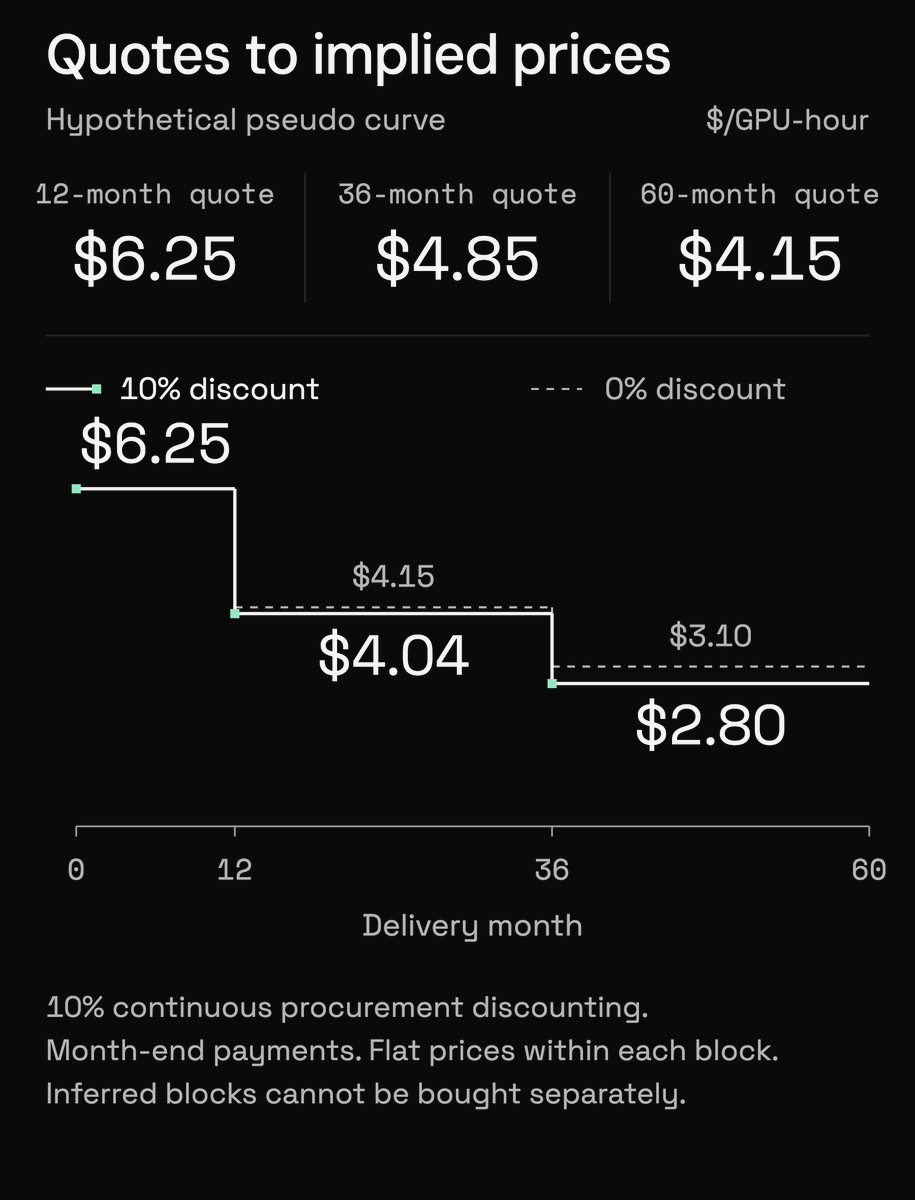
支付日期也很重要。在假设 10% 的连续年贴现率下,我减去贴现后的套餐账单,并除以额外月份中贴现后的 GPU 小时数。在月末支付的情况下,区块价格变为 $6.25、$4.04 和 $2.80,即下图的实线。

ALT

图 1. 假设的全期限报价和隐含区块。假设每月价格持平。实线:10% 连续贴现且月末支付。虚线:无贴现。区块不能单独购买。

客户的启动窗口落在第二个区块内,我将假设其每月价格持平,并使用 $4.0377 作为该季度的起始代理值。

未来的价格

曲线只是起点。对于相同的远期水平,更高的价格波动率会赋予看涨期权更多价值,因为其上涨空间可以增加,而在行权价以下其收益保持为零。

让我们在一个简单的模型中对其进行定价。我将假设我可以在今天和第 12 个月买入和卖出匹配的指数远期,涵盖我需要的所有小时数。我可以以 5% 的固定连续复利率借入和借出资金,并且我将忽略费用、违约和保证金约束。在这些假设下,我可以使用远期和现金来复制期权的收益,从而得出价格。

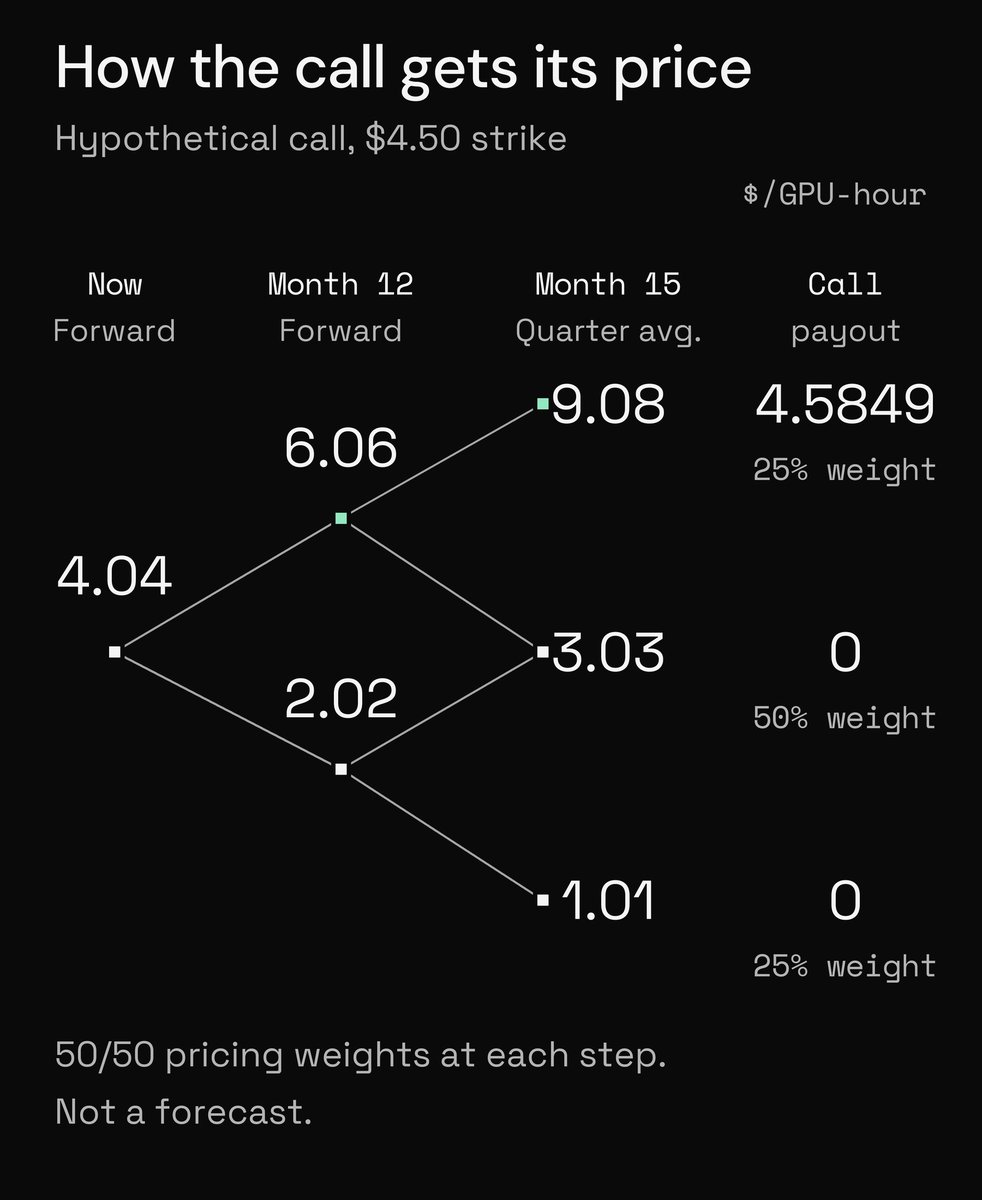
假设 $4.0377 的远期价格在第 12 个月上涨或下跌 50%,然后在季度平均值于第 15 个月结算之前再次进行同样的波动。在每一步中,我为上涨和下跌结果各分配 50% 的定价权重,这使得加权后的下一个值等于当前远期值。这些是对冲定价的权重,而不是对 GPU 租金的预测。这两步涵盖了不同的时间长度,因此这些波动也不构成恒定的年化波动率。

ALT

图 2. 假设的两步模型。今天和第 12 个月的远期值导向第 13 至 15 个月的平均指数,并在第 15 个月结算。每一步都有 50/50 的定价权重。只有两次上涨的结果支付高于 $4.50 行权价的收益,其定价权重为 25%。

季度平均值最终约为 $9.08、$3.03 或 $1.01。只有两段上涨才能使其超过 $4.50 的行权价。这才是产生收益的结果。

在最高价格下,看涨期权每覆盖小时支付 $4.584896。该结果的定价权重为 25%(50% × 50%)。将加权收益贴现回 15 个月前:

该看涨期权覆盖了客户在第 13 至 15 个月的 4,485,120 个 GPU 小时。以每覆盖小时 $1.07678 计算,今天需支付 $4.83M 以在这三个月的启动窗口期间保护价格。GPU 租赁账单仍需单独支付。

期权中的期权

现在购买这个看涨期权会在客户签约前占用 $4.83M 的现金。在这个模型中,如果计划有变,我可以稍后将其卖出。如果还能有一个报价,让我现在能在业务中保留更多现金,同时锁定一年后购买该看涨期权的成本,那就太好了。

复合期权(购买期权的期权)让我今天支付费用,以获得在第 12 个月购买同一看涨期权的选择权。我现在将那个未来的购买价格固定为每覆盖小时 $1。那未来的 1 美元买的是期权,而不是 GPU 租赁。

从第 12 个月开始往回推算。如果远期价格上涨到 $6.0566,我能买到的看涨期权价值为:

我会花 $1 买下价值 $2.264 的东西。如果远期价格下跌,看涨期权价值为零,我就不去管它。如果客户取消了计划,只要该权利仍有价值,我依然可以行权或出售它。为了得到今天的价格,我对这些结果进行加权并贴现:

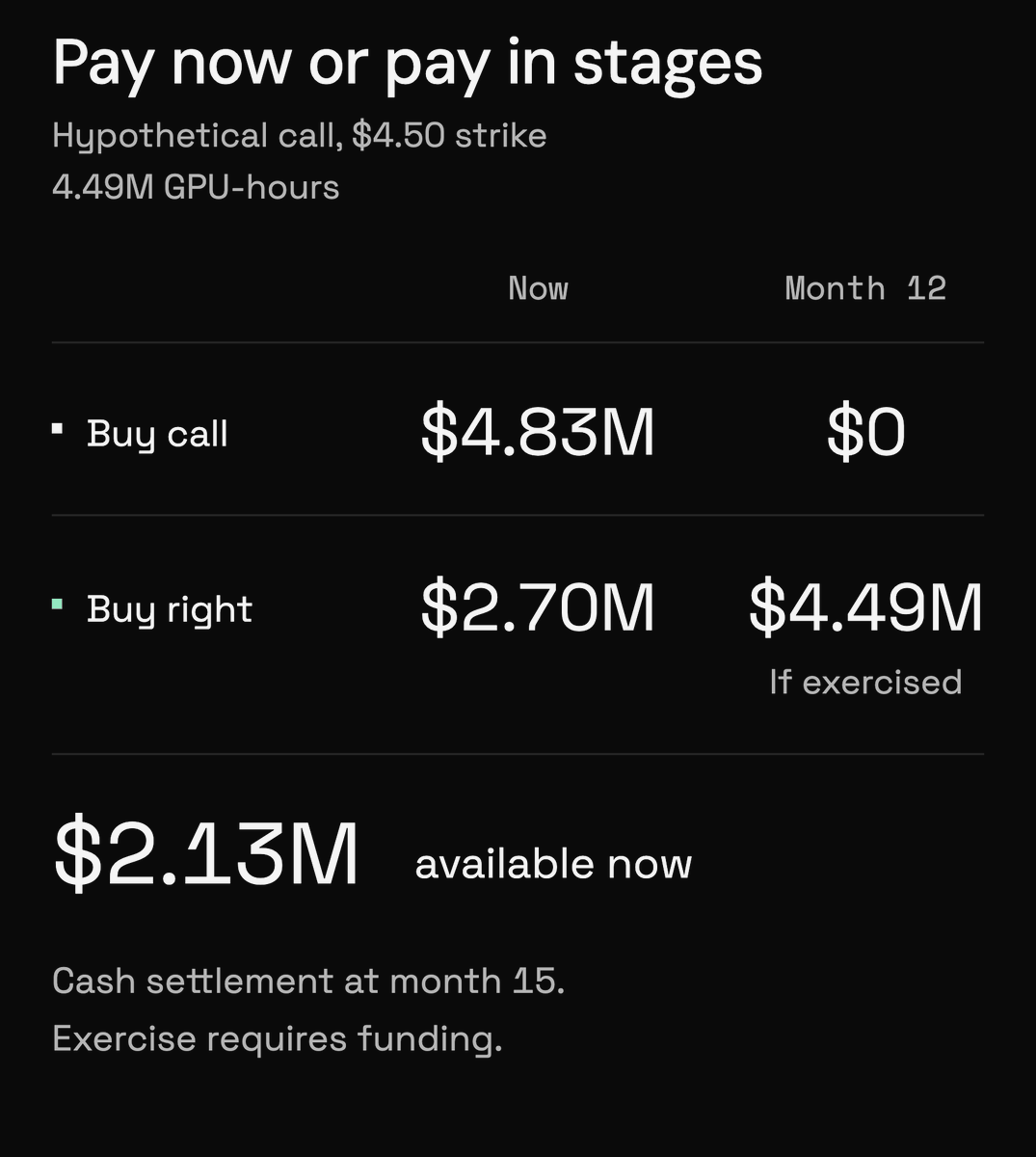
对于相同的启动窗口,这意味着现在支付 $2.70M,如果我在第 12 个月行权,还需支付 $4.49M。未来可能支付的款项具有定价加权现值 $2.13M,正好是两个前期价格之间的差额。

假设我为这次启动的价格保护预留了 $4.83M。现在购买看涨期权会立即耗尽这笔资金。而复合期权则留下了 $2.13M 的可用资金。这可以帮助我资助该客户的开发工作,同时等待启动。复合期权给了我一个不同的现金流计划供选择。在无摩擦定价模型中,我也可以借钱现在购买看涨期权。

ALT

图 3. 4,485,120 个覆盖 GPU 小时的假设付款。复合期权今天留下 $2.13M 可用资金,如果行权,则要求在第 12 个月再支付 $4.49M。无论以何种方式购买,看涨期权都在第 15 个月结算。

这对集群意味着什么?

假设启动顺利进行,这位视频生成客户成为一项持续的工作负载。我将在那时开始一个全新的五年模拟,需求为 2,048 块 GPU,并使用一个新的假设租赁菜单。预留所有算力会使我面临闲置小时的风险。每年续约给了我更多调整规模的机会,但也给了我更多遇到昂贵价格的机会。我想看看看涨期权是否能让第二种选择更容易接受。

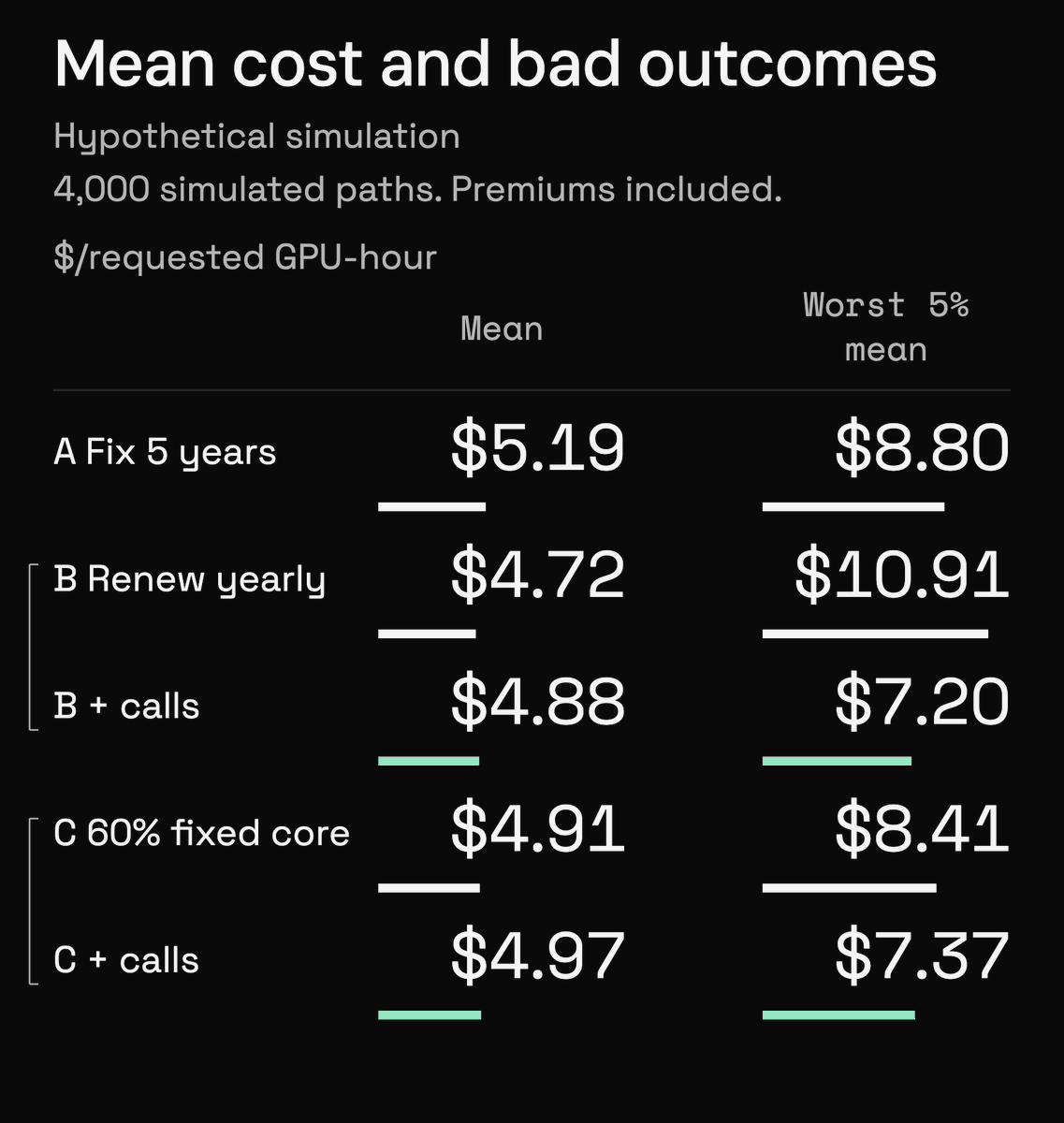
我用 4,000 条虚构的五年路径对租赁价格和客户需求进行了模拟。在这些历史数据中,年度续约的平均价格为每小时 $4.72,而最差的 5% 平均值为 $10.91。加入看涨期权后,第一个数字升至 $4.88,第二个数字降至 $7.20,其中已包含期权费。

我在相同的路径上尝试了五种采购策略,包括我为弥补短缺所支付的费用、我从闲置产能中收回的资金以及期权的成本。以下是我比较的内容:

A:将所有 2,048 块 GPU 锁定五年。 B:每年续约,根据续约时观察到的需求调整采购规模。 C:锁定原始集群的 60%,剩余需求每年续约。 B + calls / C + calls:在第 13 至 60 个运营月份增加行权价为 $4.50 的月度指数看涨期权,固定名义算力分别为 2,048 和 819.2 块 GPU。

我让价格和需求倾向于同向变动,这样企业可能会在 GPU 变贵时恰好需要更多算力。它只能以指数 80% 的价格转售 70% 的闲置产能,并为短缺支付 125% 的费用。我让它购买足够的算力来满足这里的所有需求,所以我比较的是账单。

对于价格,我使用了 50% 的年化波动率。需求驱动因素使用 35% 的波动率,其冲击与价格冲击之间的相关性为 0.6。我对需求进行截断和重新缩放,以使其预期水平保持在 2,048 块 GPU。这个五年运营案例使用了更完整的假设租赁菜单和 10% 的贴现率,与上述三个月启动对冲是分开的。我使用生成路径的相同过程对看涨期权进行定价,因此它们的预期贴现利润为零。

ALT

图 4. 假设模拟,包含期权费。独立的柱状图显示了等权平均路径成本以及每种策略在 4,000 条路径中最差的 200 条的平均成本。每条路径将贴现成本除以贴现后的请求 GPU 小时数。

这使得年度续约对我来说更有吸引力了。我仍然可以每年调整采购规模。增加看涨期权以略高的平均每小时成本换取了不那么糟糕的坏结果。如果正是这些坏结果会吞噬我的利润率或迫使我四处筹措资金,我会想要这个报价。

这对未来意味着什么

我认为这些早期的远期交易只是一个更大市场的开端。一旦未来 GPU 小时(和残值)有了可信的价格,买家就可以开始围绕自己的计划寻求保护。客户可能想要固定的账单。供应商可能希望锁定部分收入。其他人可能很乐意为了溢价承担价格风险。这些都是不同的需求,而一份五年期租赁合同是处理所有这些需求的一种相当笨拙的方式。

对于较小的运营商来说,这可能会改变哪些客户值得去争取。我可能完全有能力服务这位视频生成客户,但在他们理顺分发渠道时,却无法承担数年的租赁承诺。一个定价合理的对冲可以让我在等待期间保护启动时的租赁价格敞口。我仍然会为我信任的需求进行预留。对于可能到来的需求,我将有另一种购买方式。

而且是的,我认为了解金融层面的运营商将具有优势。非常擅长推理并不能阻止租赁账单吞噬利润。我需要知道我承担哪种风险能得到报酬,以及将其转嫁给别人需要多少成本。

这就是为什么我希望看到这里发展出一个正规的市场,提供有用的规模报价,并且有在价格变动时能够支付的交易对手。我希望能将这个假设的采购带给交易商,并获得一个实际的选择:这是预留的成本,这是保护价格的成本,这是各自会占用的现金。对于一个试图成长的初创企业来说,在投入数十亿美元之前拥有这种选择可能意义重大。

来源 交易与监管 FalconX:H100 指数场外交易掉期公告。 Wintermute:H100 远期公告。 CFTC:9 月 21 日审查延期信。将 NYMEX 算力期货审查延长至 11 月 9 日。 数据与方法论 Ornn:远期曲线与套餐拆解,公开预览及 OCPI 方法论。此处引用的曲线构建和按需租赁基准。OCPI 不包含预留合同。我将这些作为参考,未复制任何 Ornn 数据。 US Treasury:2026 年 9 月每日平价收益率曲线。9 月 25 日的 10 年期收益率为 5.17%。 研究论文 Sergey V. Chernenko, Krista B. Schwarz 和 Jonathan H. Wright:《远期与期货价格的信息含量》(2004)。远期价格如何反映预期和风险价格。 Federico M. Bandi 和 Yinan Su:(早期)AI 算力资产定价,v3。算力定价、不可储存性以及定期租赁与远期合同的区别。 John C. Cox, Stephen A. Ross 和 Mark Rubinstein:《期权定价:一种简化方法》(1979)。期权定价示例背后的二项式复制逻辑。 Mark Davis, Walter Schachermayer 和 Robert Tompkins:《风险投资作为分期付款期权的评估》(2003)。分期投资与进行后期支付的期权。 工作示例和模拟中使用了假设价格和期权条款。

Do you guys see what’s happening in the market right now?

Deals are clearing above $24/gpu/hr for some B300s with pricing for short term (<1 year) compute hovering above $7. Actually by the time you finish reading this it will have gone up again. I’m not even going to entertain the ridiculous VR pricing that’s starting to float around, let alone everyone’s promises of Q1 deployments.

Maybe one day I will share my thoughts on the current state of the public and private credit markets (no one in SF somehow cares that the 10y just passed 5%) and potential oversupply, but today I want to talk about trading compute

There’s an emerging market of compute derivative products and I believe this market could fundamentally change how neoclouds and anyone adjacent can grow as well as protect themselves. A 5 year deal asks me to take a huge bet on demand to secure an affordable rate. I'd like to pay for protection against expensive GPU-hours while leaving myself room to change how many hours I rent. A supplier or trader willing to carry the price risk could earn that premium.

For an inference cloud, this is a pretty urgent problem. If I sell a customer fixed-price service while my GPU bill floats, I've taken a position on compute prices whether I meant to or not.

Buying before the customer signs

Say I'm quoting a fixed price to a video gen customer with a distribution deal pending. They'll decide whether to launch in 12 months. If they do, I need 2,048 B300s for their first 3 months, months 13-15. That's 4,485,120 GPU-hours at 730 hours per month.

A vendor offers me those 2,048 B300s starting today at $4.15/gpu/hr if I sign for 5 years:

That buys 60 months of compute starting now. The customer has outlined a three-month launch window a year away. Ay, there's the rub.

If I make a firm reservation for their launch now, I’m committed even if the deal falls apart. If I wait, the customer might launch just as everyone else wants the same GPUs. I'd like their success to be good news for my margins too. In fact, I'd pay a bit more on average if it meant I could resize the fleet more often and take some of the sting out of an expensive renewal. The question is how much that protection costs.

A call option would help here. I pick a rental benchmark and a price I'm worried about paying above called the strike. For this launch, suppose I buy a call on the average rental index over months 13-15 with a $4.50 strike and settlement at month 15. If that average is $8, the call pays $3.50 per covered hour. If it's $2, the call pays nothing and I get the cheaper rent.

If my average rental price S matches the index, the math becomes:

That's a $4.50 ceiling on the matched quarter's rent before the option premium and financing. The rental purchase stays separate so I can choose whether to make it after the customer decides.

That still leaves me with a customer expecting 2,048 GPUs on launch day. I'd have to secure them through a separate capacity agreement or accept the risk of sourcing them later. Reserving capacity has its own cost and supplier risk. For the example below, I’m assuming I can source the GPUs and cover the rental invoices until the call pays cash at month 15 (this is a massive assumption).

The (pseudo) forward curve

Before I can decide whether this is worth buying, I need a price for the call. The hedge covers a specific future quarter so I need a reference price for those future hours.

A forward curve puts today's prices for future delivery periods on a timeline. For this call, I want the price I could agree today for the customer's months 13-15 rental index. That will be the starting input for the option calculation. Forward prices also reflect what the market charges for taking risk, so I wouldn't read the curve as a pure forecast of where GPU rents will end up.

Ideally, I'd ask a dealer for that quarter's forward quote. For now I've got the vendor's package menu for the same 2,048 GPUs: 1 year at $6.25/gpu/hr, 3 at $4.85, 5 at $4.15. Same nodes, start date and service, paid monthly with nothing down.

The three-year price includes the first year which I can also price separately so we can subtract it to see what the remaining two years contribute:

Doing the same math between the 5 and 3 year packages gives $3.10 for years 4-5. My initial block prices are therefore $6.25, $4.15 and $3.10.

This is a pseudo forward curve using the package-unbundling construction Ornn describes. The $4.15 is inferred from two whole contracts. The vendor hasn't offered to sell me just years 2-3 at that price. The packages also pay for availability, credit and commitment terms which Bandi and Su examine. A dealer's index-forward quote could differ.

Payment dates matter too. At an assumed 10% continuous annual discount rate, I subtract the discounted package bills and divide by the discounted GPU-hours in the extra months. With month-end payments, the blocks become $6.25, $4.04 and $2.80, the solid line below.

ALT

Figure 1. Hypothetical whole-term quotes and implied blocks. Flat monthly prices are assumed. Solid: 10% continuous discounting with month-end payments. Dashed: no discounting. Blocks cannot be bought separately.

The customer's launch window falls inside the second block and I'll assume its monthly price is flat and use $4.0377 as my starting proxy for the quarter.

The price of the future

The curve is only the starting point. For the same forward level, higher volatility in price gives the call more value because its upside can grow while its payout stays at zero below the strike.

Let's price it in a simple model. I'll assume I can buy and sell matching index forwards today and at month 12, for all the hours I need. I can borrow and lend at a fixed 5% continuously compounded rate, and I'll leave out fees, default and margin constraints. With those assumptions, I can use forwards and cash to replicate the option's payout, which gives us a price.

Say the $4.0377 forward goes up or down 50% at month 12 then does the same again before the quarter average settles at month 15. At each step I give the up and down outcomes a 50% pricing weight each which keeps the weighted next value equal to the current forward. These are weights for pricing the hedge, not a forecast of GPU rents. The two steps cover different lengths of time so these moves don't amount to a constant annual volatility either.

ALT

Figure 2. Hypothetical two-step model. Forward values today and at month 12 lead to the months 13-15 average index, settled at month 15. Each step has 50/50 pricing weights. Only the two-up outcome pays above the $4.50 strike, with 25% pricing weight.

The quarter average ends up around $9.08, $3.03 or $1.01. Only two up moves get it above the $4.50 strike. That's the outcome that pays.

At the top price, the call pays $4.584896 per covered hour. That outcome gets a 25% pricing weight (50% × 50%). Discount the weighted payout back 15 months:

The call covers the customer's 4,485,120 GPU-hours during months 13-15. At $1.07678 per covered hour, that's $4.83M paid today to protect the price during that three-month launch window. The GPU rental invoices are still paid separately.

Optionception

Buying this call now commits $4.83M of cash before the customer has signed. In this model I could buy it and sell it later if plans change. It’d be nice to also have a quote for keeping more cash in the business now while fixing what it would cost to buy the call in a year.

A compound option (option to buy option) lets me pay today for the choice of buying that same call at month 12. I fix that later purchase price now at $1 per covered hour. That later dollar buys the option, not the GPU rentals.

Start at month 12 and work backwards. If the forward went up to $6.0566, the call I can buy is worth:

I'd pay $1 for something worth $2.264. If the forward went down, the call is worth zero and I leave it alone. And if the customer cancels while the right is still valuable I can still exercise or sell it. To get today's price I weight those outcomes and discount them:

For the same launch window that's $2.70M now plus $4.49M at month 12 if I exercise. The possible later payment has a pricing-weighted present value of $2.13M, exactly the difference between the two upfront prices.

Say I've set aside $4.83M for price protection on this launch. Buying the call now uses it all today. The compound leaves $2.13M available. That could help fund this customer's development work while I wait on the launch. The compound gives me a different cash schedule to choose from. In the frictionless pricing model I could also borrow to buy the call now.

ALT

Figure 3. Hypothetical payments for 4,485,120 covered GPU-hours. The compound leaves $2.13M available today and requires another $4.49M at month 12 if exercised. The call settles at month 15 whichever way I buy it.

What would this change for the fleet?

Suppose the launch goes ahead and this video gen customer becomes an ongoing workload. I'll start a fresh five-year simulation at that point, with 2,048 GPUs of demand and a new hypothetical rental menu. Reserving everything exposes me to unused hours. Renewing annually gives me more chances to resize, but also more chances to encounter expensive prices. I want to see whether calls make that second choice easier to live with.

I ran a simulation with 4,000 made-up five-year paths for rental prices and customer demand. Annual renewal averaged $4.72 per hour across those histories, and its worst 5% averaged $10.91. Adding calls raised the first number to $4.88 and brought the second down to $7.20, including the option premiums.

I tried five purchasing policies on the same paths, including what I'd pay to cover shortfalls, what I'd recover from spare capacity and what the options cost. Here's what I compared:

A: fix all 2,048 GPUs for five years.

B: renew annually, sizing the purchase to demand observed at renewal.

C: fix 60% of the original fleet and renew the remaining need annually.

B + calls / C + calls: add $4.50 monthly index calls for operating months 13-60, on fixed 2,048/819.2-GPU notionals respectively.

I made price and demand tend to move together, so the business can find itself needing more GPUs just as they get expensive. It can resell only 70% of spare capacity at 80% of the index and pays 125% for shortfalls. I let it buy enough to serve all demand here, so I'm comparing the bills.

For prices I used 50% annual volatility. The demand driver uses 35%, with 0.6 correlation between its shocks and price shocks. I clip and rescale demand to keep its expected level at 2,048 GPUs. This five-year operating case uses a fuller hypothetical rental menu and 10% discounting, separate from the three-month launch hedge above. I price the calls using the same process that generates the paths, so their expected discounted profit is zero.

ALT

Figure 4. Hypothetical simulation, including premiums. The separate bars show equal-weight mean path cost and the mean of each policy's own worst 200 of 4,000 paths. Each path divides discounted cost by discounted requested GPU-hours.

That makes annual renewal much more interesting to me. I still get to resize the purchase each year. Adding calls trades a slightly higher average cost per hour for less expensive bad outcomes. If those are the outcomes that would wipe out my margin or force me to scramble for cash, I'd want that quote.

What this means for the future

I think these early forward trades are the beginning of a much bigger market. Once there are credible prices for future GPU-hours (and residuals), buyers can start asking for protection around their own plans. A customer might want a fixed bill. A supplier might want some income locked in. Someone else might be happy to take the price risk for a premium. Those are different needs and a five-year rental contract is a pretty blunt way to handle all of them.

For a smaller operator this could change which customers are even worth pursuing. I might be perfectly capable of serving this video gen customer and still be unable to carry years of rental commitments while they sort out distribution. A reasonably priced hedge could let me protect the launch's rental-price exposure while I wait. I'd still reserve against demand I trust. I'd have another way to buy for the demand that might arrive.

And yes, I think the operators who understand the financial side will have an advantage. Being very good at inference won't stop the rental bill from eating the margin. I need to know which risk I'm getting paid to carry and what it would cost to pass it to someone else.

That's why I want to see a proper market develop here with quotes in useful sizes and counterparties that can pay when prices move. I'd like to be able to take this hypothetical purchase to a dealer and get an actual choice: here's the cost of reserving, here's the cost of protecting the price, and here's the cash each would tie up. For a startup trying to grow, having that choice before committing billions of dollars could matter a lot.

Sources

Trades and regulation

FalconX: H100-index OTC swap announcement.

Wintermute: H100 forward announcement.

CFTC: Sep 21 review-extension letter. Extends the NYMEX compute-futures review through Nov 9.

Data and methodology

Ornn: Forward curves and package unbundling, public preview and OCPI methodology. The curve construction and on-demand rental benchmark referenced here. OCPI excludes reserved contracts. I used these as references and reproduced no Ornn data.

US Treasury: Daily par yield curve, September 2026. The 10-year yield was 5.17% on Sep 25.

Research papers

Sergey V. Chernenko, Krista B. Schwarz and Jonathan H. Wright: The Information Content of Forward and Futures Prices (2004). How forward prices reflect both expectations and the price of risk.

Federico M. Bandi and Yinan Su: (Early) AI Compute Asset Pricing, v3. Compute pricing, non-storability and the distinction between term rentals and forward contracts.

John C. Cox, Stephen A. Ross and Mark Rubinstein: Option Pricing: A Simplified Approach (1979). The binomial replication logic behind the option-pricing example.

Mark Davis, Walter Schachermayer and Robert Tompkins: The Evaluation of Venture Capital As an Instalment Option (2003). Staged investment and the option to make a later payment.

Hypothetical prices and option terms were used for the worked examples and simulation.

一些 B300 的成交价已超过 $24/gpu/hr,短期(<1年)算力的价格徘徊在 $7 以上。实际上,等你读完这篇文章时,价格可能又涨了。我甚至都不想理会那些开始流传的荒谬的 VR 定价,更不用说大家对第一季度部署的承诺了。

也许有一天我会分享我对公共和私人信贷市场现状的看法(不知为何,旧金山似乎没人在意 10 年期国债收益率刚刚突破 5% 这件事)以及潜在的产能过剩问题,但今天我想谈谈算力交易。

一个算力衍生品的新兴市场正在形成,我相信这个市场可能会从根本上改变新兴云厂商以及相关企业增长和保护自身的方式。一份 5 年期的合同要求我对需求进行巨大的押注,以确保获得可承受的价格。我更希望为昂贵的 GPU 小时支付保护费,同时给自己留出改变租赁时长的余地。愿意承担价格风险的供应商或交易员可以赚取这笔溢价。

对于推理云来说,这是一个相当紧迫的问题。如果我在向客户出售固定价格服务的同时,我的 GPU 账单却在浮动,那么无论我是否有意,我都已经在算力价格上持有了头寸。

在客户签约前提前购买

假设我正在向一位视频生成客户提供报价,且该客户有一笔待定的分发交易。他们将在 12 个月内决定是否启动。如果启动,我需要在前 3 个月(即第 13 至 15 个月)为其提供 2,048 块 B300。按每月 730 小时计算,这总计是 4,485,120 个 GPU 小时。

一家供应商向我提供这 2,048 块 B300,从今天算起,如果我签订 5 年合同,价格为 $4.15/gpu/hr:

这买下了从现在起 60 个月的算力。而客户设定了一年后的三个月启动窗口。哎,问题就在这里。

如果我现在就为他们的启动进行硬性预留,那么即使交易告吹,我也已做出承诺。如果我等待,客户可能会在其他人也想要同样的 GPU 时启动。我希望他们的成功对我利润率来说也是个好消息。事实上,如果这意味着我可以更频繁地调整集群规模,并减轻昂贵续约带来的一些阵痛,我愿意平均多付一点。问题是这种保护的成本是多少。

看涨期权在这里会派上用场。我选择一个租赁基准以及一个我担心会超出的价格,称为行权价。对于这次启动,假设我购买了一份针对第 13 至 15 个月平均租赁指数的看涨期权,行权价为 $4.50,并在第 15 个月进行结算。如果平均价格是 $8,该期权每覆盖小时支付 $3.50。如果是 $2,期权支付为零,而我则获得更便宜的租金。

如果我的平均租赁价格 S 与指数匹配,计算如下:

在期权费和融资成本之前,这是匹配季度租金的 $4.50 上限。租赁购买保持独立,因此我可以选择在客户做出决定后是否进行购买。

这仍然给我留下了一个在启动日期望获得 2,048 块 GPU 的客户。我必须通过单独的产能协议来确保获得它们,或者承担稍后寻找货源的风险。预留产能有其自身的成本和供应商风险。在下面的例子中,我假设我能够找到 GPU 货源,并支付租赁账单,直到看涨期权在第 15 个月支付现金(这是一个巨大的假设)。

(伪)远期曲线

在决定是否值得购买之前,我需要这个看涨期权的价格。对冲覆盖了特定的未来季度,因此我需要这些未来小时的参考价格。

远期曲线将未来交付期的今日价格放在时间轴上。对于这个看涨期权,我想要的是今天能为客户第 13 至 15 个月的租赁指数商定的价格。这将是期权计算的起始输入。远期价格也反映了市场对承担风险的收费,因此我不会将曲线视为对 GPU 租金最终走向的纯粹预测。

理想情况下,我会向交易商询问该季度的远期报价。目前,我拿到了供应商针对同样 2,048 块 GPU 的套餐菜单:1 年期 $6.25/gpu/hr,3 年期 $4.85,5 年期 $4.15。相同的节点、开始日期和服务,按月支付,无首付。

3 年期价格包含了第 1 年,而第 1 年我也可以单独定价,因此我们可以将其减去,看看剩下的两年贡献了多少:

对 5 年期和 3 年期套餐进行同样的计算,得出第 4 至 5 年的价格为 $3.10。因此,我初始的区块价格分别为 $6.25、$4.15 和 $3.10。

这是一条使用 Ornn 描述的套餐拆解结构构建的伪远期曲线。$4.15 是从两份完整合同中推断出来的。供应商并没有提出以该价格仅向我出售第 2 至 3 年的算力。这些套餐也包含了可用性、信贷和承诺条款的费用,Bandi 和 Su 对此进行了研究。交易商的指数远期报价可能会有所不同。

支付日期也很重要。在假设 10% 的连续年贴现率下,我减去贴现后的套餐账单,并除以额外月份中贴现后的 GPU 小时数。在月末支付的情况下,区块价格变为 $6.25、$4.04 和 $2.80,即下图的实线。

ALT

图 1. 假设的全期限报价和隐含区块。假设每月价格持平。实线:10% 连续贴现且月末支付。虚线:无贴现。区块不能单独购买。

客户的启动窗口落在第二个区块内,我将假设其每月价格持平,并使用 $4.0377 作为该季度的起始代理值。

未来的价格

曲线只是起点。对于相同的远期水平,更高的价格波动率会赋予看涨期权更多价值,因为其上涨空间可以增加,而在行权价以下其收益保持为零。

让我们在一个简单的模型中对其进行定价。我将假设我可以在今天和第 12 个月买入和卖出匹配的指数远期,涵盖我需要的所有小时数。我可以以 5% 的固定连续复利率借入和借出资金,并且我将忽略费用、违约和保证金约束。在这些假设下,我可以使用远期和现金来复制期权的收益,从而得出价格。

假设 $4.0377 的远期价格在第 12 个月上涨或下跌 50%,然后在季度平均值于第 15 个月结算之前再次进行同样的波动。在每一步中,我为上涨和下跌结果各分配 50% 的定价权重,这使得加权后的下一个值等于当前远期值。这些是对冲定价的权重,而不是对 GPU 租金的预测。这两步涵盖了不同的时间长度,因此这些波动也不构成恒定的年化波动率。

ALT

图 2. 假设的两步模型。今天和第 12 个月的远期值导向第 13 至 15 个月的平均指数,并在第 15 个月结算。每一步都有 50/50 的定价权重。只有两次上涨的结果支付高于 $4.50 行权价的收益,其定价权重为 25%。

季度平均值最终约为 $9.08、$3.03 或 $1.01。只有两段上涨才能使其超过 $4.50 的行权价。这才是产生收益的结果。

在最高价格下,看涨期权每覆盖小时支付 $4.584896。该结果的定价权重为 25%(50% × 50%)。将加权收益贴现回 15 个月前:

该看涨期权覆盖了客户在第 13 至 15 个月的 4,485,120 个 GPU 小时。以每覆盖小时 $1.07678 计算,今天需支付 $4.83M 以在这三个月的启动窗口期间保护价格。GPU 租赁账单仍需单独支付。

期权中的期权

现在购买这个看涨期权会在客户签约前占用 $4.83M 的现金。在这个模型中,如果计划有变,我可以稍后将其卖出。如果还能有一个报价,让我现在能在业务中保留更多现金,同时锁定一年后购买该看涨期权的成本,那就太好了。

复合期权(购买期权的期权)让我今天支付费用,以获得在第 12 个月购买同一看涨期权的选择权。我现在将那个未来的购买价格固定为每覆盖小时 $1。那未来的 1 美元买的是期权,而不是 GPU 租赁。

从第 12 个月开始往回推算。如果远期价格上涨到 $6.0566,我能买到的看涨期权价值为:

我会花 $1 买下价值 $2.264 的东西。如果远期价格下跌,看涨期权价值为零,我就不去管它。如果客户取消了计划,只要该权利仍有价值,我依然可以行权或出售它。为了得到今天的价格,我对这些结果进行加权并贴现:

对于相同的启动窗口,这意味着现在支付 $2.70M,如果我在第 12 个月行权,还需支付 $4.49M。未来可能支付的款项具有定价加权现值 $2.13M,正好是两个前期价格之间的差额。

假设我为这次启动的价格保护预留了 $4.83M。现在购买看涨期权会立即耗尽这笔资金。而复合期权则留下了 $2.13M 的可用资金。这可以帮助我资助该客户的开发工作,同时等待启动。复合期权给了我一个不同的现金流计划供选择。在无摩擦定价模型中,我也可以借钱现在购买看涨期权。

ALT

图 3. 4,485,120 个覆盖 GPU 小时的假设付款。复合期权今天留下 $2.13M 可用资金,如果行权,则要求在第 12 个月再支付 $4.49M。无论以何种方式购买,看涨期权都在第 15 个月结算。

这对集群意味着什么?

假设启动顺利进行,这位视频生成客户成为一项持续的工作负载。我将在那时开始一个全新的五年模拟,需求为 2,048 块 GPU,并使用一个新的假设租赁菜单。预留所有算力会使我面临闲置小时的风险。每年续约给了我更多调整规模的机会,但也给了我更多遇到昂贵价格的机会。我想看看看涨期权是否能让第二种选择更容易接受。

我用 4,000 条虚构的五年路径对租赁价格和客户需求进行了模拟。在这些历史数据中,年度续约的平均价格为每小时 $4.72,而最差的 5% 平均值为 $10.91。加入看涨期权后,第一个数字升至 $4.88,第二个数字降至 $7.20,其中已包含期权费。

我在相同的路径上尝试了五种采购策略,包括我为弥补短缺所支付的费用、我从闲置产能中收回的资金以及期权的成本。以下是我比较的内容:

A:将所有 2,048 块 GPU 锁定五年。

B:每年续约,根据续约时观察到的需求调整采购规模。

C:锁定原始集群的 60%,剩余需求每年续约。

B + calls / C + calls:在第 13 至 60 个运营月份增加行权价为 $4.50 的月度指数看涨期权,固定名义算力分别为 2,048 和 819.2 块 GPU。

我让价格和需求倾向于同向变动,这样企业可能会在 GPU 变贵时恰好需要更多算力。它只能以指数 80% 的价格转售 70% 的闲置产能,并为短缺支付 125% 的费用。我让它购买足够的算力来满足这里的所有需求,所以我比较的是账单。

对于价格,我使用了 50% 的年化波动率。需求驱动因素使用 35% 的波动率,其冲击与价格冲击之间的相关性为 0.6。我对需求进行截断和重新缩放,以使其预期水平保持在 2,048 块 GPU。这个五年运营案例使用了更完整的假设租赁菜单和 10% 的贴现率,与上述三个月启动对冲是分开的。我使用生成路径的相同过程对看涨期权进行定价,因此它们的预期贴现利润为零。

ALT

图 4. 假设模拟,包含期权费。独立的柱状图显示了等权平均路径成本以及每种策略在 4,000 条路径中最差的 200 条的平均成本。每条路径将贴现成本除以贴现后的请求 GPU 小时数。

这使得年度续约对我来说更有吸引力了。我仍然可以每年调整采购规模。增加看涨期权以略高的平均每小时成本换取了不那么糟糕的坏结果。如果正是这些坏结果会吞噬我的利润率或迫使我四处筹措资金,我会想要这个报价。

这对未来意味着什么

我认为这些早期的远期交易只是一个更大市场的开端。一旦未来 GPU 小时(和残值)有了可信的价格,买家就可以开始围绕自己的计划寻求保护。客户可能想要固定的账单。供应商可能希望锁定部分收入。其他人可能很乐意为了溢价承担价格风险。这些都是不同的需求,而一份五年期租赁合同是处理所有这些需求的一种相当笨拙的方式。

对于较小的运营商来说,这可能会改变哪些客户值得去争取。我可能完全有能力服务这位视频生成客户,但在他们理顺分发渠道时,却无法承担数年的租赁承诺。一个定价合理的对冲可以让我在等待期间保护启动时的租赁价格敞口。我仍然会为我信任的需求进行预留。对于可能到来的需求,我将有另一种购买方式。

而且是的,我认为了解金融层面的运营商将具有优势。非常擅长推理并不能阻止租赁账单吞噬利润。我需要知道我承担哪种风险能得到报酬,以及将其转嫁给别人需要多少成本。

这就是为什么我希望看到这里发展出一个正规的市场,提供有用的规模报价,并且有在价格变动时能够支付的交易对手。我希望能将这个假设的采购带给交易商,并获得一个实际的选择:这是预留的成本,这是保护价格的成本,这是各自会占用的现金。对于一个试图成长的初创企业来说,在投入数十亿美元之前拥有这种选择可能意义重大。

来源

交易与监管

FalconX:H100 指数场外交易掉期公告。

Wintermute:H100 远期公告。

CFTC:9 月 21 日审查延期信。将 NYMEX 算力期货审查延长至 11 月 9 日。

数据与方法论

Ornn:远期曲线与套餐拆解,公开预览及 OCPI 方法论。此处引用的曲线构建和按需租赁基准。OCPI 不包含预留合同。我将这些作为参考,未复制任何 Ornn 数据。

US Treasury:2026 年 9 月每日平价收益率曲线。9 月 25 日的 10 年期收益率为 5.17%。

研究论文

Sergey V. Chernenko, Krista B. Schwarz 和 Jonathan H. Wright:《远期与期货价格的信息含量》(2004)。远期价格如何反映预期和风险价格。

Federico M. Bandi 和 Yinan Su:(早期)AI 算力资产定价,v3。算力定价、不可储存性以及定期租赁与远期合同的区别。

John C. Cox, Stephen A. Ross 和 Mark Rubinstein:《期权定价:一种简化方法》(1979)。期权定价示例背后的二项式复制逻辑。

Mark Davis, Walter Schachermayer 和 Robert Tompkins:《风险投资作为分期付款期权的评估》(2003)。分期投资与进行后期支付的期权。

工作示例和模拟中使用了假设价格和期权条款。
Do you guys see what’s happening in the market right now? Deals are clearing above $24/gpu/hr for some B300s with pricing for short term (<1 year) compute hovering above $7. Actually by the time you finish reading this it will have gone up again. I’m not even going to entertain the ridiculous VR pricing that’s starting to float around, let alone everyone’s promises of Q1 deployments. Maybe one day I will share my thoughts on the current state of the public and private credit markets (no one in SF somehow cares that the 10y just passed 5%) and potential oversupply, but today I want to talk about trading compute There’s an emerging market of compute derivative products and I believe this market could fundamentally change how neoclouds and anyone adjacent can grow as well as protect themselves. A 5 year deal asks me to take a huge bet on demand to secure an affordable rate. I'd like to pay for protection against expensive GPU-hours while leaving myself room to change how many hours I rent. A supplier or trader willing to carry the price risk could earn that premium. For an inference cloud, this is a pretty urgent problem. If I sell a customer fixed-price service while my GPU bill floats, I've taken a position on compute prices whether I meant to or not. Buying before the customer signs Say I'm quoting a fixed price to a video gen customer with a distribution deal pending. They'll decide whether to launch in 12 months. If they do, I need 2,048 B300s for their first 3 months, months 13-15. That's 4,485,120 GPU-hours at 730 hours per month. A vendor offers me those 2,048 B300s starting today at $4.15/gpu/hr if I sign for 5 years: That buys 60 months of compute starting now. The customer has outlined a three-month launch window a year away. Ay, there's the rub. If I make a firm reservation for their launch now, I’m committed even if the deal falls apart. If I wait, the customer might launch just as everyone else wants the same GPUs. I'd like their success to be good news for my margins too. In fact, I'd pay a bit more on average if it meant I could resize the fleet more often and take some of the sting out of an expensive renewal. The question is how much that protection costs. A call option would help here. I pick a rental benchmark and a price I'm worried about paying above called the strike. For this launch, suppose I buy a call on the average rental index over months 13-15 with a $4.50 strike and settlement at month 15. If that average is $8, the call pays $3.50 per covered hour. If it's $2, the call pays nothing and I get the cheaper rent. If my average rental price S matches the index, the math becomes: That's a $4.50 ceiling on the matched quarter's rent before the option premium and financing. The rental purchase stays separate so I can choose whether to make it after the customer decides. That still leaves me with a customer expecting 2,048 GPUs on launch day. I'd have to secure them through a separate capacity agreement or accept the risk of sourcing them later. Reserving capacity has its own cost and supplier risk. For the example below, I’m assuming I can source the GPUs and cover the rental invoices until the call pays cash at month 15 (this is a massive assumption). The (pseudo) forward curve Before I can decide whether this is worth buying, I need a price for the call. The hedge covers a specific future quarter so I need a reference price for those future hours. A forward curve puts today's prices for future delivery periods on a timeline. For this call, I want the price I could agree today for the customer's months 13-15 rental index. That will be the starting input for the option calculation. Forward prices also reflect what the market charges for taking risk, so I wouldn't read the curve as a pure forecast of where GPU rents will end up. Ideally, I'd ask a dealer for that quarter's forward quote. For now I've got the vendor's package menu for the same 2,048 GPUs: 1 year at $6.25/gpu/hr, 3 at $4.85, 5 at $4.15. Same nodes, start date and service, paid monthly with nothing down. The three-year price includes the first year which I can also price separately so we can subtract it to see what the remaining two years contribute: Doing the same math between the 5 and 3 year packages gives $3.10 for years 4-5. My initial block prices are therefore $6.25, $4.15 and $3.10. This is a pseudo forward curve using the package-unbundling construction Ornn describes. The $4.15 is inferred from two whole contracts. The vendor hasn't offered to sell me just years 2-3 at that price. The packages also pay for availability, credit and commitment terms which Bandi and Su examine. A dealer's index-forward quote could differ. Payment dates matter too. At an assumed 10% continuous annual discount rate, I subtract the discounted package bills and divide by the discounted GPU-hours in the extra months. With month-end payments, the blocks become $6.25, $4.04 and $2.80, the solid line below. ALT Figure 1. Hypothetical whole-term quotes and implied blocks. Flat monthly prices are assumed. Solid: 10% continuous discounting with month-end payments. Dashed: no discounting. Blocks cannot be bought separately. The customer's launch window falls inside the second block and I'll assume its monthly price is flat and use $4.0377 as my starting proxy for the quarter. The price of the future The curve is only the starting point. For the same forward level, higher volatility in price gives the call more value because its upside can grow while its payout stays at zero below the strike. Let's price it in a simple model. I'll assume I can buy and sell matching index forwards today and at month 12, for all the hours I need. I can borrow and lend at a fixed 5% continuously compounded rate, and I'll leave out fees, default and margin constraints. With those assumptions, I can use forwards and cash to replicate the option's payout, which gives us a price. Say the $4.0377 forward goes up or down 50% at month 12 then does the same again before the quarter average settles at month 15. At each step I give the up and down outcomes a 50% pricing weight each which keeps the weighted next value equal to the current forward. These are weights for pricing the hedge, not a forecast of GPU rents. The two steps cover different lengths of time so these moves don't amount to a constant annual volatility either. ALT Figure 2. Hypothetical two-step model. Forward values today and at month 12 lead to the months 13-15 average index, settled at month 15. Each step has 50/50 pricing weights. Only the two-up outcome pays above the $4.50 strike, with 25% pricing weight. The quarter average ends up around $9.08, $3.03 or $1.01. Only two up moves get it above the $4.50 strike. That's the outcome that pays. At the top price, the call pays $4.584896 per covered hour. That outcome gets a 25% pricing weight (50% × 50%). Discount the weighted payout back 15 months: The call covers the customer's 4,485,120 GPU-hours during months 13-15. At $1.07678 per covered hour, that's $4.83M paid today to protect the price during that three-month launch window. The GPU rental invoices are still paid separately. Optionception Buying this call now commits $4.83M of cash before the customer has signed. In this model I could buy it and sell it later if plans change. It’d be nice to also have a quote for keeping more cash in the business now while fixing what it would cost to buy the call in a year. A compound option (option to buy option) lets me pay today for the choice of buying that same call at month 12. I fix that later purchase price now at $1 per covered hour. That later dollar buys the option, not the GPU rentals. Start at month 12 and work backwards. If the forward went up to $6.0566, the call I can buy is worth: I'd pay $1 for something worth $2.264. If the forward went down, the call is worth zero and I leave it alone. And if the customer cancels while the right is still valuable I can still exercise or sell it. To get today's price I weight those outcomes and discount them: For the same launch window that's $2.70M now plus $4.49M at month 12 if I exercise. The possible later payment has a pricing-weighted present value of $2.13M, exactly the difference between the two upfront prices. Say I've set aside $4.83M for price protection on this launch. Buying the call now uses it all today. The compound leaves $2.13M available. That could help fund this customer's development work while I wait on the launch. The compound gives me a different cash schedule to choose from. In the frictionless pricing model I could also borrow to buy the call now. ALT Figure 3. Hypothetical payments for 4,485,120 covered GPU-hours. The compound leaves $2.13M available today and requires another $4.49M at month 12 if exercised. The call settles at month 15 whichever way I buy it. What would this change for the fleet? Suppose the launch goes ahead and this video gen customer becomes an ongoing workload. I'll start a fresh five-year simulation at that point, with 2,048 GPUs of demand and a new hypothetical rental menu. Reserving everything exposes me to unused hours. Renewing annually gives me more chances to resize, but also more chances to encounter expensive prices. I want to see whether calls make that second choice easier to live with. I ran a simulation with 4,000 made-up five-year paths for rental prices and customer demand. Annual renewal averaged $4.72 per hour across those histories, and its worst 5% averaged $10.91. Adding calls raised the first number to $4.88 and brought the second down to $7.20, including the option premiums. I tried five purchasing policies on the same paths, including what I'd pay to cover shortfalls, what I'd recover from spare capacity and what the options cost. Here's what I compared: A: fix all 2,048 GPUs for five years. B: renew annually, sizing the purchase to demand observed at renewal. C: fix 60% of the original fleet and renew the remaining need annually. B + calls / C + calls: add $4.50 monthly index calls for operating months 13-60, on fixed 2,048/819.2-GPU notionals respectively. I made price and demand tend to move together, so the business can find itself needing more GPUs just as they get expensive. It can resell only 70% of spare capacity at 80% of the index and pays 125% for shortfalls. I let it buy enough to serve all demand here, so I'm comparing the bills. For prices I used 50% annual volatility. The demand driver uses 35%, with 0.6 correlation between its shocks and price shocks. I clip and rescale demand to keep its expected level at 2,048 GPUs. This five-year operating case uses a fuller hypothetical rental menu and 10% discounting, separate from the three-month launch hedge above. I price the calls using the same process that generates the paths, so their expected discounted profit is zero. ALT Figure 4. Hypothetical simulation, including premiums. The separate bars show equal-weight mean path cost and the mean of each policy's own worst 200 of 4,000 paths. Each path divides discounted cost by discounted requested GPU-hours. That makes annual renewal much more interesting to me. I still get to resize the purchase each year. Adding calls trades a slightly higher average cost per hour for less expensive bad outcomes. If those are the outcomes that would wipe out my margin or force me to scramble for cash, I'd want that quote. What this means for the future I think these early forward trades are the beginning of a much bigger market. Once there are credible prices for future GPU-hours (and residuals), buyers can start asking for protection around their own plans. A customer might want a fixed bill. A supplier might want some income locked in. Someone else might be happy to take the price risk for a premium. Those are different needs and a five-year rental contract is a pretty blunt way to handle all of them. For a smaller operator this could change which customers are even worth pursuing. I might be perfectly capable of serving this video gen customer and still be unable to carry years of rental commitments while they sort out distribution. A reasonably priced hedge could let me protect the launch's rental-price exposure while I wait. I'd still reserve against demand I trust. I'd have another way to buy for the demand that might arrive. And yes, I think the operators who understand the financial side will have an advantage. Being very good at inference won't stop the rental bill from eating the margin. I need to know which risk I'm getting paid to carry and what it would cost to pass it to someone else. That's why I want to see a proper market develop here with quotes in useful sizes and counterparties that can pay when prices move. I'd like to be able to take this hypothetical purchase to a dealer and get an actual choice: here's the cost of reserving, here's the cost of protecting the price, and here's the cash each would tie up. For a startup trying to grow, having that choice before committing billions of dollars could matter a lot.

Sources Trades and regulation FalconX: H100-index OTC swap announcement. Wintermute: H100 forward announcement. CFTC: Sep 21 review-extension letter. Extends the NYMEX compute-futures review through Nov 9. Data and methodology Ornn: Forward curves and package unbundling, public preview and OCPI methodology. The curve construction and on-demand rental benchmark referenced here. OCPI excludes reserved contracts. I used these as references and reproduced no Ornn data. US Treasury: Daily par yield curve, September 2026. The 10-year yield was 5.17% on Sep 25. Research papers Sergey V. Chernenko, Krista B. Schwarz and Jonathan H. Wright: The Information Content of Forward and Futures Prices (2004). How forward prices reflect both expectations and the price of risk. Federico M. Bandi and Yinan Su: (Early) AI Compute Asset Pricing, v3. Compute pricing, non-storability and the distinction between term rentals and forward contracts. John C. Cox, Stephen A. Ross and Mark Rubinstein: Option Pricing: A Simplified Approach (1979). The binomial replication logic behind the option-pricing example. Mark Davis, Walter Schachermayer and Robert Tompkins: The Evaluation of Venture Capital As an Instalment Option (2003). Staged investment and the option to make a later payment. Hypothetical prices and option terms were used for the worked examples and simulation.

📋 讨论归档

讨论进行中…