返回列表
🧠 阿头学 · 💬 讨论题

走路确实有助于发散思维,但“创造力提升60%”被明显说大了

这篇文章抓住了一个站得住脚的小结论——走路有助于发散式想法生成——但把实验室里的特定效应夸张成了普遍“创造力提升60%”,判断上明显过度外推。
打开原文 ↗

2026-05-26 原文链接 ↗
阅读简报
双语对照
完整翻译
原文
讨论归档

核心观点

  • 窄结论可信 Oppezzo 的实验设计确实强,尤其是“跑步机对白墙”和“同景轮椅对照”这两层控制,基本有力排除了“新鲜空气、风景变化”这些常见解释,因此“腿在动本身有助于发散思维”这个结论大体可信。
  • 大标题有夸张 文章把“标准发散思维测验中想法数量提升”直接包装成“创造力提升60%”,这个判断不严谨,因为实验测的是特定任务表现,不等于真实工作中的复杂创造力,更不等于科研、写作、战略决策都能同比提升。
  • 适用边界很明确 文章自己最可靠的部分反而是承认了边界:走路更适合发散,不适合收敛;如果任务是找更多可能、突破卡点,走路大概率有用;如果任务是算账、定方案、找唯一正确答案,坐着通常更合适。
  • 机制解释说得过满 文中拿默认模式网络(DMN)解释走路效应,这个方向有合理性,但该研究本身不是脑成像研究,因此“机制已经相当清楚”这个判断说得太满,更像流行科学式补叙,不是被论文直接证实的因果链。
  • 会议批判只说对了一半 文章借题发挥,把“很多坐着开的会议都过时了”说成近乎定论,这个判断失衡,因为头脑风暴型会议确实可能更适合先走后谈,但现实里大量会议是为了同步信息、压缩分歧和做决策,这些任务本来就更偏收敛。

跟我们的关联

  • 对 ATou 意味着什么:如果你在想产品方向、内容切口、叙事框架时卡住,继续盯屏幕通常是在错误姿态里硬想;下一步可以把“10-15 分钟步行预热”固定到写作、策划、策略会之前,而不是等灵感自己来。
  • 对 Neta 意味着什么:这提供了一个很实用的“先发散后收敛”认知操作法,不该把所有思考都放在同一种工作姿势里;下一步可以把任务明确分成“找可能性”和“做判断”两类,再分别绑定走路或静坐。
  • 对 Uota 意味着什么:如果讨论目标是产生新角度,纯坐着开会大概率先天吃亏;下一步更合理的用法不是废掉会议,而是把 brainstorming 改成“先各自走一圈,再回来收敛”。
  • 对三者共同意味着什么:这不是一个“增智神药”,而是一个低成本状态切换工具;下一步最值得验证的不是信不信文章,而是亲自测一周:哪些任务走路后明显更顺,哪些任务走路反而分散。

讨论引子

1. 我们现在的大多数会议,到底是在假装头脑风暴,还是本质上其实是在做收敛决策? 2. 如果“走路只利于发散不利于收敛”,那团队流程应该怎么拆成两个阶段,而不是混在一次会里互相干扰? 3. 对高强度知识工作者来说,最该优化的是“思考内容”,还是“思考时的身体状态”?

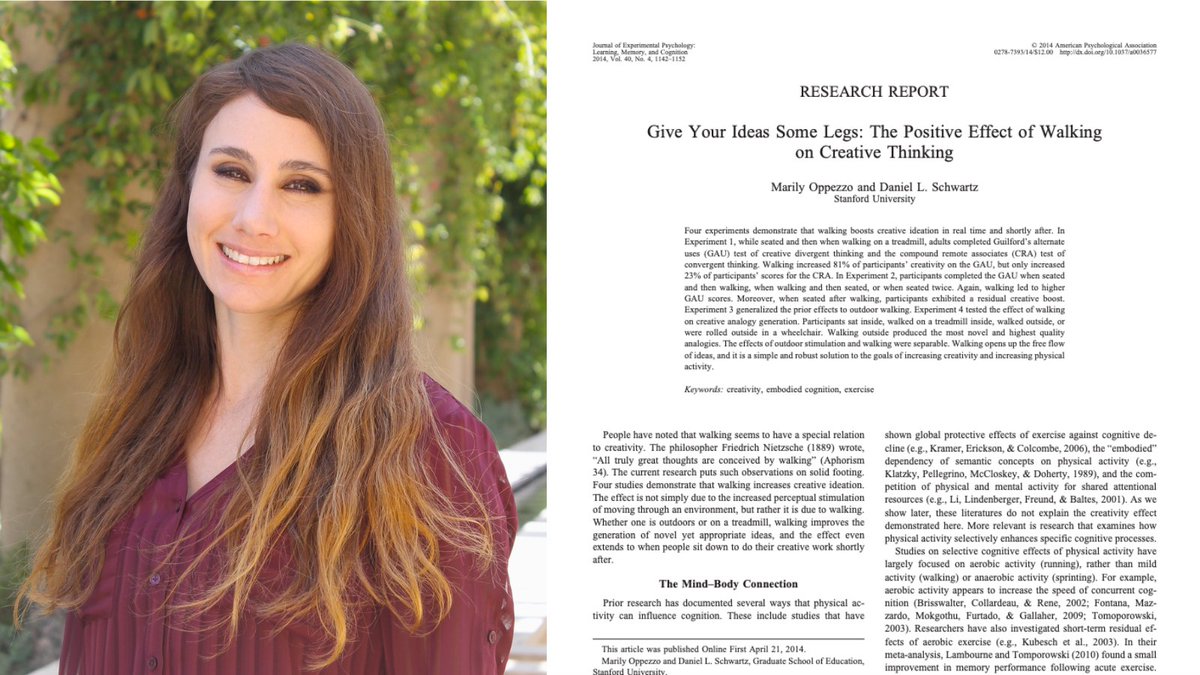
斯坦福的一位心理学家花了 4 年时间证明,一个再简单不过的动作,走路,比坐着能多激发出 60% 的创造性想法。而她为了排除所有其他解释所设计的实验,是现代心理学中最有决定性的发现之一。

她的名字叫 Marily Oppezzo。

她研究这个课题的灵感,来自一次和导师在斯坦福边走边聊论文选题的经历。后来,她在 2014 年发表在《Journal of Experimental Psychology》上的那篇论文,严谨得几乎足以让一切坐着开的会议,从发表当天起就显得过时了。

她在 176 个人身上做了 4 组实验。同一个人测试两次。一次坐着,一次走路。创造力任务用的是心理学家几十年来一直在使用的标准测验,用来衡量一个人大脑生成新颖且有用想法的能力。

结果干净得几乎让人觉得不真实。

第一组实验里,81% 的参与者在走路时提出了比坐着时更多的创造性想法。第二组实验里,这个比例是 88%。第三组实验里,是 100%。每一个人,都在走动中变成了一个更有创造力的自己。

平均来看,只要双腿开始动起来,人们立刻就能多产生 60% 的新颖且有用的想法。

怀疑者最自然会问的那个问题也很明显。也许是新鲜空气的作用。也许是路上的风景。也许真正起作用的是环境变化,而不是走路本身。

Oppezzo 用一个实验设计,彻底干掉了这些解释。

她让参与者站在跑步机上,对着一面空白的墙。没有风景。没有新鲜空气。没有环境变化。只是双腿在原地动,眼睛盯着白色石膏墙。那 60% 的提升依然存在。

接着,她做了那个几乎彻底结案的实验。她把参与者带到室外,分成两种条件。一半人在斯坦福的庭院里步行。另一半则坐在轮椅里,被人推着穿过同一个庭院。一样的户外刺激。一样的风景以同样的速度掠过。唯一的区别,就是腿有没有在动。

步行组产生的新颖、高质量想法,明显多于轮椅组。户外环境本身几乎没起什么作用。真正起作用的,就是走路。

这也是我第一次读到这项研究时,感受最强的一部分。

她还测试了另一种相反的思维方式。聚合式思维。也就是只有一个正确答案,你必须不断收缩范围,最后找到它的那种思考。

比如词语谜题。给你 3 个词,它们共享一个隐藏的第 4 个词,把它们连接起来。坐着的参与者在这类任务里表现略好一些。走路的人则稍微差一点。

走路不是一种通用的智力增强器。它只做一件非常具体的事。它会打开你大脑里的发散式搜索。就是那个负责生成选项的部分。那个负责制造意外连接的部分。那个面对一个问题时,不是只看到一条路,而是能找到五条路进去的部分。

当你需要收敛到唯一正确答案时,坐下来。当你首先需要找到答案在哪里时,站起来。

这个机制现在已经被相当清楚地理解了。走路会选择性激活神经科学家所说的默认模式网络,也就是你大脑里那个在你没有刻意思考任何事情时仍在运行的系统。DMN 是白日漫游发生的地方。是记忆彼此交叉索引的地方。也是那些原本分开放在脑海不同文件夹里的想法,终于彼此碰撞的地方。

当你坐在桌前,强迫自己集中注意力时,你是在压制 DMN。可当你以自然速度走路时,大脑中负责执行控制的那一部分,恰好会因为处理走路这件事而忙到刚刚好,于是 DMN 就上线了,开始去做那些原本被专注挡住的工作。

整篇论文里最有用的发现,几乎没人引用。

这种提升并不会在人一停下脚步的瞬间就消失。那些先走路再坐下来的参与者,创造力水平仍然维持在较高状态。他们接下来坐着完成的新一轮创造性任务,表现依旧显著优于那些从头到尾一直坐着的人。也就是说,这种效果在双腿停下来之后,至少还会持续几分钟。

你不需要一边走路一边做创造性工作。你需要的是,在做创造性工作之前先走一走。大脑会把这种状态保留下来。

这段历史,才是最应该让那些还坚持坐着开会的人感到不安的部分。

Charles Darwin 在肯特郡家后面修了一条铺着碎石的环形小路,叫作 Sandwalk。此后余生,他每天都要在上面走 3 次。进化论,就是在那条路上一圈一圈走出来的。

Nietzsche 在写下自己最重要那些书的几年里,每天最多会走 10 个小时,还公开说过,那些作品是在双脚上构思出来的。

Beethoven 上午作曲,下午则会一连走上 5 个小时,口袋里总带着一支铅笔,以防灵感忽然降临。

Kahneman 说,他那段最终拿到诺奖的生涯里,最好的思考都发生在和 Amos Tversky 漫步的时候。Steve Jobs 拒绝坐着谈重要的事。他总是边走边谈。

他们每一个人,用的都是 Oppezzo 直到 2014 年才正式测量出来的那套系统。只是他们当时还不知道该怎么称呼它。

真正值得静下来想想的问题,是几乎没人去问的那个。

你这辈子参加过的每一场围着桌子坐着开的会议,其实都只用了房间里那些人大脑能力的一小部分。每一次被困在会议室里的头脑风暴。每一个你坐在桌前试着解决、最后却放弃了的问题。每一个你差一点点却始终没够到的想法。

而这个干预办法,是现代科学里最容易做到的那一种。不用补剂。不用 app。不用订阅。不用训练课程。只需要一双腿和 15 分钟。

斯坦福的实验室已经证明了它。哲学家早就知道它。神经科学也解释了它。

可几乎每一个正在读这篇文章的人,依然还在试图一动不动地坐着,把自己从问题里想出来。

A Stanford psychologist spent 4 years proving that the simple act of walking generates 60% more creative ideas than sitting, and the experiment she designed to kill every alternative explanation is one of the most decisive findings in modern psychology.

斯坦福的一位心理学家花了 4 年时间证明,一个再简单不过的动作,走路,比坐着能多激发出 60% 的创造性想法。而她为了排除所有其他解释所设计的实验,是现代心理学中最有决定性的发现之一。

Her name is Marily Oppezzo.

她的名字叫 Marily Oppezzo。

She got the idea for the study while walking with her advisor at Stanford to discuss her thesis topic, and the paper she eventually published in the Journal of Experimental Psychology in 2014 is sharp enough that it should have ended the seated meeting on the day it came out.

她研究这个课题的灵感,来自一次和导师在斯坦福边走边聊论文选题的经历。后来,她在 2014 年发表在《Journal of Experimental Psychology》上的那篇论文,严谨得几乎足以让一切坐着开的会议,从发表当天起就显得过时了。

She ran 4 experiments on 176 people. Same person tested twice. Once sitting, once walking. The creativity tasks were the standard ones psychologists have used for decades to measure how good a brain is at generating novel useful ideas.

她在 176 个人身上做了 4 组实验。同一个人测试两次。一次坐着,一次走路。创造力任务用的是心理学家几十年来一直在使用的标准测验,用来衡量一个人大脑生成新颖且有用想法的能力。

The result was almost too clean to publish.

结果干净得几乎让人觉得不真实。

81% of participants in the first experiment produced more creative ideas while walking than while sitting. In the second experiment, 88%. In the third, 100%. Every single person walked into a more creative version of themselves.

第一组实验里,81% 的参与者在走路时提出了比坐着时更多的创造性想法。第二组实验里,这个比例是 88%。第三组实验里,是 100%。每一个人,都在走动中变成了一个更有创造力的自己。

On average, people generated 60% more novel useful ideas the moment their legs started moving.

平均来看,只要双腿开始动起来,人们立刻就能多产生 60% 的新颖且有用的想法。

The skeptical question is the obvious one. Maybe it was the fresh air. Maybe it was the scenery passing by. Maybe it was the change of environment doing the work, not the walking itself.

怀疑者最自然会问的那个问题也很明显。也许是新鲜空气的作用。也许是路上的风景。也许真正起作用的是环境变化,而不是走路本身。

Oppezzo killed every one of those explanations with one experimental decision.

Oppezzo 用一个实验设计,彻底干掉了这些解释。

She put people on a treadmill facing a blank wall. No scenery. No fresh air. No environmental change. Just legs moving in place while staring at white drywall. The 60% boost held.

她让参与者站在跑步机上,对着一面空白的墙。没有风景。没有新鲜空气。没有环境变化。只是双腿在原地动,眼睛盯着白色石膏墙。那 60% 的提升依然存在。

Then she ran the experiment that closed the case completely. She took participants outside in two conditions. Half of them walked through a Stanford courtyard. The other half were pushed through the exact same courtyard in a wheelchair. Same outdoor stimulation. Same scenery passing at the same speed. The only difference was whether the legs were moving.

接着,她做了那个几乎彻底结案的实验。她把参与者带到室外,分成两种条件。一半人在斯坦福的庭院里步行。另一半则坐在轮椅里,被人推着穿过同一个庭院。一样的户外刺激。一样的风景以同样的速度掠过。唯一的区别,就是腿有没有在动。

The walkers produced dramatically more novel high-quality ideas than the wheelchair group. The outdoors did almost nothing on its own. The walking did everything.

步行组产生的新颖、高质量想法,明显多于轮椅组。户外环境本身几乎没起什么作用。真正起作用的,就是走路。

This is the part of the study that hit hardest when I read it the first time.

这也是我第一次读到这项研究时,感受最强的一部分。

She also tested the opposite kind of thinking. Convergent thinking. The kind where there is one right answer and you have to narrow down to it.

她还测试了另一种相反的思维方式。聚合式思维。也就是只有一个正确答案,你必须不断收缩范围,最后找到它的那种思考。

Word puzzles where 3 words share a hidden fourth word that connects them. The seated participants did slightly better on these. Walkers got slightly worse.

比如词语谜题。给你 3 个词,它们共享一个隐藏的第 4 个词,把它们连接起来。坐着的参与者在这类任务里表现略好一些。走路的人则稍微差一点。

Walking is not a general intelligence enhancer. It does one specific thing. It opens up the divergent search inside your brain. The part that generates options. The part that produces unexpected connections. The part that takes a problem and finds five ways into it instead of one.

走路不是一种通用的智力增强器。它只做一件非常具体的事。它会打开你大脑里的发散式搜索。就是那个负责生成选项的部分。那个负责制造意外连接的部分。那个面对一个问题时,不是只看到一条路,而是能找到五条路进去的部分。

When you need to converge on the single right answer, sit down. When you need to find the answer in the first place, get up.

当你需要收敛到唯一正确答案时,坐下来。当你首先需要找到答案在哪里时,站起来。

The mechanism is now well understood. Walking selectively activates what neuroscientists call the default mode network, the system inside your brain that runs when you are not consciously focused on anything. The DMN is where mind-wandering happens. Where memories cross-reference each other. Where ideas that have been sitting in separate folders inside your head finally bump into each other.

这个机制现在已经被相当清楚地理解了。走路会选择性激活神经科学家所说的默认模式网络,也就是你大脑里那个在你没有刻意思考任何事情时仍在运行的系统。DMN 是白日漫游发生的地方。是记忆彼此交叉索引的地方。也是那些原本分开放在脑海不同文件夹里的想法,终于彼此碰撞的地方。

When you sit at a desk and force yourself to concentrate, you suppress the DMN. When you walk at a natural pace, the executive part of your brain gets just busy enough handling the walking that the DMN comes online and starts doing the work that focus was blocking.

当你坐在桌前,强迫自己集中注意力时,你是在压制 DMN。可当你以自然速度走路时,大脑中负责执行控制的那一部分,恰好会因为处理走路这件事而忙到刚刚好,于是 DMN 就上线了,开始去做那些原本被专注挡住的工作。

The most useful finding in the entire paper is the one almost nobody quotes.

整篇论文里最有用的发现,几乎没人引用。

The boost did not turn off the moment people stopped walking. Participants who walked first and then sat back down stayed elevated. Their next round of seated creativity work was still significantly better than people who had been sitting the whole time. The rest lingered for at least several minutes after the legs stopped moving.

这种提升并不会在人一停下脚步的瞬间就消失。那些先走路再坐下来的参与者,创造力水平仍然维持在较高状态。他们接下来坐着完成的新一轮创造性任务,表现依旧显著优于那些从头到尾一直坐着的人。也就是说,这种效果在双腿停下来之后,至少还会持续几分钟。

You do not need to do creative work while walking. You need to walk before the creative work. The brain holds the state.

你不需要一边走路一边做创造性工作。你需要的是,在做创造性工作之前先走一走。大脑会把这种状态保留下来。

The history of this is the part that should haunt anyone who still does meetings in chairs.

这段历史,才是最应该让那些还坚持坐着开会的人感到不安的部分。

Charles Darwin built a gravel loop behind his house in Kent called the Sandwalk and walked it 3 times a day for the rest of his life. The theory of evolution was developed one lap at a time on that path.

Charles Darwin 在肯特郡家后面修了一条铺着碎石的环形小路,叫作 Sandwalk。此后余生,他每天都要在上面走 3 次。进化论,就是在那条路上一圈一圈走出来的。

Nietzsche walked up to 10 hours a day during the years he wrote his most important books and openly said the work was conceived on his feet.

Nietzsche 在写下自己最重要那些书的几年里,每天最多会走 10 个小时,还公开说过,那些作品是在双脚上构思出来的。

Beethoven composed for the morning and walked for 5 hours every afternoon with a pencil in his pocket for when something landed.

Beethoven 上午作曲,下午则会一连走上 5 个小时,口袋里总带着一支铅笔,以防灵感忽然降临。

Kahneman said the best thinking of his Nobel Prize-winning career happened on leisurely walks with Amos Tversky. Steve Jobs refused to take important conversations sitting down. He held them on foot.

Kahneman 说,他那段最终拿到诺奖的生涯里,最好的思考都发生在和 Amos Tversky 漫步的时候。Steve Jobs 拒绝坐着谈重要的事。他总是边走边谈。

Every one of them was using the system Oppezzo would not measure until 2014. They just did not know what to call it.

他们每一个人,用的都是 Oppezzo 直到 2014 年才正式测量出来的那套系统。只是他们当时还不知道该怎么称呼它。

The question worth sitting with is the one almost nobody asks.

真正值得静下来想想的问题,是几乎没人去问的那个。

Every meeting you have ever attended sitting around a table was a meeting held at a fraction of the brain power that was actually available to the people in the room. Every brainstorm that got stuck inside a conference room. Every problem you tried to solve at a desk and gave up on. Every idea you could not quite get to.

你这辈子参加过的每一场围着桌子坐着开的会议,其实都只用了房间里那些人大脑能力的一小部分。每一次被困在会议室里的头脑风暴。每一个你坐在桌前试着解决、最后却放弃了的问题。每一个你差一点点却始终没够到的想法。

The intervention is the easiest one in modern science. No supplement. No app. No subscription. No training program. Just a pair of legs and 15 minutes.

而这个干预办法,是现代科学里最容易做到的那一种。不用补剂。不用 app。不用订阅。不用训练课程。只需要一双腿和 15 分钟。

The Stanford lab proved it. The philosophers knew it. The neuroscience explains it.

斯坦福的实验室已经证明了它。哲学家早就知道它。神经科学也解释了它。

And almost everyone reading this is still trying to think their way out of problems sitting completely still.
可几乎每一个正在读这篇文章的人,依然还在试图一动不动地坐着,把自己从问题里想出来。

A Stanford psychologist spent 4 years proving that the simple act of walking generates 60% more creative ideas than sitting, and the experiment she designed to kill every alternative explanation is one of the most decisive findings in modern psychology.

Her name is Marily Oppezzo.

She got the idea for the study while walking with her advisor at Stanford to discuss her thesis topic, and the paper she eventually published in the Journal of Experimental Psychology in 2014 is sharp enough that it should have ended the seated meeting on the day it came out.

She ran 4 experiments on 176 people. Same person tested twice. Once sitting, once walking. The creativity tasks were the standard ones psychologists have used for decades to measure how good a brain is at generating novel useful ideas.

The result was almost too clean to publish.

81% of participants in the first experiment produced more creative ideas while walking than while sitting. In the second experiment, 88%. In the third, 100%. Every single person walked into a more creative version of themselves.

On average, people generated 60% more novel useful ideas the moment their legs started moving.

The skeptical question is the obvious one. Maybe it was the fresh air. Maybe it was the scenery passing by. Maybe it was the change of environment doing the work, not the walking itself.

Oppezzo killed every one of those explanations with one experimental decision.

She put people on a treadmill facing a blank wall. No scenery. No fresh air. No environmental change. Just legs moving in place while staring at white drywall. The 60% boost held.

Then she ran the experiment that closed the case completely. She took participants outside in two conditions. Half of them walked through a Stanford courtyard. The other half were pushed through the exact same courtyard in a wheelchair. Same outdoor stimulation. Same scenery passing at the same speed. The only difference was whether the legs were moving.

The walkers produced dramatically more novel high-quality ideas than the wheelchair group. The outdoors did almost nothing on its own. The walking did everything.

This is the part of the study that hit hardest when I read it the first time.

She also tested the opposite kind of thinking. Convergent thinking. The kind where there is one right answer and you have to narrow down to it.

Word puzzles where 3 words share a hidden fourth word that connects them. The seated participants did slightly better on these. Walkers got slightly worse.

Walking is not a general intelligence enhancer. It does one specific thing. It opens up the divergent search inside your brain. The part that generates options. The part that produces unexpected connections. The part that takes a problem and finds five ways into it instead of one.

When you need to converge on the single right answer, sit down. When you need to find the answer in the first place, get up.

The mechanism is now well understood. Walking selectively activates what neuroscientists call the default mode network, the system inside your brain that runs when you are not consciously focused on anything. The DMN is where mind-wandering happens. Where memories cross-reference each other. Where ideas that have been sitting in separate folders inside your head finally bump into each other.

When you sit at a desk and force yourself to concentrate, you suppress the DMN. When you walk at a natural pace, the executive part of your brain gets just busy enough handling the walking that the DMN comes online and starts doing the work that focus was blocking.

The most useful finding in the entire paper is the one almost nobody quotes.

The boost did not turn off the moment people stopped walking. Participants who walked first and then sat back down stayed elevated. Their next round of seated creativity work was still significantly better than people who had been sitting the whole time. The rest lingered for at least several minutes after the legs stopped moving.

You do not need to do creative work while walking. You need to walk before the creative work. The brain holds the state.

The history of this is the part that should haunt anyone who still does meetings in chairs.

Charles Darwin built a gravel loop behind his house in Kent called the Sandwalk and walked it 3 times a day for the rest of his life. The theory of evolution was developed one lap at a time on that path.

Nietzsche walked up to 10 hours a day during the years he wrote his most important books and openly said the work was conceived on his feet.

Beethoven composed for the morning and walked for 5 hours every afternoon with a pencil in his pocket for when something landed.

Kahneman said the best thinking of his Nobel Prize-winning career happened on leisurely walks with Amos Tversky. Steve Jobs refused to take important conversations sitting down. He held them on foot.

Every one of them was using the system Oppezzo would not measure until 2014. They just did not know what to call it.

The question worth sitting with is the one almost nobody asks.

Every meeting you have ever attended sitting around a table was a meeting held at a fraction of the brain power that was actually available to the people in the room. Every brainstorm that got stuck inside a conference room. Every problem you tried to solve at a desk and gave up on. Every idea you could not quite get to.

The intervention is the easiest one in modern science. No supplement. No app. No subscription. No training program. Just a pair of legs and 15 minutes.

The Stanford lab proved it. The philosophers knew it. The neuroscience explains it.

And almost everyone reading this is still trying to think their way out of problems sitting completely still.

📋 讨论归档

讨论进行中…