返回列表
🧠 阿头学

AI驱动的UGC规模化运营与提示词工程

该文构建的“视频降维拆解+长上下文聚类”流水线确实能大幅提升UGC内容迭代的确定性与反馈精度,但其刻意隐瞒创作者劳务成本与AI算力开销,用“零广告支出”包装技术神话,属于典型的营销获客软文,不可作为普适增长方案盲目照搬。
打开原文 ↗

2026-09-13 原文链接 ↗
阅读简报
双语对照
完整翻译
原文
讨论归档

核心观点

  • 结构化输入优于原生多模态:用ffmpeg与yt-dlp将视频强制降维为关键帧描述与转录文本,再注入百万级上下文窗口,是当前技术条件下规避多模态幻觉、实现稳定视频分析的唯一可行路径。
  • 按结构骨架聚类取代主题归类:剥离具体内容,以“POV+意外结果”等钩子骨架进行数据聚类与中位数计算,能精准暴露创作者执行偏移,并直接锁定高转化内容公式。
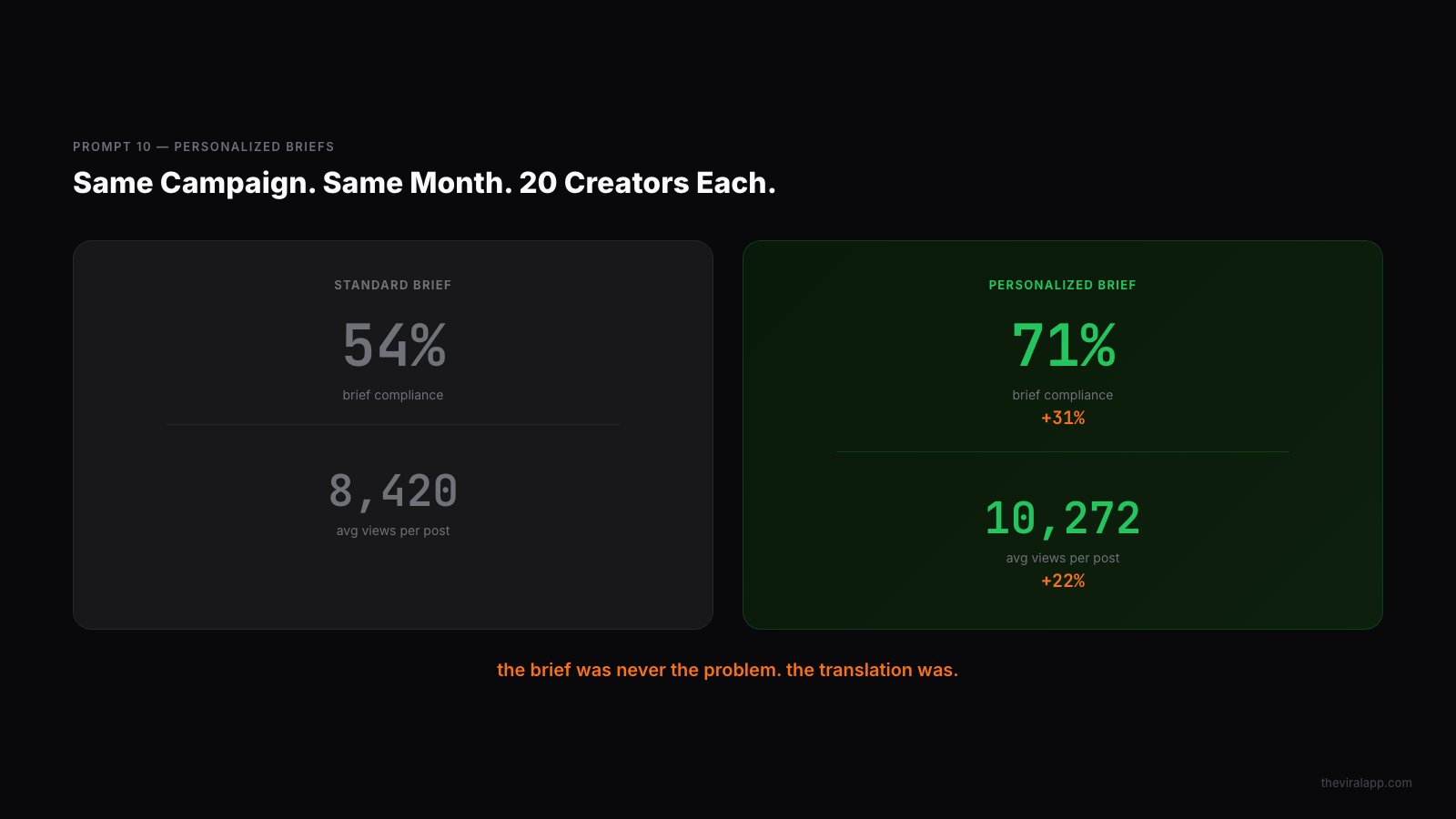
  • 个性化翻译碾压标准化SOP:将统一商业目标转化为匹配创作者历史数据与语言习惯的个性化简报,能直接提升31%的合规率与22%的均播量,证明规模化的前提是算法对齐差异而非抹平差异。
  • 反馈必须具体到帧与时间戳:强制禁用“吸引人”等模糊形容词,要求输出“第X秒流失原因+具体修改动作”,是降低创作者沟通摩擦、杜绝无效返工的唯一有效管理手段。

跟我们的关联

  • 对ATou意味着内容增长策略必须从“经验驱动”转向“结构工程”,下一步需立即搭建自动化数据清洗管道,用AI替代人工逐条审核字幕与评论,并建立周级偏移检测机制。
  • 对Neta意味着AI落地必须遵循“感知工具链+认知长上下文”的解耦架构,下一步需严格测算该流水线的API调用成本与并发处理开销,验证其在内部业务中的真实ROI而非盲目追求全量自动化。
  • 对Uota意味着所有增长复盘必须剔除幸存者偏差,下一步需在活动审计中强制加入“剔除头部异常值后的真实CPV”与“Top3集中度风险”指标,用分布数据替代平均值决策。

讨论引子

  • 当大模型原生支持长视频直读后,文中依赖外部脚本的“文本降维”流水线是会被彻底淘汰,还是因其强制结构化的优势反而成为更优解?
  • 在UGC规模化运营中,AI生成的“个性化简报”与品牌“标准化SOP”的冲突边界在哪里?过度个性化是否会必然导致核心信息传递的稀释?

OpenAI 在 9 月 3 日发布了其最强大的模型。我原本不打算写这篇文章。 我们在 62 个营销活动中创造了 26 亿次自然浏览量,管理了 590 位创作者,并为移动应用制作了 22,504 个可追踪视频。零广告支出。 这 15 个提示词(Prompts)是我如何使用 ChatGPT Astra 以两周前在物理上还不可能达到的水平来运营这些活动的方法。每一个都可以直接复制粘贴。我把它们全部免费分享,因为当你读到这篇文章时,我已经在下一个活动中使用它们了。 收藏这篇文章。你会需要它的。 在运行任何提示词之前:加载你的活动上下文(Context) 这是每个人都会跳过的步骤,但正是这个步骤让其他一切发挥作用。没有它,你就像是在向一个从未见过你业务的陌生人寻求建议。 在做任何其他事情之前,将以下内容粘贴到 ChatGPT Astra 中: "here is everything you need to know about my UGC program before we start any analysis. reference this every time i ask you to run an audit, generate a brief, or analyze performance. never ask me for this information again.

BUSINESS BASICS: app name: [your app name] app store URL: [iOS and/or Android link] category: [health, education, finance, social, etc.] monthly downloads: [X] MRR: [if comfortable sharing] one-sentence value prop: [what the app does in 15 words or less]

CAMPAIGN HISTORY: total creators managed: [X] total videos produced: [X] total organic views: [X] platforms active on: [TikTok, Instagram Reels, YouTube Shorts] average views per post: [X] best single video performance: [X views, link if available] biggest campaign win: [one sentence] biggest campaign failure: [one sentence - be honest]

CURRENT CAMPAIGN: campaign name: [X] number of active creators: [X] videos per creator per week: [X] brief template: [paste your current brief or describe it] compensation model: [flat fee per video / monthly retainer / bonus structure] target hook rate (1s): [X% or 'don't track yet'] target view-through rate (3s): [X% or 'don't track yet']

CONTENT STRATEGY: primary content formats: [testimonial, tutorial, day-in-my-life, reaction, before/after, etc.] top 3 performing hooks from last 30 days: [paste exact hook text] top 3 underperforming hooks: [paste exact hook text] competitors running UGC: [app 1, app 2, app 3]

HOW I WANT YOU TO WORK: always prioritize actionable output over analysis. when you give me a recommendation, tell me impact level (high/medium/low) and time to implement. output data in table format when comparing anything. never invent a number. if you can't verify it, say so. when analyzing hooks, cluster by structure not by topic." 一旦加载了这些内容,随后的每一个提示词都会变得 10 倍敏锐。Astra 不再回答泛泛的营销问题,而是开始回答你的具体问题。 第一部分:视频分析(Video Analysis)(提示词 1-3) 每个人都认为 Astra 无法观看视频。他们错了。它只是无法以你认为的方式观看。 Astra 接受文本和图像作为输入。它不接受原始的 .mp4 文件。但大多数人都忽略了一点:你不需要它这么做。你需要一个流水线(Pipeline)替它观看视频,并交给它一份结构化的拆解报告。 这就是我们实际运行的系统,也是改变了我们一切的技术。

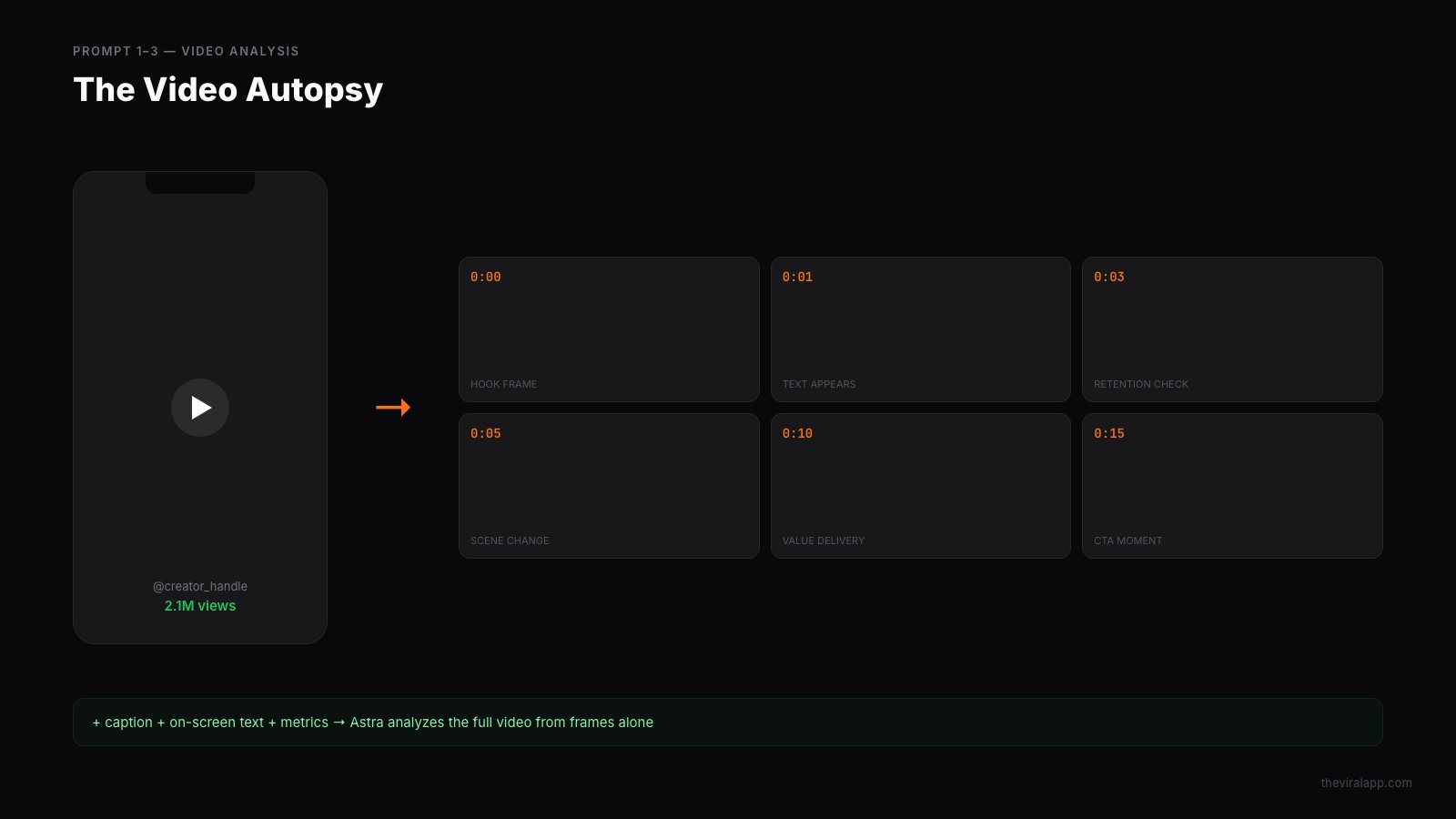
流水线:我们如何让 AI 每周“观看” 200 多个视频 我们构建了一个自动化视频智能流水线。以下是它的端到端工作原理。 步骤 1:智能体(Agent)观看视频 我们使用一个 AI 编码智能体(OpenAI Codex、Claude Code 或任何具有工具访问权限的智能体)连接到两个命令行工具: - yt-dlp:从 URL 下载任何 TikTok、Instagram Reel 或 YouTube Short 视频 - ffmpeg:以自适应间隔提取帧(在钩子部分提取更多帧,在中间部分提取较少帧) 智能体会自动运行此操作。你给它一个视频 URL。它会下载视频,提取 8-12 个关键帧(向存在钩子的前 3 秒倾斜),从字幕中提取转录文本或运行 whisper 进行语音转文字,并从帧中读取任何屏幕文本。 输出结果是每个视频的结构化报告(顺便说一句,这是我们其中一个活动的视频): VIDEO: @juliislearning - TikTok URL: https://tiktok.com/@juliislearning/video/7650298655236246792 DURATION: 55 seconds FRAMES EXTRACTED: 12 FRAME 0:00 - creator sitting at desk, hands on notebook, text overlay top-left: "3 things i wish i knew before finals" FRAME 0:01 - eye contact with camera, slight head tilt, text still visible FRAME 0:03 - cuts to phone screen showing app, finger scrolling FRAME 0:05 - back to face, talking, hands gesturing FRAME 0:10 - screen recording of app in use, flashcard generation FRAME 0:15 - split screen: creator left, app right FRAME 0:25 - close-up of app results FRAME 0:35 - creator reaction face FRAME 0:45 - back to talking head, summarizing FRAME 0:52 - CTA frame, text overlay: "link in bio" TRANSCRIPT: "ok so if you're a student and you haven't tried this yet i genuinely don't know what you're doing. i found this app called knowt like two weeks ago and it literally makes flashcards from your notes automatically. you just upload a pdf and..." ON-SCREEN TEXT: "3 things i wish i knew before finals" CAPTION: "this changed my entire study routine honestly #studytok

finals

#studywithme " 2. 步骤 2:批量处理所有活动视频 智能体不会在单个视频上停止。我们将其指向整个活动。它处理从我们 sideshift 导出的每一个视频 URL,并为每个视频生成一份结构化报告。对于 50 个视频的批次,这在后台运行大约需要 20 分钟。无需人工干预。 输出结果是一个文件,其中每个视频都以相同的结构化格式进行描述:帧、转录文本、屏幕文本、视觉元素、节奏、场景变化。 3. 步骤 3:将所有内容输入 Astra 现在你将这些结构化描述(不是原始视频,而是关于视频内容的文本描述)粘贴到 Astra 的 1,050,000 token 上下文窗口(Context Window)中。奇迹就在这里发生。 Astra 现在可以通过描述同时“看到” 50 个视频。它知道每个第一帧长什么样,每个钩子说了什么,每个视频有多少场景变化,CTA 出现在哪里,转录文本说了什么,一切。而且它可以同时比较所有这些内容。

A. 视频解剖(Video Autopsy) 一旦你的流水线处理完一个视频,就使用以下提示词将结构化报告输入 Astra: "here is a structured breakdown of a UGC video from our campaign. an agent extracted the frames, transcript, and on-screen text automatically.

[paste the full structured video report from the pipeline]

metrics: [views, likes, comments, shares, saves] platform: [TikTok / Instagram Reels] creator follower count: [X] campaign brief: [paste brief or summarize]

analyze this video across these dimensions:

HOOK (0-1 second): - based on the first frame description, what visual hook is present? what emotion does it trigger? - what is the text hook? does it create a knowledge gap, fear of missing out, or pattern interrupt? - based on the frame sequence, would a viewer stop scrolling? why?

RETENTION (1-5 seconds): - does the content deliver on the hook's promise by frame 3 or does it stall? - how many visual changes happen in the first 5 seconds? - is there a reason to keep watching past second 3?

STRUCTURE: - what content format is this? (testimonial, tutorial, day-in-my-life, reaction, before/after, storytime, comparison) - what is the information architecture? (problem-solution, list, narrative, demonstration) - how many distinct scenes or visual changes are there across all frames? - at what timestamp does the app first appear on screen?

TRANSCRIPT ANALYSIS: - does the spoken content match the brief's key messaging? - what specific phrases does the creator use to describe the product? - are there any claims that weren't in the brief?

CREATOR FIT: - based on the visual descriptions, does the creator look authentic? - does the setting match their usual content style?

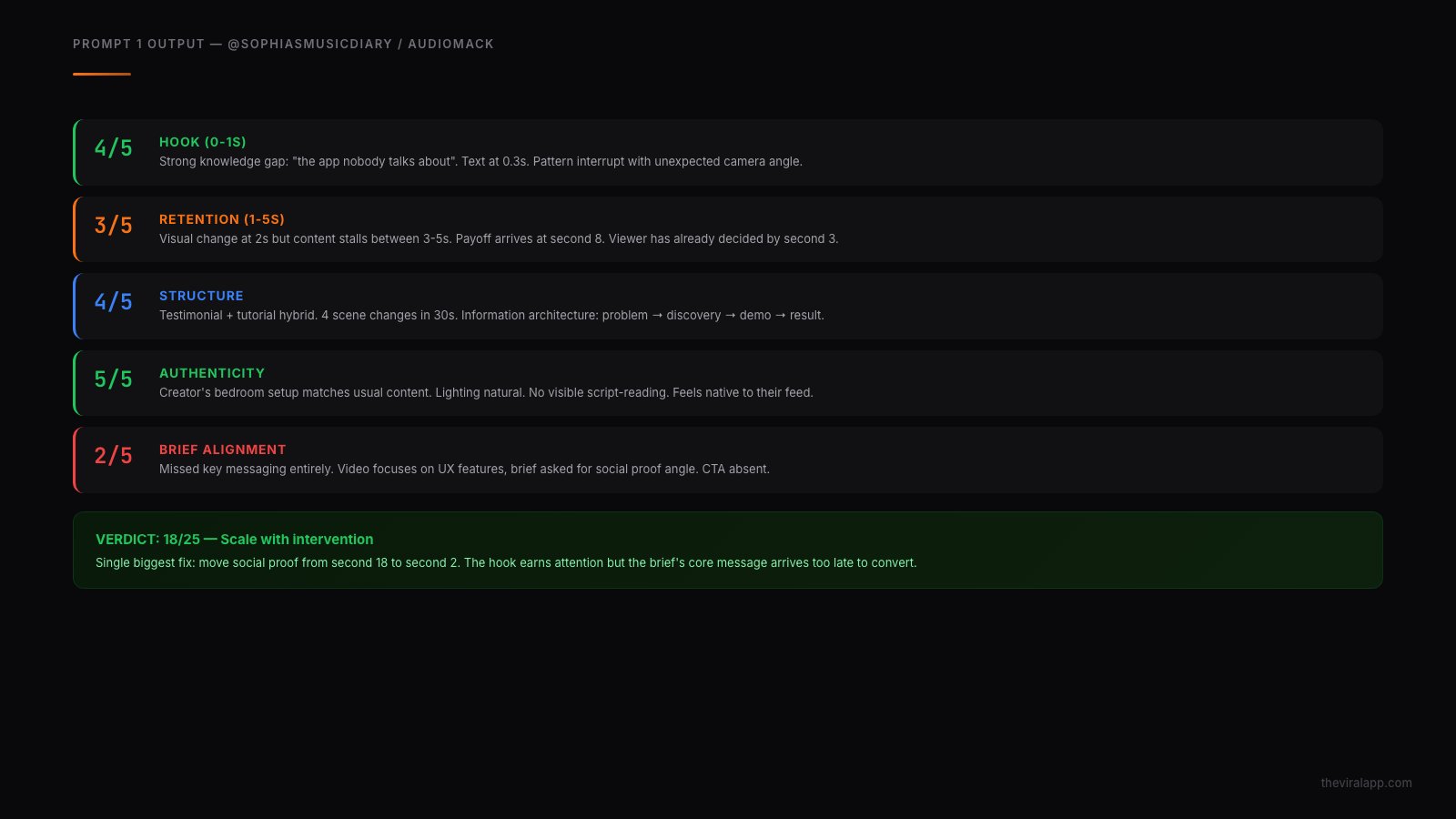
VERDICT: - score this video 1-5 on hook strength, retention structure, authenticity, and brief alignment - what is the single biggest thing that would improve this video? - would you scale this creator based on this video? why or why not? - write a 3-line feedback message for this creator (one positive, one fix, one suggestion)" 与手动执行此操作的关键区别在于:是智能体观看视频,而不是你。结构化报告捕捉到了人类审核员遗漏的细节,因为它读取了每一帧并转录了每一个字。而且输出的反馈足够具体,可以直接发送给创作者。 为什么这很重要:我们每周要在 62 个活动中审核数百个视频。瓶颈从来不是找出表现不佳的视频,而是用一种创作者能够采取行动的方式去表达为什么视频表现不佳。“让它更吸引人”是无用的反馈。“你的钩子制造了知识鸿沟,但回报出现在第 8 秒而不是第 2 秒,这就是为什么你的 3 秒留存率下降到 22%”是创作者可以在下一个草稿中修复的反馈。 这个提示词为你提供了每个视频的这种级别的具体性。我们过去每个视频要花 15-20 分钟写反馈。现在我们只花 2 分钟确认模型发现的内容。

B. 并排视频对比(Side-by-side Video Comparison) 从同一个活动中取出你表现最好和最差的视频。从两者中提取帧。 "i'm going to show you two UGC videos from the same campaign for the same app. one performed well, one didn't. both had the same brief.

VIDEO A (winner): frames: [attach 6-10 screenshots] caption: [paste] on-screen text: [paste] metrics: [views, likes, comments, shares]

VIDEO B (underperformer): frames: [attach 6-10 screenshots] caption: [paste] on-screen text: [paste] metrics: [views, likes, comments, shares]

both videos had this brief: [paste brief or summarize the 5 key components]

analyze the gap: 1. what did video A execute from the brief that video B missed? 2. compare the first frame of each. which one stops the scroll and why? 3. compare the hook text. which one creates a stronger knowledge gap? 4. at what second does each video 'earn the next second'? identify the exact moment 5. compare pacing: how many visual changes per 10 seconds in each? 6. compare authenticity: which creator feels more natural with the product? 7. if you could only change ONE thing about video B to match video A's structure, what would it be?

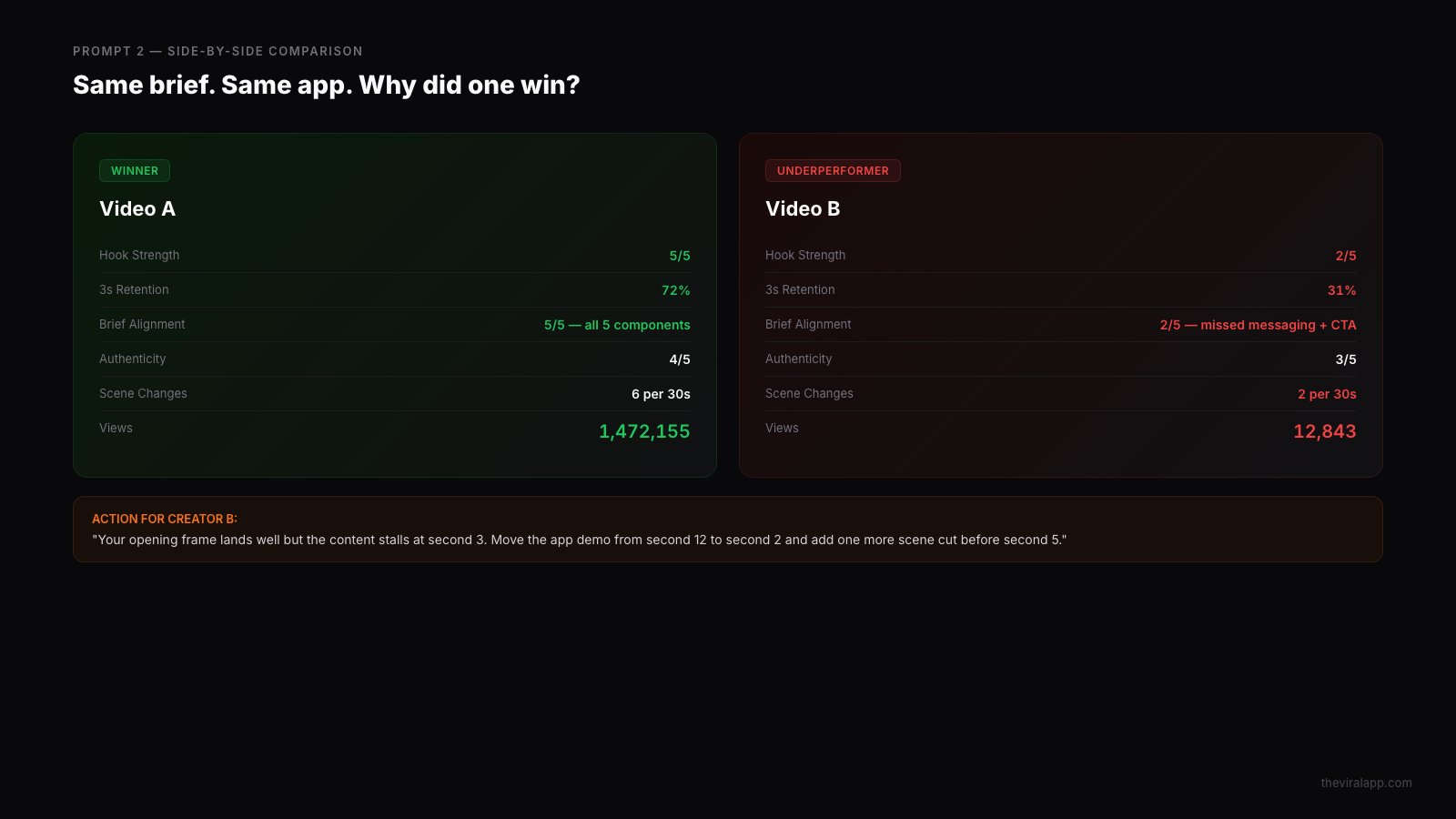
output as a comparison table with scores for each dimension, then a 3-sentence action item i can send directly to video B's creator as feedback." 为什么这很重要:比较才是真正学习发生的地方。当你孤立地看一个视频时,一切都很主观。当你把赢家和输家放在同一个简报旁边时,结构上的差异就变得明显了。3 句话的反馈输出是刻意设计的。创作者不看长邮件。他们需要一个具体的修复点。

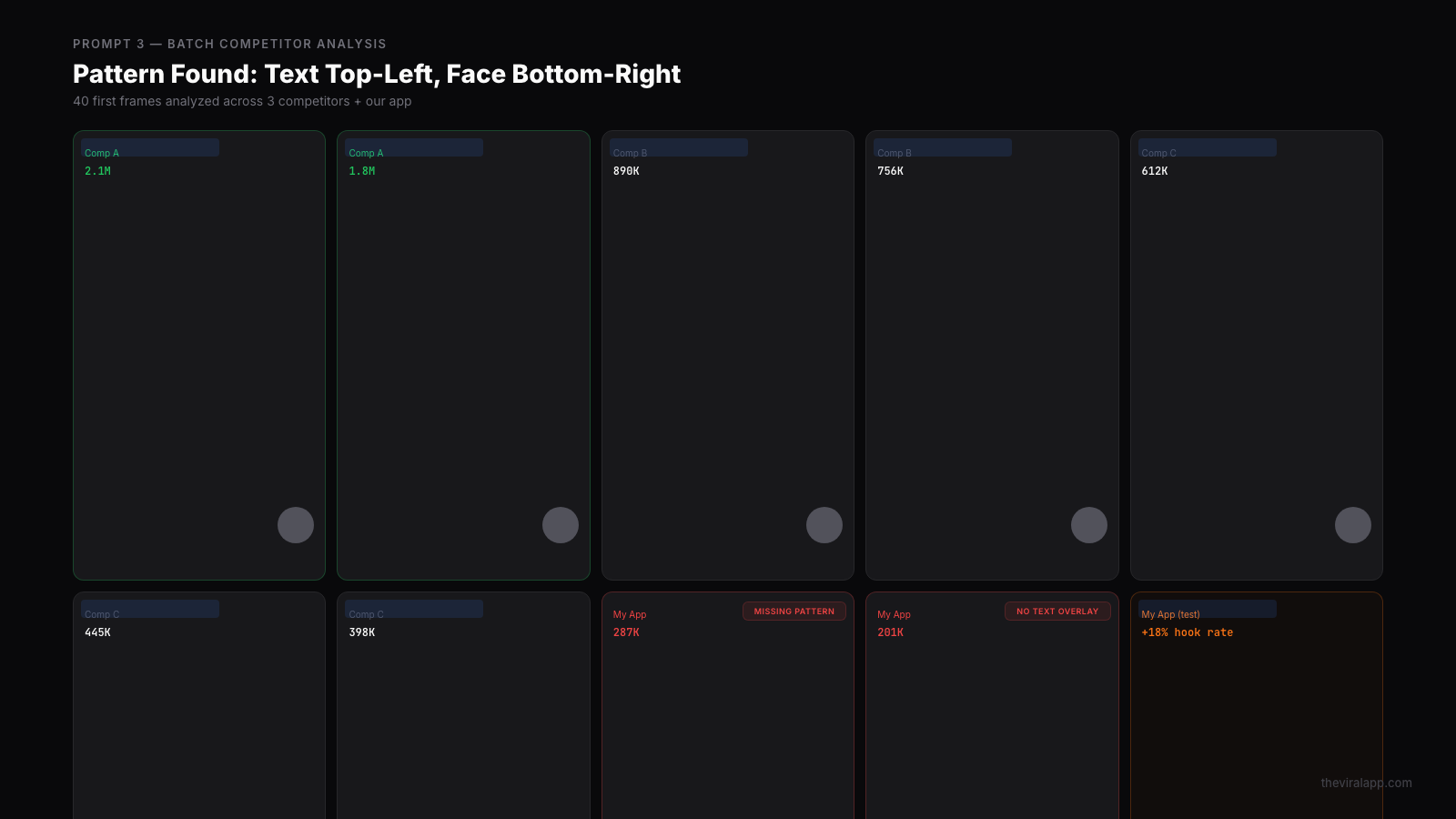
C. 跨竞品的批量格式分析(Batch Format Analysis Across Competitors) 这个需要更多设置,但它是整篇文章中最有价值的研究提示词。 去 3 个竞品应用的 TikTok 或 IG 账号。截取他们最近 10 个视频的第一帧(共 30 张截图)。记录每个视频的观看次数。 "i'm analyzing the UGC strategy of 3 competitor apps in my category. for each app i've captured the first frame of their 10 most recent videos along with the view count.

COMPETITOR A: [app name] [attach 10 first-frame screenshots with view counts listed]

COMPETITOR B: [app name] [attach 10 first-frame screenshots with view counts listed]

COMPETITOR C: [app name] [attach 10 first-frame screenshots with view counts listed]

MY APP: [app name] [attach 10 first-frame screenshots with view counts listed]

analyze across all 40 videos:

  1. VISUAL PATTERNS: what do the top 5 highest-performing first frames have in common? (face position, text placement, colors, props, background, lighting)
  2. TEXT HOOK PATTERNS: group all 40 on-screen text hooks by structure type. which structure type has the highest median views?
  3. FORMAT DISTRIBUTION: what % of each competitor's content is testimonial vs tutorial vs reaction vs other? which format type wins?
  4. WHAT MY COMPETITORS DO THAT I DON'T: identify any visual or structural pattern that appears in 2+ competitor accounts but not in mine
  5. WHAT I DO THAT NO ONE ELSE DOES: identify anything unique to my content that could be a differentiator or a blind spot
  6. THE PLAY: based on all 40 videos, what is the single highest-opportunity content format and hook structure that i should test next week? be specific - give me the exact first-frame composition, text hook structure, and content flow." 为什么这很重要:这种竞争情报过去需要雇佣一名分析师花一周时间才能获得。你正在从视觉层面对整个竞争格局进行结构性拆解。对我们来说,关键的洞察是发现我们有 3 个竞品应用使用了完全相同的第一帧模板(文本在左上角,人脸在右下角,彩色背景),而我们没有。我们第二周测试了它,我们的钩子率(Hook Rate)跃升了 18%。

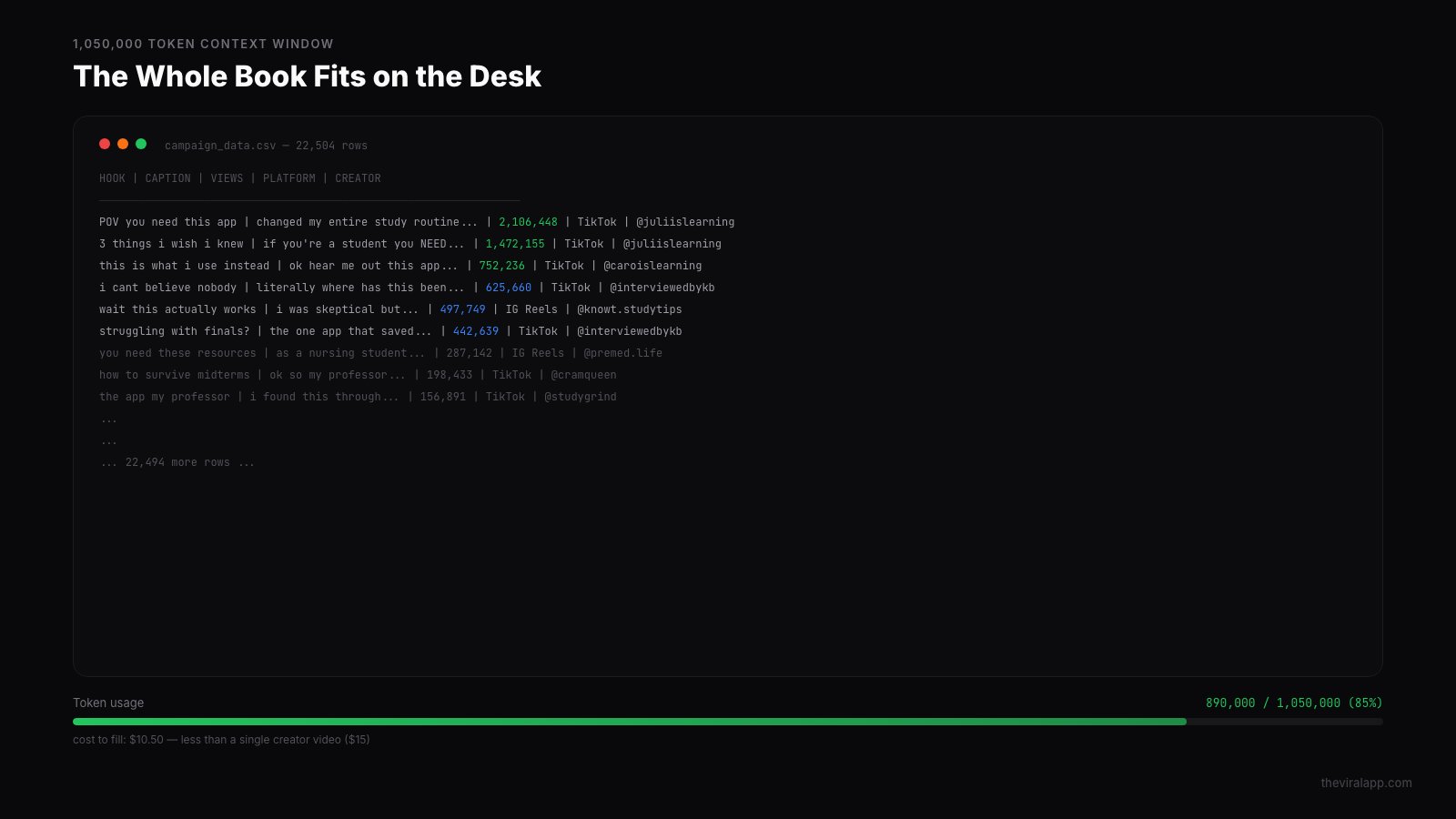
第二部分:活动情报(Campaign Intelligence)(提示词 4-8) 在这里,Astra 的 1,050,000 token 上下文窗口不再是一张规格表,而是成为了一件武器。 提供背景:我们包含指标的 22,504 个视频字幕的整个数据库都装得进那个窗口,而且还有剩余空间。这是有史以来第一次,整本书都能放在桌面上,而不是一次只看一页。

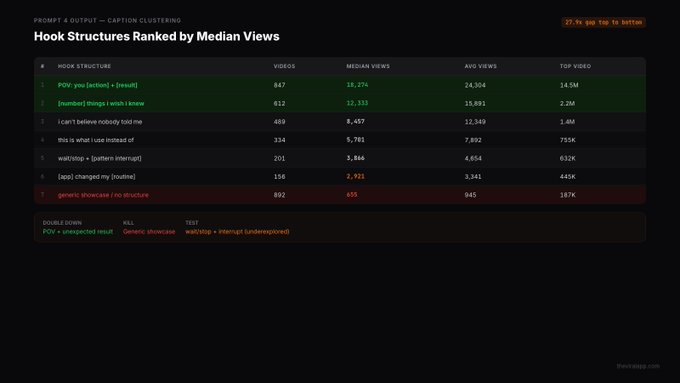
D. 字幕聚类(Caption Clustering) 按影响力排序,这是提示词 #1。如果你在这整篇文章中只运行一个提示词,就运行这个。 "here are all the captions and on-screen hooks from our last 30 days of UGC content, with the view count for each.

[paste: one line per video. format: 'HOOK TEXT | CAPTION | VIEWS | PLATFORM | CREATOR']

do not cluster these by topic. cluster them by STRUCTURE.

a structure is the skeleton of the hook, not what it's about. examples: - 'POV: you [action] and [unexpected result]' is one structure - '[number] things i wish i knew about [topic]' is another structure - 'i can't believe nobody told me about [thing]' is another - 'this is what i use instead of [alternative]' is another

find every distinct hook structure in this dataset. for each structure: 1. name it with a short label (e.g., 'POV + unexpected result') 2. count how many videos used it 3. calculate the median views for that structure 4. calculate the average views (so i can see if one outlier is inflating it) 5. list the top 3 and bottom 3 performers within that cluster

then rank all structures by median views, highest first.

finally: compare the distribution of structures in my brief against the distribution of structures in actual posts. are creators following the brief's intended structure or have they drifted into their own patterns?

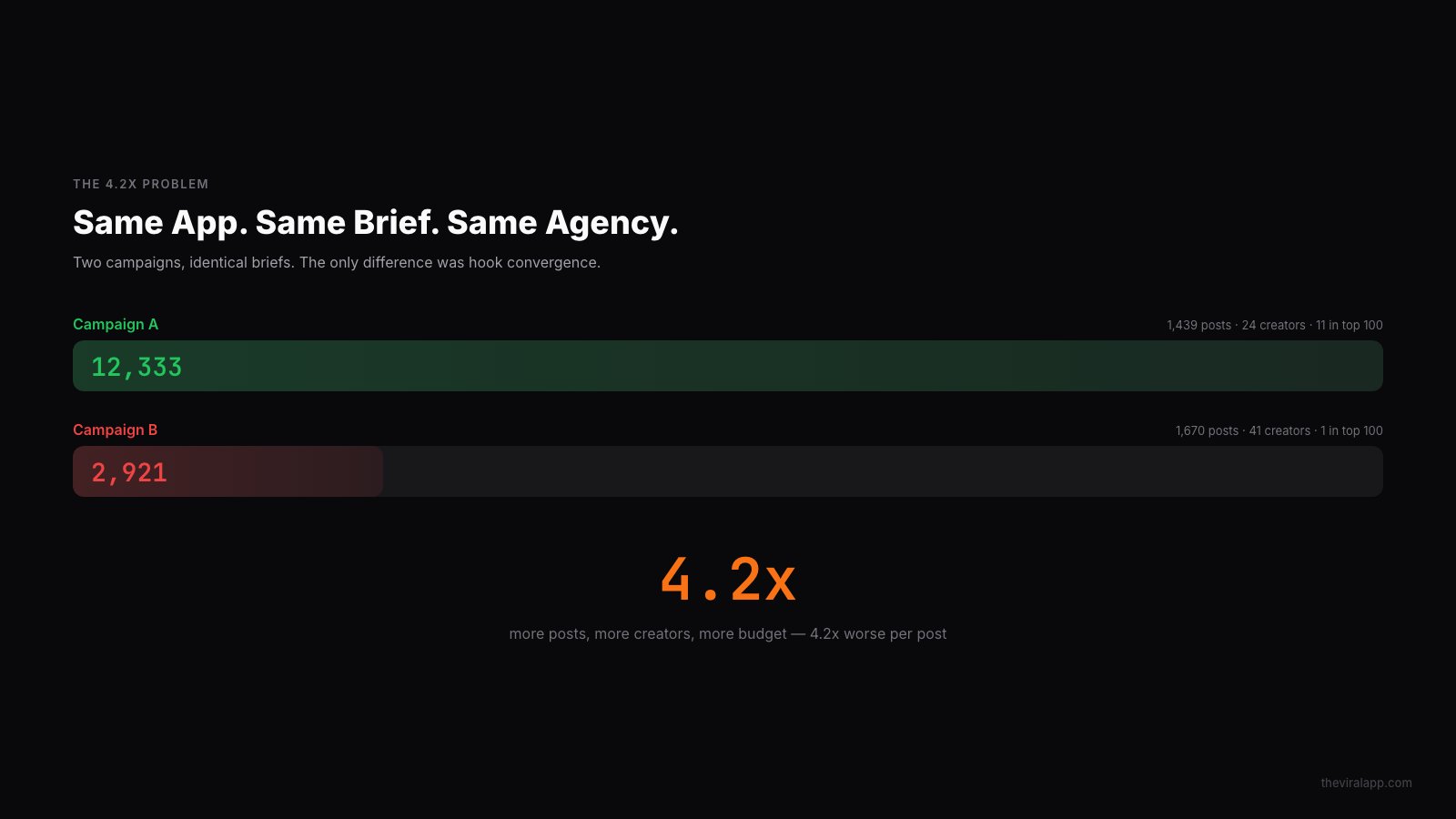
output as a table. then give me a 3-sentence recommendation: which structure should i double down on, which should i kill, and which structure from a competitor should i test." 为什么这很重要:这个提示词发现了我们 4.2 倍的问题。我们为同一个应用开展了两个活动。简报完全相同。活动 A 每个帖子有 12,333 次观看。活动 B 有 2,921 次。活动 B 有更多的帖子和创作者。 字幕聚类显示,活动 A 收敛于一种钩子结构,并在所有创作者中重复使用。活动 B 有 41 位创作者,每个人都在按照自己的理解执行。简报是一样的。执行却发生了偏移。我们流程中没有任何东西捕捉到这一点,因为没有人类会并排阅读 3,109 条字幕。 一个 1,050,000 token 的窗口做到了。现在我们每周一都运行这个。

E. 简报偏移检测(Brief Drift Detection) 你的简报有 5 个组成部分。你的创作者可能只执行了其中 3 个。另外 2 个悄无声息地消失了,直到活动结束你才会注意到。 "here is our creative brief for this campaign:

[paste your full brief - objective, key messaging, audience insight, content requirements, creative inspiration]

and here are the last 200 captions + on-screen hooks from creators on this campaign:

[paste: one line per video. format: 'CREATOR | HOOK TEXT | CAPTION | VIEWS']

for each of the 5 brief components, score every video on whether it executed that component: - objective alignment: does the video point toward the campaign goal? (yes/partial/no) - key messaging: does the video use or paraphrase the messaging points? (yes/partial/no) - audience insight: does the video speak to the target persona? (yes/partial/no) - content requirements: does the video follow format/length/CTA requirements? (yes/partial/no) - creative inspiration: does the video reflect the examples and mood we provided? (yes/partial/no)

then group by creator. for each creator, show their compliance rate per brief component.

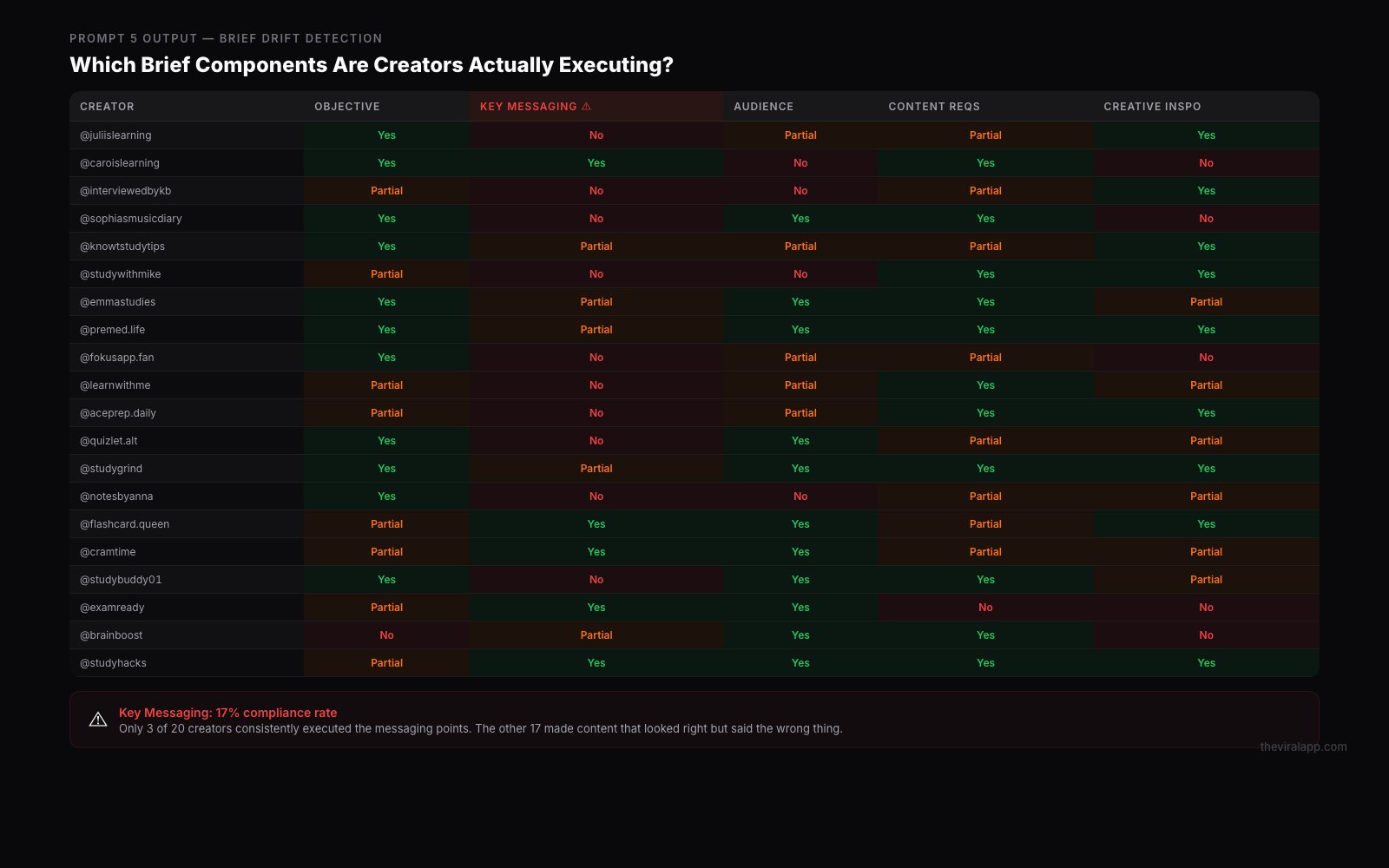
identify: 1. which brief component has the lowest compliance rate overall? 2. which creators consistently miss the same component? 3. is there a correlation between brief compliance and views? (sometimes the 'off-brief' videos win - i need to know that too) 4. for creators scoring below 60% compliance: write me a specific 2-sentence message i can send them to course-correct without killing their creativity." 为什么这很重要:信息块是悄无声息消失的那个。我们证明了这一点。在一个活动的 41 位创作者中,只有 7 位始终执行了关键信息。另外 34 位制作的内容看起来是对的,但说了错误的话。仅仅是纠偏信息就在下个月为该活动节省了 40,000 美元浪费的创作者费用。

F. 评论挖掘(Comment Mining) 这个有点令人尴尬。我们的活动中有 131,182 条评论,直到 3 个月前才有人系统地阅读它们。 "here are the last 5,000 comments from our campaign's videos.

[paste comments - one per line, include the video URL or creator name if possible]

mine these comments for:

  1. PRODUCT LANGUAGE: what exact words and phrases do commenters use to describe our app? not our marketing language - their language. list the top 20 phrases by frequency.

  2. OBJECTIONS: what concerns, doubts, or reasons NOT to download appear? group them by theme. for each theme, write a hook that directly addresses that objection.

  3. USE CASES WE DIDN'T BRIEF: are commenters describing uses for the app that we never mentioned in any brief? list them. these are content angles we're missing.

  4. COMPETITOR MENTIONS: do any comments mention competing apps by name? what do they say? what can we learn from why they're comparing?

  5. VIRAL COMMENT HOOKS: which comments got the most likes? what did they say? comments with 100+ likes often contain the exact hook phrasing that would work as a video hook.

  6. CREATOR-SPECIFIC PATTERNS: do certain creators attract different types of comments? (e.g., one creator gets mostly 'where do i download' while another gets 'is this even real'). what does that tell us about which creators drive conversions vs which drive skepticism?

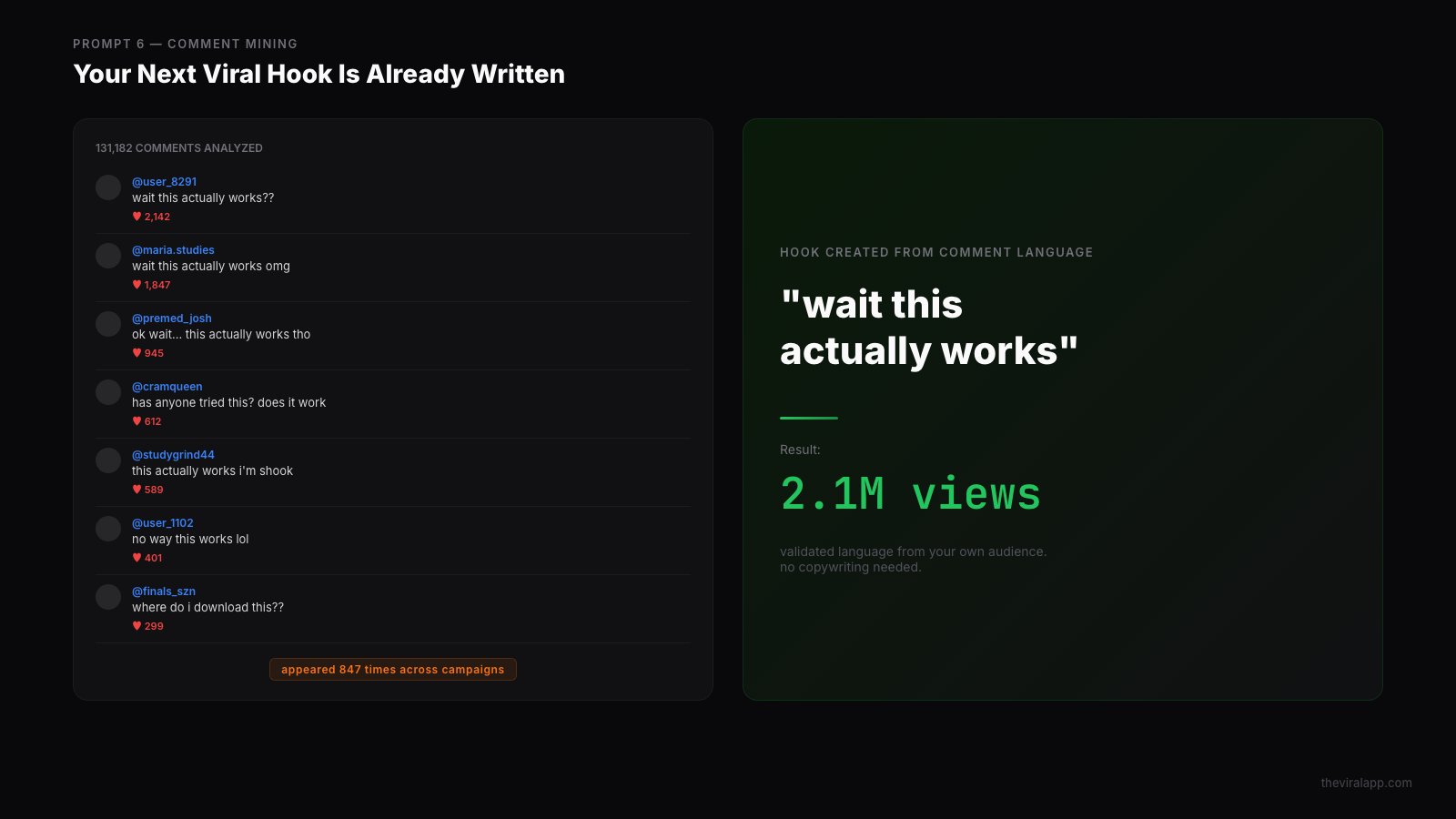
output each section as a separate table. then write me 10 new video hooks based entirely on the language, objections, and use cases you found in these comments. these hooks should sound like a real person talking, not a marketer - because they literally come from real people." 为什么这很重要:你的下一个爆款钩子已经写好了。它就在你的评论区里,用观众描述你产品的确切原话。“等等,这个真的有用?”这句话在我们的活动中出现了 847 次。这成了一个钩子。它获得了 210 万次观看,因为它是来自观众本身已经验证过的语言。

G. 创作者表现分析(Creator Performance Analysis) 停止基于粉丝数量做创作者决策。这个提示词从你自己的数据构建了一个评分模型。 "here is the performance data for every creator in our program:

[paste: one row per creator. format: 'CREATOR | FOLLOWERS | TOTAL POSTS | TOTAL VIEWS | AVG VIEWS/POST | TOP VIDEO VIEWS | BRIEF COMPLIANCE % | MONTHS ACTIVE | COMPENSATION/MONTH']

build me a creator scoring model based on this data. do not use follower count as a factor.

the model should score each creator on: 1. consistency: standard deviation of views across their posts (lower = more reliable) 2. ceiling: their top single video performance relative to the campaign average 3. efficiency: views per dollar of compensation 4. trend: are their last 10 posts trending up or down vs their first 10? 5. hit rate: what % of their posts exceed the campaign median?

tier every creator into S/A/B/C: - S tier: top 10% on composite score. these get increased budget and creative freedom. - A tier: top 25%. reliable performers. keep current terms. - B tier: middle 50%. evaluate on a per-creator basis. - C tier: bottom 25%. flag for potential replacement.

for each C-tier creator, tell me: - what specifically is underperforming (consistency? ceiling? efficiency?) - is there evidence they could improve with a brief adjustment, or is this a structural mismatch? - replacement recommendation: keep with intervention, pause, or drop?

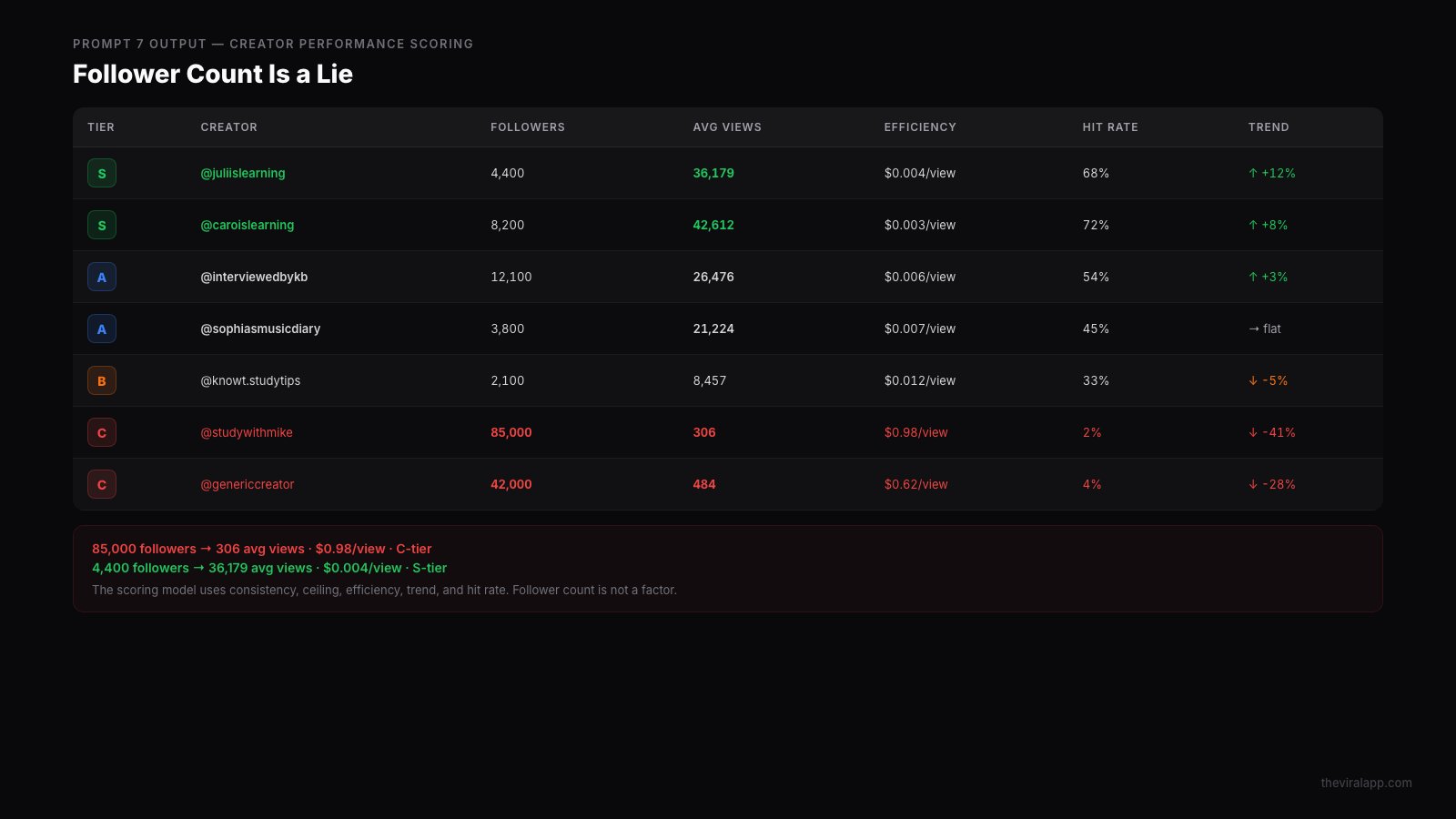
output the full ranked table, then a summary: how many creators should i scale up, how many need intervention, and how many should i replace this month?" 为什么这很重要:我们有一位拥有 4,400 名粉丝的创作者,在一个活动中获得了 2800 万次观看。我们还有另一位拥有 85,000 名粉丝的创作者,平均每个帖子只有 306 次观看。粉丝数量告诉我们的是与现实相反的情况。这个评分模型找到了真正表现好的创作者,并且随着新数据的输入每周更新。仅效率指标就在上个季度为我们节省了 12,000 美元,因为它抓住了那些高薪低能的创作者。

H. 跨平台格式转换(Cross-platform Format Translation) 在 TikTok 上有效的内容并不自动在 Instagram Reels 上也有效。机制是不同的。这个提示词改编你的赢家。 "here is our top performing TikTok video:

hook: [paste on-screen text] caption: [paste full caption] format: [describe: talking head, slideshow, screen recording, etc.] length: [X seconds] metrics on TikTok: [views, likes, comments, shares]

and here is our performance data comparing TikTok vs Instagram Reels across our campaign:

TikTok avg views/post: [X] IG Reels avg views/post: [X] TikTok hook rate benchmark: >60% IG Reels hook rate benchmark: >50% TikTok avg video length that performs: [X seconds] IG Reels avg video length that performs: [X seconds]

translate this winning TikTok format for Instagram Reels. specifically: 1. rewrite the hook for IG's different scroll behavior (IG users scroll slower, hooks can be slightly less aggressive) 2. adjust the pacing - IG Reels tend to reward slightly longer establishing shots 3. suggest caption adjustments (IG captions are more visible than TikTok's) 4. recommend any visual changes (IG favors slightly higher production quality) 5. write the full adapted brief i can send to a creator for the IG version

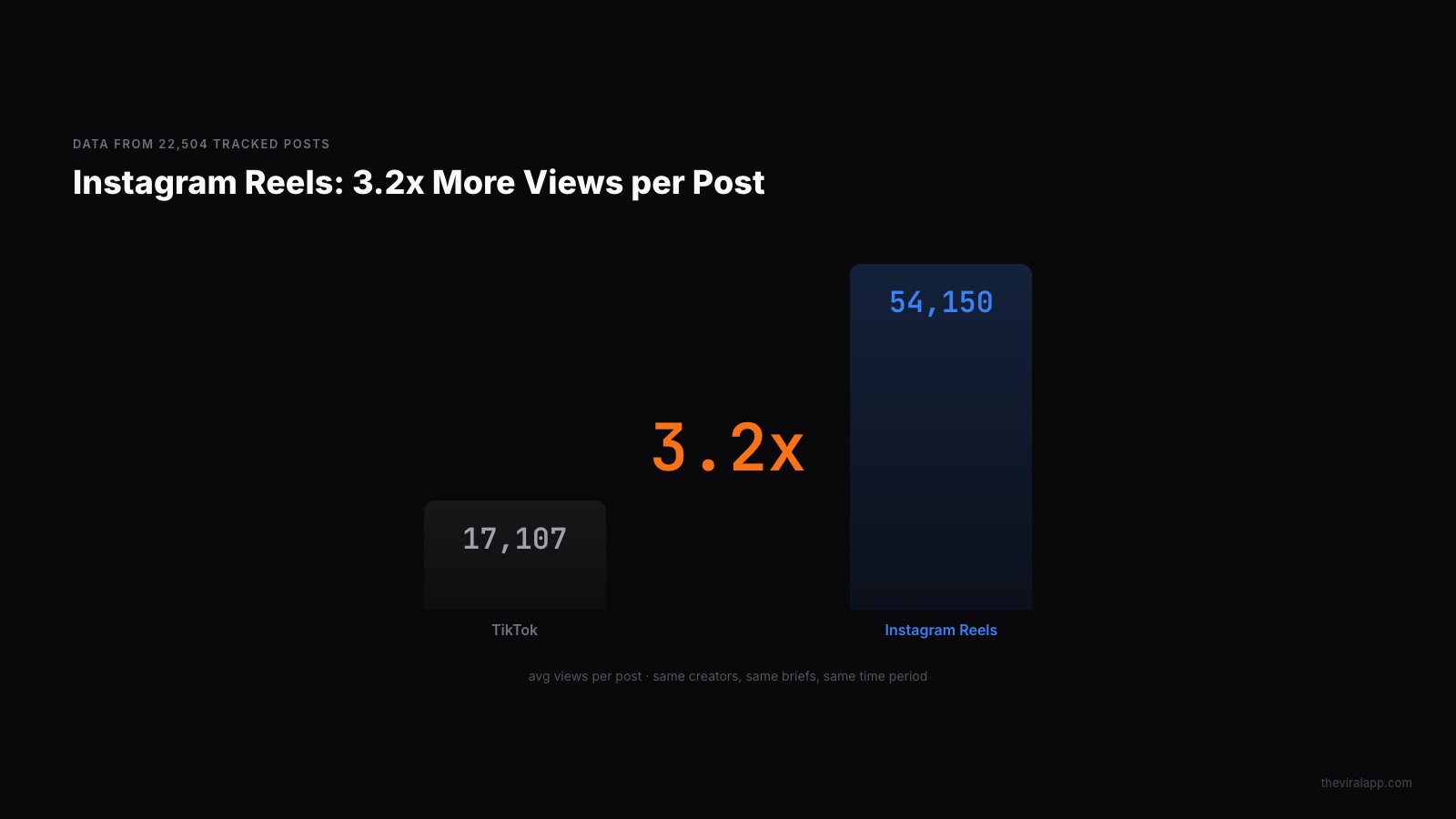
do the same in reverse: take our top IG Reel and translate it for TikTok." 为什么这很重要:我们追踪了 122,504 个帖子。在我们的数据中,Instagram Reels 每个帖子带来的观看量是 TikTok 的 3.2 倍。但在每个平台上获胜的格式在结构上是不同的。相同的视频在不经改编的情况下跨平台发布,其表现比平台原生版本差 40-60%。这个提示词为你提供了平台原生的简报,而无需你自己去弄清楚差异。 第三部分:简报生成(Brief Generation)(提示词 9-12) 大多数人使用 AI 从零开始写简报。这会给你带来通用的输出,因为模型是根据它在互联网上学到的东西来写的,而不是根据对你的产品有效的东西来写的。 这些提示词根据你自己的数据写简报。 I. 从你自己的赢家生成钩子(Hook Generation from Your Own Winners) 这就是“给我生成 30 个钩子”和“按照对我的应用已经有效的确切结构模式给我生成 30 个钩子”之间的区别。 "here are my 50 highest-performing video hooks from the last 90 days, ranked by views:

[paste: one per line. format: 'HOOK TEXT | VIEWS | PLATFORM']

first, identify the 3-4 structural patterns these hooks share. name each pattern.

then generate 30 new hooks following these rules: 1. every hook must follow one of the identified structural patterns 2. no hook should be a direct copy - they should feel fresh while being structurally identical 3. vary the specificity: some should name the app, some should be product-agnostic (for ghost accounts) 4. include 5 hooks specifically designed for the 'POV:' format 5. include 5 hooks designed for the 'list' format (3 things, 5 reasons, etc.) 6. include 5 hooks designed for the 'before/after' or 'transformation' format 7. for each hook, rate its predicted performance (high/medium/low) based on how closely it matches the winning patterns

output in a table with columns: hook text, structure pattern, format type, predicted performance, suggested creator type (face-to-camera vs voiceover vs faceless).

then pick the top 5 hooks you think will outperform and explain why each one works structurally." 为什么这很重要:当你在不向模型提供你自己的数据的情况下提示生成钩子时,你得到的是其他所有品牌都在使用的相同钩子。当你先把你表现最好的内容喂给它时,每一个输出都会根据对观众有效的内容进行校准。这种区别就在于,一个创作者脚本听起来像 ChatGPT,而另一个听起来像是每天观看你内容的人写的。 J. 针对每位创作者的个性化简报(Personalized Brief Per Creator) 这个让我们的运营团队大开眼界。你不再是给所有创作者一个简报,而是生成一个适应每个创作者风格的简报。 "here is our campaign brief:

[paste full brief with all 5 components]

and here is creator data for [creator name]:

account: [@handle ] platform: [TikTok / IG] follower count: [X] content style: [describe their typical video style] their 3 best performing videos: [paste hooks + view counts] their 3 worst performing videos: [paste hooks + view counts] what makes their content unique: [1-2 sentences] past campaign performance with us: [paste if available]

generate a personalized version of the campaign brief specifically for this creator.

the personalized brief should: 1. keep all 5 brief components intact - do not remove any requirement 2. translate the messaging into language that matches this creator's natural voice 3. suggest a specific hook from their winning patterns that fits our campaign objective 4. recommend a content format based on what this creator does best (not what we usually ask for) 5. flag any potential friction points - things in our brief that this creator might struggle with based on their past content 6. be under 300 words. creators don't read long briefs.

write it in second person ('you') and make it sound like a creative director talking to a collaborator, not a brand talking to a vendor." 为什么这很重要:我们在一个活动中测试了这个。20 位创作者拿到了标准简报。20 位拿到了个性化版本。拿到个性化简报的组制作的视频简报合规率提高了 31%,平均观看量提高了 22%。相同的应用,相同的活动,相同的月份。唯一的区别是,每个创作者收到的指令都被翻译成了他们自己的创意语言,而不是企业营销话术。在 590 位创作者的规模上,仅此一点的价值就超过了此列表中的任何其他提示词。

K. 活动脚本撰写器(Campaign Script Writer) 适用于那些需要比简报更多指导的创作者。有些人想要确切的脚本。这是根据你的数据写的,而不是凭空捏造的。 "i need a video script for a [X second] TikTok/Reel promoting [app name].

the script should follow this proven hook structure from our campaign: [paste your winning hook pattern]

here is the campaign brief: [paste brief] here is the creator who will film it: [paste their style description and best hooks] here is our target audience: [describe]

write the full script:

SECOND 0-1 (HOOK): - on-screen text: [exact text] - what the creator says: [exact dialogue] - what the viewer sees: [visual direction]

SECOND 1-5 (RETENTION): - on-screen text: [exact text] - dialogue: [exact words] - visual: [what happens on screen]

SECOND 5-15 (VALUE): - break into 2-3 scene changes - each scene: text + dialogue + visual

SECOND 15-END (CTA): - on-screen text: [exact text] - dialogue: [exact words] - visual: [what happens]

the script should feel like something this specific creator would naturally say. not corporate. not scripted-sounding. like they're talking to a friend.

also provide: - 3 alternative hooks for A/B testing - suggested filming location (based on the creator's typical content) - one 'pattern interrupt' moment to prevent mid-video drop-off" 为什么这很重要:我们默认使用“指导,而不是写脚本”的方法。但有些创作者需要更多的结构,尤其是新手。根据你的活动数据写的脚本和凭空写的脚本之间的区别,就像是一个听起来很原生的视频和一个听起来像广告的视频之间的区别。这个提示词生成的脚本是创作者真正想拍的,因为他们在字里行间看到了自己的声音。 M. 每周研究简报(Weekly Research Brief) 用 15 分钟的提示词会话取代你团队 2-3 小时的研究仪式。 "here is our campaign performance from the last 7 days:

[paste: one row per video. format: 'DATE | CREATOR | PLATFORM | HOOK | VIEWS | LIKES | COMMENTS | SHARES']

and here is the performance from the previous 7 days for comparison:

[paste same format]

run the weekly research analysis:

  1. WEEK OVER WEEK: did total views go up or down? by how much? which creators drove the change?
  2. HOOK PERFORMANCE: which hooks from this week outperformed the campaign average? which underperformed? what structural pattern do the winners share?
  3. PLATFORM SPLIT: how did TikTok vs IG Reels perform this week compared to last? is one platform trending up while the other flattens?
  4. CREATOR HEALTH: flag any creator whose average views dropped more than 30% week over week. possible causes?
  5. FORMAT TESTS: if we ran any new formats this week, how did they compare to our proven formats?
  6. BRIEF UPDATES: based on this week's data, should we update anything in the active brief? be specific.

end with: - 3 things to double down on next week - 2 things to stop doing - 1 experiment to test

keep the entire output under 500 words. this goes in our monday standup." 为什么这很重要:周一的研究仪式是 2-3 小时的手动电子表格分析。这个提示词在 15 分钟内完成,并捕捉到人类遗漏的模式,因为它阅读每一行而不是抽样。“1 个要测试的实验”输出是防止活动变得陈旧的关键。我们已经连续 8 个活动每周运行这个,实验建议的命中率达到了 40%。这意味着有 40% 的时间,模型提出了一个我们原本想不到但确实有效的测试。 第四部分:运营(Operations)(提示词 13-15) L. 创作者反馈生成器(Creator Feedback Generator) 在 UGC 中最难的运营任务是写出足够具体以改变行为,同时又不会打击创作者积极性的反馈。 "here is a draft video from a creator:

creator: [@handle ] frames: [attach screenshots if available, or describe the video] hook text: [paste] caption: [paste] video length: [X seconds] brief they were working from: [paste brief]

and here is our scoring rubric: - hook strength (1-5): does the first second stop the scroll? - retention structure (1-5): does the pacing keep viewers past 3 seconds? - brief alignment (1-5): does the content match what we asked for? - authenticity (1-5): does this feel like the creator's real content or an ad? - technical quality (1-5): lighting, audio, framing acceptable?

score this video on all 5 dimensions.

then write feedback in exactly this format: LINE 1: one specific thing they did well (always lead positive) LINE 2: one specific thing to change before posting (the single highest-impact fix) LINE 3: one creative suggestion for their next video (plant a seed, don't mandate)

the feedback must be: - under 50 words total - written in casual, encouraging tone - specific enough that the creator knows exactly what to do differently - never use the words 'engaging,' 'compelling,' or 'great job'" 为什么这很重要:我们每周要审核数百个草稿。一致性是致命的。一个 UGC 经理写了一段反馈,另一个只写“看起来不错”。这个提示词在不统一语气的情况下标准化了输出。禁止使用“吸引人”和“引人入胜”迫使反馈具体化。“你的钩子制造了好奇心,但回报出现在第 8 秒而不是第 3 秒”比“让钩子更吸引人”有用 100 倍。 N. 活动复盘(Campaign Post-mortem) 在活动结束时运行这个。它能捕捉到总结报告遗漏的模式。 "here is the complete data from a campaign that just ended:

campaign name: [X] duration: [X weeks] total creators: [X] total posts: [X] total views: [X] average views per post: [X] budget spent: [$X] CPV (cost per view): [$X]

top 10 videos: [paste with hooks, creators, views] bottom 10 videos: [paste with hooks, creators, views] brief used: [paste]

run a full post-mortem:

  1. WHAT WORKED: identify the structural patterns in the top 10. what do they share? (hook type, format, creator demo, platform, time of posting)
  2. WHAT DIDN'T: identify the structural patterns in the bottom 10. what do they share?
  3. THE 80/20: what % of views came from the top 20% of posts? what % came from the top 3 creators?
  4. BRIEF EFFECTIVENESS: based on the data, which brief components correlated with high performance? which were ignored without consequence?
  5. CREATOR TIERS: which creators should be promoted to the next campaign? which should be dropped?
  6. THE MISSED OPPORTUNITY: what format, hook style, or platform did we NOT test that the data suggests we should have?

end with a 5-point brief revision for the next campaign based on what this data shows. not what we think should work. what the data says works." 为什么这很重要:复盘是活动中最重要的文件,也是大多数人跳过的文件。这个提示词意味着没有借口。“错失的机会”部分的价值抵得上整个练习。它始终能揭示那些事后看来显而易见、但当时没人想到要去执行的测试。 O. 全面活动审计(Full Campaign Audit) 这是核武器级别的选项。把所有东西都倒进上下文窗口,然后问一个没人问的问题。 "i'm going to give you our complete campaign data. this includes every video, every caption, every creator, every metric, and our brief. this is [X] rows of data representing [X] months of work.

[paste the full dataset]

before you start analyzing, confirm: how many rows did you receive? how many unique creators? what date range does this cover? i want to make sure nothing was truncated.

then answer the 5 questions that determine whether this campaign was actually good or just felt good:

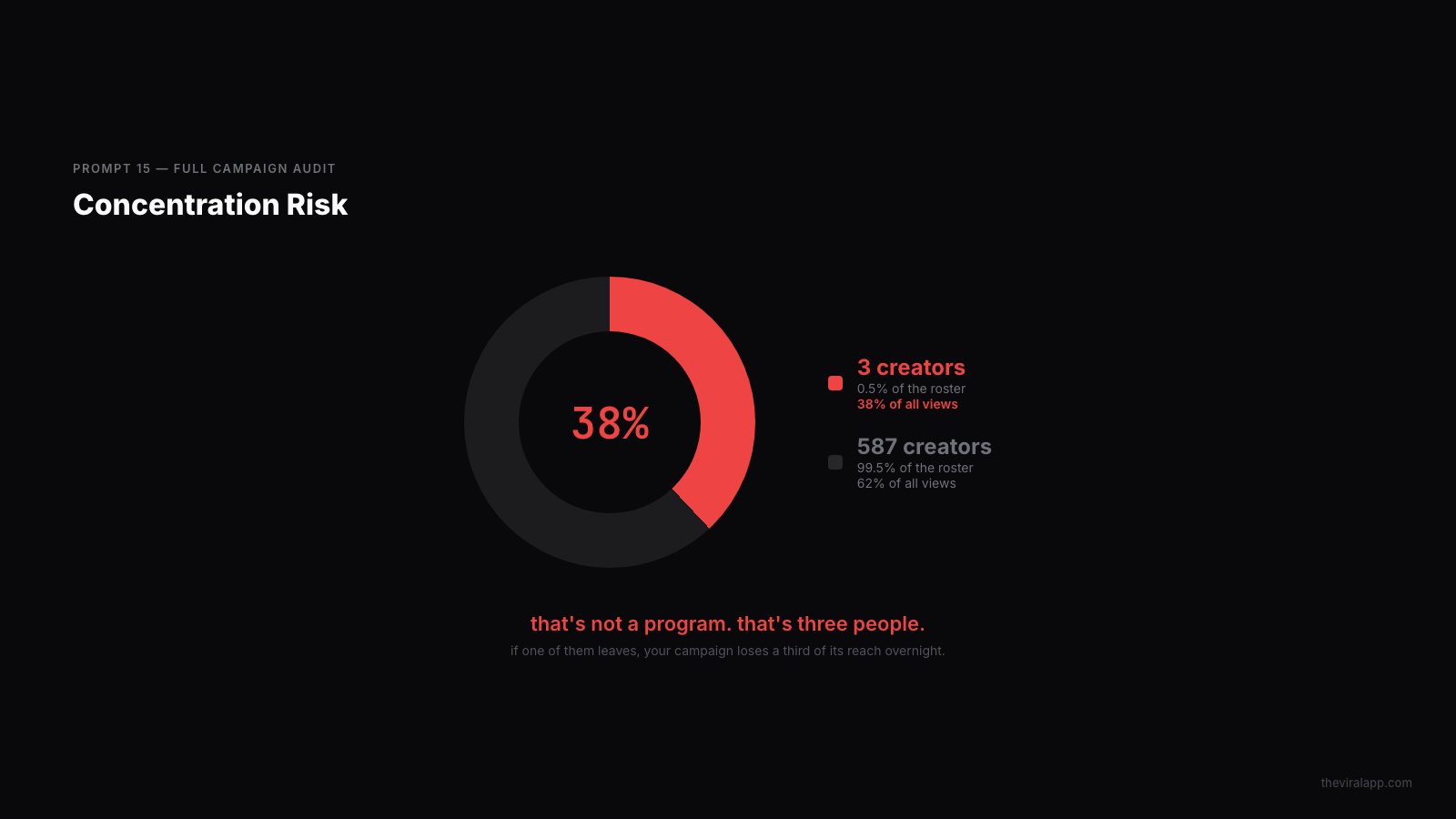
  1. CONCENTRATION RISK: what % of total views came from the top 3 creators? if more than 60%, this campaign is fragile. one creator leaving kills it.

  2. HOOK CONVERGENCE: did the campaign converge on a winning hook structure over time, or did hook styles stay scattered? convergence = good (the system is learning). scatter = bad (every creator is running solo).

  3. VELOCITY TREND: are views per post trending up or down over the campaign's lifetime? plot the weekly averages. a campaign that starts hot and fades is different from one that builds momentum.

  4. THE REAL CPV: not the headline CPV. calculate CPV excluding the top 3 outlier videos. that's the performance you can actually rely on and scale.

  5. REPEATABILITY: if i launched this exact campaign again tomorrow with 20 new creators and the same brief, what would the expected views per post be? high variance = lucky, not good. low variance = a system that works.

be honest. if the campaign was mediocre, say so. the only thing worse than a failed campaign is one that felt successful but can't be repeated." 为什么这很重要:我要告诉你一个数字,这个数字应该会让任何大规模运营 UGC 的人感到恐惧。在我们的数据中,590 位创作者中的 3 位占了所有观看量的 38%。这不是一个项目。这是三个人。这个提示词捕捉到了这个现实,并迫使你围绕它进行构建,而不是假装你的平均值代表了你的实际表现。 如何使用这些提示词 不要一次运行所有 15 个。这是顺序。 第 1 天:加载你的活动上下文。然后运行提示词 4(字幕聚类)。这是你能获得的最快的洞察。30 分钟的工作。今天就做。 第 2-3 天:在你最好和最差的视频上运行提示词 1(视频解剖)。然后运行提示词 2(并排对比)。你现在明白了为什么你的内容表现如此。 第 1 周:运行提示词 5(简报偏移)和 6(评论挖掘)。你现在知道了你的简报实际产生了什么,对比你原本的意图,以及你的观众实际在说什么。 第 2 周:运行提示词 7(创作者评分)和 9(钩子生成)。你现在知道了该扩大哪些创作者的规模,并拥有 30 个根据你的数据校准的新钩子。 第 3 周:为你的前 10 名创作者运行提示词 10(个性化简报)。从现在起,每周一运行提示词 12(每周研究)。 持续进行:在每个草稿上运行提示词 13(创作者反馈)。在每次活动结束时运行提示词 14(复盘)。每季度运行一次提示词 15(全面审计)。 运行这个系统 90 天,你将拥有比那些运营多年的机构更好的活动情报。我知道这一点,因为我们在管理价值 26 亿次观看量的活动中构建了这些提示词。提示词就是系统。系统才是可扩展的。 真心话 95% 阅读这篇文章的人会把它收藏起来,但永远不会粘贴任何一个提示词。没关系。 如果你想让我团队为你的应用运行这整个系统(每个活动、每个创作者、每个简报、每周的执行),这就是我们在 The Viral App 所做的事情。 26 亿次自然浏览量。590 位创作者。62 个活动。零广告支出。
openai shipped its most capable model on september 3. i wasn't going to write this. we've generated 2.6 billion organic views across 62 campaigns, managed 590 creators, and produced 22,504 tracked videos for mobile apps. zero ad spend. these 15 prompts are how i'm using ChatGPT Astra to run those campaigns at a level that was physically impossible 2 weeks ago. every single one is copy-paste ready. i'm giving them all away because by the time you read this i'll already be running them on the next campaign. save this. you will need it. before you run a single prompt: load your campaign context this is the step everyone skips and it's the step that makes everything else work. without it you're asking a stranger for advice about a business they've never seen. paste this into ChatGPT Astra before anything else: "here is everything you need to know about my UGC program before we start any analysis. reference this every time i ask you to run an audit, generate a brief, or analyze performance. never ask me for this information again.

OpenAI 在 9 月 3 日发布了其最强大的模型。我原本不打算写这篇文章。 我们在 62 个营销活动中创造了 26 亿次自然浏览量,管理了 590 位创作者,并为移动应用制作了 22,504 个可追踪视频。零广告支出。 这 15 个提示词(Prompts)是我如何使用 ChatGPT Astra 以两周前在物理上还不可能达到的水平来运营这些活动的方法。每一个都可以直接复制粘贴。我把它们全部免费分享,因为当你读到这篇文章时,我已经在下一个活动中使用它们了。 收藏这篇文章。你会需要它的。 在运行任何提示词之前:加载你的活动上下文(Context) 这是每个人都会跳过的步骤,但正是这个步骤让其他一切发挥作用。没有它,你就像是在向一个从未见过你业务的陌生人寻求建议。 在做任何其他事情之前,将以下内容粘贴到 ChatGPT Astra 中: "here is everything you need to know about my UGC program before we start any analysis. reference this every time i ask you to run an audit, generate a brief, or analyze performance. never ask me for this information again.

BUSINESS BASICS: app name: [your app name] app store URL: [iOS and/or Android link] category: [health, education, finance, social, etc.] monthly downloads: [X] MRR: [if comfortable sharing] one-sentence value prop: [what the app does in 15 words or less]

BUSINESS BASICS: app name: [your app name] app store URL: [iOS and/or Android link] category: [health, education, finance, social, etc.] monthly downloads: [X] MRR: [if comfortable sharing] one-sentence value prop: [what the app does in 15 words or less]

CAMPAIGN HISTORY: total creators managed: [X] total videos produced: [X] total organic views: [X] platforms active on: [TikTok, Instagram Reels, YouTube Shorts] average views per post: [X] best single video performance: [X views, link if available] biggest campaign win: [one sentence] biggest campaign failure: [one sentence - be honest]

CAMPAIGN HISTORY: total creators managed: [X] total videos produced: [X] total organic views: [X] platforms active on: [TikTok, Instagram Reels, YouTube Shorts] average views per post: [X] best single video performance: [X views, link if available] biggest campaign win: [one sentence] biggest campaign failure: [one sentence - be honest]

CURRENT CAMPAIGN: campaign name: [X] number of active creators: [X] videos per creator per week: [X] brief template: [paste your current brief or describe it] compensation model: [flat fee per video / monthly retainer / bonus structure] target hook rate (1s): [X% or 'don't track yet'] target view-through rate (3s): [X% or 'don't track yet']

CURRENT CAMPAIGN: campaign name: [X] number of active creators: [X] videos per creator per week: [X] brief template: [paste your current brief or describe it] compensation model: [flat fee per video / monthly retainer / bonus structure] target hook rate (1s): [X% or 'don't track yet'] target view-through rate (3s): [X% or 'don't track yet']

CONTENT STRATEGY: primary content formats: [testimonial, tutorial, day-in-my-life, reaction, before/after, etc.] top 3 performing hooks from last 30 days: [paste exact hook text] top 3 underperforming hooks: [paste exact hook text] competitors running UGC: [app 1, app 2, app 3]

CONTENT STRATEGY: primary content formats: [testimonial, tutorial, day-in-my-life, reaction, before/after, etc.] top 3 performing hooks from last 30 days: [paste exact hook text] top 3 underperforming hooks: [paste exact hook text] competitors running UGC: [app 1, app 2, app 3]

HOW I WANT YOU TO WORK: always prioritize actionable output over analysis. when you give me a recommendation, tell me impact level (high/medium/low) and time to implement. output data in table format when comparing anything. never invent a number. if you can't verify it, say so. when analyzing hooks, cluster by structure not by topic." once this is loaded, every prompt that follows gets 10x sharper. Astra stops answering a generic marketing question and starts answering yours. PART 1: VIDEO ANALYSIS (prompts 1-3) everyone thinks Astra can't watch videos. they're wrong. it just can't watch them the way you think. Astra takes text and images as input. it does not accept raw .mp4 files. but here is the thing most people miss: you don't need it to. you need a pipeline that watches the video FOR it and hands it a structured breakdown. this is the system we actually run, and it's the technique that changed everything for us.

HOW I WANT YOU TO WORK: always prioritize actionable output over analysis. when you give me a recommendation, tell me impact level (high/medium/low) and time to implement. output data in table format when comparing anything. never invent a number. if you can't verify it, say so. when analyzing hooks, cluster by structure not by topic." 一旦加载了这些内容,随后的每一个提示词都会变得 10 倍敏锐。Astra 不再回答泛泛的营销问题,而是开始回答你的具体问题。 第一部分:视频分析(Video Analysis)(提示词 1-3) 每个人都认为 Astra 无法观看视频。他们错了。它只是无法以你认为的方式观看。 Astra 接受文本和图像作为输入。它不接受原始的 .mp4 文件。但大多数人都忽略了一点:你不需要它这么做。你需要一个流水线(Pipeline)替它观看视频,并交给它一份结构化的拆解报告。 这就是我们实际运行的系统,也是改变了我们一切的技术。

the pipeline: how we make AI "watch" 200+ videos per week we built an automated video intelligence pipeline. here is how it works end to end. step 1: agent watches the video we use an AI coding agent (openai codex, claude code, or any agent with tool access) connected to two command-line tools: - yt-dlp: downloads any TikTok, Instagram Reel, or YouTube Short from a URL - ffmpeg: extracts frames at adaptive intervals (more frames during the hook, fewer during the middle) the agent runs this automatically. you give it a video URL. it downloads the video, extracts 8-12 key frames (weighted toward the first 3 seconds where hooks live), pulls the transcript from captions or runs whisper for speech-to-text, and reads any on-screen text from the frames. the output is a structured report per video (btw this is a video from one of our campaigns): VIDEO: @juliislearning - TikTok URL: https://tiktok.com/@juliislearning/video/7650298655236246792 DURATION: 55 seconds FRAMES EXTRACTED: 12 FRAME 0:00 - creator sitting at desk, hands on notebook, text overlay top-left: "3 things i wish i knew before finals" FRAME 0:01 - eye contact with camera, slight head tilt, text still visible FRAME 0:03 - cuts to phone screen showing app, finger scrolling FRAME 0:05 - back to face, talking, hands gesturing FRAME 0:10 - screen recording of app in use, flashcard generation FRAME 0:15 - split screen: creator left, app right FRAME 0:25 - close-up of app results FRAME 0:35 - creator reaction face FRAME 0:45 - back to talking head, summarizing FRAME 0:52 - CTA frame, text overlay: "link in bio" TRANSCRIPT: "ok so if you're a student and you haven't tried this yet i genuinely don't know what you're doing. i found this app called knowt like two weeks ago and it literally makes flashcards from your notes automatically. you just upload a pdf and..." ON-SCREEN TEXT: "3 things i wish i knew before finals" CAPTION: "this changed my entire study routine honestly #studytok

finals

#studywithme " 2. step 2: batch process all campaign videos the agent doesn't stop at one video. we point it at an entire campaign. it processes every video URL from our sideshift export and generates a structured report for each one. for a 50-video batch, this takes about 20 minutes running in the background. no human involvement. the output is one file with every video described in the same structured format: frames, transcript, on-screen text, visual elements, pacing, scene changes. 3. step 3: feed everything into astra now you take those structured descriptions (not the raw videos, the text descriptions of what's IN the videos) and paste them into astra's 1,050,000 token context window. this is where the magic happens. astra can now "see" 50 videos at once through their descriptions. it knows what every first frame looks like, what every hook says, how many scene changes each video has, where the CTA appears, what the transcript says, everything. and it can compare all of them simultaneously.

流水线:我们如何让 AI 每周“观看” 200 多个视频 我们构建了一个自动化视频智能流水线。以下是它的端到端工作原理。 步骤 1:智能体(Agent)观看视频 我们使用一个 AI 编码智能体(OpenAI Codex、Claude Code 或任何具有工具访问权限的智能体)连接到两个命令行工具: - yt-dlp:从 URL 下载任何 TikTok、Instagram Reel 或 YouTube Short 视频 - ffmpeg:以自适应间隔提取帧(在钩子部分提取更多帧,在中间部分提取较少帧) 智能体会自动运行此操作。你给它一个视频 URL。它会下载视频,提取 8-12 个关键帧(向存在钩子的前 3 秒倾斜),从字幕中提取转录文本或运行 whisper 进行语音转文字,并从帧中读取任何屏幕文本。 输出结果是每个视频的结构化报告(顺便说一句,这是我们其中一个活动的视频): VIDEO: @juliislearning - TikTok URL: https://tiktok.com/@juliislearning/video/7650298655236246792 DURATION: 55 seconds FRAMES EXTRACTED: 12 FRAME 0:00 - creator sitting at desk, hands on notebook, text overlay top-left: "3 things i wish i knew before finals" FRAME 0:01 - eye contact with camera, slight head tilt, text still visible FRAME 0:03 - cuts to phone screen showing app, finger scrolling FRAME 0:05 - back to face, talking, hands gesturing FRAME 0:10 - screen recording of app in use, flashcard generation FRAME 0:15 - split screen: creator left, app right FRAME 0:25 - close-up of app results FRAME 0:35 - creator reaction face FRAME 0:45 - back to talking head, summarizing FRAME 0:52 - CTA frame, text overlay: "link in bio" TRANSCRIPT: "ok so if you're a student and you haven't tried this yet i genuinely don't know what you're doing. i found this app called knowt like two weeks ago and it literally makes flashcards from your notes automatically. you just upload a pdf and..." ON-SCREEN TEXT: "3 things i wish i knew before finals" CAPTION: "this changed my entire study routine honestly #studytok

finals

#studywithme " 2. 步骤 2:批量处理所有活动视频 智能体不会在单个视频上停止。我们将其指向整个活动。它处理从我们 sideshift 导出的每一个视频 URL,并为每个视频生成一份结构化报告。对于 50 个视频的批次,这在后台运行大约需要 20 分钟。无需人工干预。 输出结果是一个文件,其中每个视频都以相同的结构化格式进行描述:帧、转录文本、屏幕文本、视觉元素、节奏、场景变化。 3. 步骤 3:将所有内容输入 Astra 现在你将这些结构化描述(不是原始视频,而是关于视频内容的文本描述)粘贴到 Astra 的 1,050,000 token 上下文窗口(Context Window)中。奇迹就在这里发生。 Astra 现在可以通过描述同时“看到” 50 个视频。它知道每个第一帧长什么样,每个钩子说了什么,每个视频有多少场景变化,CTA 出现在哪里,转录文本说了什么,一切。而且它可以同时比较所有这些内容。

A. the video autopsy once your pipeline has processed a video, feed the structured report into astra with this prompt: "here is a structured breakdown of a UGC video from our campaign. an agent extracted the frames, transcript, and on-screen text automatically.

A. 视频解剖(Video Autopsy) 一旦你的流水线处理完一个视频,就使用以下提示词将结构化报告输入 Astra: "here is a structured breakdown of a UGC video from our campaign. an agent extracted the frames, transcript, and on-screen text automatically.

[paste the full structured video report from the pipeline]

[paste the full structured video report from the pipeline]

metrics: [views, likes, comments, shares, saves] platform: [TikTok / Instagram Reels] creator follower count: [X] campaign brief: [paste brief or summarize]

metrics: [views, likes, comments, shares, saves] platform: [TikTok / Instagram Reels] creator follower count: [X] campaign brief: [paste brief or summarize]

analyze this video across these dimensions:

analyze this video across these dimensions:

HOOK (0-1 second): - based on the first frame description, what visual hook is present? what emotion does it trigger? - what is the text hook? does it create a knowledge gap, fear of missing out, or pattern interrupt? - based on the frame sequence, would a viewer stop scrolling? why?

HOOK (0-1 second): - based on the first frame description, what visual hook is present? what emotion does it trigger? - what is the text hook? does it create a knowledge gap, fear of missing out, or pattern interrupt? - based on the frame sequence, would a viewer stop scrolling? why?

RETENTION (1-5 seconds): - does the content deliver on the hook's promise by frame 3 or does it stall? - how many visual changes happen in the first 5 seconds? - is there a reason to keep watching past second 3?

RETENTION (1-5 seconds): - does the content deliver on the hook's promise by frame 3 or does it stall? - how many visual changes happen in the first 5 seconds? - is there a reason to keep watching past second 3?

STRUCTURE: - what content format is this? (testimonial, tutorial, day-in-my-life, reaction, before/after, storytime, comparison) - what is the information architecture? (problem-solution, list, narrative, demonstration) - how many distinct scenes or visual changes are there across all frames? - at what timestamp does the app first appear on screen?

STRUCTURE: - what content format is this? (testimonial, tutorial, day-in-my-life, reaction, before/after, storytime, comparison) - what is the information architecture? (problem-solution, list, narrative, demonstration) - how many distinct scenes or visual changes are there across all frames? - at what timestamp does the app first appear on screen?

TRANSCRIPT ANALYSIS: - does the spoken content match the brief's key messaging? - what specific phrases does the creator use to describe the product? - are there any claims that weren't in the brief?

TRANSCRIPT ANALYSIS: - does the spoken content match the brief's key messaging? - what specific phrases does the creator use to describe the product? - are there any claims that weren't in the brief?

CREATOR FIT: - based on the visual descriptions, does the creator look authentic? - does the setting match their usual content style?

CREATOR FIT: - based on the visual descriptions, does the creator look authentic? - does the setting match their usual content style?

VERDICT: - score this video 1-5 on hook strength, retention structure, authenticity, and brief alignment - what is the single biggest thing that would improve this video? - would you scale this creator based on this video? why or why not? - write a 3-line feedback message for this creator (one positive, one fix, one suggestion)" the key difference from doing this manually: the agent watches the video, not you. the structured report captures details a human reviewer misses because it reads every frame and transcribes every word. and the feedback output is specific enough to send directly to the creator. why this matters: we review hundreds of videos per week across 62 campaigns. the bottleneck was never finding bad videos. it was articulating WHY a video underperformed in a way a creator can act on. "make it more engaging" is useless feedback. "your hook creates a knowledge gap but the payoff comes at second 8 instead of second 2, which is why your 3-second retention drops to 22%" is feedback a creator can fix in their next draft. this prompt gives you that level of specificity for every single video. we used to spend 15-20 minutes writing feedback per video. now we spend 2 minutes confirming what the model found.

VERDICT: - score this video 1-5 on hook strength, retention structure, authenticity, and brief alignment - what is the single biggest thing that would improve this video? - would you scale this creator based on this video? why or why not? - write a 3-line feedback message for this creator (one positive, one fix, one suggestion)" 与手动执行此操作的关键区别在于:是智能体观看视频,而不是你。结构化报告捕捉到了人类审核员遗漏的细节,因为它读取了每一帧并转录了每一个字。而且输出的反馈足够具体,可以直接发送给创作者。 为什么这很重要:我们每周要在 62 个活动中审核数百个视频。瓶颈从来不是找出表现不佳的视频,而是用一种创作者能够采取行动的方式去表达为什么视频表现不佳。“让它更吸引人”是无用的反馈。“你的钩子制造了知识鸿沟,但回报出现在第 8 秒而不是第 2 秒,这就是为什么你的 3 秒留存率下降到 22%”是创作者可以在下一个草稿中修复的反馈。 这个提示词为你提供了每个视频的这种级别的具体性。我们过去每个视频要花 15-20 分钟写反馈。现在我们只花 2 分钟确认模型发现的内容。

B. side-by-side video comparison take your best performing video and your worst from the same campaign. extract frames from both. "i'm going to show you two UGC videos from the same campaign for the same app. one performed well, one didn't. both had the same brief.

B. 并排视频对比(Side-by-side Video Comparison) 从同一个活动中取出你表现最好和最差的视频。从两者中提取帧。 "i'm going to show you two UGC videos from the same campaign for the same app. one performed well, one didn't. both had the same brief.

VIDEO A (winner): frames: [attach 6-10 screenshots] caption: [paste] on-screen text: [paste] metrics: [views, likes, comments, shares]

VIDEO A (winner): frames: [attach 6-10 screenshots] caption: [paste] on-screen text: [paste] metrics: [views, likes, comments, shares]

VIDEO B (underperformer): frames: [attach 6-10 screenshots] caption: [paste] on-screen text: [paste] metrics: [views, likes, comments, shares]

VIDEO B (underperformer): frames: [attach 6-10 screenshots] caption: [paste] on-screen text: [paste] metrics: [views, likes, comments, shares]

both videos had this brief: [paste brief or summarize the 5 key components]

both videos had this brief: [paste brief or summarize the 5 key components]

analyze the gap: 1. what did video A execute from the brief that video B missed? 2. compare the first frame of each. which one stops the scroll and why? 3. compare the hook text. which one creates a stronger knowledge gap? 4. at what second does each video 'earn the next second'? identify the exact moment 5. compare pacing: how many visual changes per 10 seconds in each? 6. compare authenticity: which creator feels more natural with the product? 7. if you could only change ONE thing about video B to match video A's structure, what would it be?

analyze the gap: 1. what did video A execute from the brief that video B missed? 2. compare the first frame of each. which one stops the scroll and why? 3. compare the hook text. which one creates a stronger knowledge gap? 4. at what second does each video 'earn the next second'? identify the exact moment 5. compare pacing: how many visual changes per 10 seconds in each? 6. compare authenticity: which creator feels more natural with the product? 7. if you could only change ONE thing about video B to match video A's structure, what would it be?

output as a comparison table with scores for each dimension, then a 3-sentence action item i can send directly to video B's creator as feedback." why this matters: the comparison is where the real learning happens. when you look at one video in isolation, everything feels subjective. when you put the winner and loser next to each other with the same brief, the structural difference becomes obvious. the 3-sentence feedback output is deliberate. creators don't read long emails. they need one specific thing to fix.

output as a comparison table with scores for each dimension, then a 3-sentence action item i can send directly to video B's creator as feedback." 为什么这很重要:比较才是真正学习发生的地方。当你孤立地看一个视频时,一切都很主观。当你把赢家和输家放在同一个简报旁边时,结构上的差异就变得明显了。3 句话的反馈输出是刻意设计的。创作者不看长邮件。他们需要一个具体的修复点。

C. batch format analysis across competitors this one requires more setup but it's the most valuable research prompt in this entire article. go to 3 competitor apps' TikTok or IG accounts. screenshot the first frame of their 10 most recent videos (30 screenshots total). note the view count for each. "i'm analyzing the UGC strategy of 3 competitor apps in my category. for each app i've captured the first frame of their 10 most recent videos along with the view count.

C. 跨竞品的批量格式分析(Batch Format Analysis Across Competitors) 这个需要更多设置,但它是整篇文章中最有价值的研究提示词。 去 3 个竞品应用的 TikTok 或 IG 账号。截取他们最近 10 个视频的第一帧(共 30 张截图)。记录每个视频的观看次数。 "i'm analyzing the UGC strategy of 3 competitor apps in my category. for each app i've captured the first frame of their 10 most recent videos along with the view count.

COMPETITOR A: [app name] [attach 10 first-frame screenshots with view counts listed]

COMPETITOR A: [app name] [attach 10 first-frame screenshots with view counts listed]

COMPETITOR B: [app name] [attach 10 first-frame screenshots with view counts listed]

COMPETITOR B: [app name] [attach 10 first-frame screenshots with view counts listed]

COMPETITOR C: [app name] [attach 10 first-frame screenshots with view counts listed]

COMPETITOR C: [app name] [attach 10 first-frame screenshots with view counts listed]

MY APP: [app name] [attach 10 first-frame screenshots with view counts listed]

MY APP: [app name] [attach 10 first-frame screenshots with view counts listed]

analyze across all 40 videos:

analyze across all 40 videos:

  1. VISUAL PATTERNS: what do the top 5 highest-performing first frames have in common? (face position, text placement, colors, props, background, lighting)
  2. TEXT HOOK PATTERNS: group all 40 on-screen text hooks by structure type. which structure type has the highest median views?
  3. FORMAT DISTRIBUTION: what % of each competitor's content is testimonial vs tutorial vs reaction vs other? which format type wins?
  4. WHAT MY COMPETITORS DO THAT I DON'T: identify any visual or structural pattern that appears in 2+ competitor accounts but not in mine
  5. WHAT I DO THAT NO ONE ELSE DOES: identify anything unique to my content that could be a differentiator or a blind spot
  6. THE PLAY: based on all 40 videos, what is the single highest-opportunity content format and hook structure that i should test next week? be specific - give me the exact first-frame composition, text hook structure, and content flow." why this matters: this is competitive intelligence that used to require hiring an analyst for a week. you're getting a structural breakdown of your entire competitive landscape from the visual layer. the key insight for us was discovering that 3 of our competitor apps were using the exact same first-frame template (text in top-left, face in bottom-right, colored background) and we weren't. we tested it the next week and our hook rate jumped 18%.
  1. VISUAL PATTERNS: what do the top 5 highest-performing first frames have in common? (face position, text placement, colors, props, background, lighting)
  2. TEXT HOOK PATTERNS: group all 40 on-screen text hooks by structure type. which structure type has the highest median views?
  3. FORMAT DISTRIBUTION: what % of each competitor's content is testimonial vs tutorial vs reaction vs other? which format type wins?
  4. WHAT MY COMPETITORS DO THAT I DON'T: identify any visual or structural pattern that appears in 2+ competitor accounts but not in mine
  5. WHAT I DO THAT NO ONE ELSE DOES: identify anything unique to my content that could be a differentiator or a blind spot
  6. THE PLAY: based on all 40 videos, what is the single highest-opportunity content format and hook structure that i should test next week? be specific - give me the exact first-frame composition, text hook structure, and content flow." 为什么这很重要:这种竞争情报过去需要雇佣一名分析师花一周时间才能获得。你正在从视觉层面对整个竞争格局进行结构性拆解。对我们来说,关键的洞察是发现我们有 3 个竞品应用使用了完全相同的第一帧模板(文本在左上角,人脸在右下角,彩色背景),而我们没有。我们第二周测试了它,我们的钩子率(Hook Rate)跃升了 18%。

PART 2: CAMPAIGN INTELLIGENCE (prompts 4-8) this is where Astra's 1,050,000 token context window stops being a spec sheet and starts being a weapon. for context: our entire database of 22,504 video captions with metrics fits in that window with room to spare. for the first time ever, the whole book fits on the desk instead of one page at a time.

第二部分:活动情报(Campaign Intelligence)(提示词 4-8) 在这里,Astra 的 1,050,000 token 上下文窗口不再是一张规格表,而是成为了一件武器。 提供背景:我们包含指标的 22,504 个视频字幕的整个数据库都装得进那个窗口,而且还有剩余空间。这是有史以来第一次,整本书都能放在桌面上,而不是一次只看一页。

D. caption clustering this is prompt #1 in order of impact. if you only run one prompt from this entire article, run this one. "here are all the captions and on-screen hooks from our last 30 days of UGC content, with the view count for each.

D. 字幕聚类(Caption Clustering) 按影响力排序,这是提示词 #1。如果你在这整篇文章中只运行一个提示词,就运行这个。 "here are all the captions and on-screen hooks from our last 30 days of UGC content, with the view count for each.

[paste: one line per video. format: 'HOOK TEXT | CAPTION | VIEWS | PLATFORM | CREATOR']

[paste: one line per video. format: 'HOOK TEXT | CAPTION | VIEWS | PLATFORM | CREATOR']

do not cluster these by topic. cluster them by STRUCTURE.

do not cluster these by topic. cluster them by STRUCTURE.

a structure is the skeleton of the hook, not what it's about. examples: - 'POV: you [action] and [unexpected result]' is one structure - '[number] things i wish i knew about [topic]' is another structure - 'i can't believe nobody told me about [thing]' is another - 'this is what i use instead of [alternative]' is another

a structure is the skeleton of the hook, not what it's about. examples: - 'POV: you [action] and [unexpected result]' is one structure - '[number] things i wish i knew about [topic]' is another structure - 'i can't believe nobody told me about [thing]' is another - 'this is what i use instead of [alternative]' is another

find every distinct hook structure in this dataset. for each structure: 1. name it with a short label (e.g., 'POV + unexpected result') 2. count how many videos used it 3. calculate the median views for that structure 4. calculate the average views (so i can see if one outlier is inflating it) 5. list the top 3 and bottom 3 performers within that cluster

find every distinct hook structure in this dataset. for each structure: 1. name it with a short label (e.g., 'POV + unexpected result') 2. count how many videos used it 3. calculate the median views for that structure 4. calculate the average views (so i can see if one outlier is inflating it) 5. list the top 3 and bottom 3 performers within that cluster

then rank all structures by median views, highest first.

then rank all structures by median views, highest first.

finally: compare the distribution of structures in my brief against the distribution of structures in actual posts. are creators following the brief's intended structure or have they drifted into their own patterns?

finally: compare the distribution of structures in my brief against the distribution of structures in actual posts. are creators following the brief's intended structure or have they drifted into their own patterns?

output as a table. then give me a 3-sentence recommendation: which structure should i double down on, which should i kill, and which structure from a competitor should i test." why this matters: this is the prompt that found our 4.2x problem. we had two campaigns for the same app. identical briefs. campaign A did 12,333 views per post. campaign B did 2,921. campaign B had more posts and more creators. the caption clustering showed that campaign A had converged on one hook structure and repeated it across all creators. campaign B had 41 creators each running their own interpretation. the brief was the same. the execution drifted. nothing in our process caught it because no human reads 3,109 captions side by side. a 1,050,000 token window does. and now we run this every monday.

output as a table. then give me a 3-sentence recommendation: which structure should i double down on, which should i kill, and which structure from a competitor should i test." 为什么这很重要:这个提示词发现了我们 4.2 倍的问题。我们为同一个应用开展了两个活动。简报完全相同。活动 A 每个帖子有 12,333 次观看。活动 B 有 2,921 次。活动 B 有更多的帖子和创作者。 字幕聚类显示,活动 A 收敛于一种钩子结构,并在所有创作者中重复使用。活动 B 有 41 位创作者,每个人都在按照自己的理解执行。简报是一样的。执行却发生了偏移。我们流程中没有任何东西捕捉到这一点,因为没有人类会并排阅读 3,109 条字幕。 一个 1,050,000 token 的窗口做到了。现在我们每周一都运行这个。

E. brief drift detection your brief has 5 components. your creators execute maybe 3 of them. the other 2 disappear silently and you don't notice until the campaign wraps. "here is our creative brief for this campaign:

E. 简报偏移检测(Brief Drift Detection) 你的简报有 5 个组成部分。你的创作者可能只执行了其中 3 个。另外 2 个悄无声息地消失了,直到活动结束你才会注意到。 "here is our creative brief for this campaign:

[paste your full brief - objective, key messaging, audience insight, content requirements, creative inspiration]

[paste your full brief - objective, key messaging, audience insight, content requirements, creative inspiration]

and here are the last 200 captions + on-screen hooks from creators on this campaign:

and here are the last 200 captions + on-screen hooks from creators on this campaign:

[paste: one line per video. format: 'CREATOR | HOOK TEXT | CAPTION | VIEWS']

[paste: one line per video. format: 'CREATOR | HOOK TEXT | CAPTION | VIEWS']

for each of the 5 brief components, score every video on whether it executed that component: - objective alignment: does the video point toward the campaign goal? (yes/partial/no) - key messaging: does the video use or paraphrase the messaging points? (yes/partial/no) - audience insight: does the video speak to the target persona? (yes/partial/no) - content requirements: does the video follow format/length/CTA requirements? (yes/partial/no) - creative inspiration: does the video reflect the examples and mood we provided? (yes/partial/no)

for each of the 5 brief components, score every video on whether it executed that component: - objective alignment: does the video point toward the campaign goal? (yes/partial/no) - key messaging: does the video use or paraphrase the messaging points? (yes/partial/no) - audience insight: does the video speak to the target persona? (yes/partial/no) - content requirements: does the video follow format/length/CTA requirements? (yes/partial/no) - creative inspiration: does the video reflect the examples and mood we provided? (yes/partial/no)

then group by creator. for each creator, show their compliance rate per brief component.

then group by creator. for each creator, show their compliance rate per brief component.

identify: 1. which brief component has the lowest compliance rate overall? 2. which creators consistently miss the same component? 3. is there a correlation between brief compliance and views? (sometimes the 'off-brief' videos win - i need to know that too) 4. for creators scoring below 60% compliance: write me a specific 2-sentence message i can send them to course-correct without killing their creativity." why this matters: the messaging block is the one that silently disappears. we proved it. across 41 creators on one campaign, only 7 consistently executed the key messaging. the other 34 were making content that looked right but said the wrong thing. the course-correction messages alone saved that campaign $40,000 in wasted creator fees the following month.

identify: 1. which brief component has the lowest compliance rate overall? 2. which creators consistently miss the same component? 3. is there a correlation between brief compliance and views? (sometimes the 'off-brief' videos win - i need to know that too) 4. for creators scoring below 60% compliance: write me a specific 2-sentence message i can send them to course-correct without killing their creativity." 为什么这很重要:信息块是悄无声息消失的那个。我们证明了这一点。在一个活动的 41 位创作者中,只有 7 位始终执行了关键信息。另外 34 位制作的内容看起来是对的,但说了错误的话。仅仅是纠偏信息就在下个月为该活动节省了 40,000 美元浪费的创作者费用。

F. comment mining this one is embarrassing. we had 131,182 comments across our campaigns and nobody was reading them systematically until 3 months ago. "here are the last 5,000 comments from our campaign's videos.

F. 评论挖掘(Comment Mining) 这个有点令人尴尬。我们的活动中有 131,182 条评论,直到 3 个月前才有人系统地阅读它们。 "here are the last 5,000 comments from our campaign's videos.

[paste comments - one per line, include the video URL or creator name if possible]

[paste comments - one per line, include the video URL or creator name if possible]

mine these comments for:

mine these comments for:

  1. PRODUCT LANGUAGE: what exact words and phrases do commenters use to describe our app? not our marketing language - their language. list the top 20 phrases by frequency.
  1. PRODUCT LANGUAGE: what exact words and phrases do commenters use to describe our app? not our marketing language - their language. list the top 20 phrases by frequency.
  1. OBJECTIONS: what concerns, doubts, or reasons NOT to download appear? group them by theme. for each theme, write a hook that directly addresses that objection.
  1. OBJECTIONS: what concerns, doubts, or reasons NOT to download appear? group them by theme. for each theme, write a hook that directly addresses that objection.
  1. USE CASES WE DIDN'T BRIEF: are commenters describing uses for the app that we never mentioned in any brief? list them. these are content angles we're missing.
  1. USE CASES WE DIDN'T BRIEF: are commenters describing uses for the app that we never mentioned in any brief? list them. these are content angles we're missing.
  1. COMPETITOR MENTIONS: do any comments mention competing apps by name? what do they say? what can we learn from why they're comparing?
  1. COMPETITOR MENTIONS: do any comments mention competing apps by name? what do they say? what can we learn from why they're comparing?
  1. VIRAL COMMENT HOOKS: which comments got the most likes? what did they say? comments with 100+ likes often contain the exact hook phrasing that would work as a video hook.
  1. VIRAL COMMENT HOOKS: which comments got the most likes? what did they say? comments with 100+ likes often contain the exact hook phrasing that would work as a video hook.
  1. CREATOR-SPECIFIC PATTERNS: do certain creators attract different types of comments? (e.g., one creator gets mostly 'where do i download' while another gets 'is this even real'). what does that tell us about which creators drive conversions vs which drive skepticism?
  1. CREATOR-SPECIFIC PATTERNS: do certain creators attract different types of comments? (e.g., one creator gets mostly 'where do i download' while another gets 'is this even real'). what does that tell us about which creators drive conversions vs which drive skepticism?

output each section as a separate table. then write me 10 new video hooks based entirely on the language, objections, and use cases you found in these comments. these hooks should sound like a real person talking, not a marketer - because they literally come from real people." why this matters: your next viral hook is already written. it's sitting in your comment section in the exact words your audience uses to describe your product. the phrase "wait this actually works?" appeared 847 times across our campaigns. that became a hook. it did 2.1M views because it was already validated language from the audience itself.

output each section as a separate table. then write me 10 new video hooks based entirely on the language, objections, and use cases you found in these comments. these hooks should sound like a real person talking, not a marketer - because they literally come from real people." 为什么这很重要:你的下一个爆款钩子已经写好了。它就在你的评论区里,用观众描述你产品的确切原话。“等等,这个真的有用?”这句话在我们的活动中出现了 847 次。这成了一个钩子。它获得了 210 万次观看,因为它是来自观众本身已经验证过的语言。

G. creator performance analysis stop making creator decisions based on follower count. this prompt builds a scoring model from your own data. "here is the performance data for every creator in our program:

G. 创作者表现分析(Creator Performance Analysis) 停止基于粉丝数量做创作者决策。这个提示词从你自己的数据构建了一个评分模型。 "here is the performance data for every creator in our program:

[paste: one row per creator. format: 'CREATOR | FOLLOWERS | TOTAL POSTS | TOTAL VIEWS | AVG VIEWS/POST | TOP VIDEO VIEWS | BRIEF COMPLIANCE % | MONTHS ACTIVE | COMPENSATION/MONTH']

[paste: one row per creator. format: 'CREATOR | FOLLOWERS | TOTAL POSTS | TOTAL VIEWS | AVG VIEWS/POST | TOP VIDEO VIEWS | BRIEF COMPLIANCE % | MONTHS ACTIVE | COMPENSATION/MONTH']

build me a creator scoring model based on this data. do not use follower count as a factor.

build me a creator scoring model based on this data. do not use follower count as a factor.

the model should score each creator on: 1. consistency: standard deviation of views across their posts (lower = more reliable) 2. ceiling: their top single video performance relative to the campaign average 3. efficiency: views per dollar of compensation 4. trend: are their last 10 posts trending up or down vs their first 10? 5. hit rate: what % of their posts exceed the campaign median?

the model should score each creator on: 1. consistency: standard deviation of views across their posts (lower = more reliable) 2. ceiling: their top single video performance relative to the campaign average 3. efficiency: views per dollar of compensation 4. trend: are their last 10 posts trending up or down vs their first 10? 5. hit rate: what % of their posts exceed the campaign median?

tier every creator into S/A/B/C: - S tier: top 10% on composite score. these get increased budget and creative freedom. - A tier: top 25%. reliable performers. keep current terms. - B tier: middle 50%. evaluate on a per-creator basis. - C tier: bottom 25%. flag for potential replacement.

tier every creator into S/A/B/C: - S tier: top 10% on composite score. these get increased budget and creative freedom. - A tier: top 25%. reliable performers. keep current terms. - B tier: middle 50%. evaluate on a per-creator basis. - C tier: bottom 25%. flag for potential replacement.

for each C-tier creator, tell me: - what specifically is underperforming (consistency? ceiling? efficiency?) - is there evidence they could improve with a brief adjustment, or is this a structural mismatch? - replacement recommendation: keep with intervention, pause, or drop?

for each C-tier creator, tell me: - what specifically is underperforming (consistency? ceiling? efficiency?) - is there evidence they could improve with a brief adjustment, or is this a structural mismatch? - replacement recommendation: keep with intervention, pause, or drop?

output the full ranked table, then a summary: how many creators should i scale up, how many need intervention, and how many should i replace this month?" why this matters: we had a creator with 4,400 followers who hit 28M views across a campaign. we had another with 85,000 followers who averaged 306 views per post. follower count told us the opposite of reality. this scoring model finds the creators who actually perform, and it updates every week as new data comes in. the efficiency metric alone saved us $12,000 last quarter by catching overpaid underperformers.

output the full ranked table, then a summary: how many creators should i scale up, how many need intervention, and how many should i replace this month?" 为什么这很重要:我们有一位拥有 4,400 名粉丝的创作者,在一个活动中获得了 2800 万次观看。我们还有另一位拥有 85,000 名粉丝的创作者,平均每个帖子只有 306 次观看。粉丝数量告诉我们的是与现实相反的情况。这个评分模型找到了真正表现好的创作者,并且随着新数据的输入每周更新。仅效率指标就在上个季度为我们节省了 12,000 美元,因为它抓住了那些高薪低能的创作者。

H. cross-platform format translation what works on TikTok doesn't automatically work on Instagram Reels. the mechanics are different. this prompt adapts your winners. "here is our top performing TikTok video:

H. 跨平台格式转换(Cross-platform Format Translation) 在 TikTok 上有效的内容并不自动在 Instagram Reels 上也有效。机制是不同的。这个提示词改编你的赢家。 "here is our top performing TikTok video:

hook: [paste on-screen text] caption: [paste full caption] format: [describe: talking head, slideshow, screen recording, etc.] length: [X seconds] metrics on TikTok: [views, likes, comments, shares]

hook: [paste on-screen text] caption: [paste full caption] format: [describe: talking head, slideshow, screen recording, etc.] length: [X seconds] metrics on TikTok: [views, likes, comments, shares]

and here is our performance data comparing TikTok vs Instagram Reels across our campaign:

and here is our performance data comparing TikTok vs Instagram Reels across our campaign:

TikTok avg views/post: [X] IG Reels avg views/post: [X] TikTok hook rate benchmark: >60% IG Reels hook rate benchmark: >50% TikTok avg video length that performs: [X seconds] IG Reels avg video length that performs: [X seconds]

TikTok avg views/post: [X] IG Reels avg views/post: [X] TikTok hook rate benchmark: >60% IG Reels hook rate benchmark: >50% TikTok avg video length that performs: [X seconds] IG Reels avg video length that performs: [X seconds]

translate this winning TikTok format for Instagram Reels. specifically: 1. rewrite the hook for IG's different scroll behavior (IG users scroll slower, hooks can be slightly less aggressive) 2. adjust the pacing - IG Reels tend to reward slightly longer establishing shots 3. suggest caption adjustments (IG captions are more visible than TikTok's) 4. recommend any visual changes (IG favors slightly higher production quality) 5. write the full adapted brief i can send to a creator for the IG version

translate this winning TikTok format for Instagram Reels. specifically: 1. rewrite the hook for IG's different scroll behavior (IG users scroll slower, hooks can be slightly less aggressive) 2. adjust the pacing - IG Reels tend to reward slightly longer establishing shots 3. suggest caption adjustments (IG captions are more visible than TikTok's) 4. recommend any visual changes (IG favors slightly higher production quality) 5. write the full adapted brief i can send to a creator for the IG version

do the same in reverse: take our top IG Reel and translate it for TikTok." why this matters: we tracked this across 122,504 posts. Instagram Reels delivered 3.2x more views per post than TikTok in our data. but the formats that won on each platform were structurally different. the same video cross-posted without adaptation performed 40-60% worse than a platform-native version. this prompt gives you the platform-native brief without having to figure out the differences yourself. PART 3: BRIEF GENERATION (prompts 9-12) most people use AI to write briefs from scratch. that gives you generic output because the model is writing from what it learned on the internet, not from what works for your product. these prompts write briefs from your own data. I. hook generation from your own winners this is the difference between "generate me 30 hooks" and "generate me 30 hooks in the exact structural pattern that already works for my app." "here are my 50 highest-performing video hooks from the last 90 days, ranked by views:

do the same in reverse: take our top IG Reel and translate it for TikTok." 为什么这很重要:我们追踪了 122,504 个帖子。在我们的数据中,Instagram Reels 每个帖子带来的观看量是 TikTok 的 3.2 倍。但在每个平台上获胜的格式在结构上是不同的。相同的视频在不经改编的情况下跨平台发布,其表现比平台原生版本差 40-60%。这个提示词为你提供了平台原生的简报,而无需你自己去弄清楚差异。 第三部分:简报生成(Brief Generation)(提示词 9-12) 大多数人使用 AI 从零开始写简报。这会给你带来通用的输出,因为模型是根据它在互联网上学到的东西来写的,而不是根据对你的产品有效的东西来写的。 这些提示词根据你自己的数据写简报。 I. 从你自己的赢家生成钩子(Hook Generation from Your Own Winners) 这就是“给我生成 30 个钩子”和“按照对我的应用已经有效的确切结构模式给我生成 30 个钩子”之间的区别。 "here are my 50 highest-performing video hooks from the last 90 days, ranked by views:

[paste: one per line. format: 'HOOK TEXT | VIEWS | PLATFORM']

[paste: one per line. format: 'HOOK TEXT | VIEWS | PLATFORM']

first, identify the 3-4 structural patterns these hooks share. name each pattern.

first, identify the 3-4 structural patterns these hooks share. name each pattern.

then generate 30 new hooks following these rules: 1. every hook must follow one of the identified structural patterns 2. no hook should be a direct copy - they should feel fresh while being structurally identical 3. vary the specificity: some should name the app, some should be product-agnostic (for ghost accounts) 4. include 5 hooks specifically designed for the 'POV:' format 5. include 5 hooks designed for the 'list' format (3 things, 5 reasons, etc.) 6. include 5 hooks designed for the 'before/after' or 'transformation' format 7. for each hook, rate its predicted performance (high/medium/low) based on how closely it matches the winning patterns

then generate 30 new hooks following these rules: 1. every hook must follow one of the identified structural patterns 2. no hook should be a direct copy - they should feel fresh while being structurally identical 3. vary the specificity: some should name the app, some should be product-agnostic (for ghost accounts) 4. include 5 hooks specifically designed for the 'POV:' format 5. include 5 hooks designed for the 'list' format (3 things, 5 reasons, etc.) 6. include 5 hooks designed for the 'before/after' or 'transformation' format 7. for each hook, rate its predicted performance (high/medium/low) based on how closely it matches the winning patterns

output in a table with columns: hook text, structure pattern, format type, predicted performance, suggested creator type (face-to-camera vs voiceover vs faceless).

output in a table with columns: hook text, structure pattern, format type, predicted performance, suggested creator type (face-to-camera vs voiceover vs faceless).

then pick the top 5 hooks you think will outperform and explain why each one works structurally." why this matters: when you prompt for hooks without feeding the model your own data, you get the same hooks every other brand is running. when you feed it your winners first, every output is calibrated to what already performs for YOUR audience. the difference is the gap between a creator script that sounds like ChatGPT and one that sounds like it was written by someone who watches your content daily. J. personalized brief per creator this is the one that blew our operations team's mind. instead of one brief for all creators, you generate a brief adapted to each creator's style. "here is our campaign brief:

then pick the top 5 hooks you think will outperform and explain why each one works structurally." 为什么这很重要:当你在不向模型提供你自己的数据的情况下提示生成钩子时,你得到的是其他所有品牌都在使用的相同钩子。当你先把你表现最好的内容喂给它时,每一个输出都会根据对观众有效的内容进行校准。这种区别就在于,一个创作者脚本听起来像 ChatGPT,而另一个听起来像是每天观看你内容的人写的。 J. 针对每位创作者的个性化简报(Personalized Brief Per Creator) 这个让我们的运营团队大开眼界。你不再是给所有创作者一个简报,而是生成一个适应每个创作者风格的简报。 "here is our campaign brief:

[paste full brief with all 5 components]

[paste full brief with all 5 components]

and here is creator data for [creator name]:

and here is creator data for [creator name]:

account: [@handle ] platform: [TikTok / IG] follower count: [X] content style: [describe their typical video style] their 3 best performing videos: [paste hooks + view counts] their 3 worst performing videos: [paste hooks + view counts] what makes their content unique: [1-2 sentences] past campaign performance with us: [paste if available]

account: [@handle ] platform: [TikTok / IG] follower count: [X] content style: [describe their typical video style] their 3 best performing videos: [paste hooks + view counts] their 3 worst performing videos: [paste hooks + view counts] what makes their content unique: [1-2 sentences] past campaign performance with us: [paste if available]

generate a personalized version of the campaign brief specifically for this creator.

generate a personalized version of the campaign brief specifically for this creator.

the personalized brief should: 1. keep all 5 brief components intact - do not remove any requirement 2. translate the messaging into language that matches this creator's natural voice 3. suggest a specific hook from their winning patterns that fits our campaign objective 4. recommend a content format based on what this creator does best (not what we usually ask for) 5. flag any potential friction points - things in our brief that this creator might struggle with based on their past content 6. be under 300 words. creators don't read long briefs.

the personalized brief should: 1. keep all 5 brief components intact - do not remove any requirement 2. translate the messaging into language that matches this creator's natural voice 3. suggest a specific hook from their winning patterns that fits our campaign objective 4. recommend a content format based on what this creator does best (not what we usually ask for) 5. flag any potential friction points - things in our brief that this creator might struggle with based on their past content 6. be under 300 words. creators don't read long briefs.

write it in second person ('you') and make it sound like a creative director talking to a collaborator, not a brand talking to a vendor." why this matters: we tested this across one campaign. 20 creators got the standard brief. 20 got the personalized version. the personalized-brief group produced videos with 31% higher brief compliance and 22% higher average views. same app, same campaign, same month. the only difference was that each creator received instructions translated into their own creative language instead of corporate marketing speak. at scale across 590 creators, this alone is worth more than any other prompt in this list.

write it in second person ('you') and make it sound like a creative director talking to a collaborator, not a brand talking to a vendor." 为什么这很重要:我们在一个活动中测试了这个。20 位创作者拿到了标准简报。20 位拿到了个性化版本。拿到个性化简报的组制作的视频简报合规率提高了 31%,平均观看量提高了 22%。相同的应用,相同的活动,相同的月份。唯一的区别是,每个创作者收到的指令都被翻译成了他们自己的创意语言,而不是企业营销话术。在 590 位创作者的规模上,仅此一点的价值就超过了此列表中的任何其他提示词。

K. campaign script writer for creators who need more direction than a brief. some want the exact script. this writes it from your data, not from thin air. "i need a video script for a [X second] TikTok/Reel promoting [app name].

K. 活动脚本撰写器(Campaign Script Writer) 适用于那些需要比简报更多指导的创作者。有些人想要确切的脚本。这是根据你的数据写的,而不是凭空捏造的。 "i need a video script for a [X second] TikTok/Reel promoting [app name].

the script should follow this proven hook structure from our campaign: [paste your winning hook pattern]

the script should follow this proven hook structure from our campaign: [paste your winning hook pattern]

here is the campaign brief: [paste brief] here is the creator who will film it: [paste their style description and best hooks] here is our target audience: [describe]

here is the campaign brief: [paste brief] here is the creator who will film it: [paste their style description and best hooks] here is our target audience: [describe]

write the full script:

write the full script:

SECOND 0-1 (HOOK): - on-screen text: [exact text] - what the creator says: [exact dialogue] - what the viewer sees: [visual direction]

SECOND 0-1 (HOOK): - on-screen text: [exact text] - what the creator says: [exact dialogue] - what the viewer sees: [visual direction]

SECOND 1-5 (RETENTION): - on-screen text: [exact text] - dialogue: [exact words] - visual: [what happens on screen]

SECOND 1-5 (RETENTION): - on-screen text: [exact text] - dialogue: [exact words] - visual: [what happens on screen]

SECOND 5-15 (VALUE): - break into 2-3 scene changes - each scene: text + dialogue + visual

SECOND 5-15 (VALUE): - break into 2-3 scene changes - each scene: text + dialogue + visual

SECOND 15-END (CTA): - on-screen text: [exact text] - dialogue: [exact words] - visual: [what happens]

SECOND 15-END (CTA): - on-screen text: [exact text] - dialogue: [exact words] - visual: [what happens]

the script should feel like something this specific creator would naturally say. not corporate. not scripted-sounding. like they're talking to a friend.

the script should feel like something this specific creator would naturally say. not corporate. not scripted-sounding. like they're talking to a friend.

also provide: - 3 alternative hooks for A/B testing - suggested filming location (based on the creator's typical content) - one 'pattern interrupt' moment to prevent mid-video drop-off" why this matters: we use the "guide, don't script" approach as default. but some creators need more structure, especially newer ones. the difference between a script written from your campaign data vs a script written from nothing is the difference between a video that sounds native and one that sounds like an ad. this prompt produces scripts that creators actually want to film because they see their own voice in the words. M. weekly research brief replace your team's 2-3 hour research ritual with a 15-minute prompt session. "here is our campaign performance from the last 7 days:

also provide: - 3 alternative hooks for A/B testing - suggested filming location (based on the creator's typical content) - one 'pattern interrupt' moment to prevent mid-video drop-off" 为什么这很重要:我们默认使用“指导,而不是写脚本”的方法。但有些创作者需要更多的结构,尤其是新手。根据你的活动数据写的脚本和凭空写的脚本之间的区别,就像是一个听起来很原生的视频和一个听起来像广告的视频之间的区别。这个提示词生成的脚本是创作者真正想拍的,因为他们在字里行间看到了自己的声音。 M. 每周研究简报(Weekly Research Brief) 用 15 分钟的提示词会话取代你团队 2-3 小时的研究仪式。 "here is our campaign performance from the last 7 days:

[paste: one row per video. format: 'DATE | CREATOR | PLATFORM | HOOK | VIEWS | LIKES | COMMENTS | SHARES']

[paste: one row per video. format: 'DATE | CREATOR | PLATFORM | HOOK | VIEWS | LIKES | COMMENTS | SHARES']

and here is the performance from the previous 7 days for comparison:

and here is the performance from the previous 7 days for comparison:

[paste same format]

[paste same format]

run the weekly research analysis:

run the weekly research analysis:

  1. WEEK OVER WEEK: did total views go up or down? by how much? which creators drove the change?
  2. HOOK PERFORMANCE: which hooks from this week outperformed the campaign average? which underperformed? what structural pattern do the winners share?
  3. PLATFORM SPLIT: how did TikTok vs IG Reels perform this week compared to last? is one platform trending up while the other flattens?
  4. CREATOR HEALTH: flag any creator whose average views dropped more than 30% week over week. possible causes?
  5. FORMAT TESTS: if we ran any new formats this week, how did they compare to our proven formats?
  6. BRIEF UPDATES: based on this week's data, should we update anything in the active brief? be specific.
  1. WEEK OVER WEEK: did total views go up or down? by how much? which creators drove the change?
  2. HOOK PERFORMANCE: which hooks from this week outperformed the campaign average? which underperformed? what structural pattern do the winners share?
  3. PLATFORM SPLIT: how did TikTok vs IG Reels perform this week compared to last? is one platform trending up while the other flattens?
  4. CREATOR HEALTH: flag any creator whose average views dropped more than 30% week over week. possible causes?
  5. FORMAT TESTS: if we ran any new formats this week, how did they compare to our proven formats?
  6. BRIEF UPDATES: based on this week's data, should we update anything in the active brief? be specific.

end with: - 3 things to double down on next week - 2 things to stop doing - 1 experiment to test

end with: - 3 things to double down on next week - 2 things to stop doing - 1 experiment to test

keep the entire output under 500 words. this goes in our monday standup." why this matters: the monday research ritual was 2-3 hours of manual spreadsheet analysis. this prompt does it in 15 minutes and catches patterns a human misses because it reads every single row instead of sampling. the "1 experiment to test" output is what keeps campaigns from going stale. we've been running this weekly for 8 campaigns and the experiment suggestions have a 40% hit rate. that's 40% of the time the model surfaces a test we wouldn't have thought of that actually works. PART 4: OPERATIONS (prompts 13-15) L. creator feedback generator the hardest operational task in UGC is writing feedback that is specific enough to change behavior without killing the creator's motivation. "here is a draft video from a creator:

keep the entire output under 500 words. this goes in our monday standup." 为什么这很重要:周一的研究仪式是 2-3 小时的手动电子表格分析。这个提示词在 15 分钟内完成,并捕捉到人类遗漏的模式,因为它阅读每一行而不是抽样。“1 个要测试的实验”输出是防止活动变得陈旧的关键。我们已经连续 8 个活动每周运行这个,实验建议的命中率达到了 40%。这意味着有 40% 的时间,模型提出了一个我们原本想不到但确实有效的测试。 第四部分:运营(Operations)(提示词 13-15) L. 创作者反馈生成器(Creator Feedback Generator) 在 UGC 中最难的运营任务是写出足够具体以改变行为,同时又不会打击创作者积极性的反馈。 "here is a draft video from a creator:

creator: [@handle ] frames: [attach screenshots if available, or describe the video] hook text: [paste] caption: [paste] video length: [X seconds] brief they were working from: [paste brief]

creator: [@handle ] frames: [attach screenshots if available, or describe the video] hook text: [paste] caption: [paste] video length: [X seconds] brief they were working from: [paste brief]

and here is our scoring rubric: - hook strength (1-5): does the first second stop the scroll? - retention structure (1-5): does the pacing keep viewers past 3 seconds? - brief alignment (1-5): does the content match what we asked for? - authenticity (1-5): does this feel like the creator's real content or an ad? - technical quality (1-5): lighting, audio, framing acceptable?

and here is our scoring rubric: - hook strength (1-5): does the first second stop the scroll? - retention structure (1-5): does the pacing keep viewers past 3 seconds? - brief alignment (1-5): does the content match what we asked for? - authenticity (1-5): does this feel like the creator's real content or an ad? - technical quality (1-5): lighting, audio, framing acceptable?

score this video on all 5 dimensions.

score this video on all 5 dimensions.

then write feedback in exactly this format: LINE 1: one specific thing they did well (always lead positive) LINE 2: one specific thing to change before posting (the single highest-impact fix) LINE 3: one creative suggestion for their next video (plant a seed, don't mandate)

then write feedback in exactly this format: LINE 1: one specific thing they did well (always lead positive) LINE 2: one specific thing to change before posting (the single highest-impact fix) LINE 3: one creative suggestion for their next video (plant a seed, don't mandate)

the feedback must be: - under 50 words total - written in casual, encouraging tone - specific enough that the creator knows exactly what to do differently - never use the words 'engaging,' 'compelling,' or 'great job'" why this matters: we review hundreds of drafts per week. consistency is the killer. one UGC manager writes a paragraph of feedback, another writes "looks good." this prompt standardizes the output without standardizing the voice. the ban on "engaging" and "compelling" forces specificity. "your hook creates curiosity but the payoff comes at second 8 instead of second 3" is 100x more useful than "make the hook more engaging." N. campaign post-mortem run this when a campaign ends. it catches the patterns that the wrap report misses. "here is the complete data from a campaign that just ended:

the feedback must be: - under 50 words total - written in casual, encouraging tone - specific enough that the creator knows exactly what to do differently - never use the words 'engaging,' 'compelling,' or 'great job'" 为什么这很重要:我们每周要审核数百个草稿。一致性是致命的。一个 UGC 经理写了一段反馈,另一个只写“看起来不错”。这个提示词在不统一语气的情况下标准化了输出。禁止使用“吸引人”和“引人入胜”迫使反馈具体化。“你的钩子制造了好奇心,但回报出现在第 8 秒而不是第 3 秒”比“让钩子更吸引人”有用 100 倍。 N. 活动复盘(Campaign Post-mortem) 在活动结束时运行这个。它能捕捉到总结报告遗漏的模式。 "here is the complete data from a campaign that just ended:

campaign name: [X] duration: [X weeks] total creators: [X] total posts: [X] total views: [X] average views per post: [X] budget spent: [$X] CPV (cost per view): [$X]

campaign name: [X] duration: [X weeks] total creators: [X] total posts: [X] total views: [X] average views per post: [X] budget spent: [$X] CPV (cost per view): [$X]

top 10 videos: [paste with hooks, creators, views] bottom 10 videos: [paste with hooks, creators, views] brief used: [paste]

top 10 videos: [paste with hooks, creators, views] bottom 10 videos: [paste with hooks, creators, views] brief used: [paste]

run a full post-mortem:

run a full post-mortem:

  1. WHAT WORKED: identify the structural patterns in the top 10. what do they share? (hook type, format, creator demo, platform, time of posting)
  2. WHAT DIDN'T: identify the structural patterns in the bottom 10. what do they share?
  3. THE 80/20: what % of views came from the top 20% of posts? what % came from the top 3 creators?
  4. BRIEF EFFECTIVENESS: based on the data, which brief components correlated with high performance? which were ignored without consequence?
  5. CREATOR TIERS: which creators should be promoted to the next campaign? which should be dropped?
  6. THE MISSED OPPORTUNITY: what format, hook style, or platform did we NOT test that the data suggests we should have?
  1. WHAT WORKED: identify the structural patterns in the top 10. what do they share? (hook type, format, creator demo, platform, time of posting)
  2. WHAT DIDN'T: identify the structural patterns in the bottom 10. what do they share?
  3. THE 80/20: what % of views came from the top 20% of posts? what % came from the top 3 creators?
  4. BRIEF EFFECTIVENESS: based on the data, which brief components correlated with high performance? which were ignored without consequence?
  5. CREATOR TIERS: which creators should be promoted to the next campaign? which should be dropped?
  6. THE MISSED OPPORTUNITY: what format, hook style, or platform did we NOT test that the data suggests we should have?

end with a 5-point brief revision for the next campaign based on what this data shows. not what we think should work. what the data says works." why this matters: post-mortems are the most important document in a campaign and the one most people skip. this prompt means there's no excuse. the "missed opportunity" section is worth the entire exercise. it consistently surfaces the obvious-in-hindsight test that nobody thought to run. O. the full campaign audit this is the nuclear option. dump everything into the context window and ask the question nobody asks. "i'm going to give you our complete campaign data. this includes every video, every caption, every creator, every metric, and our brief. this is [X] rows of data representing [X] months of work.

end with a 5-point brief revision for the next campaign based on what this data shows. not what we think should work. what the data says works." 为什么这很重要:复盘是活动中最重要的文件,也是大多数人跳过的文件。这个提示词意味着没有借口。“错失的机会”部分的价值抵得上整个练习。它始终能揭示那些事后看来显而易见、但当时没人想到要去执行的测试。 O. 全面活动审计(Full Campaign Audit) 这是核武器级别的选项。把所有东西都倒进上下文窗口,然后问一个没人问的问题。 "i'm going to give you our complete campaign data. this includes every video, every caption, every creator, every metric, and our brief. this is [X] rows of data representing [X] months of work.

[paste the full dataset]

[paste the full dataset]

before you start analyzing, confirm: how many rows did you receive? how many unique creators? what date range does this cover? i want to make sure nothing was truncated.

before you start analyzing, confirm: how many rows did you receive? how many unique creators? what date range does this cover? i want to make sure nothing was truncated.

then answer the 5 questions that determine whether this campaign was actually good or just felt good:

then answer the 5 questions that determine whether this campaign was actually good or just felt good:

  1. CONCENTRATION RISK: what % of total views came from the top 3 creators? if more than 60%, this campaign is fragile. one creator leaving kills it.
  1. CONCENTRATION RISK: what % of total views came from the top 3 creators? if more than 60%, this campaign is fragile. one creator leaving kills it.
  1. HOOK CONVERGENCE: did the campaign converge on a winning hook structure over time, or did hook styles stay scattered? convergence = good (the system is learning). scatter = bad (every creator is running solo).
  1. HOOK CONVERGENCE: did the campaign converge on a winning hook structure over time, or did hook styles stay scattered? convergence = good (the system is learning). scatter = bad (every creator is running solo).
  1. VELOCITY TREND: are views per post trending up or down over the campaign's lifetime? plot the weekly averages. a campaign that starts hot and fades is different from one that builds momentum.
  1. VELOCITY TREND: are views per post trending up or down over the campaign's lifetime? plot the weekly averages. a campaign that starts hot and fades is different from one that builds momentum.
  1. THE REAL CPV: not the headline CPV. calculate CPV excluding the top 3 outlier videos. that's the performance you can actually rely on and scale.
  1. THE REAL CPV: not the headline CPV. calculate CPV excluding the top 3 outlier videos. that's the performance you can actually rely on and scale.
  1. REPEATABILITY: if i launched this exact campaign again tomorrow with 20 new creators and the same brief, what would the expected views per post be? high variance = lucky, not good. low variance = a system that works.
  1. REPEATABILITY: if i launched this exact campaign again tomorrow with 20 new creators and the same brief, what would the expected views per post be? high variance = lucky, not good. low variance = a system that works.

be honest. if the campaign was mediocre, say so. the only thing worse than a failed campaign is one that felt successful but can't be repeated." why this matters: i'll tell you a number that should terrify anyone running UGC at scale. in our data, 3 creators out of 590 account for 38% of all views. that's not a program. that's three people. this prompt catches that reality and forces you to build around it instead of pretending your averages represent your actual performance. how to use these prompts do not run all 15 at once. here's the order. day 1: load your campaign context. then run prompt 4 (caption clustering). this is the single fastest insight you will get. 30 minutes of work. do it today. day 2-3: run prompt 1 (video autopsy) on your best and worst video. then run prompt 2 (side-by-side comparison). you now understand WHY your content performs the way it does. week 1: run prompts 5 (brief drift) and 6 (comment mining). you now know what your brief is actually producing vs what you intended, and what your audience is actually saying. week 2: run prompts 7 (creator scoring) and 9 (hook generation). you now know which creators to scale and have 30 new hooks calibrated to your data. week 3: run prompt 10 (personalized briefs) for your top 10 creators. run prompt 12 (weekly research) every monday from this point forward. ongoing: prompt 13 (creator feedback) on every draft. prompt 14 (post-mortem) at every campaign end. prompt 15 (full audit) once per quarter. 90 days of running this system and you will have better campaign intelligence than agencies that have been operating for years. i know because we built these prompts from managing 2.6 billion views worth of campaigns. the prompts are the system. the system is what scales. the real talk 95% of people reading this will save it and never paste a single prompt. that's fine. if you want my team to run this entire system for your app (every campaign, every creator, every brief, every week of execution) that's what we do at The Viral App. 2.6 billion organic views. 590 creators. 62 campaigns. zero ad spend.

be honest. if the campaign was mediocre, say so. the only thing worse than a failed campaign is one that felt successful but can't be repeated." 为什么这很重要:我要告诉你一个数字,这个数字应该会让任何大规模运营 UGC 的人感到恐惧。在我们的数据中,590 位创作者中的 3 位占了所有观看量的 38%。这不是一个项目。这是三个人。这个提示词捕捉到了这个现实,并迫使你围绕它进行构建,而不是假装你的平均值代表了你的实际表现。 如何使用这些提示词 不要一次运行所有 15 个。这是顺序。 第 1 天:加载你的活动上下文。然后运行提示词 4(字幕聚类)。这是你能获得的最快的洞察。30 分钟的工作。今天就做。 第 2-3 天:在你最好和最差的视频上运行提示词 1(视频解剖)。然后运行提示词 2(并排对比)。你现在明白了为什么你的内容表现如此。 第 1 周:运行提示词 5(简报偏移)和 6(评论挖掘)。你现在知道了你的简报实际产生了什么,对比你原本的意图,以及你的观众实际在说什么。 第 2 周:运行提示词 7(创作者评分)和 9(钩子生成)。你现在知道了该扩大哪些创作者的规模,并拥有 30 个根据你的数据校准的新钩子。 第 3 周:为你的前 10 名创作者运行提示词 10(个性化简报)。从现在起,每周一运行提示词 12(每周研究)。 持续进行:在每个草稿上运行提示词 13(创作者反馈)。在每次活动结束时运行提示词 14(复盘)。每季度运行一次提示词 15(全面审计)。 运行这个系统 90 天,你将拥有比那些运营多年的机构更好的活动情报。我知道这一点,因为我们在管理价值 26 亿次观看量的活动中构建了这些提示词。提示词就是系统。系统才是可扩展的。 真心话 95% 阅读这篇文章的人会把它收藏起来,但永远不会粘贴任何一个提示词。没关系。 如果你想让我团队为你的应用运行这整个系统(每个活动、每个创作者、每个简报、每周的执行),这就是我们在 The Viral App 所做的事情。 26 亿次自然浏览量。590 位创作者。62 个活动。零广告支出。
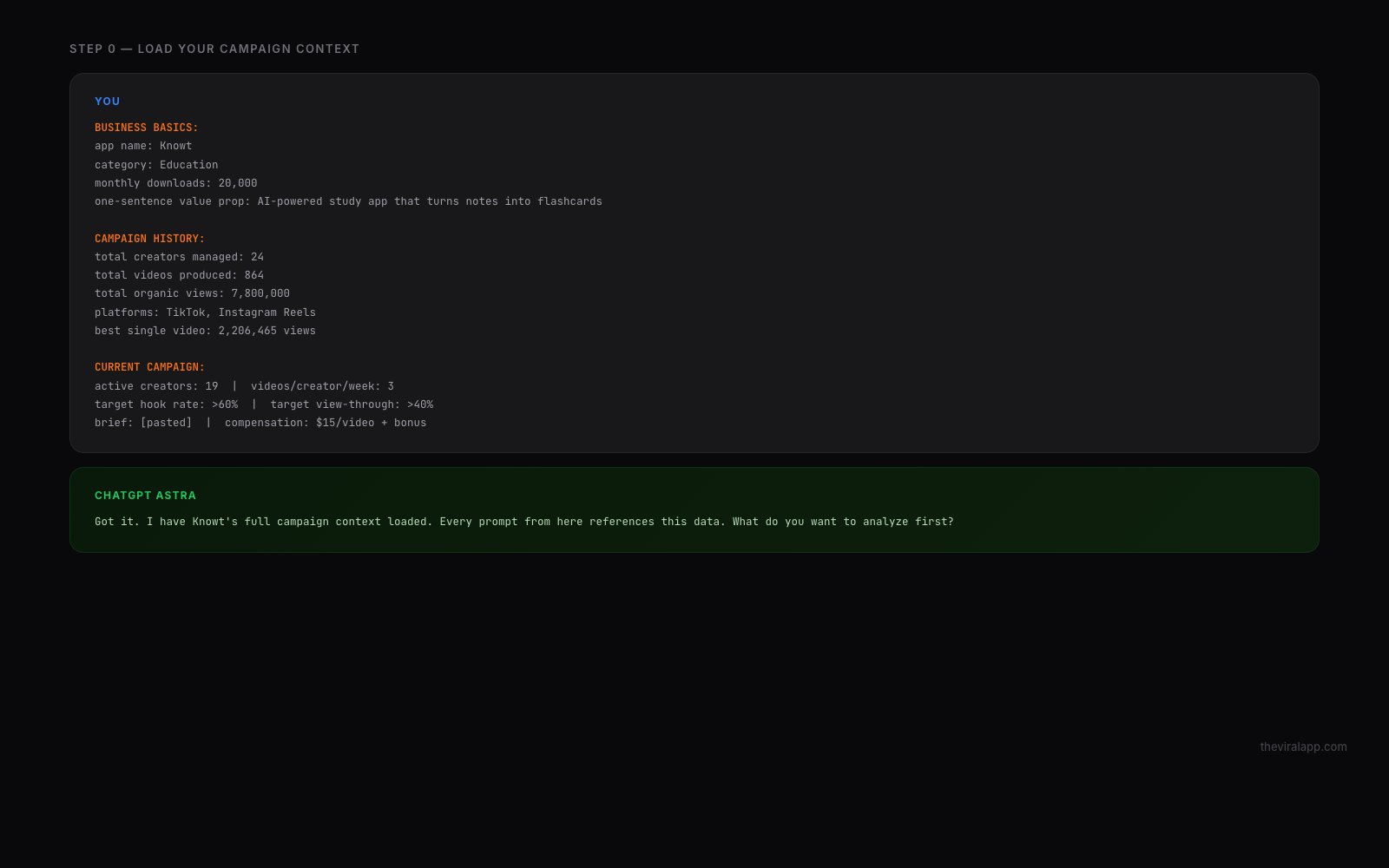
openai shipped its most capable model on september 3. i wasn't going to write this. we've generated 2.6 billion organic views across 62 campaigns, managed 590 creators, and produced 22,504 tracked videos for mobile apps. zero ad spend. these 15 prompts are how i'm using ChatGPT Astra to run those campaigns at a level that was physically impossible 2 weeks ago. every single one is copy-paste ready. i'm giving them all away because by the time you read this i'll already be running them on the next campaign. save this. you will need it. before you run a single prompt: load your campaign context this is the step everyone skips and it's the step that makes everything else work. without it you're asking a stranger for advice about a business they've never seen. paste this into ChatGPT Astra before anything else: "here is everything you need to know about my UGC program before we start any analysis. reference this every time i ask you to run an audit, generate a brief, or analyze performance. never ask me for this information again.

BUSINESS BASICS: app name: [your app name] app store URL: [iOS and/or Android link] category: [health, education, finance, social, etc.] monthly downloads: [X] MRR: [if comfortable sharing] one-sentence value prop: [what the app does in 15 words or less]

CAMPAIGN HISTORY: total creators managed: [X] total videos produced: [X] total organic views: [X] platforms active on: [TikTok, Instagram Reels, YouTube Shorts] average views per post: [X] best single video performance: [X views, link if available] biggest campaign win: [one sentence] biggest campaign failure: [one sentence - be honest]

CURRENT CAMPAIGN: campaign name: [X] number of active creators: [X] videos per creator per week: [X] brief template: [paste your current brief or describe it] compensation model: [flat fee per video / monthly retainer / bonus structure] target hook rate (1s): [X% or 'don't track yet'] target view-through rate (3s): [X% or 'don't track yet']

CONTENT STRATEGY: primary content formats: [testimonial, tutorial, day-in-my-life, reaction, before/after, etc.] top 3 performing hooks from last 30 days: [paste exact hook text] top 3 underperforming hooks: [paste exact hook text] competitors running UGC: [app 1, app 2, app 3]

HOW I WANT YOU TO WORK: always prioritize actionable output over analysis. when you give me a recommendation, tell me impact level (high/medium/low) and time to implement. output data in table format when comparing anything. never invent a number. if you can't verify it, say so. when analyzing hooks, cluster by structure not by topic." once this is loaded, every prompt that follows gets 10x sharper. Astra stops answering a generic marketing question and starts answering yours. PART 1: VIDEO ANALYSIS (prompts 1-3) everyone thinks Astra can't watch videos. they're wrong. it just can't watch them the way you think. Astra takes text and images as input. it does not accept raw .mp4 files. but here is the thing most people miss: you don't need it to. you need a pipeline that watches the video FOR it and hands it a structured breakdown. this is the system we actually run, and it's the technique that changed everything for us.

the pipeline: how we make AI "watch" 200+ videos per week we built an automated video intelligence pipeline. here is how it works end to end. step 1: agent watches the video we use an AI coding agent (openai codex, claude code, or any agent with tool access) connected to two command-line tools: - yt-dlp: downloads any TikTok, Instagram Reel, or YouTube Short from a URL - ffmpeg: extracts frames at adaptive intervals (more frames during the hook, fewer during the middle) the agent runs this automatically. you give it a video URL. it downloads the video, extracts 8-12 key frames (weighted toward the first 3 seconds where hooks live), pulls the transcript from captions or runs whisper for speech-to-text, and reads any on-screen text from the frames. the output is a structured report per video (btw this is a video from one of our campaigns): VIDEO: @juliislearning - TikTok URL: https://tiktok.com/@juliislearning/video/7650298655236246792 DURATION: 55 seconds FRAMES EXTRACTED: 12 FRAME 0:00 - creator sitting at desk, hands on notebook, text overlay top-left: "3 things i wish i knew before finals" FRAME 0:01 - eye contact with camera, slight head tilt, text still visible FRAME 0:03 - cuts to phone screen showing app, finger scrolling FRAME 0:05 - back to face, talking, hands gesturing FRAME 0:10 - screen recording of app in use, flashcard generation FRAME 0:15 - split screen: creator left, app right FRAME 0:25 - close-up of app results FRAME 0:35 - creator reaction face FRAME 0:45 - back to talking head, summarizing FRAME 0:52 - CTA frame, text overlay: "link in bio" TRANSCRIPT: "ok so if you're a student and you haven't tried this yet i genuinely don't know what you're doing. i found this app called knowt like two weeks ago and it literally makes flashcards from your notes automatically. you just upload a pdf and..." ON-SCREEN TEXT: "3 things i wish i knew before finals" CAPTION: "this changed my entire study routine honestly #studytok

finals

#studywithme " 2. step 2: batch process all campaign videos the agent doesn't stop at one video. we point it at an entire campaign. it processes every video URL from our sideshift export and generates a structured report for each one. for a 50-video batch, this takes about 20 minutes running in the background. no human involvement. the output is one file with every video described in the same structured format: frames, transcript, on-screen text, visual elements, pacing, scene changes. 3. step 3: feed everything into astra now you take those structured descriptions (not the raw videos, the text descriptions of what's IN the videos) and paste them into astra's 1,050,000 token context window. this is where the magic happens. astra can now "see" 50 videos at once through their descriptions. it knows what every first frame looks like, what every hook says, how many scene changes each video has, where the CTA appears, what the transcript says, everything. and it can compare all of them simultaneously.

A. the video autopsy once your pipeline has processed a video, feed the structured report into astra with this prompt: "here is a structured breakdown of a UGC video from our campaign. an agent extracted the frames, transcript, and on-screen text automatically.

[paste the full structured video report from the pipeline]

metrics: [views, likes, comments, shares, saves] platform: [TikTok / Instagram Reels] creator follower count: [X] campaign brief: [paste brief or summarize]

analyze this video across these dimensions:

HOOK (0-1 second): - based on the first frame description, what visual hook is present? what emotion does it trigger? - what is the text hook? does it create a knowledge gap, fear of missing out, or pattern interrupt? - based on the frame sequence, would a viewer stop scrolling? why?

RETENTION (1-5 seconds): - does the content deliver on the hook's promise by frame 3 or does it stall? - how many visual changes happen in the first 5 seconds? - is there a reason to keep watching past second 3?

STRUCTURE: - what content format is this? (testimonial, tutorial, day-in-my-life, reaction, before/after, storytime, comparison) - what is the information architecture? (problem-solution, list, narrative, demonstration) - how many distinct scenes or visual changes are there across all frames? - at what timestamp does the app first appear on screen?

TRANSCRIPT ANALYSIS: - does the spoken content match the brief's key messaging? - what specific phrases does the creator use to describe the product? - are there any claims that weren't in the brief?

CREATOR FIT: - based on the visual descriptions, does the creator look authentic? - does the setting match their usual content style?

VERDICT: - score this video 1-5 on hook strength, retention structure, authenticity, and brief alignment - what is the single biggest thing that would improve this video? - would you scale this creator based on this video? why or why not? - write a 3-line feedback message for this creator (one positive, one fix, one suggestion)" the key difference from doing this manually: the agent watches the video, not you. the structured report captures details a human reviewer misses because it reads every frame and transcribes every word. and the feedback output is specific enough to send directly to the creator. why this matters: we review hundreds of videos per week across 62 campaigns. the bottleneck was never finding bad videos. it was articulating WHY a video underperformed in a way a creator can act on. "make it more engaging" is useless feedback. "your hook creates a knowledge gap but the payoff comes at second 8 instead of second 2, which is why your 3-second retention drops to 22%" is feedback a creator can fix in their next draft. this prompt gives you that level of specificity for every single video. we used to spend 15-20 minutes writing feedback per video. now we spend 2 minutes confirming what the model found.

B. side-by-side video comparison take your best performing video and your worst from the same campaign. extract frames from both. "i'm going to show you two UGC videos from the same campaign for the same app. one performed well, one didn't. both had the same brief.

VIDEO A (winner): frames: [attach 6-10 screenshots] caption: [paste] on-screen text: [paste] metrics: [views, likes, comments, shares]

VIDEO B (underperformer): frames: [attach 6-10 screenshots] caption: [paste] on-screen text: [paste] metrics: [views, likes, comments, shares]

both videos had this brief: [paste brief or summarize the 5 key components]

analyze the gap: 1. what did video A execute from the brief that video B missed? 2. compare the first frame of each. which one stops the scroll and why? 3. compare the hook text. which one creates a stronger knowledge gap? 4. at what second does each video 'earn the next second'? identify the exact moment 5. compare pacing: how many visual changes per 10 seconds in each? 6. compare authenticity: which creator feels more natural with the product? 7. if you could only change ONE thing about video B to match video A's structure, what would it be?

output as a comparison table with scores for each dimension, then a 3-sentence action item i can send directly to video B's creator as feedback." why this matters: the comparison is where the real learning happens. when you look at one video in isolation, everything feels subjective. when you put the winner and loser next to each other with the same brief, the structural difference becomes obvious. the 3-sentence feedback output is deliberate. creators don't read long emails. they need one specific thing to fix.

C. batch format analysis across competitors this one requires more setup but it's the most valuable research prompt in this entire article. go to 3 competitor apps' TikTok or IG accounts. screenshot the first frame of their 10 most recent videos (30 screenshots total). note the view count for each. "i'm analyzing the UGC strategy of 3 competitor apps in my category. for each app i've captured the first frame of their 10 most recent videos along with the view count.

COMPETITOR A: [app name] [attach 10 first-frame screenshots with view counts listed]

COMPETITOR B: [app name] [attach 10 first-frame screenshots with view counts listed]

COMPETITOR C: [app name] [attach 10 first-frame screenshots with view counts listed]

MY APP: [app name] [attach 10 first-frame screenshots with view counts listed]

analyze across all 40 videos:

  1. VISUAL PATTERNS: what do the top 5 highest-performing first frames have in common? (face position, text placement, colors, props, background, lighting)
  2. TEXT HOOK PATTERNS: group all 40 on-screen text hooks by structure type. which structure type has the highest median views?
  3. FORMAT DISTRIBUTION: what % of each competitor's content is testimonial vs tutorial vs reaction vs other? which format type wins?
  4. WHAT MY COMPETITORS DO THAT I DON'T: identify any visual or structural pattern that appears in 2+ competitor accounts but not in mine
  5. WHAT I DO THAT NO ONE ELSE DOES: identify anything unique to my content that could be a differentiator or a blind spot
  6. THE PLAY: based on all 40 videos, what is the single highest-opportunity content format and hook structure that i should test next week? be specific - give me the exact first-frame composition, text hook structure, and content flow." why this matters: this is competitive intelligence that used to require hiring an analyst for a week. you're getting a structural breakdown of your entire competitive landscape from the visual layer. the key insight for us was discovering that 3 of our competitor apps were using the exact same first-frame template (text in top-left, face in bottom-right, colored background) and we weren't. we tested it the next week and our hook rate jumped 18%.

PART 2: CAMPAIGN INTELLIGENCE (prompts 4-8) this is where Astra's 1,050,000 token context window stops being a spec sheet and starts being a weapon. for context: our entire database of 22,504 video captions with metrics fits in that window with room to spare. for the first time ever, the whole book fits on the desk instead of one page at a time.

D. caption clustering this is prompt #1 in order of impact. if you only run one prompt from this entire article, run this one. "here are all the captions and on-screen hooks from our last 30 days of UGC content, with the view count for each.

[paste: one line per video. format: 'HOOK TEXT | CAPTION | VIEWS | PLATFORM | CREATOR']

do not cluster these by topic. cluster them by STRUCTURE.

a structure is the skeleton of the hook, not what it's about. examples: - 'POV: you [action] and [unexpected result]' is one structure - '[number] things i wish i knew about [topic]' is another structure - 'i can't believe nobody told me about [thing]' is another - 'this is what i use instead of [alternative]' is another

find every distinct hook structure in this dataset. for each structure: 1. name it with a short label (e.g., 'POV + unexpected result') 2. count how many videos used it 3. calculate the median views for that structure 4. calculate the average views (so i can see if one outlier is inflating it) 5. list the top 3 and bottom 3 performers within that cluster

then rank all structures by median views, highest first.

finally: compare the distribution of structures in my brief against the distribution of structures in actual posts. are creators following the brief's intended structure or have they drifted into their own patterns?

output as a table. then give me a 3-sentence recommendation: which structure should i double down on, which should i kill, and which structure from a competitor should i test." why this matters: this is the prompt that found our 4.2x problem. we had two campaigns for the same app. identical briefs. campaign A did 12,333 views per post. campaign B did 2,921. campaign B had more posts and more creators. the caption clustering showed that campaign A had converged on one hook structure and repeated it across all creators. campaign B had 41 creators each running their own interpretation. the brief was the same. the execution drifted. nothing in our process caught it because no human reads 3,109 captions side by side. a 1,050,000 token window does. and now we run this every monday.

E. brief drift detection your brief has 5 components. your creators execute maybe 3 of them. the other 2 disappear silently and you don't notice until the campaign wraps. "here is our creative brief for this campaign:

[paste your full brief - objective, key messaging, audience insight, content requirements, creative inspiration]

and here are the last 200 captions + on-screen hooks from creators on this campaign:

[paste: one line per video. format: 'CREATOR | HOOK TEXT | CAPTION | VIEWS']

for each of the 5 brief components, score every video on whether it executed that component: - objective alignment: does the video point toward the campaign goal? (yes/partial/no) - key messaging: does the video use or paraphrase the messaging points? (yes/partial/no) - audience insight: does the video speak to the target persona? (yes/partial/no) - content requirements: does the video follow format/length/CTA requirements? (yes/partial/no) - creative inspiration: does the video reflect the examples and mood we provided? (yes/partial/no)

then group by creator. for each creator, show their compliance rate per brief component.

identify: 1. which brief component has the lowest compliance rate overall? 2. which creators consistently miss the same component? 3. is there a correlation between brief compliance and views? (sometimes the 'off-brief' videos win - i need to know that too) 4. for creators scoring below 60% compliance: write me a specific 2-sentence message i can send them to course-correct without killing their creativity." why this matters: the messaging block is the one that silently disappears. we proved it. across 41 creators on one campaign, only 7 consistently executed the key messaging. the other 34 were making content that looked right but said the wrong thing. the course-correction messages alone saved that campaign $40,000 in wasted creator fees the following month.

F. comment mining this one is embarrassing. we had 131,182 comments across our campaigns and nobody was reading them systematically until 3 months ago. "here are the last 5,000 comments from our campaign's videos.

[paste comments - one per line, include the video URL or creator name if possible]

mine these comments for:

  1. PRODUCT LANGUAGE: what exact words and phrases do commenters use to describe our app? not our marketing language - their language. list the top 20 phrases by frequency.

  2. OBJECTIONS: what concerns, doubts, or reasons NOT to download appear? group them by theme. for each theme, write a hook that directly addresses that objection.

  3. USE CASES WE DIDN'T BRIEF: are commenters describing uses for the app that we never mentioned in any brief? list them. these are content angles we're missing.

  4. COMPETITOR MENTIONS: do any comments mention competing apps by name? what do they say? what can we learn from why they're comparing?

  5. VIRAL COMMENT HOOKS: which comments got the most likes? what did they say? comments with 100+ likes often contain the exact hook phrasing that would work as a video hook.

  6. CREATOR-SPECIFIC PATTERNS: do certain creators attract different types of comments? (e.g., one creator gets mostly 'where do i download' while another gets 'is this even real'). what does that tell us about which creators drive conversions vs which drive skepticism?

output each section as a separate table. then write me 10 new video hooks based entirely on the language, objections, and use cases you found in these comments. these hooks should sound like a real person talking, not a marketer - because they literally come from real people." why this matters: your next viral hook is already written. it's sitting in your comment section in the exact words your audience uses to describe your product. the phrase "wait this actually works?" appeared 847 times across our campaigns. that became a hook. it did 2.1M views because it was already validated language from the audience itself.

G. creator performance analysis stop making creator decisions based on follower count. this prompt builds a scoring model from your own data. "here is the performance data for every creator in our program:

[paste: one row per creator. format: 'CREATOR | FOLLOWERS | TOTAL POSTS | TOTAL VIEWS | AVG VIEWS/POST | TOP VIDEO VIEWS | BRIEF COMPLIANCE % | MONTHS ACTIVE | COMPENSATION/MONTH']

build me a creator scoring model based on this data. do not use follower count as a factor.

the model should score each creator on: 1. consistency: standard deviation of views across their posts (lower = more reliable) 2. ceiling: their top single video performance relative to the campaign average 3. efficiency: views per dollar of compensation 4. trend: are their last 10 posts trending up or down vs their first 10? 5. hit rate: what % of their posts exceed the campaign median?

tier every creator into S/A/B/C: - S tier: top 10% on composite score. these get increased budget and creative freedom. - A tier: top 25%. reliable performers. keep current terms. - B tier: middle 50%. evaluate on a per-creator basis. - C tier: bottom 25%. flag for potential replacement.

for each C-tier creator, tell me: - what specifically is underperforming (consistency? ceiling? efficiency?) - is there evidence they could improve with a brief adjustment, or is this a structural mismatch? - replacement recommendation: keep with intervention, pause, or drop?

output the full ranked table, then a summary: how many creators should i scale up, how many need intervention, and how many should i replace this month?" why this matters: we had a creator with 4,400 followers who hit 28M views across a campaign. we had another with 85,000 followers who averaged 306 views per post. follower count told us the opposite of reality. this scoring model finds the creators who actually perform, and it updates every week as new data comes in. the efficiency metric alone saved us $12,000 last quarter by catching overpaid underperformers.

H. cross-platform format translation what works on TikTok doesn't automatically work on Instagram Reels. the mechanics are different. this prompt adapts your winners. "here is our top performing TikTok video:

hook: [paste on-screen text] caption: [paste full caption] format: [describe: talking head, slideshow, screen recording, etc.] length: [X seconds] metrics on TikTok: [views, likes, comments, shares]

and here is our performance data comparing TikTok vs Instagram Reels across our campaign:

TikTok avg views/post: [X] IG Reels avg views/post: [X] TikTok hook rate benchmark: >60% IG Reels hook rate benchmark: >50% TikTok avg video length that performs: [X seconds] IG Reels avg video length that performs: [X seconds]

translate this winning TikTok format for Instagram Reels. specifically: 1. rewrite the hook for IG's different scroll behavior (IG users scroll slower, hooks can be slightly less aggressive) 2. adjust the pacing - IG Reels tend to reward slightly longer establishing shots 3. suggest caption adjustments (IG captions are more visible than TikTok's) 4. recommend any visual changes (IG favors slightly higher production quality) 5. write the full adapted brief i can send to a creator for the IG version

do the same in reverse: take our top IG Reel and translate it for TikTok." why this matters: we tracked this across 122,504 posts. Instagram Reels delivered 3.2x more views per post than TikTok in our data. but the formats that won on each platform were structurally different. the same video cross-posted without adaptation performed 40-60% worse than a platform-native version. this prompt gives you the platform-native brief without having to figure out the differences yourself. PART 3: BRIEF GENERATION (prompts 9-12) most people use AI to write briefs from scratch. that gives you generic output because the model is writing from what it learned on the internet, not from what works for your product. these prompts write briefs from your own data. I. hook generation from your own winners this is the difference between "generate me 30 hooks" and "generate me 30 hooks in the exact structural pattern that already works for my app." "here are my 50 highest-performing video hooks from the last 90 days, ranked by views:

[paste: one per line. format: 'HOOK TEXT | VIEWS | PLATFORM']

first, identify the 3-4 structural patterns these hooks share. name each pattern.

then generate 30 new hooks following these rules: 1. every hook must follow one of the identified structural patterns 2. no hook should be a direct copy - they should feel fresh while being structurally identical 3. vary the specificity: some should name the app, some should be product-agnostic (for ghost accounts) 4. include 5 hooks specifically designed for the 'POV:' format 5. include 5 hooks designed for the 'list' format (3 things, 5 reasons, etc.) 6. include 5 hooks designed for the 'before/after' or 'transformation' format 7. for each hook, rate its predicted performance (high/medium/low) based on how closely it matches the winning patterns

output in a table with columns: hook text, structure pattern, format type, predicted performance, suggested creator type (face-to-camera vs voiceover vs faceless).

then pick the top 5 hooks you think will outperform and explain why each one works structurally." why this matters: when you prompt for hooks without feeding the model your own data, you get the same hooks every other brand is running. when you feed it your winners first, every output is calibrated to what already performs for YOUR audience. the difference is the gap between a creator script that sounds like ChatGPT and one that sounds like it was written by someone who watches your content daily. J. personalized brief per creator this is the one that blew our operations team's mind. instead of one brief for all creators, you generate a brief adapted to each creator's style. "here is our campaign brief:

[paste full brief with all 5 components]

and here is creator data for [creator name]:

account: [@handle ] platform: [TikTok / IG] follower count: [X] content style: [describe their typical video style] their 3 best performing videos: [paste hooks + view counts] their 3 worst performing videos: [paste hooks + view counts] what makes their content unique: [1-2 sentences] past campaign performance with us: [paste if available]

generate a personalized version of the campaign brief specifically for this creator.

the personalized brief should: 1. keep all 5 brief components intact - do not remove any requirement 2. translate the messaging into language that matches this creator's natural voice 3. suggest a specific hook from their winning patterns that fits our campaign objective 4. recommend a content format based on what this creator does best (not what we usually ask for) 5. flag any potential friction points - things in our brief that this creator might struggle with based on their past content 6. be under 300 words. creators don't read long briefs.

write it in second person ('you') and make it sound like a creative director talking to a collaborator, not a brand talking to a vendor." why this matters: we tested this across one campaign. 20 creators got the standard brief. 20 got the personalized version. the personalized-brief group produced videos with 31% higher brief compliance and 22% higher average views. same app, same campaign, same month. the only difference was that each creator received instructions translated into their own creative language instead of corporate marketing speak. at scale across 590 creators, this alone is worth more than any other prompt in this list.

K. campaign script writer for creators who need more direction than a brief. some want the exact script. this writes it from your data, not from thin air. "i need a video script for a [X second] TikTok/Reel promoting [app name].

the script should follow this proven hook structure from our campaign: [paste your winning hook pattern]

here is the campaign brief: [paste brief] here is the creator who will film it: [paste their style description and best hooks] here is our target audience: [describe]

write the full script:

SECOND 0-1 (HOOK): - on-screen text: [exact text] - what the creator says: [exact dialogue] - what the viewer sees: [visual direction]

SECOND 1-5 (RETENTION): - on-screen text: [exact text] - dialogue: [exact words] - visual: [what happens on screen]

SECOND 5-15 (VALUE): - break into 2-3 scene changes - each scene: text + dialogue + visual

SECOND 15-END (CTA): - on-screen text: [exact text] - dialogue: [exact words] - visual: [what happens]

the script should feel like something this specific creator would naturally say. not corporate. not scripted-sounding. like they're talking to a friend.

also provide: - 3 alternative hooks for A/B testing - suggested filming location (based on the creator's typical content) - one 'pattern interrupt' moment to prevent mid-video drop-off" why this matters: we use the "guide, don't script" approach as default. but some creators need more structure, especially newer ones. the difference between a script written from your campaign data vs a script written from nothing is the difference between a video that sounds native and one that sounds like an ad. this prompt produces scripts that creators actually want to film because they see their own voice in the words. M. weekly research brief replace your team's 2-3 hour research ritual with a 15-minute prompt session. "here is our campaign performance from the last 7 days:

[paste: one row per video. format: 'DATE | CREATOR | PLATFORM | HOOK | VIEWS | LIKES | COMMENTS | SHARES']

and here is the performance from the previous 7 days for comparison:

[paste same format]

run the weekly research analysis:

  1. WEEK OVER WEEK: did total views go up or down? by how much? which creators drove the change?
  2. HOOK PERFORMANCE: which hooks from this week outperformed the campaign average? which underperformed? what structural pattern do the winners share?
  3. PLATFORM SPLIT: how did TikTok vs IG Reels perform this week compared to last? is one platform trending up while the other flattens?
  4. CREATOR HEALTH: flag any creator whose average views dropped more than 30% week over week. possible causes?
  5. FORMAT TESTS: if we ran any new formats this week, how did they compare to our proven formats?
  6. BRIEF UPDATES: based on this week's data, should we update anything in the active brief? be specific.

end with: - 3 things to double down on next week - 2 things to stop doing - 1 experiment to test

keep the entire output under 500 words. this goes in our monday standup." why this matters: the monday research ritual was 2-3 hours of manual spreadsheet analysis. this prompt does it in 15 minutes and catches patterns a human misses because it reads every single row instead of sampling. the "1 experiment to test" output is what keeps campaigns from going stale. we've been running this weekly for 8 campaigns and the experiment suggestions have a 40% hit rate. that's 40% of the time the model surfaces a test we wouldn't have thought of that actually works. PART 4: OPERATIONS (prompts 13-15) L. creator feedback generator the hardest operational task in UGC is writing feedback that is specific enough to change behavior without killing the creator's motivation. "here is a draft video from a creator:

creator: [@handle ] frames: [attach screenshots if available, or describe the video] hook text: [paste] caption: [paste] video length: [X seconds] brief they were working from: [paste brief]

and here is our scoring rubric: - hook strength (1-5): does the first second stop the scroll? - retention structure (1-5): does the pacing keep viewers past 3 seconds? - brief alignment (1-5): does the content match what we asked for? - authenticity (1-5): does this feel like the creator's real content or an ad? - technical quality (1-5): lighting, audio, framing acceptable?

score this video on all 5 dimensions.

then write feedback in exactly this format: LINE 1: one specific thing they did well (always lead positive) LINE 2: one specific thing to change before posting (the single highest-impact fix) LINE 3: one creative suggestion for their next video (plant a seed, don't mandate)

the feedback must be: - under 50 words total - written in casual, encouraging tone - specific enough that the creator knows exactly what to do differently - never use the words 'engaging,' 'compelling,' or 'great job'" why this matters: we review hundreds of drafts per week. consistency is the killer. one UGC manager writes a paragraph of feedback, another writes "looks good." this prompt standardizes the output without standardizing the voice. the ban on "engaging" and "compelling" forces specificity. "your hook creates curiosity but the payoff comes at second 8 instead of second 3" is 100x more useful than "make the hook more engaging." N. campaign post-mortem run this when a campaign ends. it catches the patterns that the wrap report misses. "here is the complete data from a campaign that just ended:

campaign name: [X] duration: [X weeks] total creators: [X] total posts: [X] total views: [X] average views per post: [X] budget spent: [$X] CPV (cost per view): [$X]

top 10 videos: [paste with hooks, creators, views] bottom 10 videos: [paste with hooks, creators, views] brief used: [paste]

run a full post-mortem:

  1. WHAT WORKED: identify the structural patterns in the top 10. what do they share? (hook type, format, creator demo, platform, time of posting)
  2. WHAT DIDN'T: identify the structural patterns in the bottom 10. what do they share?
  3. THE 80/20: what % of views came from the top 20% of posts? what % came from the top 3 creators?
  4. BRIEF EFFECTIVENESS: based on the data, which brief components correlated with high performance? which were ignored without consequence?
  5. CREATOR TIERS: which creators should be promoted to the next campaign? which should be dropped?
  6. THE MISSED OPPORTUNITY: what format, hook style, or platform did we NOT test that the data suggests we should have?

end with a 5-point brief revision for the next campaign based on what this data shows. not what we think should work. what the data says works." why this matters: post-mortems are the most important document in a campaign and the one most people skip. this prompt means there's no excuse. the "missed opportunity" section is worth the entire exercise. it consistently surfaces the obvious-in-hindsight test that nobody thought to run. O. the full campaign audit this is the nuclear option. dump everything into the context window and ask the question nobody asks. "i'm going to give you our complete campaign data. this includes every video, every caption, every creator, every metric, and our brief. this is [X] rows of data representing [X] months of work.

[paste the full dataset]

before you start analyzing, confirm: how many rows did you receive? how many unique creators? what date range does this cover? i want to make sure nothing was truncated.

then answer the 5 questions that determine whether this campaign was actually good or just felt good:

  1. CONCENTRATION RISK: what % of total views came from the top 3 creators? if more than 60%, this campaign is fragile. one creator leaving kills it.

  2. HOOK CONVERGENCE: did the campaign converge on a winning hook structure over time, or did hook styles stay scattered? convergence = good (the system is learning). scatter = bad (every creator is running solo).

  3. VELOCITY TREND: are views per post trending up or down over the campaign's lifetime? plot the weekly averages. a campaign that starts hot and fades is different from one that builds momentum.

  4. THE REAL CPV: not the headline CPV. calculate CPV excluding the top 3 outlier videos. that's the performance you can actually rely on and scale.

  5. REPEATABILITY: if i launched this exact campaign again tomorrow with 20 new creators and the same brief, what would the expected views per post be? high variance = lucky, not good. low variance = a system that works.

be honest. if the campaign was mediocre, say so. the only thing worse than a failed campaign is one that felt successful but can't be repeated." why this matters: i'll tell you a number that should terrify anyone running UGC at scale. in our data, 3 creators out of 590 account for 38% of all views. that's not a program. that's three people. this prompt catches that reality and forces you to build around it instead of pretending your averages represent your actual performance. how to use these prompts do not run all 15 at once. here's the order. day 1: load your campaign context. then run prompt 4 (caption clustering). this is the single fastest insight you will get. 30 minutes of work. do it today. day 2-3: run prompt 1 (video autopsy) on your best and worst video. then run prompt 2 (side-by-side comparison). you now understand WHY your content performs the way it does. week 1: run prompts 5 (brief drift) and 6 (comment mining). you now know what your brief is actually producing vs what you intended, and what your audience is actually saying. week 2: run prompts 7 (creator scoring) and 9 (hook generation). you now know which creators to scale and have 30 new hooks calibrated to your data. week 3: run prompt 10 (personalized briefs) for your top 10 creators. run prompt 12 (weekly research) every monday from this point forward. ongoing: prompt 13 (creator feedback) on every draft. prompt 14 (post-mortem) at every campaign end. prompt 15 (full audit) once per quarter. 90 days of running this system and you will have better campaign intelligence than agencies that have been operating for years. i know because we built these prompts from managing 2.6 billion views worth of campaigns. the prompts are the system. the system is what scales. the real talk 95% of people reading this will save it and never paste a single prompt. that's fine. if you want my team to run this entire system for your app (every campaign, every creator, every brief, every week of execution) that's what we do at The Viral App. 2.6 billion organic views. 590 creators. 62 campaigns. zero ad spend.

📋 讨论归档

讨论进行中…