返回列表
🧠 阿头学 · 💬 讨论题

从 SIMT 到脉动阵列,GPU 与 TPU 的真正分野是“谁更会搬数据”

这篇文章最有价值的判断是:现代 AI 加速器的胜负越来越不由峰值算力决定,而由“谁能更确定地把数据留在算术单元附近”决定;作者据此强推 TPU 路线更有复利,但他把结论推得比证据更快。
打开原文 ↗

2026-04-17 原文链接 ↗
阅读简报
双语对照
完整翻译
原文
讨论归档

核心观点

  • 内存墙才是总导演 作者把 GPU、TPU、dtype、fabric、编译器这些分散话题统一到一个硬约束上:算术越来越便宜,数据移动越来越贵,所以真正的优化对象不是“多做一点数学”,而是“少搬一次数据、晚一点搬数据、在近处复用更多次数据”。这个判断是站得住的,而且足以解释 tiling、VMEM、TMA、TMEM、microscaling 为何都重要。
  • GPU 与 TPU 的分歧不是品牌之争,而是架构哲学之争 作者把 NVIDIA 抽象为“线程优先、运行时帮你遮丑”的 SIMT 路线,把 Google 抽象为“矩阵数据流优先、编译器提前排满流水线”的 systolic 路线。这个抽象是有效的,因为它确实解释了 Hopper/Blackwell 为什么不断加强异步搬运与解耦执行,也解释了 TPU 为什么围绕 MXU、VMEM、ICI 组织一切;但作者进一步暗示 TPU 因此“更正确”,这个结论在本文里还没有被完全证明。
  • GPU 正在朝“更像 TPU”演化,这个观察有洞察力 Hopper 的 TMA 把数据搬运从线程手里拿走,Blackwell 的解耦 Tensor Core issue path 又把密集算术进一步从 warp 调度中剥离。作者据此判断:GPU 表面上还是 SIMT,底层却越来越像编译器调度的数据流机器。这个方向判断大概率是对的,但“GPU 变得更像 TPU”不等于“TPU 必然会赢”,因为 GPU 仍然保留了更强的通用性和生态惯性。
  • fabric 规模是前沿训练里最硬的非对称优势 作者最强的数据点不是单芯片 FLOPs,而是同步域规模:NVL72/NVL144 对 Ironwood 9216 芯片。这个差距不是宣传口径,而会直接改变并行策略可行域:TPU 更容易用较少并行维度吃下大模型训练,GPU 则更容易被迫引入 pipeline/context 等补救性并行。这个判断在集群级别很有说服力,也是本文最像“投资级洞察”的部分。
  • 作者对 TPU 的押注有信息量,但也有明显立场驱动 作者刚从 Meta Triton 转到 Google TPU 团队,且开篇就预告“我会说服你 TPU 连 custom kernel 都更好”。这让文章兼具一线洞察和强烈目的性:技术细节很真,但叙事明显在为 TPU 路线造势。读者应该把它当成高水平立场文,而不是中立教材。

跟我们的关联

  • 对 ATou 意味着什么 如果你在看 AI 基础设施、模型训练平台或芯片生态,不能再只盯“单卡峰值”这种浅指标;下一步应该把判断框架切到“数据驻留能力、同步域规模、编译器接管程度、近算存储层级”这四个维度,重新评估 GPU/TPU/自研 ASIC 的长期壁垒。
  • 对 Neta 意味着什么 这篇文章说明“系统形状约束策略选择”不是工程细节,而是第一性原理;下一步可以把 roofline/ridge point 这个方法迁移到其他复杂系统里,用来判断瓶颈究竟在算力、带宽还是调度,而不是陷入局部优化。
  • 对 Uota 意味着什么 如果你的工作更靠近产品和应用,这篇文章也在提醒:真正贵的往往不是“计算本身”,而是上下文、状态和数据在系统中反复传输;下一步可以把“让数据靠近决策单元”作为设计 AI agent、RAG、工作流系统的核心原则,而不是只卷模型参数。
  • 对 ATou/Neta/Uota 共同意味着什么 作者最值得吸收的不是 TPU 必胜论,而是“架构会复利、网络形状会锁死软件策略”;下一步讨论任何平台型技术时,都应先问它的底层拓扑和调度哲学,而不是先看表面的易用性宣传。

讨论引子

1. 如果 GPU 正在吸收越来越多“编译器调度 + 数据流优先”的设计,那它最终会不会在保留生态优势的同时吃掉 TPU 的哲学红利? 2. 在真实世界里,fabric 同步域规模比单芯片性能更重要,这个判断是否会重塑我们对 AI 基础设施投资标的的排序? 3. TPU 的高上限是否会被其陡峭的性能 cliff、shape 约束和编译复杂度抵消,还是这些问题最终都会被软件栈抹平?

几周前,我离开了 Meta 的 Triton 编译器团队,加入了 Google 的 PyTorch/TPU 团队。这个转变差不多就是你能想到的样子。我在 GPU 栈里待了多年,为 Hopper 和 Blackwell 写过 lowerings,争论过 warpgroup intrinsics,写过成千上万个 benchmark 和几十个工具。现在,我盯着脉动阵列,心里想的是,为什么文档里没人这么叫它们。

这是我写过最长的一篇文章。它长,是有意为之。我想写一篇能同时服务四类读者的文章。如果你从没认真想过 ML 硬件,第一部分是给你的。如果你懂分布式训练,但不熟悉加速器架构,Part 2A 和 2B 会带你穿过两边,而且不假设你已经懂另一边。如果你已经熟悉 CUDA,只想看 TPU 这条线,你会先得到一次不错的复习,然后进入 TPU 的重点。如果你写 kernel,或者做编译器,整篇都会有东西可拿;而 Article 2 会展开编程模型上的论证。我真的没法把所有好东西塞进 X 的文章字数限制里。

到这个系列结束时,我会试着说服你,哪怕是在 GPU 本该完全占据优势的领域,也就是自定义 kernel 编写,TPU 也是更好的平台。这是一个很强的判断,我也不指望靠感觉赢。下面我会先把基础铺好,等到第二篇文章结束时,你会被说服。

开始前最后说一句。我两套栈都用。工作需要时,我仍然会写 Triton,也会写其他 DSL。在 TPU 上构建新算子时,我仍然需要 GPU 来做对比。这不是宗教战争。这是一个判断:哪一组架构选择,会在事实层面产生复利。

加速器为什么存在

CPU 的形状来自一个判断:大多数程序有大量分支,内存访问不可预测,并且奖励单线程低延迟。所以,一个现代 CPU 核心会把大部分硅面积花在分支预测器、乱序调度器、投机执行机制,以及那些很努力地让不可预测代码看起来很快的缓存上。相比之下,算术单元很小。一个 Xeon 核心可以做出很可观的 FLOPs,但晶体管并不是主要花在 FLOPs 上的。

然后,深度学习出现了。现代 ML 工作负载来自另一种判断。主导操作是收缩。全连接层里的 matmul,attention 里的 matmul,到处都是 batched matmul。这些操作可预测,循环密集,几乎不花时间在分支上。运行前,你就知道循环边界。运行前,你就知道内存访问模式。运行前,你就知道算术强度。

如果盯着这件事看得够久,你会发现,理想硬件的形状几乎和 CPU 相反。你希望大部分硅面积都在做乘法和累加。你不需要分支预测器,因为没有分支。你不需要投机执行,因为没有不确定性。你也基本不需要巨大的缓存,因为访问模式是密集数组的分块,你可以手动暂存它。

加速器来自认真对待这个观察。NVIDIA 走了一条路。Google 走了另一条路。两条路都从同一个根本事实出发:工作负载由少数几类收缩操作主导,所以硬件也应该由矩阵单元主导。芯片上的其他东西,都是为了让这些单元不断粮。

在 GPU 上,我们原本甚至不是在解决这些问题。Shader 和其他图形计算机制,碰巧成了未来的好地基。对 GPU 来说,答案是从一个已经擅长图形的并行线程底座出发,在每个 streaming multiprocessor 里加入叫 Tensor Core 的矩阵引擎,然后让成千上万个线程掩盖把数据送到这些单元时产生的延迟。对 TPU 来说,答案是直接丢掉大部分调度机制,把一个巨大的脉动阵列放在芯片中央,再让编译器围绕它编排数据移动,让阵列永远不饿着。

同一个观察,两种哲学。本文剩下的部分,就是讲这些哲学跨越几代之后会发生什么。

这里有一条底层轴线,值得现在就点出来。CPU 优化延迟:让一个线程快。GPU 通过过量提交优化吞吐:准备足够多的线程,让机器总有活干。TPU 通过确定性优化吞吐:提前调度每个操作,并通过构造方式让流水线保持满载。延迟对吞吐;在吞吐内部,是过量提交对确定性。这就是每个加速器架构师都不得不选择的三个位置。

内存墙

下面这个事实,会塑造本文中所有其他选择。算术相对便宜。移动数据很贵。差距不小,而且每年都在变大。

在现代加速器上,一次矩阵乘的能耗是个位数皮焦。从片上 SRAM 读取一次,能耗大约高一个数量级。从 HBM 读取一次,大约是乘法本身能耗的 100 倍。通过主机 CPU 的内存总线从 DRAM 读取,又比 HBM 高一个数量级。这里只是在说能耗。时间成本也呈现同样的形状。matmul 是纳秒级。HBM 访问是数百纳秒。PCIe 或 NVLink 往返是微秒级。跨数据中心跳转是毫秒级。

本文里每一个架构决策,都是对这个差距的回应。这些文章里你会遇到一袋缩写词,每一个都是在用不同方式说同一句话:缩短数据所在位置和数学发生位置之间的距离。现在不用急着记术语。只要知道,它们全都在回答同一个问题。

你可以把 ML 加速器的整个演化,看成一场缩短数据和数学距离的战役。芯片变大。内存变近。网络变平。编译器做更多事。每一代,FLOPs 和移动字节数的比例都会上升,这意味着软件必须更努力,才能让机器吃饱。

不见过几次很难意识到的一点是:这不是靠更多带宽就能解决的问题。HBM 每一代都在变快。它仍然不够快。Ironwood 每芯片 7.37 TB/s 的 HBM3e 听起来已经离谱,直到你注意到这颗芯片能做超过 4.6 PFLOPS 的 FP8,于是比例还在继续爬升。带宽追不上。比例会变得更糟。你无法跑赢内存墙,只能绕着它跳舞。

这就是为什么任何人教 kernel 编写时,第一件事都是 tiling。把数据分块。移动一次 tile。尽可能在再次移动它之前,对它做更多数学。加速器上的每个优化故事,最后都会塌缩成一个数据暂存故事。硬件把策略说得很明白。编译器、库、手写 kernel,最后都会编码同一条规则的某个版本:让数据尽可能长时间待在离算术单元近的地方,只有绝对必要时才把它溢出。

记住这条规则。后面你会再次看到它。TMA 是这条规则。producer-consumer warpgroups 是这条规则。emit_pipeline 是这条规则。torus topology 也是这条规则。本文里的一切都是这个主题的变体,因为内存墙就是那个不会消失的东西。

真正重要的算术

这一节里,只靠一个概念你就能走很远:算术强度就是每移动一个字节,你做多少次浮点操作。就这样。FLOPs per byte。

两个 [N, N] 矩阵相乘,大约做 2N^3 次 FLOPs,移动大约 3N^2 字节,忽略复用的话就是两个输入和一个输出。算术强度随 N 增长。tile 越大,每移动一个字节做的数学越多,越好。一次逐点加法的算术强度基本为零。你移动两个字节,做一次 FLOP,再写一个字节。无论如何都是 bandwidth-bound。

roofline model 把这件事拼在一起。横轴画算术强度,纵轴画实际达到的每秒 FLOPs。你会得到两条屋顶线。平的屋顶是芯片的峰值计算能力。斜的屋顶是带宽上限:强度越高,每移动一个字节能做的 FLOPs 越多,就越接近峰值。两条屋顶相交的地方叫 ridge point。低于 ridge 的操作是 bandwidth-bound,除了让操作更密集之外,你什么也做不了。高于 ridge 的操作是 compute-bound,问题就不是总线,而是怎么让矩阵单元不断粮。

还有第三种状态,没人画在图上:issue-latency-bound。你有带宽,也有计算能力,但无法足够快地发射指令来用满两者。GPU occupancy discipline 就来自这里,TPU 编译器的 instruction-packing 工作也在这里产生价值。

来自 HBM 的具体 ridge point,因为具体数字能让模型更牢:

  • H100 SXM5:Tensor-Core BF16 峰值 1,979 TFLOPS,HBM3 带宽 3.35 TB/s,得到的 ridge point 大约是每字节 591 FLOPs。

  • TPU v5e:用同样方式推导,大约是每字节 240 FLOPs。

  • TPU v5p:大约是每字节 166 FLOPs。pod 比 v5e 扩得更大,但单芯片 ridge point 反而更低,因为 v5p 的 HBM 带宽增长超过了 BF16 峰值。

  • TPU v6e(Trillium):大约是每字节 560 FLOPs。这是一次大跳。

带着两个具体数字往后看。v5e 在 BF16 下,每个 replica 大约需要 240 个 token 的 batch,才能站到来自 HBM 的 ridge point 之上。如果使用 int8 activations 和 bf16 weights,这个数字会降到大约 120。在 H100 上,由于 ridge point 会和更深的缓存、更灵活的调度互动,你可以用更小的有效 batch 勉强过关。TPU 要你认真思考 batch size。GPU 允许你更久地忽略它,但也只是到某个点为止

如果这一整节只记一件事,就记这个:ridge point 会告诉你,你现在跑的是内存问题还是计算问题,而答案会改变哪些优化真的有用。

精度和 dtype

对抗内存墙的另一个杠杆是精度。每一个不移动的 bit,都是你不用付出的成本。所以,加速器在过去近十年里,一直沿着 bit-width 下探。

在走过这些名字之前,先带着一个心智模型。尺度很小时,现代技巧是 microscaling:你用小格式存数,比如四位或八位;再为一小组值单独存一个 scaling factor;硬件在做数学时把 scale 乘回去。存储和带宽主要由小格式决定。准确性来自 scale。你下面看到的每一种 sub-byte format,都是这个技巧的某种变体。

训练 dtype。 FP32 是旧基线。密集、准确、昂贵。TF32 是 NVIDIA 的发明:在 FP32 范围里使用 19 位 mantissa,通过 Tensor Cores 运行,在 Ampere 上作为 FP32 的直接替代。BF16 是今天占主导地位的训练 dtype。它像 FP32 一样有 8 个 exponent bits,7 个 mantissa bits,所以保留范围,牺牲精度。从 PaLM 到 Llama,再到当前前沿模型,所有严肃训练栈都用 BF16 加 FP32 accumulation 训练。FP16 早于 BF16,现在仍然存在,主要用于向后兼容和推理。它的 exponent 太小,不做 loss-scaling 之类的体操就很难训练,这也是 BF16 在训练侧取代它的原因。

推理和小占用 dtype。 Hopper 引入了两种 FP8:E4M3 用于 forward pass 和推理,E5M2 用于 backward pass 和 gradient storage。Hopper 上的 Transformer Engine 会跨 step 跟踪 activation statistics,并为每个 tensor 应用 scaling factor,避免 FP8 在数值上崩掉。Blackwell 用 NVFP4(四位、两级 scaling)和 MXFP8(八位 microscaling)扩展了这条路。INT8 是 TPU 上长期存在的推理 dtype;Trillium 每芯片达到 1,836 TOPS 的 INT8,我们会在 §2B.3 看到 Trillium。Ironwood 把原生计算迁到了 FP8。TPU 谱系的其他部分在 Ironwood 之前对精度一直比较保守,因为 Google 的判断是,仔细编译可以从 BF16 中榨出大部分吞吐,不必依赖 sub-byte formats。

有一条历史经验值得带着。每一代向下跳精度的产品,客户采用率也会随之跳升,因为人们真正撞上的约束是内存带宽,而把带宽需求砍半,往往比把峰值 FLOPs 翻倍更有用。精度故事和内存墙故事,其实是同一个故事。

三种执行模型

加速器最终基本都在实现三种执行模型之一。理解这三种模型,是你读完本文剩下部分而不迷路的关键。

SIMD 是最古老的。Single Instruction, Multiple Data。你有一定数量的 lane,发射一条指令,每个 lane 在自己的数据上执行它。CPU SIMD(AVX、SSE、NEON)就是这样。早期 GPU 上的 vector units 也是这样。SIMD 很精简,因为所有 lane 共享一个 instruction pointer,但它很僵硬。如果 lane 需要做不同的事,你要么 mask 它们,要么 stall。

SIMT 是 NVIDIA 的发明,也是现代 GPU 的定义性模式。Single Instruction, Multiple Threads。想象一个指挥家带领 32 人乐团:一次下拍让所有乐手同时动作,但每个人读自己的谱。这就是 SIMT。你写的代码看起来像是在一个线程上运行。硬件把线程组织成 32 个一组的 warp,并在底层让 warp lockstep 运行,所以在抽象之下,它实际上像 SIMD。但编程模型看起来像线程:每个线程有自己的 program counter、自己的 registers、自己的控制流。当一个 warp 里的线程需要做不同的事,就会出现 warp divergence。硬件会串行化分支,先运行一条路径,同时 mask 另一边的 lane,然后再运行另一条路径。它能工作,但会消耗吞吐。

SIMT 是 GPU 让人觉得高效好用的原因。你写的 kernel 看起来像并行循环。硬件处理 lockstep execution、memory coalescing,以及通过 warp-level overcommit 隐藏延迟。大多数时候,你不用考虑物理 lane。当你不得不考虑时,通常是撞上了这个抽象的锋利边缘:warp divergence、uncoalesced memory accesses、register pressure、shared memory bank conflicts。这些锋利边缘,就是 GPU kernel 优化像一门手艺的全部原因。

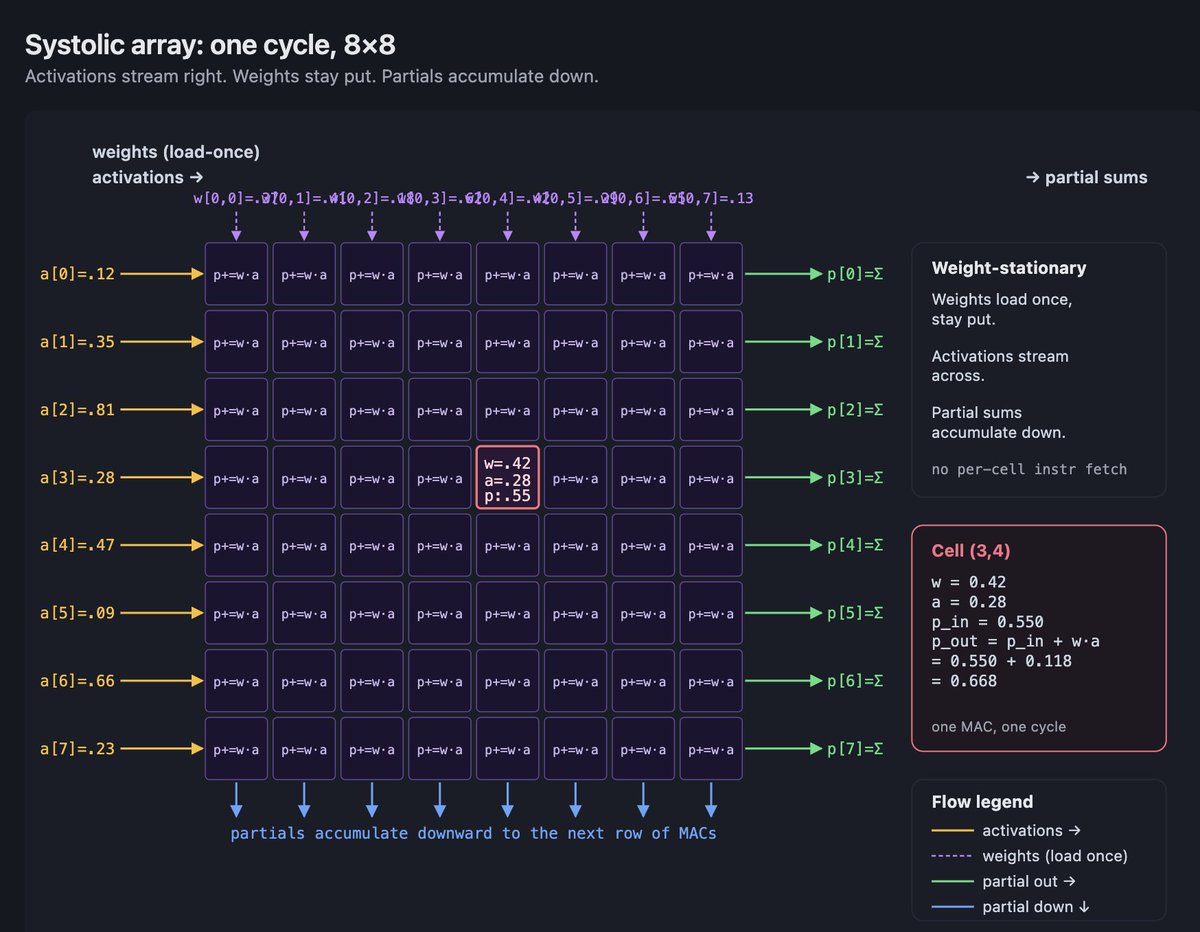
Systolic 是 TPU 漂亮的答案。脉动阵列是一个二维 multiply-accumulate 单元网格,它们互相连线,让数据像水穿过网格一样流动。每个 cycle,每个 MAC 单元从邻居那里拿一个值,用一个 stationary weight 做 multiply-add,或者根据 dataflow 使用 streaming weight,然后把结果交给下一个邻居。每个单元不需要 instruction fetch。不需要控制逻辑。只有数据穿过算术网格时的节奏。

收益是密度。如果每个 MAC 单元不需要取自己的指令,也不需要管理自己的 registers,你就能在每平方毫米里塞进更多 MAC 单元。一个 256×256 的脉动阵列有 65,536 个 MAC 按节奏工作。代价是僵硬:阵列以固定形状工作,任何不是 matmul 形状的操作,都必须发生在阵列旁边的 vector 或 scalar units 里。这也是 TPU 为什么如此在意 tile shapes。pad 太多会浪费网格。填不满会浪费 cycle。

稍微眯着眼看,你能在同一张图里看到三种模型。SIMD 是许多 lane 中的一条指令,lockstep。SIMT 是许多 lane 的许多 lane,上面盖着一个线程幻觉。Systolic 是固定功能单元的网格,数据按编排流过。SIMD 在规则代码上赢吞吐。SIMT 在规则代码上保留良好吞吐,同时赢生产力。Systolic 在矩阵形状代码上赢密度。每种加速器架构都是某种混合。
两种哲学

接下来所有内容,都可以通过一个分裂来读。这个分裂出现在 NVIDIA 和 Google 做过的每个架构选择里。

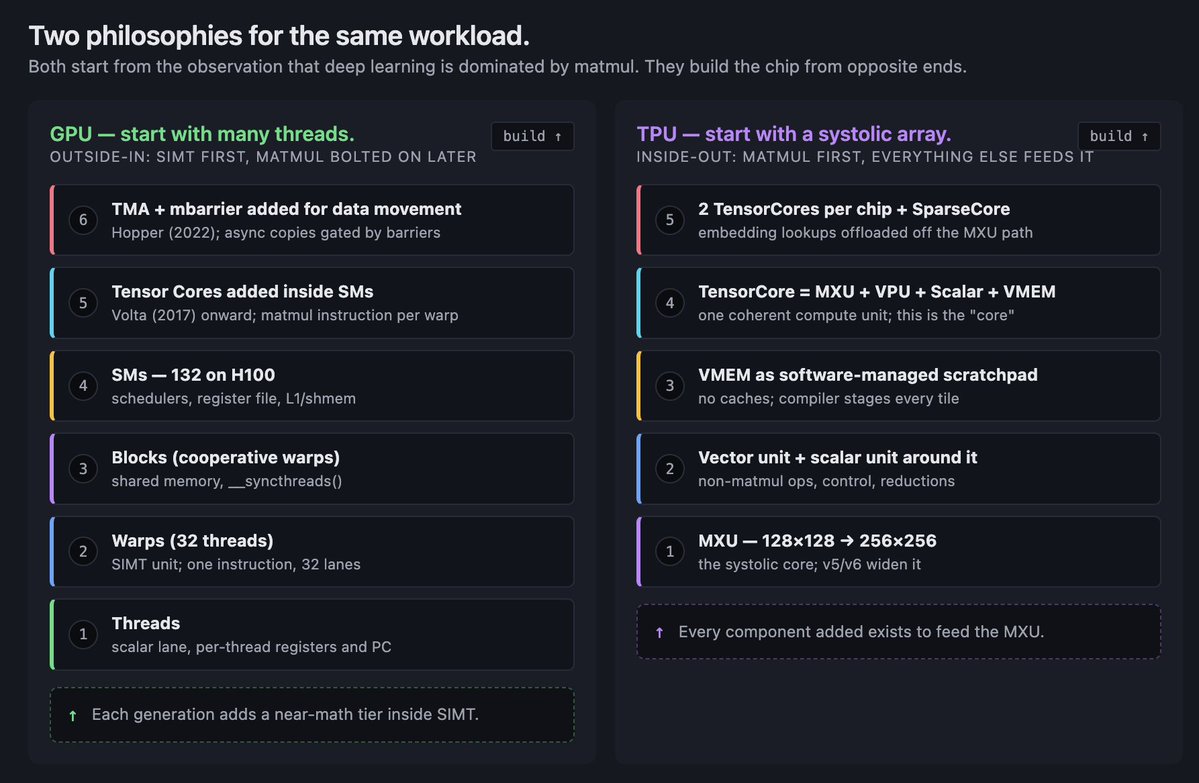
NVIDIA 的哲学,从程序员往里读:从许多并行线程开始。围绕它们构建内存层级。在每个 streaming multiprocessor 里加入矩阵引擎,让线程可以集体发射矩阵指令。随着时间增加功能,让线程更紧密地协作,像 warpgroups、thread block clusters、distributed shared memory。线程先在那里。其他一切都围绕它们适配。

Google 的哲学,从相反方向读:从矩阵 dataflow 开始。把 MXU 放在芯片中央。加入 vector unit 处理那些不适合 MXU 的东西。加入 scalar unit 做控制。加入 VMEM,让编译器能把数据暂存成 MXU 能消费的形状。加入 ICI,让芯片可以不经过 HBM 就交换 tile。脉动阵列先在那里。其他一切都围绕它适配。

这些不只是组织差异。它们会复利。一旦 NVIDIA 承诺 SIMT,之后每个设计决策都必须让线程更有生产力:shared memory、Tensor Cores、warp-level intrinsics、TMA、mbarrier、cluster APIs。一旦 Google 承诺脉动阵列,每个决策都必须喂饱它:确定性的 VMEM staging、compiler-scheduled DMAs、torus fabrics、sparse-core offload,用来处理 MXU 吸收不了的操作。

随着抽象成熟,GPU 会变得更容易编程。随着编译器成熟,TPU 会变得更有吞吐密度。GPU 的下限,也就是写显而易见代码能拿到的东西很高,因为 runtime 帮你做了很多事。TPU 的上限,也就是写 compiler-aware code 能拿到的东西很高,因为没有东西浪费在运行时动态性上。两种哲学没有哪种严格更好。它们产生的是不同形状的好。

当你读到 Hopper 上的 TMA,请注意这是 GPU 侧承认 compiler-scheduled data movement 是正确方向,并试图在 SIMT 抽象里触达它。当你读到 Ironwood 的 FP8 和 OCS fabric,请注意这是 TPU 侧从相反方向到达与 Blackwell 相同的尺度:让 systolic core 足够快,让 fabric 足够大。两种哲学,同一个目的地,非常不同的形状。
从这里开始的提醒

这篇文章有意写得很长。需要的话,分几次读。它本来就是按这种方式写的。

Part 2A:NVIDIA 这条线

GPU 基础入门

在讲 Ampere、Hopper 和 Blackwell 之前,你需要在脑子里带着一张图。我用文字描述它。

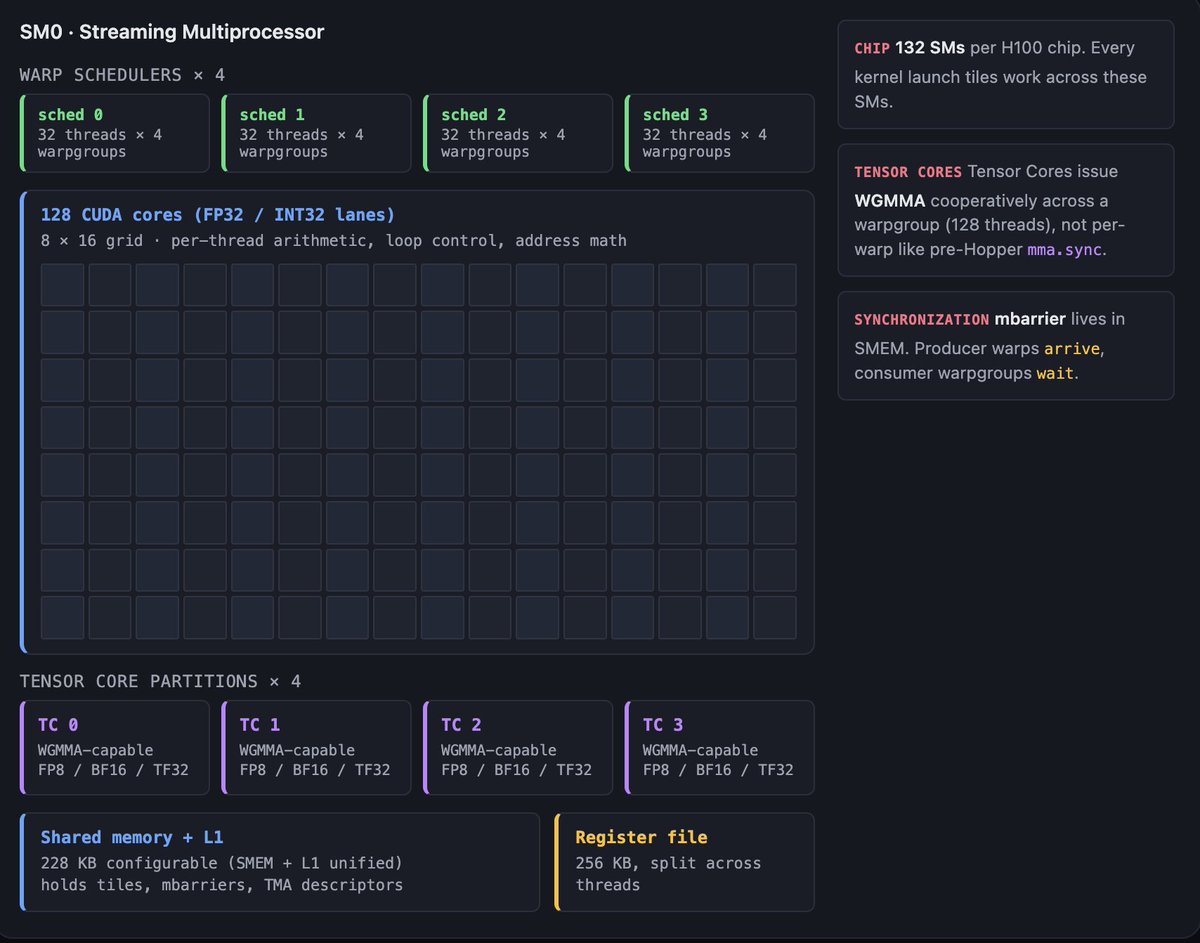
现代 NVIDIA GPU 是一个 streaming multiprocessors(SM)网格。H100 有 132 个。B200 更多。每个 SM 是执行单元。当你 launch 一个 kernel,GPU scheduler 会把 thread blocks 分配给 SM。block 会在拿到它的 SM 上运行到完成。如果 registers 和 shared memory 允许,一个 SM 可以同时容纳多个 block。

在单个 SM 里面,有用于 scalar 和 vector FP arithmetic 的 CUDA cores,有少量用于 transcendentals 的 special-function units,还有 Tensor Cores,也就是矩阵引擎。Tensor Cores 是 SM 里唯一能以接近峰值速率做密集矩阵数学的部分。如果你没有发射 Tensor Core instructions,你就跑在慢路径上。

线程被组织成 32 个一组的 warps。Warps 是 SIMT 执行单位:32 个线程,一条指令,大多数时候一个 program counter。多个 warp 组成一个 thread block,这是程序员调度的单位。Thread blocks 共享一块 shared memory(SMEM),它是 physically located in the SM 的片上 SRAM。一个 block 内的线程可以便宜地同步。跨 block 的线程不行。

SM 外面的内存层级是这样:L1 cache 位于每个 SM 中,在现代 GPU 上和 SMEM 物理统一,你在二者之间分配预算。L2 cache 由芯片上所有 SM 共享。HBM 是片外主内存。越往外,每一层越慢,也越大。Registers 最近也最小。HBM 最远也最大。kernel 编写的游戏,就是把数据往内存层级上方移动,并在它回落之前做尽可能多的数学。

如果你看到这些词而疑惑,这里先给三个词汇:warp divergence,一个 warp 里的线程走不同分支时会顺序运行,所以吞吐下降;coalescing,来自一个 warp 的相邻地址 load 会被合并成一次 transaction;occupancy,一个 SM 保持多少 warp in flight 来隐藏 stall。如果你不写 kernel,可以放心略过这些。Tensor Cores 相比 CUDA cores 不那么在意 occupancy,因为它们有专用路径和自己的调度。

这些足够读完 Part 2A 的剩余部分了。我们讲的每一代,都会往这张图里加东西。Ampere 加入 TF32 和 async copies。Hopper 加入 warpgroups、TMA 和 mbarrier。Blackwell 加入 TMEM,并把 Tensor Cores 从 warp scheduler 中解耦。底层形状保持不变。
Ampere / A100

A100 是 NVIDIA 停止假装这是一颗图形芯片的一代。每一份 Ampere 技术说明读起来都像数据中心白皮书,因为它本来就是。它也是 大多数 GPU 专用 DSL 所基于的芯片。理解 Ampere,至今仍是理解几乎每一种 DSL 的关键。

我认为,对 kernel 作者来说,最有后果的新增能力是 cp.async。它可以把数据从 global memory 直接移动到 shared memory,而不经过 register spill。Ampere 上的版本是半异步的,意思是你发出 copy,去做别的工作,最终在 completion 上 fence。Hopper 上现代的 TMA+mbarrier 模式,就是这个想法的完全异步版本。Ampere 上的 cp.async 是第一次尝到这个味道。

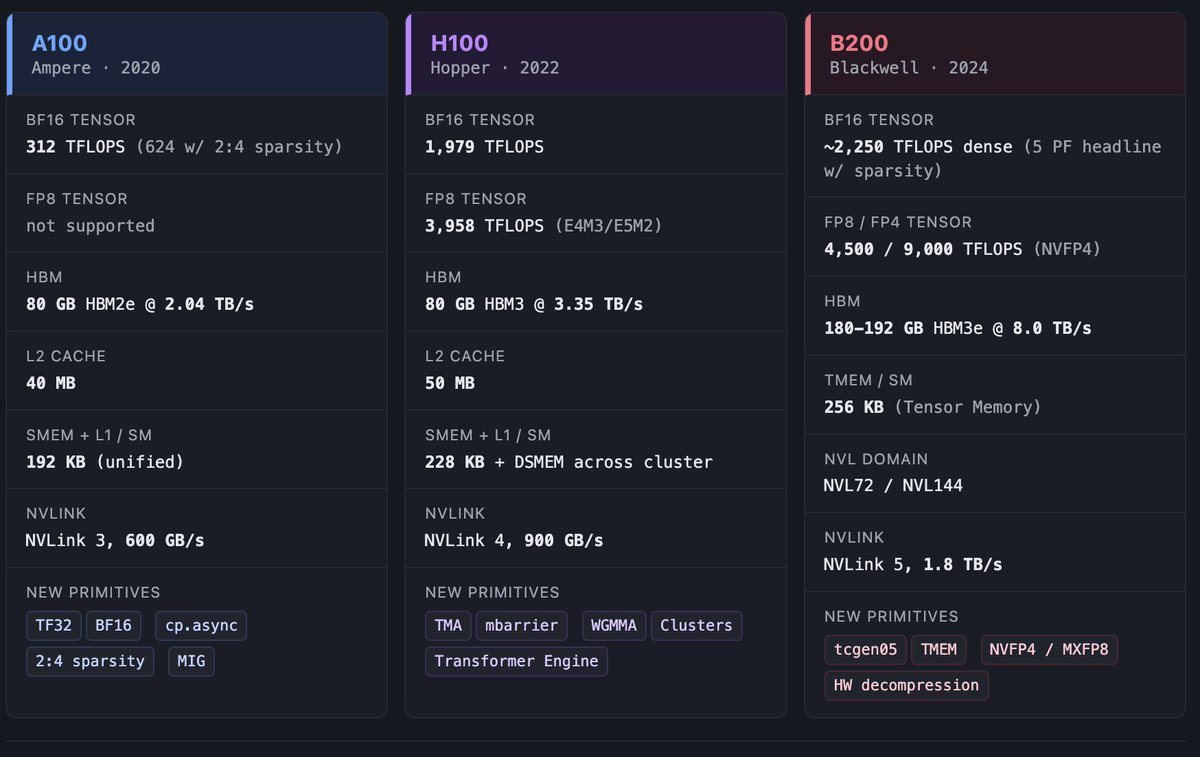
A100 有 80 GB 的 HBM2e,带宽 2,039 GB/s;Tensor Cores 提供 312 dense BF16 TFLOPS,使用 2:4 sparsity 时是 624;还有 MIG(Multi-Instance GPU)分区,给那些想把芯片切成更小加速器、用于多租户工作负载的云服务商。MIG 听起来枯燥,但它是重要背景:到了 A100,NVIDIA 设计的不只是整芯片工作负载,也包括被租出去的一片片芯片。

重新算 roofline:A100 来自 HBM 的 ridge point 是 312 × 1000 / 2,039 ≈ 每字节 153 FLOPs。这个数高于 BERT 和 ResNet 规模 matmul 所在的位置,低于密集 transformer training 所在的位置。A100 不需要像后来的几代那样担心 ridge point。

A100 定义了现代 ML training 的 下限。在它之后的一切,都至少假设有这个硬件水平。如果你读 2021 到 2023 年的论文,里面说“我们在 8 个 GPU 上训练”,你大概率可以在脑中把它替换成“8 个 A100”,而且通常不会错。

2A.2 Hopper / H100

Hopper 是本文的锚点世代,因为 Hopper 是数据移动不再只是副作用,而是成为程序本身的一代。

在缩写词出现前,先用白话说。Hopper 之前,GPU 线程是让 copy 发生的东西:你写循环,线程执行每一次 load。Hopper 之后,你给硬件一段 copy 的简短描述:“从 HBM 取这个 tile,用这个 layout 放到 shared memory”,然后硬件在你的线程去做其他工作时完成剩下的事。本节剩余部分,就是让这个变化成真的机制,也是你以后读到的每个优化 H100 kernel 都长成那样的原因。

我想逐步建立这个判断。A100 已经有 cp.async,已经有 Tensor Cores,已经有 BF16。H100 的新功能不是孤立的 bullet points。它们共同改变了 kernel 是什么

Thread Block Clusters 是执行层级中的新一级。旧图景里,threads 组成 warps,warps 组成 blocks,blocks 组成 grid,而 blocks 之间不能通信。在 Hopper 上,相邻 block 可以被组成一个 cluster,通常是 4 或 8 个 blocks,cluster 会被调度到一组连续的 SM 上。cluster 内的 block 可以访问彼此的 shared memory。这叫 Distributed Shared Memory(DSMEM)。底层看,它是 SMEM 加上 cluster 内 SM 之间的物理互连。DSMEM 不像本地 SMEM 那么快,但比出去到 L2 或 HBM 快得多。

DSMEM 重要,是因为它允许你把操作跨多个 SM 分块,而不必付通过 L2 共享数据的往返成本。过去一个 SM per head 的 flash-attention 风格 kernel,现在可以一个 cluster per head,并让 per-head 数据在多个 SM 之间协作保持。

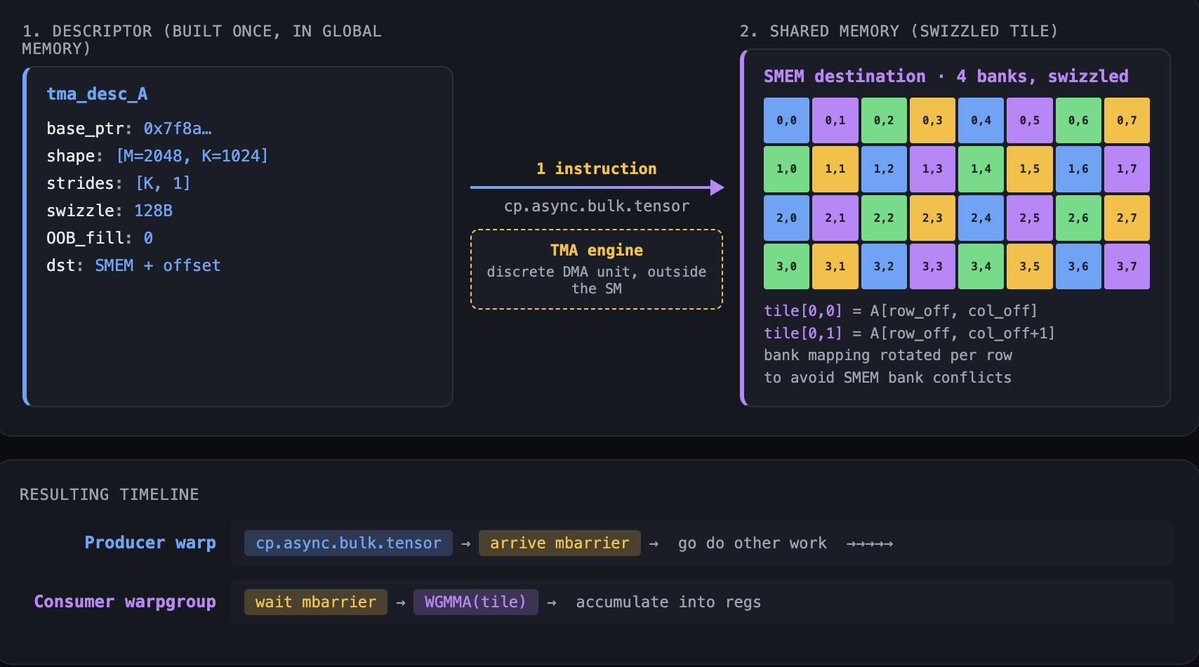
Tensor Memory Accelerator(TMA) 是重新排列一切的功能。TMA 是 descriptor-driven async copy engine。你构造一个 descriptor 描述 source tensor,包含 base pointer、shape、strides、swizzle pattern、out-of-bounds fill value;再构造一个 descriptor 描述 shared memory 中的 destination tensor;发出一条指令,DMA engine 就会移动 tile。写循环的是编译器,不是线程。发出 TMA 的 warp 可以在 copy 运行时去做其他工作。

TMA 有三件重要的事不会出现在规格表上。第一,TMA 在硬件中处理 bounds checking 和 padding。如果你的 tile 超过 tensor 边界,TMA 会用指定值填充,而不是 trap。这会从 kernel code 中消灭一整类 tail-case branches。第二,TMA 可以在 copy 过程中应用 swizzle patterns,让数据以一种避免 Tensor Cores 读取时 bank conflicts 的 layout 落进 shared memory。第三,TMA 是 cluster 上 multicast 的底座。一次 TMA 可以把同一个 tile 同时落到 cluster 内多个 SM 的 SMEM 中,替代原本需要的 N 次独立 loads。

Warpgroup MMA(WGMMA) 是新的 Tensor Core instruction family。一个 warpgroup 是四个 warps,也就是 128 个线程。不同于以前运行在单个 warp 上的 mma instructions,WGMMA 是 warpgroup-cooperative:指令由四个 warp 一起发出,硬件调度一个更大的矩阵操作,把 issue cost 摊到更多线程和更多数据上。WGMMA 可以直接从 shared memory 取 operands(RS-stage),不用先搬到 registers,这是巨大的带宽收益。

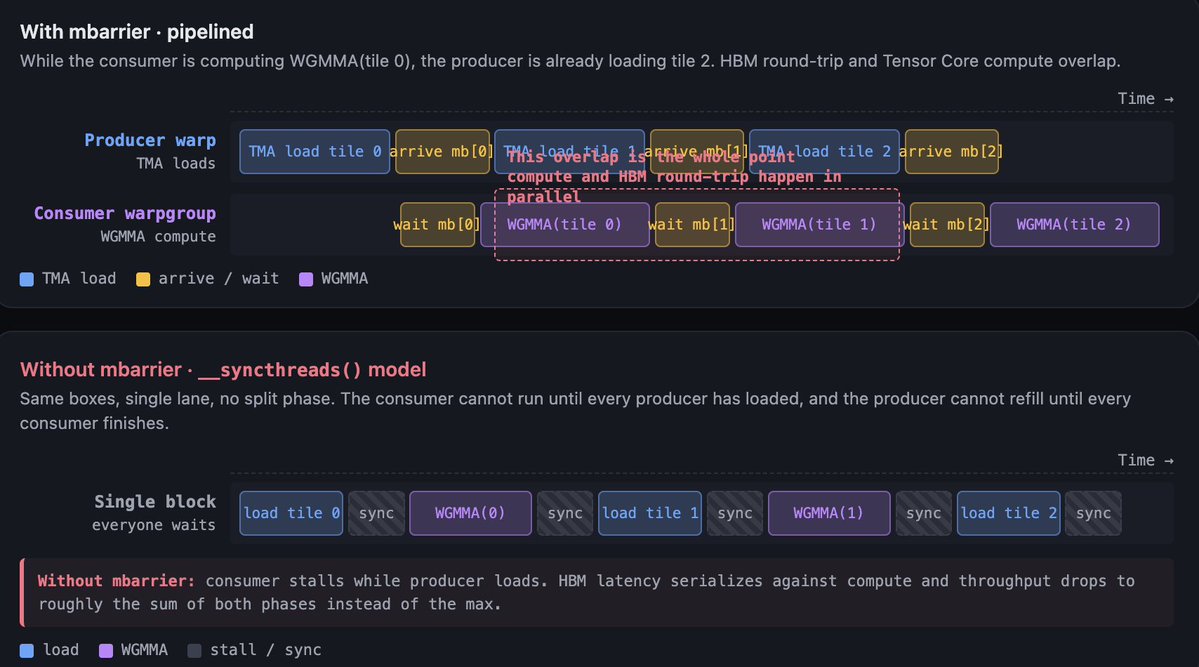
mbarrier 是把这条流水线绑在一起的同步原语。GPU 上经典的 shared-memory sync 是 __syncthreads(),像一道悬崖:block 里的每个线程都要等到所有其他线程到达。简单模式下这很好,但对 overlap 来说很糟。mbarrier 是 split-phase barrier:你可以让一个 warp arrive,另一个 warp wait。这让 producer-consumer pattern 成立。一个 warp 发出 TMA load,在 mbarrier 上 arrive,然后继续。另一个 warp 在 mbarrier 上 wait,用 WGMMA 消费数据,再在另一个 mbarrier 上 arrive,表示这个 tile 空出来了,然后继续。除非流水线从根上卡住,否则 warps 不会 stall。
Hopper 上的 FP8 是 E4M3 和 E5M2,配合 Transformer Engine 通过 delayed-scaling protocol 跨 step 跟踪 per-tensor scales。Delayed scaling 的意思是,你跟踪前几次 iteration 的 amax,并用它来 scale 当前 iteration,这样不用为在线计算 scale 付同步成本。只要做得仔细,FP8 training 在相关任务上的 accuracy drop 接近于零。带宽节省则很有意义。

内存层级方面:HBM3 3.35 TB/s,50 MB L2,比 A100 的 40 MB 提升;cluster 间有 DSMEM;每个 SM 的可配置 SMEM+L1 预算也更大。NVLink 4 每 GPU 900 GB/s,聚合在 NVL8 和 NVL64 server topologies 中。数字重要,但真正重要的是,层级中的每一层都变快了,而且新增了一个 near-math level,也就是 DSMEM。

现在功能都摆上桌了,可以说那个判断了。Hopper 之前,kernel 是“做算术,然后围绕它协调一点内存移动”。Hopper 之后,kernel 是“调度内存移动,而算术发生在移动留下的空隙里”。一个调好的 H100 matmul 主循环,是 producer warp 把 TMA loads 发进 circular SMEM buffers,consumer warpgroups 通过 WGMMA 从这些 buffers 中拉数据,mbarrier chains 把整条流水线 gate 起来。你可以用 CUDA 手写这个循环。你可以从 CUTLASS 得到自动生成版本。也可以让 Triton 替你写。

Triton 会这样处理它:
这就是整个 kernel。三十行。读起来像教科书里的 tiled matmul。现在看看 Triton 编译器在 Hopper 上实际发射了什么。如果你不是 kernel 作者,可以略过下一段:重点只是,编译器把三十行看起来无害的代码,变成了我们刚刚搭起来的完整 Hopper pipeline。

a = tl.load(a_ptrs)b = tl.load(b_ptrs) 这两处 tl.load 会变成 TMA descriptor constructions 和 cp.async.bulk.tensor instructions。编译器选择一个匹配 WGMMA operand layout 的 swizzle pattern。遍历 K 的 for-loop 会变成一个 software-pipelined loop,里面有 multi-buffered SMEM staging、producer-consumer warpgroup split,以及一串 mbarrier arrives/waits gate 每个 stage。tl.dot 会变成由 consumer warpgroups 协作发出的 WGMMA instruction,尽可能直接从 SMEM 读取。最后的 tl.store 会变成 grid-striding TMA store。

这些都不会出现在 kernel source 里。Triton 的完整主张是,tile 是抽象单位,编译器根据你的目标 GPU 判断该怎么做。在 A100 上,同一个 kernel 会发射 cp.async 而不是 TMA,mma.sync 而不是 WGMMA,并使用经典的 __syncthreads() 模式,而不是 mbarrier。同一份 source,不同的 codegen。这就是 Triton 在做它该做的事。

这个 snippet 会在 Article 2 再次出现。Pallas 对比不是在比哪个 kernel 更短。它讨论的是编译器边界上发生了什么,以及每套栈怎样理解抽象。现在,只要注意这三十行隐藏了多少 Hopper-specific hardware。

Blackwell / B200 和 GB200

如果你刚接触这些,最短总结是:Blackwell 把 Hopper 的核心想法,也就是 async data movement、cooperative Tensor Cores、close-to-math memory,做得更大,并推得更远。两个新节拍是:NVLink domain 就是 机器,72 个 GPU 在一个 fabric 中,而不是 8 个;warp scheduler 不再控制 Tensor Cores,它们有了自己的 issue path。

先说明限制:Blackwell 的公开微架构披露比 Hopper 少,所以我会区分哪些是明确的,哪些是指示性的。

明确的是:B200 是一个 dual-die 芯片,有 10 TB/s 的 die-to-die interconnect(NV-HBI),并对程序员呈现为一个逻辑加速器。你不需要直接管理两个 die;CUDA 把这对 die 当作一个 device。每个 die 有自己的 SM 和自己的 HBM stacks。

明确的是:每 GPU 汇总 8 TB/s 的 HBM3e,容量 192 GB,指高配 B200。这比 H100 的带宽超过 2 倍,容量也超过 2 倍。由于 compute 增长更快,compute-to-bandwidth ratio 仍然收紧,但原始内存预算变得友好多了。

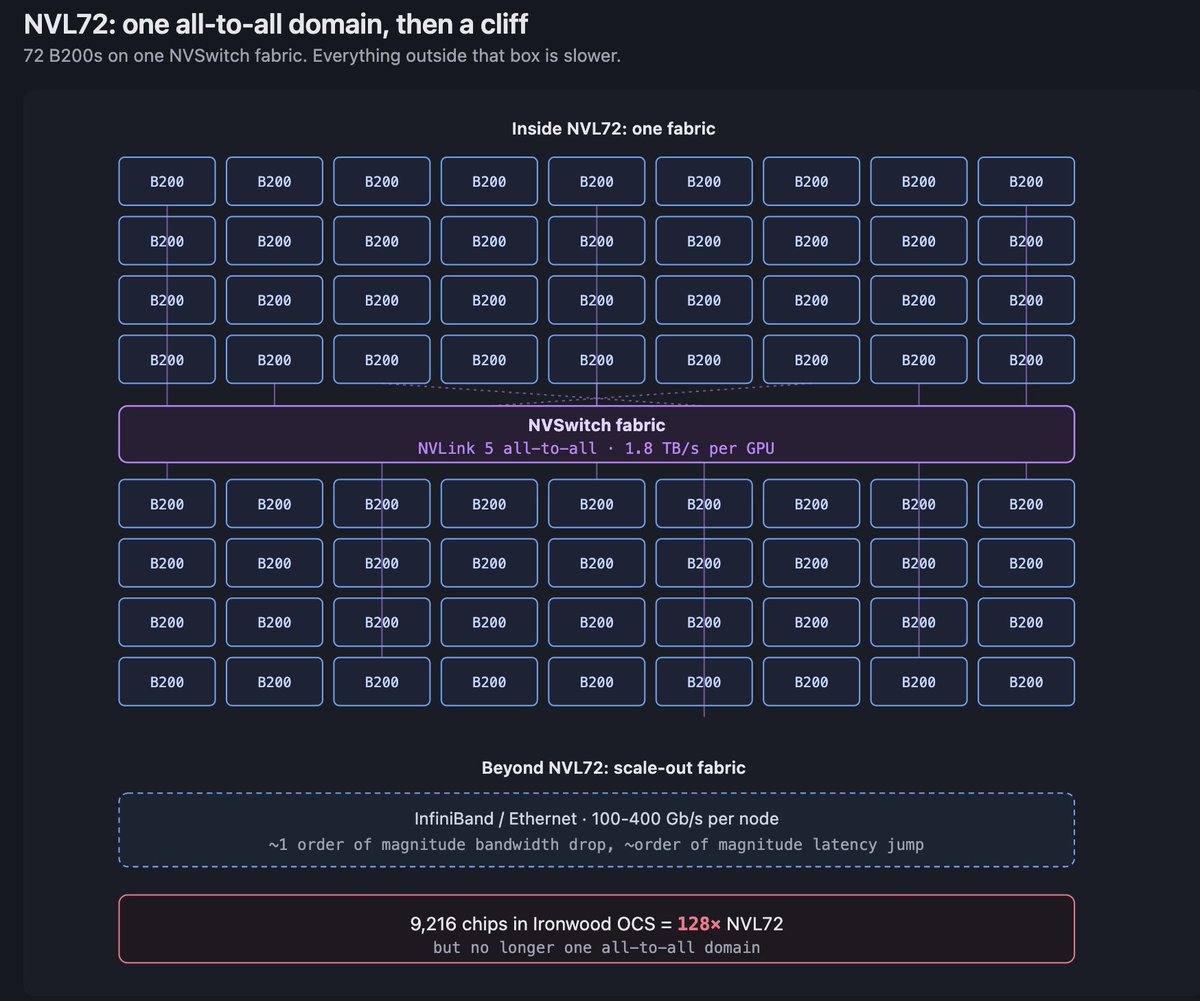
明确的是:NVLink 5 每 GPU 1.8 TB/s,并且 NVL72 成为标准 domain。72 个 GPU 在一个 all-to-all-connected NVLink fabric 中,NVL144 是更大的配置。Blackwell 之前,NVLink domains 在一台服务器里最多到 8 个 GPU。Blackwell 的 NVL72 大了一个数量级。这是对现代训练规模的有意回应,我们会在 §2C 把它和 TPU fabric 故事对比时再谈。

明确的是:通过 NVFP4 进入 FP4 era。NVFP4 是一种两级 scaling format,每 GPU 达到 9 PFLOPS dense,带 sparsity 时 18 PFLOPS;MXFP8 则是八位 microscaling 替代方案。二者都是 Blackwell 上 Transformer Engine 的目标。FP8 峰值数字是每 GPU 4.5 PFLOPS dense,已经接近 Ironwood 的 FP8,使两颗芯片在这个 per-chip 指标上大致可比。

指示性信息,来自 Blackwell microbenchmarking papers 和 vendor tutorials,而不是 NVIDIA 一手文档:Blackwell 引入了 Tensor Memory(TMEM),据报道每 SM 256 KB,这是一个专门用于 Tensor Core operands 的新 near-math storage level。TMEM 位于 SMEM 和 Tensor Core registers 之间。重点是:在 Blackwell 的 Tensor Core throughput 下,就连 SMEM 都离数学太远了,operands 需要活在更近的一层。

指示性信息:tcgen05 是 Blackwell Tensor Core instruction family,公开教程中的描述说 tcgen05warp scheduler 解耦。Tensor Core 有自己的 issue path 和 operand staging。这是 Hopper 趋势的另一半。Hopper 把内存移动从线程中解耦出来,也就是 TMA。Blackwell 把算术从线程中解耦出来,也就是 tcgen05。warp 不再参与 dense linear algebra 的循环。

指示性信息:用于 weight-compressed formats 的 hardware decompression engines,使推理 kernel 可以从 HBM 分页读取加密或压缩权重,并即时解压,而不需要 software pass。

眯着眼看 Blackwell,你会看到一种架构:SM 越来越像 dispatcher,真正的工作发生在那些不再像 Hopper Tensor Cores 那样住在 SM 内部的硬件块里。编程模型通过让作者描述协作来容纳这一点,而底下的机器越来越不可见。表面上仍是 SIMT。底下几乎不再是 SIMT。

GPU 这条线

三代,用三句话说。Ampere 拓宽了高速路。 更高的 Tensor Core peak,更多 HBM bandwidth,async copies,sparsity。Hopper 让移动显式化。 TMA、mbarrier、warpgroups、distributed shared memory。kernel 从循环变成流水线。Blackwell 让 fabric 成为机器。 NVL72、decoupled Tensor Cores、TMEM、microscaling formats。单个 GPU 没有以前那么重要;72-GPU domain 比以前更重要。

把这条线合成一个轨迹:NVIDIA 过去两代一直在沿 SIMT 阶梯向上爬,试图抵达一个位置,在那里由编译器,而不是程序员,来调度数据移动和数学。TMA 是大步。tcgen05 decoupling 是下一步。这是 GPU 栈自己走向 TPU 从一开始就通过构造拥有的东西。

这是一个挑衅性的框架,我是认真这么说的。先把它放在这里,等你继续读下一部分。然后我们会看到 TPU 侧一直站在哪里。
Google 这条线

说明:这些内容都是我加入 Google 前写的,基于我准备期间关于 TPU 的笔记。所有开放数据都来自当时的新鲜笔记,然后我把它写成了人们真的能读懂的形式,而不是我的碎碎念。

TPU 基础入门

TPU 芯片是一小组大块,而不是许多小块组成的网格。在进入各代之前,把这句话再读一遍。它是最重要的心智模型切换。

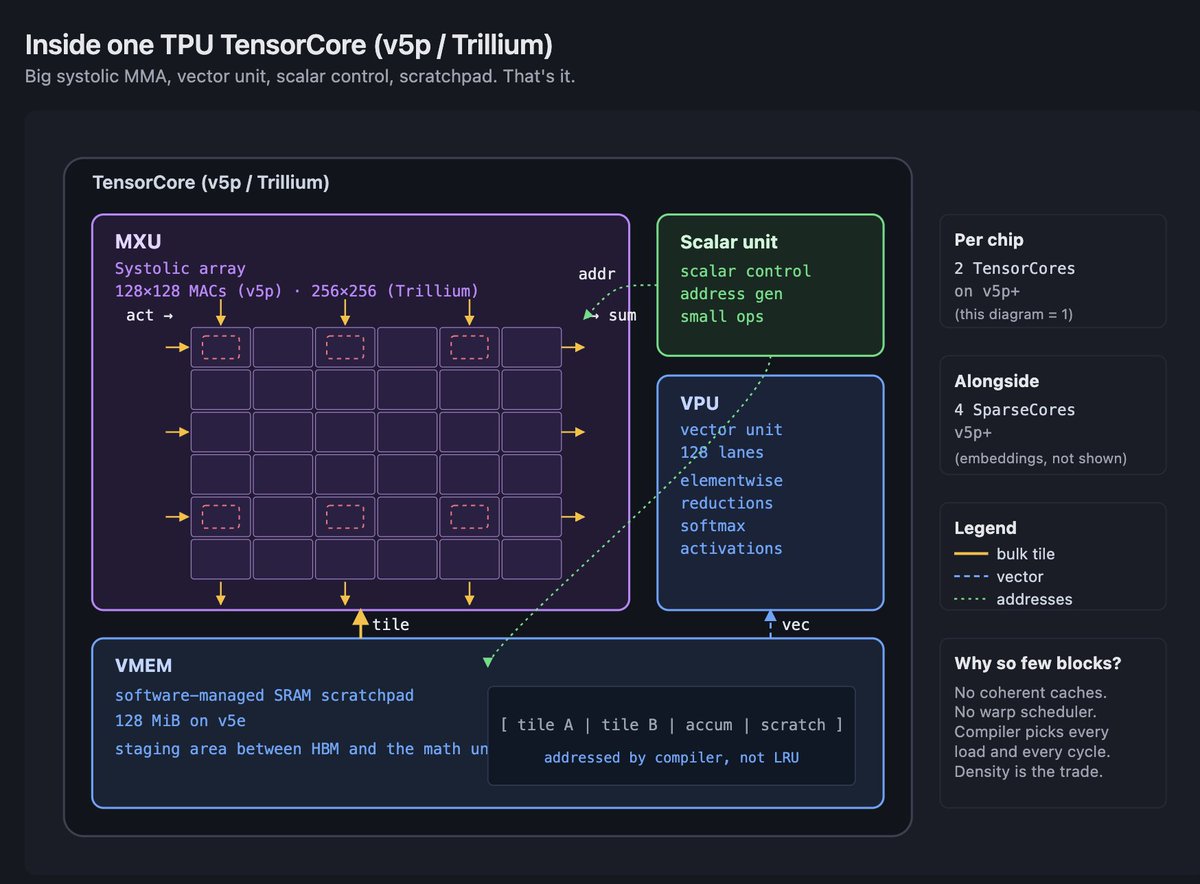
一颗 v5p 芯片有两个 TensorCores。一颗 Ironwood 芯片也有两个。Trillium 芯片在 dual-chiplet package 上也有两个。数量少是有意的。每个 TensorCore 都是一台围绕一个主导单元构建的大机器,这个主导单元就是 MXU,旁边围着 vector unit、scalar unit 和 local memory。

MXU 是一个 systolic array。在 v4 和 v5e 上,它是 128×128。在 v5p 上,每芯片仍是 128×128,但芯片里有更多这样的阵列,每个 TensorCore 有两个 MXU。在 Trillium 上,它跳到了 256×256。MXU 做的是密集矩阵数学。它的 dataflow 是 weight-stationary 的一种变体,意思是 weights 停在原地,activations 从中流过。一旦加载了 weights,你就让 activations 穿过网格,累加结果从另一侧流出。tile 适配网格时,吞吐极其夸张。代价是,一切都必须被塑造成适合 MXU 的形状,否则 MXU 就做不了有用的事。

vector unit(VPU)接住 MXU 做不了的一切。Elementwise operations、reductions、softmax interior、layer norm math、activation functions。它是 SIMD-style unit,有自己的 register file 和自己的 lane count。每个 TPU kernel 故事最终都会经过 MXU 和 VPU 的互动:MXU 做 matmul,VPU 做 nonlinearity,编译器用显式数据移动把两者缝起来。

scalar unit 处理控制流、地址生成,以及少数无法表达为 vector 或 matrix units 的操作。它很小。TPU 架构的重点是,把大部分硅面积给 MXU。

TPU 上的内存不像 GPU 内存。这里 没有硬件管理的 L1 或 L2 cache。相反,每颗芯片有 VMEM(Vector Memory),这是一块大的软件管理 SRAM scratchpad。在 v5e 上,每芯片 VMEM 是 128 MiB。后续几代会继续扩展。编译器负责把数据从 HBM 暂存到 VMEM,再从 VMEM 放进 MXU 和 VPU register files。这个细节不能留到后面再藏起来;它是这个平台的定义性特征。

最尖锐的后果,是任何 miss VMEM 的东西都会受到算术强度约束。在 v5e 上,来自 HBM 的 ridge point 大约是每字节 240 FLOPs,而来自 VMEM 的 ridge point 低得多,大概低一个数量级。这意味着,如果你能让一个 tile 常驻 VMEM 并复用它,就只需要低得多的算术强度,也能保持 compute-bound。如果每个操作都必须从 HBM 重新加载,你就需要高得多。TPU 上的每个优化故事,都以这样或那样的方式,讲的是如何让数据尽可能长时间常驻 VMEM。

batch size 是新用户最先被咬到的地方。在 v5e 上,BF16 下每个 replica 需要大约 240 个 token 的 batch,才能超过 HBM ridge point。使用 int8 activations 和 bf16 weights 时,会降到大约 120。低于这些阈值,MXU 会在 HBM 重新填充时闲着。GPU 会随着 batch size 缩小而平滑退化。TPU 会掉下悬崖。修复方式不是更用力地调 kernel,而是重新设计 parallelism strategy,让 per-replica batch 足够大,或者使用更小精度。

ICI(Inter-Chip Interconnect)是 TPU 对应 NVLink 的东西,但更扁平,也更密。在 v5p 上,每芯片 ICI 是 4.8 Tbps,芯片以 3D torus 连接。一个完整 pod 是 8,960 颗芯片。在 Ironwood 上,每芯片 ICI 是 9.6 Tbps,一个 pod 是 9,216 颗芯片。ICI 的重要之处在于,它是 torus,不是 fat tree。每颗芯片都有本地邻居。能很好映射到 torus 的 collective operations,比如 all-reduce、ring-based all-gather,会飞快。需要 global any-to-any 的操作,要么用 Optical Circuit Switching 动态重塑 torus,要么就要付出代价。

SparseCore 是 v4 之后位于 TensorCores 旁边的独立执行单元。它为 MXU 极不擅长的操作设计:sparse embeddings、gather-scatter、hash-table-heavy workloads。v5p 每芯片有四个 SparseCores。每个 SparseCore 有自己的 vector 和 scalar subcores,以及 shared vector SRAM。推荐系统活在 SparseCore 上。LM 中的大词表 embeddings 也一样。

这些够了。下面每一代 TPU 都是这个结构的变体。数 MXU。数 TensorCores。量 VMEM。量 HBM。量 ICI。注意 MXU 是变大、变小,还是保持不变。

TPU v1:哲学论文

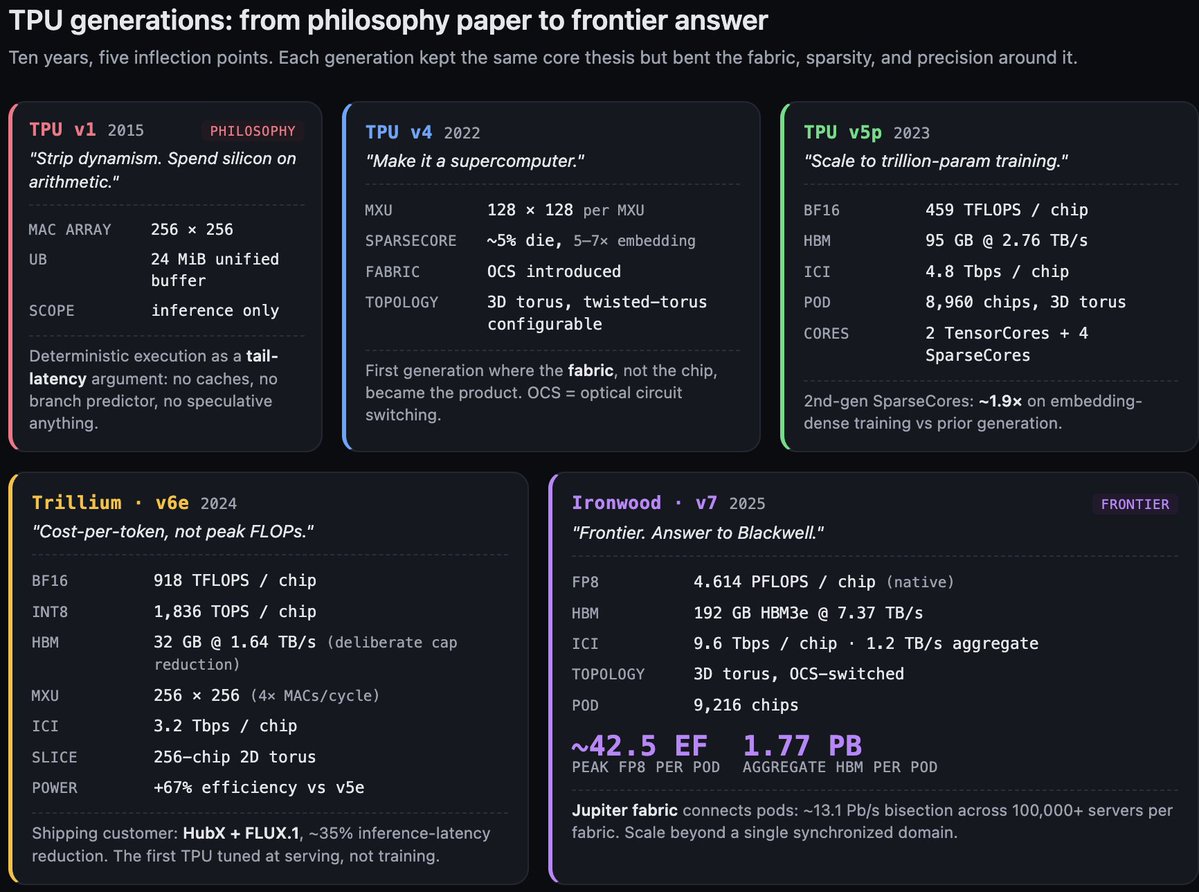
我不想把 v1 写成产品巡礼。它是一颗 2015 年出货的 inference-only chip,有一个 256×256 MAC array,24 MiB 的片上内存,叫 Unified Buffer,还有确定性执行模型。规格不是重点。

重点是 Google 团队在 2017 年写的那篇论文,题为 "In-Datacenter Performance Analysis of a Tensor Processing Unit." 在我看来,它是过去十年里最有后果的架构论文,没有之一,而原因并不是这颗芯片的性能。原因是这篇论文提出了一个激进立场:caches 是坏的,out-of-order execution 是坏的,SMT 是坏的,speculation 是坏的,branch prediction 是坏的,hardware prefetching 是坏的,一切 latency-hiding dynamism 都是坏的。 这些全是为了让不可预测代码看起来很快而花掉的硅面积。ML 工作负载并不可预测。你花在动态性上的每一字节硅,都是没有花在算术单元上的一字节硅。

这就是论点。它至今仍是这条谱系的北极星,我完全同意。如果你想知道 2026 年的 TPU 为什么长这样,就从 2017 年那篇论文开始。

确定性执行部分,是 tail-latency 论点。如果每个操作都提前调度,硬件没有动态性,那么同一程序每次运行都会花同样数量的 cycles。这对训练来说无关紧要,训练看吞吐,不看 tail latency;但对 inference serving 极其重要。确定性加速器不会因为一次调度抖动产生 p99 latency spike。

v1 是推理芯片,它的确定性故事面向推理。v4 之后,同一个论点也开始适用于训练。

v4 和 v5p:通往 Ironwood 的路

我会把 v4 和 v5p 合并成一条线,因为它们讲的是同一个故事,第二次更大而已。先承认 v2 和 v3,这样你不会疑惑:v2 带来了 BF16 和双 TensorCore layout,后续每颗芯片都保留了它。v3 扩大了 MXU array,并加入液冷。二者都不是锚点。v4 才是事情再次变有趣的地方。

v4 引入了两个重塑 TPU pod 的功能。第一个是 SparseCore。v4 大约 5% 的 die area 给了一个独立引擎,用来做 gather-scatter 和 embedding operations,速度是 MXU 无法企及的。在 embedding-heavy workloads 上,SparseCore 相比在 MXU 上跑同样工作能带来 5–7× speedups。它是第一个不是纯 matmul accelerator 的 TPU 功能。

第二个,也是结构上更大的,是 Optical Circuit Switching(OCS)。OCS 允许 Google 在 provisioning time 重新配置 pod 的 interconnect topology。物理 fabric 是由光交换机组成的 3D torus,这些交换机可以重新编程,把不同芯片连接到不同邻居。这带来两个后果。第一,它让 pods 可以针对 workload-specific topologies 重新配置,所以一个受益于 2D slice 的 job 可以拿到一个,而不必布一套独立 fabric。第二,它让 fabric 具备容错性:如果一颗芯片失败,OCS 可以绕开它,pod 以少一颗芯片的状态继续运行。对一个需要同步 8,000+ 颗芯片的 fabric 来说,这种韧性不是锦上添花,而是要求。

v4 还引入了 twisted torus topologies,也就是一些小的拓扑技巧,用来降低 all-to-all collectives 的最坏情况延迟。标准 torus 的最坏 hop count 与边长成正比。twisted torus 把它砍半。这种细节对真实世界的 MFU 很重要,但对没在大规模跑过 collectives 的人完全不重要。

v5p 是放大版 v4。仍然是 3D torus。仍然启用 SparseCore。pod 从 v4 的 4,096 颗芯片增长到 8,960。每颗芯片有 2 个 TensorCores、4 个 SparseCores、95 GB HBM,每芯片带宽 2.76 TB/s,以及每芯片 4.8 Tbps ICI。MXU 每芯片仍是 128×128,但数量更多,所以每芯片 BF16 峰值是 459 TFLOPS。

SparseCore 的收益值得引用:Google 对 v5p 的官方表述是,第二代 SparseCores 让 embedding-dense model training 加速约 1.9×。这是广义的 embedding-heavy workloads,不是专指 MoE。如果你在训练 recommender,或者带非常大词表的 LM,不管你有没有特意要求,SparseCore 都在为你做非平凡的工作。

v5p 是 Google 内部让 trillion-parameter training 变成常规操作的一代。如果你读到过 Gemini 以 petaflop 规模训练,v5p 就是干这活的硬件。

Trillium / v6e:经济性的一代

Trillium 是 TPU 故事变成客户获取故事的地方。核心判断是,Trillium 优化的是每 token 成本,而不是峰值 FLOPs,并且这正在转化为采用率。

规格表本身有趣,但不戏剧性。每芯片 918 TFLOPS BF16、1,836 TOPS INT8、32 GB HBM,每芯片带宽 1.64 TB/s、每芯片 3.2 Tbps ICI、256-chip 2D torus slices。MXU 扩展到 256×256,这让每个 array 每 cycle 的 MAC count 变成四倍。

围绕这些数字的设计决策,才是故事所在。

第一,MXU 跳到 256×256。这让每 cycle MAC count 增加 4×,也把相对于 v5e 的每芯片峰值推高了大致同样倍数。代价是 padding tax。如果你的 matmul tiles 不能在两个轴上都被 256 整除,就会浪费 cycles。Trillium 上的 kernel 作者比在 v5p 上更认真地思考 tile shapes。编译器会做很多 padding,但税是真实存在的。

第二,HBM 容量下降。Trillium 每芯片 32 GB,而 v5p 有 95 GB。这不是倒退,而是有意选择。Trillium 的 pod topology,也就是带强 ICI 的 256-chip 2D torus slices,旨在吸收你原本需要用本地容量支付的 tensor-parallel 和 model-parallel sharding。不是把大 weight shards 保存在每颗芯片上,而是跨更多芯片 sharding,并用 ICI 服务这些 shards。它是 fabric-first memory hierarchy,不是 capacity-first。

第三,功耗故事。Trillium 的 TDP 不是我会引用的公开数字,但已发布的 相比 v5e 能效提升 67% 是干净的 Google 数据。效率是 Trillium 押注的轴线,也是对推理部署最重要的轴线,因为每一瓦都会直接打到你的 per-token cost 上。

Ironwood / v7:锚点世代

Ironwood 是 TPU 侧对 Blackwell 的回答。标题很熟悉。每芯片 4.614 PFLOPS FP8、192 GB HBM3e,每芯片带宽 7.37 TB/s、每芯片 9.6 Tbps ICI,也就是 1.2 TB/s aggregate。按单芯片看,Ironwood 和 B200 在 peak FP8 上处在同一个邻域。这是无聊的部分。

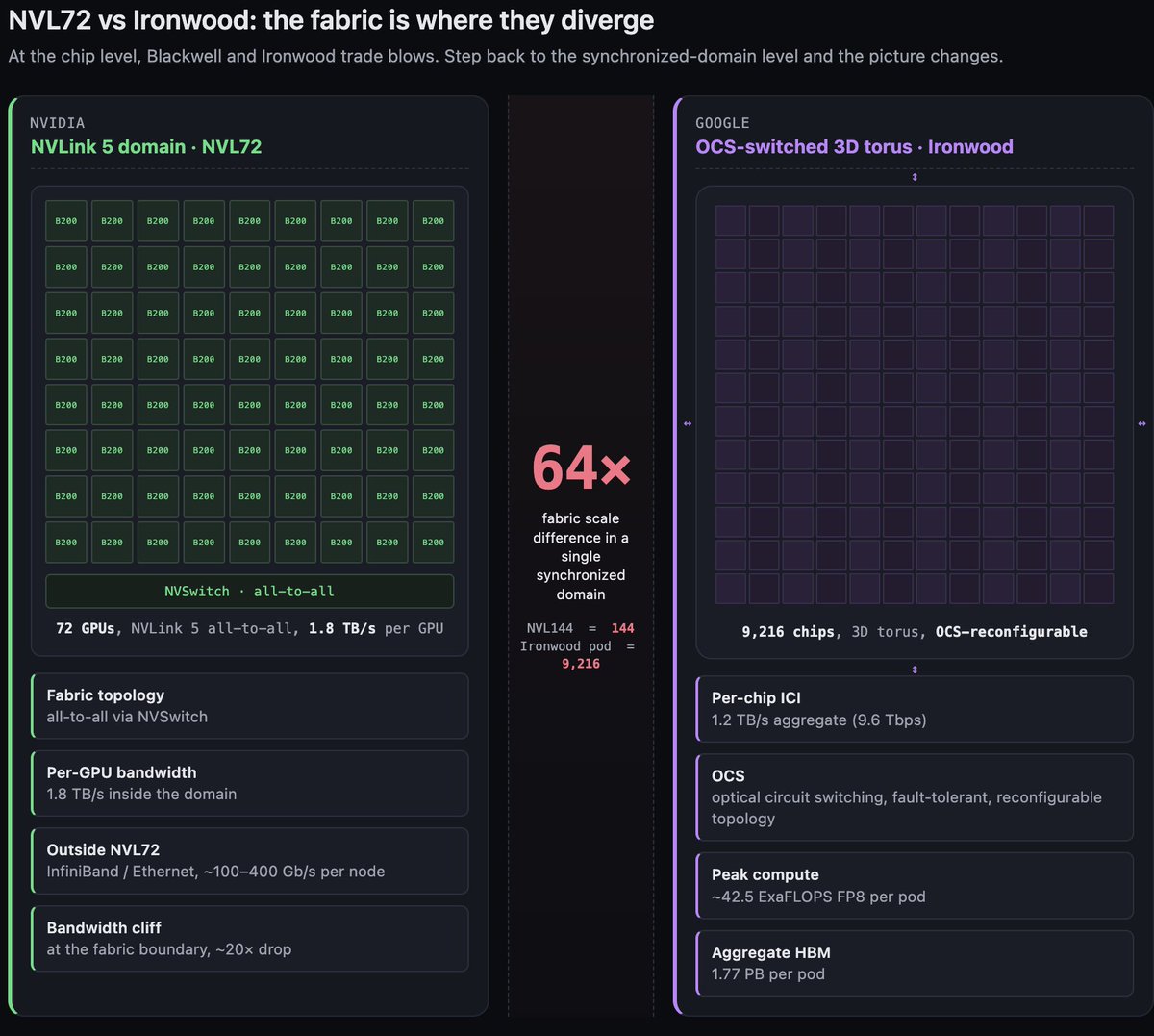
有趣的是 fabric。Ironwood 的 pod 是 9,216 颗芯片组成的 3D torus,通过 OCS 连接。pod-level peak 大约是 42.5 ExaFLOPS。pod-level aggregate HBM 是 1.77 PB。pod 里的每颗芯片都是同一个同步 fabric 的一部分,ICI latency 以数百纳秒计,而不是微秒。

和 Blackwell 对比。NVLink 5 每 GPU 1.8 TB/s。NVL72 是 72 个 GPU,NVL144 是 144 个,二者都在 all-to-all domains 中。超过 NVL144 后,规模必须经过 InfiniBand 或 Ethernet,这会让你从 1.8 TB/s 降到几百 gigabits,latency 也上升超过一个数量级。

Ironwood 的 9,216 是 NVL144 的 64×。这不是一个小数字。在 64× fabric scale 下,每个 parallelism decision 都会改变。在 ICI 成为瓶颈之前,tensor-parallel groups 可以更大。需要 all-to-all communication 的 sharding strategies,在 GPU cluster 上致命的规模,在这里会变得可行。pipeline parallelism 原本是为了掩盖 inter-node latency 而存在的,但由于“inter-node” penalty 小得多,它变得没那么必要。

pod 之外,Google 的 Jupiter fabric 是连接 pods 的数据中心级网络。Jupiter 在每个 fabric 内跨 100,000+ servers 承载大约 13.1 Pb/s 的 bisection bandwidth,Google 在全球运行着数百个这样的 fabrics。它不是某些二手来源偶尔暗示的单一多数据中心网络。它是一个 per-fabric bisection number,适用于一个数据中心部署内部。但这样的部署有很多,总量非常巨大。

Ironwood 也支持类似 MXFP8 的 microscaling precision formats,从而补上 Blackwell 低精度故事的差距。更大的架构变化是,Ironwood 的 TensorCore 在 tile 如何被喂入、MXU 如何与 VPU 组合、编译器如何调度 bundles 来保持 pipeline 满载方面更灵活。我不会展开每个微优化。标题是:FP8 是原生的,HBM3e 匹配或超过 Blackwell 的每芯片带宽,而 fabric 是主导性差异。

如果你从这里带走一件事,就带走 fabric comparison。9,216 对 144。单个同步 domain 内 64×。其他每个规格都在两家厂商之间收敛。fabric 没有。

TPU 这条线

五代,用五句话。v1 证明了这个论点:ML accelerators 应该剥掉动态性,把硅面积花在算术单元上。v4 把它变成了超级计算机,通过 SparseCore 和 OCS。v5p 扩展到 trillion-parameter training,并且架构没有断。Trillium 让它便宜,通过押注经济性而不是 headline FLOPs。Ironwood 让它进入前沿,通过赶上 FP8,并把 fabric advantage 扩展到 NVLink-domain scale 的 64×。

把这条线合成一个轨迹:TPU 谱系一直在下注,认为 compiler-scheduled determinism、systolic matrix density 和 fabric-first scale,比 SIMT flexibility、cache hierarchies 和 per-node optimization 更能产生复利。在前沿规模上,这个下注正在兑现。Article 2 会解释为什么这个下注在 kernel-author scale 上也会兑现,而按传统看法,那里本该是 GPU 赢的地方。

import triton
import triton.language as tl

@triton.jit
def matmul_kernel(
    a_ptr, b_ptr, c_ptr,
    M, N, K,
    stride_am, stride_ak,
    stride_bk, stride_bn,
    stride_cm, stride_cn,
    BLOCK_M: tl.constexpr,
    BLOCK_N: tl.constexpr,
    BLOCK_K: tl.constexpr,
):
    pid_m = tl.program_id(0)
    pid_n = tl.program_id(1)

    offs_m = pid_m * BLOCK_M + tl.arange(0, BLOCK_M)
    offs_n = pid_n * BLOCK_N + tl.arange(0, BLOCK_N)
    offs_k = tl.arange(0, BLOCK_K)

    a_ptrs = a_ptr + offs_m[:, None] * stride_am + offs_k[None, :] * stride_ak
    b_ptrs = b_ptr + offs_k[:, None] * stride_bk + offs_n[None, :] * stride_bn

    acc = tl.zeros((BLOCK_M, BLOCK_N), dtype=tl.float32)
    for k in range(0, K, BLOCK_K):
        a = tl.load(a_ptrs)
        b = tl.load(b_ptrs)
        acc += tl.dot(a, b)
        a_ptrs += BLOCK_K * stride_ak
        b_ptrs += BLOCK_K * stride_bk

    c_ptrs = c_ptr + offs_m[:, None] * stride_cm + offs_n[None, :] * stride_cn
    tl.store(c_ptrs, acc.to(tl.float16))

两条线在哪里相撞

我们已经走完两边。现在,我来点出那些地方。在那里,两条线看起来不再像平行故事,而更像是对同一个问题给出的不同答案。

内存层级分歧,通过增加发生。 GPU memory hierarchies 每一代都在 增加 near-math tiers。早期 Volta 上的 SMEM。Ampere 上 L1-combined SMEM。Hopper 上的 Distributed Shared Memory。Blackwell 上的 Tensor Memory。每一层都比前一层更靠近数学。TPU 从一开始就有 VMEM。TPU 不需要增加新的 near-math tier;它本来就是围绕这个东西设计的。GPU 架构师一直在构建的,是 SIMT 模型内部逐层形成的某种 VMEM。

移动分歧,通过承认发生。 Hopper 上的 TMA,是 NVIDIA 承认 descriptor-driven async transfers 才是在 Tensor Core throughput 下移动数据的方式。TPU 上的数据一直就是这样移动的,因为做调度的是编译器,不是线程。Hopper descriptor model,包括 source tensor shape、destination SMEM layout、swizzle、OOB fill、mbarrier gate,是 Mosaic 一直为 MXU 生成的那类调度的后代。

执行模型分歧,通过解耦发生。 Blackwell 的 tcgen05 把 Tensor Cores 从 warp scheduler 中解耦出来。warp 不再参与 dense arithmetic 的循环。这是一次结构性变化,让矩阵引擎更像一个有自己 issue path 的协作块。在 TPU 上,MXU 从一开始就没有 warp scheduler。编译器给阵列喂一个 tile,阵列节奏完成数学,结果落到编译器指定的位置。NVIDIA 正在逐步让 Tensor Cores 更像 systolic pipeline,同时仍在向程序员呈现线程模型。

规模分歧,通过 fabric 发生。 NVL72 是 72 个 GPU,NVL144 是 144 个。Ironwood 是单个 OCS-switched torus 中的 9,216 颗芯片。这是同步 domain 内的 64×。前沿规模上的每个 parallelism decision 都取决于这个比例。这是两条线尚未收敛的一条轴,也是设计哲学分歧最清楚的一条轴。NVIDIA 的 fabric 从 8 增长到 144,之后是 InfiniBand。Google 的 fabric 从数百增长到数千,仍在一个同步 OCS torus 中,之后是 Jupiter。

精度收敛,通过多条路径发生。 两套栈都在落向 FP8,把它作为标准训练精度,下一步是 microscaling formats,比如 NVFP4、MXFP8。Blackwell 通过从 Hopper 的 Transformer Engine 迭代到达那里。Ironwood 通过直接跳到原生 FP8,到达那里并追上。路径不同,目的地相同。

现在到了前沿规模的重点。这件事我从一开始就在铺垫。

PaLM 540B 在 6,144 颗 TPU v4 芯片 上训练,达到 46.2% model FLOPs utilization。PaLM 论文把它描述为“pipeline-free training”。他们在 3D torus 上运行纯 data 加 model,也就是 tensor parallelism。两个 v4 pods,通过 DCN 连接。完全没有 pipeline parallelism。v4 fabric 的形状让他们能跳过 pipeline。

Llama 3 405B 在 16,384 个 H100 上训练,MFU 大约是 38–43%。Llama 3 论文描述了 4D parallelism:tensor,一个 matmul 跨芯片 sharding;pipeline,不同 layer 放在不同芯片上,activations 按 stage 向前传;context,长序列跨芯片切分;data,同一模型跑不同 batch,并用 FSDP sharding parameters。四个轴,因为 NVLink domain 本身装不下完整 tensor-parallel group,而 NVLink 之外的 InfiniBand fabric 又无法在所需规模上吸收 all-to-all,于是 pipeline parallelism 不得不掩盖这两个缺口。

两个 MFU 处在接近范围。一个用了两个 parallelism 轴达到。另一个用了四个。原因是 bandwidth hierarchy 的形状。PaLM 的 v4 fabric 足够平,data 和 tensor parallelism 就能吸收计算。Llama 3 的 H100 fabric 在 NVLink 和 InfiniBand 之间有一道悬崖,而填平这道悬崖需要 pipeline 和 context parallelism 作为补救。

每个 cluster 的 bandwidth hierarchy 形状,会决定你被允许选择什么 parallelism strategy。这就是前沿规模上的事实。

记住它。Article 2 明天发布,讲的是同样的 shape-constrains-strategy 逻辑是否也会在 kernel scale 上发生,而不只是在 cluster scale 上。我的判断是会。我们会在 Article 2 遇到的编程模型,不是这些架构之上的中性选择。它们是架构通过软件开口说话。

收起这个大怪物

这就是架构基础。两种哲学,两边各自大约五代,一堵内存墙塑造全局,一个 fabric gap 分开两个前沿。

带着三件事继续往后读。

  1. 内存墙是主角。本文里的每个缩写词,都是让数据靠近数学的不同工具。

  2. SIMT 和 systolic 不是同一种关于如何喂饱矩阵乘的赌注。NVIDIA 赌的是有生产力的线程,并且过去两代一直在线程下方加入 compiler-scheduled machinery。Google 赌的是 compiler-scheduled systolic core,并在它周围增加灵活性。

  3. 在前沿规模上,fabric 已经成为差异点。9,216 对 144,是同步 domain 内的 64× 差距,而这个比例会重塑你被允许使用的 parallelism strategy。

Article 2 会从这里接上。我们会用刚才这种平行游览的形状,讲 NVIDIA stack(CUDA、CUTLASS、cuDNN、Triton、frameworks)和 Google stack(XLA、StableHLO、JAX、Pallas、Mosaic、PyTorch/XLA)。然后进入带立场的论证:我会论证,composition、compiler leverage 和 profiler tooling 叠起来,会在 GPU 本该完全占据优势的地方,也就是 custom kernel authoring,形成优势。最后是一份给我这种位置上的工程师看的 Triton-to-Pallas migration playbook。

从 Meta 到 Google 的转变发生得很快,但心智模型的转变慢一些。Article 2 一部分是技术论证,一部分也是这次转变的记录。两者都是。

到那里见。

A few weeks ago I left Meta's Triton compiler team for Google's PyTorch/TPU team. The move is what you'd expect: I spent years inside the GPU stack, wrote lowerings for Hopper and Blackwell, argued about warpgroup intrinsics, wrote thousands of benchmarks + dozens of tools, and now I'm staring at systolic arrays and asking why nobody calls them that in the docs.

几周前,我离开了 Meta 的 Triton 编译器团队,加入了 Google 的 PyTorch/TPU 团队。这个转变差不多就是你能想到的样子。我在 GPU 栈里待了多年,为 Hopper 和 Blackwell 写过 lowerings,争论过 warpgroup intrinsics,写过成千上万个 benchmark 和几十个工具。现在,我盯着脉动阵列,心里想的是,为什么文档里没人这么叫它们。

This is the longest piece I've ever written. It's long on purpose. I wanted something that works for four different readers at once. If you've never thought hard about ML hardware, Part 1 is yours. If you know distributed training but not accelerator architecture, Part 2A and 2B carry you through both sides without assuming the other. If you're already fluent in CUDA and just want the TPU arc, you will get a good refresh and then your TPU fix. If you write kernels or work on compilers, you'll get something out of the whole thing, and Article 2 is where the programming-model argument lives. I literally cant fit all the goodness in X's word limit on articles.

这是我写过最长的一篇文章。它长,是有意为之。我想写一篇能同时服务四类读者的文章。如果你从没认真想过 ML 硬件,第一部分是给你的。如果你懂分布式训练,但不熟悉加速器架构,Part 2A 和 2B 会带你穿过两边,而且不假设你已经懂另一边。如果你已经熟悉 CUDA,只想看 TPU 这条线,你会先得到一次不错的复习,然后进入 TPU 的重点。如果你写 kernel,或者做编译器,整篇都会有东西可拿;而 Article 2 会展开编程模型上的论证。我真的没法把所有好东西塞进 X 的文章字数限制里。

By the end of the series, I'll try to convince you that TPU is the better platform even for the thing GPUs were supposed to own outright, which is custom kernel authoring. That's a strong claim and I don't expect to win it on vibes. I will set up all your foundation below and by the end of our second article you will be convinced.

到这个系列结束时,我会试着说服你,哪怕是在 GPU 本该完全占据优势的领域,也就是自定义 kernel 编写,TPU 也是更好的平台。这是一个很强的判断,我也不指望靠感觉赢。下面我会先把基础铺好,等到第二篇文章结束时,你会被说服。

One last note before we start. I use both stacks. I still write Triton when the job calls for it or any other DSL. I still need GPUs to compare while building new ops in TPU. None of this is a religious war. It's a bet on which set of architectural choices compounds in my fact.

开始前最后说一句。我两套栈都用。工作需要时,我仍然会写 Triton,也会写其他 DSL。在 TPU 上构建新算子时,我仍然需要 GPU 来做对比。这不是宗教战争。这是一个判断:哪一组架构选择,会在事实层面产生复利。

Why accelerators exist at all

加速器为什么存在

CPUs are shaped by a bet: most programs branch a lot, access memory unpredictably, and reward low latency on a single thread. So a modern CPU core spends most of its silicon on branch predictors, out-of-order schedulers, speculation machinery, and caches that work very hard to look fast to unpredictable code. The arithmetic units are tiny in comparison. A Xeon core can do impressive FLOPs, but the FLOPs aren't where the transistors went.

CPU 的形状来自一个判断:大多数程序有大量分支,内存访问不可预测,并且奖励单线程低延迟。所以,一个现代 CPU 核心会把大部分硅面积花在分支预测器、乱序调度器、投机执行机制,以及那些很努力地让不可预测代码看起来很快的缓存上。相比之下,算术单元很小。一个 Xeon 核心可以做出很可观的 FLOPs,但晶体管并不是主要花在 FLOPs 上的。

Then deep learning showed up. Modern ML workloads are shaped by a different bet. The dominant operations are contractions. Matmul inside fully-connected layers, matmul inside attention, batched matmul everywhere. These operations are predictable, loop-heavy, and spend almost nothing on branching. You know the loop bounds before you run. You know the memory access pattern before you run. You know the arithmetic intensity before you run.

然后,深度学习出现了。现代 ML 工作负载来自另一种判断。主导操作是收缩。全连接层里的 matmul,attention 里的 matmul,到处都是 batched matmul。这些操作可预测,循环密集,几乎不花时间在分支上。运行前,你就知道循环边界。运行前,你就知道内存访问模式。运行前,你就知道算术强度。

If you stare at this long enough, you realize the shape of the ideal hardware is almost the opposite of a CPU. You want most of the silicon doing multiplies and accumulates. You don't need a branch predictor, because you don't have branches. You don't need speculation, because nothing is uncertain. You don't need giant caches (mostly), because the access pattern is a tiling of a dense array and you can stage it by hand.

如果盯着这件事看得够久,你会发现,理想硬件的形状几乎和 CPU 相反。你希望大部分硅面积都在做乘法和累加。你不需要分支预测器,因为没有分支。你不需要投机执行,因为没有不确定性。你也基本不需要巨大的缓存,因为访问模式是密集数组的分块,你可以手动暂存它。

Accelerators come from taking that observation seriously. NVIDIA took one path. Google took another. Both paths start from the same root fact: the workload is dominated by a handful of contractions, so the hardware should be dominated by matrix units. Everything else on the chip exists to keep those units fed.

加速器来自认真对待这个观察。NVIDIA 走了一条路。Google 走了另一条路。两条路都从同一个根本事实出发:工作负载由少数几类收缩操作主导,所以硬件也应该由矩阵单元主导。芯片上的其他东西,都是为了让这些单元不断粮。

On a GPU, we werent even originally fucking solving for any of this. Shaders and the rest happen to be a good staging ground for the future. For GPU the answer was to start from a parallel-threads substrate that was already good at graphics, add matrix engines called Tensor Cores inside each streaming multiprocessor, and let thousands of threads cover for the latency of getting data to those units. On a TPU, the answer was to throw out most of the scheduling machinery entirely, put a huge systolic array at the center of the chip, and have the compiler choreograph data movement around it so the array never starves.

在 GPU 上,我们原本甚至不是在解决这些问题。Shader 和其他图形计算机制,碰巧成了未来的好地基。对 GPU 来说,答案是从一个已经擅长图形的并行线程底座出发,在每个 streaming multiprocessor 里加入叫 Tensor Core 的矩阵引擎,然后让成千上万个线程掩盖把数据送到这些单元时产生的延迟。对 TPU 来说,答案是直接丢掉大部分调度机制,把一个巨大的脉动阵列放在芯片中央,再让编译器围绕它编排数据移动,让阵列永远不饿着。

Same observation, two philosophies. The rest of the article is about what happens when those philosophies compound across generations.

同一个观察,两种哲学。本文剩下的部分,就是讲这些哲学跨越几代之后会发生什么。

One axis underneath all of this is worth naming now. CPUs optimize for latency: make one thread fast. GPUs optimize for throughput through overcommit: make enough threads that you always have work to do. TPUs optimize for throughput through determinism: schedule every operation ahead of time and keep the pipe full by construction. Latency versus throughput, and inside throughput, overcommit versus determinism. Those are the three positions every accelerator architect is forced to pick from.

这里有一条底层轴线,值得现在就点出来。CPU 优化延迟:让一个线程快。GPU 通过过量提交优化吞吐:准备足够多的线程,让机器总有活干。TPU 通过确定性优化吞吐:提前调度每个操作,并通过构造方式让流水线保持满载。延迟对吞吐;在吞吐内部,是过量提交对确定性。这就是每个加速器架构师都不得不选择的三个位置。

The memory wall

内存墙

Here's the fact that shapes every other choice in the article. Arithmetic is relatively cheap. Moving data is expensive. The gap is not small and it gets bigger every year.

下面这个事实,会塑造本文中所有其他选择。算术相对便宜。移动数据很贵。差距不小,而且每年都在变大。

A matrix multiply on a modern accelerator costs single-digit picojoules. A read from on-chip SRAM costs around an order of magnitude more than that. A read from HBM costs roughly 100× the energy of the multiply itself. A read from DRAM over the memory bus on a host CPU is another order of magnitude beyond HBM. And that's just energy. The time cost follows the same shape. The matmul is nanoseconds. The HBM access is hundreds of nanoseconds. The PCIe or NVLink trip is microseconds. The cross-datacenter hop is milliseconds.

在现代加速器上,一次矩阵乘的能耗是个位数皮焦。从片上 SRAM 读取一次,能耗大约高一个数量级。从 HBM 读取一次,大约是乘法本身能耗的 100 倍。通过主机 CPU 的内存总线从 DRAM 读取,又比 HBM 高一个数量级。这里只是在说能耗。时间成本也呈现同样的形状。matmul 是纳秒级。HBM 访问是数百纳秒。PCIe 或 NVLink 往返是微秒级。跨数据中心跳转是毫秒级。

Every architectural decision in this article is a response to that gap. You'll meet a bag of acronyms in in these articles and every one of them is a different way of saying "shorten the distance between where the data sits and where the math happens." Don't memorize the terms yet. Just know they're all answers to the same question.

本文里每一个架构决策,都是对这个差距的回应。这些文章里你会遇到一袋缩写词,每一个都是在用不同方式说同一句话:缩短数据所在位置和数学发生位置之间的距离。现在不用急着记术语。只要知道,它们全都在回答同一个问题。

You can frame the entire evolution of ML accelerators as a campaign to shorten the distance between data and math. The chip gets bigger. The memory gets closer. The network gets flatter. The compiler does more. And every generation, the ratio of FLOPs to bytes moved goes up, which means the software has to work harder to keep the machine fed.

你可以把 ML 加速器的整个演化,看成一场缩短数据和数学距离的战役。芯片变大。内存变近。网络变平。编译器做更多事。每一代,FLOPs 和移动字节数的比例都会上升,这意味着软件必须更努力,才能让机器吃饱。

The part that isn't obvious until you've seen it a few times: this isn't a problem you solve with more bandwidth. HBM has been getting faster every generation. It's still not fast enough. Ironwood's 7.37 TB/s of HBM3e per chip sounds absurd, until you notice the chip does over 4.6 PFLOPS of FP8, and then the ratio is still climbing. The bandwidth is not catching up. The ratio gets worse. You can't outrun the memory wall, you can only dance around it.

不见过几次很难意识到的一点是:这不是靠更多带宽就能解决的问题。HBM 每一代都在变快。它仍然不够快。Ironwood 每芯片 7.37 TB/s 的 HBM3e 听起来已经离谱,直到你注意到这颗芯片能做超过 4.6 PFLOPS 的 FP8,于是比例还在继续爬升。带宽追不上。比例会变得更糟。你无法跑赢内存墙,只能绕着它跳舞。

This is why tiling is the first thing anyone teaches when they teach kernel authoring. Tile your data. Move the tile once. Do as much math as you can on it before you move it again. Every optimization story on an accelerator eventually collapses into a data-staging story. The hardware makes the policy clear. The compilers, libraries, and handwritten kernels all end up encoding some version of the same rule: keep the data close to the arithmetic units for as long as possible, then spill it only when you absolutely have to.

这就是为什么任何人教 kernel 编写时,第一件事都是 tiling。把数据分块。移动一次 tile。尽可能在再次移动它之前,对它做更多数学。加速器上的每个优化故事,最后都会塌缩成一个数据暂存故事。硬件把策略说得很明白。编译器、库、手写 kernel,最后都会编码同一条规则的某个版本:让数据尽可能长时间待在离算术单元近的地方,只有绝对必要时才把它溢出。

Hold onto that rule. You'll see it show up later. TMA is that rule. Producer-consumer warpgroups are that rule. emit_pipeline is that rule. The torus topology is that rule. Everything in this article is a variation on that theme, because the memory wall is the thing that won't leave.

记住这条规则。后面你会再次看到它。TMA 是这条规则。producer-consumer warpgroups 是这条规则。emit_pipeline 是这条规则。torus topology 也是这条规则。本文里的一切都是这个主题的变体,因为内存墙就是那个不会消失的东西。

The arithmetic that matters

真正重要的算术

You can get very far with one idea from this section: arithmetic intensity is the number of floating-point operations you do for every byte you move. That's it. FLOPs per byte.

这一节里,只靠一个概念你就能走很远:算术强度就是每移动一个字节,你做多少次浮点操作。就这样。FLOPs per byte。

A matmul of two [N, N] matrices does on the order of 2N^3 FLOPs and moves roughly 3N^2 bytes (two inputs and one output, ignoring reuse). The arithmetic intensity scales with N. Bigger tiles, more math per byte moved, better. A pointwise add has arithmetic intensity of basically zero. You move two bytes, do one FLOP, write one byte. Bandwidth-bound no matter what.

两个 [N, N] 矩阵相乘,大约做 2N^3 次 FLOPs,移动大约 3N^2 字节,忽略复用的话就是两个输入和一个输出。算术强度随 N 增长。tile 越大,每移动一个字节做的数学越多,越好。一次逐点加法的算术强度基本为零。你移动两个字节,做一次 FLOP,再写一个字节。无论如何都是 bandwidth-bound。

The roofline model stitches this together. Plot arithmetic intensity on the x-axis and achieved FLOPs per second on the y-axis. You get two roofs. The flat roof is the peak compute of your chip. The sloped roof is the bandwidth ceiling: more intensity, more FLOPs per byte moved, closer to peak. Where the two roofs meet is the ridge point. Operations below the ridge are bandwidth-bound and you can't do anything about it except make the operation denser. Operations above the ridge are compute-bound and your problem is keeping the matrix units fed, not the bus.

roofline model 把这件事拼在一起。横轴画算术强度,纵轴画实际达到的每秒 FLOPs。你会得到两条屋顶线。平的屋顶是芯片的峰值计算能力。斜的屋顶是带宽上限:强度越高,每移动一个字节能做的 FLOPs 越多,就越接近峰值。两条屋顶相交的地方叫 ridge point。低于 ridge 的操作是 bandwidth-bound,除了让操作更密集之外,你什么也做不了。高于 ridge 的操作是 compute-bound,问题就不是总线,而是怎么让矩阵单元不断粮。

There's a third regime nobody draws on the plot: issue-latency-bound. You have bandwidth, you have compute, but you can't launch instructions fast enough to use either. This is where GPU occupancy discipline comes from and where the TPU compiler's instruction-packing work pays off.

还有第三种状态,没人画在图上:issue-latency-bound。你有带宽,也有计算能力,但无法足够快地发射指令来用满两者。GPU occupancy discipline 就来自这里,TPU 编译器的 instruction-packing 工作也在这里产生价值。

Concrete ridge points from HBM, because specifics make the model stick:

来自 HBM 的具体 ridge point,因为具体数字能让模型更牢:

  • H100 SXM5: peak Tensor-Core BF16 of 1,979 TFLOPS over 3.35 TB/s of HBM3 gives a ridge point of roughly 591 FLOPs per byte.
  • H100 SXM5:Tensor-Core BF16 峰值 1,979 TFLOPS,HBM3 带宽 3.35 TB/s,得到的 ridge point 大约是每字节 591 FLOPs。
  • TPU v5e: roughly 240 FLOPs per byte, derived the same way.
  • TPU v5e:用同样方式推导,大约是每字节 240 FLOPs。
  • TPU v5p: roughly 166 FLOPs per byte. The pod scales bigger than v5e, but the ridge point is actually lower per chip because HBM bandwidth on v5p outpaces the BF16 peak.
  • TPU v5p:大约是每字节 166 FLOPs。pod 比 v5e 扩得更大,但单芯片 ridge point 反而更低,因为 v5p 的 HBM 带宽增长超过了 BF16 峰值。
  • TPU v6e (Trillium): roughly 560 FLOPs per byte. The big jump.
  • TPU v6e(Trillium):大约是每字节 560 FLOPs。这是一次大跳。

Two concrete numbers to carry forward. v5e needs a batch of around 240 tokens per replica in BF16 to sit above the ridge point from HBM. With int8 activations and bf16 weights that drops to roughly 120. On H100, you can get away with smaller effective batches because the ridge point interacts with deeper caches and more flexible scheduling. The TPU wants you to think about batch size. The GPU lets you get away with ignoring it longer, up to a point.

带着两个具体数字往后看。v5e 在 BF16 下,每个 replica 大约需要 240 个 token 的 batch,才能站到来自 HBM 的 ridge point 之上。如果使用 int8 activations 和 bf16 weights,这个数字会降到大约 120。在 H100 上,由于 ridge point 会和更深的缓存、更灵活的调度互动,你可以用更小的有效 batch 勉强过关。TPU 要你认真思考 batch size。GPU 允许你更久地忽略它,但也只是到某个点为止

If you're going to remember one thing from this whole section, make it this: the ridge point tells you whether you're running a memory problem or a compute problem, and the answer changes what optimizations are allowed to help.

如果这一整节只记一件事,就记这个:ridge point 会告诉你,你现在跑的是内存问题还是计算问题,而答案会改变哪些优化真的有用。

Precision and dtypes

精度和 dtype

The other lever you have against the memory wall is precision. Every bit you don't move is a bit you don't pay for. So accelerators have been on a steady march downward in bit-width for almost a decade.

对抗内存墙的另一个杠杆是精度。每一个不移动的 bit,都是你不用付出的成本。所以,加速器在过去近十年里,一直沿着 bit-width 下探。

One mental model to carry before we walk through the names. The modern trick at the small end of the scale is microscaling: you store the numbers in a small format (four or eight bits), store a separate scaling factor per small group of values, and let the hardware multiply the scale back in during the math. The storage and bandwidth are dominated by the small format. The accuracy comes from the scales. Every sub-byte format you'll see below is a variation on that trick.

在走过这些名字之前,先带着一个心智模型。尺度很小时,现代技巧是 microscaling:你用小格式存数,比如四位或八位;再为一小组值单独存一个 scaling factor;硬件在做数学时把 scale 乘回去。存储和带宽主要由小格式决定。准确性来自 scale。你下面看到的每一种 sub-byte format,都是这个技巧的某种变体。

Training dtypes. FP32 is the old baseline. Dense, exact, expensive. TF32 is NVIDIA's invention: 19 bits of mantissa in an FP32 range, run through Tensor Cores, used as a drop-in replacement for FP32 on Ampere. BF16 is the dominant training dtype today. 8 exponent bits like FP32, 7 mantissa bits, so it keeps range and gives up precision. Every serious training stack from PaLM to Llama to current frontier models trains in BF16 with FP32 accumulation. FP16 predates BF16 and still exists, mostly for backwards-compat and inference. The exponent is too small for training without loss-scaling gymnastics, which is why BF16 displaced it on the training side.

训练 dtype。 FP32 是旧基线。密集、准确、昂贵。TF32 是 NVIDIA 的发明:在 FP32 范围里使用 19 位 mantissa,通过 Tensor Cores 运行,在 Ampere 上作为 FP32 的直接替代。BF16 是今天占主导地位的训练 dtype。它像 FP32 一样有 8 个 exponent bits,7 个 mantissa bits,所以保留范围,牺牲精度。从 PaLM 到 Llama,再到当前前沿模型,所有严肃训练栈都用 BF16 加 FP32 accumulation 训练。FP16 早于 BF16,现在仍然存在,主要用于向后兼容和推理。它的 exponent 太小,不做 loss-scaling 之类的体操就很难训练,这也是 BF16 在训练侧取代它的原因。

Inference and small-footprint dtypes. Hopper introduced FP8 in two flavors: E4M3 for forward passes and inference, E5M2 for backward passes and gradient storage. The Transformer Engine on Hopper tracks activation statistics across steps and applies a scaling factor per tensor so FP8 doesn't numerically fall over. Blackwell extended this with NVFP4 (four bits, two-level scaling) and MXFP8 (microscaling in eight bits). INT8 is the long-running inference dtype on TPU; Trillium hits 1,836 TOPS of INT8 per chip (we'll meet Trillium in §2B.3). Ironwood moved native compute to FP8. The rest of the TPU lineage stayed conservative on precision until Ironwood because Google's bet was that careful compilation could extract most of the throughput from BF16 without needing sub-byte formats.

推理和小占用 dtype。 Hopper 引入了两种 FP8:E4M3 用于 forward pass 和推理,E5M2 用于 backward pass 和 gradient storage。Hopper 上的 Transformer Engine 会跨 step 跟踪 activation statistics,并为每个 tensor 应用 scaling factor,避免 FP8 在数值上崩掉。Blackwell 用 NVFP4(四位、两级 scaling)和 MXFP8(八位 microscaling)扩展了这条路。INT8 是 TPU 上长期存在的推理 dtype;Trillium 每芯片达到 1,836 TOPS 的 INT8,我们会在 §2B.3 看到 Trillium。Ironwood 把原生计算迁到了 FP8。TPU 谱系的其他部分在 Ironwood 之前对精度一直比较保守,因为 Google 的判断是,仔细编译可以从 BF16 中榨出大部分吞吐,不必依赖 sub-byte formats。

One historical note worth carrying. Every generation that jumped precision downward also jumped in customer adoption, because memory bandwidth is the constraint people actually hit and halving the bandwidth demand is more useful than doubling the peak FLOPs. The precision story and the memory-wall story are the same story.

有一条历史经验值得带着。每一代向下跳精度的产品,客户采用率也会随之跳升,因为人们真正撞上的约束是内存带宽,而把带宽需求砍半,往往比把峰值 FLOPs 翻倍更有用。精度故事和内存墙故事,其实是同一个故事。

Three execution models

三种执行模型

Accelerators have ended up implementing one of three execution models, and understanding all three is how you read the rest of this article without getting lost.

加速器最终基本都在实现三种执行模型之一。理解这三种模型,是你读完本文剩下部分而不迷路的关键。

SIMD is the oldest. Single Instruction, Multiple Data. You have a lane count, you dispatch one instruction, every lane executes it on its own data. CPU SIMD (AVX, SSE, NEON) is this. Vector units on early GPUs were this. SIMD is lean because you share one instruction pointer across every lane, but it's rigid. If lanes need to do different things, you either mask them or you stall.

SIMD 是最古老的。Single Instruction, Multiple Data。你有一定数量的 lane,发射一条指令,每个 lane 在自己的数据上执行它。CPU SIMD(AVX、SSE、NEON)就是这样。早期 GPU 上的 vector units 也是这样。SIMD 很精简,因为所有 lane 共享一个 instruction pointer,但它很僵硬。如果 lane 需要做不同的事,你要么 mask 它们,要么 stall。

SIMT is NVIDIA's invention and the defining pattern of modern GPUs. Single Instruction, Multiple Threads. Picture a conductor leading a 32-person orchestra: one downbeat moves every musician at once, but each one reads their own part. That's SIMT. You write code that looks like it's running on a thread. The hardware groups threads into warps of 32 and runs the warp in lockstep under the hood, so it's effectively SIMD under the abstraction. But the programming model looks like threads: each one has its own program counter, its own registers, its own flow of control. When the threads in a warp need to do different things, you get warp divergence. The hardware serializes the branches, runs one path with the other lanes masked, then runs the other path. It works, but it costs throughput.

SIMT 是 NVIDIA 的发明,也是现代 GPU 的定义性模式。Single Instruction, Multiple Threads。想象一个指挥家带领 32 人乐团:一次下拍让所有乐手同时动作,但每个人读自己的谱。这就是 SIMT。你写的代码看起来像是在一个线程上运行。硬件把线程组织成 32 个一组的 warp,并在底层让 warp lockstep 运行,所以在抽象之下,它实际上像 SIMD。但编程模型看起来像线程:每个线程有自己的 program counter、自己的 registers、自己的控制流。当一个 warp 里的线程需要做不同的事,就会出现 warp divergence。硬件会串行化分支,先运行一条路径,同时 mask 另一边的 lane,然后再运行另一条路径。它能工作,但会消耗吞吐。

SIMT is why GPUs feel productive. You write kernels that look like parallel loops. The hardware handles the lockstep execution, the memory coalescing, the latency hiding through warp-level overcommit. You don't have to think about the physical lanes, most of the time. When you do, it's because you hit one of the sharp edges of the abstraction: warp divergence, uncoalesced memory accesses, register pressure, shared memory bank conflicts. These sharp edges are everything that makes GPU kernel optimization feel like a craft.

SIMT 是 GPU 让人觉得高效好用的原因。你写的 kernel 看起来像并行循环。硬件处理 lockstep execution、memory coalescing,以及通过 warp-level overcommit 隐藏延迟。大多数时候,你不用考虑物理 lane。当你不得不考虑时,通常是撞上了这个抽象的锋利边缘:warp divergence、uncoalesced memory accesses、register pressure、shared memory bank conflicts。这些锋利边缘,就是 GPU kernel 优化像一门手艺的全部原因。

Systolic is the beautiful TPU answer. A systolic array is a two-dimensional grid of multiply-accumulate units wired together so that data flows through the grid like water through a mesh. Each cycle, every MAC unit takes a value from its neighbor, performs a multiply-add with a stationary weight (or streaming weight depending on the dataflow), and hands its result to the next neighbor. No instruction fetch per unit. No control logic per unit. Just a rhythm of data flowing through a grid of arithmetic.

Systolic 是 TPU 漂亮的答案。脉动阵列是一个二维 multiply-accumulate 单元网格,它们互相连线,让数据像水穿过网格一样流动。每个 cycle,每个 MAC 单元从邻居那里拿一个值,用一个 stationary weight 做 multiply-add,或者根据 dataflow 使用 streaming weight,然后把结果交给下一个邻居。每个单元不需要 instruction fetch。不需要控制逻辑。只有数据穿过算术网格时的节奏。

The win is density. You can fit far more MAC units per square millimeter if each one doesn't need to fetch its own instruction or manage its own registers. A 256×256 systolic array has 65,536 MACs working in rhythm. The cost is rigidity: the array works at a fixed shape, and anything that isn't a matmul-shaped operation has to happen in the vector or scalar units beside the array. It's also why TPUs care so deeply about tile shapes. Pad too much and you waste the grid. Under-fill and you waste cycles.

收益是密度。如果每个 MAC 单元不需要取自己的指令,也不需要管理自己的 registers,你就能在每平方毫米里塞进更多 MAC 单元。一个 256×256 的脉动阵列有 65,536 个 MAC 按节奏工作。代价是僵硬:阵列以固定形状工作,任何不是 matmul 形状的操作,都必须发生在阵列旁边的 vector 或 scalar units 里。这也是 TPU 为什么如此在意 tile shapes。pad 太多会浪费网格。填不满会浪费 cycle。

You can see all three models in the same picture if you squint. SIMD is one lane of many, lockstep. SIMT is many lanes of many lanes, with a thread illusion on top. Systolic is a grid of fixed-function units, data flowing through in a choreographed pattern. SIMD wins for throughput on regular code. SIMT wins for productivity with still-good throughput on regular code. Systolic wins for density on matrix-shaped code. Every accelerator architecture is a mix.

稍微眯着眼看,你能在同一张图里看到三种模型。SIMD 是许多 lane 中的一条指令,lockstep。SIMT 是许多 lane 的许多 lane,上面盖着一个线程幻觉。Systolic 是固定功能单元的网格,数据按编排流过。SIMD 在规则代码上赢吞吐。SIMT 在规则代码上保留良好吞吐,同时赢生产力。Systolic 在矩阵形状代码上赢密度。每种加速器架构都是某种混合。

The two philosophies

两种哲学

One way to read everything that comes next is through a split that shows up in every architectural choice NVIDIA and Google have made.

接下来所有内容,都可以通过一个分裂来读。这个分裂出现在 NVIDIA 和 Google 做过的每个架构选择里。

NVIDIA's philosophy, reading from the programmer inward: start with many parallel threads. Build a memory hierarchy around them. Add matrix engines inside each streaming multiprocessor so the threads can issue matrix instructions collectively. Add features over time to let threads cooperate more tightly (warpgroups, thread block clusters, distributed shared memory). The threads were there first. Everything else fits around them.

NVIDIA 的哲学,从程序员往里读:从许多并行线程开始。围绕它们构建内存层级。在每个 streaming multiprocessor 里加入矩阵引擎,让线程可以集体发射矩阵指令。随着时间增加功能,让线程更紧密地协作,像 warpgroups、thread block clusters、distributed shared memory。线程先在那里。其他一切都围绕它们适配。

Google's philosophy, reading the other direction: start with a matrix dataflow. Put the MXU at the center of the chip. Add a vector unit to handle the things that don't fit in the MXU. Add a scalar unit for control. Add VMEM so the compiler can stage data in a shape the MXU can consume. Add ICI so chips can exchange tiles without going through HBM. The systolic array was there first. Everything else fits around it.

Google 的哲学,从相反方向读:从矩阵 dataflow 开始。把 MXU 放在芯片中央。加入 vector unit 处理那些不适合 MXU 的东西。加入 scalar unit 做控制。加入 VMEM,让编译器能把数据暂存成 MXU 能消费的形状。加入 ICI,让芯片可以不经过 HBM 就交换 tile。脉动阵列先在那里。其他一切都围绕它适配。

These aren't just organizational differences. They compound. Once NVIDIA made the commitment to SIMT, every subsequent design decision had to make threads more productive: shared memory, Tensor Cores, warp-level intrinsics, TMA, mbarrier, cluster APIs. Once Google committed to the systolic array, every decision had to feed it: deterministic VMEM staging, compiler-scheduled DMAs, torus fabrics, sparse-core offload for the operations the MXU can't absorb.

这些不只是组织差异。它们会复利。一旦 NVIDIA 承诺 SIMT,之后每个设计决策都必须让线程更有生产力:shared memory、Tensor Cores、warp-level intrinsics、TMA、mbarrier、cluster APIs。一旦 Google 承诺脉动阵列,每个决策都必须喂饱它:确定性的 VMEM staging、compiler-scheduled DMAs、torus fabrics、sparse-core offload,用来处理 MXU 吸收不了的操作。

A GPU becomes easier to program as the abstractions mature. A TPU becomes more throughput-dense as the compiler matures. The floor of a GPU (what you get by writing obvious code) is high because the runtime is doing a lot for you. The ceiling of a TPU (what you get with compiler-aware code) is high because nothing is spent on runtime dynamism. Neither philosophy is strictly better. They produce different shapes of good.

随着抽象成熟,GPU 会变得更容易编程。随着编译器成熟,TPU 会变得更有吞吐密度。GPU 的下限,也就是写显而易见代码能拿到的东西很高,因为 runtime 帮你做了很多事。TPU 的上限,也就是写 compiler-aware code 能拿到的东西很高,因为没有东西浪费在运行时动态性上。两种哲学没有哪种严格更好。它们产生的是不同形状的好。

When you read about TMA on Hopper, notice that it's the GPU side admitting that compiler-scheduled data movement is the thing to do, and trying to reach for it inside a SIMT abstraction. When you read about Ironwood's FP8 and its OCS fabric, notice that it's the TPU side arriving at the same scale as Blackwell from the opposite direction, by making the systolic core fast enough and the fabric large enough. Two philosophies, same destination, very different shapes.

当你读到 Hopper 上的 TMA,请注意这是 GPU 侧承认 compiler-scheduled data movement 是正确方向,并试图在 SIMT 抽象里触达它。当你读到 Ironwood 的 FP8 和 OCS fabric,请注意这是 TPU 侧从相反方向到达与 Blackwell 相同的尺度:让 systolic core 足够快,让 fabric 足够大。两种哲学,同一个目的地,非常不同的形状。

A warning from here

从这里开始的提醒

The article is long on purpose. Read it in sessions if you have to. It was written to be read that way.

这篇文章有意写得很长。需要的话,分几次读。它本来就是按这种方式写的。

Part 2A: The NVIDIA Arc

Part 2A:NVIDIA 这条线

GPU fundamentals primer

GPU 基础入门

Before we do Ampere, Hopper, and Blackwell, you need to carry one diagram in your head. I'll describe it in words.

在讲 Ampere、Hopper 和 Blackwell 之前,你需要在脑子里带着一张图。我用文字描述它。

A modern NVIDIA GPU is a grid of streaming multiprocessors (SMs). H100 has 132 of them. B200 has more. Each SM is the unit of execution. When you launch a kernel, the GPU scheduler assigns thread blocks to SMs. Blocks run to completion on whichever SM got them. One SM can hold multiple blocks concurrently if registers and shared memory allow.

现代 NVIDIA GPU 是一个 streaming multiprocessors(SM)网格。H100 有 132 个。B200 更多。每个 SM 是执行单元。当你 launch 一个 kernel,GPU scheduler 会把 thread blocks 分配给 SM。block 会在拿到它的 SM 上运行到完成。如果 registers 和 shared memory 允许,一个 SM 可以同时容纳多个 block。

Inside a single SM, there are CUDA cores for scalar and vector FP arithmetic, a handful of special-function units for transcendentals, and Tensor Cores, which are the matrix engines. Tensor Cores are the only part of the SM that does dense matrix math at anything close to peak rates. If you aren't issuing Tensor Core instructions, you're running on the slow paths.

在单个 SM 里面,有用于 scalar 和 vector FP arithmetic 的 CUDA cores,有少量用于 transcendentals 的 special-function units,还有 Tensor Cores,也就是矩阵引擎。Tensor Cores 是 SM 里唯一能以接近峰值速率做密集矩阵数学的部分。如果你没有发射 Tensor Core instructions,你就跑在慢路径上。

Threads are grouped into warps of 32. Warps are the unit of SIMT execution: 32 threads, one instruction, one program counter most of the time. Several warps form a thread block, which is the unit the programmer schedules. Thread blocks share a chunk of shared memory (SMEM) which is on-die SRAM physically located in the SM. Threads within a block can synchronize cheaply. Threads across blocks cannot.

线程被组织成 32 个一组的 warps。Warps 是 SIMT 执行单位:32 个线程,一条指令,大多数时候一个 program counter。多个 warp 组成一个 thread block,这是程序员调度的单位。Thread blocks 共享一块 shared memory(SMEM),它是 physically located in the SM 的片上 SRAM。一个 block 内的线程可以便宜地同步。跨 block 的线程不行。

Memory hierarchy, outside the SM: L1 cache sits in each SM, physically unified with SMEM on modern GPUs (you partition the budget between them). L2 cache is shared across all SMs on the chip. HBM is the off-chip main memory. Every level gets slower and larger as you go out. Registers are closest and smallest. HBM is farthest and largest. The game of kernel authoring is moving data up the hierarchy and doing as much math as possible before it spills back down.

SM 外面的内存层级是这样:L1 cache 位于每个 SM 中,在现代 GPU 上和 SMEM 物理统一,你在二者之间分配预算。L2 cache 由芯片上所有 SM 共享。HBM 是片外主内存。越往外,每一层越慢,也越大。Registers 最近也最小。HBM 最远也最大。kernel 编写的游戏,就是把数据往内存层级上方移动,并在它回落之前做尽可能多的数学。

Three vocabulary items in case you see them and wonder: warp divergence (threads in a warp taking different branches run sequentially, so throughput drops), coalescing (adjacent-address loads from one warp get batched into a single transaction), and occupancy (how many warps an SM keeps in flight to hide stalls). If you're not writing kernels you can safely skim past these. Tensor Cores care less about occupancy than CUDA cores do, because they have dedicated paths and their own scheduling.

如果你看到这些词而疑惑,这里先给三个词汇:warp divergence,一个 warp 里的线程走不同分支时会顺序运行,所以吞吐下降;coalescing,来自一个 warp 的相邻地址 load 会被合并成一次 transaction;occupancy,一个 SM 保持多少 warp in flight 来隐藏 stall。如果你不写 kernel,可以放心略过这些。Tensor Cores 相比 CUDA cores 不那么在意 occupancy,因为它们有专用路径和自己的调度。

That's enough to read the rest of Part 2A. Every generation we cover adds something to this picture. Ampere adds TF32 and async copies. Hopper adds warpgroups, TMA, and mbarrier. Blackwell adds TMEM and decouples the Tensor Cores from the warp scheduler. The underlying shape stays the same.

这些足够读完 Part 2A 的剩余部分了。我们讲的每一代,都会往这张图里加东西。Ampere 加入 TF32 和 async copies。Hopper 加入 warpgroups、TMA 和 mbarrier。Blackwell 加入 TMEM,并把 Tensor Cores 从 warp scheduler 中解耦。底层形状保持不变。

Ampere / A100

Ampere / A100

A100 is the generation where NVIDIA stopped pretending this was a graphics chip. Every Ampere technical note reads like a data-center whitepaper, which is because that's what it was. This is also the chip that MOST gpu specific DSLs are based on. Understanding Ampere is still key to understanding almost every DSL.

A100 是 NVIDIA 停止假装这是一颗图形芯片的一代。每一份 Ampere 技术说明读起来都像数据中心白皮书,因为它本来就是。它也是 大多数 GPU 专用 DSL 所基于的芯片。理解 Ampere,至今仍是理解几乎每一种 DSL 的关键。

The single most consequential addition for kernel authors was in my opinion cp.async, which moves data from global memory directly into shared memory without going through a register spill. The version on Ampere is semi-asynchronous, which means you issue the copy, go do other work, and eventually fence on completion. The modern TMA+mbarrier pattern on Hopper is the full async version of this idea. cp.async on Ampere was the first taste.

我认为,对 kernel 作者来说,最有后果的新增能力是 cp.async。它可以把数据从 global memory 直接移动到 shared memory,而不经过 register spill。Ampere 上的版本是半异步的,意思是你发出 copy,去做别的工作,最终在 completion 上 fence。Hopper 上现代的 TMA+mbarrier 模式,就是这个想法的完全异步版本。Ampere 上的 cp.async 是第一次尝到这个味道。

A100 had 80 GB of HBM2e at 2,039 GB/s, 312 dense BF16 TFLOPS from the Tensor Cores (624 with 2:4 sparsity), and MIG (Multi-Instance GPU) partitioning for cloud providers who wanted to carve the chip into smaller accelerators for multi-tenant workloads. MIG sounds dry but it's important context: by A100, NVIDIA was designing for rented slices of the chip, not just full-chip workloads.

A100 有 80 GB 的 HBM2e,带宽 2,039 GB/s;Tensor Cores 提供 312 dense BF16 TFLOPS,使用 2:4 sparsity 时是 624;还有 MIG(Multi-Instance GPU)分区,给那些想把芯片切成更小加速器、用于多租户工作负载的云服务商。MIG 听起来枯燥,但它是重要背景:到了 A100,NVIDIA 设计的不只是整芯片工作负载,也包括被租出去的一片片芯片。

For the roofline recomputation: A100's ridge point from HBM is 312 × 1000 / 2,039 ≈ 153 FLOPs per byte. That was above where BERT and ResNet-sized matmuls lived and below where dense transformer training sat. A100 didn't need to worry about the ridge point the way later generations would.

重新算 roofline:A100 来自 HBM 的 ridge point 是 312 × 1000 / 2,039 ≈ 每字节 153 FLOPs。这个数高于 BERT 和 ResNet 规模 matmul 所在的位置,低于密集 transformer training 所在的位置。A100 不需要像后来的几代那样担心 ridge point。

A100 is the generation that defines the floor of modern ML training. Everything after this assumes at least this hardware level. If you're reading a paper from 2021–2023 and it says "we trained on 8 GPUs," odds are you can mentally substitute "8 A100s" and be right.

A100 定义了现代 ML training 的 下限。在它之后的一切,都至少假设有这个硬件水平。如果你读 2021 到 2023 年的论文,里面说“我们在 8 个 GPU 上训练”,你大概率可以在脑中把它替换成“8 个 A100”,而且通常不会错。

2A.2 Hopper / H100

2A.2 Hopper / H100

Hopper is the anchor generation of this article because Hopper is the generation where data movement stopped being a side effect and became the program.

Hopper 是本文的锚点世代,因为 Hopper 是数据移动不再只是副作用,而是成为程序本身的一代。

Plain-English version before the acronyms show up. Before Hopper, a GPU thread was the thing that made copies happen: you wrote the loop, the thread executed each load. After Hopper, you hand the hardware a short description of the copy ("this tile from HBM, land it in shared memory, with this layout") and the hardware does the rest while your threads go do other work. The rest of this section is the machinery that makes that shift real, and the reason every optimized H100 kernel you'll ever read looks the way it does.

在缩写词出现前,先用白话说。Hopper 之前,GPU 线程是让 copy 发生的东西:你写循环,线程执行每一次 load。Hopper 之后,你给硬件一段 copy 的简短描述:“从 HBM 取这个 tile,用这个 layout 放到 shared memory”,然后硬件在你的线程去做其他工作时完成剩下的事。本节剩余部分,就是让这个变化成真的机制,也是你以后读到的每个优化 H100 kernel 都长成那样的原因。

I want to build up to that claim. A100 already had cp.async, already had Tensor Cores, already had BF16. H100's new features aren't isolated bullet points. They're a coherent shift in what a kernel is.

我想逐步建立这个判断。A100 已经有 cp.async,已经有 Tensor Cores,已经有 BF16。H100 的新功能不是孤立的 bullet points。它们共同改变了 kernel 是什么

Thread Block Clusters are a new level of the execution hierarchy. In the old picture, threads form warps, warps form blocks, blocks form a grid, and blocks can't talk to each other. On Hopper, adjacent blocks can be grouped into a cluster (typically 4 or 8 blocks), and the cluster is scheduled onto a contiguous group of SMs. The blocks inside a cluster can access each other's shared memory. That's called Distributed Shared Memory (DSMEM). Under the hood, it's SMEM with a physical interconnect between the SMs in the cluster. DSMEM is not as fast as local SMEM, but it's much faster than going out to L2 or HBM.

Thread Block Clusters 是执行层级中的新一级。旧图景里,threads 组成 warps,warps 组成 blocks,blocks 组成 grid,而 blocks 之间不能通信。在 Hopper 上,相邻 block 可以被组成一个 cluster,通常是 4 或 8 个 blocks,cluster 会被调度到一组连续的 SM 上。cluster 内的 block 可以访问彼此的 shared memory。这叫 Distributed Shared Memory(DSMEM)。底层看,它是 SMEM 加上 cluster 内 SM 之间的物理互连。DSMEM 不像本地 SMEM 那么快,但比出去到 L2 或 HBM 快得多。

DSMEM matters because it lets you tile operations across multiple SMs without paying the round-trip cost of sharing through L2. Flash-attention-style kernels that used to fit one SM per head can now fit one cluster per head and keep the per-head data cooperative across SMs.

DSMEM 重要,是因为它允许你把操作跨多个 SM 分块,而不必付通过 L2 共享数据的往返成本。过去一个 SM per head 的 flash-attention 风格 kernel,现在可以一个 cluster per head,并让 per-head 数据在多个 SM 之间协作保持。

Tensor Memory Accelerator (TMA) is the feature that rearranged everything. TMA is a descriptor-driven async copy engine. You build a descriptor describing the source tensor (base pointer, shape, strides, swizzle pattern, out-of-bounds fill value), you build a descriptor describing the destination tensor in shared memory, you issue one instruction, and the DMA engine moves the tile. The compiler, not the threads, writes the loop. The warp that issued the TMA is free to do other work while the copy runs.

Tensor Memory Accelerator(TMA) 是重新排列一切的功能。TMA 是 descriptor-driven async copy engine。你构造一个 descriptor 描述 source tensor,包含 base pointer、shape、strides、swizzle pattern、out-of-bounds fill value;再构造一个 descriptor 描述 shared memory 中的 destination tensor;发出一条指令,DMA engine 就会移动 tile。写循环的是编译器,不是线程。发出 TMA 的 warp 可以在 copy 运行时去做其他工作。

Three things are important about TMA that don't show up in the spec sheet. First, TMA handles bounds checking and padding in hardware. If your tile extends past the edge of the tensor, TMA fills with a specified value instead of trapping. That eliminates an entire class of tail-case branches from kernel code. Second, TMA can apply swizzle patterns during the copy, so the data lands in shared memory in a layout that avoids bank conflicts when the Tensor Cores read it. Third, TMA is the substrate for multicast on a cluster. A single TMA can land the same tile into SMEM across multiple SMs in a cluster simultaneously, which replaces what would have been N separate loads.

TMA 有三件重要的事不会出现在规格表上。第一,TMA 在硬件中处理 bounds checking 和 padding。如果你的 tile 超过 tensor 边界,TMA 会用指定值填充,而不是 trap。这会从 kernel code 中消灭一整类 tail-case branches。第二,TMA 可以在 copy 过程中应用 swizzle patterns,让数据以一种避免 Tensor Cores 读取时 bank conflicts 的 layout 落进 shared memory。第三,TMA 是 cluster 上 multicast 的底座。一次 TMA 可以把同一个 tile 同时落到 cluster 内多个 SM 的 SMEM 中,替代原本需要的 N 次独立 loads。

Warpgroup MMA (WGMMA) is the new Tensor Core instruction family. A warpgroup is four warps (128 threads). Unlike previous mma instructions that ran on a single warp, WGMMA is warpgroup-cooperative: the instruction is issued by all four warps together, and the hardware schedules a larger matrix op that amortizes the issue cost across more threads and more data. WGMMA can take its operands from shared memory directly (RS-stage) without first moving them to registers, which is a huge bandwidth win.

Warpgroup MMA(WGMMA) 是新的 Tensor Core instruction family。一个 warpgroup 是四个 warps,也就是 128 个线程。不同于以前运行在单个 warp 上的 mma instructions,WGMMA 是 warpgroup-cooperative:指令由四个 warp 一起发出,硬件调度一个更大的矩阵操作,把 issue cost 摊到更多线程和更多数据上。WGMMA 可以直接从 shared memory 取 operands(RS-stage),不用先搬到 registers,这是巨大的带宽收益。

mbarrier is the synchronization primitive that holds this pipeline together. Classical shared-memory sync on GPUs was __syncthreads(), a cliff: every thread in a block waits until every other thread arrives. That's fine for simple patterns but horrible for overlap. mbarrier is a split-phase barrier: you can arrive on one warp and wait on another. That's what makes the producer-consumer pattern work. One warp issues a TMA load, arrives on an mbarrier, moves on. Another warp waits on the mbarrier, consumes the data with WGMMA, arrives on a different mbarrier signaling the tile is free, moves on. The warps never stall unless the pipeline is fundamentally stuck.

mbarrier 是把这条流水线绑在一起的同步原语。GPU 上经典的 shared-memory sync 是 __syncthreads(),像一道悬崖:block 里的每个线程都要等到所有其他线程到达。简单模式下这很好,但对 overlap 来说很糟。mbarrier 是 split-phase barrier:你可以让一个 warp arrive,另一个 warp wait。这让 producer-consumer pattern 成立。一个 warp 发出 TMA load,在 mbarrier 上 arrive,然后继续。另一个 warp 在 mbarrier 上 wait,用 WGMMA 消费数据,再在另一个 mbarrier 上 arrive,表示这个 tile 空出来了,然后继续。除非流水线从根上卡住,否则 warps 不会 stall。

FP8 on Hopper is E4M3 and E5M2, with the Transformer Engine tracking per-tensor scales across steps via a delayed-scaling protocol. Delayed scaling means you track the amax from previous iterations and use it to scale the current iteration, so you don't pay the synchronization cost of computing a scale online. The accuracy drop from FP8 training, when done carefully, is close to zero on the relevant tasks. The bandwidth savings are meaningful.

Hopper 上的 FP8 是 E4M3 和 E5M2,配合 Transformer Engine 通过 delayed-scaling protocol 跨 step 跟踪 per-tensor scales。Delayed scaling 的意思是,你跟踪前几次 iteration 的 amax,并用它来 scale 当前 iteration,这样不用为在线计算 scale 付同步成本。只要做得仔细,FP8 training 在相关任务上的 accuracy drop 接近于零。带宽节省则很有意义。

On the memory hierarchy side: HBM3 at 3.35 TB/s, 50 MB of L2 (up from 40 MB on A100), DSMEM across clusters, and a larger configurable SMEM+L1 budget per SM. NVLink 4 at 900 GB/s per GPU, aggregated across the NVL8 and NVL64 server topologies. The numbers are important but what matters is that every level of the hierarchy got faster, and a new near-math level (DSMEM) got added.

内存层级方面:HBM3 3.35 TB/s,50 MB L2,比 A100 的 40 MB 提升;cluster 间有 DSMEM;每个 SM 的可配置 SMEM+L1 预算也更大。NVLink 4 每 GPU 900 GB/s,聚合在 NVL8 和 NVL64 server topologies 中。数字重要,但真正重要的是,层级中的每一层都变快了,而且新增了一个 near-math level,也就是 DSMEM。

Here's the claim, now that the features are on the table. Before Hopper, a kernel was "do arithmetic, then coordinate a bit of memory movement around it." After Hopper, a kernel is "schedule memory movement, and arithmetic happens inside the slots the movement leaves open." The main loop of a well-tuned H100 matmul is a producer warp issuing TMA loads into circular SMEM buffers, consumer warpgroups pulling from those buffers through WGMMA, and mbarrier chains gating the whole pipeline. You can write that loop by hand in CUDA. You can get an autogenerated version from CUTLASS. Or you can let Triton write it for you.

现在功能都摆上桌了,可以说那个判断了。Hopper 之前,kernel 是“做算术,然后围绕它协调一点内存移动”。Hopper 之后,kernel 是“调度内存移动,而算术发生在移动留下的空隙里”。一个调好的 H100 matmul 主循环,是 producer warp 把 TMA loads 发进 circular SMEM buffers,consumer warpgroups 通过 WGMMA 从这些 buffers 中拉数据,mbarrier chains 把整条流水线 gate 起来。你可以用 CUDA 手写这个循环。你可以从 CUTLASS 得到自动生成版本。也可以让 Triton 替你写。

Here's what Triton does with it:

Triton 会这样处理它:

That's the whole kernel. Thirty lines. It reads like a textbook tiled matmul. Now read what the Triton compiler actually emits on Hopper. If you're not a kernel author, skim the next paragraph: the point is only that the compiler is turning thirty innocuous-looking lines into the full Hopper pipeline we just built up.

这就是整个 kernel。三十行。读起来像教科书里的 tiled matmul。现在看看 Triton 编译器在 Hopper 上实际发射了什么。如果你不是 kernel 作者,可以略过下一段:重点只是,编译器把三十行看起来无害的代码,变成了我们刚刚搭起来的完整 Hopper pipeline。

The two tl.load calls on lines a = tl.load(a_ptrs) and b = tl.load(b_ptrs) become TMA descriptor constructions and cp.async.bulk.tensor instructions. The compiler picks a swizzle pattern that matches the WGMMA operand layout. The for-loop over K becomes a software-pipelined loop with multi-buffered SMEM staging, producer-consumer warpgroup split, and a chain of mbarrier arrives/waits gating each stage. The tl.dot becomes a WGMMA instruction issued cooperatively across the consumer warpgroups, reading from SMEM directly where possible. The final tl.store becomes a grid-striding TMA store.

a = tl.load(a_ptrs)b = tl.load(b_ptrs) 这两处 tl.load 会变成 TMA descriptor constructions 和 cp.async.bulk.tensor instructions。编译器选择一个匹配 WGMMA operand layout 的 swizzle pattern。遍历 K 的 for-loop 会变成一个 software-pipelined loop,里面有 multi-buffered SMEM staging、producer-consumer warpgroup split,以及一串 mbarrier arrives/waits gate 每个 stage。tl.dot 会变成由 consumer warpgroups 协作发出的 WGMMA instruction,尽可能直接从 SMEM 读取。最后的 tl.store 会变成 grid-striding TMA store。

None of that is visible in the kernel source. Triton's whole pitch is that the tile is the unit of abstraction, and the compiler figures out what to do with it on your target GPU. On an A100, the same kernel emits cp.async (not TMA), mma.sync (not WGMMA), and classical __syncthreads() patterns instead of mbarrier. Same source, different codegen. That's Triton doing its job.

这些都不会出现在 kernel source 里。Triton 的完整主张是,tile 是抽象单位,编译器根据你的目标 GPU 判断该怎么做。在 A100 上,同一个 kernel 会发射 cp.async 而不是 TMA,mma.sync 而不是 WGMMA,并使用经典的 __syncthreads() 模式,而不是 mbarrier。同一份 source,不同的 codegen。这就是 Triton 在做它该做的事。

This snippet is going to come back up in Article 2. The Pallas comparison is not about which kernel is shorter. It's about what happens at the compiler boundary and how each stack thinks about abstraction. For now, just notice how much Hopper-specific hardware is hidden by these thirty lines.

这个 snippet 会在 Article 2 再次出现。Pallas 对比不是在比哪个 kernel 更短。它讨论的是编译器边界上发生了什么,以及每套栈怎样理解抽象。现在,只要注意这三十行隐藏了多少 Hopper-specific hardware。

Blackwell / B200 and GB200

Blackwell / B200 和 GB200

If you're new to this, the shortest possible summary: Blackwell is Hopper's core ideas (async data movement, cooperative Tensor Cores, close-to-math memory) made bigger and pushed further. The two new beats are that the NVLink domain is the machine (72 GPUs in one fabric, not 8), and the warp scheduler stopped controlling the Tensor Cores (they got their own issue path).

如果你刚接触这些,最短总结是:Blackwell 把 Hopper 的核心想法,也就是 async data movement、cooperative Tensor Cores、close-to-math memory,做得更大,并推得更远。两个新节拍是:NVLink domain 就是 机器,72 个 GPU 在一个 fabric 中,而不是 8 个;warp scheduler 不再控制 Tensor Cores,它们有了自己的 issue path。

I'll caveat up front: public microarch disclosures on Blackwell are less complete than Hopper's, so I'll distinguish what's solid from what's indicative.

先说明限制:Blackwell 的公开微架构披露比 Hopper 少,所以我会区分哪些是明确的,哪些是指示性的。

Solid: B200 is a dual-die chip with a 10 TB/s die-to-die interconnect (NV-HBI) that presents as a single logical accelerator to the programmer. You don't manage the two dies directly; CUDA treats the pair as one device. Each die has its own SMs and its own HBM stacks.

明确的是:B200 是一个 dual-die 芯片,有 10 TB/s 的 die-to-die interconnect(NV-HBI),并对程序员呈现为一个逻辑加速器。你不需要直接管理两个 die;CUDA 把这对 die 当作一个 device。每个 die 有自己的 SM 和自己的 HBM stacks。

Solid: HBM3e at 8 TB/s aggregate per GPU, 192 GB capacity (on the higher-SKU B200). That's more than 2× H100's bandwidth and more than 2× H100's capacity. The ratio of compute to bandwidth still tightens because compute moved up faster, but the raw memory budget gets a lot friendlier.

明确的是:每 GPU 汇总 8 TB/s 的 HBM3e,容量 192 GB,指高配 B200。这比 H100 的带宽超过 2 倍,容量也超过 2 倍。由于 compute 增长更快,compute-to-bandwidth ratio 仍然收紧,但原始内存预算变得友好多了。

Solid: NVLink 5 at 1.8 TB/s per GPU, and NVL72 as the standard domain. 72 GPUs in one all-to-all-connected NVLink fabric, with NVL144 as the bigger configuration. Pre-Blackwell, NVLink domains topped out at 8 GPUs in a server. Blackwell's NVL72 is an order of magnitude larger. It's a deliberate response to the scale of modern training runs, and we'll talk about it again in §2C when we compare it to the TPU fabric story.

明确的是:NVLink 5 每 GPU 1.8 TB/s,并且 NVL72 成为标准 domain。72 个 GPU 在一个 all-to-all-connected NVLink fabric 中,NVL144 是更大的配置。Blackwell 之前,NVLink domains 在一台服务器里最多到 8 个 GPU。Blackwell 的 NVL72 大了一个数量级。这是对现代训练规模的有意回应,我们会在 §2C 把它和 TPU fabric 故事对比时再谈。

Solid: FP4 era via NVFP4, the two-level scaling format that hits 9 PFLOPS dense (18 PFLOPS with sparsity) per GPU, and MXFP8 as the eight-bit microscaling alternative. Both are what the Transformer Engine targets on Blackwell. The peak FP8 number is 4.5 PFLOPS dense per GPU, close enough to Ironwood's FP8 to make the two chips roughly comparable per-chip on that metric.

明确的是:通过 NVFP4 进入 FP4 era。NVFP4 是一种两级 scaling format,每 GPU 达到 9 PFLOPS dense,带 sparsity 时 18 PFLOPS;MXFP8 则是八位 microscaling 替代方案。二者都是 Blackwell 上 Transformer Engine 的目标。FP8 峰值数字是每 GPU 4.5 PFLOPS dense,已经接近 Ironwood 的 FP8,使两颗芯片在这个 per-chip 指标上大致可比。

Indicative, cross-referenced from Blackwell microbenchmarking papers and vendor tutorials rather than primary NVIDIA docs: Blackwell introduced Tensor Memory (TMEM), reported at 256 KB per SM, which is a new near-math storage level specifically for Tensor Core operands. TMEM sits between SMEM and the Tensor Core registers. The point: at Blackwell's Tensor Core throughput, even SMEM is too far from the math, and operands need to live in a closer tier.

指示性信息,来自 Blackwell microbenchmarking papers 和 vendor tutorials,而不是 NVIDIA 一手文档:Blackwell 引入了 Tensor Memory(TMEM),据报道每 SM 256 KB,这是一个专门用于 Tensor Core operands 的新 near-math storage level。TMEM 位于 SMEM 和 Tensor Core registers 之间。重点是:在 Blackwell 的 Tensor Core throughput 下,就连 SMEM 都离数学太远了,operands 需要活在更近的一层。

Indicative: tcgen05 is the Blackwell Tensor Core instruction family, and the descriptions in public tutorials say tcgen05 is decoupled from the warp scheduler. The Tensor Core has its own issue path and its own operand staging. This is the second half of the Hopper trend. Hopper decoupled memory movement from threads (TMA). Blackwell decouples arithmetic from threads (tcgen05). The warp is no longer in the loop for the dense linear algebra.

指示性信息:tcgen05 是 Blackwell Tensor Core instruction family,公开教程中的描述说 tcgen05warp scheduler 解耦。Tensor Core 有自己的 issue path 和 operand staging。这是 Hopper 趋势的另一半。Hopper 把内存移动从线程中解耦出来,也就是 TMA。Blackwell 把算术从线程中解耦出来,也就是 tcgen05。warp 不再参与 dense linear algebra 的循环。

Indicative: hardware decompression engines for weight-compressed formats, so inference kernels can page encrypted or compressed weights from HBM and decompress on the fly without a software pass.

指示性信息:用于 weight-compressed formats 的 hardware decompression engines,使推理 kernel 可以从 HBM 分页读取加密或压缩权重,并即时解压,而不需要 software pass。

If you squint at the Blackwell picture, you see an architecture where the SM is increasingly a dispatcher and the real work happens in hardware blocks that don't live inside the SM the way Tensor Cores did on Hopper. The programming model accommodates this by letting the author describe cooperation with ever-less-visible machinery. It's still SIMT at the surface. It's almost not SIMT underneath.

眯着眼看 Blackwell,你会看到一种架构:SM 越来越像 dispatcher,真正的工作发生在那些不再像 Hopper Tensor Cores 那样住在 SM 内部的硬件块里。编程模型通过让作者描述协作来容纳这一点,而底下的机器越来越不可见。表面上仍是 SIMT。底下几乎不再是 SIMT。

The GPU arc

GPU 这条线

Three generations in three sentences. Ampere widened the highway. More Tensor Core peak, more HBM bandwidth, async copies, sparsity. Hopper made movement explicit. TMA, mbarrier, warpgroups, distributed shared memory. The kernel became a pipeline instead of a loop. Blackwell made the fabric the machine. NVL72, decoupled Tensor Cores, TMEM, microscaling formats. The individual GPU matters less than it used to; the 72-GPU domain matters more than it used to.

三代,用三句话说。Ampere 拓宽了高速路。 更高的 Tensor Core peak,更多 HBM bandwidth,async copies,sparsity。Hopper 让移动显式化。 TMA、mbarrier、warpgroups、distributed shared memory。kernel 从循环变成流水线。Blackwell 让 fabric 成为机器。 NVL72、decoupled Tensor Cores、TMEM、microscaling formats。单个 GPU 没有以前那么重要;72-GPU domain 比以前更重要。

The arc, stated as one trajectory: NVIDIA has been climbing the SIMT ladder for two generations trying to reach the place where the compiler, not the programmer, schedules data movement and math. TMA was the big step. tcgen05 decoupling is the next one. It's the GPU stack walking itself toward the thing TPUs had by construction from the start.

把这条线合成一个轨迹:NVIDIA 过去两代一直在沿 SIMT 阶梯向上爬,试图抵达一个位置,在那里由编译器,而不是程序员,来调度数据移动和数学。TMA 是大步。tcgen05 decoupling 是下一步。这是 GPU 栈自己走向 TPU 从一开始就通过构造拥有的东西。

That's a provocative framing and I mean it. Hold it until for now until you continue to the next part. Then we'll see where the TPU side was standing the whole time.

这是一个挑衅性的框架,我是认真这么说的。先把它放在这里,等你继续读下一部分。然后我们会看到 TPU 侧一直站在哪里。
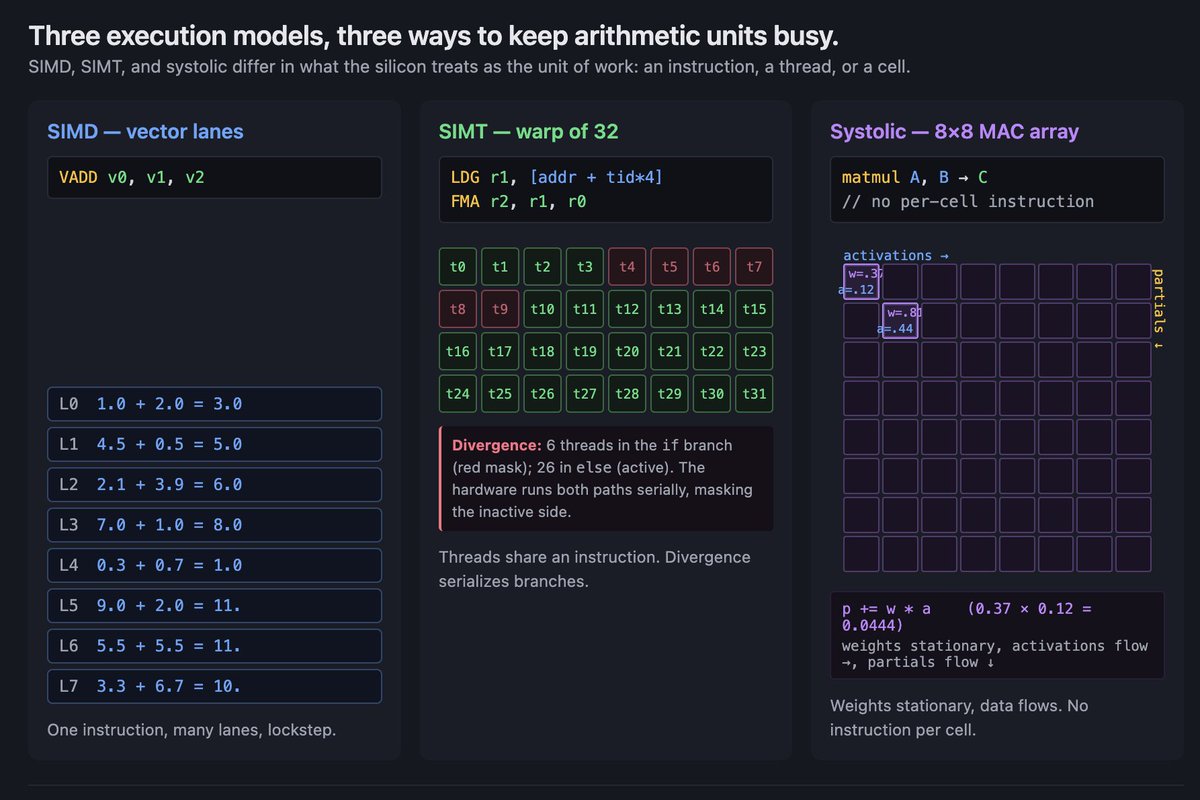
The Google Arc

Google 这条线

Note: This was all written before I started at google based on my notes on TPU while preparing. All open source data all fresh from my notes then written in a format folks could actually understand, instead of just my rants.

说明:这些内容都是我加入 Google 前写的,基于我准备期间关于 TPU 的笔记。所有开放数据都来自当时的新鲜笔记,然后我把它写成了人们真的能读懂的形式,而不是我的碎碎念。

TPU fundamentals primer

TPU 基础入门

A TPU chip is a small number of big blocks, not a grid of small blocks. Read that sentence again before we go into the generations. It's the single most important mental model shift.

TPU 芯片是一小组大块,而不是许多小块组成的网格。在进入各代之前,把这句话再读一遍。它是最重要的心智模型切换。

A v5p chip has two TensorCores. An Ironwood chip has two as well. A Trillium chip has two on a dual-chiplet package. The count is small on purpose. Each TensorCore is a big machine built around one dominant unit, the MXU, surrounded by a vector unit, a scalar unit, and local memory.

一颗 v5p 芯片有两个 TensorCores。一颗 Ironwood 芯片也有两个。Trillium 芯片在 dual-chiplet package 上也有两个。数量少是有意的。每个 TensorCore 都是一台围绕一个主导单元构建的大机器,这个主导单元就是 MXU,旁边围着 vector unit、scalar unit 和 local memory。

The MXU is a systolic array. On v4 and v5e it's 128×128. On v5p it's still 128×128 per chip but the chip has more of them (two MXUs per TensorCore). On Trillium it jumped to 256×256. The MXU is what does dense matrix math. Its dataflow is a variant of weight-stationary, which means the weights sit in place and activations flow through. Once you've loaded weights, you stream activations across the grid and accumulated results pour out the other side. The throughput is absurd when the tile fits the grid. The cost is that everything has to be shaped for the MXU, or the MXU does nothing useful.

MXU 是一个 systolic array。在 v4 和 v5e 上,它是 128×128。在 v5p 上,每芯片仍是 128×128,但芯片里有更多这样的阵列,每个 TensorCore 有两个 MXU。在 Trillium 上,它跳到了 256×256。MXU 做的是密集矩阵数学。它的 dataflow 是 weight-stationary 的一种变体,意思是 weights 停在原地,activations 从中流过。一旦加载了 weights,你就让 activations 穿过网格,累加结果从另一侧流出。tile 适配网格时,吞吐极其夸张。代价是,一切都必须被塑造成适合 MXU 的形状,否则 MXU 就做不了有用的事。

The vector unit (VPU) is what catches everything the MXU can't do. Elementwise operations, reductions, softmax interior, layer norm math, activation functions. It's a SIMD-style unit with its own register file and its own lane count. Every TPU kernel story eventually routes through the interaction between MXU and VPU: the MXU does the matmul, the VPU does the nonlinearity, and the compiler stitches the two together with explicit data movement.

vector unit(VPU)接住 MXU 做不了的一切。Elementwise operations、reductions、softmax interior、layer norm math、activation functions。它是 SIMD-style unit,有自己的 register file 和自己的 lane count。每个 TPU kernel 故事最终都会经过 MXU 和 VPU 的互动:MXU 做 matmul,VPU 做 nonlinearity,编译器用显式数据移动把两者缝起来。

The scalar unit handles control flow, address generation, and the handful of operations that can't be expressed in the vector or matrix units. It's small. The point of the TPU architecture is that most of the silicon goes to the MXU.

scalar unit 处理控制流、地址生成,以及少数无法表达为 vector 或 matrix units 的操作。它很小。TPU 架构的重点是,把大部分硅面积给 MXU。

Memory on a TPU does not look like GPU memory. There is no hardware-managed L1 or L2 cache. Instead, each chip has VMEM (Vector Memory), a large software-managed SRAM scratchpad. On v5e, VMEM is 128 MiB per chip. On later generations it scales up. The compiler is responsible for staging data from HBM into VMEM, and from VMEM into the MXU and VPU register files. That's not a detail to hide later; it's the defining feature of the platform.

TPU 上的内存不像 GPU 内存。这里 没有硬件管理的 L1 或 L2 cache。相反,每颗芯片有 VMEM(Vector Memory),这是一块大的软件管理 SRAM scratchpad。在 v5e 上,每芯片 VMEM 是 128 MiB。后续几代会继续扩展。编译器负责把数据从 HBM 暂存到 VMEM,再从 VMEM 放进 MXU 和 VPU register files。这个细节不能留到后面再藏起来;它是这个平台的定义性特征。

The sharpest consequence is arithmetic intensity for anything that misses VMEM. On v5e, the ridge point from HBM is roughly 240 FLOPs per byte, and the ridge point from VMEM is substantially lower, something like an order of magnitude lower. That means if you can keep a tile resident in VMEM and reuse it, you need much less arithmetic intensity to stay compute-bound. If you have to reload from HBM every operation, you need much more. Every optimization story on a TPU is, in one way or another, a story about keeping data resident in VMEM for as long as possible.

最尖锐的后果,是任何 miss VMEM 的东西都会受到算术强度约束。在 v5e 上,来自 HBM 的 ridge point 大约是每字节 240 FLOPs,而来自 VMEM 的 ridge point 低得多,大概低一个数量级。这意味着,如果你能让一个 tile 常驻 VMEM 并复用它,就只需要低得多的算术强度,也能保持 compute-bound。如果每个操作都必须从 HBM 重新加载,你就需要高得多。TPU 上的每个优化故事,都以这样或那样的方式,讲的是如何让数据尽可能长时间常驻 VMEM。

Batch size is where this bites first-time users. On v5e, you need a batch of roughly 240 tokens per replica in BF16 to get above the HBM ridge point. With int8 activations and bf16 weights, that drops to around 120. Below those thresholds, the MXU sits idle while HBM refills. GPUs degrade gracefully as batch size shrinks. TPUs fall off a cliff. The fix is not to tune the kernel harder. It's to redesign the parallelism strategy so the per-replica batch is big enough, or to use smaller precision.

batch size 是新用户最先被咬到的地方。在 v5e 上,BF16 下每个 replica 需要大约 240 个 token 的 batch,才能超过 HBM ridge point。使用 int8 activations 和 bf16 weights 时,会降到大约 120。低于这些阈值,MXU 会在 HBM 重新填充时闲着。GPU 会随着 batch size 缩小而平滑退化。TPU 会掉下悬崖。修复方式不是更用力地调 kernel,而是重新设计 parallelism strategy,让 per-replica batch 足够大,或者使用更小精度。

ICI (Inter-Chip Interconnect) is the TPU's equivalent of NVLink, but flatter and denser. On v5p, ICI is 4.8 Tbps per chip and chips are wired in a 3D torus. A full pod is 8,960 chips. On Ironwood, ICI is 9.6 Tbps per chip and a pod is 9,216 chips. The important thing about ICI is that it's a torus, not a fat tree. Every chip has local neighbors. Collective operations that map well to a torus (all-reduce, ring-based all-gather) fly. Operations that need global any-to-any either use Optical Circuit Switching to reshape the torus on the fly, or they cost you.

ICI(Inter-Chip Interconnect)是 TPU 对应 NVLink 的东西,但更扁平,也更密。在 v5p 上,每芯片 ICI 是 4.8 Tbps,芯片以 3D torus 连接。一个完整 pod 是 8,960 颗芯片。在 Ironwood 上,每芯片 ICI 是 9.6 Tbps,一个 pod 是 9,216 颗芯片。ICI 的重要之处在于,它是 torus,不是 fat tree。每颗芯片都有本地邻居。能很好映射到 torus 的 collective operations,比如 all-reduce、ring-based all-gather,会飞快。需要 global any-to-any 的操作,要么用 Optical Circuit Switching 动态重塑 torus,要么就要付出代价。

SparseCore is a separate execution unit that sits alongside the TensorCores on v4 onward. It's designed for operations the MXU is terrible at: sparse embeddings, gather-scatter, hash-table-heavy workloads. v5p has four SparseCores per chip. Each SparseCore has its own vector and scalar subcores and shared vector SRAM. Recommender systems live on SparseCore. So do large-vocab embeddings in LMs.

SparseCore 是 v4 之后位于 TensorCores 旁边的独立执行单元。它为 MXU 极不擅长的操作设计:sparse embeddings、gather-scatter、hash-table-heavy workloads。v5p 每芯片有四个 SparseCores。每个 SparseCore 有自己的 vector 和 scalar subcores,以及 shared vector SRAM。推荐系统活在 SparseCore 上。LM 中的大词表 embeddings 也一样。

That's enough. Every TPU generation below is a variation on this structure. Count MXUs. Count TensorCores. Measure VMEM. Measure HBM. Measure ICI. Pay attention to whether the MXU grew, shrank, or stayed put.

这些够了。下面每一代 TPU 都是这个结构的变体。数 MXU。数 TensorCores。量 VMEM。量 HBM。量 ICI。注意 MXU 是变大、变小,还是保持不变。
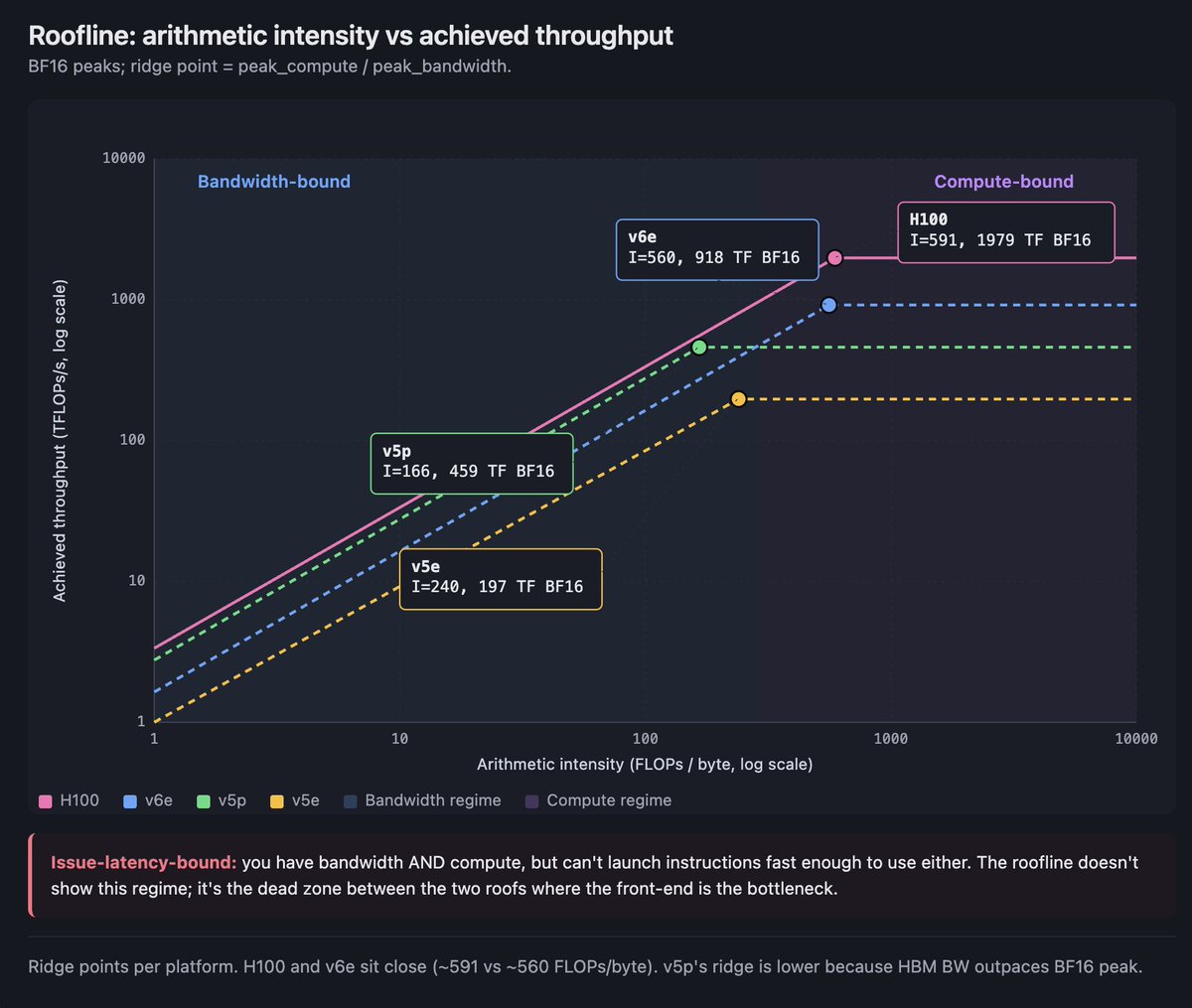
TPU v1: the philosophy paper

TPU v1:哲学论文

I don't want to do a product tour for v1. It was an inference-only chip that shipped in 2015 and had a 256×256 MAC array, 24 MiB of on-chip memory called the Unified Buffer, and a deterministic execution model. The specs aren't the point.

我不想把 v1 写成产品巡礼。它是一颗 2015 年出货的 inference-only chip,有一个 256×256 MAC array,24 MiB 的片上内存,叫 Unified Buffer,还有确定性执行模型。规格不是重点。

The point is the paper the Google team wrote about it in 2017, titled "In-Datacenter Performance Analysis of a Tensor Processing Unit." It is, as far as I can tell, the single MOST consequential architecture paper of the last decade, and it's not because of the chip's performance. It's because the paper stated an aggressive position: caches are bad, out-of-order execution is bad, SMT is bad, speculation is bad, branch prediction is bad, hardware prefetching is bad, every form of latency-hiding dynamism is bad. All of it is silicon spent on making unpredictable code look fast. ML workloads aren't unpredictable. Every byte of silicon you spend on dynamism is a byte you didn't spend on arithmetic units.

重点是 Google 团队在 2017 年写的那篇论文,题为 "In-Datacenter Performance Analysis of a Tensor Processing Unit." 在我看来,它是过去十年里最有后果的架构论文,没有之一,而原因并不是这颗芯片的性能。原因是这篇论文提出了一个激进立场:caches 是坏的,out-of-order execution 是坏的,SMT 是坏的,speculation 是坏的,branch prediction 是坏的,hardware prefetching 是坏的,一切 latency-hiding dynamism 都是坏的。 这些全是为了让不可预测代码看起来很快而花掉的硅面积。ML 工作负载并不可预测。你花在动态性上的每一字节硅,都是没有花在算术单元上的一字节硅。

That's the argument. It's still the lineage's north star and I couldnt agree more. If you want to know why TPUs look the way they do in 2026, start with the 2017 paper.

这就是论点。它至今仍是这条谱系的北极星,我完全同意。如果你想知道 2026 年的 TPU 为什么长这样,就从 2017 年那篇论文开始。

The deterministic execution part is the tail-latency argument. If every operation is scheduled ahead of time and the hardware has no dynamism, every run of the same program takes the same number of cycles. That's irrelevant for training (throughput matters, not tail latency) but it's extremely relevant for inference serving. A deterministic accelerator has no p99 latency spike from a scheduling hiccup.

确定性执行部分,是 tail-latency 论点。如果每个操作都提前调度,硬件没有动态性,那么同一程序每次运行都会花同样数量的 cycles。这对训练来说无关紧要,训练看吞吐,不看 tail latency;但对 inference serving 极其重要。确定性加速器不会因为一次调度抖动产生 p99 latency spike。

v1 was an inference chip and its deterministic story was aimed at inference. v4 onward made the same argument work for training.

v1 是推理芯片,它的确定性故事面向推理。v4 之后,同一个论点也开始适用于训练。

v4 and v5p: the road to Ironwood

v4 和 v5p:通往 Ironwood 的路

I'll merge v4 and v5p into one arc because they're the same story told twice, bigger the second time. I'll acknowledge v2 and v3 first so you don't wonder about them: v2 brought BF16 and the dual-TensorCore layout that every subsequent chip keeps. v3 scaled up the MXU array and added liquid cooling. Neither of those is the anchor. v4 is where things got interesting again.

我会把 v4 和 v5p 合并成一条线,因为它们讲的是同一个故事,第二次更大而已。先承认 v2 和 v3,这样你不会疑惑:v2 带来了 BF16 和双 TensorCore layout,后续每颗芯片都保留了它。v3 扩大了 MXU array,并加入液冷。二者都不是锚点。v4 才是事情再次变有趣的地方。

v4 introduced two features that reshaped what a TPU pod could be. The first is SparseCore. About 5% of the v4 die area is given over to a separate engine that does gather-scatter and embedding operations at rates the MXU can't touch. On embedding-heavy workloads, SparseCore delivers 5–7× speedups over running the same work on the MXU. It's the first TPU feature that isn't a pure matmul accelerator.

v4 引入了两个重塑 TPU pod 的功能。第一个是 SparseCore。v4 大约 5% 的 die area 给了一个独立引擎,用来做 gather-scatter 和 embedding operations,速度是 MXU 无法企及的。在 embedding-heavy workloads 上,SparseCore 相比在 MXU 上跑同样工作能带来 5–7× speedups。它是第一个不是纯 matmul accelerator 的 TPU 功能。

The second, and the bigger one structurally, is Optical Circuit Switching (OCS). OCS lets Google reconfigure the interconnect topology of a pod at provisioning time. The physical fabric is a 3D torus made of optical switches, and the switches can be reprogrammed to connect different chips to different neighbors. That has two consequences. First, it makes pods reconfigurable for workload-specific topologies, so a job that benefits from a 2D slice can get one without wiring a separate fabric. Second, it makes the fabric fault-tolerant: if a chip fails, OCS routes around it and the pod keeps running with one fewer chip. For a fabric that's supposed to have 8,000+ chips synchronized, that resilience is not a nice-to-have. It's a requirement.

第二个,也是结构上更大的,是 Optical Circuit Switching(OCS)。OCS 允许 Google 在 provisioning time 重新配置 pod 的 interconnect topology。物理 fabric 是由光交换机组成的 3D torus,这些交换机可以重新编程,把不同芯片连接到不同邻居。这带来两个后果。第一,它让 pods 可以针对 workload-specific topologies 重新配置,所以一个受益于 2D slice 的 job 可以拿到一个,而不必布一套独立 fabric。第二,它让 fabric 具备容错性:如果一颗芯片失败,OCS 可以绕开它,pod 以少一颗芯片的状态继续运行。对一个需要同步 8,000+ 颗芯片的 fabric 来说,这种韧性不是锦上添花,而是要求。

v4 also introduced twisted torus topologies, which are small topological tricks that reduce the worst-case latency for all-to-all collectives. Standard torus has a worst-case hop count proportional to the side length. Twisted torus halves it. It's the kind of detail that matters a lot for real-world MFU and not at all to anyone who hasn't run collectives at scale.

v4 还引入了 twisted torus topologies,也就是一些小的拓扑技巧,用来降低 all-to-all collectives 的最坏情况延迟。标准 torus 的最坏 hop count 与边长成正比。twisted torus 把它砍半。这种细节对真实世界的 MFU 很重要,但对没在大规模跑过 collectives 的人完全不重要。

v5p is v4 scaled up. It's still 3D torus. It's still SparseCore-enabled. The pod grew from v4's 4,096 chips to 8,960. Each chip has 2 TensorCores, 4 SparseCores, 95 GB of HBM at 2.76 TB/s per chip, and 4.8 Tbps of ICI per chip. The MXU is still 128×128 per chip but there are more of them, so the peak BF16 per chip is 459 TFLOPS.

v5p 是放大版 v4。仍然是 3D torus。仍然启用 SparseCore。pod 从 v4 的 4,096 颗芯片增长到 8,960。每颗芯片有 2 个 TensorCores、4 个 SparseCores、95 GB HBM,每芯片带宽 2.76 TB/s,以及每芯片 4.8 Tbps ICI。MXU 每芯片仍是 128×128,但数量更多,所以每芯片 BF16 峰值是 459 TFLOPS。

The SparseCore payoff worth citing: Google's own framing on v5p is that second-generation SparseCores speed up embedding-dense model training by around 1.9×. That's embedding-heavy workloads broadly, not MoE specifically. If you're training a recommender or an LM with a very large vocabulary, SparseCore is doing nontrivial work for you whether you asked for it or not.

SparseCore 的收益值得引用:Google 对 v5p 的官方表述是,第二代 SparseCores 让 embedding-dense model training 加速约 1.9×。这是广义的 embedding-heavy workloads,不是专指 MoE。如果你在训练 recommender,或者带非常大词表的 LM,不管你有没有特意要求,SparseCore 都在为你做非平凡的工作。

v5p is the generation that made trillion-parameter training routine inside Google. If you've read about Gemini training at the petaflop scale, v5p is the hardware that did the work.

v5p 是 Google 内部让 trillion-parameter training 变成常规操作的一代。如果你读到过 Gemini 以 petaflop 规模训练,v5p 就是干这活的硬件。

Trillium / v6e: the economics generation

Trillium / v6e:经济性的一代

Trillium is where the TPU story became a customer-acquisition story. The thesis is that Trillium optimized for cost per token, not peak FLOPs, and it's paying off in adoption.

Trillium 是 TPU 故事变成客户获取故事的地方。核心判断是,Trillium 优化的是每 token 成本,而不是峰值 FLOPs,并且这正在转化为采用率。

The spec sheet, on its own, is interesting but not dramatic. 918 TFLOPS of BF16 per chip, 1,836 TOPS of INT8, 32 GB of HBM at 1.64 TB/s per chip, 3.2 Tbps of ICI per chip, 256-chip 2D torus slices. The MXU expanded to 256×256, which quadruples the per-cycle MAC count per array.

规格表本身有趣,但不戏剧性。每芯片 918 TFLOPS BF16、1,836 TOPS INT8、32 GB HBM,每芯片带宽 1.64 TB/s、每芯片 3.2 Tbps ICI、256-chip 2D torus slices。MXU 扩展到 256×256,这让每个 array 每 cycle 的 MAC count 变成四倍。

The design decisions around those numbers are where the story lives.

围绕这些数字的设计决策,才是故事所在。

First, the MXU jump to 256×256. That's a 4× increase in MAC count per cycle, which drives the per-chip peak up by roughly the same factor over v5e. The cost is a padding tax. If your matmul tiles don't divide evenly by 256 on both axes, you waste cycles. Kernel authors on Trillium think harder about tile shapes than they did on v5p. The compiler does a lot of the padding, but the tax is real.

第一,MXU 跳到 256×256。这让每 cycle MAC count 增加 4×,也把相对于 v5e 的每芯片峰值推高了大致同样倍数。代价是 padding tax。如果你的 matmul tiles 不能在两个轴上都被 256 整除,就会浪费 cycles。Trillium 上的 kernel 作者比在 v5p 上更认真地思考 tile shapes。编译器会做很多 padding,但税是真实存在的。

Second, the HBM capacity reduction. Trillium has 32 GB per chip, where v5p had 95 GB. That's not a regression; it's a deliberate bet. Trillium's pod topology (256-chip 2D torus slices with strong ICI) is designed to absorb the tensor-parallel and model-parallel sharding that you'd otherwise pay for with local capacity. Instead of keeping big weight shards on each chip, you shard across more chips and use ICI to serve the shards. It's a fabric-first memory hierarchy, not a capacity-first one.

第二,HBM 容量下降。Trillium 每芯片 32 GB,而 v5p 有 95 GB。这不是倒退,而是有意选择。Trillium 的 pod topology,也就是带强 ICI 的 256-chip 2D torus slices,旨在吸收你原本需要用本地容量支付的 tensor-parallel 和 model-parallel sharding。不是把大 weight shards 保存在每颗芯片上,而是跨更多芯片 sharding,并用 ICI 服务这些 shards。它是 fabric-first memory hierarchy,不是 capacity-first。

Third, the power story. Trillium's TDP is not a public number I'll quote, but the published 67% energy-efficiency gain over v5e is clean Google data. Efficiency is the axis Trillium bet on, and it's the axis that matters most for inference deployments where every watt hits your per-token cost directly.

第三,功耗故事。Trillium 的 TDP 不是我会引用的公开数字,但已发布的 相比 v5e 能效提升 67% 是干净的 Google 数据。效率是 Trillium 押注的轴线,也是对推理部署最重要的轴线,因为每一瓦都会直接打到你的 per-token cost 上。

Ironwood / v7: the anchor generation

Ironwood / v7:锚点世代

Ironwood is the TPU side's answer to Blackwell. The headline is familiar. 4.614 PFLOPS of FP8 per chip, 192 GB of HBM3e at 7.37 TB/s per chip, 9.6 Tbps of ICI per chip (1.2 TB/s aggregate). Per-chip, Ironwood and B200 are in the same neighborhood on peak FP8. That's the boring part.

Ironwood 是 TPU 侧对 Blackwell 的回答。标题很熟悉。每芯片 4.614 PFLOPS FP8、192 GB HBM3e,每芯片带宽 7.37 TB/s、每芯片 9.6 Tbps ICI,也就是 1.2 TB/s aggregate。按单芯片看,Ironwood 和 B200 在 peak FP8 上处在同一个邻域。这是无聊的部分。

The interesting part is the fabric. Ironwood's pod is 9,216 chips in a 3D torus, wired through OCS. Pod-level peak is ~42.5 ExaFLOPS. Pod-level aggregate HBM is 1.77 PB. Every chip in the pod is part of one synchronized fabric with ICI latencies measured in hundreds of nanoseconds, not microseconds.

有趣的是 fabric。Ironwood 的 pod 是 9,216 颗芯片组成的 3D torus,通过 OCS 连接。pod-level peak 大约是 42.5 ExaFLOPS。pod-level aggregate HBM 是 1.77 PB。pod 里的每颗芯片都是同一个同步 fabric 的一部分,ICI latency 以数百纳秒计,而不是微秒。

Compare to Blackwell. NVLink 5 at 1.8 TB/s per GPU. NVL72 at 72 GPUs, NVL144 at 144, both in all-to-all domains. Beyond NVL144, the scale has to go through InfiniBand or Ethernet, which drops you from 1.8 TB/s to a few hundred gigabits, and the latency goes up by more than an order of magnitude.

和 Blackwell 对比。NVLink 5 每 GPU 1.8 TB/s。NVL72 是 72 个 GPU,NVL144 是 144 个,二者都在 all-to-all domains 中。超过 NVL144 后,规模必须经过 InfiniBand 或 Ethernet,这会让你从 1.8 TB/s 降到几百 gigabits,latency 也上升超过一个数量级。

Ironwood's 9,216 is 64× the size of NVL144. That's not a small number. Every parallelism decision changes at 64× fabric scale. Tensor-parallel groups can be larger before ICI becomes the bottleneck. Sharding strategies that require all-to-all communication are practical at scales where they'd be fatal on a GPU cluster. Pipeline parallelism, which exists to paper over inter-node latency, becomes less necessary because the "inter-node" penalty is much smaller.

Ironwood 的 9,216 是 NVL144 的 64×。这不是一个小数字。在 64× fabric scale 下,每个 parallelism decision 都会改变。在 ICI 成为瓶颈之前,tensor-parallel groups 可以更大。需要 all-to-all communication 的 sharding strategies,在 GPU cluster 上致命的规模,在这里会变得可行。pipeline parallelism 原本是为了掩盖 inter-node latency 而存在的,但由于“inter-node” penalty 小得多,它变得没那么必要。

Beyond the pod, Google's Jupiter fabric is the data-center-scale network that connects pods. Jupiter carries roughly 13.1 Pb/s of bisection bandwidth across 100,000+ servers per fabric, and Google runs hundreds of such fabrics globally. It is not a single multi-data-center network, as some secondary sources occasionally imply. It's a per-fabric bisection number that applies inside one data-center deployment. But there are many deployments and the aggregate is enormous.

pod 之外,Google 的 Jupiter fabric 是连接 pods 的数据中心级网络。Jupiter 在每个 fabric 内跨 100,000+ servers 承载大约 13.1 Pb/s 的 bisection bandwidth,Google 在全球运行着数百个这样的 fabrics。它不是某些二手来源偶尔暗示的单一多数据中心网络。它是一个 per-fabric bisection number,适用于一个数据中心部署内部。但这样的部署有很多,总量非常巨大。

Ironwood also supports microscaling precision formats analogous to MXFP8, which closes the gap on Blackwell's lower-precision story. The bigger architectural shift is that Ironwood's TensorCore has more flexibility in how tiles are fed, how the MXU composes with the VPU, and how the compiler can schedule bundles to keep the pipeline full. I won't go into every micro-optimization. The headline is: FP8 is native, HBM3e matches or beats Blackwell's per-chip bandwidth, and the fabric is the dominant differentiator.

Ironwood 也支持类似 MXFP8 的 microscaling precision formats,从而补上 Blackwell 低精度故事的差距。更大的架构变化是,Ironwood 的 TensorCore 在 tile 如何被喂入、MXU 如何与 VPU 组合、编译器如何调度 bundles 来保持 pipeline 满载方面更灵活。我不会展开每个微优化。标题是:FP8 是原生的,HBM3e 匹配或超过 Blackwell 的每芯片带宽,而 fabric 是主导性差异。

If you take one thing from here, make it the fabric comparison. 9,216 versus 144. 64× in a single synchronized domain. Every other spec converges between the two vendors. The fabric doesn't.

如果你从这里带走一件事,就带走 fabric comparison。9,216 对 144。单个同步 domain 内 64×。其他每个规格都在两家厂商之间收敛。fabric 没有。

The TPU arc

TPU 这条线

Five generations, five sentences. v1 proved the thesis that ML accelerators should strip dynamism and spend silicon on arithmetic units. v4 made it a supercomputer with SparseCore and OCS. v5p scaled to trillion-parameter training without anything in the architecture breaking. Trillium made it cheap by betting on economics over headline FLOPs. Ironwood made it frontier by catching up on FP8 and extending the fabric advantage to 64× the NVLink-domain scale.

五代,用五句话。v1 证明了这个论点:ML accelerators 应该剥掉动态性,把硅面积花在算术单元上。v4 把它变成了超级计算机,通过 SparseCore 和 OCS。v5p 扩展到 trillion-parameter training,并且架构没有断。Trillium 让它便宜,通过押注经济性而不是 headline FLOPs。Ironwood 让它进入前沿,通过赶上 FP8,并把 fabric advantage 扩展到 NVLink-domain scale 的 64×。

Stated as one trajectory: the TPU lineage has been betting that compiler-scheduled determinism, systolic matrix density, and fabric-first scale compound more productively than SIMT flexibility, cache hierarchies, and per-node optimization. The bet is paying off at frontier scale. Article 2 will explain why the bet also pays off at kernel-author scale, which is where the conventional wisdom says GPUs should win.

把这条线合成一个轨迹:TPU 谱系一直在下注,认为 compiler-scheduled determinism、systolic matrix density 和 fabric-first scale,比 SIMT flexibility、cache hierarchies 和 per-node optimization 更能产生复利。在前沿规模上,这个下注正在兑现。Article 2 会解释为什么这个下注在 kernel-author scale 上也会兑现,而按传统看法,那里本该是 GPU 赢的地方。

import triton
import triton.language as tl

@triton.jit
def matmul_kernel(
    a_ptr, b_ptr, c_ptr,
    M, N, K,
    stride_am, stride_ak,
    stride_bk, stride_bn,
    stride_cm, stride_cn,
    BLOCK_M: tl.constexpr,
    BLOCK_N: tl.constexpr,
    BLOCK_K: tl.constexpr,
):
    pid_m = tl.program_id(0)
    pid_n = tl.program_id(1)

    offs_m = pid_m * BLOCK_M + tl.arange(0, BLOCK_M)
    offs_n = pid_n * BLOCK_N + tl.arange(0, BLOCK_N)
    offs_k = tl.arange(0, BLOCK_K)

    a_ptrs = a_ptr + offs_m[:, None] * stride_am + offs_k[None, :] * stride_ak
    b_ptrs = b_ptr + offs_k[:, None] * stride_bk + offs_n[None, :] * stride_bn

    acc = tl.zeros((BLOCK_M, BLOCK_N), dtype=tl.float32)
    for k in range(0, K, BLOCK_K):
        a = tl.load(a_ptrs)
        b = tl.load(b_ptrs)
        acc += tl.dot(a, b)
        a_ptrs += BLOCK_K * stride_ak
        b_ptrs += BLOCK_K * stride_bk

    c_ptrs = c_ptr + offs_m[:, None] * stride_cm + offs_n[None, :] * stride_cn
    tl.store(c_ptrs, acc.to(tl.float16))
import triton
import triton.language as tl

@triton.jit
def matmul_kernel(
    a_ptr, b_ptr, c_ptr,
    M, N, K,
    stride_am, stride_ak,
    stride_bk, stride_bn,
    stride_cm, stride_cn,
    BLOCK_M: tl.constexpr,
    BLOCK_N: tl.constexpr,
    BLOCK_K: tl.constexpr,
):
    pid_m = tl.program_id(0)
    pid_n = tl.program_id(1)

    offs_m = pid_m * BLOCK_M + tl.arange(0, BLOCK_M)
    offs_n = pid_n * BLOCK_N + tl.arange(0, BLOCK_N)
    offs_k = tl.arange(0, BLOCK_K)

    a_ptrs = a_ptr + offs_m[:, None] * stride_am + offs_k[None, :] * stride_ak
    b_ptrs = b_ptr + offs_k[:, None] * stride_bk + offs_n[None, :] * stride_bn

    acc = tl.zeros((BLOCK_M, BLOCK_N), dtype=tl.float32)
    for k in range(0, K, BLOCK_K):
        a = tl.load(a_ptrs)
        b = tl.load(b_ptrs)
        acc += tl.dot(a, b)
        a_ptrs += BLOCK_K * stride_ak
        b_ptrs += BLOCK_K * stride_bk

    c_ptrs = c_ptr + offs_m[:, None] * stride_cm + offs_n[None, :] * stride_cn
    tl.store(c_ptrs, acc.to(tl.float16))

Where the Arcs Collide

两条线在哪里相撞

We've walked both sides. Now let me name the places where the two arcs look less like parallel stories and more like different answers to the same question.

我们已经走完两边。现在,我来点出那些地方。在那里,两条线看起来不再像平行故事,而更像是对同一个问题给出的不同答案。

Memory hierarchy divergence, by addition. GPU memory hierarchies have been adding near-math tiers every generation. SMEM on early Volta. L1-combined SMEM on Ampere. Distributed Shared Memory on Hopper. Tensor Memory on Blackwell. Every tier is closer to the math than the one before. TPUs have had VMEM from the start. The TPU didn't need to add a new near-math tier; it was designed around one. What GPU architects have been building is a version of VMEM, one level at a time, inside the SIMT model.

内存层级分歧,通过增加发生。 GPU memory hierarchies 每一代都在 增加 near-math tiers。早期 Volta 上的 SMEM。Ampere 上 L1-combined SMEM。Hopper 上的 Distributed Shared Memory。Blackwell 上的 Tensor Memory。每一层都比前一层更靠近数学。TPU 从一开始就有 VMEM。TPU 不需要增加新的 near-math tier;它本来就是围绕这个东西设计的。GPU 架构师一直在构建的,是 SIMT 模型内部逐层形成的某种 VMEM。

Movement divergence, by admission. TMA on Hopper is NVIDIA acknowledging that descriptor-driven async transfers are how data has to move at Tensor Core throughput. That was how data always moved on TPU, because the compiler, not the threads, did the scheduling. The Hopper descriptor model (source tensor shape, destination SMEM layout, swizzle, OOB fill, mbarrier gate) is a descendant of the kind of scheduling Mosaic has always produced for the MXU.

移动分歧,通过承认发生。 Hopper 上的 TMA,是 NVIDIA 承认 descriptor-driven async transfers 才是在 Tensor Core throughput 下移动数据的方式。TPU 上的数据一直就是这样移动的,因为做调度的是编译器,不是线程。Hopper descriptor model,包括 source tensor shape、destination SMEM layout、swizzle、OOB fill、mbarrier gate,是 Mosaic 一直为 MXU 生成的那类调度的后代。

Execution-model divergence, by decoupling. Blackwell's tcgen05 decouples Tensor Cores from the warp scheduler. The warp is no longer in the loop for the dense arithmetic. That's a structural shift toward treating the matrix engine as a cooperating block with its own issue path. On TPU, the MXU never had a warp scheduler in the first place. The compiler feeds the array a tile, the array rhythm does the math, the result lands where the compiler told it to land. NVIDIA is incrementally making Tensor Cores behave more like a systolic pipeline, inside a model that still presents threads to the programmer.

执行模型分歧,通过解耦发生。 Blackwell 的 tcgen05 把 Tensor Cores 从 warp scheduler 中解耦出来。warp 不再参与 dense arithmetic 的循环。这是一次结构性变化,让矩阵引擎更像一个有自己 issue path 的协作块。在 TPU 上,MXU 从一开始就没有 warp scheduler。编译器给阵列喂一个 tile,阵列节奏完成数学,结果落到编译器指定的位置。NVIDIA 正在逐步让 Tensor Cores 更像 systolic pipeline,同时仍在向程序员呈现线程模型。

Scale divergence, by fabric. NVL72 at 72 GPUs, NVL144 at 144. Ironwood at 9,216 chips in a single OCS-switched torus. That's 64× in a synchronized domain. Every parallelism decision at frontier scale hinges on that ratio. It's the one axis where the two arcs haven't converged, and it's the axis where the design philosophies diverge most clearly. NVIDIA's fabric grew from 8 to 144 and has InfiniBand beyond that. Google's fabric grew from hundreds to thousands in one synchronized OCS torus, with Jupiter beyond that.

规模分歧,通过 fabric 发生。 NVL72 是 72 个 GPU,NVL144 是 144 个。Ironwood 是单个 OCS-switched torus 中的 9,216 颗芯片。这是同步 domain 内的 64×。前沿规模上的每个 parallelism decision 都取决于这个比例。这是两条线尚未收敛的一条轴,也是设计哲学分歧最清楚的一条轴。NVIDIA 的 fabric 从 8 增长到 144,之后是 InfiniBand。Google 的 fabric 从数百增长到数千,仍在一个同步 OCS torus 中,之后是 Jupiter。
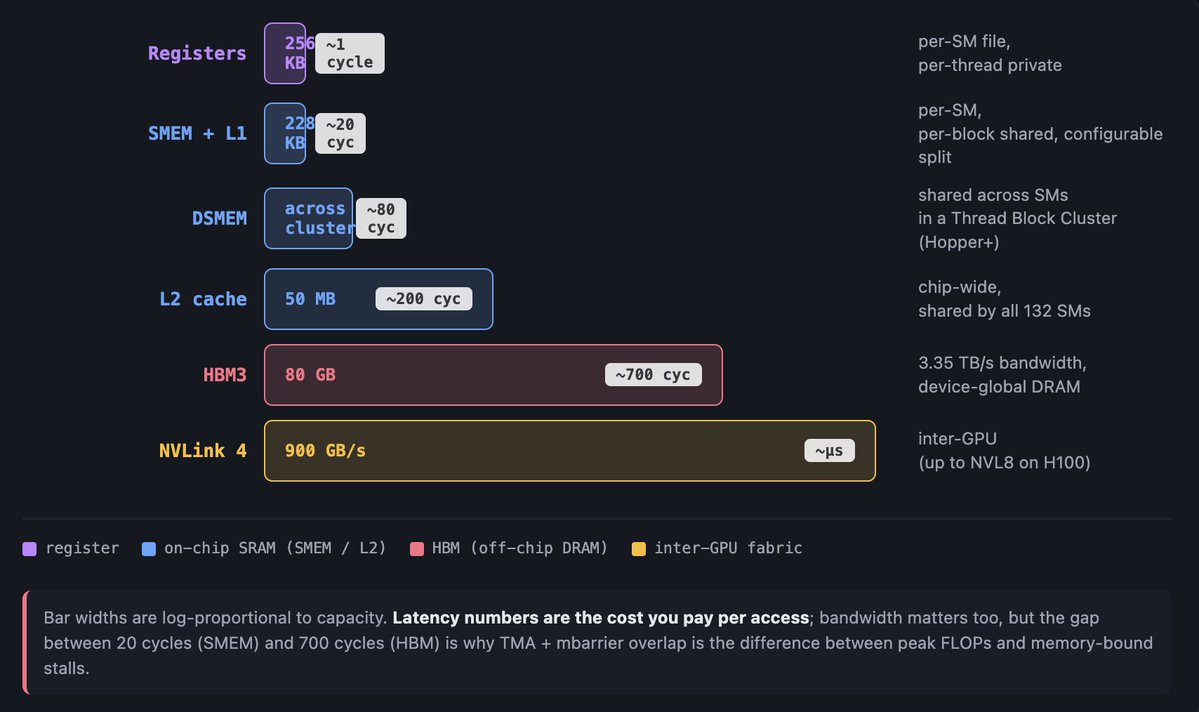
Precision convergence, by multiple paths. Both stacks are landing at FP8 as the canonical training precision, with microscaling formats (NVFP4, MXFP8) as the next step down. Blackwell got there by iterating on the Transformer Engine from Hopper. Ironwood got there by jumping directly to FP8 native as the generation that catches up. Different paths, same destination.

精度收敛,通过多条路径发生。 两套栈都在落向 FP8,把它作为标准训练精度,下一步是 microscaling formats,比如 NVFP4、MXFP8。Blackwell 通过从 Hopper 的 Transformer Engine 迭代到达那里。Ironwood 通过直接跳到原生 FP8,到达那里并追上。路径不同,目的地相同。

And now the frontier-scale punchline, which I've been setting up since the beginning.

现在到了前沿规模的重点。这件事我从一开始就在铺垫。

PaLM 540B trained at 46.2% model FLOPs utilization on 6,144 TPU v4 chips. The PaLM paper describes it as "pipeline-free training." They ran pure data plus model (tensor) parallelism on the 3D torus. Two v4 pods, connected over DCN. No pipeline parallelism at all. The shape of the v4 fabric let them skip pipeline entirely.

PaLM 540B 在 6,144 颗 TPU v4 芯片 上训练,达到 46.2% model FLOPs utilization。PaLM 论文把它描述为“pipeline-free training”。他们在 3D torus 上运行纯 data 加 model,也就是 tensor parallelism。两个 v4 pods,通过 DCN 连接。完全没有 pipeline parallelism。v4 fabric 的形状让他们能跳过 pipeline。

Llama 3 405B trained at roughly 38–43% MFU on 16,384 H100s. The Llama 3 paper describes 4D parallelism: tensor (one matmul sharded across chips), pipeline (different layers on different chips, passing activations forward in stages), context (long sequences split across chips), and data (same model on different batches, with FSDP sharding the parameters). Four axes, because the NVLink domain couldn't hold a full tensor-parallel group by itself and the InfiniBand fabric outside NVLink couldn't absorb all-to-all at the scale they needed, and pipeline parallelism had to paper over both gaps.

Llama 3 405B 在 16,384 个 H100 上训练,MFU 大约是 38–43%。Llama 3 论文描述了 4D parallelism:tensor,一个 matmul 跨芯片 sharding;pipeline,不同 layer 放在不同芯片上,activations 按 stage 向前传;context,长序列跨芯片切分;data,同一模型跑不同 batch,并用 FSDP sharding parameters。四个轴,因为 NVLink domain 本身装不下完整 tensor-parallel group,而 NVLink 之外的 InfiniBand fabric 又无法在所需规模上吸收 all-to-all,于是 pipeline parallelism 不得不掩盖这两个缺口。

Two MFUs, close in range. One took two axes of parallelism to hit. The other took four. The reason is the shape of the bandwidth hierarchy. PaLM's v4 fabric was flat enough that data and tensor parallelism alone absorbed the compute. Llama 3's H100 fabric had a cliff between NVLink and InfiniBand, and closing that cliff required pipeline and context parallelism as workarounds.

两个 MFU 处在接近范围。一个用了两个 parallelism 轴达到。另一个用了四个。原因是 bandwidth hierarchy 的形状。PaLM 的 v4 fabric 足够平,data 和 tensor parallelism 就能吸收计算。Llama 3 的 H100 fabric 在 NVLink 和 InfiniBand 之间有一道悬崖,而填平这道悬崖需要 pipeline 和 context parallelism 作为补救。

The shape of each cluster's bandwidth hierarchy dictates the parallelism strategy you're allowed to choose. That's the frontier-scale fact.

每个 cluster 的 bandwidth hierarchy 形状,会决定你被允许选择什么 parallelism strategy。这就是前沿规模上的事实。

Hold that. Article 2 coming out TOMORROW is about whether the same shape-constrains-strategy logic plays out at kernel scale, not just at cluster scale. My claim is yes. The programming models we'll meet in Article 2 aren't neutral choices on top of these architectures. They're the architectures speaking through the software.

记住它。Article 2 明天发布,讲的是同样的 shape-constrains-strategy 逻辑是否也会在 kernel scale 上发生,而不只是在 cluster scale 上。我的判断是会。我们会在 Article 2 遇到的编程模型,不是这些架构之上的中性选择。它们是架构通过软件开口说话。

wrapping this monster up

收起这个大怪物

That's the architectural foundation. Two philosophies, five-ish generations on each side, one memory wall shaping the whole picture, one fabric gap separating the two frontiers.

这就是架构基础。两种哲学,两边各自大约五代,一堵内存墙塑造全局,一个 fabric gap 分开两个前沿。

Carry three things forward.

带着三件事继续往后读。

  1. the memory wall is the protagonist. Every acronym in this article is a different tool for keeping data near the math.
  1. 内存墙是主角。本文里的每个缩写词,都是让数据靠近数学的不同工具。
  1. SIMT and systolic are not the same bet about how to feed a matrix multiply. NVIDIA bet on productive threads and has been adding compiler-scheduled machinery underneath them for two generations. Google bet on a compiler-scheduled systolic core and has been adding flexibility around it.
  1. SIMT 和 systolic 不是同一种关于如何喂饱矩阵乘的赌注。NVIDIA 赌的是有生产力的线程,并且过去两代一直在线程下方加入 compiler-scheduled machinery。Google 赌的是 compiler-scheduled systolic core,并在它周围增加灵活性。
  1. at frontier scale the fabric is now the differentiator. 9,216 versus 144 is a 64× gap in a synchronized domain, and that ratio reshapes the parallelism strategy you're allowed to use.
  1. 在前沿规模上,fabric 已经成为差异点。9,216 对 144,是同步 domain 内的 64× 差距,而这个比例会重塑你被允许使用的 parallelism strategy。

Article 2 picks up where this one ends. We'll do the NVIDIA stack (CUDA, CUTLASS, cuDNN, Triton, frameworks) and the Google stack (XLA, StableHLO, JAX, Pallas, Mosaic, PyTorch/XLA) in the same parallel-tour shape you just read. Then the partisan case: I'll argue that composition, compiler leverage, and profiler tooling stack up to an advantage even in the place GPU was supposed to own outright, which is custom kernel authoring. Then a Triton-to-Pallas migration playbook for engineers in my position.

Article 2 会从这里接上。我们会用刚才这种平行游览的形状,讲 NVIDIA stack(CUDA、CUTLASS、cuDNN、Triton、frameworks)和 Google stack(XLA、StableHLO、JAX、Pallas、Mosaic、PyTorch/XLA)。然后进入带立场的论证:我会论证,composition、compiler leverage 和 profiler tooling 叠起来,会在 GPU 本该完全占据优势的地方,也就是 custom kernel authoring,形成优势。最后是一份给我这种位置上的工程师看的 Triton-to-Pallas migration playbook。

The move from Meta to Google happened fast and the mental-model shift happened slower. Article 2 is partly a technical argument and partly a record of that shift. Both.

从 Meta 到 Google 的转变发生得很快,但心智模型的转变慢一些。Article 2 一部分是技术论证,一部分也是这次转变的记录。两者都是。

See you there.

到那里见。

A few weeks ago I left Meta's Triton compiler team for Google's PyTorch/TPU team. The move is what you'd expect: I spent years inside the GPU stack, wrote lowerings for Hopper and Blackwell, argued about warpgroup intrinsics, wrote thousands of benchmarks + dozens of tools, and now I'm staring at systolic arrays and asking why nobody calls them that in the docs.

This is the longest piece I've ever written. It's long on purpose. I wanted something that works for four different readers at once. If you've never thought hard about ML hardware, Part 1 is yours. If you know distributed training but not accelerator architecture, Part 2A and 2B carry you through both sides without assuming the other. If you're already fluent in CUDA and just want the TPU arc, you will get a good refresh and then your TPU fix. If you write kernels or work on compilers, you'll get something out of the whole thing, and Article 2 is where the programming-model argument lives. I literally cant fit all the goodness in X's word limit on articles.

By the end of the series, I'll try to convince you that TPU is the better platform even for the thing GPUs were supposed to own outright, which is custom kernel authoring. That's a strong claim and I don't expect to win it on vibes. I will set up all your foundation below and by the end of our second article you will be convinced.

One last note before we start. I use both stacks. I still write Triton when the job calls for it or any other DSL. I still need GPUs to compare while building new ops in TPU. None of this is a religious war. It's a bet on which set of architectural choices compounds in my fact.

Why accelerators exist at all

CPUs are shaped by a bet: most programs branch a lot, access memory unpredictably, and reward low latency on a single thread. So a modern CPU core spends most of its silicon on branch predictors, out-of-order schedulers, speculation machinery, and caches that work very hard to look fast to unpredictable code. The arithmetic units are tiny in comparison. A Xeon core can do impressive FLOPs, but the FLOPs aren't where the transistors went.

Then deep learning showed up. Modern ML workloads are shaped by a different bet. The dominant operations are contractions. Matmul inside fully-connected layers, matmul inside attention, batched matmul everywhere. These operations are predictable, loop-heavy, and spend almost nothing on branching. You know the loop bounds before you run. You know the memory access pattern before you run. You know the arithmetic intensity before you run.

If you stare at this long enough, you realize the shape of the ideal hardware is almost the opposite of a CPU. You want most of the silicon doing multiplies and accumulates. You don't need a branch predictor, because you don't have branches. You don't need speculation, because nothing is uncertain. You don't need giant caches (mostly), because the access pattern is a tiling of a dense array and you can stage it by hand.

Accelerators come from taking that observation seriously. NVIDIA took one path. Google took another. Both paths start from the same root fact: the workload is dominated by a handful of contractions, so the hardware should be dominated by matrix units. Everything else on the chip exists to keep those units fed.

On a GPU, we werent even originally fucking solving for any of this. Shaders and the rest happen to be a good staging ground for the future. For GPU the answer was to start from a parallel-threads substrate that was already good at graphics, add matrix engines called Tensor Cores inside each streaming multiprocessor, and let thousands of threads cover for the latency of getting data to those units. On a TPU, the answer was to throw out most of the scheduling machinery entirely, put a huge systolic array at the center of the chip, and have the compiler choreograph data movement around it so the array never starves.

Same observation, two philosophies. The rest of the article is about what happens when those philosophies compound across generations.

One axis underneath all of this is worth naming now. CPUs optimize for latency: make one thread fast. GPUs optimize for throughput through overcommit: make enough threads that you always have work to do. TPUs optimize for throughput through determinism: schedule every operation ahead of time and keep the pipe full by construction. Latency versus throughput, and inside throughput, overcommit versus determinism. Those are the three positions every accelerator architect is forced to pick from.

The memory wall

Here's the fact that shapes every other choice in the article. Arithmetic is relatively cheap. Moving data is expensive. The gap is not small and it gets bigger every year.

A matrix multiply on a modern accelerator costs single-digit picojoules. A read from on-chip SRAM costs around an order of magnitude more than that. A read from HBM costs roughly 100× the energy of the multiply itself. A read from DRAM over the memory bus on a host CPU is another order of magnitude beyond HBM. And that's just energy. The time cost follows the same shape. The matmul is nanoseconds. The HBM access is hundreds of nanoseconds. The PCIe or NVLink trip is microseconds. The cross-datacenter hop is milliseconds.

Every architectural decision in this article is a response to that gap. You'll meet a bag of acronyms in in these articles and every one of them is a different way of saying "shorten the distance between where the data sits and where the math happens." Don't memorize the terms yet. Just know they're all answers to the same question.

You can frame the entire evolution of ML accelerators as a campaign to shorten the distance between data and math. The chip gets bigger. The memory gets closer. The network gets flatter. The compiler does more. And every generation, the ratio of FLOPs to bytes moved goes up, which means the software has to work harder to keep the machine fed.

The part that isn't obvious until you've seen it a few times: this isn't a problem you solve with more bandwidth. HBM has been getting faster every generation. It's still not fast enough. Ironwood's 7.37 TB/s of HBM3e per chip sounds absurd, until you notice the chip does over 4.6 PFLOPS of FP8, and then the ratio is still climbing. The bandwidth is not catching up. The ratio gets worse. You can't outrun the memory wall, you can only dance around it.

This is why tiling is the first thing anyone teaches when they teach kernel authoring. Tile your data. Move the tile once. Do as much math as you can on it before you move it again. Every optimization story on an accelerator eventually collapses into a data-staging story. The hardware makes the policy clear. The compilers, libraries, and handwritten kernels all end up encoding some version of the same rule: keep the data close to the arithmetic units for as long as possible, then spill it only when you absolutely have to.

Hold onto that rule. You'll see it show up later. TMA is that rule. Producer-consumer warpgroups are that rule. emit_pipeline is that rule. The torus topology is that rule. Everything in this article is a variation on that theme, because the memory wall is the thing that won't leave.

The arithmetic that matters

You can get very far with one idea from this section: arithmetic intensity is the number of floating-point operations you do for every byte you move. That's it. FLOPs per byte.

A matmul of two [N, N] matrices does on the order of 2N^3 FLOPs and moves roughly 3N^2 bytes (two inputs and one output, ignoring reuse). The arithmetic intensity scales with N. Bigger tiles, more math per byte moved, better. A pointwise add has arithmetic intensity of basically zero. You move two bytes, do one FLOP, write one byte. Bandwidth-bound no matter what.

The roofline model stitches this together. Plot arithmetic intensity on the x-axis and achieved FLOPs per second on the y-axis. You get two roofs. The flat roof is the peak compute of your chip. The sloped roof is the bandwidth ceiling: more intensity, more FLOPs per byte moved, closer to peak. Where the two roofs meet is the ridge point. Operations below the ridge are bandwidth-bound and you can't do anything about it except make the operation denser. Operations above the ridge are compute-bound and your problem is keeping the matrix units fed, not the bus.

There's a third regime nobody draws on the plot: issue-latency-bound. You have bandwidth, you have compute, but you can't launch instructions fast enough to use either. This is where GPU occupancy discipline comes from and where the TPU compiler's instruction-packing work pays off.

Concrete ridge points from HBM, because specifics make the model stick:

  • H100 SXM5: peak Tensor-Core BF16 of 1,979 TFLOPS over 3.35 TB/s of HBM3 gives a ridge point of roughly 591 FLOPs per byte.

  • TPU v5e: roughly 240 FLOPs per byte, derived the same way.

  • TPU v5p: roughly 166 FLOPs per byte. The pod scales bigger than v5e, but the ridge point is actually lower per chip because HBM bandwidth on v5p outpaces the BF16 peak.

  • TPU v6e (Trillium): roughly 560 FLOPs per byte. The big jump.

Two concrete numbers to carry forward. v5e needs a batch of around 240 tokens per replica in BF16 to sit above the ridge point from HBM. With int8 activations and bf16 weights that drops to roughly 120. On H100, you can get away with smaller effective batches because the ridge point interacts with deeper caches and more flexible scheduling. The TPU wants you to think about batch size. The GPU lets you get away with ignoring it longer, up to a point.

If you're going to remember one thing from this whole section, make it this: the ridge point tells you whether you're running a memory problem or a compute problem, and the answer changes what optimizations are allowed to help.

Precision and dtypes

The other lever you have against the memory wall is precision. Every bit you don't move is a bit you don't pay for. So accelerators have been on a steady march downward in bit-width for almost a decade.

One mental model to carry before we walk through the names. The modern trick at the small end of the scale is microscaling: you store the numbers in a small format (four or eight bits), store a separate scaling factor per small group of values, and let the hardware multiply the scale back in during the math. The storage and bandwidth are dominated by the small format. The accuracy comes from the scales. Every sub-byte format you'll see below is a variation on that trick.

Training dtypes. FP32 is the old baseline. Dense, exact, expensive. TF32 is NVIDIA's invention: 19 bits of mantissa in an FP32 range, run through Tensor Cores, used as a drop-in replacement for FP32 on Ampere. BF16 is the dominant training dtype today. 8 exponent bits like FP32, 7 mantissa bits, so it keeps range and gives up precision. Every serious training stack from PaLM to Llama to current frontier models trains in BF16 with FP32 accumulation. FP16 predates BF16 and still exists, mostly for backwards-compat and inference. The exponent is too small for training without loss-scaling gymnastics, which is why BF16 displaced it on the training side.

Inference and small-footprint dtypes. Hopper introduced FP8 in two flavors: E4M3 for forward passes and inference, E5M2 for backward passes and gradient storage. The Transformer Engine on Hopper tracks activation statistics across steps and applies a scaling factor per tensor so FP8 doesn't numerically fall over. Blackwell extended this with NVFP4 (four bits, two-level scaling) and MXFP8 (microscaling in eight bits). INT8 is the long-running inference dtype on TPU; Trillium hits 1,836 TOPS of INT8 per chip (we'll meet Trillium in §2B.3). Ironwood moved native compute to FP8. The rest of the TPU lineage stayed conservative on precision until Ironwood because Google's bet was that careful compilation could extract most of the throughput from BF16 without needing sub-byte formats.

One historical note worth carrying. Every generation that jumped precision downward also jumped in customer adoption, because memory bandwidth is the constraint people actually hit and halving the bandwidth demand is more useful than doubling the peak FLOPs. The precision story and the memory-wall story are the same story.

Three execution models

Accelerators have ended up implementing one of three execution models, and understanding all three is how you read the rest of this article without getting lost.

SIMD is the oldest. Single Instruction, Multiple Data. You have a lane count, you dispatch one instruction, every lane executes it on its own data. CPU SIMD (AVX, SSE, NEON) is this. Vector units on early GPUs were this. SIMD is lean because you share one instruction pointer across every lane, but it's rigid. If lanes need to do different things, you either mask them or you stall.

SIMT is NVIDIA's invention and the defining pattern of modern GPUs. Single Instruction, Multiple Threads. Picture a conductor leading a 32-person orchestra: one downbeat moves every musician at once, but each one reads their own part. That's SIMT. You write code that looks like it's running on a thread. The hardware groups threads into warps of 32 and runs the warp in lockstep under the hood, so it's effectively SIMD under the abstraction. But the programming model looks like threads: each one has its own program counter, its own registers, its own flow of control. When the threads in a warp need to do different things, you get warp divergence. The hardware serializes the branches, runs one path with the other lanes masked, then runs the other path. It works, but it costs throughput.

SIMT is why GPUs feel productive. You write kernels that look like parallel loops. The hardware handles the lockstep execution, the memory coalescing, the latency hiding through warp-level overcommit. You don't have to think about the physical lanes, most of the time. When you do, it's because you hit one of the sharp edges of the abstraction: warp divergence, uncoalesced memory accesses, register pressure, shared memory bank conflicts. These sharp edges are everything that makes GPU kernel optimization feel like a craft.

Systolic is the beautiful TPU answer. A systolic array is a two-dimensional grid of multiply-accumulate units wired together so that data flows through the grid like water through a mesh. Each cycle, every MAC unit takes a value from its neighbor, performs a multiply-add with a stationary weight (or streaming weight depending on the dataflow), and hands its result to the next neighbor. No instruction fetch per unit. No control logic per unit. Just a rhythm of data flowing through a grid of arithmetic.

The win is density. You can fit far more MAC units per square millimeter if each one doesn't need to fetch its own instruction or manage its own registers. A 256×256 systolic array has 65,536 MACs working in rhythm. The cost is rigidity: the array works at a fixed shape, and anything that isn't a matmul-shaped operation has to happen in the vector or scalar units beside the array. It's also why TPUs care so deeply about tile shapes. Pad too much and you waste the grid. Under-fill and you waste cycles.

You can see all three models in the same picture if you squint. SIMD is one lane of many, lockstep. SIMT is many lanes of many lanes, with a thread illusion on top. Systolic is a grid of fixed-function units, data flowing through in a choreographed pattern. SIMD wins for throughput on regular code. SIMT wins for productivity with still-good throughput on regular code. Systolic wins for density on matrix-shaped code. Every accelerator architecture is a mix.

The two philosophies

One way to read everything that comes next is through a split that shows up in every architectural choice NVIDIA and Google have made.

NVIDIA's philosophy, reading from the programmer inward: start with many parallel threads. Build a memory hierarchy around them. Add matrix engines inside each streaming multiprocessor so the threads can issue matrix instructions collectively. Add features over time to let threads cooperate more tightly (warpgroups, thread block clusters, distributed shared memory). The threads were there first. Everything else fits around them.

Google's philosophy, reading the other direction: start with a matrix dataflow. Put the MXU at the center of the chip. Add a vector unit to handle the things that don't fit in the MXU. Add a scalar unit for control. Add VMEM so the compiler can stage data in a shape the MXU can consume. Add ICI so chips can exchange tiles without going through HBM. The systolic array was there first. Everything else fits around it.

These aren't just organizational differences. They compound. Once NVIDIA made the commitment to SIMT, every subsequent design decision had to make threads more productive: shared memory, Tensor Cores, warp-level intrinsics, TMA, mbarrier, cluster APIs. Once Google committed to the systolic array, every decision had to feed it: deterministic VMEM staging, compiler-scheduled DMAs, torus fabrics, sparse-core offload for the operations the MXU can't absorb.

A GPU becomes easier to program as the abstractions mature. A TPU becomes more throughput-dense as the compiler matures. The floor of a GPU (what you get by writing obvious code) is high because the runtime is doing a lot for you. The ceiling of a TPU (what you get with compiler-aware code) is high because nothing is spent on runtime dynamism. Neither philosophy is strictly better. They produce different shapes of good.

When you read about TMA on Hopper, notice that it's the GPU side admitting that compiler-scheduled data movement is the thing to do, and trying to reach for it inside a SIMT abstraction. When you read about Ironwood's FP8 and its OCS fabric, notice that it's the TPU side arriving at the same scale as Blackwell from the opposite direction, by making the systolic core fast enough and the fabric large enough. Two philosophies, same destination, very different shapes.

A warning from here

The article is long on purpose. Read it in sessions if you have to. It was written to be read that way.

Part 2A: The NVIDIA Arc

GPU fundamentals primer

Before we do Ampere, Hopper, and Blackwell, you need to carry one diagram in your head. I'll describe it in words.

A modern NVIDIA GPU is a grid of streaming multiprocessors (SMs). H100 has 132 of them. B200 has more. Each SM is the unit of execution. When you launch a kernel, the GPU scheduler assigns thread blocks to SMs. Blocks run to completion on whichever SM got them. One SM can hold multiple blocks concurrently if registers and shared memory allow.

Inside a single SM, there are CUDA cores for scalar and vector FP arithmetic, a handful of special-function units for transcendentals, and Tensor Cores, which are the matrix engines. Tensor Cores are the only part of the SM that does dense matrix math at anything close to peak rates. If you aren't issuing Tensor Core instructions, you're running on the slow paths.

Threads are grouped into warps of 32. Warps are the unit of SIMT execution: 32 threads, one instruction, one program counter most of the time. Several warps form a thread block, which is the unit the programmer schedules. Thread blocks share a chunk of shared memory (SMEM) which is on-die SRAM physically located in the SM. Threads within a block can synchronize cheaply. Threads across blocks cannot.

Memory hierarchy, outside the SM: L1 cache sits in each SM, physically unified with SMEM on modern GPUs (you partition the budget between them). L2 cache is shared across all SMs on the chip. HBM is the off-chip main memory. Every level gets slower and larger as you go out. Registers are closest and smallest. HBM is farthest and largest. The game of kernel authoring is moving data up the hierarchy and doing as much math as possible before it spills back down.

Three vocabulary items in case you see them and wonder: warp divergence (threads in a warp taking different branches run sequentially, so throughput drops), coalescing (adjacent-address loads from one warp get batched into a single transaction), and occupancy (how many warps an SM keeps in flight to hide stalls). If you're not writing kernels you can safely skim past these. Tensor Cores care less about occupancy than CUDA cores do, because they have dedicated paths and their own scheduling.

That's enough to read the rest of Part 2A. Every generation we cover adds something to this picture. Ampere adds TF32 and async copies. Hopper adds warpgroups, TMA, and mbarrier. Blackwell adds TMEM and decouples the Tensor Cores from the warp scheduler. The underlying shape stays the same.

Ampere / A100

A100 is the generation where NVIDIA stopped pretending this was a graphics chip. Every Ampere technical note reads like a data-center whitepaper, which is because that's what it was. This is also the chip that MOST gpu specific DSLs are based on. Understanding Ampere is still key to understanding almost every DSL.

The single most consequential addition for kernel authors was in my opinion cp.async, which moves data from global memory directly into shared memory without going through a register spill. The version on Ampere is semi-asynchronous, which means you issue the copy, go do other work, and eventually fence on completion. The modern TMA+mbarrier pattern on Hopper is the full async version of this idea. cp.async on Ampere was the first taste.

A100 had 80 GB of HBM2e at 2,039 GB/s, 312 dense BF16 TFLOPS from the Tensor Cores (624 with 2:4 sparsity), and MIG (Multi-Instance GPU) partitioning for cloud providers who wanted to carve the chip into smaller accelerators for multi-tenant workloads. MIG sounds dry but it's important context: by A100, NVIDIA was designing for rented slices of the chip, not just full-chip workloads.

For the roofline recomputation: A100's ridge point from HBM is 312 × 1000 / 2,039 ≈ 153 FLOPs per byte. That was above where BERT and ResNet-sized matmuls lived and below where dense transformer training sat. A100 didn't need to worry about the ridge point the way later generations would.

A100 is the generation that defines the floor of modern ML training. Everything after this assumes at least this hardware level. If you're reading a paper from 2021–2023 and it says "we trained on 8 GPUs," odds are you can mentally substitute "8 A100s" and be right.

2A.2 Hopper / H100

Hopper is the anchor generation of this article because Hopper is the generation where data movement stopped being a side effect and became the program.

Plain-English version before the acronyms show up. Before Hopper, a GPU thread was the thing that made copies happen: you wrote the loop, the thread executed each load. After Hopper, you hand the hardware a short description of the copy ("this tile from HBM, land it in shared memory, with this layout") and the hardware does the rest while your threads go do other work. The rest of this section is the machinery that makes that shift real, and the reason every optimized H100 kernel you'll ever read looks the way it does.

I want to build up to that claim. A100 already had cp.async, already had Tensor Cores, already had BF16. H100's new features aren't isolated bullet points. They're a coherent shift in what a kernel is.

Thread Block Clusters are a new level of the execution hierarchy. In the old picture, threads form warps, warps form blocks, blocks form a grid, and blocks can't talk to each other. On Hopper, adjacent blocks can be grouped into a cluster (typically 4 or 8 blocks), and the cluster is scheduled onto a contiguous group of SMs. The blocks inside a cluster can access each other's shared memory. That's called Distributed Shared Memory (DSMEM). Under the hood, it's SMEM with a physical interconnect between the SMs in the cluster. DSMEM is not as fast as local SMEM, but it's much faster than going out to L2 or HBM.

DSMEM matters because it lets you tile operations across multiple SMs without paying the round-trip cost of sharing through L2. Flash-attention-style kernels that used to fit one SM per head can now fit one cluster per head and keep the per-head data cooperative across SMs.

Tensor Memory Accelerator (TMA) is the feature that rearranged everything. TMA is a descriptor-driven async copy engine. You build a descriptor describing the source tensor (base pointer, shape, strides, swizzle pattern, out-of-bounds fill value), you build a descriptor describing the destination tensor in shared memory, you issue one instruction, and the DMA engine moves the tile. The compiler, not the threads, writes the loop. The warp that issued the TMA is free to do other work while the copy runs.

Three things are important about TMA that don't show up in the spec sheet. First, TMA handles bounds checking and padding in hardware. If your tile extends past the edge of the tensor, TMA fills with a specified value instead of trapping. That eliminates an entire class of tail-case branches from kernel code. Second, TMA can apply swizzle patterns during the copy, so the data lands in shared memory in a layout that avoids bank conflicts when the Tensor Cores read it. Third, TMA is the substrate for multicast on a cluster. A single TMA can land the same tile into SMEM across multiple SMs in a cluster simultaneously, which replaces what would have been N separate loads.

Warpgroup MMA (WGMMA) is the new Tensor Core instruction family. A warpgroup is four warps (128 threads). Unlike previous mma instructions that ran on a single warp, WGMMA is warpgroup-cooperative: the instruction is issued by all four warps together, and the hardware schedules a larger matrix op that amortizes the issue cost across more threads and more data. WGMMA can take its operands from shared memory directly (RS-stage) without first moving them to registers, which is a huge bandwidth win.

mbarrier is the synchronization primitive that holds this pipeline together. Classical shared-memory sync on GPUs was __syncthreads(), a cliff: every thread in a block waits until every other thread arrives. That's fine for simple patterns but horrible for overlap. mbarrier is a split-phase barrier: you can arrive on one warp and wait on another. That's what makes the producer-consumer pattern work. One warp issues a TMA load, arrives on an mbarrier, moves on. Another warp waits on the mbarrier, consumes the data with WGMMA, arrives on a different mbarrier signaling the tile is free, moves on. The warps never stall unless the pipeline is fundamentally stuck.

FP8 on Hopper is E4M3 and E5M2, with the Transformer Engine tracking per-tensor scales across steps via a delayed-scaling protocol. Delayed scaling means you track the amax from previous iterations and use it to scale the current iteration, so you don't pay the synchronization cost of computing a scale online. The accuracy drop from FP8 training, when done carefully, is close to zero on the relevant tasks. The bandwidth savings are meaningful.

On the memory hierarchy side: HBM3 at 3.35 TB/s, 50 MB of L2 (up from 40 MB on A100), DSMEM across clusters, and a larger configurable SMEM+L1 budget per SM. NVLink 4 at 900 GB/s per GPU, aggregated across the NVL8 and NVL64 server topologies. The numbers are important but what matters is that every level of the hierarchy got faster, and a new near-math level (DSMEM) got added.

Here's the claim, now that the features are on the table. Before Hopper, a kernel was "do arithmetic, then coordinate a bit of memory movement around it." After Hopper, a kernel is "schedule memory movement, and arithmetic happens inside the slots the movement leaves open." The main loop of a well-tuned H100 matmul is a producer warp issuing TMA loads into circular SMEM buffers, consumer warpgroups pulling from those buffers through WGMMA, and mbarrier chains gating the whole pipeline. You can write that loop by hand in CUDA. You can get an autogenerated version from CUTLASS. Or you can let Triton write it for you.

Here's what Triton does with it:

That's the whole kernel. Thirty lines. It reads like a textbook tiled matmul. Now read what the Triton compiler actually emits on Hopper. If you're not a kernel author, skim the next paragraph: the point is only that the compiler is turning thirty innocuous-looking lines into the full Hopper pipeline we just built up.

The two tl.load calls on lines a = tl.load(a_ptrs) and b = tl.load(b_ptrs) become TMA descriptor constructions and cp.async.bulk.tensor instructions. The compiler picks a swizzle pattern that matches the WGMMA operand layout. The for-loop over K becomes a software-pipelined loop with multi-buffered SMEM staging, producer-consumer warpgroup split, and a chain of mbarrier arrives/waits gating each stage. The tl.dot becomes a WGMMA instruction issued cooperatively across the consumer warpgroups, reading from SMEM directly where possible. The final tl.store becomes a grid-striding TMA store.

None of that is visible in the kernel source. Triton's whole pitch is that the tile is the unit of abstraction, and the compiler figures out what to do with it on your target GPU. On an A100, the same kernel emits cp.async (not TMA), mma.sync (not WGMMA), and classical __syncthreads() patterns instead of mbarrier. Same source, different codegen. That's Triton doing its job.

This snippet is going to come back up in Article 2. The Pallas comparison is not about which kernel is shorter. It's about what happens at the compiler boundary and how each stack thinks about abstraction. For now, just notice how much Hopper-specific hardware is hidden by these thirty lines.

Blackwell / B200 and GB200

If you're new to this, the shortest possible summary: Blackwell is Hopper's core ideas (async data movement, cooperative Tensor Cores, close-to-math memory) made bigger and pushed further. The two new beats are that the NVLink domain is the machine (72 GPUs in one fabric, not 8), and the warp scheduler stopped controlling the Tensor Cores (they got their own issue path).

I'll caveat up front: public microarch disclosures on Blackwell are less complete than Hopper's, so I'll distinguish what's solid from what's indicative.

Solid: B200 is a dual-die chip with a 10 TB/s die-to-die interconnect (NV-HBI) that presents as a single logical accelerator to the programmer. You don't manage the two dies directly; CUDA treats the pair as one device. Each die has its own SMs and its own HBM stacks.

Solid: HBM3e at 8 TB/s aggregate per GPU, 192 GB capacity (on the higher-SKU B200). That's more than 2× H100's bandwidth and more than 2× H100's capacity. The ratio of compute to bandwidth still tightens because compute moved up faster, but the raw memory budget gets a lot friendlier.

Solid: NVLink 5 at 1.8 TB/s per GPU, and NVL72 as the standard domain. 72 GPUs in one all-to-all-connected NVLink fabric, with NVL144 as the bigger configuration. Pre-Blackwell, NVLink domains topped out at 8 GPUs in a server. Blackwell's NVL72 is an order of magnitude larger. It's a deliberate response to the scale of modern training runs, and we'll talk about it again in §2C when we compare it to the TPU fabric story.

Solid: FP4 era via NVFP4, the two-level scaling format that hits 9 PFLOPS dense (18 PFLOPS with sparsity) per GPU, and MXFP8 as the eight-bit microscaling alternative. Both are what the Transformer Engine targets on Blackwell. The peak FP8 number is 4.5 PFLOPS dense per GPU, close enough to Ironwood's FP8 to make the two chips roughly comparable per-chip on that metric.

Indicative, cross-referenced from Blackwell microbenchmarking papers and vendor tutorials rather than primary NVIDIA docs: Blackwell introduced Tensor Memory (TMEM), reported at 256 KB per SM, which is a new near-math storage level specifically for Tensor Core operands. TMEM sits between SMEM and the Tensor Core registers. The point: at Blackwell's Tensor Core throughput, even SMEM is too far from the math, and operands need to live in a closer tier.

Indicative: tcgen05 is the Blackwell Tensor Core instruction family, and the descriptions in public tutorials say tcgen05 is decoupled from the warp scheduler. The Tensor Core has its own issue path and its own operand staging. This is the second half of the Hopper trend. Hopper decoupled memory movement from threads (TMA). Blackwell decouples arithmetic from threads (tcgen05). The warp is no longer in the loop for the dense linear algebra.

Indicative: hardware decompression engines for weight-compressed formats, so inference kernels can page encrypted or compressed weights from HBM and decompress on the fly without a software pass.

If you squint at the Blackwell picture, you see an architecture where the SM is increasingly a dispatcher and the real work happens in hardware blocks that don't live inside the SM the way Tensor Cores did on Hopper. The programming model accommodates this by letting the author describe cooperation with ever-less-visible machinery. It's still SIMT at the surface. It's almost not SIMT underneath.

The GPU arc

Three generations in three sentences. Ampere widened the highway. More Tensor Core peak, more HBM bandwidth, async copies, sparsity. Hopper made movement explicit. TMA, mbarrier, warpgroups, distributed shared memory. The kernel became a pipeline instead of a loop. Blackwell made the fabric the machine. NVL72, decoupled Tensor Cores, TMEM, microscaling formats. The individual GPU matters less than it used to; the 72-GPU domain matters more than it used to.

The arc, stated as one trajectory: NVIDIA has been climbing the SIMT ladder for two generations trying to reach the place where the compiler, not the programmer, schedules data movement and math. TMA was the big step. tcgen05 decoupling is the next one. It's the GPU stack walking itself toward the thing TPUs had by construction from the start.

That's a provocative framing and I mean it. Hold it until for now until you continue to the next part. Then we'll see where the TPU side was standing the whole time.

The Google Arc

Note: This was all written before I started at google based on my notes on TPU while preparing. All open source data all fresh from my notes then written in a format folks could actually understand, instead of just my rants.

TPU fundamentals primer

A TPU chip is a small number of big blocks, not a grid of small blocks. Read that sentence again before we go into the generations. It's the single most important mental model shift.

A v5p chip has two TensorCores. An Ironwood chip has two as well. A Trillium chip has two on a dual-chiplet package. The count is small on purpose. Each TensorCore is a big machine built around one dominant unit, the MXU, surrounded by a vector unit, a scalar unit, and local memory.

The MXU is a systolic array. On v4 and v5e it's 128×128. On v5p it's still 128×128 per chip but the chip has more of them (two MXUs per TensorCore). On Trillium it jumped to 256×256. The MXU is what does dense matrix math. Its dataflow is a variant of weight-stationary, which means the weights sit in place and activations flow through. Once you've loaded weights, you stream activations across the grid and accumulated results pour out the other side. The throughput is absurd when the tile fits the grid. The cost is that everything has to be shaped for the MXU, or the MXU does nothing useful.

The vector unit (VPU) is what catches everything the MXU can't do. Elementwise operations, reductions, softmax interior, layer norm math, activation functions. It's a SIMD-style unit with its own register file and its own lane count. Every TPU kernel story eventually routes through the interaction between MXU and VPU: the MXU does the matmul, the VPU does the nonlinearity, and the compiler stitches the two together with explicit data movement.

The scalar unit handles control flow, address generation, and the handful of operations that can't be expressed in the vector or matrix units. It's small. The point of the TPU architecture is that most of the silicon goes to the MXU.

Memory on a TPU does not look like GPU memory. There is no hardware-managed L1 or L2 cache. Instead, each chip has VMEM (Vector Memory), a large software-managed SRAM scratchpad. On v5e, VMEM is 128 MiB per chip. On later generations it scales up. The compiler is responsible for staging data from HBM into VMEM, and from VMEM into the MXU and VPU register files. That's not a detail to hide later; it's the defining feature of the platform.

The sharpest consequence is arithmetic intensity for anything that misses VMEM. On v5e, the ridge point from HBM is roughly 240 FLOPs per byte, and the ridge point from VMEM is substantially lower, something like an order of magnitude lower. That means if you can keep a tile resident in VMEM and reuse it, you need much less arithmetic intensity to stay compute-bound. If you have to reload from HBM every operation, you need much more. Every optimization story on a TPU is, in one way or another, a story about keeping data resident in VMEM for as long as possible.

Batch size is where this bites first-time users. On v5e, you need a batch of roughly 240 tokens per replica in BF16 to get above the HBM ridge point. With int8 activations and bf16 weights, that drops to around 120. Below those thresholds, the MXU sits idle while HBM refills. GPUs degrade gracefully as batch size shrinks. TPUs fall off a cliff. The fix is not to tune the kernel harder. It's to redesign the parallelism strategy so the per-replica batch is big enough, or to use smaller precision.

ICI (Inter-Chip Interconnect) is the TPU's equivalent of NVLink, but flatter and denser. On v5p, ICI is 4.8 Tbps per chip and chips are wired in a 3D torus. A full pod is 8,960 chips. On Ironwood, ICI is 9.6 Tbps per chip and a pod is 9,216 chips. The important thing about ICI is that it's a torus, not a fat tree. Every chip has local neighbors. Collective operations that map well to a torus (all-reduce, ring-based all-gather) fly. Operations that need global any-to-any either use Optical Circuit Switching to reshape the torus on the fly, or they cost you.

SparseCore is a separate execution unit that sits alongside the TensorCores on v4 onward. It's designed for operations the MXU is terrible at: sparse embeddings, gather-scatter, hash-table-heavy workloads. v5p has four SparseCores per chip. Each SparseCore has its own vector and scalar subcores and shared vector SRAM. Recommender systems live on SparseCore. So do large-vocab embeddings in LMs.

That's enough. Every TPU generation below is a variation on this structure. Count MXUs. Count TensorCores. Measure VMEM. Measure HBM. Measure ICI. Pay attention to whether the MXU grew, shrank, or stayed put.

TPU v1: the philosophy paper

I don't want to do a product tour for v1. It was an inference-only chip that shipped in 2015 and had a 256×256 MAC array, 24 MiB of on-chip memory called the Unified Buffer, and a deterministic execution model. The specs aren't the point.

The point is the paper the Google team wrote about it in 2017, titled "In-Datacenter Performance Analysis of a Tensor Processing Unit." It is, as far as I can tell, the single MOST consequential architecture paper of the last decade, and it's not because of the chip's performance. It's because the paper stated an aggressive position: caches are bad, out-of-order execution is bad, SMT is bad, speculation is bad, branch prediction is bad, hardware prefetching is bad, every form of latency-hiding dynamism is bad. All of it is silicon spent on making unpredictable code look fast. ML workloads aren't unpredictable. Every byte of silicon you spend on dynamism is a byte you didn't spend on arithmetic units.

That's the argument. It's still the lineage's north star and I couldnt agree more. If you want to know why TPUs look the way they do in 2026, start with the 2017 paper.

The deterministic execution part is the tail-latency argument. If every operation is scheduled ahead of time and the hardware has no dynamism, every run of the same program takes the same number of cycles. That's irrelevant for training (throughput matters, not tail latency) but it's extremely relevant for inference serving. A deterministic accelerator has no p99 latency spike from a scheduling hiccup.

v1 was an inference chip and its deterministic story was aimed at inference. v4 onward made the same argument work for training.

v4 and v5p: the road to Ironwood

I'll merge v4 and v5p into one arc because they're the same story told twice, bigger the second time. I'll acknowledge v2 and v3 first so you don't wonder about them: v2 brought BF16 and the dual-TensorCore layout that every subsequent chip keeps. v3 scaled up the MXU array and added liquid cooling. Neither of those is the anchor. v4 is where things got interesting again.

v4 introduced two features that reshaped what a TPU pod could be. The first is SparseCore. About 5% of the v4 die area is given over to a separate engine that does gather-scatter and embedding operations at rates the MXU can't touch. On embedding-heavy workloads, SparseCore delivers 5–7× speedups over running the same work on the MXU. It's the first TPU feature that isn't a pure matmul accelerator.

The second, and the bigger one structurally, is Optical Circuit Switching (OCS). OCS lets Google reconfigure the interconnect topology of a pod at provisioning time. The physical fabric is a 3D torus made of optical switches, and the switches can be reprogrammed to connect different chips to different neighbors. That has two consequences. First, it makes pods reconfigurable for workload-specific topologies, so a job that benefits from a 2D slice can get one without wiring a separate fabric. Second, it makes the fabric fault-tolerant: if a chip fails, OCS routes around it and the pod keeps running with one fewer chip. For a fabric that's supposed to have 8,000+ chips synchronized, that resilience is not a nice-to-have. It's a requirement.

v4 also introduced twisted torus topologies, which are small topological tricks that reduce the worst-case latency for all-to-all collectives. Standard torus has a worst-case hop count proportional to the side length. Twisted torus halves it. It's the kind of detail that matters a lot for real-world MFU and not at all to anyone who hasn't run collectives at scale.

v5p is v4 scaled up. It's still 3D torus. It's still SparseCore-enabled. The pod grew from v4's 4,096 chips to 8,960. Each chip has 2 TensorCores, 4 SparseCores, 95 GB of HBM at 2.76 TB/s per chip, and 4.8 Tbps of ICI per chip. The MXU is still 128×128 per chip but there are more of them, so the peak BF16 per chip is 459 TFLOPS.

The SparseCore payoff worth citing: Google's own framing on v5p is that second-generation SparseCores speed up embedding-dense model training by around 1.9×. That's embedding-heavy workloads broadly, not MoE specifically. If you're training a recommender or an LM with a very large vocabulary, SparseCore is doing nontrivial work for you whether you asked for it or not.

v5p is the generation that made trillion-parameter training routine inside Google. If you've read about Gemini training at the petaflop scale, v5p is the hardware that did the work.

Trillium / v6e: the economics generation

Trillium is where the TPU story became a customer-acquisition story. The thesis is that Trillium optimized for cost per token, not peak FLOPs, and it's paying off in adoption.

The spec sheet, on its own, is interesting but not dramatic. 918 TFLOPS of BF16 per chip, 1,836 TOPS of INT8, 32 GB of HBM at 1.64 TB/s per chip, 3.2 Tbps of ICI per chip, 256-chip 2D torus slices. The MXU expanded to 256×256, which quadruples the per-cycle MAC count per array.

The design decisions around those numbers are where the story lives.

First, the MXU jump to 256×256. That's a 4× increase in MAC count per cycle, which drives the per-chip peak up by roughly the same factor over v5e. The cost is a padding tax. If your matmul tiles don't divide evenly by 256 on both axes, you waste cycles. Kernel authors on Trillium think harder about tile shapes than they did on v5p. The compiler does a lot of the padding, but the tax is real.

Second, the HBM capacity reduction. Trillium has 32 GB per chip, where v5p had 95 GB. That's not a regression; it's a deliberate bet. Trillium's pod topology (256-chip 2D torus slices with strong ICI) is designed to absorb the tensor-parallel and model-parallel sharding that you'd otherwise pay for with local capacity. Instead of keeping big weight shards on each chip, you shard across more chips and use ICI to serve the shards. It's a fabric-first memory hierarchy, not a capacity-first one.

Third, the power story. Trillium's TDP is not a public number I'll quote, but the published 67% energy-efficiency gain over v5e is clean Google data. Efficiency is the axis Trillium bet on, and it's the axis that matters most for inference deployments where every watt hits your per-token cost directly.

Ironwood / v7: the anchor generation

Ironwood is the TPU side's answer to Blackwell. The headline is familiar. 4.614 PFLOPS of FP8 per chip, 192 GB of HBM3e at 7.37 TB/s per chip, 9.6 Tbps of ICI per chip (1.2 TB/s aggregate). Per-chip, Ironwood and B200 are in the same neighborhood on peak FP8. That's the boring part.

The interesting part is the fabric. Ironwood's pod is 9,216 chips in a 3D torus, wired through OCS. Pod-level peak is ~42.5 ExaFLOPS. Pod-level aggregate HBM is 1.77 PB. Every chip in the pod is part of one synchronized fabric with ICI latencies measured in hundreds of nanoseconds, not microseconds.

Compare to Blackwell. NVLink 5 at 1.8 TB/s per GPU. NVL72 at 72 GPUs, NVL144 at 144, both in all-to-all domains. Beyond NVL144, the scale has to go through InfiniBand or Ethernet, which drops you from 1.8 TB/s to a few hundred gigabits, and the latency goes up by more than an order of magnitude.

Ironwood's 9,216 is 64× the size of NVL144. That's not a small number. Every parallelism decision changes at 64× fabric scale. Tensor-parallel groups can be larger before ICI becomes the bottleneck. Sharding strategies that require all-to-all communication are practical at scales where they'd be fatal on a GPU cluster. Pipeline parallelism, which exists to paper over inter-node latency, becomes less necessary because the "inter-node" penalty is much smaller.

Beyond the pod, Google's Jupiter fabric is the data-center-scale network that connects pods. Jupiter carries roughly 13.1 Pb/s of bisection bandwidth across 100,000+ servers per fabric, and Google runs hundreds of such fabrics globally. It is not a single multi-data-center network, as some secondary sources occasionally imply. It's a per-fabric bisection number that applies inside one data-center deployment. But there are many deployments and the aggregate is enormous.

Ironwood also supports microscaling precision formats analogous to MXFP8, which closes the gap on Blackwell's lower-precision story. The bigger architectural shift is that Ironwood's TensorCore has more flexibility in how tiles are fed, how the MXU composes with the VPU, and how the compiler can schedule bundles to keep the pipeline full. I won't go into every micro-optimization. The headline is: FP8 is native, HBM3e matches or beats Blackwell's per-chip bandwidth, and the fabric is the dominant differentiator.

If you take one thing from here, make it the fabric comparison. 9,216 versus 144. 64× in a single synchronized domain. Every other spec converges between the two vendors. The fabric doesn't.

The TPU arc

Five generations, five sentences. v1 proved the thesis that ML accelerators should strip dynamism and spend silicon on arithmetic units. v4 made it a supercomputer with SparseCore and OCS. v5p scaled to trillion-parameter training without anything in the architecture breaking. Trillium made it cheap by betting on economics over headline FLOPs. Ironwood made it frontier by catching up on FP8 and extending the fabric advantage to 64× the NVLink-domain scale.

Stated as one trajectory: the TPU lineage has been betting that compiler-scheduled determinism, systolic matrix density, and fabric-first scale compound more productively than SIMT flexibility, cache hierarchies, and per-node optimization. The bet is paying off at frontier scale. Article 2 will explain why the bet also pays off at kernel-author scale, which is where the conventional wisdom says GPUs should win.

import triton
import triton.language as tl

@triton.jit
def matmul_kernel(
    a_ptr, b_ptr, c_ptr,
    M, N, K,
    stride_am, stride_ak,
    stride_bk, stride_bn,
    stride_cm, stride_cn,
    BLOCK_M: tl.constexpr,
    BLOCK_N: tl.constexpr,
    BLOCK_K: tl.constexpr,
):
    pid_m = tl.program_id(0)
    pid_n = tl.program_id(1)

    offs_m = pid_m * BLOCK_M + tl.arange(0, BLOCK_M)
    offs_n = pid_n * BLOCK_N + tl.arange(0, BLOCK_N)
    offs_k = tl.arange(0, BLOCK_K)

    a_ptrs = a_ptr + offs_m[:, None] * stride_am + offs_k[None, :] * stride_ak
    b_ptrs = b_ptr + offs_k[:, None] * stride_bk + offs_n[None, :] * stride_bn

    acc = tl.zeros((BLOCK_M, BLOCK_N), dtype=tl.float32)
    for k in range(0, K, BLOCK_K):
        a = tl.load(a_ptrs)
        b = tl.load(b_ptrs)
        acc += tl.dot(a, b)
        a_ptrs += BLOCK_K * stride_ak
        b_ptrs += BLOCK_K * stride_bk

    c_ptrs = c_ptr + offs_m[:, None] * stride_cm + offs_n[None, :] * stride_cn
    tl.store(c_ptrs, acc.to(tl.float16))

Where the Arcs Collide

We've walked both sides. Now let me name the places where the two arcs look less like parallel stories and more like different answers to the same question.

Memory hierarchy divergence, by addition. GPU memory hierarchies have been adding near-math tiers every generation. SMEM on early Volta. L1-combined SMEM on Ampere. Distributed Shared Memory on Hopper. Tensor Memory on Blackwell. Every tier is closer to the math than the one before. TPUs have had VMEM from the start. The TPU didn't need to add a new near-math tier; it was designed around one. What GPU architects have been building is a version of VMEM, one level at a time, inside the SIMT model.

Movement divergence, by admission. TMA on Hopper is NVIDIA acknowledging that descriptor-driven async transfers are how data has to move at Tensor Core throughput. That was how data always moved on TPU, because the compiler, not the threads, did the scheduling. The Hopper descriptor model (source tensor shape, destination SMEM layout, swizzle, OOB fill, mbarrier gate) is a descendant of the kind of scheduling Mosaic has always produced for the MXU.

Execution-model divergence, by decoupling. Blackwell's tcgen05 decouples Tensor Cores from the warp scheduler. The warp is no longer in the loop for the dense arithmetic. That's a structural shift toward treating the matrix engine as a cooperating block with its own issue path. On TPU, the MXU never had a warp scheduler in the first place. The compiler feeds the array a tile, the array rhythm does the math, the result lands where the compiler told it to land. NVIDIA is incrementally making Tensor Cores behave more like a systolic pipeline, inside a model that still presents threads to the programmer.

Scale divergence, by fabric. NVL72 at 72 GPUs, NVL144 at 144. Ironwood at 9,216 chips in a single OCS-switched torus. That's 64× in a synchronized domain. Every parallelism decision at frontier scale hinges on that ratio. It's the one axis where the two arcs haven't converged, and it's the axis where the design philosophies diverge most clearly. NVIDIA's fabric grew from 8 to 144 and has InfiniBand beyond that. Google's fabric grew from hundreds to thousands in one synchronized OCS torus, with Jupiter beyond that.

Precision convergence, by multiple paths. Both stacks are landing at FP8 as the canonical training precision, with microscaling formats (NVFP4, MXFP8) as the next step down. Blackwell got there by iterating on the Transformer Engine from Hopper. Ironwood got there by jumping directly to FP8 native as the generation that catches up. Different paths, same destination.

And now the frontier-scale punchline, which I've been setting up since the beginning.

PaLM 540B trained at 46.2% model FLOPs utilization on 6,144 TPU v4 chips. The PaLM paper describes it as "pipeline-free training." They ran pure data plus model (tensor) parallelism on the 3D torus. Two v4 pods, connected over DCN. No pipeline parallelism at all. The shape of the v4 fabric let them skip pipeline entirely.

Llama 3 405B trained at roughly 38–43% MFU on 16,384 H100s. The Llama 3 paper describes 4D parallelism: tensor (one matmul sharded across chips), pipeline (different layers on different chips, passing activations forward in stages), context (long sequences split across chips), and data (same model on different batches, with FSDP sharding the parameters). Four axes, because the NVLink domain couldn't hold a full tensor-parallel group by itself and the InfiniBand fabric outside NVLink couldn't absorb all-to-all at the scale they needed, and pipeline parallelism had to paper over both gaps.

Two MFUs, close in range. One took two axes of parallelism to hit. The other took four. The reason is the shape of the bandwidth hierarchy. PaLM's v4 fabric was flat enough that data and tensor parallelism alone absorbed the compute. Llama 3's H100 fabric had a cliff between NVLink and InfiniBand, and closing that cliff required pipeline and context parallelism as workarounds.

The shape of each cluster's bandwidth hierarchy dictates the parallelism strategy you're allowed to choose. That's the frontier-scale fact.

Hold that. Article 2 coming out TOMORROW is about whether the same shape-constrains-strategy logic plays out at kernel scale, not just at cluster scale. My claim is yes. The programming models we'll meet in Article 2 aren't neutral choices on top of these architectures. They're the architectures speaking through the software.

wrapping this monster up

That's the architectural foundation. Two philosophies, five-ish generations on each side, one memory wall shaping the whole picture, one fabric gap separating the two frontiers.

Carry three things forward.

  1. the memory wall is the protagonist. Every acronym in this article is a different tool for keeping data near the math.

  2. SIMT and systolic are not the same bet about how to feed a matrix multiply. NVIDIA bet on productive threads and has been adding compiler-scheduled machinery underneath them for two generations. Google bet on a compiler-scheduled systolic core and has been adding flexibility around it.

  3. at frontier scale the fabric is now the differentiator. 9,216 versus 144 is a 64× gap in a synchronized domain, and that ratio reshapes the parallelism strategy you're allowed to use.

Article 2 picks up where this one ends. We'll do the NVIDIA stack (CUDA, CUTLASS, cuDNN, Triton, frameworks) and the Google stack (XLA, StableHLO, JAX, Pallas, Mosaic, PyTorch/XLA) in the same parallel-tour shape you just read. Then the partisan case: I'll argue that composition, compiler leverage, and profiler tooling stack up to an advantage even in the place GPU was supposed to own outright, which is custom kernel authoring. Then a Triton-to-Pallas migration playbook for engineers in my position.

The move from Meta to Google happened fast and the mental-model shift happened slower. Article 2 is partly a technical argument and partly a record of that shift. Both.

See you there.

📋 讨论归档

讨论进行中…