返回列表
💬 讨论题 · 🧠 阿头学

DeepSeek 的真正赌注不是应用收费,而是重写 AI 硬件成本曲线

这篇文章最有价值的判断是:DeepSeek 的技术路线确实在系统性降低 AI 对 HBM 和顶级 GPU 的依赖,但作者把这种工程优势直接拔高成“10 万亿美元产业+1 万亿美元估值”叙事,证据明显不够,且夹杂大量可疑事实,结论严重超前。
打开原文 ↗

2026-05-24 原文链接 ↗
阅读简报
双语对照
完整翻译
原文
讨论归档

核心观点

  • 技术判断大体成立 DeepSeek 在 MoE、KV Cache 压缩、长上下文优化、memory-for-compute 等方向的持续投入,确实指向同一个目标:把 AI 从依赖最稀缺的 HBM 和高端 GPU,转向更多利用 SSD、LPDDR 和系统工程能力,这个方向不是噱头,而是现实约束下的有效创新。
  • 战略解读有启发但被过度神话 把 DeepSeek 理解成“不急着卖订阅,而是在重构产业瓶颈”的公司,这个视角比“他们为什么不开更多产品线”更有解释力;但把所有技术选择都解释为一盘预谋已久的国家级硬件生态大棋,明显是过度外推,因为“被制裁后被迫极致优化”同样能解释大部分现象。
  • 商业闭环是全文最大缺口 即便 DeepSeek 真能推动更多国产存储、内存、ASIC 和推理框架上桌,也不等于它就能捕获足够大的经济价值;“行业受益”与“公司赚到钱”不是一回事,作者拿股权绑定、认股权证类比来补这个缺口,但证据薄弱,推导过猛。
  • 开源可能是标准战,不只是品牌战 作者最值得保留的洞察是:如果 DeepSeek 通过开源让更多模型、框架和硬件围绕其架构优化,它争夺的就不是单一产品收入,而是技术路线定义权;这个判断成立的前提是 adoption 持续扩大,而不是只靠粉丝叙事。
  • 可信度被硬伤显著拖垮 文中出现未来时间线、可疑论文、明显混乱的技术史和不可靠商业案例,这不是小瑕疵,而是会直接破坏论证地基;一篇靠未来幻觉和伪锚点撑起来的战略分析,不能被当成严肃投资研究。

跟我们的关联

  • 对 ATou 意味着什么 不要只盯着“谁的模型更强”,而要盯“谁在改写成本结构”;下一步可以把你对 AI 公司的分析框架从产品功能表,升级为“稀缺资源依赖图”和“瓶颈迁移图”。
  • 对 Neta 意味着什么 这篇材料提醒你,真正的大机会常常不在最显眼的应用层,而在谁定义底层约束;下一步可以把“标准战/生态战/价值捕获”作为分析 AI 基础设施项目的固定问题清单。
  • 对 Uota 意味着什么 如果你关心长期 Agent、长上下文和持续运行系统,这篇文章点中了“记忆成本”这个核心变量;下一步可以专门追踪 KV Cache、offload、memory-compute substitution 对产品体验和单位经济模型的影响。
  • 对三者共同意味着什么 看到“开源、技术分享、不急着商业化”时,不要自动判断为缺商业头脑,也不要反过来神化成帝国战略;下一步最该做的是区分:哪些开源是在做 adoption,哪些真的能形成价值捕获。

讨论引子

1. DeepSeek 这类公司真正的护城河会是模型能力、工程效率、开源 adoption,还是与硬件生态的绑定能力? 2. “降低 HBM 依赖”到底只是制裁下的生存策略,还是足以定义下一代 AI 基础设施范式的主动战略? 3. 如果技术路线广泛扩散,最大受益者会是 DeepSeek、本土硬件厂商、开源生态,还是新的云平台与系统软件公司?

你有没有想过,DeepSeek 可能会怎么赚钱,而且会赚很多钱?

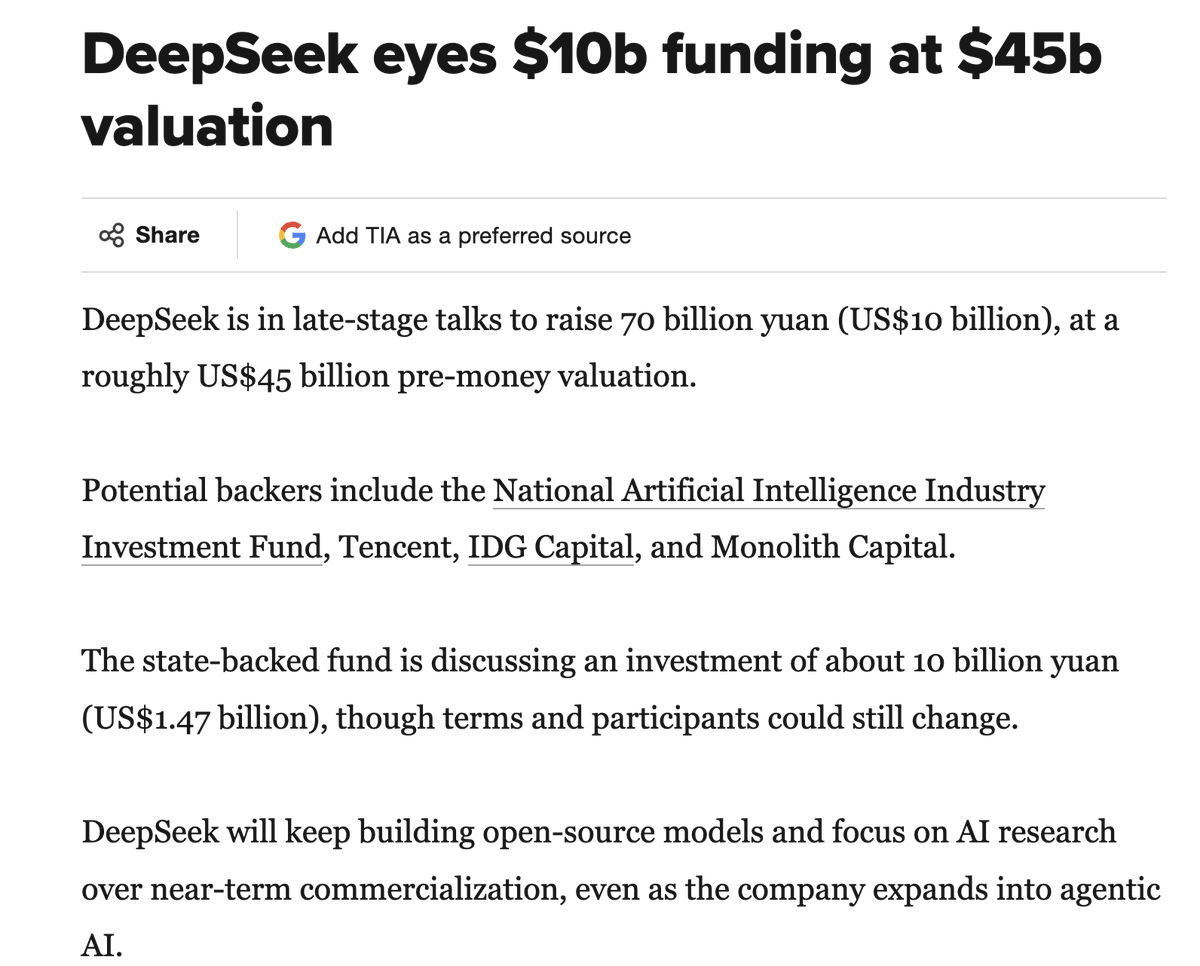
他们没有像 GLM、MoonShot 和 MiniMax 那样推出有竞争力的 coding 计划。他们没有多模态、音频、视频模型。到目前为止,他们甚至还没有 harness(他们最近才开始招聘搭建 harness 的人)?DeepSeek 还长期坚持开源,而且非常乐于分享自己的独门诀窍。这是疯狂吗?这是在白白烧钱吗?那些准备向他们投资 100 亿美元的投资人,是在把钱往下水道里扔吗? ** 不是,恰恰相反,依我看完全不是!!!

**下面我想讲讲他们到目前为止做过的事,以及他们似乎正在遵循的一套战略。梁文锋(DeepSeek CEO)看中的奖赏显然大得多,他们有可能做到 1 万亿美元估值,同时帮助创造一个 10 万亿美元的产业!
重看 DeepSeek 的英雄之旅

DeepSeek 一直都在逆风而行。他们不走那种把模型一点点做得更好,然后赶紧卖现成应用的路子,比如 coding 计划。2025 年 1 月 27 日,我写过一条传播很广的推文,谈我眼中的 DeepSeek 英雄之旅。现在这个故事只会越来越有意思。

  • 当大家都在尝试构建 dense model 时,DeepSeek 转向了更难训练的 Mixture of Expert model,也就是 MoE。

  • 他们从 first principal 的思路出发,发明了新的算法 GRPO,用来替代在 Reinforcement Learning(RL)里占主导地位、实现成本更高的 PPO 算法。

  • 他们把 Reinforcement Learning from Verified Rewards(RLVR)找出来,作为提升模型推理能力的一项关键策略。

  • 他们提出了一个简单的 Speculative Decoding 策略,也就是通过 Multi Token Prediction,同时还让训练信号变得更密集。

  • 他们把 ZERO bubble pipeline 做到了极致,用来提升有限 GPU 资源的利用率。

  • 他们发布了 Expert Load balancer,让所有人都能更容易部署 Mixture of Expert model。尤其是配合 Wide Expert Parallel 策略,模型服务成本可以低很多,因为可以使用更大的 batch。

  • 他们发明了 MLA、DSA、CSA、HCA,用来降低 KV Cache 需求,并让计算需求在 context 持续变长时仍然接近恒定。

  • 他们发明了 Engram,用 memory 换 compute。

  • 他们发明了 mHC,在模型规模继续变大时依然能保持稳定训练。后面的例子还可以继续列下去。

在英雄之旅这种故事结构里,也是最普遍的一种结构,英雄从不会一开始就决定自己的旅程终点是什么。他是在路上不断学习,最后为自己找到一个伟大的使命,并在几乎不可能的情况下把它完成。他会遇到很多唱反调的人,但他不会理会。他会遇到很多动机不纯的人。他也会有很大的缺陷或短板,但他最终会克服这些,完成自己的使命。他会面对看上去根本跨不过去的挑战,但最后会想明白该怎么结盟,怎么珍惜并合理使用宝贵资源。这就是为什么观众会站在英雄这边。这也是 DeepSeek 为什么会拥有粉丝、全球性的尊重,当然也包括反对者。

接下来我会更详细地说明,DeepSeek 在这条路上已经走了够久,也已经看到了最终命运。那不是去卖 coding 计划,而是去促成一个 10 万亿美元规模的中国 AI 硬件生态,同时让自己拿到 1 万亿美元估值。在这个过程中,他们也会推动西方硬件生态里出现许多新的参与者。

欢迎评论和批评 @naval @teortaxesTex @jukan05 @bubbleboi @poezhao0605 @hsu_steve @tphuang
https://arxiv.org/pdf/2405.04434

先从一些有意思的 KV Cache 计算开始:

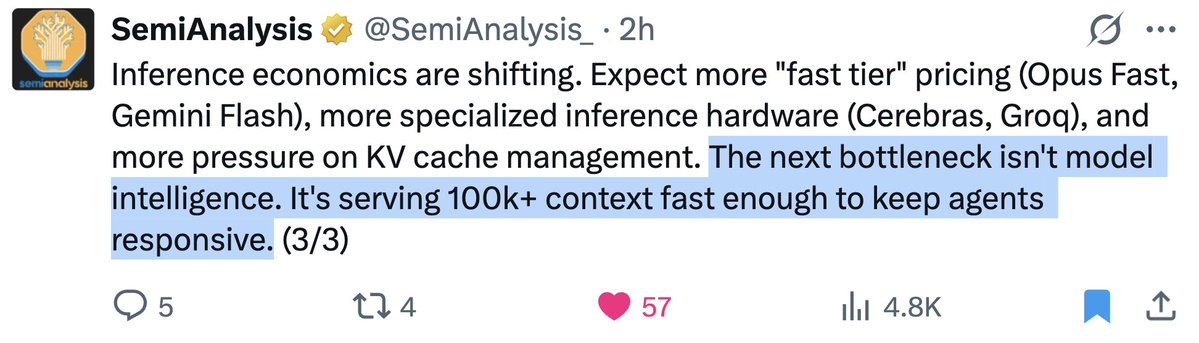
看看这条非常应景的推文,来自 @SemiAnalysis_:

https://arxiv.org/pdf/2512.24880

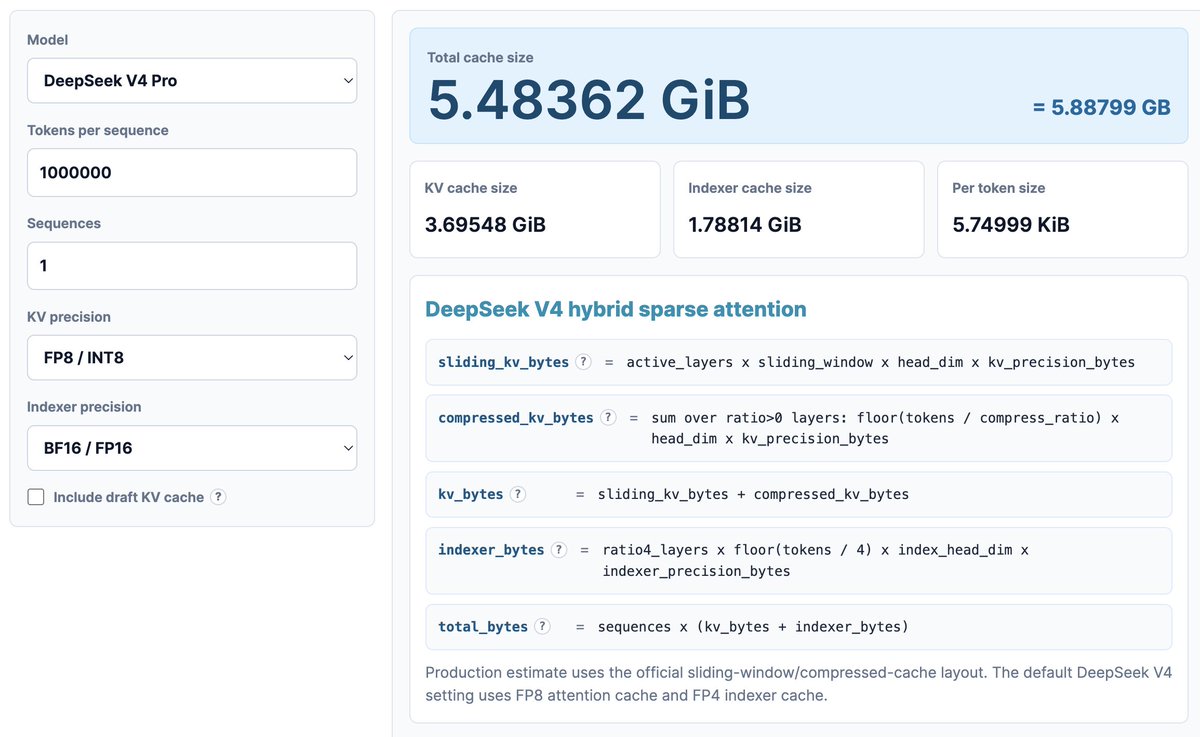
先来做点有意思的 KV cache 数学题。就算你不喜欢数学也别担心。我们会用最近发布的 KV Cache calculator,看一看 DeepSeek V4 Pro 带来的 KV Cache 节省,再和最新的 GLM 与 Qwen 模型做对比。

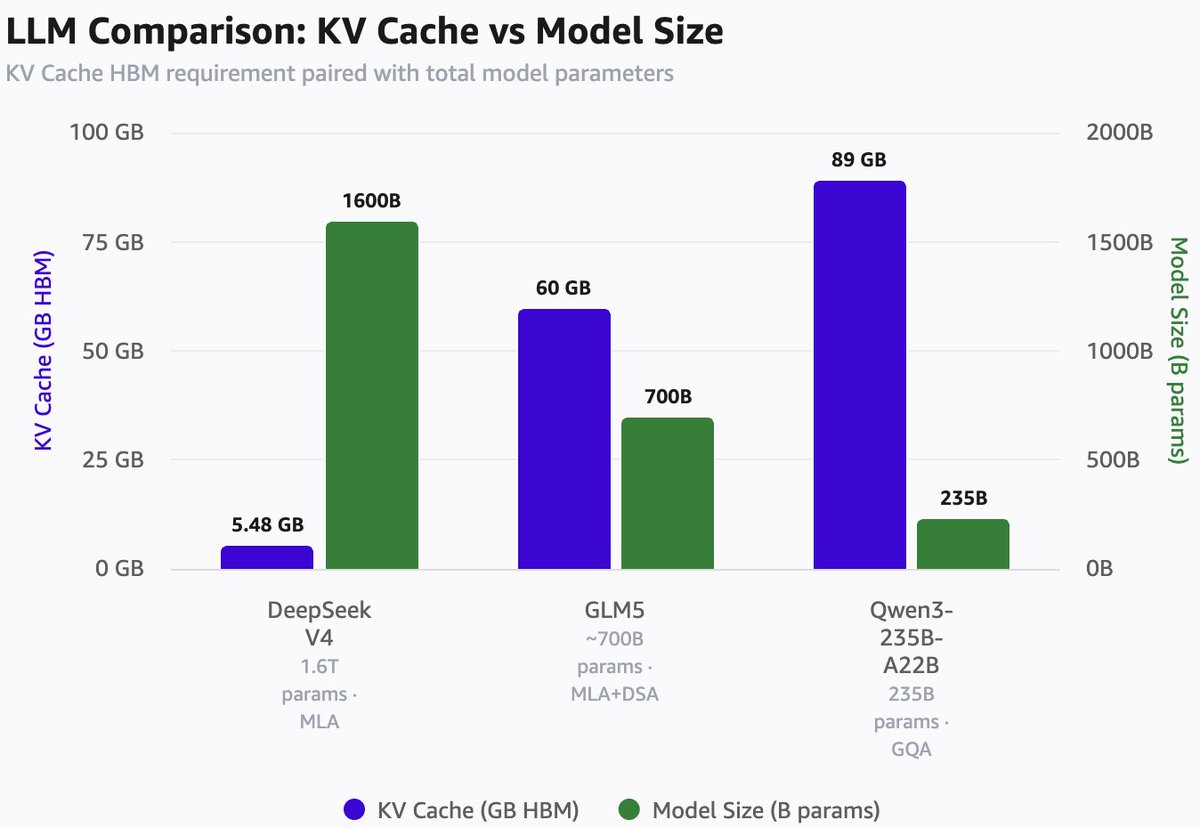
我按 1M context 来算。假设 KV precision 是 8 bit,indexer precision 是 16 bit。你也可以自己玩这个 calculator。

https://kvcache.ai/tools/kv-cache-calculator/

在 1M context 下

  1. DeepSeek V4 只需要 5.48GB HBM

  2. GML5 需要 60GB HBM

  3. Qwen3-235B-A22B 夸张地需要 89B

别忘了

  1. DeepSeek 是一个 1.6T parameter model,

  2. GLM5 大约是 700B parameter,它已经用了 DeepSeek 的 MLA 和 DSA,不过还没用上最新的 compressed attention

  3. Qwen3-235B-A22B 大约是 235B,并且使用的是 GQA attention

DeepSeek 在缓解 memory 压力这件事上做出了基础性贡献。如果这些创新被广泛采用,就能让 long horizon agent 变得极其经济,并解锁下一批用例。

疯狂背后的方法:

这种很小的 KV cache 体积,而且不牺牲质量,正是他们能把长时间持有 cache 的价格压到荒谬低水平的原因。价格还不到 Sonnet 4.6 cache hit 的 3%,而且他们能持有好几个小时。

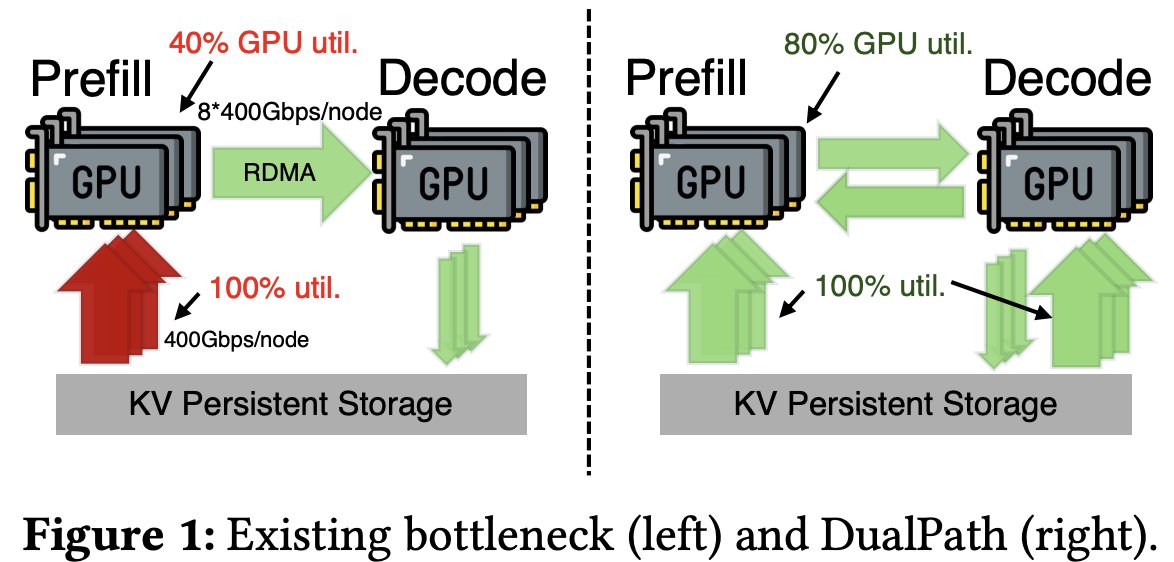
对 long horizon task 来说,少量 cache 意味着可以非常经济地卸载到 SSD,再重新加载。这减少了对 HBM 的需求,而 HBM 恰恰是供应最紧张、也是从中国 AI 硬件产业角度最难制造出来的 memory。DeepSeek 还开发了从 SSD 更快加载 KV cache 的技术,这一点在 Dual Path 论文里有描述。

https://arxiv.org/pdf/1701.06538

谁是 KV Cache 压缩的直接受益者?

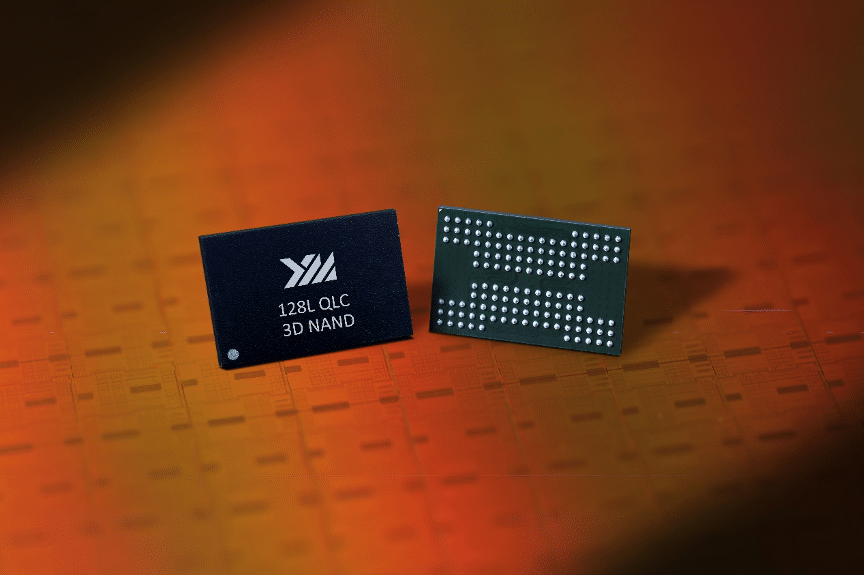
谁能大规模供应 SSD?别忘了,YMCT 正在崛起为 3D NAND 巨头。NAND 让 DeepSeek 可以避免对 KV 进行重复计算。反过来,DeepSeek 又为 NAND 和 SSD 创造了一个巨大的市场,不只是 YMTC,也包括其他所有厂商。

但这不只是 NAND 和 SSD 的事:

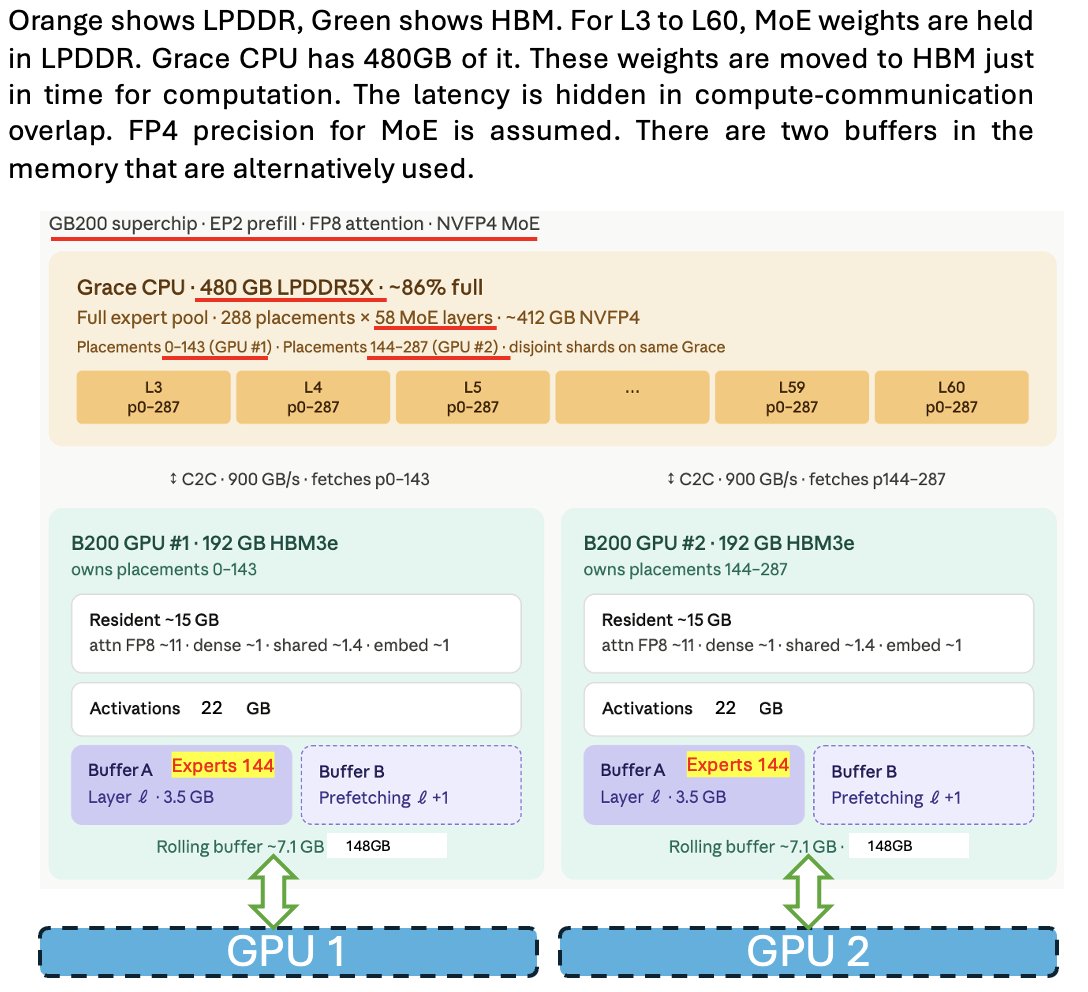
LPDDR memory 也很有潜力。它可以成为存放 weights 的地方,再按需把 weights 流式送入 HBM,从而减轻对 HBM 需求的压力。SGLang 团队写过一篇很好的博客讲这件事。下面这张图可以帮助理解这个方案是怎么工作的。

虽然 DeepSeek 没有专门为这件事单独做什么,但他们的 MoE 架构拥有大量 expert,再加上 4 bit weights,这让这个方案很容易实现。

这种创新,再加上超紧凑的 KV Cache 压缩方案,而且还是无损的,会显著降低 HBM 需求。

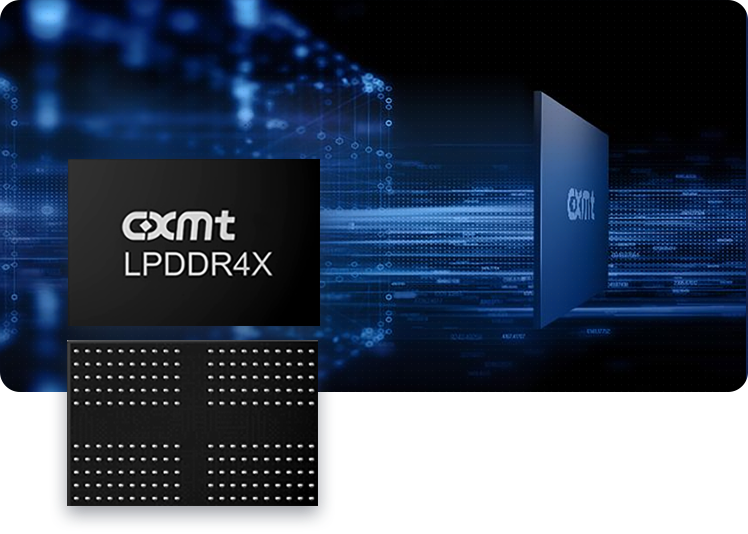
中国谁做 LPDDR?CXMT。他们在 LPDDR 的速度上只落后 0.5 代,在 density 上落后 1 代。差得并不远!再加上充足的 NAND,中国生态在不久的将来还会拥有充足的 LPDDR。这能缓解 compute 压力吗?答案是能。继续往下看。

聪明地使用 memory,也能减轻 GPU/ASIC 的压力

很容易看明白,拿 NAND 存 KV cache,可以更长时间持有 KV cache,减轻 HBM 压力,还能避免 KV cache 重算,从而降低 GPU 和 ASIC 的 compute 压力。那 LPDDR 能不能也起到类似作用,除了作为一个按需流入 weights 的地方之外?答案也是能。

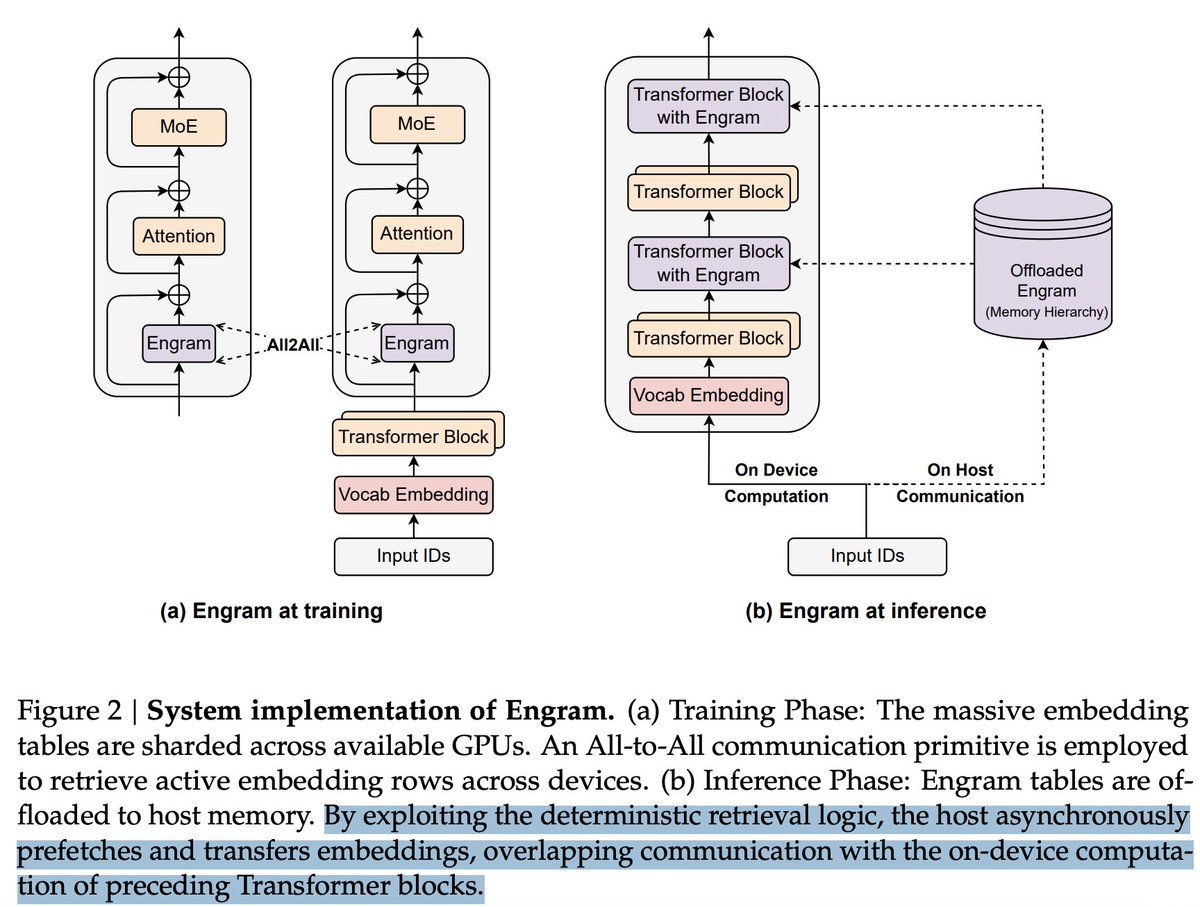
LPDDR 支持存放大量所谓的 Engram。在他们关于 Engram 的论文里,DeepSeek 说明了一点。MoE 通过 conditional computation 扩展 capacity,但 Transformer 本身缺少一种原生的 knowledge lookup primitive。所以它们不得不通过计算,低效地模拟 retrieval。他们引入了 Engram 这个模块,把经典的 N-gram embedding 现代化,变成基于哈希的 O(1) lookup,从而创造出另一条互补的 sparsity 轴,他们称之为 conditional memory。这样可以节省 computation,但需要 memory 来承载 embedding table,而这个表可能很大。这是典型的memory-compute substitution,但关键洞见在于,memory 这一侧每取回一 bit 的成本要便宜得多,一个 LPDDR lookup,对比一次穿过多层 transformer 的完整 forward pass,在大规模场景下这是极其划算的交换。他们就是这样用 memory 换 compute,来节省计算的!!!

https://x.com/@bubbleboi

这种 trade-off 非常值得:中国的 GPU 和 ASIC 在原始 FLOPs 上会长期落后于西方 GPU,因为它们做不到同样的 chiplet transistor density,也就是没有 EUV。它们在 packaging 上也落后不少。所以这种 trade-off 非常值得做,尤其是在 NAND 和 LPDDR 都能大量生产的前提下。

回顾 DeepSeek 的长期布局:

从这一连串创新来看,DeepSeek 的盘算不像是立刻去赚几亿美元。考虑到他们做过的所有选择,没有多模态,没有语音模型,视频更是谈不上,他们显然在下的是一盘耐心的 10 万亿美元大棋,目标是扶持出一套替代性的硬件生态。

这不只是让中国的 memory 厂商在中国和全球 AI 硬件舞台上成为关键玩家,也是在降低资源需求本身,好让 AI 模型能以更经济的方式训练和服务。这会让更多 GPU/ASIC 厂商以及网络芯片厂商都有机会,因为它们会成为可行选项。所有这些创新,同样也会帮助西方开源生态,以及新的硬件制造商。

所有迹象都已经在那里了。下面就把他们提出的这些创新详细回顾一遍:

  1. Mixture of Expert(MoE)和 MLA,最早出现在 DeepSeek V2。MoE 让训练非常聪明的模型所需 compute 降低了 40% 到 50%。MLA 则让 KV cache 降低了 90%。这让把 KV cache 卸载到 SSD 变得很高效。这些想法来自他们 2024 年 5 月发布的 DeepSeek V2 论文。后来它又进一步解锁了 DeepSeek V3 的训练。当时这个模型几乎是 close source 状态,却只用了 2048 张被削弱的 H800 GPU。

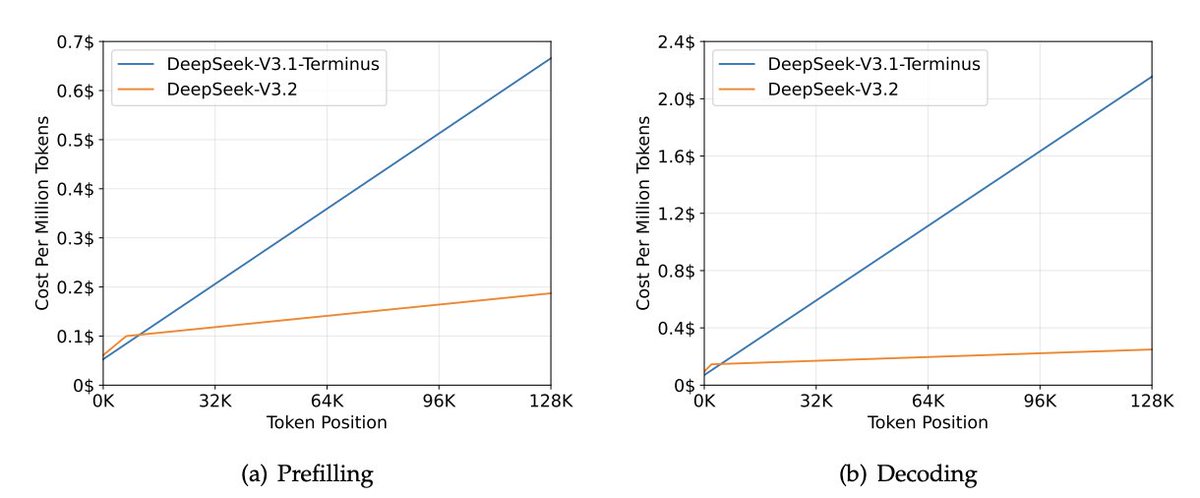
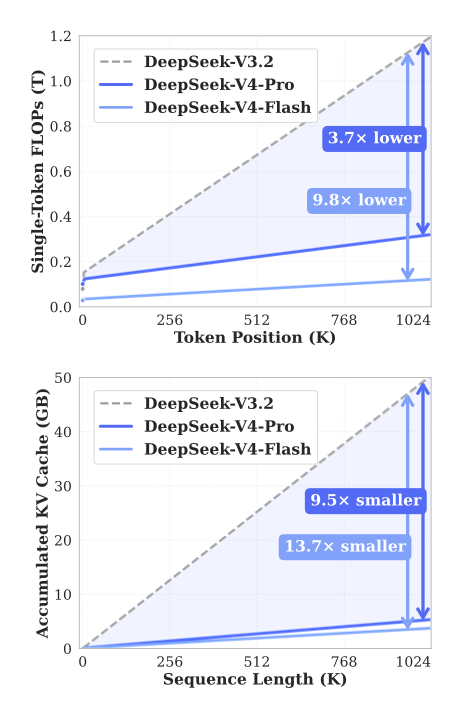
  1. DSA,出现在 DeepSeek V3.2 Exp,用来减少 long context 场景下的 compute,同时缓解 HBM bandwidth 的压力。它保证 computation 不会随着 context 变长而增长。请看下面的图,DeepSeek-v3.2 的处理时间会随着 context 保持平坦。

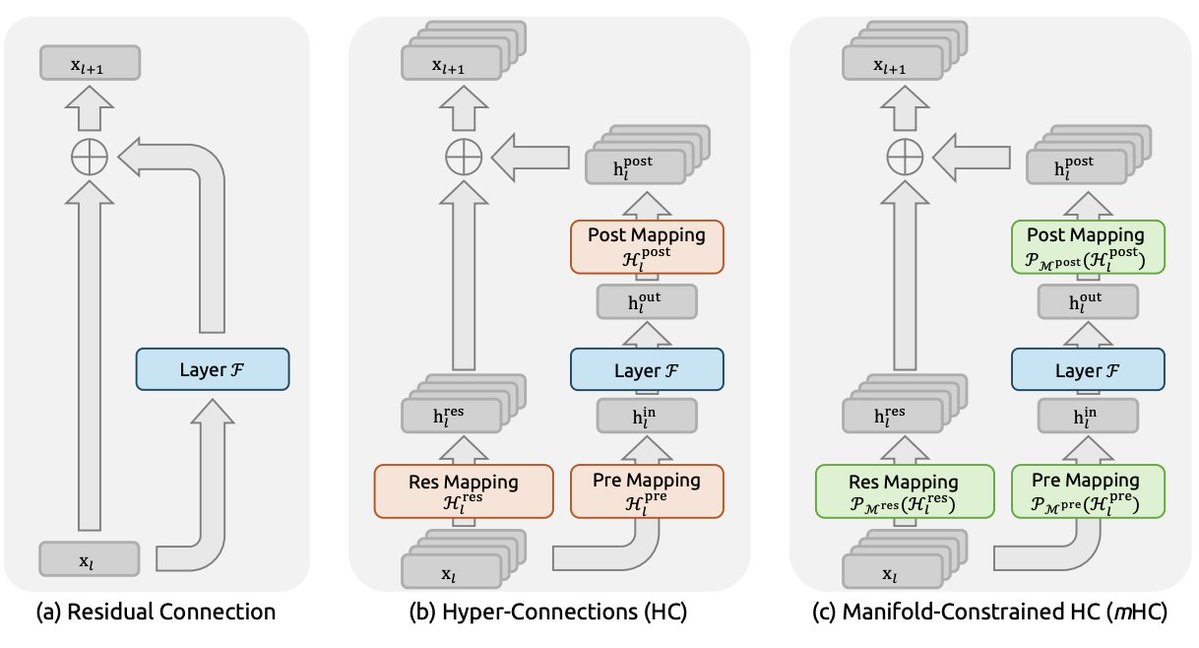
  1. mHC,发表于 2025 年 12 月的论文 mHC: Manifold-Constrained Hyper-Connections。mHC 是 DeepSeek 提出的一项宏观架构创新,它重新发明了 transformer layer 之间的信息流动方式。它不再使用自 ResNet 时代就存在的标准 residual connection,也就是 (x + F(x)),而是把 residual stream 扩展成多条并行的信息高速通道,并允许它们之间进行可学习的混合。更关键的是,这些 mixing matrix 会被约束为 doubly stochastic,也就是通过 Sinkhorn-Knopp projection 投影到 Birkhoff polytope 上,这在数学上保证了无论网络有多深,signal magnitude 都能被保留下来。

  2. 这解决了灾难性的稳定性问题,之前 unconstrained Hyper-Connections 会碰上这个问题。这个思路最早来自 ByteDance。当模型规模到 27B 时,signal amplification 会爆炸到 3000 倍,导致训练彻底崩掉。

  3. 计算成本非常低:mHC 只增加了 6.7% 的 wall-clock 训练开销,因为它并不改变 attention 或 FFN layer 的 FLOPs,只是改变它们输出在 layer 之间的路由方式。

  4. 但性能收益相当可观:在 27B parameter 规模上,mHC 在 BIG-Bench Hard reasoning 上提高了 7.2 分,在 DROP 上提高 3.2 分,在 GSM8K math 上提高 2.8 分,在 MMLU general knowledge 上提高 1.4 分,而且模型大小不变,compute budget 也几乎一样。

本质上,mHC 通过给网络一个更丰富、更有表达力的信息路由拓扑,在几乎不增加额外 FLOPs 的前提下,实现了每个 parameter 对应更高的 intelligence。

  1. CSA、HSA,在 2026 年 4 月发布的 DeepSeek V4 中提出, 通过压缩 KV token,把 KV 需求再压低 90%,同时大幅减少所需 FLOPs,从而同时缓解 HBM 和 GPU/ASIC 的压力。

https://arxiv.org/pdf/2601.07372

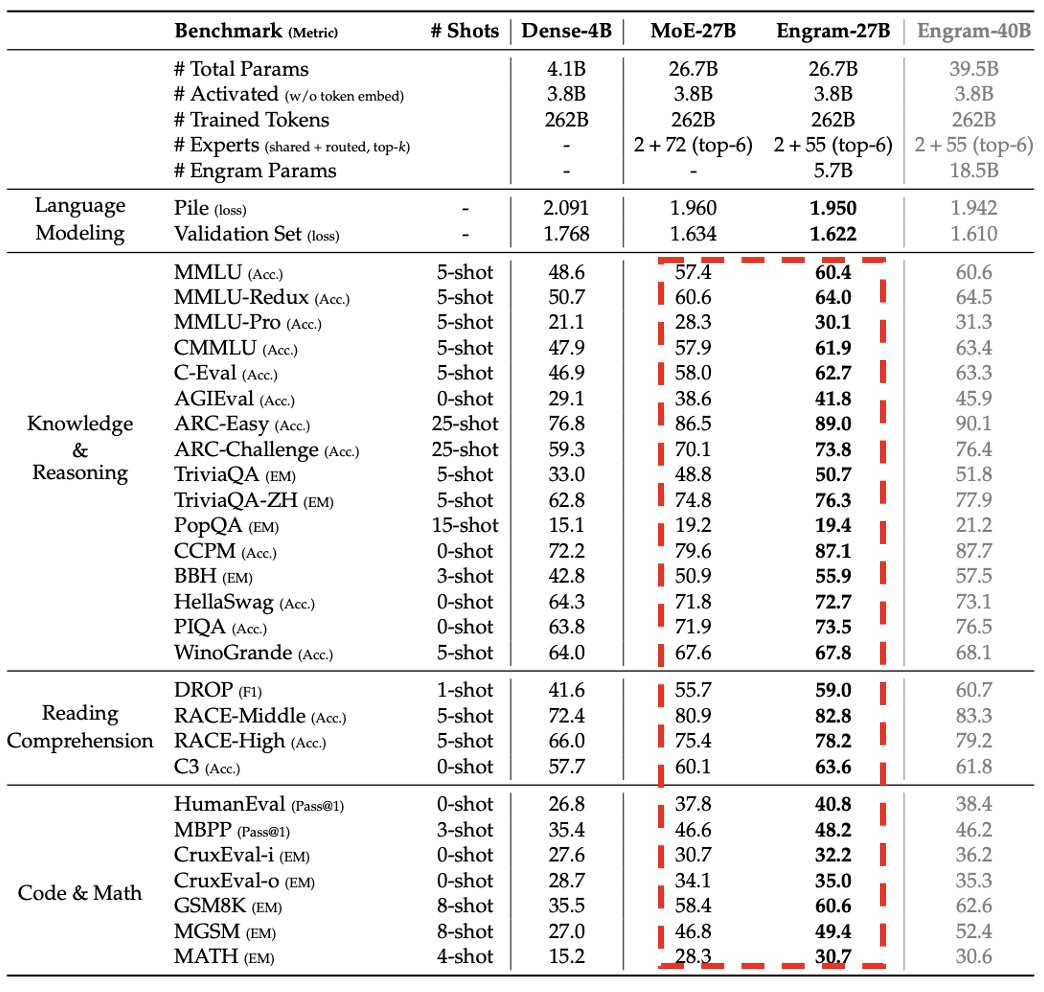
  1. Engram,发表于 2026 年第一季度,他们在这里用 memory,也就是 LPDDR memory,去换 compute。下面这张更详细的图展示了 Engram 在同样总体参数预算下带来的性能提升。

https://x.com/bookwormengr/status/1883712073814954379?s=20

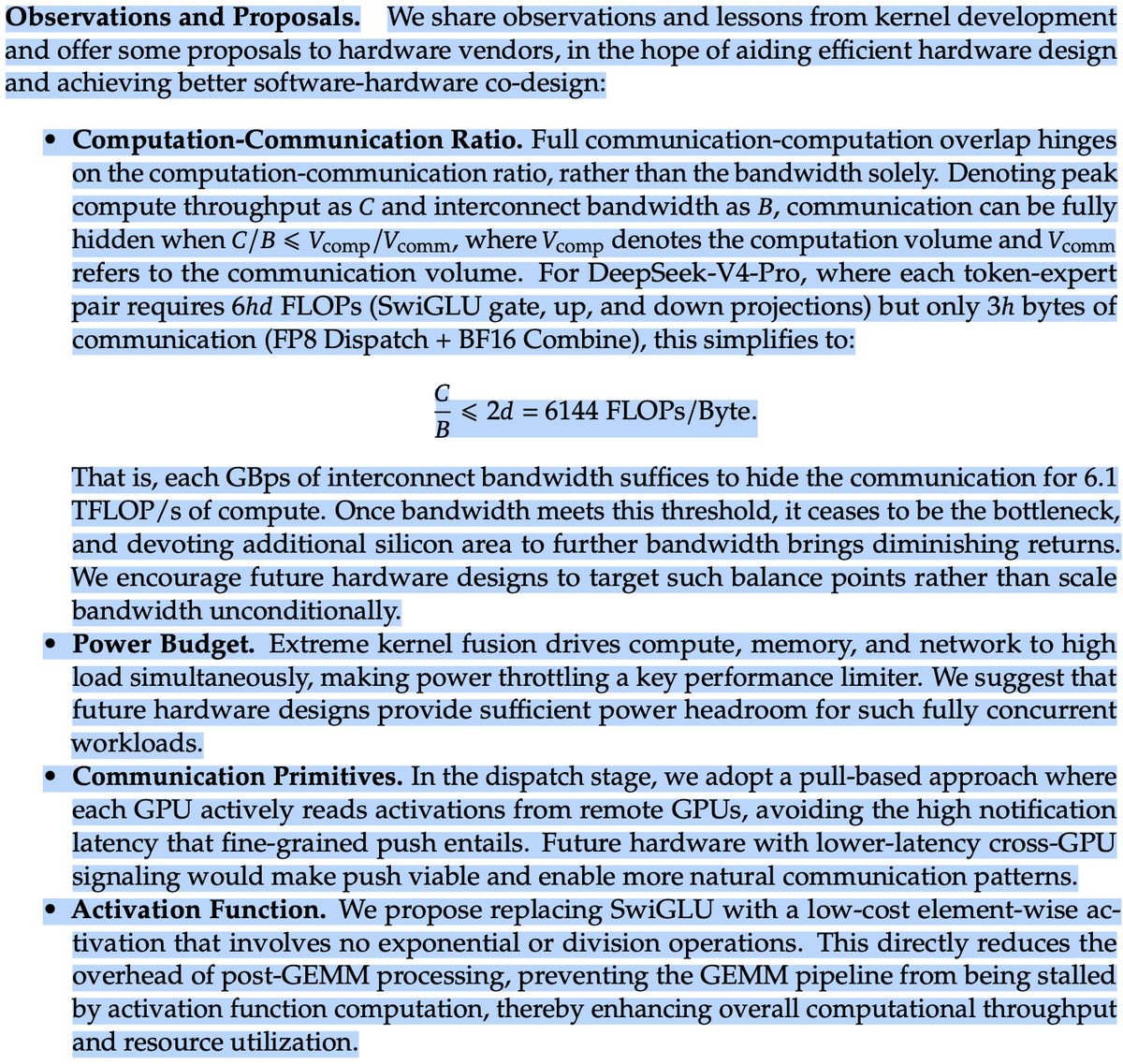
  1. 他们极端专注于 ComputeCommunication 的重叠利用,而 Dual Path 之类的创新,也可以理解为对资源约束的一种绕法。但 DeepSeek 还更进一步,会直接给硬件厂商提供 ASIC design 建议,确保他们不会浪费宝贵的 silicon 资源。这段内容来自 DeepSeek V4 论文。

  1. TileLang 的投入,也一致说明他们不只是想解决自己的 compute 紧张,而是想让中国硬件生态能真正和西方生态竞争。借助 TileLang,可以只开发一次 kernel,也就是 computation code,然后在多个具备 TileLang backend 的硬件平台上成功运行。我预计其他中国实验室也会加入进来,这会帮助中国硬件厂商从侧面应对 CUDA moat。它同样也会解锁更多西方硬件,比如 AMD。 Note: 中国很多 AI 平台要么提供 CUDA compatibility,要么提供 CUDA translation layer。Moore Threads、MetaX、Biren 和 Iluvatar CoreX 是最兼容 CUDA 的中国芯片,它们主要靠 translation layer 实现。理论上说,它们并不需要 TileLang。

https://arxiv.org/pdf/2601.07372

大规模 RL 和 RSI:

随着能拿到更多 compute,也就是因为潜在硬件选项变多了,同时 compute 需求本身又在下降,DeepSeek 就能去做更有野心的训练项目,尤其是 RL post training。RL 需要生成大量 trajectory,也就是数万亿 token 的生成,成本会很快飙升。再进一步说,如果你要训练 1M context model,那你就需要生成同样长度的 trajectory。训练这种超长 trajectory 的模型,也就意味着它能处理 long horizon task。

另外,由于可选硬件变多,DeepSeek 手里的硬件资源也会更多,这会推动 automated research,也就是 RSI。RSI 指的是由 AI 自己来设计并执行实验。这种方法包含大量 trial and error,成本会非常快地膨胀。但 RSI 对于探索整个 design space 非常重要。DeepSeek 如果想先碰到 AGI,再走向 ASI,就必须先具备 RSI 能力。

DeepSeek 今天做的事,就是行业明天会做的事:

DeepSeek 围绕 Mixture of Expert、MLA、DSA 做出的创新,已经被全球其他 AI 实验室和中国实验室陆续接住了。

比如,GLM 系列模型的开发者 ZAI,就使用了 MLA 和 DSA。Kimi(Moonshot)也采用了 MLA,而且并不避讳承认自己的架构就是建立在 DeepSeek 架构之上的。反过来,DeepSeek 也在使用 Muon optimizer,而这是 Kimi(Moonshot)最早拿来做大规模训练的。

(NOTE: - MoE 是 Google 在 2027 年发明的,Naom Shazeer 是关键作者。DeepSeek 把它应用到了超大规模上,并发展出自己的一套技巧。 - Muon(MomentUm Orthogonalized by Newton-Schulz)optimizer 由机器学习研究者 Keller Jordan 于 2024 年底提出。Kimi(Moonshot)团队是第一个把它用到超大规模上的团队。)

那怎么赚大钱呢?:

我们来看看 OpenAI 这个有意思的例子。OpenAI 曾基于消费里程碑,获得以低价购买 AMD 和 Cerebras 股票的 warrant/options。这对 AMD 和 Cerebras 来说是笔很好的交易。OpenAI 对它们做出承诺,也会让它们更有可能长期成功。

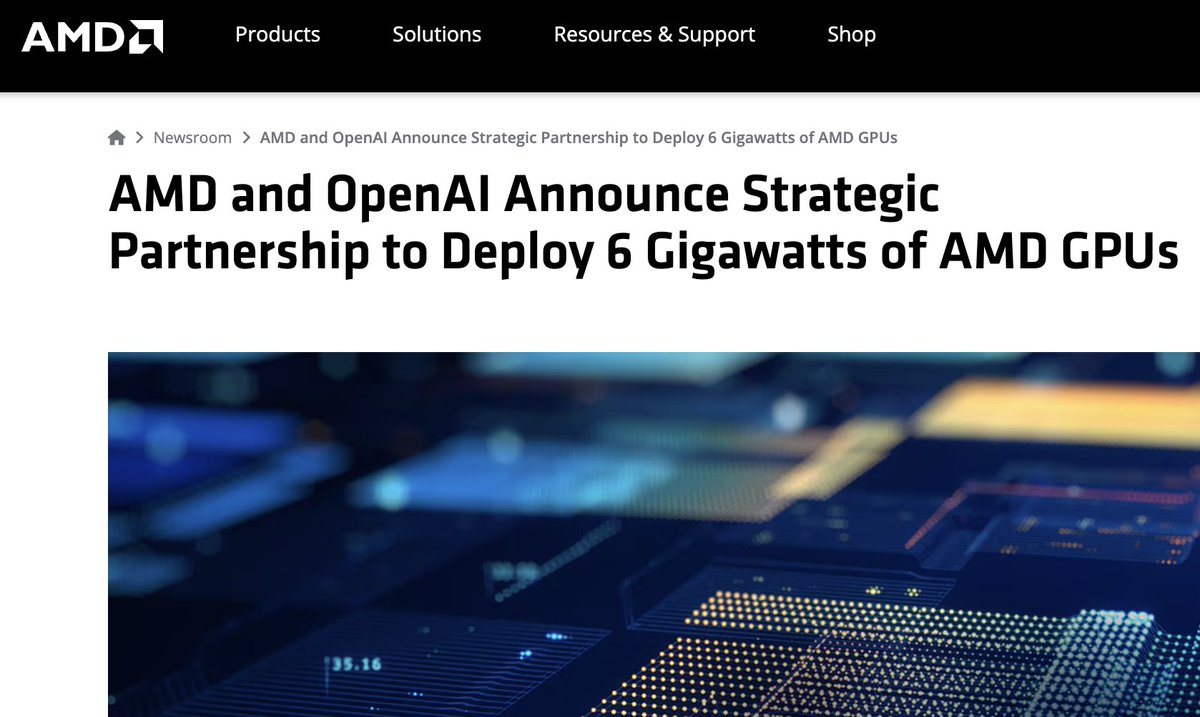
AMD 公告中的原话是这样说的:As part of the agreement, to further align strategic interests, AMD has issued OpenAI a warrant for up to 160 million shares of AMD common stock, structured to vest as specific milestones are achieved. The first tranche vests with the initial 1 gigawatt deployment, with additional tranches vesting as purchases scale up to 6 gigawatts. Vesting is further tied to AMD achieving certain share-price targets and to OpenAI achieving the technical and commercial milestones required to enable AMD deployments at scale.

https://x.com/@naval

我预测,DeepSeek 也会和多家中国 memory、ASIC、CPU 以及 networking stack 厂商签下类似协议,并与它们紧密合作,让它们的硬件栈真正能跑最领先的 AI workload。

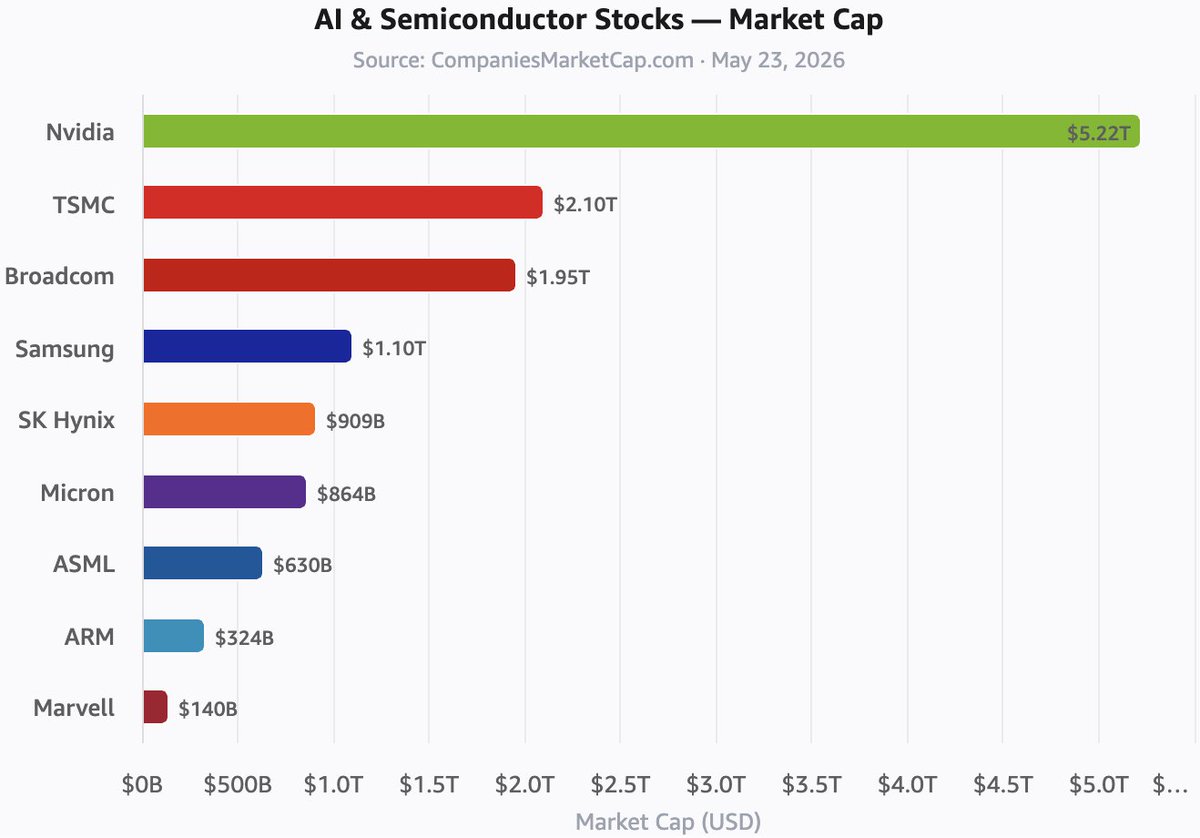
考虑到西方,包括东亚盟友在内,所有 AI 股票的合并估值早就远远超过 10 万亿美元。这样一种以股权奖励合作方的方式,能让 DeepSeek 帮助中国也创造出同样巨大的产业,同时分到属于自己的一块蛋糕,并最终实现1 万亿美元估值。

这样一来,他们不仅能赚到更多钱,也能实现他们自己所说的AGI for everyone。梁文锋是 Jim Simmon 的铁粉,不可能聪明到这个程度却错过这种资本主义玩法。

**如果你回头看 DeepSeek 到目前为止做过的所有事,这几乎是唯一说得通的解释……

https://huggingface.co/deepseek-ai/DeepSeek-V4-Pro/blob/main/DeepSeek_V4.pdf

关于这些创新的详细博客会在本周末发出来。有兴趣的话可以关注我的 substack https://polymath707.substack.com/

**Have you ever wondered, how DeepSeek may make money, and lot of it? **

They didn't come up with competitive coding plans like GLM, MoonShot and MiniMax. They don't have multimodal, audio, video models. Till date they don't have a harness (they have begun hiring recently for building a harness)? DeepSeek is also committed to open source in the long term and is too happy to share their secret sauce. Is this madness? Is this sheer waste of money? Are investors who are about to invest 10B USD in them throwing money into a drain? ** No - quite the contrary, imho!!!

**Here I present observations about what they have done till date, and a strategy they seem to be following . Liang Wenfeng's (DeepSeek CEO) eyes seem to be on much bigger prize and they could achieve 1T USD valuation, while helping create a 10T USD industry!

你有没有想过,DeepSeek 可能会怎么赚钱,而且会赚很多钱?

他们没有像 GLM、MoonShot 和 MiniMax 那样推出有竞争力的 coding 计划。他们没有多模态、音频、视频模型。到目前为止,他们甚至还没有 harness(他们最近才开始招聘搭建 harness 的人)?DeepSeek 还长期坚持开源,而且非常乐于分享自己的独门诀窍。这是疯狂吗?这是在白白烧钱吗?那些准备向他们投资 100 亿美元的投资人,是在把钱往下水道里扔吗? ** 不是,恰恰相反,依我看完全不是!!!

**下面我想讲讲他们到目前为止做过的事,以及他们似乎正在遵循的一套战略。梁文锋(DeepSeek CEO)看中的奖赏显然大得多,他们有可能做到 1 万亿美元估值,同时帮助创造一个 10 万亿美元的产业!

Revisiting DeepSeek's Hero's Journey

DeepSeek has always gone against the wind of building incrementally better models and trying to sell immediate applications - e.g. coding plans. I wrote this viral tweet on 27th Jan 2025 about what I saw as DeepSeek's Hero's Journey. The story is getting only more interesting.

  • When people were trying building dense models, DeepSeek went after Mixture of Expert models (MoE) that were hard to train.

  • They worked from 'first principal' approach and invented new algorithm GRPO to replace dominant PPO algorithm for Reinforcement Learning (RL) that was more expensive to implement.

  • They figured out Reinforcement Learning from Verified Rewards (RLVR) as a key strategy to improve reasoning ability of models.

  • They came up with a simple strategy for Speculative Decoding through "Multi Token Prediction" that also densified the training signal.

  • They perfected "ZERO bubble" pipelines to improve use of limited GPU resources.

  • They published Expert Load balancer to make it easy for everyone deploy Mixture of Expert models. Particularly with "Wide Expert Parallel" strategy models can be served much more economically as one can have large batches.

  • They invented MLA, DSA, CSA, HCA to reduce KV Cache need and keep computation demand against growing context near constant.

  • They invented Engram to trade memory for compute.

  • They invented mHC to achieve stable training as model size grows. And th list continues....

In Hero's Journey story structure (the most universal), hero never decides what his journey is going to be. He learns along the way and figures out a great mission for himself and completes it against all the odds. He meets many detractors, but he ignores them. He meets many bad faith actors. He has great flaw or shortcoming - but he overcomes them to accomplish his mission. He confronts challenges that seem unsurmountable, but figures out how to make alliances and how to use precious resources wisely. This is what gets the audience to root for the hero. This is what earns DeepSeek their fan following and global respect and also detractors.

As I will show you in detail, DeepSeek is on this journey for long enough now and have discovered the ultimate destiny: ** it is not selling coding plans, but to enable a 10T USD Chinese AI hardware ecosystem and achieve 1T USD valuation for itself.** In doing to so they will enable many new entrants in the western hardware ecosystem as well.

Comments and criticism welcome: @naval @teortaxesTex @jukan05 @bubbleboi @poezhao0605 @hsu_steve @tphuang

https://arxiv.org/pdf/2405.04434

重看 DeepSeek 的英雄之旅

DeepSeek 一直都在逆风而行。他们不走那种把模型一点点做得更好,然后赶紧卖现成应用的路子,比如 coding 计划。2025 年 1 月 27 日,我写过一条传播很广的推文,谈我眼中的 DeepSeek 英雄之旅。现在这个故事只会越来越有意思。

  • 当大家都在尝试构建 dense model 时,DeepSeek 转向了更难训练的 Mixture of Expert model,也就是 MoE。

  • 他们从 first principal 的思路出发,发明了新的算法 GRPO,用来替代在 Reinforcement Learning(RL)里占主导地位、实现成本更高的 PPO 算法。

  • 他们把 Reinforcement Learning from Verified Rewards(RLVR)找出来,作为提升模型推理能力的一项关键策略。

  • 他们提出了一个简单的 Speculative Decoding 策略,也就是通过 Multi Token Prediction,同时还让训练信号变得更密集。

  • 他们把 ZERO bubble pipeline 做到了极致,用来提升有限 GPU 资源的利用率。

  • 他们发布了 Expert Load balancer,让所有人都能更容易部署 Mixture of Expert model。尤其是配合 Wide Expert Parallel 策略,模型服务成本可以低很多,因为可以使用更大的 batch。

  • 他们发明了 MLA、DSA、CSA、HCA,用来降低 KV Cache 需求,并让计算需求在 context 持续变长时仍然接近恒定。

  • 他们发明了 Engram,用 memory 换 compute。

  • 他们发明了 mHC,在模型规模继续变大时依然能保持稳定训练。后面的例子还可以继续列下去。

在英雄之旅这种故事结构里,也是最普遍的一种结构,英雄从不会一开始就决定自己的旅程终点是什么。他是在路上不断学习,最后为自己找到一个伟大的使命,并在几乎不可能的情况下把它完成。他会遇到很多唱反调的人,但他不会理会。他会遇到很多动机不纯的人。他也会有很大的缺陷或短板,但他最终会克服这些,完成自己的使命。他会面对看上去根本跨不过去的挑战,但最后会想明白该怎么结盟,怎么珍惜并合理使用宝贵资源。这就是为什么观众会站在英雄这边。这也是 DeepSeek 为什么会拥有粉丝、全球性的尊重,当然也包括反对者。

接下来我会更详细地说明,DeepSeek 在这条路上已经走了够久,也已经看到了最终命运。那不是去卖 coding 计划,而是去促成一个 10 万亿美元规模的中国 AI 硬件生态,同时让自己拿到 1 万亿美元估值。在这个过程中,他们也会推动西方硬件生态里出现许多新的参与者。

欢迎评论和批评 @naval @teortaxesTex @jukan05 @bubbleboi @poezhao0605 @hsu_steve @tphuang
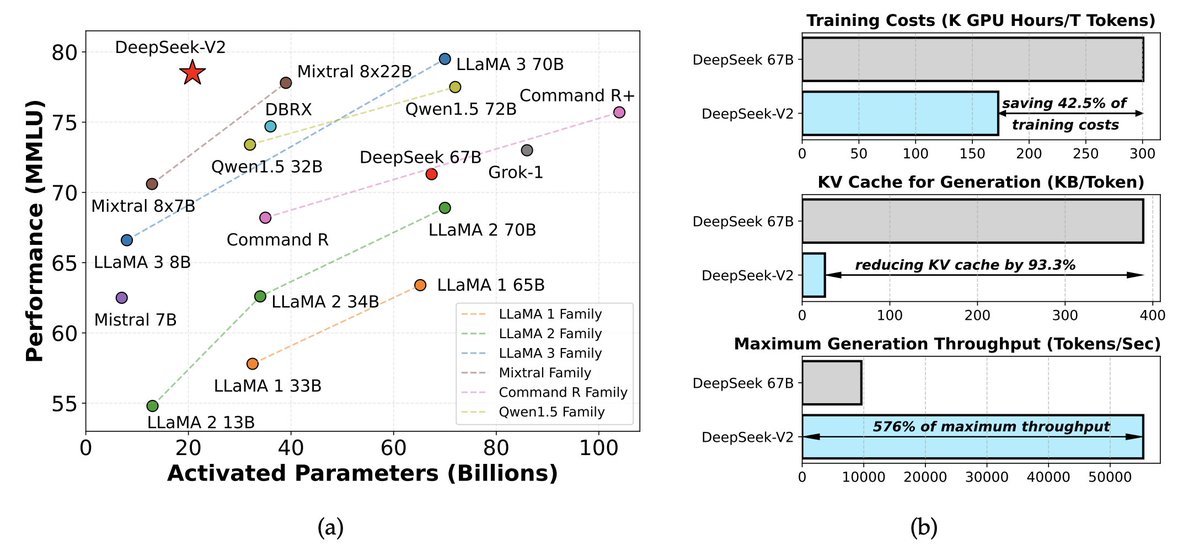
https://arxiv.org/pdf/2405.04434

Starting with some fun with KV Cache calculations:

Read this timely tweet from @SemiAnalysis_ :

https://arxiv.org/pdf/2512.24880

Let us do some fun KV cache math first. Don't worry if you don't like Math. We will use recently release KV Cache calculator to see KV Cache saving made possible by DeepSeek V4 Pro and compare it with latest GLM and Qwen models.

I compute for 1M context. I assume 8 bit KV precision and 16 bit indexer precision. You can play with the calculator.

https://kvcache.ai/tools/kv-cache-calculator/

**For 1M context **

  1. DeepSeek V4 needs only 5.48GB HBM

  2. GML5 needs 60GB HBM

  3. Qwen3-235B-A22B needs whopping 89B

Mind you

  1. DeepSeek is 1.6T parameter model,

  2. GLM5 is around 700B parameter, it already uses DeepSeek's MLA and DSA; though not latest compressed attention

  3. Qwen3-235B-A22B is around 235B and uses GQA attention

DeepSeek has made foundational contribution to ease pressure on memory. If widely adopted this innovation can make long horizon agents highly economical and unlock next set of use cases.

先从一些有意思的 KV Cache 计算开始:

看看这条非常应景的推文,来自 @SemiAnalysis_:

https://arxiv.org/pdf/2512.24880

先来做点有意思的 KV cache 数学题。就算你不喜欢数学也别担心。我们会用最近发布的 KV Cache calculator,看一看 DeepSeek V4 Pro 带来的 KV Cache 节省,再和最新的 GLM 与 Qwen 模型做对比。

我按 1M context 来算。假设 KV precision 是 8 bit,indexer precision 是 16 bit。你也可以自己玩这个 calculator。

https://kvcache.ai/tools/kv-cache-calculator/

在 1M context 下

  1. DeepSeek V4 只需要 5.48GB HBM

  2. GML5 需要 60GB HBM

  3. Qwen3-235B-A22B 夸张地需要 89B

别忘了

  1. DeepSeek 是一个 1.6T parameter model,

  2. GLM5 大约是 700B parameter,它已经用了 DeepSeek 的 MLA 和 DSA,不过还没用上最新的 compressed attention

  3. Qwen3-235B-A22B 大约是 235B,并且使用的是 GQA attention

DeepSeek 在缓解 memory 压力这件事上做出了基础性贡献。如果这些创新被广泛采用,就能让 long horizon agent 变得极其经济,并解锁下一批用例。

Method behind the madness:

This small size of KV cache - without compromising on quality - is the reason they can offer long held cache at such a ridiculously low price - less than 3% price of Cache hits for Sonnet 4.6 - and they hold it for multiple hours.

Small amount of cache for long horizon task enables offloading to SSDs and reloading very cost effective. This reduces requirement of HBM that is in short supply and hardest to make memory from Chinese AI hardware industry perspective. DeepSeek have also developed techniques to load KV cache faster from SSD as described in the Dual Path paper.

https://arxiv.org/pdf/1701.06538

疯狂背后的方法:

这种很小的 KV cache 体积,而且不牺牲质量,正是他们能把长时间持有 cache 的价格压到荒谬低水平的原因。价格还不到 Sonnet 4.6 cache hit 的 3%,而且他们能持有好几个小时。

对 long horizon task 来说,少量 cache 意味着可以非常经济地卸载到 SSD,再重新加载。这减少了对 HBM 的需求,而 HBM 恰恰是供应最紧张、也是从中国 AI 硬件产业角度最难制造出来的 memory。DeepSeek 还开发了从 SSD 更快加载 KV cache 的技术,这一点在 Dual Path 论文里有描述。

https://arxiv.org/pdf/1701.06538

Who is the immediate beneficiary of KV Cache compression?:

Who supplies SSD in large quantity? Remember YMCT is emerging as 3D NAND giant. NAND allows DeepSeek to avoid re-computation of KVs. In turn, DeepSeek creates a large market for NAND & SSD - not just of YMTC's but everyone else's as well.

谁是 KV Cache 压缩的直接受益者?

谁能大规模供应 SSD?别忘了,YMCT 正在崛起为 3D NAND 巨头。NAND 让 DeepSeek 可以避免对 KV 进行重复计算。反过来,DeepSeek 又为 NAND 和 SSD 创造了一个巨大的市场,不只是 YMTC,也包括其他所有厂商。

It is not only about NAND & SSD, however:

LPDDR memory has great potential to be a place where you hold weights and stream them into HBM as needed, reducing the pressure on HBM demand. SGLang team has published great blog about it. I present below diagram to explain how the scheme works.

While DeepSeek did not do anything specifically for this - their MoE architecture with large number of experts and 4 bit weights make it easy to implement this scheme.

This innovation combined with super compact KV Cache (lossless) reduce HBM demand significantly.

Who in China makes LPDDR? CXMT. They are only 0.5 Gen behind on speed for LPDDR and 1 generation behind on density. Not very far! In addition abundant NAND, Chinese ecosystem will have abundant LPDDR in near future. Can this relieve pressure on compute? YES. Follow on..

但这不只是 NAND 和 SSD 的事:

LPDDR memory 也很有潜力。它可以成为存放 weights 的地方,再按需把 weights 流式送入 HBM,从而减轻对 HBM 需求的压力。SGLang 团队写过一篇很好的博客讲这件事。下面这张图可以帮助理解这个方案是怎么工作的。

虽然 DeepSeek 没有专门为这件事单独做什么,但他们的 MoE 架构拥有大量 expert,再加上 4 bit weights,这让这个方案很容易实现。

这种创新,再加上超紧凑的 KV Cache 压缩方案,而且还是无损的,会显著降低 HBM 需求。

中国谁做 LPDDR?CXMT。他们在 LPDDR 的速度上只落后 0.5 代,在 density 上落后 1 代。差得并不远!再加上充足的 NAND,中国生态在不久的将来还会拥有充足的 LPDDR。这能缓解 compute 压力吗?答案是能。继续往下看。

Smart use of memory also reduces pressure of GPUs/ASICS as well

It is quite clear to understand use of NAND for KV cache allows holding KV cache for longer, reduce pressure of HBM and helps avoid re-computation of KV cache that relieves compute pressure on GPUs & ASICs. Can LPDDR also help in similar manner, in addition being a place from where weights can be streamed in "just in time fashion"? **The answer is YES. **

LPDDR supports holding large amount of what is known as "Engram". In their Engram paper DeepSeek showed that while MoE scales capacity via conditional computation, Transformers lack a native primitive for knowledge lookup. They're forced to inefficiently simulate retrieval through computation. They introduce Engram, a module that modernizes classic N-gram embedding into an O(1) hash-based lookup, creating a complementary sparsity axis they call conditional memory. This saves computation, but needs memory to host the embeddings table which can be large in size. It is a classic memory-compute substitution, but with the insight that the "memory" side is dramatically cheaper per bit retrieved (a LPDDR lookup vs. a full forward pass through transformer layers), making it a very favorable trade at scale. This is how they save on compute by trading memory!!!

https://x.com/@bubbleboi

Trade-offs worth having: Chinese GPUs & ASICS are forever going to lag in raw FLOPs compared to western GPUs due to not having same transistor density per chiplet (no EUV). They are quite behind in packaging as well. So such trade-offs are well worth it, particularly if you can make abundant NAND and LPDDR memory.

聪明地使用 memory,也能减轻 GPU/ASIC 的压力

很容易看明白,拿 NAND 存 KV cache,可以更长时间持有 KV cache,减轻 HBM 压力,还能避免 KV cache 重算,从而降低 GPU 和 ASIC 的 compute 压力。那 LPDDR 能不能也起到类似作用,除了作为一个按需流入 weights 的地方之外?答案也是能。

LPDDR 支持存放大量所谓的 Engram。在他们关于 Engram 的论文里,DeepSeek 说明了一点。MoE 通过 conditional computation 扩展 capacity,但 Transformer 本身缺少一种原生的 knowledge lookup primitive。所以它们不得不通过计算,低效地模拟 retrieval。他们引入了 Engram 这个模块,把经典的 N-gram embedding 现代化,变成基于哈希的 O(1) lookup,从而创造出另一条互补的 sparsity 轴,他们称之为 conditional memory。这样可以节省 computation,但需要 memory 来承载 embedding table,而这个表可能很大。这是典型的memory-compute substitution,但关键洞见在于,memory 这一侧每取回一 bit 的成本要便宜得多,一个 LPDDR lookup,对比一次穿过多层 transformer 的完整 forward pass,在大规模场景下这是极其划算的交换。他们就是这样用 memory 换 compute,来节省计算的!!!

https://x.com/@bubbleboi

这种 trade-off 非常值得:中国的 GPU 和 ASIC 在原始 FLOPs 上会长期落后于西方 GPU,因为它们做不到同样的 chiplet transistor density,也就是没有 EUV。它们在 packaging 上也落后不少。所以这种 trade-off 非常值得做,尤其是在 NAND 和 LPDDR 都能大量生产的前提下。

DeepSeek's long game recounted:

From all these innovations, DeepSeek's game doesn't seem to be immediate profits of few hundred millions given all the choices they have made (no multimodality yet, no voice models, video - what is that?) - but they are playing a patient 10T USD game to enable alternative hardware ecosystem.

It is not only about making Chinese memory players key players on Chinese and global AI hardware arena, but also reducing the resource demand itself, to be able to train and serve AI models cost effectively - this will enable many GPU/ASIC makers as well as networking chip makers as they will become viable options. All these innovations will also help Western open source ecosystem as well as new hardware makers.

All the signs are there. Just let us recount in detail all the innovations they came up with:

  1. Mixture of Expert (MoE) and MLA introduced in DeepSeek V2. MoE is made it possible to train very intelligent models at 40 to 50% less compute. MLA made it possible to reduce KV cache by 90%. This made offloading KV cache to SSD quite efficient. This ideas were introduced in their May 2024 paper DeepSeek V2. It later unlocked training DeepSeek V3 which was near closed source at the time with only 2048 H800 nerfed GPUs.

  1. DSA (introduced in DeepSeek V3.2 Exp) to reduce compute for long context scenarios and also relieve pressure on HBM bandwidth. It ensures computation doesn't grow with growing context. Please see charts below - processing time for DeepSeek-v3.2 stays flat with context.

  1. mHC introduced in Dec 2025 in paper mHC: Manifold-Constrained Hyper-Connections. mHC is a macro-architecture innovation from DeepSeek that reinvents how information flows between transformer layers. Instead of the standard residual connection (x + F(x)) used since ResNet, mHC expands the residual stream into multiple parallel information highways and allows learned mixing between them — but crucially constrains the mixing matrices to be doubly stochastic (via Sinkhorn-Knopp projection onto the Birkhoff polytope), which mathematically guarantees that signal magnitude is preserved across arbitrary depth.

  2. This solves the catastrophic instability that plagued unconstrained Hyper-Connections (initially invented at ByteDance), where signal amplification exploded to 3000× at 27B scale, collapsing training entirely.

  3. The compute cost is minimal: mHC adds only 6.7% wall-clock training overhead since it doesn't change the FLOPs of attention or FFN layers, only how their outputs are routed between layers.

  4. The performance gains, however, are substantial: at 27B parameters, mHC delivers +7.2 points on BIG-Bench Hard reasoning, +3.2 on DROP, +2.8 on GSM8K math, and +1.4 on MMLU general knowledge, all at the same model size and nearly identical compute budget.

In essence, mHC achieves meaningfully higher intelligence per parameter by giving the network a richer, more expressive topology for routing information across layers, while paying almost nothing in additional FLOPs.

  1. CSA, HSA (introduced in DeepSeek V4 in April 2026) to reduce KV need by another 90% by compressing KV tokens and reduces FLOPs needed by large margin relieving pressure on both HBM and GPU/ASIC.

https://arxiv.org/pdf/2601.07372

  1. Engram introduced in Q1 2026 where they trade memory (LPDDR memory) for compute (in a way). As the following detailed chart show performance gain due to Engram at same overall parameters budget.

https://x.com/bookwormengr/status/1883712073814954379?s=20

  1. Extreme focus on Compute and Communication overlap, and innovations like Dual Path can be explained as work around to resource constraint. But DeepSeek goes further to advise hardware vendors on their ASIC design to make sure they don't waste precious silicon resources. This is from DeepSeek V4 paper.

  1. Investment in TileLang point in the consistent direction that they are not just dealing with their own compute crunch but making Chinese hardware ecosystem competitive with western ecosystem. With Tilelang it is possible to develop kernel (code for computation) once and have it run successfully on multiple hardware platforms for which TileLang backend is available. I expect all other China based labs to join in - helping Chinese hardware makers deal indirectly with the "CUDA moat". This also unlocks more western hardware like AMD. Note: many AI platforms in China either provide CUDA compatibility or CUDA translation layer: Moore Threads, MetaX, Biren, and Iluvatar CoreX are the most CUDA-compatible Chinese chips via translation layers. They do not need TileLang (in theory).

https://arxiv.org/pdf/2601.07372

回顾 DeepSeek 的长期布局:

从这一连串创新来看,DeepSeek 的盘算不像是立刻去赚几亿美元。考虑到他们做过的所有选择,没有多模态,没有语音模型,视频更是谈不上,他们显然在下的是一盘耐心的 10 万亿美元大棋,目标是扶持出一套替代性的硬件生态。

这不只是让中国的 memory 厂商在中国和全球 AI 硬件舞台上成为关键玩家,也是在降低资源需求本身,好让 AI 模型能以更经济的方式训练和服务。这会让更多 GPU/ASIC 厂商以及网络芯片厂商都有机会,因为它们会成为可行选项。所有这些创新,同样也会帮助西方开源生态,以及新的硬件制造商。

所有迹象都已经在那里了。下面就把他们提出的这些创新详细回顾一遍:

  1. Mixture of Expert(MoE)和 MLA,最早出现在 DeepSeek V2。MoE 让训练非常聪明的模型所需 compute 降低了 40% 到 50%。MLA 则让 KV cache 降低了 90%。这让把 KV cache 卸载到 SSD 变得很高效。这些想法来自他们 2024 年 5 月发布的 DeepSeek V2 论文。后来它又进一步解锁了 DeepSeek V3 的训练。当时这个模型几乎是 close source 状态,却只用了 2048 张被削弱的 H800 GPU。

  1. DSA,出现在 DeepSeek V3.2 Exp,用来减少 long context 场景下的 compute,同时缓解 HBM bandwidth 的压力。它保证 computation 不会随着 context 变长而增长。请看下面的图,DeepSeek-v3.2 的处理时间会随着 context 保持平坦。

  1. mHC,发表于 2025 年 12 月的论文 mHC: Manifold-Constrained Hyper-Connections。mHC 是 DeepSeek 提出的一项宏观架构创新,它重新发明了 transformer layer 之间的信息流动方式。它不再使用自 ResNet 时代就存在的标准 residual connection,也就是 (x + F(x)),而是把 residual stream 扩展成多条并行的信息高速通道,并允许它们之间进行可学习的混合。更关键的是,这些 mixing matrix 会被约束为 doubly stochastic,也就是通过 Sinkhorn-Knopp projection 投影到 Birkhoff polytope 上,这在数学上保证了无论网络有多深,signal magnitude 都能被保留下来。

  2. 这解决了灾难性的稳定性问题,之前 unconstrained Hyper-Connections 会碰上这个问题。这个思路最早来自 ByteDance。当模型规模到 27B 时,signal amplification 会爆炸到 3000 倍,导致训练彻底崩掉。

  3. 计算成本非常低:mHC 只增加了 6.7% 的 wall-clock 训练开销,因为它并不改变 attention 或 FFN layer 的 FLOPs,只是改变它们输出在 layer 之间的路由方式。

  4. 但性能收益相当可观:在 27B parameter 规模上,mHC 在 BIG-Bench Hard reasoning 上提高了 7.2 分,在 DROP 上提高 3.2 分,在 GSM8K math 上提高 2.8 分,在 MMLU general knowledge 上提高 1.4 分,而且模型大小不变,compute budget 也几乎一样。

本质上,mHC 通过给网络一个更丰富、更有表达力的信息路由拓扑,在几乎不增加额外 FLOPs 的前提下,实现了每个 parameter 对应更高的 intelligence。

  1. CSA、HSA,在 2026 年 4 月发布的 DeepSeek V4 中提出, 通过压缩 KV token,把 KV 需求再压低 90%,同时大幅减少所需 FLOPs,从而同时缓解 HBM 和 GPU/ASIC 的压力。

https://arxiv.org/pdf/2601.07372

  1. Engram,发表于 2026 年第一季度,他们在这里用 memory,也就是 LPDDR memory,去换 compute。下面这张更详细的图展示了 Engram 在同样总体参数预算下带来的性能提升。

https://x.com/bookwormengr/status/1883712073814954379?s=20

  1. 他们极端专注于 ComputeCommunication 的重叠利用,而 Dual Path 之类的创新,也可以理解为对资源约束的一种绕法。但 DeepSeek 还更进一步,会直接给硬件厂商提供 ASIC design 建议,确保他们不会浪费宝贵的 silicon 资源。这段内容来自 DeepSeek V4 论文。

  1. TileLang 的投入,也一致说明他们不只是想解决自己的 compute 紧张,而是想让中国硬件生态能真正和西方生态竞争。借助 TileLang,可以只开发一次 kernel,也就是 computation code,然后在多个具备 TileLang backend 的硬件平台上成功运行。我预计其他中国实验室也会加入进来,这会帮助中国硬件厂商从侧面应对 CUDA moat。它同样也会解锁更多西方硬件,比如 AMD。 Note: 中国很多 AI 平台要么提供 CUDA compatibility,要么提供 CUDA translation layer。Moore Threads、MetaX、Biren 和 Iluvatar CoreX 是最兼容 CUDA 的中国芯片,它们主要靠 translation layer 实现。理论上说,它们并不需要 TileLang。

https://arxiv.org/pdf/2601.07372

Large scale RL and RSI:

With access to more compute (due to more potential hardware options) and reduction in compute demand, DeepSeek can take on much more ambitious training projects; particularly RL post training. RL involves generating large number of trajectories - generating trillions of tokens. It can get expensive real fast. Furthermore to train 1M context models, you need to generate trajectories that long. Training models for such long trajectories enables long horizon tasks.

Furthermore, availability of more hardware at DeepSeek due to increased options will enable automated research (RSI). RSI involves AI itself designing and carrying out experiments. The approach has large number of trials and errors and can get costly very quickly. However, RSI is important to explore the entire design space. DeepSeek will need to be RSI capable before they hit AGI followed by ASI.

大规模 RL 和 RSI:

随着能拿到更多 compute,也就是因为潜在硬件选项变多了,同时 compute 需求本身又在下降,DeepSeek 就能去做更有野心的训练项目,尤其是 RL post training。RL 需要生成大量 trajectory,也就是数万亿 token 的生成,成本会很快飙升。再进一步说,如果你要训练 1M context model,那你就需要生成同样长度的 trajectory。训练这种超长 trajectory 的模型,也就意味着它能处理 long horizon task。

另外,由于可选硬件变多,DeepSeek 手里的硬件资源也会更多,这会推动 automated research,也就是 RSI。RSI 指的是由 AI 自己来设计并执行实验。这种方法包含大量 trial and error,成本会非常快地膨胀。但 RSI 对于探索整个 design space 非常重要。DeepSeek 如果想先碰到 AGI,再走向 ASI,就必须先具备 RSI 能力。

What DeepSeek does today, rest of the industry does tomorrow:

DeepSeek's innovations around Mixture of Expert, MLA, DSA have been picked up by rest of the AI labs from around the world and from China.

For example, ZAI - makers of GLM family of models - use MLA and DSA. Kimi (Moonshot) has adopted MLA and have no hesitation in saying their architecture is based on DeepSeek's architecture. In return DeepSeek uses Muon optimiser that was first used my Kimi (Moonshot) for large scale training.

(NOTE: - MoE was invented at Google in 2027 with Naom Shazeer as the key author. DeepSeek applied it at massive scale and invented their own tricks. - The Muon (MomentUm Orthogonalized by Newton-Schulz) optimizer was created by machine learning researcher Keller Jordan in late 2024. Kimi (Moonshot) team were the first one to use it at massive scale.)

DeepSeek 今天做的事,就是行业明天会做的事:

DeepSeek 围绕 Mixture of Expert、MLA、DSA 做出的创新,已经被全球其他 AI 实验室和中国实验室陆续接住了。

比如,GLM 系列模型的开发者 ZAI,就使用了 MLA 和 DSA。Kimi(Moonshot)也采用了 MLA,而且并不避讳承认自己的架构就是建立在 DeepSeek 架构之上的。反过来,DeepSeek 也在使用 Muon optimizer,而这是 Kimi(Moonshot)最早拿来做大规模训练的。

(NOTE: - MoE 是 Google 在 2027 年发明的,Naom Shazeer 是关键作者。DeepSeek 把它应用到了超大规模上,并发展出自己的一套技巧。 - Muon(MomentUm Orthogonalized by Newton-Schulz)optimizer 由机器学习研究者 Keller Jordan 于 2024 年底提出。Kimi(Moonshot)团队是第一个把它用到超大规模上的团队。)

What about making $$$?:

Let us study interesting example of OpenAI. OpenAI received warrant/options to buy stocks of AMD and Cerebras at a low price, based on consumption mile stones. It is a great deal for AMD and Cerebras. OpenAI being committed to them, makes they likely to succeed in the long run.

Quote from AMD announcement: "As part of the agreement, to further align strategic interests, AMD has issued OpenAI a warrant for up to 160 million shares of AMD common stock, structured to vest as specific milestones are achieved. The first tranche vests with the initial 1 gigawatt deployment, with additional tranches vesting as purchases scale up to 6 gigawatts. Vesting is further tied to AMD achieving certain share-price targets and to OpenAI achieving the technical and commercial milestones required to enable AMD deployments at scale."

https://x.com/@naval

I forecast DeepSeek to enter in such agreements with multiple Chinese memory, ASIC, CPU and networking stack makers and work closely with them to make their hardware stacks viable for leading AI workloads.

Given combined valuation of all Western (including East Asian allies) AI stocks far exceeds 10T USD. This - collaboration that awards equity - approach allows DeepSeek to help create equally big industry in China and claim their piece of the pie while achieving 1T USD valuation for themselves.

This will allow them to make far more $$$ while also achieving their goal in their words of** "AGI for everyone". Liang Wenfeng - a big fan of Jim Simmon - is too smart a capitalist to miss this!

**This is the only thing that makes sense, if you look at everything DeepSeek have done so far...

https://huggingface.co/deepseek-ai/DeepSeek-V4-Pro/blob/main/DeepSeek_V4.pdf

Detailed blog on these innovation coming out this weekend, follow my substack https://polymath707.substack.com/ if interested...

那怎么赚大钱呢?:

我们来看看 OpenAI 这个有意思的例子。OpenAI 曾基于消费里程碑,获得以低价购买 AMD 和 Cerebras 股票的 warrant/options。这对 AMD 和 Cerebras 来说是笔很好的交易。OpenAI 对它们做出承诺,也会让它们更有可能长期成功。

AMD 公告中的原话是这样说的:As part of the agreement, to further align strategic interests, AMD has issued OpenAI a warrant for up to 160 million shares of AMD common stock, structured to vest as specific milestones are achieved. The first tranche vests with the initial 1 gigawatt deployment, with additional tranches vesting as purchases scale up to 6 gigawatts. Vesting is further tied to AMD achieving certain share-price targets and to OpenAI achieving the technical and commercial milestones required to enable AMD deployments at scale.

https://x.com/@naval

我预测,DeepSeek 也会和多家中国 memory、ASIC、CPU 以及 networking stack 厂商签下类似协议,并与它们紧密合作,让它们的硬件栈真正能跑最领先的 AI workload。

考虑到西方,包括东亚盟友在内,所有 AI 股票的合并估值早就远远超过 10 万亿美元。这样一种以股权奖励合作方的方式,能让 DeepSeek 帮助中国也创造出同样巨大的产业,同时分到属于自己的一块蛋糕,并最终实现1 万亿美元估值。

这样一来,他们不仅能赚到更多钱,也能实现他们自己所说的AGI for everyone。梁文锋是 Jim Simmon 的铁粉,不可能聪明到这个程度却错过这种资本主义玩法。

**如果你回头看 DeepSeek 到目前为止做过的所有事,这几乎是唯一说得通的解释……

https://huggingface.co/deepseek-ai/DeepSeek-V4-Pro/blob/main/DeepSeek_V4.pdf

关于这些创新的详细博客会在本周末发出来。有兴趣的话可以关注我的 substack https://polymath707.substack.com/

**Have you ever wondered, how DeepSeek may make money, and lot of it? **

They didn't come up with competitive coding plans like GLM, MoonShot and MiniMax. They don't have multimodal, audio, video models. Till date they don't have a harness (they have begun hiring recently for building a harness)? DeepSeek is also committed to open source in the long term and is too happy to share their secret sauce. Is this madness? Is this sheer waste of money? Are investors who are about to invest 10B USD in them throwing money into a drain? ** No - quite the contrary, imho!!!

**Here I present observations about what they have done till date, and a strategy they seem to be following . Liang Wenfeng's (DeepSeek CEO) eyes seem to be on much bigger prize and they could achieve 1T USD valuation, while helping create a 10T USD industry!

Revisiting DeepSeek's Hero's Journey

DeepSeek has always gone against the wind of building incrementally better models and trying to sell immediate applications - e.g. coding plans. I wrote this viral tweet on 27th Jan 2025 about what I saw as DeepSeek's Hero's Journey. The story is getting only more interesting.

  • When people were trying building dense models, DeepSeek went after Mixture of Expert models (MoE) that were hard to train.

  • They worked from 'first principal' approach and invented new algorithm GRPO to replace dominant PPO algorithm for Reinforcement Learning (RL) that was more expensive to implement.

  • They figured out Reinforcement Learning from Verified Rewards (RLVR) as a key strategy to improve reasoning ability of models.

  • They came up with a simple strategy for Speculative Decoding through "Multi Token Prediction" that also densified the training signal.

  • They perfected "ZERO bubble" pipelines to improve use of limited GPU resources.

  • They published Expert Load balancer to make it easy for everyone deploy Mixture of Expert models. Particularly with "Wide Expert Parallel" strategy models can be served much more economically as one can have large batches.

  • They invented MLA, DSA, CSA, HCA to reduce KV Cache need and keep computation demand against growing context near constant.

  • They invented Engram to trade memory for compute.

  • They invented mHC to achieve stable training as model size grows. And th list continues....

In Hero's Journey story structure (the most universal), hero never decides what his journey is going to be. He learns along the way and figures out a great mission for himself and completes it against all the odds. He meets many detractors, but he ignores them. He meets many bad faith actors. He has great flaw or shortcoming - but he overcomes them to accomplish his mission. He confronts challenges that seem unsurmountable, but figures out how to make alliances and how to use precious resources wisely. This is what gets the audience to root for the hero. This is what earns DeepSeek their fan following and global respect and also detractors.

As I will show you in detail, DeepSeek is on this journey for long enough now and have discovered the ultimate destiny: ** it is not selling coding plans, but to enable a 10T USD Chinese AI hardware ecosystem and achieve 1T USD valuation for itself.** In doing to so they will enable many new entrants in the western hardware ecosystem as well.

Comments and criticism welcome: @naval @teortaxesTex @jukan05 @bubbleboi @poezhao0605 @hsu_steve @tphuang
https://arxiv.org/pdf/2405.04434

Starting with some fun with KV Cache calculations:

Read this timely tweet from @SemiAnalysis_ :

https://arxiv.org/pdf/2512.24880

Let us do some fun KV cache math first. Don't worry if you don't like Math. We will use recently release KV Cache calculator to see KV Cache saving made possible by DeepSeek V4 Pro and compare it with latest GLM and Qwen models.

I compute for 1M context. I assume 8 bit KV precision and 16 bit indexer precision. You can play with the calculator.

https://kvcache.ai/tools/kv-cache-calculator/
**For 1M context **

  1. DeepSeek V4 needs only 5.48GB HBM

  2. GML5 needs 60GB HBM

  3. Qwen3-235B-A22B needs whopping 89B

Mind you

  1. DeepSeek is 1.6T parameter model,

  2. GLM5 is around 700B parameter, it already uses DeepSeek's MLA and DSA; though not latest compressed attention

  3. Qwen3-235B-A22B is around 235B and uses GQA attention

DeepSeek has made foundational contribution to ease pressure on memory. If widely adopted this innovation can make long horizon agents highly economical and unlock next set of use cases.

Method behind the madness:

This small size of KV cache - without compromising on quality - is the reason they can offer long held cache at such a ridiculously low price - less than 3% price of Cache hits for Sonnet 4.6 - and they hold it for multiple hours.

Small amount of cache for long horizon task enables offloading to SSDs and reloading very cost effective. This reduces requirement of HBM that is in short supply and hardest to make memory from Chinese AI hardware industry perspective. DeepSeek have also developed techniques to load KV cache faster from SSD as described in the Dual Path paper.

https://arxiv.org/pdf/1701.06538

Who is the immediate beneficiary of KV Cache compression?:

Who supplies SSD in large quantity? Remember YMCT is emerging as 3D NAND giant. NAND allows DeepSeek to avoid re-computation of KVs. In turn, DeepSeek creates a large market for NAND & SSD - not just of YMTC's but everyone else's as well.

It is not only about NAND & SSD, however:

LPDDR memory has great potential to be a place where you hold weights and stream them into HBM as needed, reducing the pressure on HBM demand. SGLang team has published great blog about it. I present below diagram to explain how the scheme works.

While DeepSeek did not do anything specifically for this - their MoE architecture with large number of experts and 4 bit weights make it easy to implement this scheme.

This innovation combined with super compact KV Cache (lossless) reduce HBM demand significantly.

Who in China makes LPDDR? CXMT. They are only 0.5 Gen behind on speed for LPDDR and 1 generation behind on density. Not very far! In addition abundant NAND, Chinese ecosystem will have abundant LPDDR in near future. Can this relieve pressure on compute? YES. Follow on..

Smart use of memory also reduces pressure of GPUs/ASICS as well

It is quite clear to understand use of NAND for KV cache allows holding KV cache for longer, reduce pressure of HBM and helps avoid re-computation of KV cache that relieves compute pressure on GPUs & ASICs. Can LPDDR also help in similar manner, in addition being a place from where weights can be streamed in "just in time fashion"? **The answer is YES. **

LPDDR supports holding large amount of what is known as "Engram". In their Engram paper DeepSeek showed that while MoE scales capacity via conditional computation, Transformers lack a native primitive for knowledge lookup. They're forced to inefficiently simulate retrieval through computation. They introduce Engram, a module that modernizes classic N-gram embedding into an O(1) hash-based lookup, creating a complementary sparsity axis they call conditional memory. This saves computation, but needs memory to host the embeddings table which can be large in size. It is a classic memory-compute substitution, but with the insight that the "memory" side is dramatically cheaper per bit retrieved (a LPDDR lookup vs. a full forward pass through transformer layers), making it a very favorable trade at scale. This is how they save on compute by trading memory!!!

https://x.com/@bubbleboi

Trade-offs worth having: Chinese GPUs & ASICS are forever going to lag in raw FLOPs compared to western GPUs due to not having same transistor density per chiplet (no EUV). They are quite behind in packaging as well. So such trade-offs are well worth it, particularly if you can make abundant NAND and LPDDR memory.

DeepSeek's long game recounted:

From all these innovations, DeepSeek's game doesn't seem to be immediate profits of few hundred millions given all the choices they have made (no multimodality yet, no voice models, video - what is that?) - but they are playing a patient 10T USD game to enable alternative hardware ecosystem.

It is not only about making Chinese memory players key players on Chinese and global AI hardware arena, but also reducing the resource demand itself, to be able to train and serve AI models cost effectively - this will enable many GPU/ASIC makers as well as networking chip makers as they will become viable options. All these innovations will also help Western open source ecosystem as well as new hardware makers.

All the signs are there. Just let us recount in detail all the innovations they came up with:

  1. Mixture of Expert (MoE) and MLA introduced in DeepSeek V2. MoE is made it possible to train very intelligent models at 40 to 50% less compute. MLA made it possible to reduce KV cache by 90%. This made offloading KV cache to SSD quite efficient. This ideas were introduced in their May 2024 paper DeepSeek V2. It later unlocked training DeepSeek V3 which was near closed source at the time with only 2048 H800 nerfed GPUs.

  1. DSA (introduced in DeepSeek V3.2 Exp) to reduce compute for long context scenarios and also relieve pressure on HBM bandwidth. It ensures computation doesn't grow with growing context. Please see charts below - processing time for DeepSeek-v3.2 stays flat with context.

  1. mHC introduced in Dec 2025 in paper mHC: Manifold-Constrained Hyper-Connections. mHC is a macro-architecture innovation from DeepSeek that reinvents how information flows between transformer layers. Instead of the standard residual connection (x + F(x)) used since ResNet, mHC expands the residual stream into multiple parallel information highways and allows learned mixing between them — but crucially constrains the mixing matrices to be doubly stochastic (via Sinkhorn-Knopp projection onto the Birkhoff polytope), which mathematically guarantees that signal magnitude is preserved across arbitrary depth.

  2. This solves the catastrophic instability that plagued unconstrained Hyper-Connections (initially invented at ByteDance), where signal amplification exploded to 3000× at 27B scale, collapsing training entirely.

  3. The compute cost is minimal: mHC adds only 6.7% wall-clock training overhead since it doesn't change the FLOPs of attention or FFN layers, only how their outputs are routed between layers.

  4. The performance gains, however, are substantial: at 27B parameters, mHC delivers +7.2 points on BIG-Bench Hard reasoning, +3.2 on DROP, +2.8 on GSM8K math, and +1.4 on MMLU general knowledge, all at the same model size and nearly identical compute budget.

In essence, mHC achieves meaningfully higher intelligence per parameter by giving the network a richer, more expressive topology for routing information across layers, while paying almost nothing in additional FLOPs.

  1. CSA, HSA (introduced in DeepSeek V4 in April 2026) to reduce KV need by another 90% by compressing KV tokens and reduces FLOPs needed by large margin relieving pressure on both HBM and GPU/ASIC.

https://arxiv.org/pdf/2601.07372

  1. Engram introduced in Q1 2026 where they trade memory (LPDDR memory) for compute (in a way). As the following detailed chart show performance gain due to Engram at same overall parameters budget.

https://x.com/bookwormengr/status/1883712073814954379?s=20

  1. Extreme focus on Compute and Communication overlap, and innovations like Dual Path can be explained as work around to resource constraint. But DeepSeek goes further to advise hardware vendors on their ASIC design to make sure they don't waste precious silicon resources. This is from DeepSeek V4 paper.

  1. Investment in TileLang point in the consistent direction that they are not just dealing with their own compute crunch but making Chinese hardware ecosystem competitive with western ecosystem. With Tilelang it is possible to develop kernel (code for computation) once and have it run successfully on multiple hardware platforms for which TileLang backend is available. I expect all other China based labs to join in - helping Chinese hardware makers deal indirectly with the "CUDA moat". This also unlocks more western hardware like AMD. Note: many AI platforms in China either provide CUDA compatibility or CUDA translation layer: Moore Threads, MetaX, Biren, and Iluvatar CoreX are the most CUDA-compatible Chinese chips via translation layers. They do not need TileLang (in theory).

https://arxiv.org/pdf/2601.07372

Large scale RL and RSI:

With access to more compute (due to more potential hardware options) and reduction in compute demand, DeepSeek can take on much more ambitious training projects; particularly RL post training. RL involves generating large number of trajectories - generating trillions of tokens. It can get expensive real fast. Furthermore to train 1M context models, you need to generate trajectories that long. Training models for such long trajectories enables long horizon tasks.

Furthermore, availability of more hardware at DeepSeek due to increased options will enable automated research (RSI). RSI involves AI itself designing and carrying out experiments. The approach has large number of trials and errors and can get costly very quickly. However, RSI is important to explore the entire design space. DeepSeek will need to be RSI capable before they hit AGI followed by ASI.

What DeepSeek does today, rest of the industry does tomorrow:

DeepSeek's innovations around Mixture of Expert, MLA, DSA have been picked up by rest of the AI labs from around the world and from China.

For example, ZAI - makers of GLM family of models - use MLA and DSA. Kimi (Moonshot) has adopted MLA and have no hesitation in saying their architecture is based on DeepSeek's architecture. In return DeepSeek uses Muon optimiser that was first used my Kimi (Moonshot) for large scale training.

(NOTE: - MoE was invented at Google in 2027 with Naom Shazeer as the key author. DeepSeek applied it at massive scale and invented their own tricks. - The Muon (MomentUm Orthogonalized by Newton-Schulz) optimizer was created by machine learning researcher Keller Jordan in late 2024. Kimi (Moonshot) team were the first one to use it at massive scale.)

What about making $$$?:

Let us study interesting example of OpenAI. OpenAI received warrant/options to buy stocks of AMD and Cerebras at a low price, based on consumption mile stones. It is a great deal for AMD and Cerebras. OpenAI being committed to them, makes they likely to succeed in the long run.

Quote from AMD announcement: "As part of the agreement, to further align strategic interests, AMD has issued OpenAI a warrant for up to 160 million shares of AMD common stock, structured to vest as specific milestones are achieved. The first tranche vests with the initial 1 gigawatt deployment, with additional tranches vesting as purchases scale up to 6 gigawatts. Vesting is further tied to AMD achieving certain share-price targets and to OpenAI achieving the technical and commercial milestones required to enable AMD deployments at scale."

https://x.com/@naval

I forecast DeepSeek to enter in such agreements with multiple Chinese memory, ASIC, CPU and networking stack makers and work closely with them to make their hardware stacks viable for leading AI workloads.

Given combined valuation of all Western (including East Asian allies) AI stocks far exceeds 10T USD. This - collaboration that awards equity - approach allows DeepSeek to help create equally big industry in China and claim their piece of the pie while achieving 1T USD valuation for themselves.

This will allow them to make far more $$$ while also achieving their goal in their words of** "AGI for everyone". Liang Wenfeng - a big fan of Jim Simmon - is too smart a capitalist to miss this!

**This is the only thing that makes sense, if you look at everything DeepSeek have done so far...

https://huggingface.co/deepseek-ai/DeepSeek-V4-Pro/blob/main/DeepSeek_V4.pdf

Detailed blog on these innovation coming out this weekend, follow my substack https://polymath707.substack.com/ if interested...

📋 讨论归档

讨论进行中…