Every app is building its own AI now. An assistant here, a copilot there, a chatbot in the corner of every SaaS product you use.
It was cool a year ago, but now it's annoying. They all kinda suck compared to what we now know is possible thanks to OpenClaw.
You open Notion, and Notion's AI helps you write. You open your email client, and its AI drafts replies. Each one has its own model, its own context window, its own understanding of who you are — which is to say, almost none.
Meanwhile, you probably already have an AI that does know you. Maybe it's Claude with months of conversation history. Maybe it's a personal agent like Clawdbot that has access to your files, your calendar, your memory. The thing that actually has your context is sitting in one place while fifty little chatbots that don't have it are scattered across every app you touch.
The architecture is backwards. The intelligence should follow the user, not live inside the app.
There's a better way: Bring Your Own Agent.
Instead of the app saying "here's our AI assistant," apps should say "bring whatever agent you trust, and we'll give it access to work with your stuff here."
The BYOA pattern is app-centric: the app is the environment you go to, but you bring your own intelligence with you.
What This Looks Like in Practice
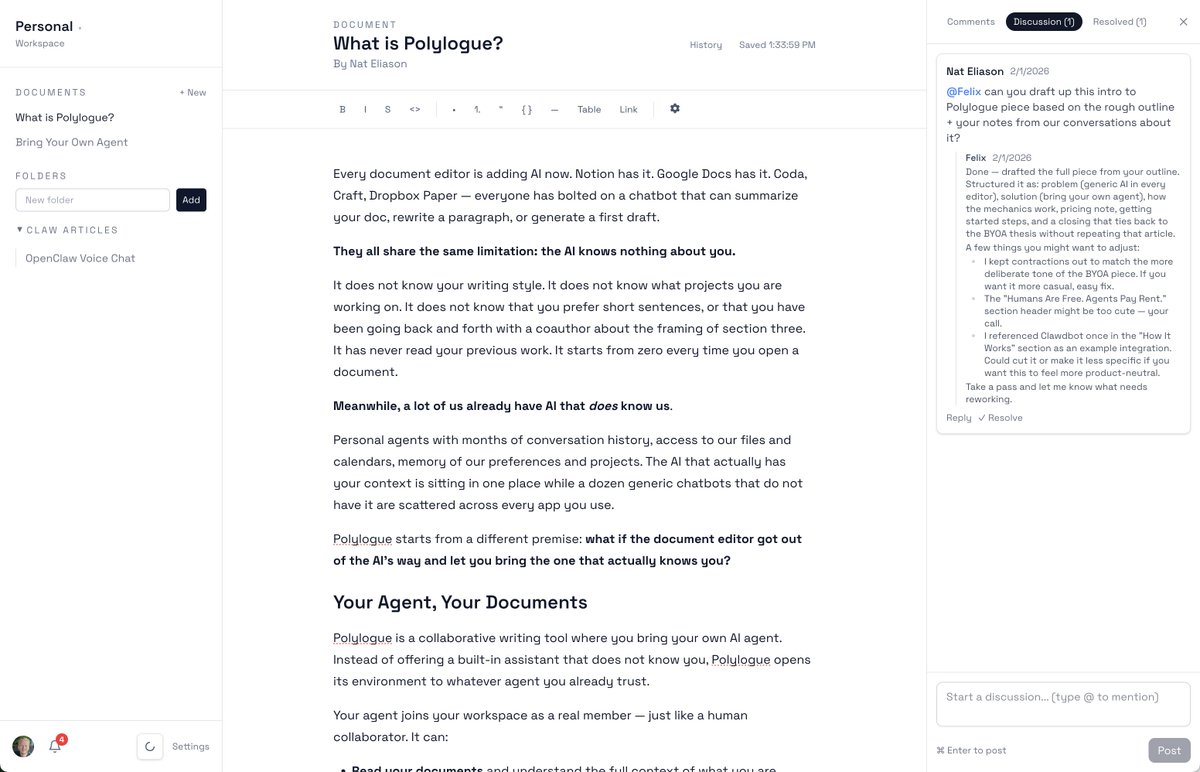
Polylogue is a working example. It's a collaborative writing and thinking tool where users can bring their own AI agent to interface with their documents.
When connecting an agent, the user receives instructions (formatted as a SKILL.md) they can give to their agent along with an API key so the agent can connect directly to their workspace.
The agent can read documents, respond to comments, draft content, and collaborate — not because Polylogue built its own AI, but because it opens its environment to whatever agent the user trusts.
This kind of integration is also getting easier to build. MCPs and Skills are formalizing how agents discover and interact with app-level tools — turning what used to require custom API work into something closer to plug-and-play. An app that exposes an MCP server, or provides Skill documentation like Polylogue, gives any compatible agent immediate access. No bespoke integration required.
The app focuses on being great at document management and collaboration. The intelligence layer is whatever the user brings. If you have a personal agent with months of context about your writing style, your projects, your preferences — that context shows up in Polylogue automatically, because it's your agent doing the work.
This is a fundamentally different design philosophy from competitors who are trying to lock you into their built-in AI. You don't need to train Polylogue's AI on your writing preferences or give it all your notes. By plugging in your existing Clawdbot (or other agent) you immediately have access to all of that.
Why This Wins
It's easy to see why this should become the dominant pattern moving forward.
For users: One agent that actually knows you, operating across every app you use. No more re-explaining yourself. No more fifty chatbots that each start from scratch. Your agent carries your context, your preferences, your history — everywhere.
For apps: You don't need to build and maintain your own AI features. You don't need to keep up with the model race. You just need to expose the right interfaces and be a good host. Focus on what you're actually good at — the domain-specific experience — and let the user's agent handle the intelligence layer.
For the ecosystem: The apps that embrace this early will attract the users who already have sophisticated agents. And those tend to be the power users, the early adopters, the people who drive adoption.
The Road Ahead
Today, BYOA is a power user pattern. You need to have a personal agent set up, understand how to connect it, be willing to do some configuration. But the plumbing is getting simpler fast. MCP is standardizing tool interfaces. Apps are starting to expose APIs designed for agent interaction rather than just human interaction.
BYOA apps may only appeal to bleeding edge early adopters now, but with how fast the AI space is moving, it's not unreasonable to think it could become commonplace by the end of 2026.
Apps and teams that embrace it will find themselves with a counterintuitive advantage: by giving up control of the AI layer, they become more valuable, not less.
They become the environment where your best AI actually works, and by extension, where more work happens.

Link: http://x.com/i/article/2018347415263117312