返回列表
🧠 阿头学 · 💬 讨论题

AI 整合收购:用智能体重构传统服务业利润

独立投资者可通过收购临近退休的传统服务企业,并以“人机协同”模式重构后台交付,实现 EBITDA 利润率的结构性跃升,但该策略高度依赖合规风控与真实的整合执行力,绝非无风险套利。
打开原文 ↗

2026-09-27 原文链接 ↗
阅读简报
双语对照
完整翻译
原文
讨论归档

核心观点

  • 估值套利逻辑成立 传统服务业因利润率触顶预期而估值偏低,利用 AI 将交付成本边际化后,可在不改变客户与营收的前提下实现资产内在价值的倍数跃升。
  • “收购存量”优于“从零创业” 直接获取三十年积累的客户信任、行业资质与边缘案例数据,能彻底跳过 AI 产品的冷启动与获客陷阱。
  • 工程化落地路径明确 采用“影子模式并行测试+准备者/审核者权限隔离+修正日志迭代规则手册”的架构,是当前企业级 AI 部署唯一可控制幻觉与合规风险的务实方案。
  • 独立创始人具备非对称优势 十亿美元级 PE 基金受限于资金体量与管理半径,必然放弃小微标的,这为能亲自下场整合的个人投资者留出了真实的竞争真空。

跟我们的关联

  • 对 👤ATou 意味着个人投资者需从“技术极客”转向“运营操盘手”,下一步应优先跑通单一垂直行业的自动化映射图,验证单店模型后再考虑杠杆收购。
  • 对 🧠Neta 意味着 AI 产品团队必须放弃“全自动替代”的幻想,下一步应将研发重心转向“审核者工作台”与“规则库管理系统”,以适配企业级人机协同的真实需求。
  • 对 🪞Uota 意味着传统行业从业者面临交付模式重构的生存危机,下一步需主动将隐性经验转化为结构化 SOP,否则将在 AI 整合浪潮中被边缘化。

讨论引子

  • 当 AI 接管后台交付导致服务“去人格化”时,高净值客户必然要求价格重估,企业应如何重构定价模型以对冲信任折损?
  • 在强监管行业,AI 幻觉引发的职业责任风险无法通过技术补丁消除,必须通过何种保险架构或法律实体进行硬性隔离?
  • 独立创始人使用 SBA 贷款加个人担保进行收购,在利率高企与整合期现金流波动的双重压力下,如何设计债务缓冲机制以避免个人破产?

我将阐述为什么你应该收购一家企业,并利用 AI 智能体(AI Agents)将其息税折旧摊销前利润(EBITDA)提升三倍。读完这份极其简单的指南后,你将知道如何找到合适的企业、完成收购,并使用智能体来运营它,细节将精确到文件夹结构和提示词(Prompts)。文章有点长(大约需要 10-15 分钟阅读),但对感兴趣的人来说,绝对物有所值。

根据麦肯锡(McKinsey)的数据,到 2035 年,价值约 5 万亿美元的美国企业将易主。其中大多数属于即将退休的婴儿潮一代(Baby Boomers),而许多所有者根本没有安排好接班人或买家。

在华盛顿州的贝灵汉(Bellingham),有一家名为 Larson Gross 的会计师事务所。它成立于 1949 年,拥有五家办事处和约 200 名员工,Thrive Holdings 最近收购了它的一部分股权。

在这个报税季,该事务所的 AI 处理了 7,000 份纳税申报表。会计师们平均节省了 31% 的时间。其中一位会计师接手了一项过去每年要耗费 180 小时的工作,现在将其缩短到了 15 小时。这简直太疯狂了!!!

这就是核心理念。收购一家已经拥有客户、资质和信任的企业,然后利用 AI 智能体改变其工作方式。

AI 整合(AI Roll-up)究竟是什么

我认为 AI 整合(AI Roll-ups)就是新一代的私募股权(Private Equity)。

“整合”(Roll-up)其实是个相当古老的概念!你在同一行业收购大量小型企业,将它们合并,合并后的大公司价值会超过各部分之和。过去 40 年来,私募股权(PE)一直在服务型企业上玩这套把戏,主要依靠金融工程(Financial Engineering)。整合后台部门、谈判更优的供应商合同、增加杠杆债务,然后在五年后卖给更大的基金。

AI 整合(AI Roll-up)改变的是中间环节。你以服务型企业的价格收购一家服务企业,然后利用智能体承担大部分工作,彻底重构其交付方式。客户留下来了。收入留下来了。而交付每单位工作的成本却下降了。

传统服务型企业的息税折旧摊销前利润(EBITDA)利润率通常在 5% 到 10% 左右。核心论点是,同一家企业可以将其提升至 30% 到 40%。同样的客户,同样的账单,利润却能翻 3 到 4 倍。

为什么是现在?

三件事恰好同时发生。

1/ 模型在实际工作上的表现已经足够出色。数据录入、纳税申报表初稿、合同审查、客服工单、维护请求。两年前,这些输出还需要重做;现在,只需要人工复核。 2/ 所有者正在退休。美国大量小型服务企业由六七十岁、渴望退出的所有者掌控,且许多人没有制定继任计划。他们的子女不想接手,员工也买不起。 3/ 财务逻辑成立。服务型企业的出售估值倍数较低,因为市场假设其利润率已触顶。如果你能证明并非如此,你就相当于以低于当前实际价值的折扣价买下了一项资产。

谁在做这件事

访问 Gregisenberg.com 获取更多类似案例研究,直接发送至您的邮箱

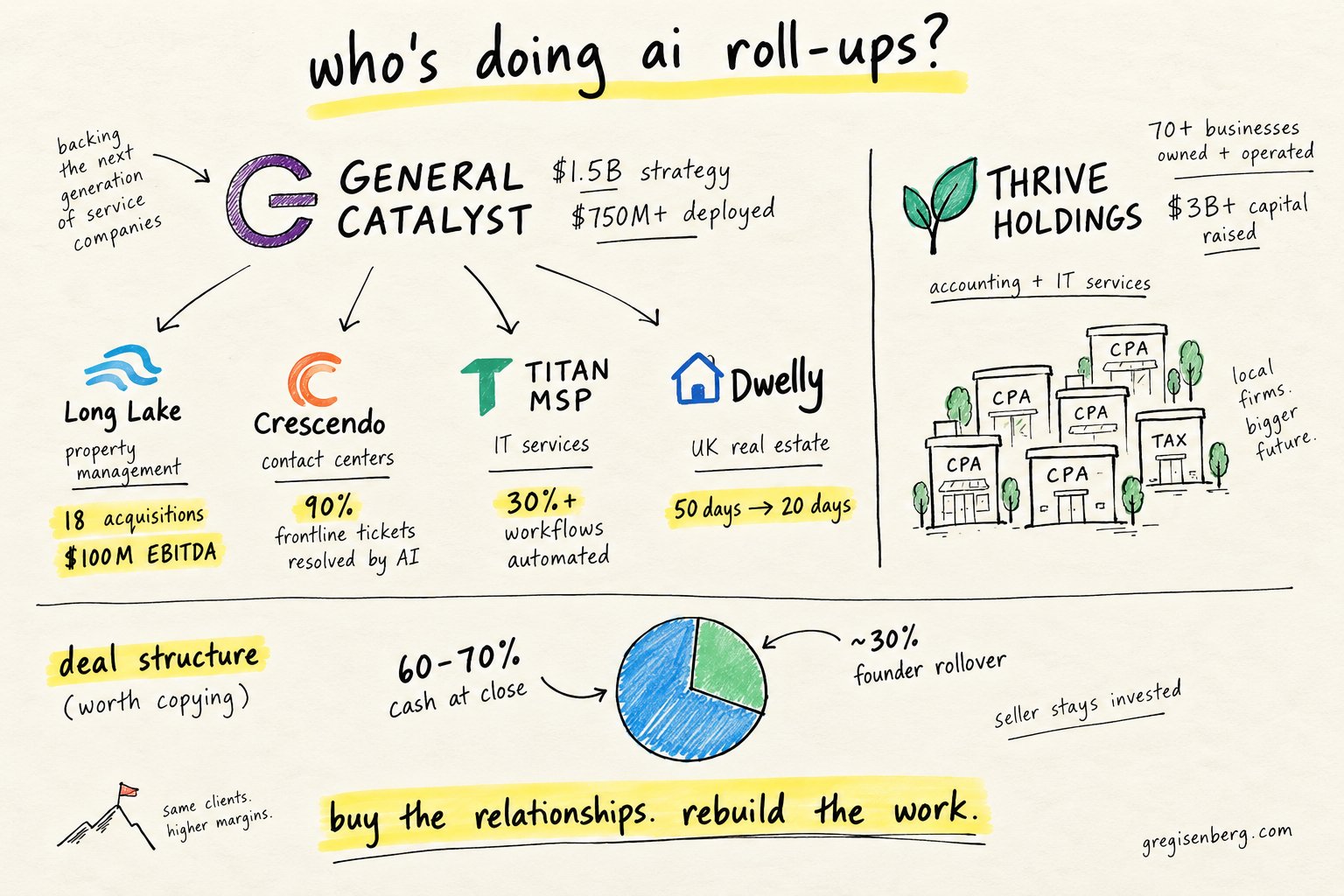
1/ Long Lake Property management(物业管理):收购 18 家企业,不到两年实现 1 亿美元 EBITDA,利润率翻倍
2/ Crescendo(呼叫中心):90% 的一线工单由 AI 解决,利润率是传统运营商的 4 倍
3/ Titan MSP(IT 服务):30% 以上的工作流实现自动化,目标是将净利润率提升三倍
4/ Dwelly(英国房地产):问题解决周期从 50 天缩短至 20 天,利润率翻倍 5/ Thrive Holdings:在过去两年中收购了近 50 家本地会计师事务所,并刚刚承诺投入 10 亿美元继续收购。简直太疯狂了! 6/ General Catalyst:为该策略预留了 15 亿美元,已向至少十家公司投入超过 7.5 亿美元。他们报告的结果令人瞩目,但需坦诚说明:这些数据均为自我报告,且这些公司尚未经历过经济衰退的考验。

General Catalyst 的交易结构无论规模大小都值得借鉴。交割时支付约 60% 到 70% 的现金,并将约 30% 的收购价转为创始人的股权,这样建立客户关系的人就有理由留下来,确保交接顺利。这是一个有趣的模式。

为什么这不仅仅是 Thrive、General Catalyst 和大机构的专利(你也可以做到!)

当人们读到十亿美元级别的基金收购会计师事务所时,我猜很多人会认为这超出了普通人的能力范围。但我认为恰恰相反!大型基金将把大部分市场留给个人投资者,原因有以下几点。

1/ 基金需要大额交易。一个十亿美元规模的基金不可能把时间花在年收入仅 200 万美元的记账公司上。这笔钱太小,无法拉动他们的整体回报。麦肯锡预计到 2035 年将有超过 100 万家由婴儿潮一代拥有的企业出售,其中绝大多数正是这个规模。Thrive 的人永远不会给他们打电话。这正是竞争最薄弱的地方。 2/ 你用的工具和他们一样。Larson Gross 的税务智能体运行在 OpenAI 的 Codex 上。支撑全国最大规模整合交易的模型,任何人只需按月订阅即可使用。基金在收购前会先搭建平台。而独立创始人可以在晚上用 Claude Code 或 Codex 为一家企业搭建工作流,并随着实际业务的流入不断优化它们。 3/ 你可以亲自完成整合。任何整合交易中最大的风险就是收购速度超过了整合能力。基金必须雇佣经理来运营每家收购的企业,而这些经理必须从零开始学习业务。当一个人收购一家企业时,这个人就在办公室里,能叫出每个客户的名字,并亲自审查智能体的每一份草稿。拖慢基金速度的瓶颈,恰恰是独立创始人自然而然就能做到的事。 4/ 相当一部分所有者更愿意卖给个人。一个花了 40 年时间建立起 12 人公司的人,会在乎谁来接手。他们中的许多人更愿意把公司交给一个坐在自家餐桌旁、关心他们客户的人,而不是交给在 Zoom 会议上认识的基金。这种关系是金钱买不到的优势。 5/ 这个规模有现成的融资渠道。美国小企业管理局(SBA)贷款和卖方票据(Seller Notes)正是为这类交易设计的。你无需募集基金,就能收购一家年收入数百万美元的企业。

基金正在证明这个模式是可行的。他们也在向所有人展示利润在哪里,而这些利润大多存在于规模太小、不值得他们费心的企业中。

所以你会看到越来越多十亿美元级别的基金登上头条新闻。

但事实是,一位独立创始人只要完成一次优质收购并配备一套智能体,就能拿下剩下的 99.9 万家企业。

每个人都有足够的空间。

为什么选择收购而不是从零创建

如果你能开发一款 AI 会计产品,为什么还要收购一家会计师事务所?

因为服务型企业最困难的部分与软件毫无关系。客户名单花了 30 年才建立起来。信任是个人化的。资质需要考试和时间积累。在这个细分领域里,什么才算“正确”的知识,存在于那些干了几十年的人的脑子里。

初创公司要花上几年时间,去争取一次收购在第一天就能交给你的东西。你不需要去说服一家牙科诊所信任一个新供应商。他们从 2006 年起就信任这家事务所了。

还有历史数据。每一次过往的业务往来、每一个边缘案例、每一个被发现并修正的错误。这些都是你训练智能体的素材,而初创公司一无所有。

初创公司必须先赢得客户,然后才能开展工作。而收购已经拥有了客户,所以你唯一要做的就是改变工作方式。

控股公司(Holdco)的文件夹结构

所以,如果你是独立操作或只有一个小团队,我很乐意分享一些利用 AI 建立你“小帝国”的技巧。

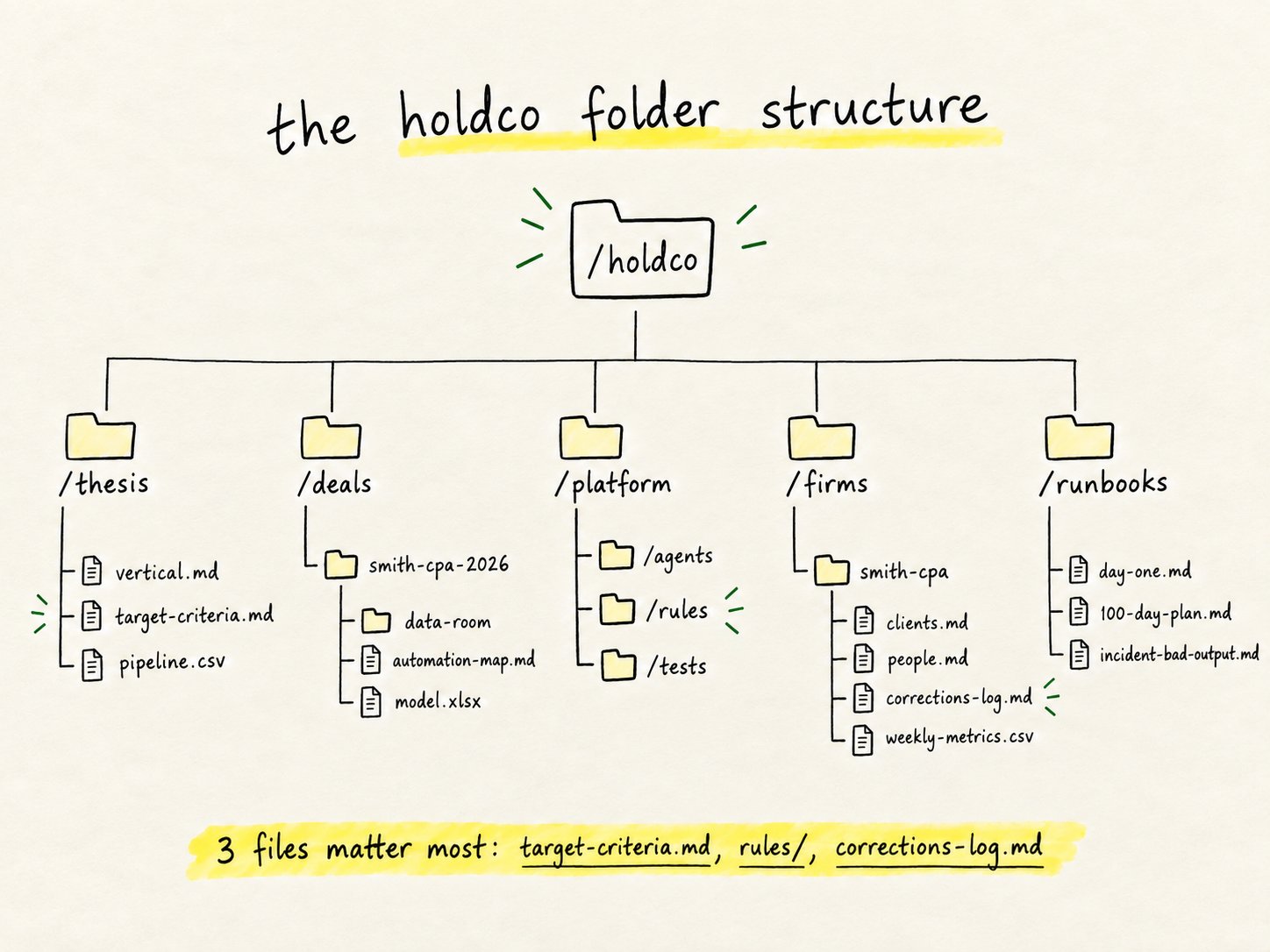
在收购任何东西之前,先搭建好你将用来运营一切的系统。文件夹结构就是运营模型。每家被收购的企业都接入同一个架构。

访问 Gregisenberg.com 获取更多类似案例研究,直接发送至您的邮箱

因此,三个小文件承担了大部分工作:target-criteria.md 决定你收购什么,rules/ 决定智能体是否值得信赖,而 corrections-log.md 则是规则每周迭代优化的方式。如果你什么都不设置,至少要把这三个建好。

你需要构建的智能体

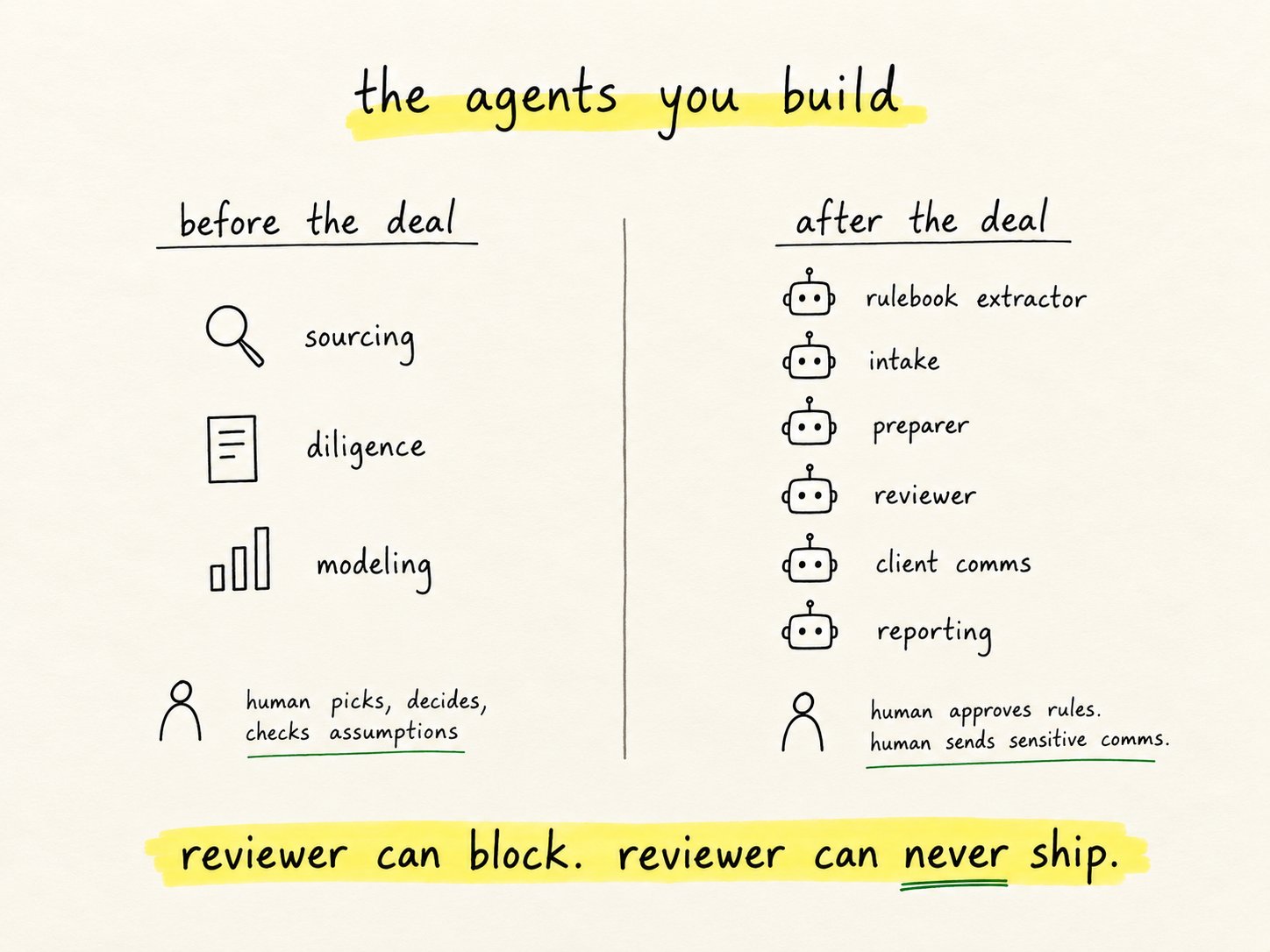
你需要两套智能体。第一套帮助你收购正确的企业。第二套在你拥有企业后负责运营它。

交易达成前

访问 Gregisenberg.com 获取更多类似案例研究,直接发送至您的邮箱

这份清单上最重要的设计决策:审核者(Reviewer)可以拦截但绝不能直接发布,而准备者(Preparer)绝不能自行发布任何内容。将两者分离,能防止绝大多数劣质输出到达客户手中。

步骤 1:寻找标的

大多数愿意出售的小型企业根本不会在任何地方挂牌。所有者还没做出决定。你的工作是在经纪人找到他们之前先找到他们。

优质渠道:州执照委员会查询(注册会计师、保险代理人、物业经理都持有公开记录的执照)、州务卿企业备案、行业协会名录、BizBuySell 及类似交易平台,以及地方商业期刊。

你是一家控股公司的寻源分析师,负责在 [region] 收购 [industry] 企业。利用附带的持牌企业名单,识别可能符合以下标准的企业:5 至 50 名员工,成立于 2005 年之前,所有者亲自运营,无明显继任计划。针对每家企业,记录成立年份、所有者姓名及其持牌时长、分支机构数量、提供的服务,以及任何表明有退休意向的迹象(如缩短营业时间、近期有合伙人离职、网站陈旧等)。按匹配度进行排名。将所有推断明确标记为“推断”。

然后亲自给所有者写信。每一次这样的对话,都始于一个花了数十年心血建立事业、并希望知道它会被善待的人。

不过我得说实话。我认为交易平台并不理想。一旦企业上了交易平台,很多“超额收益(Alpha)”就已经消失了,这就是为什么我通常更喜欢直接联系。请记住这一点。

步骤 2:评分卡

访问 Gregisenberg.com 获取更多类似案例研究,直接发送至您的邮箱

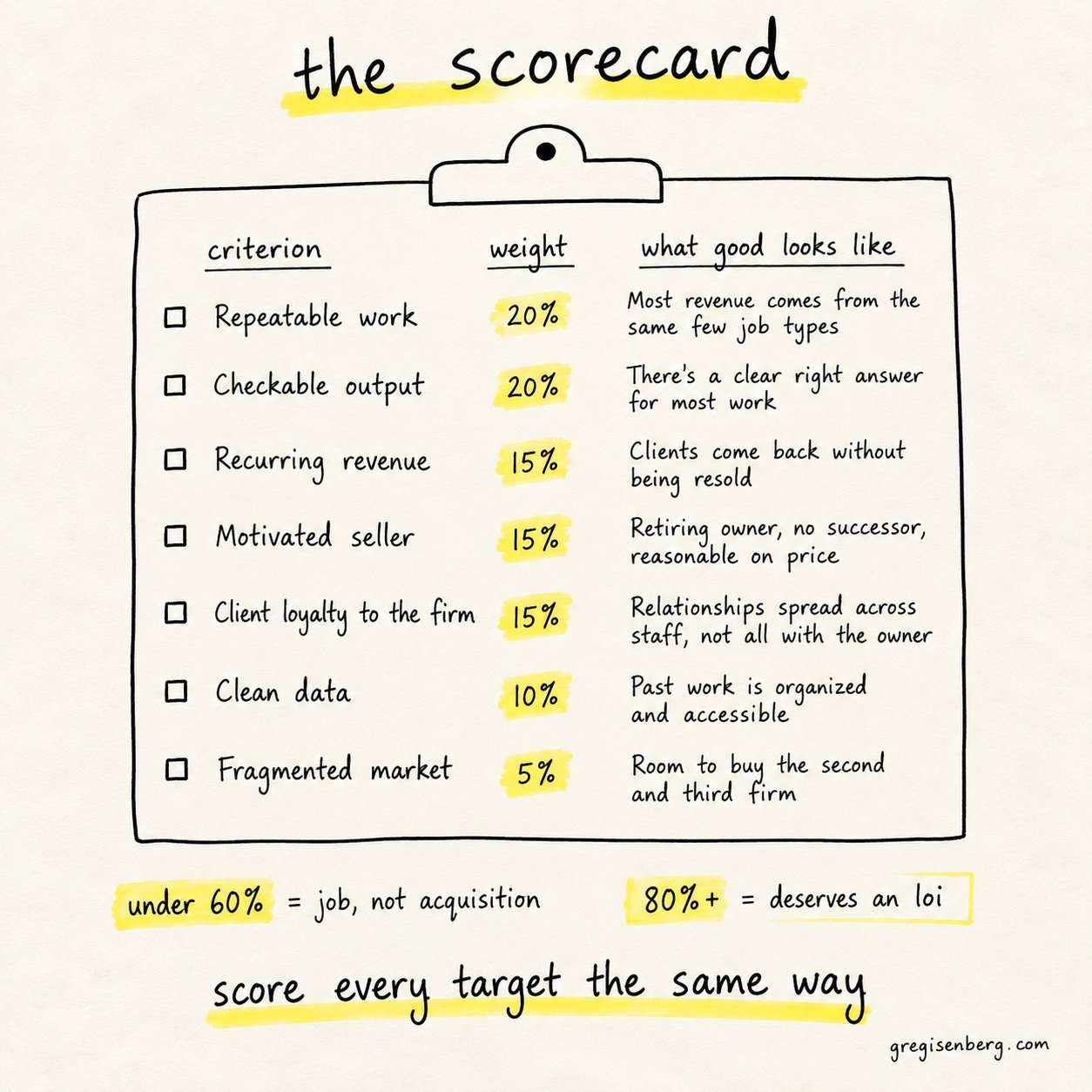
用统一的标准给每个标的打分,这样你的兴奋情绪就不会替你做决定。

得分低于 60% 的企业通常只是一份工作,而不是一笔收购。得分高于 80% 的企业才值得你发出意向书(Letter of Intent)。

步骤 3:基于工作样本的尽职调查(Due Diligence)

财务尽职调查告诉你企业赚了多少钱。但它不会告诉你工作具体是怎么做的,而工作正是你即将改变的部分。

要求对方提供 20 到 50 份真实的、已脱敏的已完成工作样本,涵盖该企业的核心服务。然后构建自动化映射图(Automation Map)。

审查这些来自 [industry] 企业的已完成工作样本。针对工作流中的每一项独立任务,列出:触发条件、输入内容、执行步骤、输出结果、人工完成所需的大致时间、每月发生频率、输出结果是否可对照明确标准进行核查,以及如果做错会导致什么后果。然后将每项任务分类为:立即自动化、需人工复核的自动化、仅辅助、或保留人工。解释每一项分类的理由。对任何不确定的地方进行标记,而不是猜测。

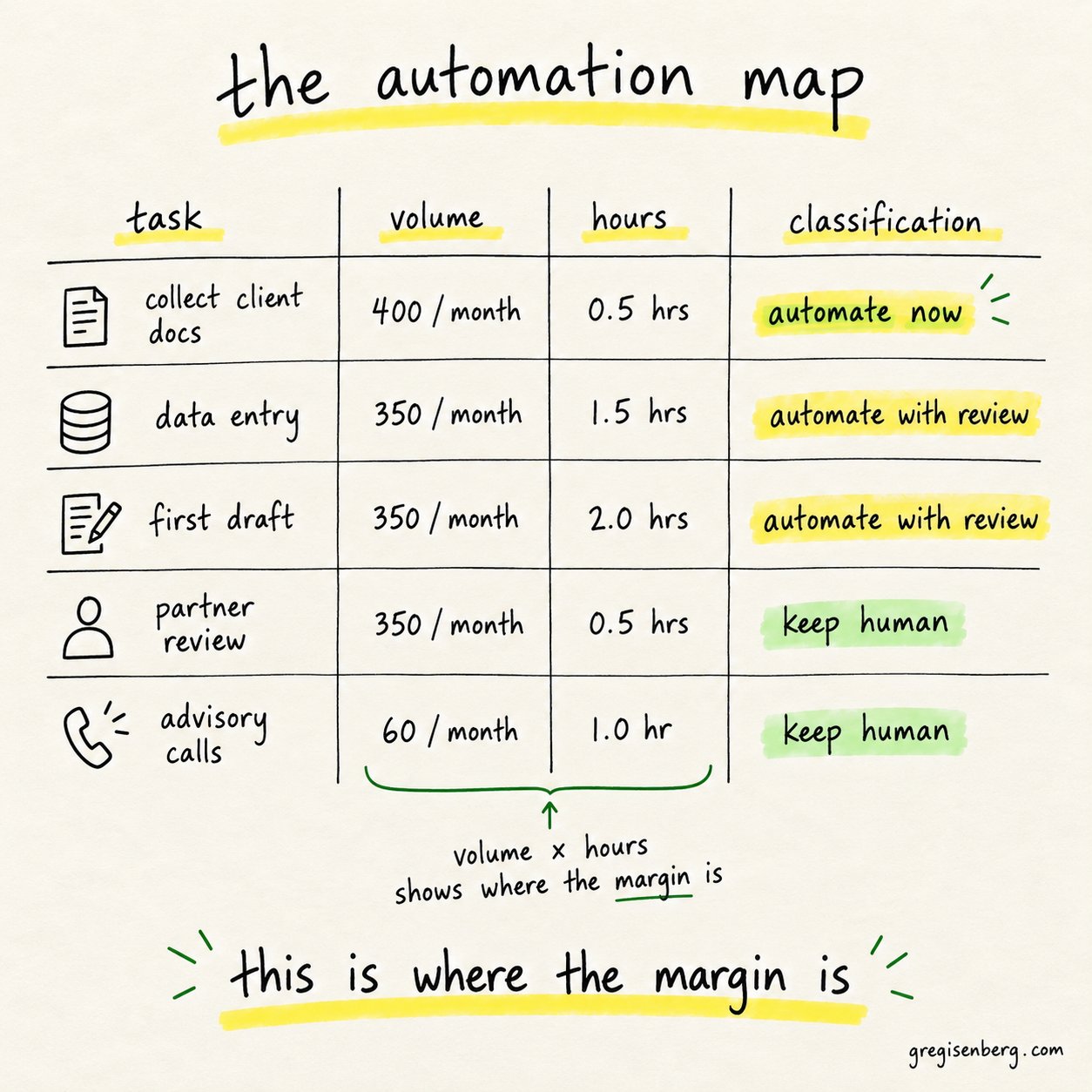
输出结果大致如下:

访问 Gregisenberg.com 获取更多类似案例研究,直接发送至您的邮箱

将业务量乘以工时,你就能在签署任何文件之前知道利润空间在哪里。自动化映射图是整笔交易中最有价值的文件。

步骤 4:财务测算

这里有一个使用整数说明的示例。

访问 Gregisenberg.com 获取更多类似案例研究,直接发送至您的邮箱

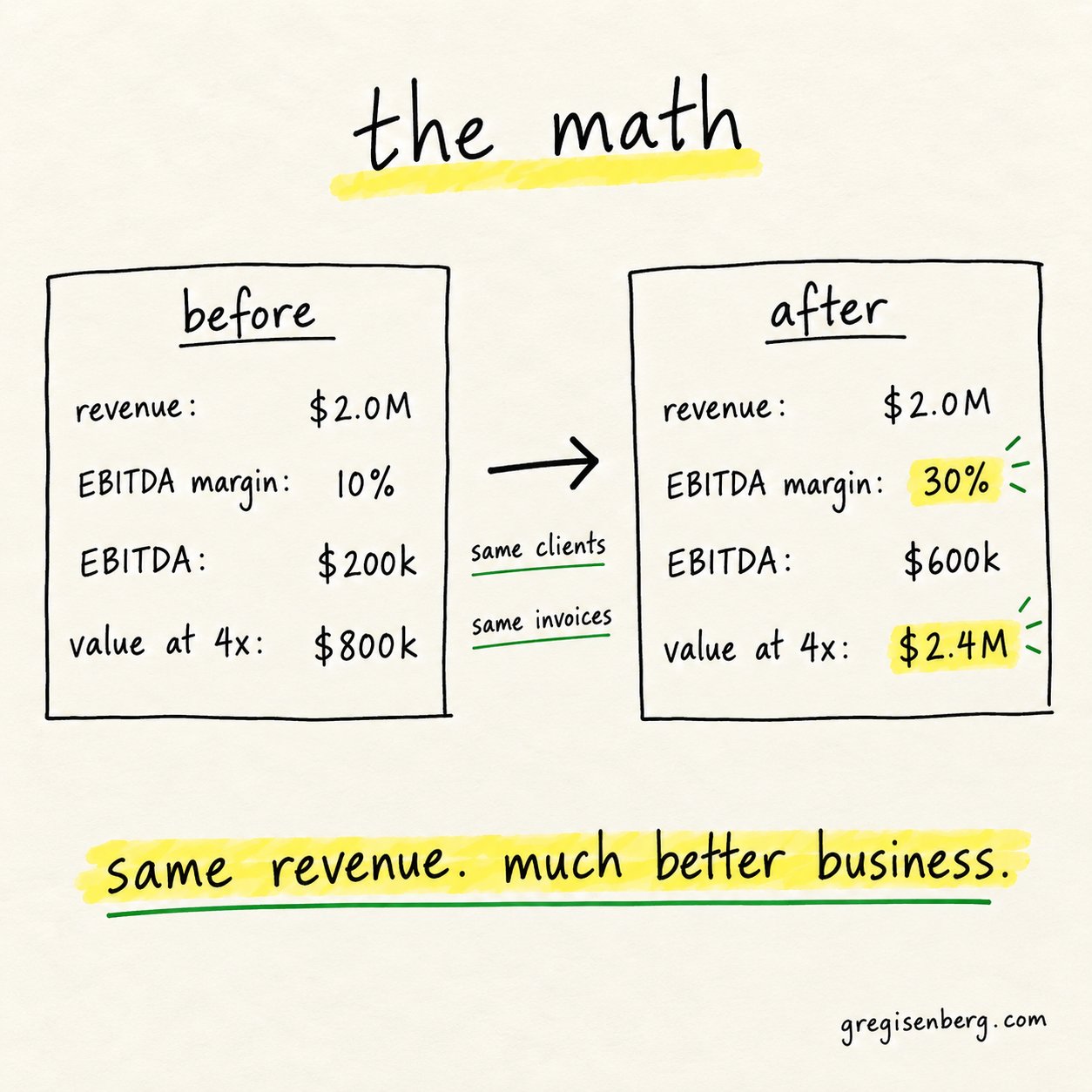
你以约 80 万美元的价格收购。你不改变任何客户或他们的付费标准。如果你能将利润率从 10% 提升至 30% 并保持住,在任何人认为它值得更高估值倍数之前,该企业的价值就已经是你支付价格的三倍左右(按相同倍数计算)。

这还没算上工具成本、所需花费的数月时间,以及任何可能出现的差错。这只是机会的轮廓。整个游戏的核心在于你能否守住利润率。

这类小型收购通常通过美国小企业管理局(SBA)贷款加卖方票据(Seller Note)进行融资,即部分收购款分期支付。卖方票据的作用与 General Catalyst 的股权滚动(Rollover Equity)相同:让了解客户的人继续留在交接过程中,保持利益绑定。

步骤 5:规则手册

真正的资产正是在这里构建的。

每家企业都运行在无人写下的规则之上。总是迟交文件的客户。高级合伙人总会反复核对的扣除项类型。某位客户认为粗鲁的措辞。当资深员工离开时,这些规则也随之而去。你在前 60 天的工作,就是把这些规则从人们的脑子里提取出来,存入文件。

你正在采访一家 [industry] 企业的资深 [role],以记录他们的工作方式。询问初级员工最常犯的错误、需要特殊处理的客户及其原因、任何文件离开公司前他们总会进行的检查,以及他们会停下来向他人请教的情况。访谈结束后,将每个答案转化为带编号的规则,并附上示例。标记任何相互冲突的规则。在他们批准之前,任何规则都不生效。

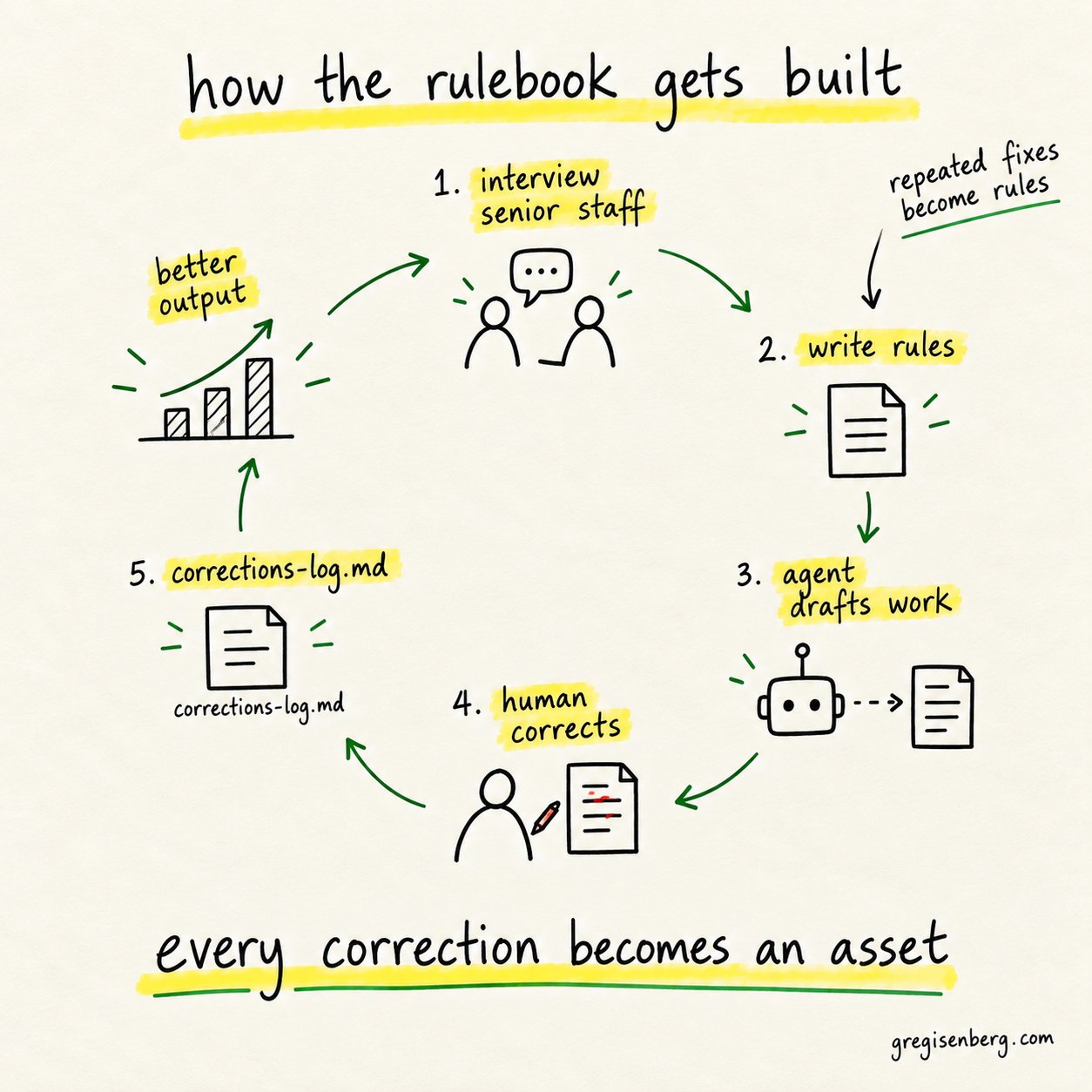
然后每周将修正日志转化为规则: 将智能体的每份草稿与人工批准的版本进行对比。将每次修改分类为:事实错误、客户偏好、信息缺失或风格调整。为任何重复出现两次以上的修正提出一条新规则。使用原始输入和已接受的输出,将每条批准的规则添加为测试用例。

经过几百个业务后,规则手册就是你输出结果值得信赖的原因。任何人都可以使用相同的模型。但没有人拥有你这份记录该细分领域所有出错方式的清单。

访问 Gregisenberg.com 获取更多类似案例研究,直接发送至您的邮箱

步骤 6:前 100 天

第 1 至 30 天:不改变任何客户能看到的东西。 与每位员工进行一对一沟通。亲自向客户宣布交易,让前任所有者在场或参与通话。获取所有系统的访问权限。以“影子模式(Shadow Mode)”运行智能体:它们并行处理工作,人工按常规方式处理,你进行对比。开始规则手册访谈。

第 31 至 60 天:迁移后台部门。 正式开启客户接入和文件收集。将准备者智能体部署在自动化映射图中业务量最大、风险最低的任务上,并复核每一份草稿。每周跟踪每项任务消耗的人工关注分钟数。重新定义角色:过去负责准备的人现在转为审核。

第 61 至 100 天:谨慎扩张。 将映射图中的下两项任务投入生产环境。启动客户沟通智能体,仅用于常规状态更新。每月与资深员工开会,审查修正日志并批准新规则。在衡量利润率的同时,跟踪客户留存率和核心人员留存率。

到第 100 天,你应该清楚三件事:智能体能可靠完成多少工作、人工复核的实际成本是多少,以及是否有任何重要人员感到不满!

干得漂亮。

数据看板

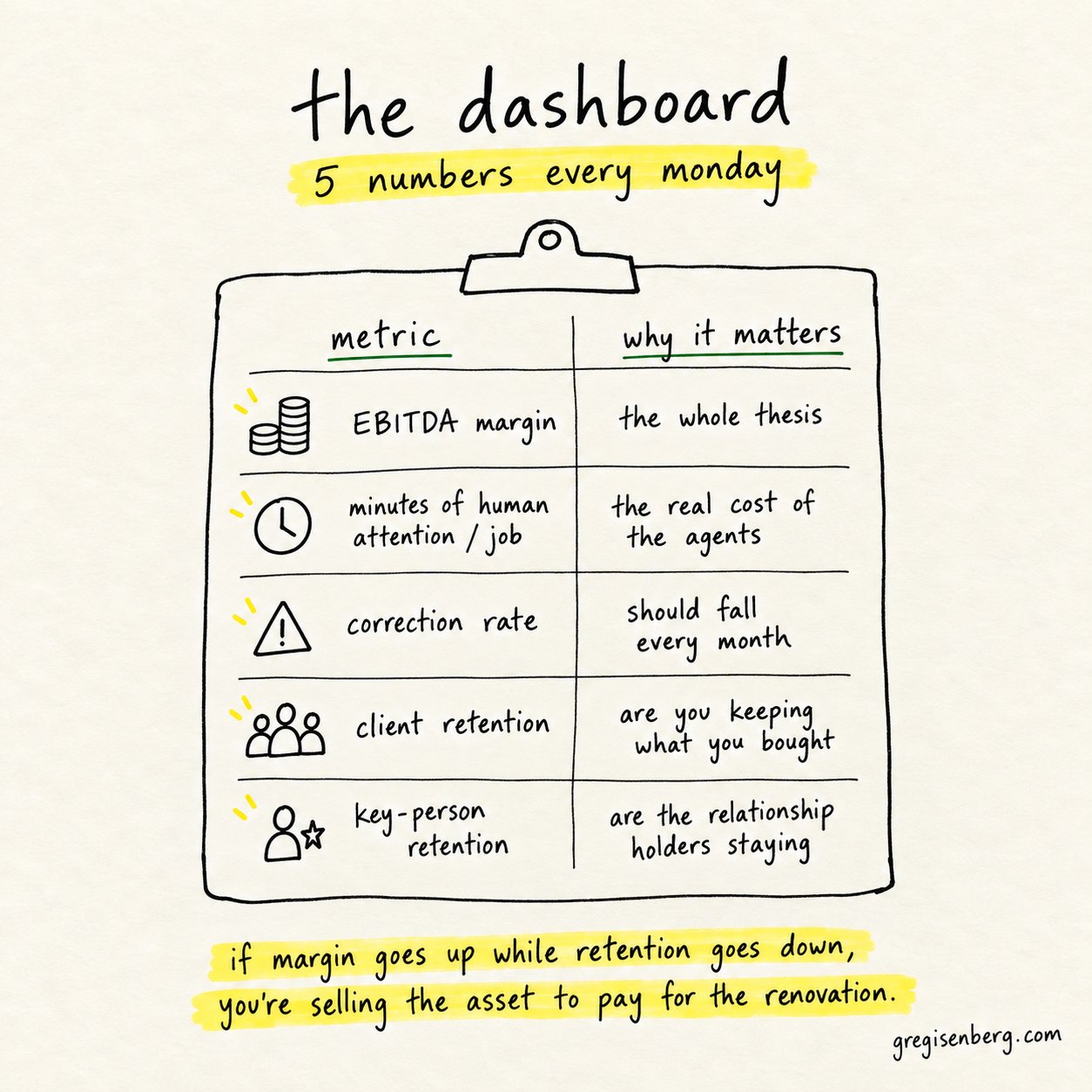
每周一,为每家企业跟踪 5 个核心数据。

访问 Gregisenberg.com 获取更多类似案例研究,直接发送至您的邮箱

如果利润率上升但客户留存率下降,你基本上就是在变卖资产来支付翻新费用。

收购什么

通常能通过大多数筛选条件的行业:会计与记账、物业管理、保险代理、IT 托管服务、医疗账单、薪资管理、业主协会(HOA)管理、产权与托管、货运经纪和人力资源外包。

每个行业都具备可重复的工作、可核查的输出、经常性客户、分散的所有权,以及大量临近退休的所有者。

还有上百万个细分领域。这些只是一些思路。更多创业点子请访问 Ideabrowser.com

哪些环节会出问题

1/ 收购速度超过整合能力。这是整合交易失败最常见的原因,无论是否使用 AI。如果收购跑在整合前面,你拥有的只是一堆烂摊子。 2/ 核心人员离职。熟悉每位客户的会计师在交易完成六周后辞职,客户关系也随之流失。股权滚动(Rollover Equity)、卖方票据(Seller Notes)和实质性的留任奖金正是为此而设。我见过很多次,这非常残酷。 3/ 客户随所有者离开。有些客户只忠于某个人。为一定的客户流失做好预案,让过渡期缓慢且充满人情味。 4/ 自动化侵蚀了信任。利润率的提升来自后台。而价值来自客户关系。如果让客户关系感觉廉价,你就失去了你花钱买来的核心资产。 5/ 智能体权限过大。一个无需检查点就能直接发送客户邮件的智能体,迟早会把错误的邮件发给错误的人。保留检查点,直到修正率低到足以证明可以移除它们。 6/ 盲目相信头条数据。该领域公布的大多数结果都是由正在融资的年轻公司自我报告的。它们或许能维持,但尚未经历过经济下行的考验。用你自己的数据来评估交易(Underwrite)。

太长不看版(TLDR)

这就是完整的操作手册。我的目标只是激发大家的灵感,希望我做到了。想要更多灵感,可以随时收听我的播客 @startupideaspod(Spotify/Apple/YouTube)。如果我能帮上忙,请私信我;或者如果你正在寻找合作伙伴来构建你的 AI 原生公司,请联系我们的设计公司 LCA。我们是领先的 AI 产品设计公司。

未来十年,价值约 5 万亿美元的企业将易主。其中大多数规模较小。大多数所有者非常在乎谁来接手。而且其中大多数企业的后台运营方式,仍然和二十年前一模一样。特别感谢 Boring Marketer,他们很早就洞察了这一趋势,并利用 AI 实现营销自动化。

如果你收购了一家企业,照顾好客户,留住优秀员工,让智能体处理后台工作,你就有很大机会让该企业的利润翻三倍。

我认为未来十年会有很多人这么做。今年从一家“无聊”的企业起步的人,将会占据非常有利的先机。

如果我能帮上忙,请私信我。我无法回复所有人,但会回复一部分!如果你喜欢这份指南,有任何疑问、反馈,或者希望我接下来写什么,请告诉我。

我为你加油。 Greg Isenberg

I'll make the case why you should buy a business and use AI agents to 3x EBITDA. By the end of this dead simple guide, you'll know how to find the right business, buy it, and run it with agents, down to the folders and prompts. It's kinda long (~10-15 min read) but for those interested, worth it.

~$5 trillion worth of American businesses will change hands by 2035, according to McKinsey. Most belong to baby boomers heading into retirement, and a lot of those owners have nobody lined up to buy them.

In Bellingham, Washington, there's an accounting firm called Larson Gross. It was founded in 1949. It has five offices and about 200 employees, and Thrive Holdings recently bought a stake in it.

This tax season, the firm's AI processed 7,000 returns. Accountants saved 31% of their time on average. One accountant took a job that used to eat 180 hours a year and got it down to 15. That's insane!!!

That's the whole idea. Buy a business that already has the customers, the licenses and the trust, then change how the work gets done with AI agents.

What an AI roll up actually is

I think AI roll-ups are the new private equity.

A roll-up is a pretty old idea! You buy a lot of small businesses in the same industry, combine them, and the bigger company is worth more than the pieces were. PE has been running this play on services businesses for 40 years, mostly with financial engineering. Consolidate the back office, negotiate better vendor contracts, add debt, sell to a bigger fund in five years.

An AI roll-up changes the middle step. You buy a services business at a services price, then rebuild how the work gets delivered, with agents doing a large share of it. The customers stay. The revenue stays. The cost of delivering each unit of work drops.

A traditional services firm runs somewhere around 5 to 10% EBITDA margins. The thesis is that the same firm can run at 30 to 40%. Same clients, same invoices, 3 to 4x the profit.Why this is happening now

Three things landed at the same time.

1/The models got good enough at the actual work. Data entry, first drafts of tax returns, contract review, support tickets, maintenance requests. Two years ago the output needed redoing. Now it needs checking.

2/The owners are retiring. A large share of small services firms in the US are owned by people in their sixties and seventies who want out, and many have no succession plan. Their kids don't want the firm. Their employees can't afford to buy it.

3/And the arithmetic works. Services businesses sell for a low multiple because the market assumes their margins are stuck. If you can prove they aren't, you bought an asset at a discount to what it's now worth.

Who's doing it

Gregisenberg.com for more case studies like this to your inbox

1/Long Lake Property management 18 businesses acquired, $100M EBITDA in under two years, margins doubled

2/Crescendo Contact centers 90% of frontline tickets resolved by AI, 4x the margins of traditional operators

3/Titan MSP IT services 30%+ of workflows automated, targeting tripled net margins

4/Dwelly UK real estate Problem resolution down from 50 days to 20, margins doubled

5/Thrive Holdings has bought nearly 50 local accounting practices over two years and just committed $1 billion to buy more. Pretty insane!

6/ General Catalyst set aside $1.5 billion for this strategy and has put more than $750 million into at least ten companies. The results they report are striking, with an honest caveat: they're self-reported, and none of these companies has been through a recession yet.

GC's deal structure is worth copying at any size. Roughly 60 to 70% cash at close, and about 30% of the price rolled into equity for the founder, so the person who built the relationships has a reason to stay and make the handoff work. Interesting model.

Why this isn't only for Thrive, General Catalyst and the big dogs (you can do this too!)

When people read about billion dollar funds buying accounting firms, I assume lots of people think its out of reach of the average person. I think it's the opposite! The big funds are going to leave most of this market to individuals, and there are a few reasons why.

1/The funds need big deals. A billion dollar vehicle can't spend its time on a bookkeeping firm doing $2 million a year. The check is too small to move their returns. McKinsey expects about a 1M+ boomer-owned businesses to sell by 2035, and the vast majority of them are exactly that size. Nobody from Thrive is ever going to call them. That's where the competition is thinnest.

2/The tools are the same ones you already have. Larson Gross's tax agents run on OpenAI's Codex. The models behind the biggest roll-ups in the country are available to anyone for a monthly subscription. A fund builds a platform before it buys anything. A solo founder can build the workflows for one firm, with Claude Code or Codex, in the evenings, and improve them as the real work comes in.

3/You can be the integration. The biggest risk in any roll-up is buying faster than you can integrate. Funds have to hire managers to run each firm they buy, and those managers have to learn the business from scratch. When one person buys one firm, that person is in the office, knows every client by name, and watches every agent draft. The bottleneck that slows the funds down is the thing a solo founder does naturally.

4/ A good chunk of owners would often rather sell to a person. Someone who spent 40 years building a 12 person firm cares who takes it over. Many of them would rather hand it to someone who sat at their kitchen table and asked about their clients than to a fund they met on a Zoom call. That relationship is an advantage money can't buy.

5/The financing exists at this size. SBA loans and seller notes were built for exactly these deals. You can buy a business doing a couple million in revenue without raising a fund.

The funds are proving the model works. They're also showing everyone where the returns are, and most of those returns sit in businesses too small for them to bother with.

So you'll be seeing more and more billion-dollar funds get those headlines.

But truth is a solo founder with one good acquisition and a set of agents gets the other 999,000 businesses.

Lots of room for everyone.

Why buy instead of build

If you can build an AI accounting product, why buy an accounting firm?

Because the hardest parts of a services business have nothing to do with software. The client list took 30 years to build. The trust is personal. The licenses took exams and time. The knowledge of what "correct" means in the niche lives in the heads of people who've done the work for decades.

A startup spends years trying to earn what an acquisition hands you on day one. You don't have to convince a dental practice to trust a new vendor. They've trusted this firm since 2006.

Then there's the history. Every past engagement, every edge case, every mistake that got caught and fixed. That's the training material for your agents, and a startup has none of it.

A startup has to earn the customer and then do the work. An acquisition already has the customer, so all you have to do is change the work.

The holdco folder structure

So, if you're doing this solo or a tiny team, I'd love to give you some tips for using AI to build your little empire.

Before you buy anything, set up the system you'll run everything through. The folder structure is the operating model. Each acquired firm plugs into the same shape.

Gregisenberg.com for more case studies like this to your inbox

So, 3 little files do most of the work: target-criteria.md decides what you buy, rules/ decides whether the agents can be trusted, and corrections-log.md is how the rules get better every week. If you set up nothing else, set up those.

The agents you build

You need two sets of agents. The first set helps you buy the right business. The second set runs it once you own it.Before the deal

Gregisenberg.com for more case studies like this to your inbox

The most important design decision on this list: the reviewer can block but never ship, and the preparer can ship nothing on its own. Keeping those apart prevents most bad output from reaching a client.

Step 1: Sourcing

Most small firms that would sell aren't listed anywhere. The owner hasn't decided yet. Your job is to find them before a broker does.

Good sources: state licensing board lookups (CPAs, insurance agents, property managers all hold licenses with public records), Secretary of State business filings, industry association directories, BizBuySell and similar marketplaces, and local business journals.

You are a sourcing analyst for a holding company buying [industry] firms in [region]. Using the attached list of licensed firms, identify businesses that likely match these criteria: 5 to 50 employees, founded before 2005, owner-operated, no obvious succession. For each firm, note the founding year, the owner's name and how long they've held their license, the number of locations, the services offered, and any signs of retirement interest such as reduced hours, a partner who recently left, or an old website. Rank them by fit. Mark every inference clearly as an inference.

Then write to the owner yourself. Every one of these conversations starts with a person who's spent decades building something and wants to know it'll be treated well.

I gotta be honest though. I think the marketplaces aren't ideal. Once they get to the marketplaces, a lot of the "alpha" is gone, that's why i prefer reaching out in general. Keep that in mind.

Step 2: The scorecard

Gregisenberg.com for more case studies like this to your inbox

Score every target the same way so your excitement doesn't make the decision.

A firm scoring under 60% is usually a job, not an acquisition. A firm scoring above 80% deserves a letter of intent.

Step 3: Diligence with work samples

Financial diligence tells you what the business earned. It doesn't tell you what the work looks like, and the work is what you're about to change.

Ask for 20 to 50 real, anonymized examples of completed jobs across the firm's main services. Then build the automation map.

Review these completed work samples from a [industry] firm. For each distinct task in the workflow, list: what triggers it, the inputs, the steps taken, the output, roughly how long it takes a person, how often it happens per month, whether the output can be checked against a clear standard, and what would go wrong if it were done incorrectly. Then classify each task as: automate now, automate with human review, assist only, or keep human. Explain every classification. Flag anything you're uncertain about instead of guessing.

The output looks like this:

Gregisenberg.com for more case studies like this to your inbox

Multiply volume by hours, and you know where the margin is before you've signed anything. The automation map is the most valuable document in the deal.

Step 4: The math

Here's an illustrative example with round numbers.

Gregisenberg.com for more case studies like this to your inbox

You buy for around $800,000. You change nothing about who the clients are or what they pay. If you move the margin from 10% to 30% and hold it, the business is worth about three times what you paid at the same multiple, before anyone decides it deserves a higher one.

That's before tooling, before the months it takes, and before anything goes wrong. It's the shape of the opportunity. The whole game is whether you can hold the margin.

Small acquisitions like this are often financed with an SBA loan plus a seller note, where part of the price gets paid out over time. The seller note does the same job as GC's rollover equity: it keeps the person who knows the clients invested in the handoff.

Step 5: The rulebook

This is where the real asset gets built.

Every firm runs on rules nobody wrote down. The client who always sends documents late. The type of deduction the senior partner always double-checks. The phrasing a certain client finds rude. When the senior people leave, those rules leave with them. Your job in the first 60 days is to get them out of people's heads and into files.

You are interviewing a senior [role] at a [industry] firm to document how they do their work. Ask about the most common mistakes junior staff make, the clients who need special handling and why, the checks they always do before anything leaves the firm, and the situations where they'd stop and ask someone. After the interview, turn every answer into a numbered rule with an example. Mark any rule that conflicts with another. Nothing becomes active until they approve it.

Then turn the corrections log into rules every week:

Compare each agent draft with the version a person approved. Classify every change as a factual error, a client preference, missing information, or a style change. Propose a rule for any correction that happened more than once. Add each approved rule as a test case using the original input and the accepted output.

After a few hundred jobs, the rulebook is the reason your output can be trusted. Anyone can use the same models. Nobody else has your list of every way they go wrong in this niche.

Gregisenberg.com for more case studies like this to your inbox

Step 6: The first 100 days

Days 1 to 30: Change nothing the clients can see.

Meet every employee one on one. Announce the deal to clients personally, with the former owner in the room or on the call. Get access to every system. Run the agents in shadow mode: they do the work in parallel, a person does it the normal way, and you compare. Start the rulebook interviews.

Days 31 to 60: Move the back office.

Turn on intake and document collection for real. Put the preparer on the highest-volume, lowest-risk task from your automation map, with every draft reviewed. Track minutes of human attention per job, every week. Rewrite roles: the people who used to prepare now review.

Days 61 to 100: Expand carefully.

Move the next 2 tasks on the map into production. Start the client-comms agent on routine status updates only. Hold a monthly session with senior staff to review the corrections log and approve new rules. Measure client retention and key-person retention alongside margin.

At day 100, you should know 3 things: how much of the work the agents can do reliably, what it actually costs you in human review, and whether anyone important is unhappy!

Good stuff.

The dashboard

5 numbers, every Monday, for every firm.

Gregisenberg.com for more case studies like this to your inbox

If margin goes up while client retention goes down, you're selling the asset to pay for the renovation pretty much.

What to buy

Industries that tend to pass most of the filters: accounting and bookkeeping, property management, insurance agencies, IT managed services, medical billing, payroll, HOA management, title and escrow, freight brokerage and staffing.

Each has repeatable work, checkable output, recurring clients, fragmented ownership and a lot of owners near retirement.

A million niches. These are just some ideas. More startup ideas at Ideabrowser.com

What breaks

1/ Buying faster than you can integrate. The most common way roll-ups fail, with or without AI. If acquisitions outrun integration, you own a pile of messes.

2/ The key people leave. The accountant who knows every client quits six weeks after the sale, and relationships walk out with her. Rollover equity, seller notes and real retention bonuses exist for this. Ive seen this a lot, it's brutal.

3/ Clients leave with the owner. Some clients were loyal to a person. Plan for some churn and make the transition slow and personal.

4/ Automating trust away. The margin gains come from the back office. The value comes from the relationship. Make the relationship feel cheaper and you've lost the thing you paid for.

5/Agents with too much authority. An agent that can send client emails without a checkpoint will eventually send the wrong one to the wrong person. Keep the checkpoints until the correction rate earns their removal.

6/ Believing the headline numbers. Most published results in this space are self-reported by young companies that are raising money. They may hold. They haven't been tested by a downturn. Underwrite your deal on your own numbers.

TLDR

So that's the whole playbook. My goal was just to get the creative juices flowing, I hope I did. For more creative juices flowing, you can always listen to my podcast @startupideaspod (Spotify/Apple/YouTube). If I can ever be helpful DM me or if you're looking for partnership for building your AI native company, speak to our design firm LCA. We are the leading product design firm for AI.

About $5 trillion worth of businesses are going to change hands over the next ten years. Most of them are small. Most of the owners care a lot about who takes over. And most of them still run the back office the same way they did twenty years ago. Shoutout to Boring Marketer who's been early on this trend and automating marketing with AI.

If you buy one, take care of the clients, keep the good people, and let agents handle the back office, you have a real shot at tripling what that business makes.

I think a lot of people are going to do this over the next decade. The ones who start with one boring business this year are going to be in a really good spot.

DM me if I can ever be helpful. Can't respond to everyone but will respond to some! Let me know if you enjoyed this guide, had any questions, feedback and what I should cover next.

I'm rooting for you.

Greg Isenberg

我将阐述为什么你应该收购一家企业,并利用 AI 智能体(AI Agents)将其息税折旧摊销前利润(EBITDA)提升三倍。读完这份极其简单的指南后,你将知道如何找到合适的企业、完成收购,并使用智能体来运营它,细节将精确到文件夹结构和提示词(Prompts)。文章有点长(大约需要 10-15 分钟阅读),但对感兴趣的人来说,绝对物有所值。

根据麦肯锡(McKinsey)的数据,到 2035 年,价值约 5 万亿美元的美国企业将易主。其中大多数属于即将退休的婴儿潮一代(Baby Boomers),而许多所有者根本没有安排好接班人或买家。

在华盛顿州的贝灵汉(Bellingham),有一家名为 Larson Gross 的会计师事务所。它成立于 1949 年,拥有五家办事处和约 200 名员工,Thrive Holdings 最近收购了它的一部分股权。

在这个报税季,该事务所的 AI 处理了 7,000 份纳税申报表。会计师们平均节省了 31% 的时间。其中一位会计师接手了一项过去每年要耗费 180 小时的工作,现在将其缩短到了 15 小时。这简直太疯狂了!!!

这就是核心理念。收购一家已经拥有客户、资质和信任的企业,然后利用 AI 智能体改变其工作方式。

AI 整合(AI Roll-up)究竟是什么

我认为 AI 整合(AI Roll-ups)就是新一代的私募股权(Private Equity)。

“整合”(Roll-up)其实是个相当古老的概念!你在同一行业收购大量小型企业,将它们合并,合并后的大公司价值会超过各部分之和。过去 40 年来,私募股权(PE)一直在服务型企业上玩这套把戏,主要依靠金融工程(Financial Engineering)。整合后台部门、谈判更优的供应商合同、增加杠杆债务,然后在五年后卖给更大的基金。

AI 整合(AI Roll-up)改变的是中间环节。你以服务型企业的价格收购一家服务企业,然后利用智能体承担大部分工作,彻底重构其交付方式。客户留下来了。收入留下来了。而交付每单位工作的成本却下降了。

传统服务型企业的息税折旧摊销前利润(EBITDA)利润率通常在 5% 到 10% 左右。核心论点是,同一家企业可以将其提升至 30% 到 40%。同样的客户,同样的账单,利润却能翻 3 到 4 倍。

为什么是现在?

三件事恰好同时发生。

1/ 模型在实际工作上的表现已经足够出色。数据录入、纳税申报表初稿、合同审查、客服工单、维护请求。两年前,这些输出还需要重做;现在,只需要人工复核。

2/ 所有者正在退休。美国大量小型服务企业由六七十岁、渴望退出的所有者掌控,且许多人没有制定继任计划。他们的子女不想接手,员工也买不起。

3/ 财务逻辑成立。服务型企业的出售估值倍数较低,因为市场假设其利润率已触顶。如果你能证明并非如此,你就相当于以低于当前实际价值的折扣价买下了一项资产。

谁在做这件事

访问 Gregisenberg.com 获取更多类似案例研究,直接发送至您的邮箱

1/ Long Lake Property management(物业管理):收购 18 家企业,不到两年实现 1 亿美元 EBITDA,利润率翻倍

2/ Crescendo(呼叫中心):90% 的一线工单由 AI 解决,利润率是传统运营商的 4 倍

3/ Titan MSP(IT 服务):30% 以上的工作流实现自动化,目标是将净利润率提升三倍

4/ Dwelly(英国房地产):问题解决周期从 50 天缩短至 20 天,利润率翻倍

5/ Thrive Holdings:在过去两年中收购了近 50 家本地会计师事务所,并刚刚承诺投入 10 亿美元继续收购。简直太疯狂了!

6/ General Catalyst:为该策略预留了 15 亿美元,已向至少十家公司投入超过 7.5 亿美元。他们报告的结果令人瞩目,但需坦诚说明:这些数据均为自我报告,且这些公司尚未经历过经济衰退的考验。

General Catalyst 的交易结构无论规模大小都值得借鉴。交割时支付约 60% 到 70% 的现金,并将约 30% 的收购价转为创始人的股权,这样建立客户关系的人就有理由留下来,确保交接顺利。这是一个有趣的模式。

为什么这不仅仅是 Thrive、General Catalyst 和大机构的专利(你也可以做到!)

当人们读到十亿美元级别的基金收购会计师事务所时,我猜很多人会认为这超出了普通人的能力范围。但我认为恰恰相反!大型基金将把大部分市场留给个人投资者,原因有以下几点。

1/ 基金需要大额交易。一个十亿美元规模的基金不可能把时间花在年收入仅 200 万美元的记账公司上。这笔钱太小,无法拉动他们的整体回报。麦肯锡预计到 2035 年将有超过 100 万家由婴儿潮一代拥有的企业出售,其中绝大多数正是这个规模。Thrive 的人永远不会给他们打电话。这正是竞争最薄弱的地方。

2/ 你用的工具和他们一样。Larson Gross 的税务智能体运行在 OpenAI 的 Codex 上。支撑全国最大规模整合交易的模型,任何人只需按月订阅即可使用。基金在收购前会先搭建平台。而独立创始人可以在晚上用 Claude Code 或 Codex 为一家企业搭建工作流,并随着实际业务的流入不断优化它们。

3/ 你可以亲自完成整合。任何整合交易中最大的风险就是收购速度超过了整合能力。基金必须雇佣经理来运营每家收购的企业,而这些经理必须从零开始学习业务。当一个人收购一家企业时,这个人就在办公室里,能叫出每个客户的名字,并亲自审查智能体的每一份草稿。拖慢基金速度的瓶颈,恰恰是独立创始人自然而然就能做到的事。

4/ 相当一部分所有者更愿意卖给个人。一个花了 40 年时间建立起 12 人公司的人,会在乎谁来接手。他们中的许多人更愿意把公司交给一个坐在自家餐桌旁、关心他们客户的人,而不是交给在 Zoom 会议上认识的基金。这种关系是金钱买不到的优势。

5/ 这个规模有现成的融资渠道。美国小企业管理局(SBA)贷款和卖方票据(Seller Notes)正是为这类交易设计的。你无需募集基金,就能收购一家年收入数百万美元的企业。

基金正在证明这个模式是可行的。他们也在向所有人展示利润在哪里,而这些利润大多存在于规模太小、不值得他们费心的企业中。

所以你会看到越来越多十亿美元级别的基金登上头条新闻。

但事实是,一位独立创始人只要完成一次优质收购并配备一套智能体,就能拿下剩下的 99.9 万家企业。

每个人都有足够的空间。

为什么选择收购而不是从零创建

如果你能开发一款 AI 会计产品,为什么还要收购一家会计师事务所?

因为服务型企业最困难的部分与软件毫无关系。客户名单花了 30 年才建立起来。信任是个人化的。资质需要考试和时间积累。在这个细分领域里,什么才算“正确”的知识,存在于那些干了几十年的人的脑子里。

初创公司要花上几年时间,去争取一次收购在第一天就能交给你的东西。你不需要去说服一家牙科诊所信任一个新供应商。他们从 2006 年起就信任这家事务所了。

还有历史数据。每一次过往的业务往来、每一个边缘案例、每一个被发现并修正的错误。这些都是你训练智能体的素材,而初创公司一无所有。

初创公司必须先赢得客户,然后才能开展工作。而收购已经拥有了客户,所以你唯一要做的就是改变工作方式。

控股公司(Holdco)的文件夹结构

所以,如果你是独立操作或只有一个小团队,我很乐意分享一些利用 AI 建立你“小帝国”的技巧。

在收购任何东西之前,先搭建好你将用来运营一切的系统。文件夹结构就是运营模型。每家被收购的企业都接入同一个架构。

访问 Gregisenberg.com 获取更多类似案例研究,直接发送至您的邮箱

因此,三个小文件承担了大部分工作:target-criteria.md 决定你收购什么,rules/ 决定智能体是否值得信赖,而 corrections-log.md 则是规则每周迭代优化的方式。如果你什么都不设置,至少要把这三个建好。

你需要构建的智能体

你需要两套智能体。第一套帮助你收购正确的企业。第二套在你拥有企业后负责运营它。

交易达成前

访问 Gregisenberg.com 获取更多类似案例研究,直接发送至您的邮箱

这份清单上最重要的设计决策:审核者(Reviewer)可以拦截但绝不能直接发布,而准备者(Preparer)绝不能自行发布任何内容。将两者分离,能防止绝大多数劣质输出到达客户手中。

步骤 1:寻找标的

大多数愿意出售的小型企业根本不会在任何地方挂牌。所有者还没做出决定。你的工作是在经纪人找到他们之前先找到他们。

优质渠道:州执照委员会查询(注册会计师、保险代理人、物业经理都持有公开记录的执照)、州务卿企业备案、行业协会名录、BizBuySell 及类似交易平台,以及地方商业期刊。

你是一家控股公司的寻源分析师,负责在 [region] 收购 [industry] 企业。利用附带的持牌企业名单,识别可能符合以下标准的企业:5 至 50 名员工,成立于 2005 年之前,所有者亲自运营,无明显继任计划。针对每家企业,记录成立年份、所有者姓名及其持牌时长、分支机构数量、提供的服务,以及任何表明有退休意向的迹象(如缩短营业时间、近期有合伙人离职、网站陈旧等)。按匹配度进行排名。将所有推断明确标记为“推断”。

然后亲自给所有者写信。每一次这样的对话,都始于一个花了数十年心血建立事业、并希望知道它会被善待的人。

不过我得说实话。我认为交易平台并不理想。一旦企业上了交易平台,很多“超额收益(Alpha)”就已经消失了,这就是为什么我通常更喜欢直接联系。请记住这一点。

步骤 2:评分卡

访问 Gregisenberg.com 获取更多类似案例研究,直接发送至您的邮箱

用统一的标准给每个标的打分,这样你的兴奋情绪就不会替你做决定。

得分低于 60% 的企业通常只是一份工作,而不是一笔收购。得分高于 80% 的企业才值得你发出意向书(Letter of Intent)。

步骤 3:基于工作样本的尽职调查(Due Diligence)

财务尽职调查告诉你企业赚了多少钱。但它不会告诉你工作具体是怎么做的,而工作正是你即将改变的部分。

要求对方提供 20 到 50 份真实的、已脱敏的已完成工作样本,涵盖该企业的核心服务。然后构建自动化映射图(Automation Map)。

审查这些来自 [industry] 企业的已完成工作样本。针对工作流中的每一项独立任务,列出:触发条件、输入内容、执行步骤、输出结果、人工完成所需的大致时间、每月发生频率、输出结果是否可对照明确标准进行核查,以及如果做错会导致什么后果。然后将每项任务分类为:立即自动化、需人工复核的自动化、仅辅助、或保留人工。解释每一项分类的理由。对任何不确定的地方进行标记,而不是猜测。

输出结果大致如下:

访问 Gregisenberg.com 获取更多类似案例研究,直接发送至您的邮箱

将业务量乘以工时,你就能在签署任何文件之前知道利润空间在哪里。自动化映射图是整笔交易中最有价值的文件。

步骤 4:财务测算

这里有一个使用整数说明的示例。

访问 Gregisenberg.com 获取更多类似案例研究,直接发送至您的邮箱

你以约 80 万美元的价格收购。你不改变任何客户或他们的付费标准。如果你能将利润率从 10% 提升至 30% 并保持住,在任何人认为它值得更高估值倍数之前,该企业的价值就已经是你支付价格的三倍左右(按相同倍数计算)。

这还没算上工具成本、所需花费的数月时间,以及任何可能出现的差错。这只是机会的轮廓。整个游戏的核心在于你能否守住利润率。

这类小型收购通常通过美国小企业管理局(SBA)贷款加卖方票据(Seller Note)进行融资,即部分收购款分期支付。卖方票据的作用与 General Catalyst 的股权滚动(Rollover Equity)相同:让了解客户的人继续留在交接过程中,保持利益绑定。

步骤 5:规则手册

真正的资产正是在这里构建的。

每家企业都运行在无人写下的规则之上。总是迟交文件的客户。高级合伙人总会反复核对的扣除项类型。某位客户认为粗鲁的措辞。当资深员工离开时,这些规则也随之而去。你在前 60 天的工作,就是把这些规则从人们的脑子里提取出来,存入文件。

你正在采访一家 [industry] 企业的资深 [role],以记录他们的工作方式。询问初级员工最常犯的错误、需要特殊处理的客户及其原因、任何文件离开公司前他们总会进行的检查,以及他们会停下来向他人请教的情况。访谈结束后,将每个答案转化为带编号的规则,并附上示例。标记任何相互冲突的规则。在他们批准之前,任何规则都不生效。

然后每周将修正日志转化为规则:

将智能体的每份草稿与人工批准的版本进行对比。将每次修改分类为:事实错误、客户偏好、信息缺失或风格调整。为任何重复出现两次以上的修正提出一条新规则。使用原始输入和已接受的输出,将每条批准的规则添加为测试用例。

经过几百个业务后,规则手册就是你输出结果值得信赖的原因。任何人都可以使用相同的模型。但没有人拥有你这份记录该细分领域所有出错方式的清单。

访问 Gregisenberg.com 获取更多类似案例研究,直接发送至您的邮箱

步骤 6:前 100 天

第 1 至 30 天:不改变任何客户能看到的东西。

与每位员工进行一对一沟通。亲自向客户宣布交易,让前任所有者在场或参与通话。获取所有系统的访问权限。以“影子模式(Shadow Mode)”运行智能体:它们并行处理工作,人工按常规方式处理,你进行对比。开始规则手册访谈。

第 31 至 60 天:迁移后台部门。

正式开启客户接入和文件收集。将准备者智能体部署在自动化映射图中业务量最大、风险最低的任务上,并复核每一份草稿。每周跟踪每项任务消耗的人工关注分钟数。重新定义角色:过去负责准备的人现在转为审核。

第 61 至 100 天:谨慎扩张。

将映射图中的下两项任务投入生产环境。启动客户沟通智能体,仅用于常规状态更新。每月与资深员工开会,审查修正日志并批准新规则。在衡量利润率的同时,跟踪客户留存率和核心人员留存率。

到第 100 天,你应该清楚三件事:智能体能可靠完成多少工作、人工复核的实际成本是多少,以及是否有任何重要人员感到不满!

干得漂亮。

数据看板

每周一,为每家企业跟踪 5 个核心数据。

访问 Gregisenberg.com 获取更多类似案例研究,直接发送至您的邮箱

如果利润率上升但客户留存率下降,你基本上就是在变卖资产来支付翻新费用。

收购什么

通常能通过大多数筛选条件的行业:会计与记账、物业管理、保险代理、IT 托管服务、医疗账单、薪资管理、业主协会(HOA)管理、产权与托管、货运经纪和人力资源外包。

每个行业都具备可重复的工作、可核查的输出、经常性客户、分散的所有权,以及大量临近退休的所有者。

还有上百万个细分领域。这些只是一些思路。更多创业点子请访问 Ideabrowser.com

哪些环节会出问题

1/ 收购速度超过整合能力。这是整合交易失败最常见的原因,无论是否使用 AI。如果收购跑在整合前面,你拥有的只是一堆烂摊子。

2/ 核心人员离职。熟悉每位客户的会计师在交易完成六周后辞职,客户关系也随之流失。股权滚动(Rollover Equity)、卖方票据(Seller Notes)和实质性的留任奖金正是为此而设。我见过很多次,这非常残酷。

3/ 客户随所有者离开。有些客户只忠于某个人。为一定的客户流失做好预案,让过渡期缓慢且充满人情味。

4/ 自动化侵蚀了信任。利润率的提升来自后台。而价值来自客户关系。如果让客户关系感觉廉价,你就失去了你花钱买来的核心资产。

5/ 智能体权限过大。一个无需检查点就能直接发送客户邮件的智能体,迟早会把错误的邮件发给错误的人。保留检查点,直到修正率低到足以证明可以移除它们。

6/ 盲目相信头条数据。该领域公布的大多数结果都是由正在融资的年轻公司自我报告的。它们或许能维持,但尚未经历过经济下行的考验。用你自己的数据来评估交易(Underwrite)。

太长不看版(TLDR)

这就是完整的操作手册。我的目标只是激发大家的灵感,希望我做到了。想要更多灵感,可以随时收听我的播客 @startupideaspod(Spotify/Apple/YouTube)。如果我能帮上忙,请私信我;或者如果你正在寻找合作伙伴来构建你的 AI 原生公司,请联系我们的设计公司 LCA。我们是领先的 AI 产品设计公司。

未来十年,价值约 5 万亿美元的企业将易主。其中大多数规模较小。大多数所有者非常在乎谁来接手。而且其中大多数企业的后台运营方式,仍然和二十年前一模一样。特别感谢 Boring Marketer,他们很早就洞察了这一趋势,并利用 AI 实现营销自动化。

如果你收购了一家企业,照顾好客户,留住优秀员工,让智能体处理后台工作,你就有很大机会让该企业的利润翻三倍。

我认为未来十年会有很多人这么做。今年从一家“无聊”的企业起步的人,将会占据非常有利的先机。

如果我能帮上忙,请私信我。我无法回复所有人,但会回复一部分!如果你喜欢这份指南,有任何疑问、反馈,或者希望我接下来写什么,请告诉我。

我为你加油。

Greg Isenberg
I'll make the case why you should buy a business and use AI agents to 3x EBITDA. By the end of this dead simple guide, you'll know how to find the right business, buy it, and run it with agents, down to the folders and prompts. It's kinda long (~10-15 min read) but for those interested, worth it. ~$5 trillion worth of American businesses will change hands by 2035, according to McKinsey. Most belong to baby boomers heading into retirement, and a lot of those owners have nobody lined up to buy them. In Bellingham, Washington, there's an accounting firm called Larson Gross. It was founded in 1949. It has five offices and about 200 employees, and Thrive Holdings recently bought a stake in it. This tax season, the firm's AI processed 7,000 returns. Accountants saved 31% of their time on average. One accountant took a job that used to eat 180 hours a year and got it down to 15. That's insane!!! That's the whole idea. Buy a business that already has the customers, the licenses and the trust, then change how the work gets done with AI agents. What an AI roll up actually is I think AI roll-ups are the new private equity. A roll-up is a pretty old idea! You buy a lot of small businesses in the same industry, combine them, and the bigger company is worth more than the pieces were. PE has been running this play on services businesses for 40 years, mostly with financial engineering. Consolidate the back office, negotiate better vendor contracts, add debt, sell to a bigger fund in five years. An AI roll-up changes the middle step. You buy a services business at a services price, then rebuild how the work gets delivered, with agents doing a large share of it. The customers stay. The revenue stays. The cost of delivering each unit of work drops. A traditional services firm runs somewhere around 5 to 10% EBITDA margins. The thesis is that the same firm can run at 30 to 40%. Same clients, same invoices, 3 to 4x the profit.Why this is happening now Three things landed at the same time. 1/The models got good enough at the actual work. Data entry, first drafts of tax returns, contract review, support tickets, maintenance requests. Two years ago the output needed redoing. Now it needs checking. 2/The owners are retiring. A large share of small services firms in the US are owned by people in their sixties and seventies who want out, and many have no succession plan. Their kids don't want the firm. Their employees can't afford to buy it. 3/And the arithmetic works. Services businesses sell for a low multiple because the market assumes their margins are stuck. If you can prove they aren't, you bought an asset at a discount to what it's now worth. Who's doing it Gregisenberg.com for more case studies like this to your inbox 1/Long Lake Property management 18 businesses acquired, $100M EBITDA in under two years, margins doubled
2/Crescendo Contact centers 90% of frontline tickets resolved by AI, 4x the margins of traditional operators
3/Titan MSP IT services 30%+ of workflows automated, targeting tripled net margins
4/Dwelly UK real estate Problem resolution down from 50 days to 20, margins doubled 5/Thrive Holdings has bought nearly 50 local accounting practices over two years and just committed $1 billion to buy more. Pretty insane! 6/ General Catalyst set aside $1.5 billion for this strategy and has put more than $750 million into at least ten companies. The results they report are striking, with an honest caveat: they're self-reported, and none of these companies has been through a recession yet. GC's deal structure is worth copying at any size. Roughly 60 to 70% cash at close, and about 30% of the price rolled into equity for the founder, so the person who built the relationships has a reason to stay and make the handoff work. Interesting model. Why this isn't only for Thrive, General Catalyst and the big dogs (you can do this too!) When people read about billion dollar funds buying accounting firms, I assume lots of people think its out of reach of the average person. I think it's the opposite! The big funds are going to leave most of this market to individuals, and there are a few reasons why. 1/The funds need big deals. A billion dollar vehicle can't spend its time on a bookkeeping firm doing $2 million a year. The check is too small to move their returns. McKinsey expects about a 1M+ boomer-owned businesses to sell by 2035, and the vast majority of them are exactly that size. Nobody from Thrive is ever going to call them. That's where the competition is thinnest. 2/The tools are the same ones you already have. Larson Gross's tax agents run on OpenAI's Codex. The models behind the biggest roll-ups in the country are available to anyone for a monthly subscription. A fund builds a platform before it buys anything. A solo founder can build the workflows for one firm, with Claude Code or Codex, in the evenings, and improve them as the real work comes in. 3/You can be the integration. The biggest risk in any roll-up is buying faster than you can integrate. Funds have to hire managers to run each firm they buy, and those managers have to learn the business from scratch. When one person buys one firm, that person is in the office, knows every client by name, and watches every agent draft. The bottleneck that slows the funds down is the thing a solo founder does naturally. 4/ A good chunk of owners would often rather sell to a person. Someone who spent 40 years building a 12 person firm cares who takes it over. Many of them would rather hand it to someone who sat at their kitchen table and asked about their clients than to a fund they met on a Zoom call. That relationship is an advantage money can't buy. 5/The financing exists at this size. SBA loans and seller notes were built for exactly these deals. You can buy a business doing a couple million in revenue without raising a fund. The funds are proving the model works. They're also showing everyone where the returns are, and most of those returns sit in businesses too small for them to bother with. So you'll be seeing more and more billion-dollar funds get those headlines. But truth is a solo founder with one good acquisition and a set of agents gets the other 999,000 businesses. Lots of room for everyone. Why buy instead of build If you can build an AI accounting product, why buy an accounting firm? Because the hardest parts of a services business have nothing to do with software. The client list took 30 years to build. The trust is personal. The licenses took exams and time. The knowledge of what "correct" means in the niche lives in the heads of people who've done the work for decades. A startup spends years trying to earn what an acquisition hands you on day one. You don't have to convince a dental practice to trust a new vendor. They've trusted this firm since 2006. Then there's the history. Every past engagement, every edge case, every mistake that got caught and fixed. That's the training material for your agents, and a startup has none of it. A startup has to earn the customer and then do the work. An acquisition already has the customer, so all you have to do is change the work. The holdco folder structure So, if you're doing this solo or a tiny team, I'd love to give you some tips for using AI to build your little empire. Before you buy anything, set up the system you'll run everything through. The folder structure is the operating model. Each acquired firm plugs into the same shape. Gregisenberg.com for more case studies like this to your inbox So, 3 little files do most of the work: target-criteria.md decides what you buy, rules/ decides whether the agents can be trusted, and corrections-log.md is how the rules get better every week. If you set up nothing else, set up those. The agents you build You need two sets of agents. The first set helps you buy the right business. The second set runs it once you own it.Before the deal Gregisenberg.com for more case studies like this to your inbox The most important design decision on this list: the reviewer can block but never ship, and the preparer can ship nothing on its own. Keeping those apart prevents most bad output from reaching a client. Step 1: Sourcing Most small firms that would sell aren't listed anywhere. The owner hasn't decided yet. Your job is to find them before a broker does. Good sources: state licensing board lookups (CPAs, insurance agents, property managers all hold licenses with public records), Secretary of State business filings, industry association directories, BizBuySell and similar marketplaces, and local business journals. You are a sourcing analyst for a holding company buying [industry] firms in [region]. Using the attached list of licensed firms, identify businesses that likely match these criteria: 5 to 50 employees, founded before 2005, owner-operated, no obvious succession. For each firm, note the founding year, the owner's name and how long they've held their license, the number of locations, the services offered, and any signs of retirement interest such as reduced hours, a partner who recently left, or an old website. Rank them by fit. Mark every inference clearly as an inference. Then write to the owner yourself. Every one of these conversations starts with a person who's spent decades building something and wants to know it'll be treated well. I gotta be honest though. I think the marketplaces aren't ideal. Once they get to the marketplaces, a lot of the "alpha" is gone, that's why i prefer reaching out in general. Keep that in mind. Step 2: The scorecard Gregisenberg.com for more case studies like this to your inbox Score every target the same way so your excitement doesn't make the decision. A firm scoring under 60% is usually a job, not an acquisition. A firm scoring above 80% deserves a letter of intent. Step 3: Diligence with work samples Financial diligence tells you what the business earned. It doesn't tell you what the work looks like, and the work is what you're about to change. Ask for 20 to 50 real, anonymized examples of completed jobs across the firm's main services. Then build the automation map. Review these completed work samples from a [industry] firm. For each distinct task in the workflow, list: what triggers it, the inputs, the steps taken, the output, roughly how long it takes a person, how often it happens per month, whether the output can be checked against a clear standard, and what would go wrong if it were done incorrectly. Then classify each task as: automate now, automate with human review, assist only, or keep human. Explain every classification. Flag anything you're uncertain about instead of guessing. The output looks like this: Gregisenberg.com for more case studies like this to your inbox Multiply volume by hours, and you know where the margin is before you've signed anything. The automation map is the most valuable document in the deal. Step 4: The math Here's an illustrative example with round numbers. Gregisenberg.com for more case studies like this to your inbox You buy for around $800,000. You change nothing about who the clients are or what they pay. If you move the margin from 10% to 30% and hold it, the business is worth about three times what you paid at the same multiple, before anyone decides it deserves a higher one. That's before tooling, before the months it takes, and before anything goes wrong. It's the shape of the opportunity. The whole game is whether you can hold the margin. Small acquisitions like this are often financed with an SBA loan plus a seller note, where part of the price gets paid out over time. The seller note does the same job as GC's rollover equity: it keeps the person who knows the clients invested in the handoff. Step 5: The rulebook This is where the real asset gets built. Every firm runs on rules nobody wrote down. The client who always sends documents late. The type of deduction the senior partner always double-checks. The phrasing a certain client finds rude. When the senior people leave, those rules leave with them. Your job in the first 60 days is to get them out of people's heads and into files. You are interviewing a senior [role] at a [industry] firm to document how they do their work. Ask about the most common mistakes junior staff make, the clients who need special handling and why, the checks they always do before anything leaves the firm, and the situations where they'd stop and ask someone. After the interview, turn every answer into a numbered rule with an example. Mark any rule that conflicts with another. Nothing becomes active until they approve it. Then turn the corrections log into rules every week: Compare each agent draft with the version a person approved. Classify every change as a factual error, a client preference, missing information, or a style change. Propose a rule for any correction that happened more than once. Add each approved rule as a test case using the original input and the accepted output. After a few hundred jobs, the rulebook is the reason your output can be trusted. Anyone can use the same models. Nobody else has your list of every way they go wrong in this niche. Gregisenberg.com for more case studies like this to your inbox Step 6: The first 100 days Days 1 to 30: Change nothing the clients can see. Meet every employee one on one. Announce the deal to clients personally, with the former owner in the room or on the call. Get access to every system. Run the agents in shadow mode: they do the work in parallel, a person does it the normal way, and you compare. Start the rulebook interviews. Days 31 to 60: Move the back office. Turn on intake and document collection for real. Put the preparer on the highest-volume, lowest-risk task from your automation map, with every draft reviewed. Track minutes of human attention per job, every week. Rewrite roles: the people who used to prepare now review. Days 61 to 100: Expand carefully. Move the next 2 tasks on the map into production. Start the client-comms agent on routine status updates only. Hold a monthly session with senior staff to review the corrections log and approve new rules. Measure client retention and key-person retention alongside margin. At day 100, you should know 3 things: how much of the work the agents can do reliably, what it actually costs you in human review, and whether anyone important is unhappy! Good stuff. The dashboard 5 numbers, every Monday, for every firm. Gregisenberg.com for more case studies like this to your inbox If margin goes up while client retention goes down, you're selling the asset to pay for the renovation pretty much. What to buy Industries that tend to pass most of the filters: accounting and bookkeeping, property management, insurance agencies, IT managed services, medical billing, payroll, HOA management, title and escrow, freight brokerage and staffing. Each has repeatable work, checkable output, recurring clients, fragmented ownership and a lot of owners near retirement. A million niches. These are just some ideas. More startup ideas at Ideabrowser.com What breaks 1/ Buying faster than you can integrate. The most common way roll-ups fail, with or without AI. If acquisitions outrun integration, you own a pile of messes. 2/ The key people leave. The accountant who knows every client quits six weeks after the sale, and relationships walk out with her. Rollover equity, seller notes and real retention bonuses exist for this. Ive seen this a lot, it's brutal. 3/ Clients leave with the owner. Some clients were loyal to a person. Plan for some churn and make the transition slow and personal. 4/ Automating trust away. The margin gains come from the back office. The value comes from the relationship. Make the relationship feel cheaper and you've lost the thing you paid for. 5/Agents with too much authority. An agent that can send client emails without a checkpoint will eventually send the wrong one to the wrong person. Keep the checkpoints until the correction rate earns their removal. 6/ Believing the headline numbers. Most published results in this space are self-reported by young companies that are raising money. They may hold. They haven't been tested by a downturn. Underwrite your deal on your own numbers. TLDR So that's the whole playbook. My goal was just to get the creative juices flowing, I hope I did. For more creative juices flowing, you can always listen to my podcast @startupideaspod (Spotify/Apple/YouTube). If I can ever be helpful DM me or if you're looking for partnership for building your AI native company, speak to our design firm LCA. We are the leading product design firm for AI. About $5 trillion worth of businesses are going to change hands over the next ten years. Most of them are small. Most of the owners care a lot about who takes over. And most of them still run the back office the same way they did twenty years ago. Shoutout to Boring Marketer who's been early on this trend and automating marketing with AI. If you buy one, take care of the clients, keep the good people, and let agents handle the back office, you have a real shot at tripling what that business makes. I think a lot of people are going to do this over the next decade. The ones who start with one boring business this year are going to be in a really good spot. DM me if I can ever be helpful. Can't respond to everyone but will respond to some! Let me know if you enjoyed this guide, had any questions, feedback and what I should cover next. I'm rooting for you. Greg Isenberg

📋 讨论归档

讨论进行中…